
Specs are compiled from manufacturer listings and verified buyer reviews and can change over time — please confirm the key details on the product page before buying.
Buying the wrong 16x24x1 filter usually shows up as two problems: a slot that will not close because the cardboard is slightly too big, or a blower that sounds strained because the media is too dense for your system. This guide ranks the options by the three specs that decide fit and airflow: actual measured size, MERV rating, and pleat openness.
I’m Mohammad Maruf — the founder and writer behind KitchPrep. This guide is built by comparing the manufacturers’ published specifications and the patterns across verified customer reviews, so you get each pick’s real strengths and trade-offs instead of marketing spin.
Every pick below is a genuine 16x24x1, but the actual sizes differ by up to half an inch and the MERV ratings run from 3 all the way to 13, which changes how hard your blower has to work. If you want the short answer, the value pick leads the pack — 4.7 stars from 54,000+ owners is hard to argue with, and it is the reason it sits at the top of this 16x24x1 air filter comparison.
Our Picks at a Glance
How To Choose The Best 16X24X1 Air Filter
Three numbers decide whether a filter works in your system or fights it: the actual measured size, the MERV rating, and the thickness of the media. Get the first one wrong and the filter will not seal the slot. Get the second one wrong and your blower has to push against a wall of fabric. Everything else is secondary.
Measure the slot, not the box
The “16x24x1” on the packaging is a nominal size — a naming convention, not a measurement. The real filter inside is always slightly smaller so it slides in without binding. Filterbuy’s 16x24x1, for example, measures 15.38″ x 23.38″ x 0.75″ in reality. That gap is normal, but the size of the gap differs from brand to brand — so if your slot is already a tight fit, pull out your old filter and measure it with a tape before you order.
Match the MERV to your blower, not the marketing
A MERV rating tells you what percentage of particles a filter is designed to trap. MERV 8 captures 90% of airborne particles. MERV 11 steps that up to 85% of large airborne particles with finer media. MERV 13 catches even smaller particles. The catch: denser media restricts airflow, so a MERV 13 in a system built for MERV 8 makes the blower work harder than it should. If your HVAC tech has ever told you to keep it simple, stay at MERV 8.
Quick Comparison
| Model | Best For | MERV Rating | Actual Size | Pack Size | Amazon |
|---|---|---|---|---|---|
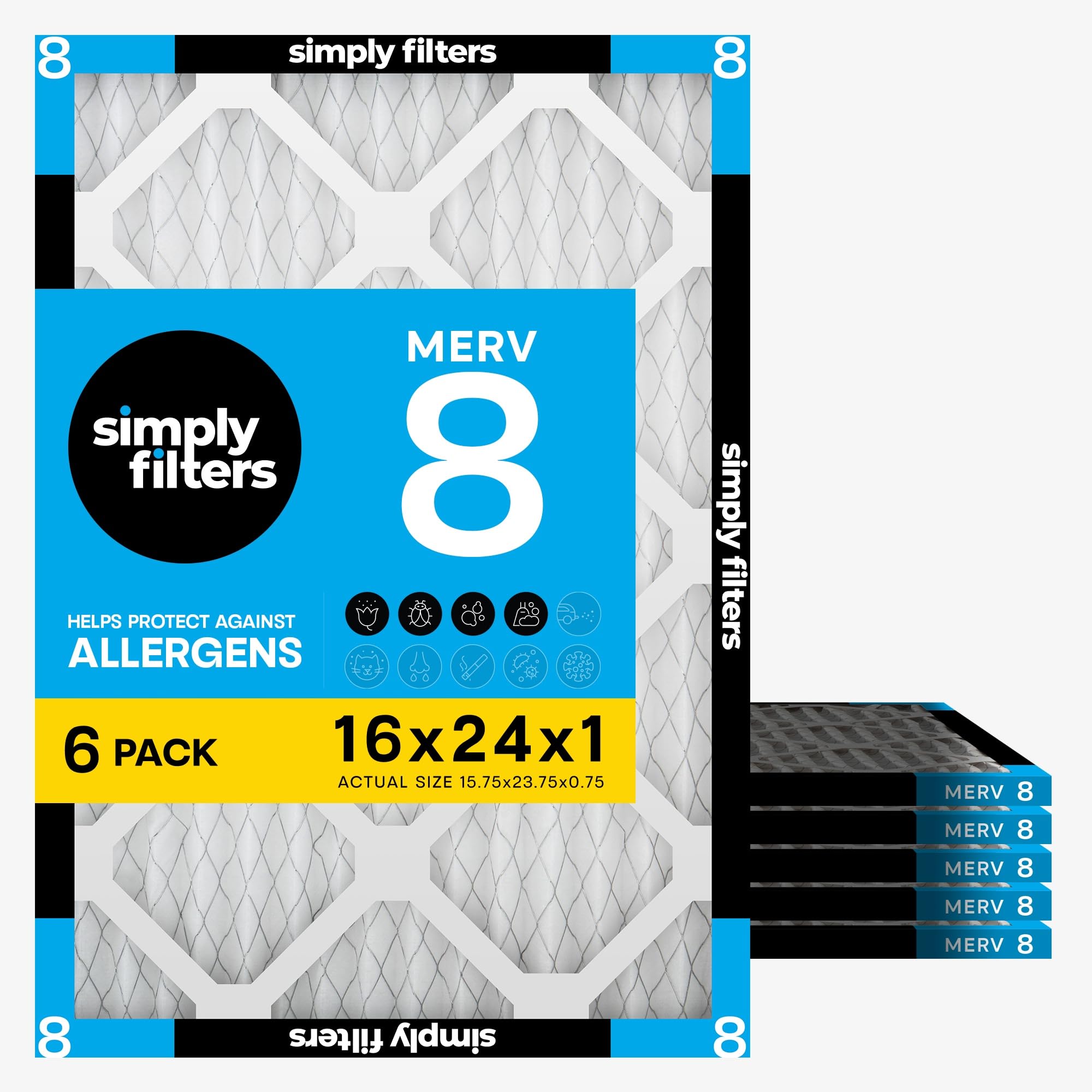
| Simply 16x24x1, MERV 8, 6-Pack★ Best Overall | Best all-round value | MERV 8 | 15.75″ x 23.75″ x 0.75″ | 6 | Amazon |
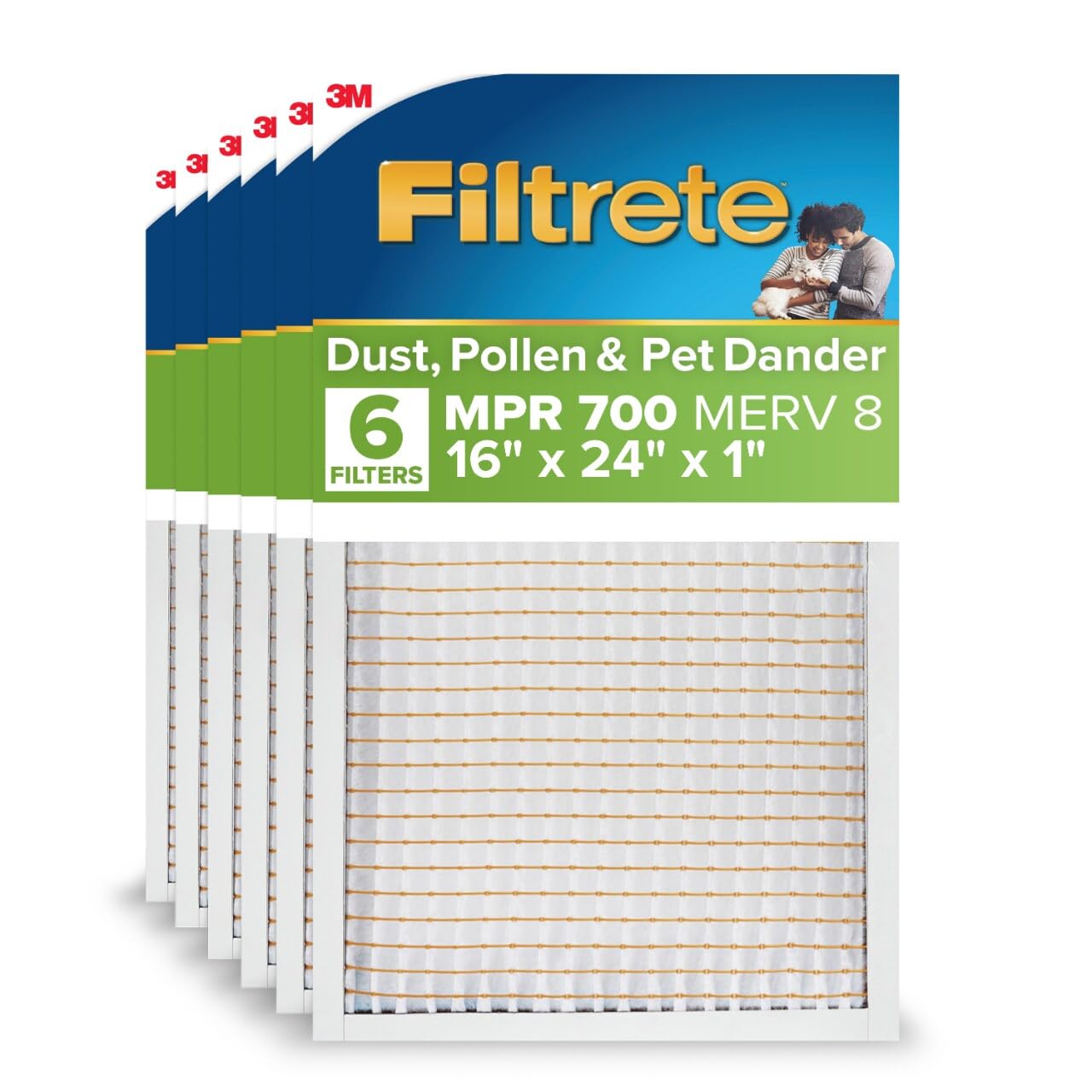
| Filtrete 16x24x1, MPR 700, 6-PackQuietest Airflow | Quietest blower operation | MERV 8 | 15.81″ x 23.81″ x 0.81″ | 6 | Amazon |
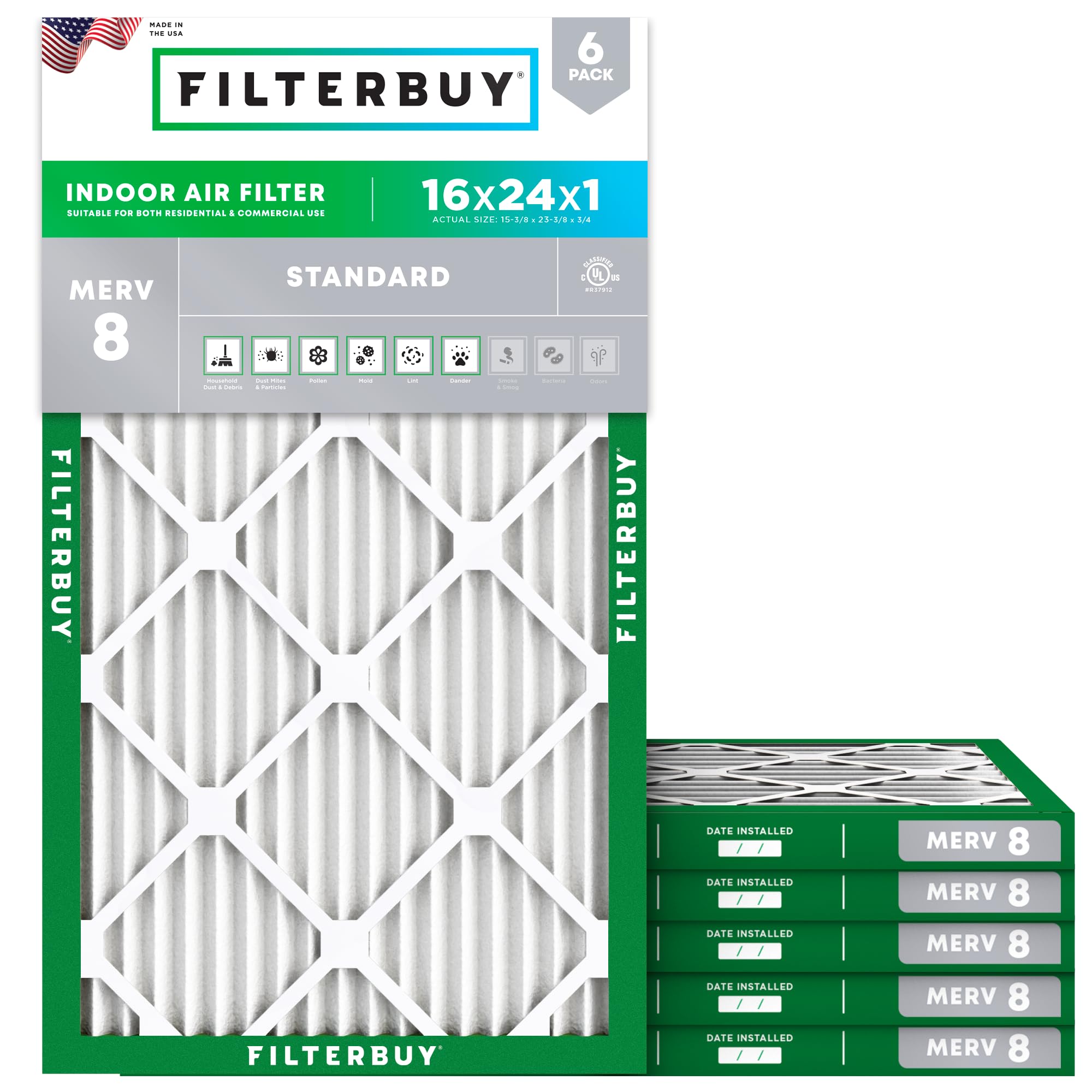
| Filterbuy 16x24x1, MERV 8, 6-PackBest Frame Build | Sturdiest frame build | MERV 8 | 15.38″ x 23.38″ x 0.75″ | 6 | Amazon |
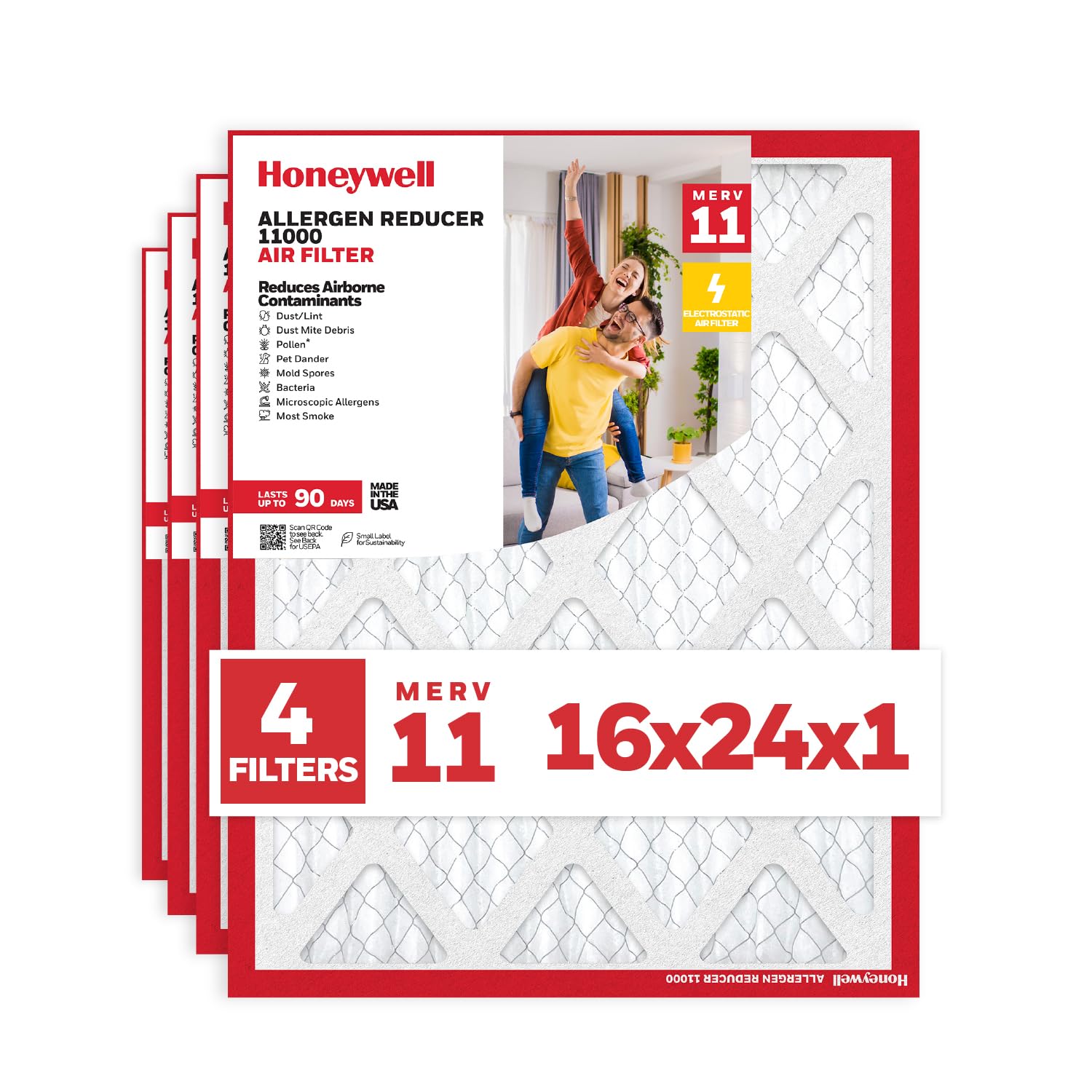
| Honeywell 16x24x1, MERV 11, 4-Pack | Allergen reduction | MERV 11 | 16″ x 24″ x 1″ | 4 | Amazon |
| Glasfloss 16x24x1 Fiberglass, 6-Pack | Maximum airflow, minimum strain | MERV 3 | 15-5/8″ x 23-5/8″ x 3/4″ | 6 | Amazon |
| Aerostar 16x24x1, MERV 11, 6-Pack | Balanced mid-range pick | MERV 11 | 15-3/4″ x 23-3/4″ x 3/4″ | 6 | Amazon |
| Chenzhit 16x24x1, MERV 13, 6-Pack | Fine particle capture | MERV 13 | 15.75″ x 23.75″ x 0.75″ | 6 | Amazon |
| AIRx Filters 16x24x1, MERV 11, 6-Pack | Heavy-duty humid climates | MERV 11 | 15.50″ x 23.50″ x 0.75″ | 6 | Amazon |
| Filter King 16x24x1, MERV 13, 6-Pack | High-use household filtering | MERV 13 | 15.5″ x 23.5″ x 0.75″ | 6 | Amazon |
In‑Depth Reviews
1. Simply 16x24x1 Air Filter, MERV 8, 6-Pack
Our pick — over 4.5★ from 54,500+ verified ratings; the strongest balance of quality and price.
Six filters built on a steel wire grid, priced so you actually swap them on time
This is the filter most people should buy first. It traps 90% of airborne particles at a MERV 8 rating, which is the balance for a residential furnace that was never designed to fight dense media. The construction is more serious than the price suggests: a 24-point beverage board frame with hot-rolled steel wire mesh backing the pleats, so it holds its shape instead of bowing into the airstream after a few weeks.
The real-world size is where it wins or loses. Simply’s actual measurement is 15.75″ x 23.75″ x 0.75″, against Filtrete’s 15.81″ x 23.81″ x 0.81″ — that is the Filtrete running roughly a sixteenth of an inch larger in each direction. Simply also comes in lighter, at 2 pounds versus the Filtrete’s 3.1 pounds, which tells you the media is thinner and less resistant to airflow. For an older system that sounds strained when a dense filter goes in, that trade is the right one.
What wins people over is the cost per change. The six-pack lands well below what a single high-MERV filter costs at a hardware store, so replacing every 90 days stops being a decision you put off. As buyers put it: “We love these, have been using for 3 years. Affordable and good quality.” The honest catch is fit — a few owners find these run slightly small and have to hold the filter in place while closing the vent door. If your slot is loose, that is a two-second annoyance. If it is already snug, you will not notice.
What earns it the top spot
- MERV 8 at 90% particle capture — high enough to matter, low enough to keep airflow open
- Steel wire mesh backing resists sagging far better than plain cardboard frames
- Compatible with almost any brand, including systems set up for 3M Filtrete MPR 600 or Honeywell FPR 5
- Six filters at a per-unit cost that makes 90-day changes painless
Where it asks you to compromise
- At 2 pounds it is the lighter build — thinner media means less resistance, not more
- The 0.75″ actual thickness can sit loose in slots sized for a full 1″ filter
- Not the pick if you need finer particle capture than MERV 8 provides
Buy it if: you want a set-and-forget six-pack for a standard residential furnace at MERV 8, and you would rather spend less and change on schedule than spend more and stretch it.
Pass it over if: your slot needs a tight 1″ seal, or you are chasing MERV 11 or 13 for allergy season — the Honeywell or Aerostar further down handles that better.
2. Filtrete 16x24x1 AC Furnace Air Filter, MPR 700, MERV 8, 6-Pack
The brand that finally quiets a blower that has been groaning for months
If your furnace has been noisy since the last filter change, start here. Filtrete builds this one with 3-in-1 technology from 3M, and the MPR 700 rating maps to MERV 8 — the same filtration level as the Simply above, but with a more refined media stack. Buyers switching over from a denser, wrong-numbered filter describe the blower noise dropping noticeably once the right MERV rating is in the slot.
Physically this is the heavier of the two MERV 8 leaders. At 3.1 pounds against the Simply’s 2 pounds, the Filtrete carries noticeably more material per filter, and its 15.81″ x 23.81″ x 0.81″ actual size runs larger than Simply’s 15.75″ x 23.75″ x 0.75″ in every direction. The 0.81″ thickness in particular gets you closer to filling a nominal 1″ slot, which matters in housings that let a thinner filter rattle or bypass air at the edges.
What it loses on quantity, it makes up for in expected life. Filtrete’s own guidance is a change every 90 days for 1″ filters, and the packaging bar code can be scanned into the Filtrete Smart App to set a 30, 60, or 90-day countdown that pings you when it is time. That countdown is genuinely useful if you have ever forgotten a filter for six months. The trade-off is pack size versus reach — this is a six-pack, but a smaller audience has reviewed it, so you are leaning on the brand’s track record rather than a giant crowd.
The brand argument: Filtrete is the only line carrying both MERV and MPR ratings on every pleated filter, and MPR 700 sits at MERV 8 — so you get the airflow of a mid-tier filter with the particle targeting of a name that HVAC techs recognize.
The practical catch: the fit is the whole story here. This is a filter that either seats perfectly in your housing or does not, so measure your slot before ordering. A few buyers with non-standard housings found it tighter than expected.
Reach for this if: your system runs quieter on MERV 8 and you want a slightly thicker, denser filter that won’t leave a bypass gap at the edges.
Look elsewhere if: you need six filters at the lowest per-unit cost — the Simply six-pack is the value play in this comparison.
3. Filterbuy 16x24x1 Air Filter MERV 8, 6-Pack
Fourteen pleats per foot and a frame that refuses to warp in the airstream
Filterbuy’s pitch is simple: build the frame better than everyone else. This filter uses a beverage board frame with dual wire backing, which resists the warping and sagging that kills cheap cardboard filters in the first month. The media is electrostatically charged with 14 pleats per foot, so it traps microscopic particles without just being a wall of dense fabric. MERV 8, same capture level as the Simply and Filtrete above, in a heavier-duty housing.
The size here is the smallest of the three MERV 8 picks — actual dimensions are 15.38″ x 23.38″ x 0.75″. Compare that to the Filtrete’s 15.81″ x 23.81″ x 0.81″ and you are looking at a filter that sits roughly a third of an inch narrower on the long edge. That matters if you have noticed a gap around the edges of your current filter letting unfiltered air slip past — in some housings this one is going to have a wider bypass channel unless the slot geometry happens to line up better.
What earns it its place is the physical durability. Buyers who have tried the big-box brands describe this media holding its shape where cheaper filters collapse inward within a couple of weeks. The honest counterweight: the frame is sturdy, but several buyers report their boxes arrived crushed in transit, which is a shipping issue rather than a filter defect. If that happens, the filter is usually still usable, but it is worth knowing before you order.
The durability angle: dual wire backing plus 14 pleats per foot is the most construction-heavy package among the MERV 8 filters here, and it is why owners running it in dusty, high-use environments keep coming back to it.
This one suits: dusty climates, homes near construction, or anyone whose current filter sags within a month and would rather spend a bit more on a frame that stays rigid.
Skip the upgrade if: your slot fits a standard-depth filter fine and your priority is per-unit price — the Simply six-pack beats it there.
4. Honeywell 16x24x1 MERV 11 Allergen Reducer 11000, 4-Pack
Steps up to MERV 11 without forcing your blower to work harder than it should
The jump in filtration level is what you pay for here. The Honeywell 11000 is rated MERV 11, which means it traps up to 85% of large airborne particles, including pollen, pet dander, dust mite debris, and most smoke. That is a meaningful step up from the MERV 8 filters above, and it is the reason to pick this one if allergies are the actual problem you are trying to solve rather than just general dust.
The electrostatic charged media is doing the heavy lifting. Static electricity attracts smaller particles as they pass through, which is how this catches things plain fiberglass media would let slip straight through. Honeywell rates the technology as outperforming standard 1-inch fiberglass home air filter models — the same family as the Glasfloss fiberglass option further down this list, which is worth knowing if you are weighing filtration against airflow.
Pack size is the practical drawback. Four filters rather than six means you change less often per order, so if you are running through filters every 90 days, the shorter supply means more frequent reordering. The other honest note is that Honeywell’s nominal dimensions are listed as a full 16″ x 24″ x 1″ — no actual-size disclosure on the listing — so it assumes your housing has some tolerance. In a tight slot, this is the pick to measure first.
Where it earns its keep
- MERV 11 with up to 85% capture of large airborne particles, plus most smoke
- Electrostatic media keeps attracting particles as they pass through
- Fits air conditioners, furnaces, heat pumps, and HVAC units and is compatible with almost any brand
- Made in the USA, and Honeywell recommends a clean 90-day replacement rhythm
The trade-offs to know
- Four filters per order rather than six — more frequent reordering
- Media is on the lighter, less rigid side, so treat the frame gently when sliding it in
- Only buy this if your system runs a MERV 11 without straining — check before upgrading
Made for: households where pollen, dander, or smoke is the actual complaint, and the system has the headroom to run finer media.
Think twice if: you have been warned your blower runs tight on airflow, or you want the lowest per-filter cost — this is a four-pack, not a six-pack.
5. Glasfloss 16x24x1 Fiberglass Air Filters, MERV 3, 6-Pack

The low-MERV filter for systems that choke on pleated media
Not every furnace wants a pleated filter, and Glasfloss is the option for the ones that do not. This is a MERV 3 fiberglass filter — the lowest filtration rating in this comparison — and that is the entire point. It is designed to catch everyday dust and lint while letting air move through almost unrestricted. If an HVAC tech has ever told you to switch to a basic filter to stop your system from straining, this is the exact type they meant.
The construction is fiberglass media bonded to a heavy-duty craftboard frame, reinforced with a double-strut design that opens up more usable media area than a traditional metal grill filter. Even at MERV 3, that extra open area makes a real difference in how much air moves per filter. Glasfloss has been manufacturing air filters in the United States for more than 70 years, and the actual measured size is 15-5/8″ x 23-5/8″ x 3/4″ — slightly under nominal so it slides in without binding. There are no metal parts inside, so when it is dirty you bag it and throw it out with regular trash.
The catch is honest and worth stating plainly: MERV 3 will not touch fine particles. Dust, lint, and larger debris get caught, but pollen, smoke, and microscopic allergens pass through. If your priority is air quality rather than airflow, this is the wrong pick and the Honeywell or Aerostar is what you actually want. What this filter does well is keep the system healthy — several buyers run it specifically as a placeholder alongside a separate room air purifier, letting the furnace breathe while the purifier handles the fine stuff.
Who it is really for: heat pumps and older blowers that trip on pressure, and anyone whose technician has already flagged high-MERV pleats as the cause of system issues.
The honest limit: MERV 3 catches dust and lint but leaves the fine particles. It is a system-protection filter, not an air-cleaning filter.
Right for you if: your heat pump or older furnace has ever acted up on denser pleated media and you need a filter that prioritizes airflow to the point of barely resisting at all.
Not for you if: allergies or air quality are the reason you are buying — you want MERV 11 or higher, not the lowest number on this page.
6. Aerostar 16x24x1 MERV 11 AC Filter, 6-Pack
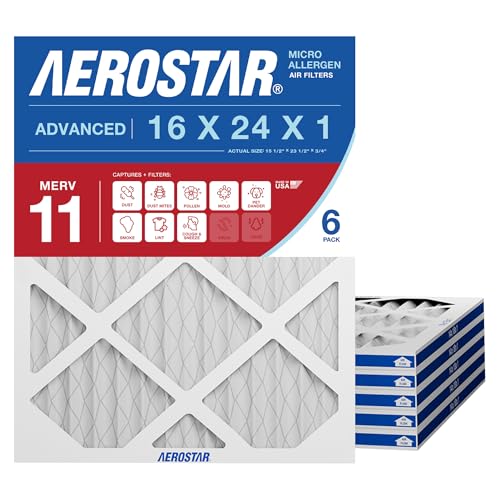
MERV 11 with the airflow resistance of a mid-tier filter
Aerostar’s angle is the one number on this page that solves the MERV-11-versus-airflow conflict: it runs 100% synthetic electrostatic media for high filtration efficiency with low air flow resistance. The MERV 11 rating puts it in the same filtration tier as the Honeywell and the AIRx, but the media is designed to keep the pressure drop low enough that a standard residential blower does not have to fight it. Comparable to MPR 1000–1200 and FPR 7 if you have been looking at those numbers.
What it filters is broad: lint, dust mites, spores, pollen, pet dander, fine dust, and smoke all get targeted, which is the practical reason MERV 11 exists as a category. Actual size is 15-3/4″ x 23-3/4″ x 3/4″, and Aerostar lists it as manufactured by Filtration Group — a real filtration manufacturer rather than a repackaged commodity. The six-pack means you can run the recommended 60-to-90-day change cycle without running out, and the guidance is to shorten that to 30 days during peak summer and winter months when the system runs hardest.
The size is where buyers split. Most find it seats perfectly, but some report it running on the smaller side and not sealing tightly enough in the housing. If your slot is sized to a nominal 16x24x1 exactly, this is the pick to measure first — a 15-3/4″ x 23-3/4″ filter in a snug housing can leave a small bypass channel. The flip side is that the smaller size makes it easier to slide in without binding, which is what most owners actually want.
What makes it the middle-ground winner: MERV 11 filtration at a pressure drop low enough that most residential systems can handle it without the blower sounding strained — that is the combination most buyers actually need and the one that is hardest to find at this rating level.
Pick this if: you want MERV 11 filtration on a standard residential system without going to a MERV 13 that might over-restrict your airflow.
Look at the Honeywell instead if: your housing runs tight and you would rather have a filter that fills the slot fully than one that slides in easily.
7. Chenzhit 16x24x1 Air Filters, MERV 13, 6-Pack

MERV 13 filtration without the premium price tag that usually comes with it
This is the entry point to MERV 13 filtration. A MERV 13 rating — equivalent to MPR 1900 and FPR 10 — means it targets particles fine enough that standard MERV 8 and MERV 11 filters let through. If you are specifically trying to catch the smallest airborne particles rather than just household dust, this is the tier you need, and the six-pack format at this rating is unusual. Actual size is 15.75″ x 23.75″ x 0.75″, which is a straightforward drop-in for standard 16x24x1 housings.
What to know before you upgrade to 13: pleated MERV 13 media is denser than MERV 8 or 11, and the tighter pleating increases air resistance. The Chenzhit listing calls out a 1-month service period and recommends replacing every 60-90 days, dropping to 30 days in peak heating and cooling months. That is more frequent changes than a MERV 8 filter typically demands, because denser media loads up faster. If you have a system that already runs tight on airflow, MERV 13 is a commitment, not a free upgrade.
Fit is the single recurring complaint. Several owners mention the actual size running smaller than the 15.75″ x 23.75″ figure suggests, and one of the buyer notes describes the media being thin enough that it catches in the furnace tray when sliding. That is a solvable quirk — a piece of smooth card stock alongside the filter slides it in cleanly — but it is the kind of thing that separates a good MERV 13 filter from a great one. Airflow-wise the media delivers, and buyers running this against the big-name store brands consistently find it competitive on both filtration and cost per change.
Why buyers reach for the 13s
- MERV 13 filtration in a six-pack — the finest capture tier at a mid-range position in this comparison
- Equivalent to MPR 1900 and FPR 10
- Fits air conditioners, furnaces, HVAC units, air scrubbers, dehumidifiers, and house vents
- Slides straight into place with no tools
Before you commit to MERV 13
- Denser media loads faster — budget for 60-90 day changes, or 30 in peak months
- Customers note the actual size can run smaller than stated, so a loose fit is possible
- Thin material can catch on furnace trays if you slide it in without a guide
Choose this if: fine-particle capture is the goal and your system can handle the airflow resistance of MERV 13 pleating without straining.
Stay on MERV 8 or 11 if: your blower runs hard on denser filters, or you want the longest possible interval between changes.
8. AIRx Filters 16x24x1 MERV 11, 6-Pack
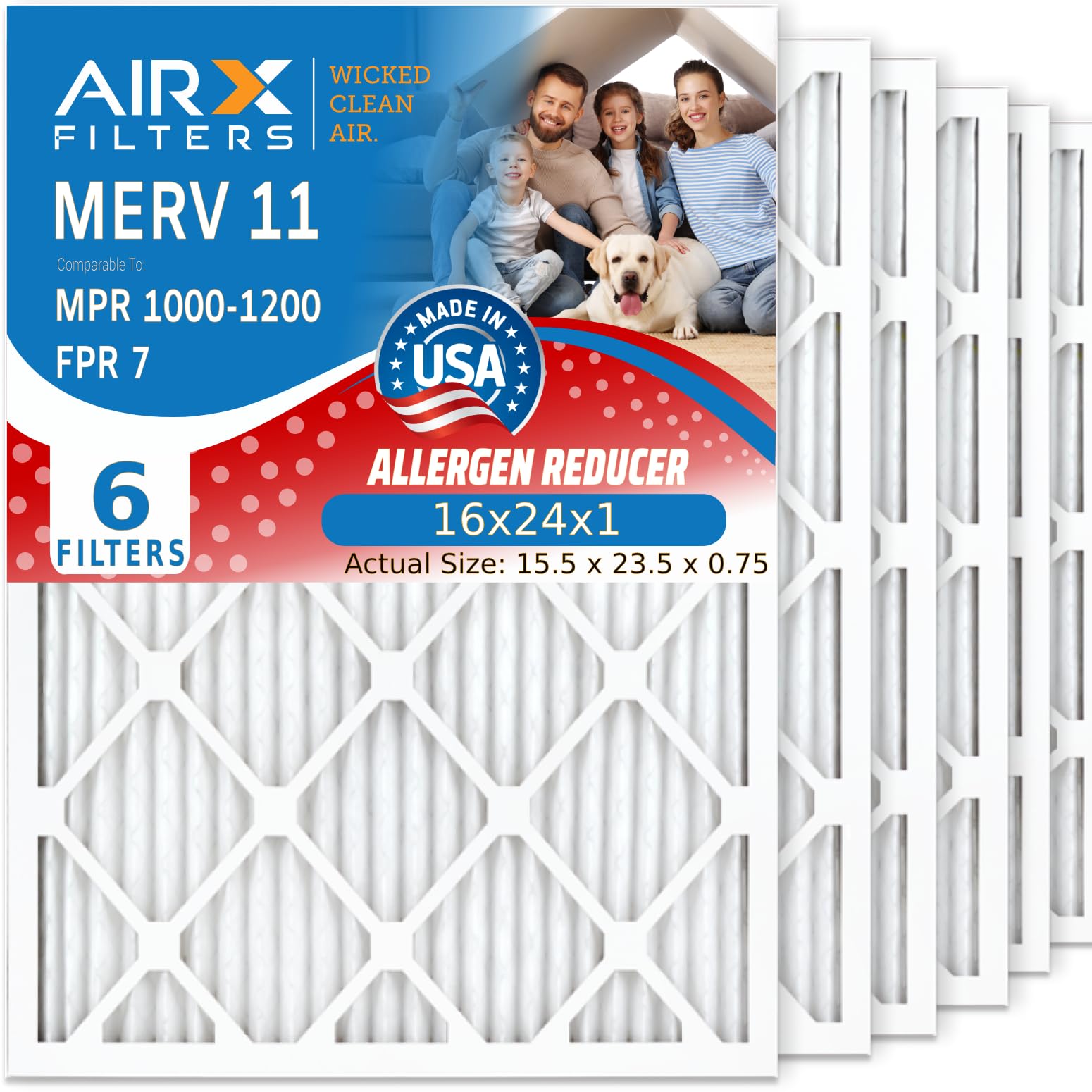
A MERV 11 built to survive humidity and heat without the frame going soft
AIRx takes the same MERV 11 filtration tier as the Honeywell and Aerostar and rounds it out with the toughest frame in that group. The construction is moisture-resistant double-wall beverage board, rated to withstand temperatures up to 180°F, which is the specification that matters in humid climates and attics where a standard filter frame goes soft within weeks. If you have ever pulled a filter out of a Florida or Gulf-coast return and found it warped, this is the answer to that problem.
Filtration sits at MERV 11, capturing 85% of particles including dust, lint, pollen, and pet dander, and it is positioned as outperforming basic fiberglass. The pleated design gives you the surface area to keep airflow moving, and the actual measured size is 15.50″ x 23.50″ x 0.75″ — smaller than most of the MERV 8 filters on this list, which is what makes it easier to slide into tight slots. Listed as compatible with MPR 1000, 1085, 1200, and FPR 7 filters.
Replacement guidance is 60-90 days for standard use, cut to 30-60 days for homes with pets, allergies, or heavy HVAC runtime. One buyer note flags that the tight weave can clog faster than expected in a smaller system, visible as a dark layer across the media within a month — that is the honest warning about running a MERV 11 on a blower that really wanted a MERV 8. Match the filter to your system’s capacity and this is a genuinely long-lasting, heavy-duty pick. Force it onto an undersized system and you will be changing filters more often than the 90-day schedule suggests.
Built for humidity: moisture-resistant double-wall frames and a 180°F temperature tolerance are what put this ahead of standard beverage-board filters in humid climates, where warping is the usual failure point.
Fair warning: MERV 11 media loads faster in undersized or high-use systems, so budget for 30-60 day changes if you have pets or run the HVAC hard.
This is your pick if: you live somewhere humid and have watched filter frames warp, or you want MERV 11 filtration in a frame that will still be rigid when it comes out.
Consider the Aerostar instead if: your priority is lower airflow resistance — the Aerostar’s synthetic media is the only MERV 11 here explicitly built around that.
9. Filter King 16x24x1 MERV 13, 6-Pack
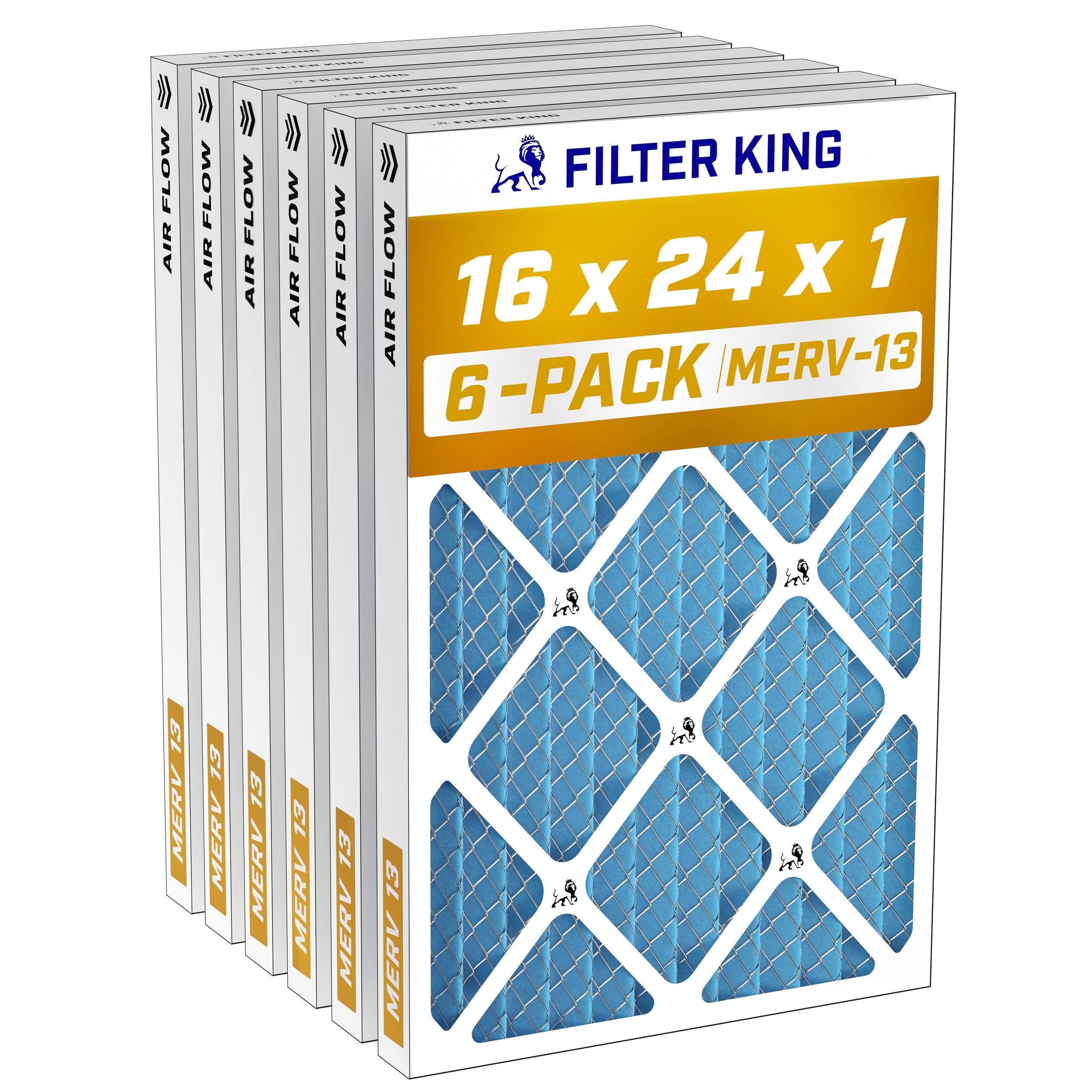
MERV 13 six-pack made from polypropylene, with an EPA establishment number on the listing
Filter King is the highest-rated MERV 13 filter in this comparison, and it earns that spot with construction rather than a filter rating alone. The media is polypropylene, a sturdier synthetic material than the thinner paper media used in the Chenzhit 13 further up this list. Filter King lists an EPA Establishment Number of 103501-FL-1 on the listing, and it holds a genuine USA manufacturing line. Reviewers point out the dust in their homes dropping to almost nothing once these are running.
Actual size is 15.5″ x 23.5″ x 0.75″, so it aligns with the tighter end of the 16x24x1 range — it will slide into housings that the Filterbuy and Glasfloss would fit more loosely. The design goal is stated clearly: capture more particles through pleated construction without blocking airflow. Filter King rates the filters at up to 90 days of service, and recommends 30-90 day changes for 1-inch filters overall, which makes the six-pack good for roughly a year and a half of coverage at the peak end of the schedule.
The honest catch is the size itself. Filter King’s listing states the actual size as 15.5″ x 23.5″ x.75″, and multiple owners have found the delivered filter running smaller than expected — some have had to use the side adjustment on their housing to hold it in place, and the smaller dimensions can leave more of a gap around the edges than a nominal 16x24x1 housing expects. If your slot is dimensioned precisely, measure first. Otherwise, the filtration performance and the per-unit cost on the six-pack are what keep buyers repeating the purchase.
Standout reasons to consider it
- MERV 13 filtration with polypropylene media — a sturdier build than paper-media alternatives at this rating
- Rated for up to 90 days per filter, so the six-pack carries you well past a full year
- Owners consistently report dramatic reductions in household dust once these go in
- Made in the USA with a listed EPA establishment number
The honest caveats
- 15.5″ x 23.5″ actual size — one of the smaller footprints here, so tight-fit housings can leave a gap
- Some shoppers say needing to use their housing adjustment to secure the filter
- MERV 13 density is a commitment — your blower needs to be able to handle the airflow resistance
The right fit for: homes that need MERV 13 filtration, and where the housing slot has enough adjustment to accommodate a slightly under-size filter.
Look at the Chenzhit if: you want to test MERV 13 at a lower entry cost and are happy with paper media — the Filter King is the upgrade once you know 13 is right for your system.
Understanding the Specs
What MERV really means
MERV stands for Minimum Efficiency Reporting Value — it is the rating that tells you roughly what percentage of airborne particles a filter is designed to trap. MERV 3 catches the obvious stuff: dust and lint, the large debris you can see floating. MERV 8 catches 90% of airborne particles and is the standard recommendation for a residential furnace. MERV 11 steps up to 85% of large airborne particles including pollen, pet dander, dust mite debris, and most smoke. MERV 13 catches finer particles still. Higher is not automatically better — denser media resists airflow harder, and a MERV 13 in a blower sized for MERV 8 can strain the system and shorten its life.
Nominal size vs actual size
Shopping for a “16x24x1” filter means shopping for a nominal size, not the measurement of the physical filter. Every legitimate filter is built slightly smaller than nominal so it slides in and out without binding. The Fiberglass Glasfloss, for example, has an actual size of 15-5/8″ x 23-5/8″ x 3/4″ — noticeably smaller than the labeled 16x24x1. That gap is deliberate and necessary. The problem is that the size of the gap varies between brands, and the difference between a 15.38″ and a 15.81″ long edge can mean the difference between a clean seal and unfiltered air bypassing around the edges. Pull your old filter out and measure it before ordering — that measurement is the only reliable guide.
FAQ
Is a higher MERV rating always better for my furnace?
How do I know if my system takes a 16x24x1 filter?
How often should I change a 16x24x1 filter?
What is the difference between MERV 8 and MERV 11?
Does a pleated filter really restrict airflow more than fiberglass?
Can I run a MERV 11 in a system that came with a MERV 8 filter?
Why does my new filter say 16x24x1 but measure smaller?
Which direction does the airflow arrow point when installing?
Is a 6-pack worth buying over a single filter?
Does a filter that says MERV 8 actually mean it captures everything above a certain size?
Can I wash and reuse a 16x24x1 pleated filter?
Final Thoughts: The Verdict
For most systems, the 16x24x1 air filter that does the job is the Simply 16x24x1 MERV 8 6-Pack — a steel mesh-backed filter that keeps airflow open, works with almost any brand, and costs little enough that you actually swap it on schedule. If a quieter blower matters more than per-unit cost, the Filtrete MPR 700 is the one to grab, with a larger physical size that seals tighter in nominal housings. And for humid climates or homes where the frame has warped before, the AIRx Filters MERV 11 uses moisture-resistant double-wall construction rated to 180°F so it stays rigid where standard beverage-board filters go soft. Those three cover most systems; the remaining picks serve narrower needs — allergen-focused homes, blowers that choke on dense media, and buyers chasing MERV 13 capture.
How We Picked
We do not accept paid placement. Every pick is matched to a real buyer and a real use-case; we do not hands-on test units.
Sources & Methodology
Specifications: manufacturer listings and product documentation. Review insights: verified customer reviews, as of September 2026. Pricing: not shown on this page (it changes often); check the current price via the retailer link.
As an Amazon Associate, KitchPrep earns from qualifying purchases. This does not affect which products we feature.
Related Guides
