
Specs are compiled from manufacturer listings and verified buyer reviews and can change over time — please confirm the key details on the product page before buying.
If you are shopping for a powerful floor-standing cooler, the honest answer is this: the real number to compare is SACC, not ASHRAE. Almost every machine on this page is sold as 14,000 BTU, but the SACC rating is what actually reaches your room. One quick note before we start: this list uses flexible, human-like matching, so not every unit is the exact number you typed in. The nearest same-type size serves the same job, and you deserve to know that upfront.
I’m Mohammad Maruf — the founder and writer behind KitchPrep. This guide is built by comparing the manufacturers’ published specifications and the patterns across verified customer reviews, so you get each pick’s real strengths and trade-offs instead of marketing spin.
Heat pumps, drain-free systems, and window kits all change how a heavy portable unit lives in your home. Here is the plain-English breakdown of the best 14000 BTU portable air conditioner picks, sorted by what each one does best.
Our Picks at a Glance
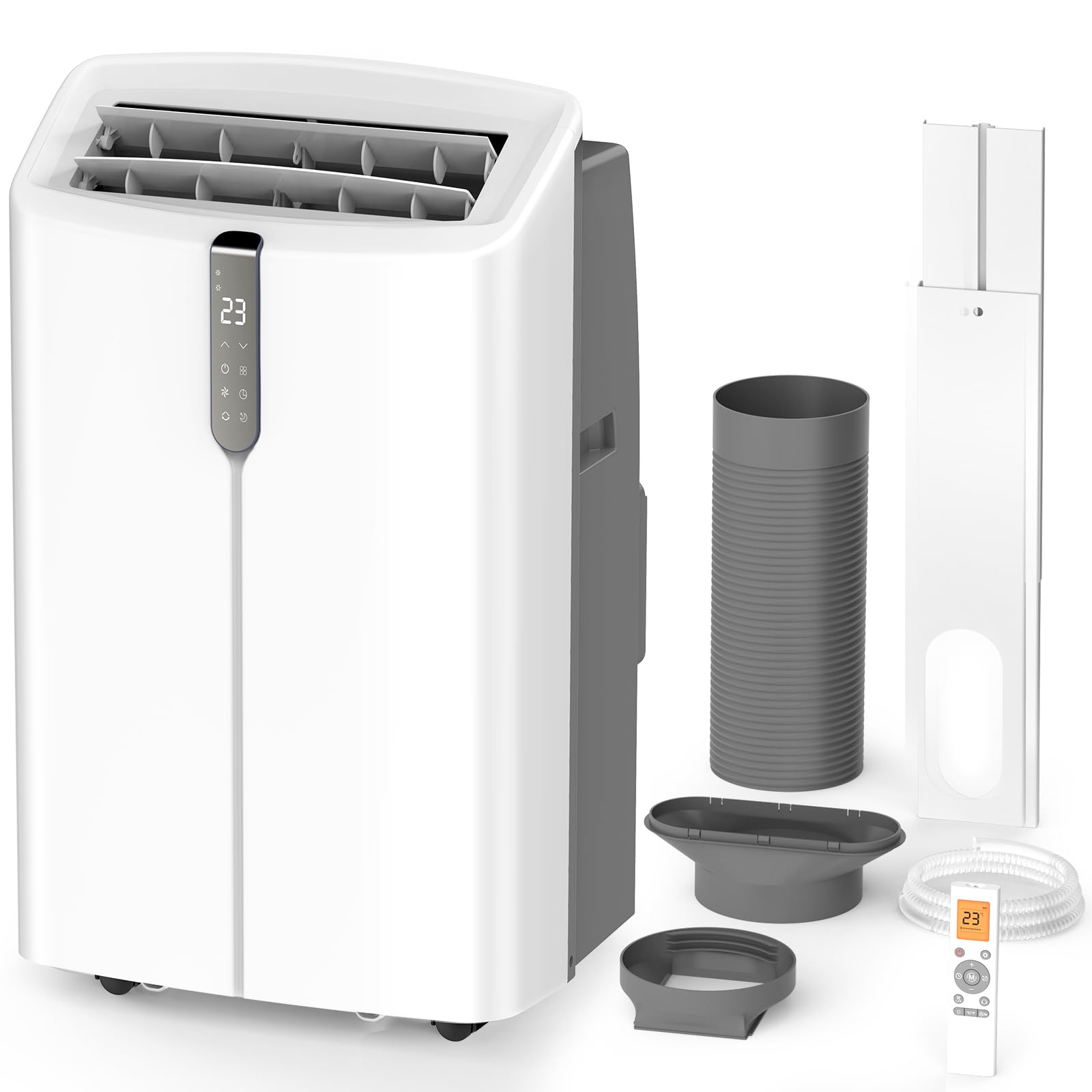
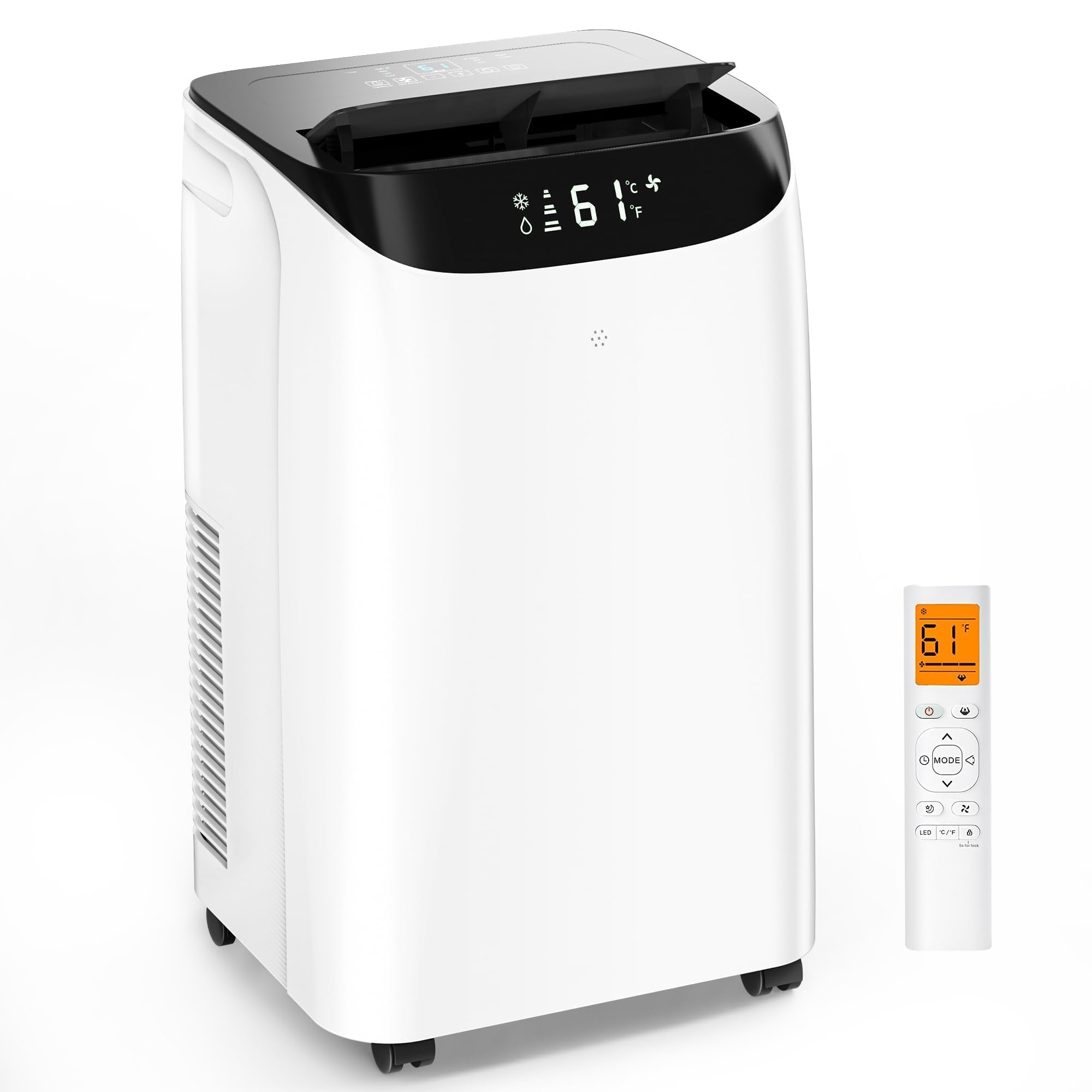
How To Choose The Best 14000 BTU Portable Air Conditioner
Three things decide whether this purchase feels smart or disappointing: the SACC number, the hose design, and how the unit handles its own water. Everything else is comfort polish.
Read the SACC number, not the headline BTU
ASHRAE BTU is the larger, older measuring standard that many sellers print in big letters. SACC is the smaller, newer number that better reflects what the machine delivers in a real room. A unit sold as 14,000 BTU ASHRAE often carries a 10,000 BTU SACC figure. Both numbers are real; they are measured differently. Compare SACC-to-SACC and the field suddenly separates.
Dual hose versus single hose matters more than brand
A single-hose unit pulls cooled air out of your room and pushes it outside, which slightly lowers indoor pressure and can pull hot outside air back in through gaps. A dual-hose design separates intake and exhaust so the room stays balanced. That is why two machines with the same BTU rating can cool the same room very differently.
Plan for the water before it becomes a chore
Every air conditioner in this category makes condensate as it dries the air. Self-evaporating designs recycle that moisture to cool the condenser coils and blow it out the exhaust hose. In heavy humidity, though, auto-evaporation can fall behind and you may need to attach a drain hose. Knowing that going in saves you a soaked rug later.
Quick Comparison
| Model | Best For | Rated Coverage | Hose Design | Stated Noise | Amazon |
|---|---|---|---|---|---|
| Gasbye Dual Hose 13.6 CEER★ Best Overall | Whole-floor cooling on less energy | Up to 500 sq. ft. | Dual hose | About 45 dB | Amazon |
| Air Future 14000 BTU SmartBest Value | Big open rooms on a mid-range budget | Up to 750 sq. ft. | Single hose | 45 dB | Amazon |
| KAMLAM 3-in-1 Floor ACBest for Damp Rooms | Wet basements that need drying too | Up to 700 sq. ft. | Single hose | 48–52 dB | Amazon |
| Midea 14,000 BTU ASHRAE | App and voice control in a compact body | Up to 450 sq. ft. | Single hose | — | Amazon |
| Westinghouse 14,000 BTU | Whole-floor cooling plus whole-home drying | Up to 700 sq. ft. | Single hose | About 52 dBA | Amazon |
| ZAFRO Smart Inverter Dual Hose | Quiet sleep in a humid climate | Up to 700 sq. ft. | Dual hose | 42 dB | Amazon |
| BLACK+DECKER BPT10HWTB | One machine for summer and shoulder season | Up to 700 sq. ft. | Single hose | — | Amazon |
| DREO 516S | Voice control in a bedroom | Listed 200 sq. ft. | Single hose | 45 dB | Amazon |
| Whynter ARC-1230WN Inverter | Slim profile against a window wall | Up to 600 sq. ft. | Dual hose-in-hose | Quiet on Auto | Amazon |
| Midea Duo with Heat | Cooling and heating across seasons | 550 sq. ft. per unit | Dual hose-in-hose | — | Amazon |
In‑Depth Reviews
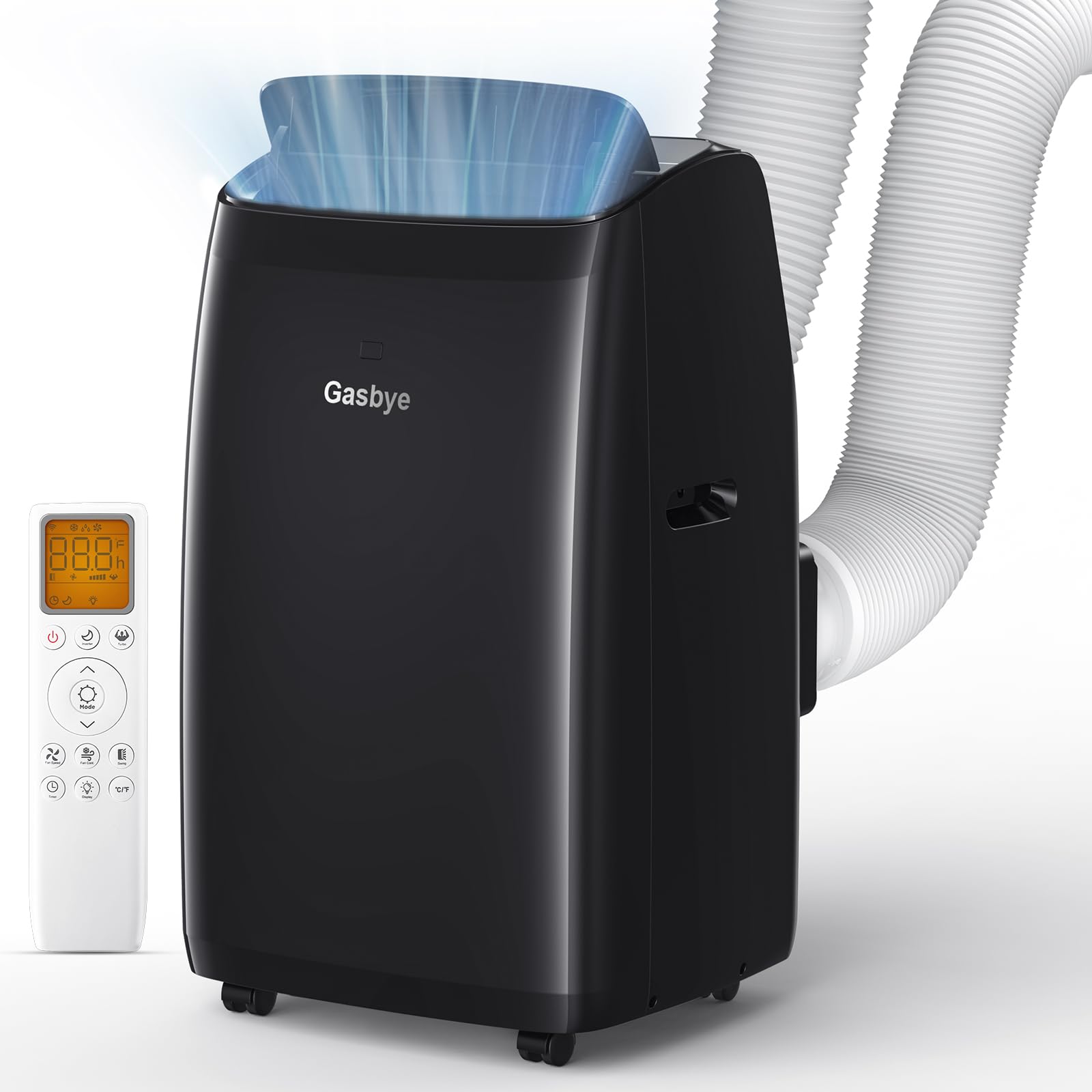
1. Gasbye Dual Hose Portable Air Conditioner, 14,000 BTU Full DC Inverter
Our pick — over 4.5★ from 450+ verified ratings; the strongest balance of quality and price.
The dual-hose inverter that quietly rewrites your summer power bill.
This is the pick for anyone cooling a bedroom, living room, or whole floor who is tired of watching the electric meter spin. It runs a full DC inverter compressor (a motor that slows down and speeds up instead of only clicking on and off) rated 13.6 CEER, a DOE-verified efficiency score. That combination is why it can hold a room steady without the compressor thrashing all night.
A dual-hose system is the headline feature here. Unlike single-hose units that push cooled indoor air outside and let hot air creep back in through window gaps, this one separates intake from exhaust so your room keeps its pressure. Turbo Mode draws roughly 800–1,300 watts for fast cooling, then drops to about 500–800 watts once the room settles — and buyers report measured draw near 530 watts in inverter mode. Tune it down further with the sleep setting and the compressor frequency falls within about two minutes, bringing noise to around 45 dB, roughly the sound of a quiet conversation from across the room.
One sizing note that saves a return: this is a true full-size 14,000 BTU chassis, not a shrunken “mini” with inflated numbers, so measure your floor space before you buy. Both hoses are 5.9 inches across and 59 inches long — fine for most windows, tight for high transoms, and the manufacturer advises against extension hoses because they cut cooling performance. A small table or stand under the unit solves that. The dual-hose design also avoids the negative-pressure problem outright, which is why this machine tops the list for buyers who want to stop guessing.
Where it wins
- 13.6 CEER inverter compressor cuts running costs versus fixed-speed rivals
- Dual-hose design keeps room pressure balanced and stops hot-air creep
- Inverter mode quiets the compressor to about 45 dB within roughly two minutes
- Backlit remote plus a display-off setting for sleep
- Owners mention it holding a 1,000 sq ft space at 68°F on a 103°F day
Where it asks patience
- The full-size body needs real floor space; measure before ordering
- The 59-inch hoses can run short on high windows
- In very humid, poorly sealed rooms the unit may need occasional manual draining
- The temperature readout can drift from your setpoint
Reach for this if: you want the lowest running cost and the strongest cooling in this group, and you have the floor space to let a full-size unit breathe.
Weigh the size first: a compact corner spot or a high transom window will fight this chassis.
2. Air Future 14000 BTU Smart Portable Air Conditioner, Cools up to 750 sq. ft.
Three modes, four casters, and a bedroom-ready 45 dB sleep setting.
For a renter or apartment dweller who needs one machine to do everything without a permanent installation, this is the value play. It cools, dehumidifies, and circulates as a fan, with a 24-hour programmable timer that lets you pre-cool before you get home. Coverage is listed up to 750 sq. ft., the largest here, and it runs on R32 refrigerant (a newer coolant blend with a much lower impact rating than older refrigerants) under 115V/60Hz power with ETL certification.
The self-evaporation system is the part you will notice day to day. Moisture pulled from the air gets recycled to cool the condenser coils, then sent out the exhaust hose — so you mostly skip the bucket routine. Four 360° swivel casters and recessed side handles make it easy to roll between rooms, and the tool-free window kit fits most vertical and horizontal sliding windows. Setup runs about an hour in most homes; one owner needed a small trim on the sliding panel and let the refrigerant settle for 24 hours first.
On performance, customers note it holding a room near 70°F by day and 67°F overnight. Efficiency here is the trade-off: it consumes 100 kW annually on the label versus 442 kW on the Gasbye, so the Gasbye is the smarter long-haul choice if you run a unit all summer. This one wins when price and sliding-window fit matter more than power draw.
Money talk: the value story is strong here — owners routinely call it worth the cost for summer cooling, especially in single rooms.
Noise is a split verdict: some owners find it surprisingly quiet, others find it loud, so treat the 45 dB figure as the sleep-mode target rather than a guarantee.
Best for: single-room cooling where you want the biggest listed coverage at the friendliest mid-range price.
One thing to know: the exhaust hose connectors can pop loose, and reviewers point out a strip of duct tape at the joint is the usual fix.
3. KAMLAM 14000 BTU Portable Air Conditioner, Free Standing, Cools Up to 700 Sq. Ft.
Built for the basement that feels clammy even after the AC kicks in.
If your real problem is dampness as much as heat, this one earns its spot. It pulls up to 95 pints of moisture out of the air per day, which puts it in a different class than the cooling-only units here. Four modes — Cooling, Fan, Dehumidifying, and Auto — let you dry the air without running the compressor full-time, which is exactly what a laundry room, garage, or basement needs.
Cooling itself is stout: 400 m³/h of airflow through a wide 75° air outlet, with an adjustable range from 61°F to 86°F and coverage listed up to 700 sq. ft. The front LED display and a remote rated for about 23 feet of range mean you can adjust from the couch. Install is a three-step job with the included window sealing kit, and shoppers say the whole thing takes roughly an hour.
Here is the honest part. Sleep mode drops the fan to about 48 dB (decibels, a measure of sound) so it is quiet enough to sleep next to, while normal cooling runs nearer 52 dB. In genuinely wet spaces, auto-evaporation can fall behind; run it in a humid basement and expect to drain the tank roughly every 8 hours, at which point the unit shuts itself off as a reminder to empty it. A standard garden hose hooks to the rear drain plug to make that quick.
The strong suit: buyers who wanted serious moisture removal alongside cooling say it does exactly the job, with one calling it cold, not too loud, and good-looking next to a window unit.
Set your expectations: a handful of units trip their protection and shut off early in very wet rooms, so pair it with the drain hose from day one in a basement.
Pick it for: wet basements, garages, and laundry rooms where drying the air is half the battle.
Look past it if: your space is sealed and dry — a drain-free inverter model will cost you less to run.
4. Midea 14,000 BTU ASHRAE Portable Air Conditioner, Cools up to 450 Sq. Ft.

The app-first unit for anyone who wants the room cold before they walk in.
Smart control is the whole pitch on this Midea, and it is a real one. You can start it from the SmartHome app on iOS or Android while you are still at work, then ask Alexa or Google Assistant to switch modes once you are home. The same unit cools a space listed up to 450 sq. ft. using a 14,000 BTU ASHRAE rating, well below the dual-hose pick’s 500 sq. ft. reach and the Westinghouse’s 700 sq. ft. claim, so it is a fit for bedrooms and small living rooms rather than open floors.
Where it shines is ease. The digital LED display and a compact remote (batteries included) handle time, temperature, and mode without a manual. Setup needs no extra tools — exhaust hose, window kit, and instructions are all in the box. That no-fuss angle is exactly why buyers call it an easy install with the included window adapters.
Now the caveat you should weigh. This is a fixed-speed reciprocating compressor, so there is no inverter ramp to soften the sound, and the label energy draw runs to 946 kW annually. Buyers describe the noise as a genuine split — some say it is quiet for its size, others say it is loud enough to interrupt sleep. Its “very quiet, doesn’t disturb” praise and its “needs a quieter inverter unit” camp both show up in the same reviews, so if a bedroom is your target, plan for it. Annual energy use sits right around 946 kW.
Standout spec: the 24-hour app scheduling plus voice control is the most flexible control package under the premium tier.
Where it sits in the field: at 4.2 stars across 300+ ratings its cooling is well-liked, but the quieter inverter models above it will suit light sleepers better.
Choose it for: a bedroom, office, or small living room where you control everything from your phone.
Think twice if: a bedroom that has to be quiet is non-negotiable — one buyer measured it near 67 dB with the compressor running.
5. Westinghouse 14,000 BTU Portable Air Conditioner with Home Dehumidifier

A cooler and a whole-home dehumidifier sharing one roller chassis.
This one stands out because it is really two machines. As an air conditioner it carries a 14,000 BTU ASHRAE rating and cools a space listed up to 700 sq. ft., a size Westinghouse compares to a typical family room. As a dehumidifier it pulls up to 90 pints of moisture a day across spaces up to 4,000 sq. ft. That dry-air reach is far wider than the KAMLAM’s 95-pints-a-day job, so if you want to dehumidify a whole house while cooling one room, this is the pick.
Comfort touches are thoughtful. A 3-speed fan moves air where you point it, the thermostat holds a set temperature, and Sleep Mode runs quieter while saving energy. You get three ways to control it — a remote with about 20 feet of range, the smartphone app, or the top touch panel. Installation is designed to take about 5 minutes with a quick-adjust knob for double-hung or sliding windows, and the box ships with a rain guard, a washable filter, and the full window vent kit.
Two honest notes. It runs as low as 52 dBA, which is a normal-conversation volume — fine for a living room, noticeable in a bedroom. And it is a heavy, full-size unit; the built-in handles are the least-loved detail, so plan its permanent spot before it lands and bring a hand when you roll it in.
What owners prize most: the functionality — one buyer says it covers an entire first floor and works to pull the summer humidity out of the air.
Where opinions split: setup stories differ, from “very easy” to window kits that needed some rigging on horizontal double-pane windows, so a tape measure at the window before delivery is worth the two minutes.
Great match for: open-plan homes and apartments where you want both cooling and air drying from one unit.
Know before you commit: it is heavy with weak handles, so pick its location and keep it there.
6. ZAFRO Smart Inverter Portable Air Conditioner, 14000 BTU (10000 BTU SACC)
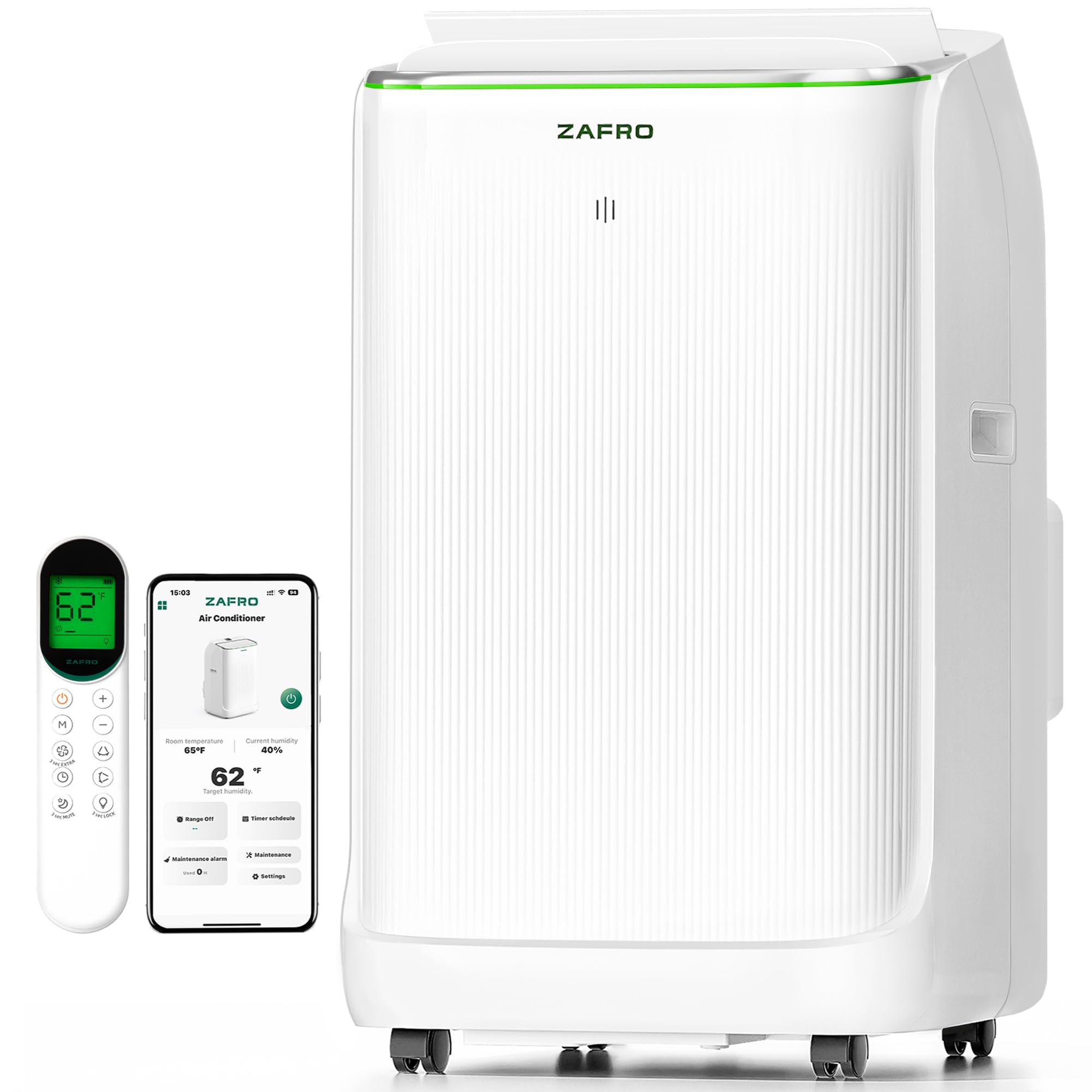
Dual-hose inverter cooling that drops to a library-quiet 42 decibels.
For sleeping in a genuinely hot, sticky climate, this is the smart money. ZAFRO pairs an upgraded inverter compressor with a dual-hose system, delivering 480 cubic meters of airflow per hour and pushing into a space listed up to 700 sq. ft. Its CEER of 12.8 beats the incoming 7.83 efficiency standard by a wide margin, which is the reason owners rave about the running cost as much as the cold. The Extra Mode is a nice touch: it locks the temperature at 61 degrees Fahrenheit and runs at full power to blast the heat down fast.
Noise is the reason this one climbs the list. It drops to as low as 42 decibels in sleep mode, quieter than a normal conversation, helped by an inverter compressor that lowers vibration and tune piping that cuts resonance. The self-evaporating design runs drainage-free for 72 hours in environments under 90% humidity, with a drain hose included for the wettest days. Six modes cover Cool, Dry, Fan, Sleep, Extra, and Eco, plus four-way oscillation to push air vertically and horizontally so no corner cooks.
Buyers put dual hose to work in real terms — casters let one owner wheel it around a 650 sq ft basement office all summer without draining the tank for weeks, and owners describe the hose setup as a clear upgrade over old single-hose units that pulled air out and let heat creep back. Everything runs through the ZAFRO app and remote, with a 24-hour timer, filter-clean reminders, and power-off memory.
What seals it: cooling performance is the thing buyers mention most, and a dual-hose inverter that tops out near 42 dB in sleep mode is why it keeps that praise while staying quiet.
Straight talk: at 4.3 stars across 400+ ratings, the one gap versus a true full-size 14,000 BTU chassis is pure coverage — its 10,000 BTU SACC rating (Seasonal Adjusted Cooling Capacity, a stricter real-world cooling measure) is close to the Gasbye’s, so budget a bedroom or home office rather than a whole open floor.
Top pick for: hot, humid bedrooms and offices where silence and low running cost top the wish list.
The honest gap: it cools a large room, but a wide-open floor plan wants the bigger chassis in the top spot.
7. BLACK+DECKER Portable Air Conditioner with Heat, 14,000 BTU

One machine that cools in July and heats in November.
If you want a single unit to cover more than one season, this BLACK+DECKER does four jobs in one body: air conditioner, heater, dehumidifier, and fan, working in spaces listed up to 700 sq. ft. That heating side separates it from every cooling-only pick above, and the Follow Me remote lets the remote itself act as a thermostat so the temperature is measured where you actually sit, not at the machine.
Cooling is the stronger half. Buyers describe it keeping rooms comfortable even in upper-80s temperatures, and one buyer cooled an insulated garage through a 112°F day. Setup is a simple rolling install near a double-hung or sliding window using the included exhaust hose and window adapter, and the auto water-evaporation feature limits how often you deal with a bucket.
Here is what to sort before buying. The heating function draws mixed reports — some owners say it heats well, others say the heater is weak, so treat this as a cooling machine that offers a shoulder-season bonus. Water management is the other watch point: in hot, dry climates it can produce several gallons of runoff a day, at which point the drain hose has to be attached. The drain outlet sits low and can fill fast in humid conditions, so keep the hose handy.
The four-in-one angle: an AC, heater, dehumidifier, and fan under one shell is genuinely unusual in this group.
The cost of that: run it hard and the manual drain becomes part of your routine, so pick a spot near a floor drain if you have one.
Buy it if: you want cooling now and heat later from one rolling unit, and your window is a standard double-hung or slider.
Leave it if: strong heating is the priority — the cooling mode is where this model earns its keep.
8. DREO 516S Portable Air Conditioner, 14000 BTU ASHRAE (10000 BTU SACC)
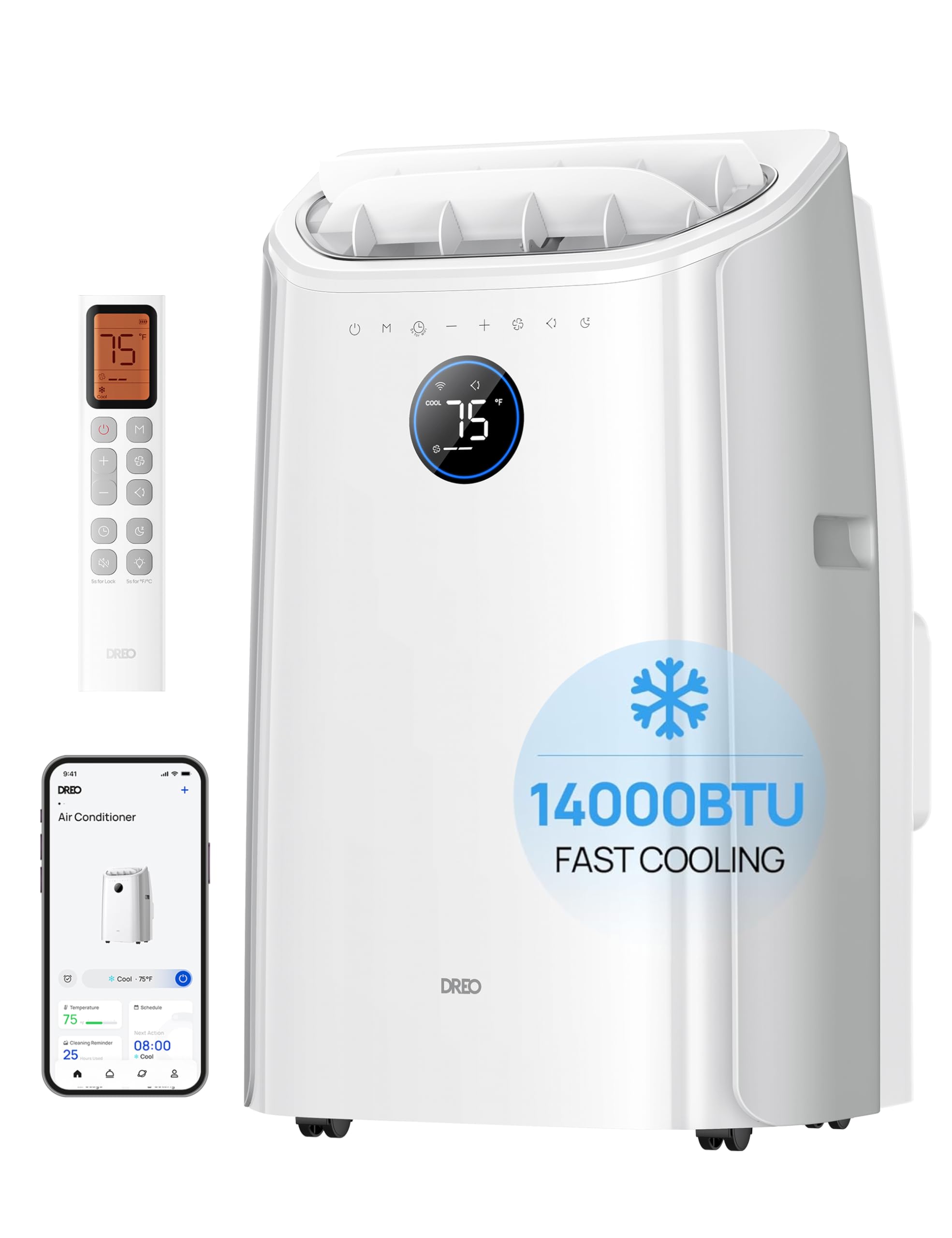
Voice-controlled cooling with a patented system built to skip the bucket.
This DREO is for the buyer who wants hands-off comfort and controls everything by voice. You can run it through Siri, Amazon Alexa, or Google Home, or use the DREO app to watch temperature and humidity in real time and build your own sleep curve. Its IceCool system lists coverage up to 16 feet of throw, and the temperature holds between 61°F and 86°F across Cool, Fan, and Dry modes.
The drainage-free system is the standout. A patented setup of sensors and a pump evaporates excess water automatically in environments under 90% humidity, so the bucket chore mostly disappears. DREO’s noise isolation system pulls compressor and turbulence sound down to about 45 dB for bedrooms and offices. On paper this is a well-equipped machine, and buyers confirm it cools fast with effective temperature control that can reach down as low as 64 degrees.
Be honest about two things before you buy. First, the listing here rates it for rooms up to 200 sq. ft., so despite the 14,000 BTU ASHRAE / 10,000 BTU SACC rating (ASHRAE is a looser industry cooling standard; SACC is the stricter real-world number), this is a small-room specialist rather than a whole-floor unit. Second, durability draws mixed feedback in the reviews — including one report of a rare internal failure that produced a strong odor after months of use — so treat that as a rare case, not a pattern, and register the warranty early.
Why buyers rate it highly: performance is what owners single out most, with cooling, quiet running, and easy setup all landing positively.
What to plan around: set the DREO app from the start and use the drainage-free mode in a sealed room, where it does its best work.
Made for: a bedroom, office, or studio with smart-home gear already in place and a room that fits its 200 sq. ft. listed coverage.
skip it if: you need one unit for a wide open floor plan — the bigger dual-hose picks fit that job better.
9. Whynter ARC-1230WN Inverter Portable Air Conditioner, 14000 BTU
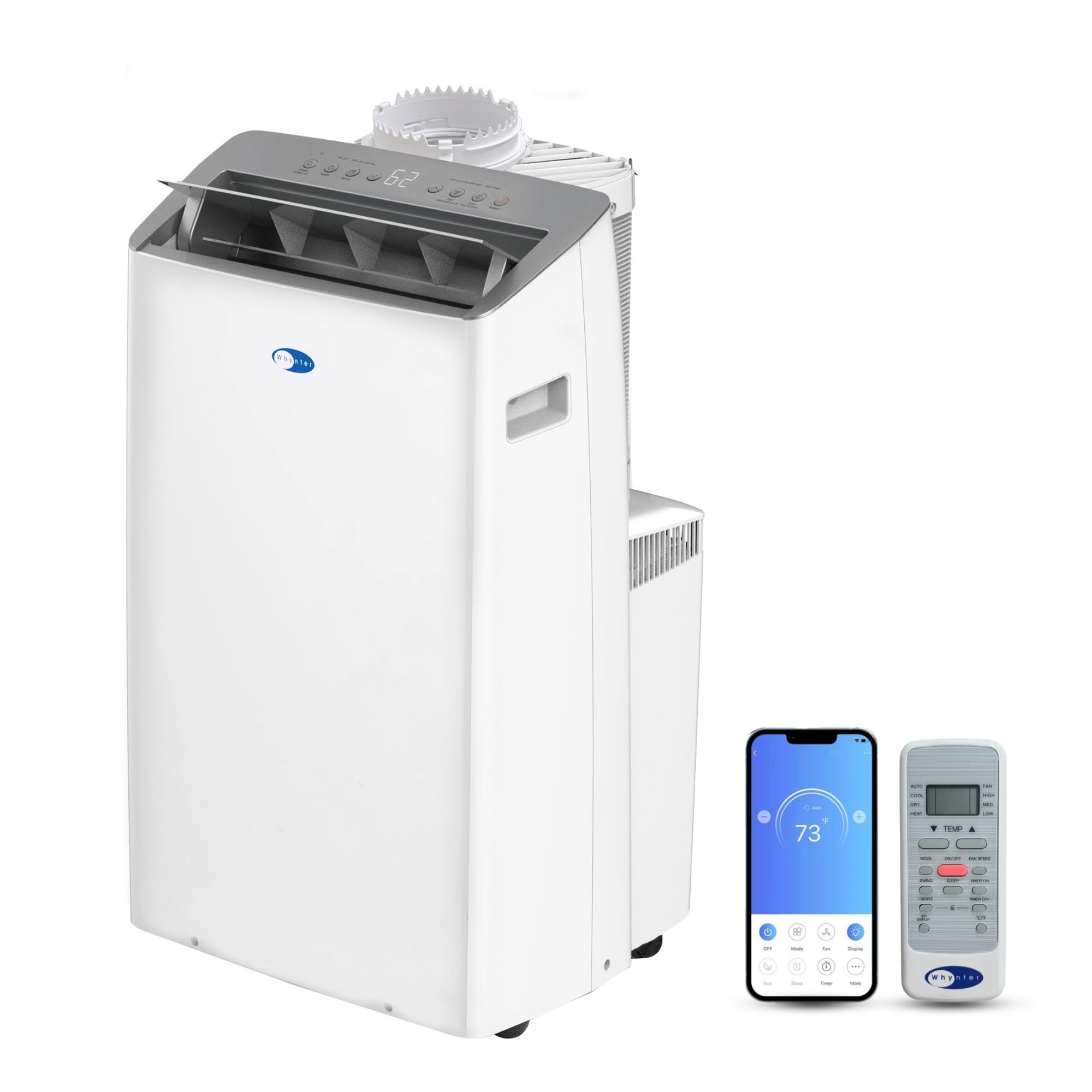
A narrow-footprint inverter that slides close to the window wall.
This Whynter is the pick for tight spaces where every inch of floor counts. Its slim indoor body sits closer to the window than a standard unit, and its stand-out hardware is a dual exhaust and intake “hose-in-hose” design that extends up to 47 inches to keep warm outside air from leaking back in. It cools a space listed up to 600 sq. ft. with 3-speed fan and full thermostatic control spanning 60°F to 86°F, running on 115V/60Hz power (standard US wall power) with a stated 12.3 efficiency rating.
Whynter’s inverter technology (a variable-speed compressor that adjusts instead of switching fully on and off) is the reason it moved up this list. The company claims 20% more cooling and 40% more efficiency versus a traditional unit, and buyers back up the smooth operation — on Auto it runs quietly, and its iSense remote thermostat reads temperature where you are sitting. Dual-hose balance is the whole game here: unlike single-hose units that quietly battle hot-air creep, this one holds pressure, which is why one owner cooled a 650 sq ft apartment with this unit alone, replacing two separate units.
The catch is the window. A dual-hose rig needs both intake and exhaust space, so this is the one pick where your window setup decides nearly everything. Owners note the quick-start instructions are poorly placed, and the included hoses are short for high transom windows. Rain can also leak through the window hose opening, so plan to disconnect the hose in wet weather.
What carries it: cooling performance leads the praise, with reliability and the 87-pints-a-day auto-drain rounding out the case.
Where it can be annoying: the window kit is the main gripe, so measure your window and confirm a two-hose fit before ordering.
Pick it when: you want dual-hose balance, quiet Auto operation, and a body that does not eat your floor space.
One real condition: it needs a window with room for both hoses — a single narrow slider will fight it.
10. Midea Duo 14,000 BTU Portable Air Conditioner with Heat, Inverter

Dual hose cooling plus heat in one tall, quiet inverter tower.
This is the premium, all-seasons choice: a heat pump that warms and cools, with Midea’s industry-first dual hose-in-hose design that takes in and rejects air outside so indoor circulation stays balanced. The variable-speed inverter compressor claims more than 40% energy savings versus the U.S. federal standard, and the unit is rated for a 2X faster and stronger whole-room cooling job — reaching a room temperature range of 41°F to 86°F in heat pump mode.
On the room-cooling side, buyers report it pulling a bedroom from a struggling 85°F HVAC down to 68°F. Setup is straightforward with a secure window kit, and the washable filter keeps maintenance simple. The unit is heavy but rolls on wheels, and app plus voice control lets you steer it from your phone.
Two real caveats to weigh. First, heating is not the strong suit — owners mention the heater overshooting the setpoint by 6 to 8°F without cutting off, so treat the heat mode as a bonus rather than a reason to buy. Second, the two-hose design that isolates intake from exhaust does not fully seal, and at least two customers note outside smoke leaking in through the hose path, which matters if you live somewhere prone to wildfire smoke. Otherwise the cooling is quick, the fan is quiet, and the window kit installs snugly.
Why buyers choose it: cooling performance and quiet operation both land strongly, with efficient inverter rumble and a clean black finish that blends into a room.
The honest trade-off: a premium price for a unit whose heating mode and outside-air sealing are its two soft spots, so know which season you are really buying for.
Best for: a home that wants strong dual-hose cooling with a seasonal heat option from a name-brand inverter.
Be sure before you spend: if clean outside air matters in smoke season, check the hose seals or look at the tighter single-room picks.
Understanding the Specs
BTU versus SACC
BTU is the raw cooling capacity printed on the box, measured under the older ASHRAE standard. SACC is the newer, tighter measurement that better reflects what reaches your room in real conditions. The same machine often carries both numbers — one 14000 BTU portable air conditioner here lists 14,000 BTU ASHRAE alongside 10,000 BTU SACC. When you compare two units side by side, match SACC to SACC, not headline to headline.
CEER and running cost
CEER is a cooling efficiency score — the higher it reads, the less electricity the unit uses for the same amount of cooling. The DOE-verified 13.6 CEER on one pick here outranks most of the field, while others run as high as 700 kW a year on the label. That gap is why an efficient inverter model can save real money over a season compared with a cheaper fixed-speed unit with a lower CEER.
Dual hose versus single hose
A single-hose unit pushes cooled room air outside, which slightly lowers indoor pressure and can pull hot air back in through window gaps. A dual-hose design separates the intake and exhaust so your room stays balanced and cooling holds steady. If your summer is brutal or your room is large, the dual-hose machines in this list are worth the extra spend.
Drain-free cooling
Air conditioners make condensate as they dry the air. Self-evaporating systems recycle that moisture to cool the condenser and send it out the exhaust hose, so in normal humidity you rarely touch a bucket. Above roughly 90% humidity, though, most units hit their limit and need a drain hose. Double-check your climate before you count on completely hands-off operation.
FAQ
What is the difference between 14,000 BTU and 10,000 BTU SACC?
Will a dual-hose unit cool better than a single-hose one?
Do I need to empty a water tank on these units?
How big a room can a 14000 BTU portable AC cool?
What does CEER mean on a portable air conditioner?
Does the exhaust hose need insulation?
Can I use an extension hose on the exhaust?
Is an inverter compressor worth the extra cost?
Can a portable AC with heat replace a space heater?
Why does the room temperature differ from my setpoint?
Final Thoughts: The Verdict
If running cost and stronger cooling are your priorities, the Gasbye Dual Hose 14,000 BTU is the pick — its DOE-verified 13.6 CEER (a government-tested efficiency score) and dual-hose design keep a room balanced and the meter calmer, and it earns the top spot on 4.7 stars across 400+ ratings. If you want almost the same quiet inverter cooling for less and can accept a slightly smaller footprint of coverage, the ZAFRO Smart Inverter drops to 42 dB in sleep mode and runs drainage-free for up to 72 hours. And if you need one machine that cools in summer and heats in the shoulder season, the BLACK+DECKER with Heat covers a room listed up to 700 sq. ft. in both directions. Whichever way you go, sizing beats specs: measure your room and your window, then buy the SACC number that fits it — the right match on the box is worth more than the biggest headline number on the shelf.
How We Picked
We do not accept paid placement. Every pick is matched to a real buyer and a real use-case; we do not hands-on test units.
Sources & Methodology
Specifications: manufacturer listings and product documentation. Review insights: verified customer reviews, as of September 2026. Pricing: not shown on this page (it changes often); check the current price via the retailer link.
As an Amazon Associate, KitchPrep earns from qualifying purchases. This does not affect which products we feature.
Related Guides
