
Specs are compiled from manufacturer listings and verified buyer reviews and can change over time — please confirm the key details on the product page before buying.
If you’re wiring a thermostat, a doorbell, or a humidifier control, the thing that actually decides whether the job goes smoothly is the copper inside the jacket. Cheap two-conductor cable snaps when you strip it, frays at the terminal screw, and leaves you fishing a new run through a wall. The picks below all use solid copper in an 18-gauge, two-conductor layout, which is the standard size for low-voltage thermostat and doorbell circuits. The differences come down to jacket flexibility, length, temperature rating, and how the wire behaves in your hands.
I’m Mohammad Maruf — the founder and writer behind KitchPrep. This guide is built by comparing the manufacturers’ published specifications and the patterns across verified customer reviews, so you get each pick’s real strengths and trade-offs instead of marketing spin.
You’ll see how length, gauge, and jacket rating change what a run can handle, and which roll fits your specific job. Everything here is a two-wire, 18-gauge low-voltage cable built for thermostats, doorbells, and HVAC controls, so you can pick the right 2-wire thermostat wire the first time.
Our Picks at a Glance
How To Choose The Best 2-Wire Thermostat Wire
Low-voltage wire looks identical on the shelf, and that’s the problem. Two rolls can both say “18/2” and behave completely differently once you cut into them. Here’s what actually separates a roll that makes the job easy from one that makes you swear in a crawlspace.
Start with the conductor count and gauge
“18/2” means 18-gauge wire with two conductors inside one jacket — one for the signal, one for the return. Every product on this list is 18/2, which is the size most thermostats, doorbells, and humidifier controls expect. If your thermostat needs a C-wire for constant power, you still need two conductors for a basic setup, but a smart thermostat with cooling often wants more, so count your terminals before you buy. Gauge matters because thinner wire carries less current over distance; 18-gauge solid copper handles the tiny loads these systems draw without meaningful voltage drop on a normal residential run.
Solid versus stranded copper
Solid copper holds its shape when you bend it around a terminal screw, which is why it’s the default for permanent thermostat and doorbell runs. Stranded wire flexes more and is easier to pull through tight conduit, but it can fray at the tip if you twist it carelessly. Three of the picks here are solid copper; the Syston cable is built with multi-strand conductors, which is worth knowing if you plan to move the wire around after installation.
Jacket ratings decide where you can legally run it
CL2, CL3, and CMR are code categories that tell you what the jacket is rated for. CL2 and CL3 cover low-voltage power-limited circuits, and the “R” in CMR means the cable is rated for riser use — vertical runs between floors. If you’re fishing wire through a finished wall, a plenum or riser rating matters for inspection. If you’re running it along a basement joist or behind a doorbell chime, a standard CL2 jacket is usually fine. Check your local code before you close up the wall, since inspectors do look at the printed rating on the jacket.
Temperature range and outdoor use
Your wire’s temperature rating decides whether the jacket survives your attic in summer and your basement in winter. A wire rated from -20°C to +60°C (about -4°F to 140°F) handles those swings, while one rated from -4°F to 176°F covers even wider extremes. A jacket that stiffens in cold can crack when you bend it, so if any part of your run goes outdoors — a doorbell on an exterior wall, a condenser unit on the side of the house — look for sunlight resistance and a wide temperature window. That way the jacket survives UV exposure and seasonal swings.
Length: measure twice, cut once
Coming up short mid-run is the most common DIY frustration. A thermostat relocation, a doorbell repair, and a humidifier control tap all need different lengths. Add a few feet of slack to whatever you measure, because routing around a corner or through a top plate eats more than you think. Buying a longer roll than you need is cheaper than buying a second roll after the first one ends six inches short.
Quick Comparison
| Model | Best For | Length | Gauge / Conductors | Temperature Rating | Amazon |
|---|---|---|---|---|---|
| THE CIMPLE CO 18/2 Thermostat Wire 50 FT★ Best Overall | All-around residential jobs | 50 ft | 18 AWG / 2 | — | Amazon |
| XRDS -RF Thermostat Wire 18/2 30FT | Tight spaces and short runs | 30 ft | 18 AWG / 2 | -4°F to 176°F | Amazon |
| Syston 18/2 Thermostat Doorbell HVAC Cable | Outdoor and riser runs | 50 ft | 18 AWG / 2 | — | Amazon |
| YDDECW Thermostat Wire 18/2 50FT | Wet and harsh outdoor spots | 50 ft | 18 AWG / 2 | -20°C to +60°C | Amazon |
In‑Depth Reviews
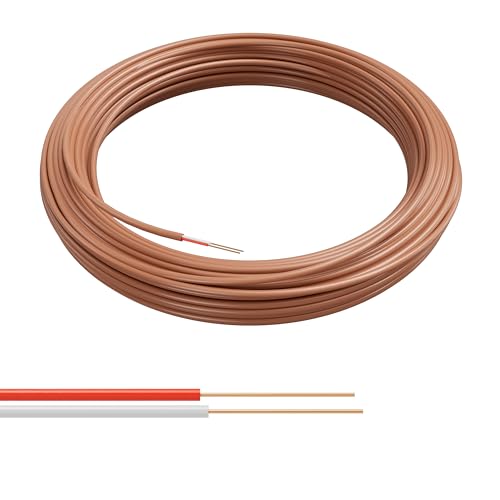
1. THE CIMPLE CO 18/2 Thermostat Wire 50 FT – Insulated Solid Copper Wiring
Our pick — over 4.5★ from 450+ verified ratings; the strongest balance of quality and price.
Fifty feet of solid copper with a wind that stops kinks before they start.
Each conductor is individually insulated inside a protective outer jacket, so stripping one wire doesn’t nick the other.
What makes it the strongest overall pick is how it behaves in the hand. It arrives on a large wind designed to prevent kinks, breaks, and twists, and the copper is thoroughly measured so it meets the current demands of residential, commercial, and industrial heating and cooling installs. It carries a CL2/R CMR rating, which means the jacket is approved for riser runs between floors as well as standard in-wall use. Practical detail: it weighs 12 ounces on the roll, light enough to hold overhead while you feed a run through a top plate.
The multipurpose angle earns its keep too. The same roll works for thermostats, HVAC equipment, security and alarm systems, door chimes, and bell installations, so you’re not buying a different spool for every small job. Buyers report a whole-home humidifier install that only needed 10 feet and two wires: “This wire was the perfect solution for the installation of a whole home humidifier I recently tackled. Just needed 10′ and two wires. It’s a quality wire and is doing the job swimmingly… no complaints here.” Buyers also report using it for thermostat swaps and Alexa thermostat hookups.
What earns its spot on top
- 50 ft of 18 AWG two-conductor solid copper gives real slack for relocations
- Large wind fights kinks, breaks, and twists on the roll
- CL2/R CMR rated, so riser and in-wall runs are both covered
- Brown jacket, 12-ounce roll, easy to route overhead
- Works across thermostats, HVAC, alarms, chimes, and bells
What a careful buyer should weigh
- No published temperature range, so a hot attic or frozen basement run is a judgment call
- Sold as a single roll — no multi-pack convenience if you’re wiring several rooms
- The 50-foot length is more than a single doorbell repair needs
Go with this if: you want one roll that covers a thermostat relocation, a doorbell repair, and a humidifier tap without a second trip to the store.
Think twice if: your run goes into a climate you can’t predict — the missing temperature rating means you’re guessing.
2. XRDS -RF Thermostat Wire 18/2 30FT Solid Copper, Low Voltage, 2 Conductor Thermostat Cable
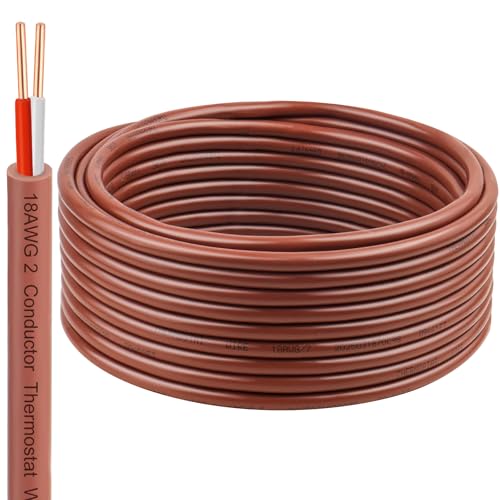
The weather-proof thirty-footer for tight spaces and short hops.
If your job is small — swapping a thermostat on the same wall, adding a Ring wired camera, or repairing a chime — 30 feet is plenty and you’re not paying for slack you’ll never use. It’s the shorter roll against the CIMPLE CO’s 50 feet. The XRDS -RF cable is 18 AWG with two solid copper conductors and a flexible brown PVC jacket that bends around corners without fighting back.
The standout spec is the temperature window: -4°F to 176°F, which covers a hot attic in July and a cold basement in January. That range is the reason this roll earns a place for a run that passes through an unconditioned space. Maximum current is 18 A, far above what a thermostat or doorbell circuit draws, so there’s headroom if you repurpose the run later. It’s suitable for thermostats, HVAC controls, doorbells, alarms, and intercoms.
Installers gravitate to this one for smart doorbells and low-voltage hookups. One buyer’s note on length captures the honest geometry of the job: “Just what i needed. Good quality and the length is good. I am glad i ordered over instead of under in feet. Had just enough to move thermostats.” That’s the whole case for measuring your run before you cut, and it’s why the 30-foot size exists. The insulation strips clean and leaves a tidy appearance at the terminal.
Where it wins: the temperature rating and the flexible jacket make this the one to reach for when the run passes through a hot attic or a cold crawlspace.
What to know before you buy: 30 feet is the shortest roll in this lineup, so a long relocation that starts in a far room can leave you short — measure the path, not the straight-line distance.
Reach for this if: your run is short, your space is tight, and the wire passes through a spot that swings hot and cold.
skip it if: you’re relocating a thermostat across the house — the 50-foot rolls above and below are the safer buy.
3. Syston 18/2 Thermostat Doorbell HVAC Heating Control Cable Wire, 100% Solid Copper Conductors CL3R/FT4/CMR Riser-Rated UL/ETL Listed
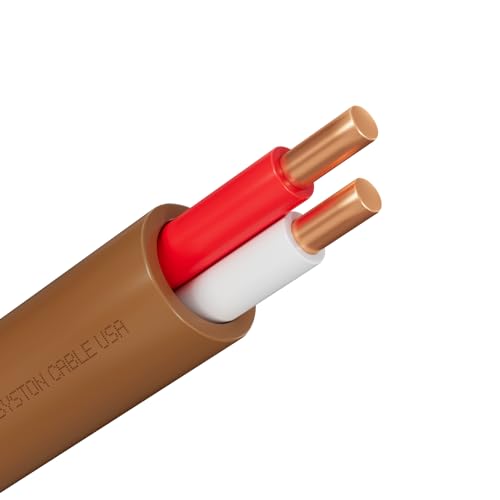
The one that goes outside and stays there, sun and all.
Most thermostat wire is designed for a wall cavity and never sees daylight. This Syston cable is built for the other case: outdoor doorbells, exterior condenser runs, and any path that leaves the conditioned envelope. It carries a 300-volt rating with CL3 compliance for Class 3 (100VA) power-limited circuits, and it’s UL/ETL listed with a sunlight-resistant jacket that meets the UL 1581 requirement for outdoor installs. It’s also RoHS compliant.
The installation hardware is where the designer earned their keep. The jacket is round and slick with smooth edges, so it pulls through rough corners without snagging, and there’s a rip cord built in to peel the jacket back without nicking the copper. The conductors are 100% solid pure copper for maximum conductivity. That combination matters most when you’re feeding wire through an exterior wall to a doorbell or camera. The roll runs 50 feet and the conductors are multi-strand rather than a single solid core, which is worth knowing if you plan to flex the wire after installation.
Doorbell and humidifier repairs are where this cable shows up most in the field. Owners mention using it to repair an old doorbell wire — “Just the right thickness to feed through a wall to replace a failed door bell wire. Good copper wire. Was easy to hook to the door bell.” — and to rewire a whole-house humidifier control. Buyers consistently praise the copper quality and how reliably it carries the signal. The recurring complaint is that the individual conductor insulation is thinner and more delicate than other same-gauge wire, so a stripped end can expose bare copper if you’re rough at the terminal. Tape up any exposed section and the joint holds fine.
The case for it: a sunlight-resistant, UL 1581-compliant jacket plus a 300V CL3 rating makes this the cleanest choice for an exterior doorbell or condenser run, and that’s a niche the other three rolls don’t fill as directly.
The honest trade-off: the conductor insulation is on the thin side, so use care when stripping and twisting — a patient hand at the terminal screw is all it takes.
Pick this one if: any part of your run goes outdoors, or you need a riser-rated cable that passes inspection.
Look elsewhere if: you’re working fast and rough on stripped ends — thinner insulation rewards a careful hand.
4. YDDECW Thermostat Wire – 18/2 50FT Solid Copper 18AWG 2 Conductor Power Circuit Cable
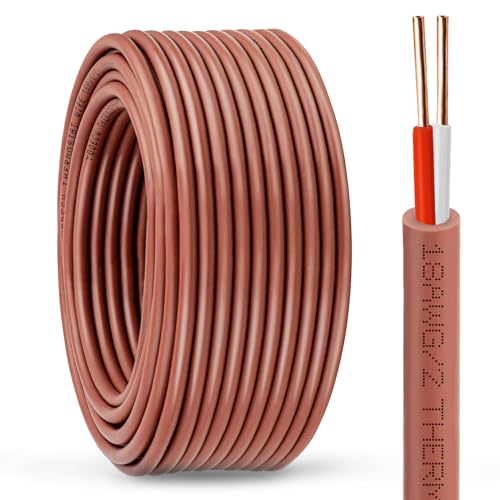
A fifty-footer with a waterproof jacket that shrugs off weather and oxidation.
Here’s the one you want if moisture is the enemy. The jacket on this 50-foot, 18-gauge two-conductor cable is made from a PVC compound the maker describes as waterproof and durable, built for harsh outdoor environments. Inside, the conductor is solid pure copper and the insulator is a premium PVC the maker says resists oxidation and corrosion. For an exterior condenser run or a sprinkler valve in a damp pit, that combination is the whole point.
The specs are clearly printed: a 150-volt rating, a temperature range of -20°C to +60°C, and CL2 with ETL compliance (CL2 means it’s rated for in-wall low-voltage use, and ETL means a third party tested it to safety standards). The 50-foot length matches the CIMPLE CO roll, so you get the same slack for a thermostat relocation. It’s flexible and durable with a smooth surface that feeds easily, and the same roll covers thermostat control, heating and A/C installs, annunciator systems, doorbells, door chimes, remote controls, and signal systems — essentially any low-voltage job you’d run into on a residential call.
Sprinkler valve installs show up repeatedly in the field notes, along with standard thermostat swaps. One buyer’s use case is almost a litmus test: “18/2 that I used to install a néw single sprinkler valve, worked perfect.” Others report the wire arrived as posted, with good packaging and a solid copper core under a heavy jacket. The maker states that any issue with the thermostat wire will be addressed within 12 hours.
Why it makes the list: a waterproof, oxidation-resistant jacket on a 50-foot roll covers the outdoor and damp-location jobs where a standard in-wall cable is the wrong tool.
The one limitation to know: the temperature window is -20°C to +60°C — fine for most residential and outdoor work, but not the widest range in this lineup, so extreme-cold installs favor the XRDS -RF roll.
Best fit: outdoor and damp-location runs where a waterproof, corrosion-resistant jacket is the deciding factor, plus any job that needs the full 50 feet.
Not the one for: a job that has to survive deep winter cold — the XRDS -RF’s wider range is the better match there.
Understanding the Specs
18 AWG, 2 Conductor
The “18/2” label tells you two things: the wire gauge is 18, and there are two conductors inside the jacket. Gauge is a measure of thickness — lower numbers mean thicker wire, and 18-gauge is the standard for low-voltage thermostat, doorbell, and HVAC control circuits. Two conductors give you a signal path and a return path. A thermostat with only a heat and a heat-call terminal needs exactly two wires; a smart thermostat with cooling and a C-wire sometimes wants more. Count your terminals before you buy so you don’t come up a wire short.
CL2, CL3, and CMR Ratings
These letters are code categories that tell you what the jacket is rated for. CL2 and CL3 cover low-voltage power-limited circuits, and CL3 carries a higher voltage allowance. The “R” in CMR or CL3R means the cable is rated for riser use — a vertical run between floors inside a wall. If you’re fishing cable through a finished wall or a riser chase, the printed rating on the jacket is what an inspector looks at. A standard CL2 jacket is fine for open runs behind a chime or along a joist, but check the rating before you close up the wall.
Temperature Range
Wire jackets stiffen in cold and soften in heat, and both extremes change how the cable handles. A rating like -4°F to 176°F covers hot attics in summer and cold crawlspaces in winter; a -20°C to +60°C window covers most residential and outdoor conditions but stops short of the highest heat. If any part of your run passes through an unconditioned space — an attic, a garage, a crawlspace — match the wire’s range to the worst condition that run will see.
Solid Versus Stranded Conductors
Solid copper is a single stiff core that holds its shape when you bend it around a terminal screw, which is why it dominates permanent thermostat and doorbell runs. Stranded wire is many thin strands bundled together, so it flexes more and pulls through tight conduit more easily, but it can fray at a stripped tip if you twist it carelessly. Three picks here are solid copper; the Syston cable uses multi-strand conductors. Neither is wrong — it’s a question of whether the wire will be moved after installation or fixed in place permanently.
FAQ
What does 18/2 mean on a thermostat wire?
Can I use 18/2 wire for a doorbell?
Is solid copper better than stranded for thermostat wiring?
How long does a thermostat wire run need to be?
What does CL2 or CL3 rated mean on thermostat cable?
Can thermostat wire be run outdoors?
Is 18-gauge wire thick enough for a low-voltage thermostat circuit?
Can I use thermostat wire to repair a broken doorbell wire?
What is the difference between 18/2 and 18/4 thermostat wire?
Does the color of the thermostat wire jacket matter?
Final Thoughts: The Verdict
For most thermostat, doorbell, and humidifier jobs, the 2-wire thermostat wire that earns the top spot is the THE CIMPLE CO 18/2 Thermostat Wire 50 FT. It gives you the full 50 feet of solid copper, a CL2/R CMR rating for riser and in-wall runs, and a wind designed to fight kinks on the roll. If your run is short and passes through a hot attic or cold crawlspace, grab the XRDS -RF Thermostat Wire 18/2 30FT for its -4°F to 176°F range and flexible jacket. And for any run that goes outdoors, the sun-resistant, UL 1581-compliant Syston 18/2 Thermostat Doorbell HVAC Cable is the one to reach for — just handle the thinner insulation with care at the terminals. Whichever you pick, buy a few feet longer than you measured; coming up short mid-run is the one mistake every DIY wire job has in common.
How We Picked
We do not accept paid placement. Every pick is matched to a real buyer and a real use-case; we do not hands-on test units.
Sources & Methodology
Specifications: manufacturer listings and product documentation. Review insights: verified customer reviews, as of September 2026. Pricing: not shown on this page (it changes often); check the current price via the retailer link.
As an Amazon Associate, KitchPrep earns from qualifying purchases. This does not affect which products we feature.
Related Guides
