
Specs are compiled from manufacturer listings and verified buyer reviews and can change over time — please confirm the key details on the product page before buying.
If you are hunting for 10/4 wire, the thing that decides whether a roll is right for you is not the brand name — it is the voltage rating printed on the jacket. A 600V SOOW cord can feed a generator, a welder, or a sub-panel run, while a 300V SJOOW cord is built for shorter equipment leads and control wiring. Pick the wrong one and you either overspent or you are running a cord outside what it was made for. This guide walks through six real 10 AWG four-conductor cords, what each one is actually good at, and which one fits your job.
I’m Mohammad Maruf — the founder and writer behind KitchPrep. This guide is built by comparing the manufacturers’ published specifications and the patterns across verified customer reviews, so you get each pick’s real strengths and trade-offs instead of marketing spin.
Copper prices move and jacket compounds differ, but a cord that coils flat on a cold morning beats one that fights you. Below you will find a plain-English breakdown of the 10/4 wire options worth your money and the job each one was built to handle.
Our Picks at a Glance

How To Choose The Best 10/4 Wire
Every cord in this guide shares the same core spec: 10 AWG gauge with four conductors. Gauge tells you how thick the copper is (thicker copper handles more current), and four conductors means you get two hots, a neutral, and a ground — the wiring a generator, dryer, or RV outlet needs. What separates one roll from another is the jacket rating, the length, and how the copper is stranded. Match the jacket rating, length, and stranding to your job and you will not have to buy twice.
Read the voltage rating before anything else
A 600V SOOW cord is the heavier-duty choice. SOOW means the jacket resists oil, water, and weather, and the 600V ceiling gives you headroom for 240V equipment like generators, welders, and sub-breaker runs. A 300V SJOOW cord is lighter and typically for shorter equipment leads, motor connections, and control circuits. Both are valid — they just serve different jobs. If you plan to run a generator to a house panel, lean toward the 600V option.
Length versus voltage drop and weight
Longer is not automatically better. Every extra foot adds resistance, so a very long run with heavy current can lose voltage at the far end. Length also adds weight — a 50 ft 10/4 cord is genuinely heavy to carry and coil. A 25 ft cord is handier for nearby equipment, while a 50 ft or 75 ft run lets you park a generator well away from the house for noise and fumes. Match the length to how far you actually need to reach.
Jacket material and temperature
Rubber and PVC jackets behave differently in cold. A rubber jacket stays pliable when the temperature drops, so the cord coils instead of cracking or kinking. Look at the temperature range listings if you plan to use the cord outdoors in winter. Also check whether the jacket is rated to resist oil, acid, and sunlight if the cord lives on a jobsite or in a yard.
Quick Comparison
| Model | Best For | Voltage | Length | Conductors | Amazon |
|---|---|---|---|---|---|
| Wire Cord, 50 Ft, Rubber Coated, 10 Gauge, 4 Conductor (10/4) 600v SOOW★ Best Overall | Generator-to-panel runs | 240 volts | 50 ft | 4 | Amazon |
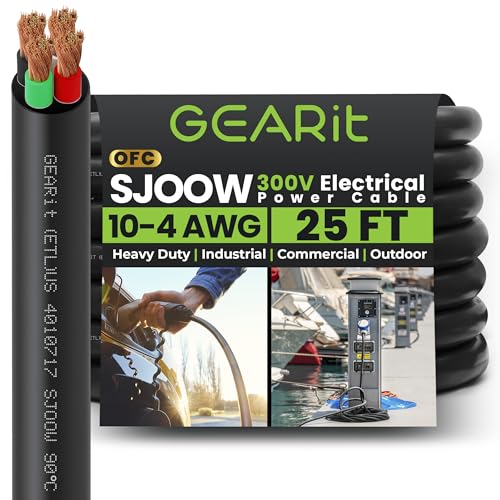
| GEARit 25ft 10/4 SJOOW Portable CordMost Flexible | Short equipment leads | 300 volts | 25 ft | 4 | Amazon |
| NASSAU ELECTRICAL SUPPLY 30FT 10/4 SOOW Wire Cord | 600V-rated custom cords | 600 volts | 30 ft | 4 | Amazon |
| GEARit 50 ft SOOW Portable Power Cable | Heavy jobsite and welder leads | 600 volts | 50 ft | 4 | Amazon |
| 50ft 10AWG 10/4 SOOW Wire Portable Power Cable | Long generator and EV runs | 600 volts | 50 ft | 4 | Amazon |
| 75ft 10/4 10 AWG Portable Power Cable | Reaching distant equipment | 300 volts | 75 ft | 4 | Amazon |
In‑Depth Reviews
1. Wire Cord, 50 Ft, Rubber Coated, 10 Gauge, 4 Conductor (10/4) 600v SOOW
Our pick — over 4.5★ from 200+ verified ratings; the strongest balance of quality and price.
The rubber-jacketed generator cord that buyers bolt into 60A sub-panels and forget about.
This 50 ft roll of 10 AWG, four-conductor stranded cable is rated for 240 volts, with the four conductors split into two power lines, a neutral, and a ground — exactly the layout a 240V generator feed needs. What wins buyers over most is build quality: the copper is real and substantial, the insulation is thick, and the jacket is water resistant. That combination is why this is the top pick here, and why it holds a 4.7 rating across 200+ reviews.
The rubber jacket stays pliable below freezing, so the cord coils and handles on a snowy yard at night. A buyer who runs a generator for rural snow outages put it plainly: a 50 ft length let them move the generator away from the building with no noticeable power loss. Another used it to feed a 220V generator into a 60A sub-breaker box and ran it four to five hours without problems. Buyers also report using it as a welder and plasma torch conversion cable at 220V.
The honest trade-off is smell. One owner found a strong odor on the jacket that took months to fade, so if you are sensitive to that kind of thing, plan to let it air out in a garage first. The other real limit is code: as one buyer put it when recommending it for outdoor and underground use, you should “Check local codes for acceptance if wiring for a domicile or outbuilding.” This is a portable and extension cord, not a substitute for Romex on a permanent indoor run.
Why this earns the top slot
- Real stranded copper with a thick, water-resistant rubber jacket that resists weather and wear
- Stays flexible in cold weather, so it coils and uncoils without fighting you
- 50 ft reaches a generator parked well away from the house
- Four conductors give you two hots, a neutral, and a ground for 240V generator feeds
What to plan around
- Noticeable jacket odor that can take months to fade for sensitive noses
- Not a code-approved substitute for permanent indoor wiring — check your local rules first
Grab this one if: you need a flexible 50 ft cord to feed a 240V generator or a sub-panel.
Think twice if: strong rubber odor is a deal-breaker for you, or you are wiring inside a dwelling permanently.
2. GEARit 25ft 10/4 SJOOW Portable Cord, 10 AWG 4 Conductor 300V Flexible Electrical Cable
The short, light 10/4 cord for dryer swaps, water-heater feeds, and quick shop repairs.
If you do not need 50 feet, carrying 50 feet is just weight. This GEARit roll is 25 ft of 10 AWG four-conductor stranded copper at 300 volts, and it weighs 7.2 pounds — noticeably less to lug around than the 50 ft GEARit above it, which sits at 15.4 pounds. The SJOOW jacket resists abrasion, oil, moisture, and weather, so it holds up indoors and outdoors. Owners use this one for shorter repair and control work where a compact cut reduces waste.
The buyer stories here skew practical. Folks wire it into a 50-amp plug to connect a water heater to a generator or to house power during an outage, and it works as a custom dryer cord too. Several note it runs cheaper than the local box store for the same job. One reviewer summed up the vibe: “It’s wire and it works.” For a cord that is fully stranded copper and strips cleanly into a plug or panel, that is close to the highest praise available.
Weigh the rating honestly. At 300 volts, this cord is built for shorter equipment leads, motor connections, and control circuits — not for a long heavy-duty generator-to-panel run where a 600V jacket is the smarter buy. It is also the shortest cord in this lineup at 25 ft, so measure your reach before you commit. If your equipment sits close by, the light weight and lower cost make this the smarter pick.
Where it shines: stranded copper that routes easily through panels and trailers, a 25 ft length that saves waste on custom cuts, and an SJOOW jacket ready for oil and moisture.
The honest catch: the 300V ceiling narrows it to shorter equipment work, and 25 ft will not reach across a driveway.
Reach for this if: your gear sits close by and you want a light 10/4 cord for a dryer, water heater, or machine lead.
Look elsewhere if: you need a 600V rating or a longer run to a distant generator.
3. NASSAU ELECTRICAL SUPPLY 30FT 10/4 SOOW Wire Cord Cable Portable Power 10 Gauge 4 Conductor 600V

A 600V SOOW cord that lies flat instead of kinking into a knotted mess.
This NASSAU roll is 30 ft of 10 AWG SOOW cable with a 600 volt rating and a finely stranded build — 104 strands of 30-gauge wire per conductor — which is why it stays flexible despite the thick rubber husk. It handles a 30-amp, 220-to-240 volt load, and owners describe it as heavy by necessity but easy to coil and handle. Unlike some stiff cables that turn into a mass of kinks, this one lies flat on the ground.
The build quality is the standout. One buyer needed a 60 ft extension with L14-30 connectors on both ends and reported it “worked out great,” calling the rubber outer husk super thick and the whole thing flexible. Another used it as a four-prong dryer cord, and several picked it precisely because a 600 volt rated cord is hard to source locally. That 600V rating is the practical reason to choose this over a 300V cord.
The main thing to know is that 30 ft is an odd middle length. It is longer than the Gearit 25 ft option but shorter than the 50 ft rolls, so it is ideal for a dryer, a water heater, or a generator that sits moderately close. The four-conductor layout gives you the neutral and ground you need, and the connectors are cut-to-fit, so be ready to terminate the ends yourself. If you want serious voltage headroom without paying for 50 feet of copper, this is a sharp middle-ground buy.
The case for this length
- 600V SOOW rating for 30-amp, 220-to-240 volt loads
- 104/30 finely stranded copper keeps it flexible and flat-lying
- Thick rubber outer husk resists weather and everyday wear
Know before you buy
- 30 ft is a middle length — longer than 25 ft, shorter than 50 ft
- Heavy for its size, since the copper is sized for the current
Best suited to: a dryer, water heater, or nearby generator that needs a genuine 600V cord.
Skip if: you need to reach more than 30 ft or want plugs already molded on the ends.
4. GEARit 50 ft SOOW Portable Power Cable, 10/4 Gauge for Generator, 600V
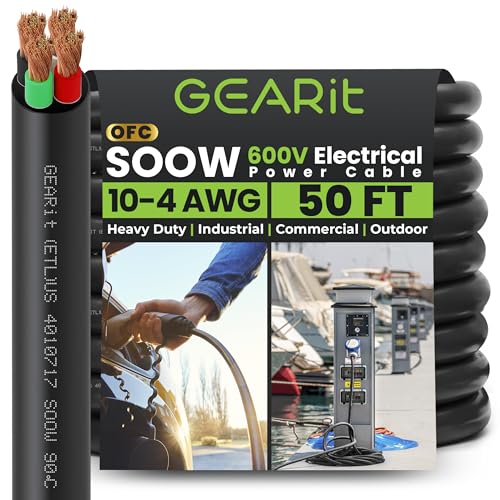
The 50 ft 600V workhorse for welders, EV charger projects, and pump wiring.
This is the cord you buy when the job is rough and the run is long. Fifty feet of 10 AWG four-conductor SOOW cable rated at 600 volts, with color-coded conductors — black, white, red, and green — so you can identify each line quickly during installation. The stranded copper keeps resistance and voltage drop low for steady power delivery, and the rubber jacket resists oil, water, abrasion, ozone, and weather, which is why it suits indoor, outdoor, and industrial use all at once.
At 15.4 pounds, this cord is heavy, and that weight is the price of copper built for demanding loads. Buyers put it to work on generator leads, motor connections, pumps, and EV charger wiring projects. One owner bought it to install a generator to a breaker panel and called it great value, with a useful caution attached — check the gauge of wire for what you are using. Ships fast, arrives in good shape.
The one thing to note is that at this weight you would not call it portable in the casual sense; a 50 ft run of 10/4 wants a dedicated carry and a coil reel to stay tidy. It also asks you to terminate the ends yourself, since it comes as bulk cable. If your applications run heavy, like welders and generators on a jobsite, this 600V cord is built for exactly that.
Tied for top voltage headroom: a full 600V rating and color-coded conductors make installation faster and less error-prone.
One caveat: at 15.4 pounds it is heavy to move, so plan to keep it near where it works.
This one wins for: jobsite and shop setups powering welders, EV chargers, pumps, and generators.
Pass on it if: you want a light cord you will carry around often.
5. 50ft 10AWG 10/4 SOOW Wire Portable Power Cable, 30A 10/4 SO Cord
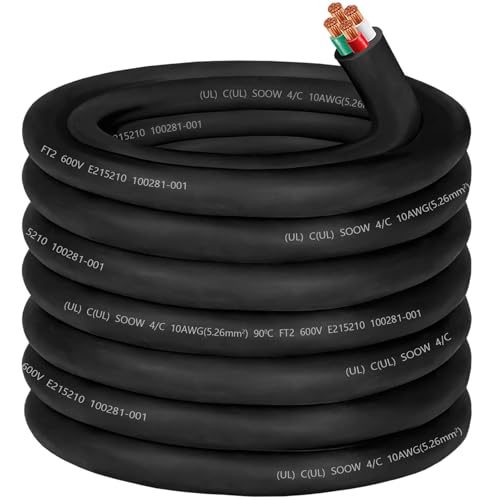
A rugged 50 ft cord built for 30-amp loads in sun, rain, and bitter cold.
This roll of 10/4 SOOW cable stands out for the range of conditions it is made to survive. The jacket is rated from -40°F to 194°F — wider than most cords here — and handles oil, acids, water, and chemicals, so you can leave it out in winter and drag it through a wet yard without babying it. It is rated at 600 volts and carries a 30 amp maximum current, which is the balance for a generator or a Level 2 EV charging extension cord at 240V.
The copper is the real selling point: it uses OFC wire, or oxygen-free copper, which is built for better conductivity and lower resistance than standard copper. The cord runs a thick outer diameter for the gauge, and buyers report it is flexible even when cold and coils neatly onto a reel. One buyer wired it to a Level 1 washer and dryer stacked unit in a brand-new install and reported it worked well. Another uses it as a generator extension and says it rolls up easily on a repurposed garden-hose reel. With a 4.7 rating across 100+ reviews, it is one of the stronger reviewed cords here.
The obvious consideration with any 50 ft, 30-amp cord is the weight and bulk — this one runs about 15 pounds, so it is not a toss-in-your-pocket accessory. It also asks you to confirm your connector types before ordering, because it sells as bare cable, so you will be terminating the ends to match your NEMA 14-30 or L14-30 setup. For heavy-duty outdoor work where the cord stays put and the load is real, the OFC build and wide temperature range make this a strong choice.
Where this cord pulls ahead
- Wide -40°F to 194°F temperature range for year-round outdoor use
- Oxygen-free copper for better conductivity and lower resistance
- 600V, 30-amp rating suits generators and Level 2 EV charging
- Thick rubber jacket resists oil, acid, water, and chemicals
The honest trade-off
- At roughly 15 pounds, it is heavy to carry and store between jobs
- Comes as bare cable, so you must confirm and fit your own connectors
Pick this for: a fixed 50 ft run to a generator, EV charger, or RV outlet that has to survive bad weather.
Choose another if: you need a light cord for quick, close-range jobs.
6. 75ft 10/4 10 AWG Portable Power Cable (4 Conductor) – SJOOW 300V
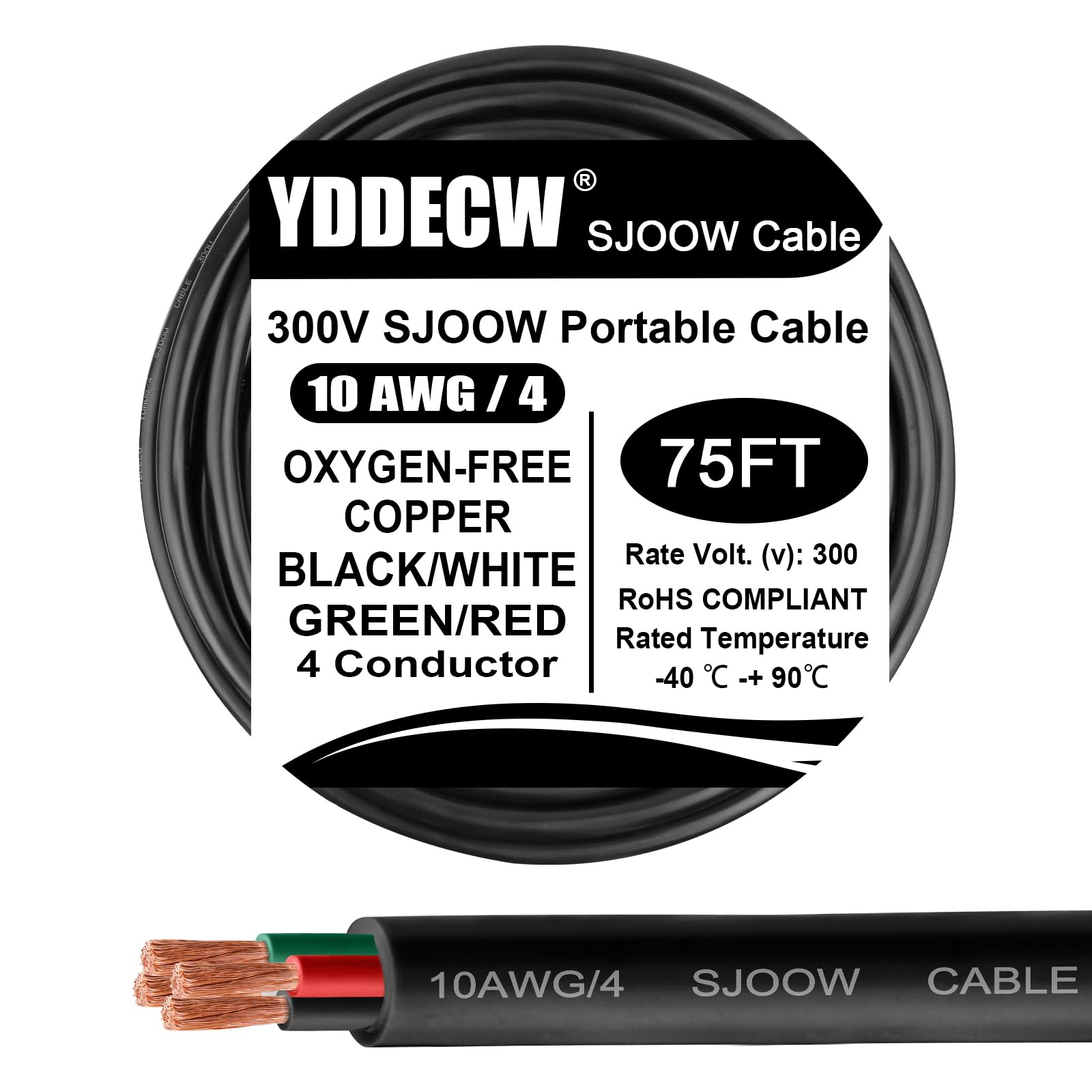
The 75 ft option for when your equipment is far from the power source.
Reach is this cord’s whole reason to exist. It runs 75 ft of 10 AWG four-conductor SJOOW cable, which is far more length than any other pick here — roughly triple the 25 ft GEARit SJOOW roll above. Inside, each of the four conductors uses 113 thin copper strands, so the cable stays flexible for portable use even at this length. The PVC jacket is rated from -40°C to 90°C and resists oils, acids, water, and chemicals, so it handles industrial, commercial, and outdoor settings.
The uses line up with the length: motor leads, portable lights, battery chargers, and machinery. The stranded build means it feeds cleanly into a panel, and owners say it strips easily for the electric panel and works well for a rack of new 20-amp breaker boxes. There is a friendly reminder worth repeating: this is a four-conductor cable, not a 4+1 type, so there is no extra grounding wire bundled in. Confirm that your setup matches before you order.
The trade-off to weigh is the voltage rating. This cord is rated at 300 volts, so it is built for equipment leads and control wiring rather than a heavy 240V generator-to-panel feed where a 600V SOOW cord is the safer match. At 75 ft, you also get the most copper weight of the group, so plan for a real coil and a place to store it. If your job is a distant machine, a long light run, or a battery charger parked far from the outlet, the extra feet are exactly what you are paying for.
The draw here: 75 ft of length with 113-strand-per-conductor copper that stays flexible and strips easily for a panel.
Keep in mind: the 300V SJOOW rating aims it at equipment leads and control circuits, not heavy 240V generator feeds.
Made for you if: the equipment or charger sits far from the outlet and you need serious reach.
Look past it if: you need a 600V cord or a shorter, lighter tool.
Understanding the Specs
Gauge and conductor count (10 AWG, 4 conductor)
Gauge measures how thick the copper inside the wire is, and a lower number means thicker metal that can safely carry more current. AWG stands for American Wire Gauge, the standard sizing system for electrical wire. A 10 AWG cord is thicker than 12 or 14 AWG, so it handles heavier loads. Conductor count is how many separate wires run inside the jacket — four conductors give you two power lines, a neutral, and a ground. That neutral and ground pairing is what 240V generator feeds, dryers, and RV outlets need to run safely.
Voltage rating and jacket type (SOOW vs SJOOW)
The voltage rating is the ceiling the cord is designed to carry. A 600V cord has more headroom for heavier 240V jobs than a 300V cord, which is built more for shorter equipment leads and control wiring. The jacket letters tell you what the outer covering resists: SOOW and SJOOW both mean the cord handles oil, water, and weather, and the extra S in SJOOW points to a lighter, more flexible service cord. Match the jacket and voltage rating to the job, and check the temperature range if the cord will live outdoors in winter.
FAQ
Can I use 10/4 wire to connect a generator to my house?
What is the difference between SOOW and SJOOW cord?
How many amps can 10 AWG 4 conductor wire carry?
Do I need 4 conductors or will 3 work?
Is stranded copper better than solid for a 10/4 cord?
Can 10/4 SOOW wire be buried underground?
What is the temperature range on these cords?
Will 10/4 wire work as an extension cord for a dryer or RV?
How long does a 10/4 power cord last?
What connectors do these cords come with?
Final Thoughts: The Verdict
For most buyers, the 10/4 wire winner is the Wire Cord, 50 Ft, Rubber Coated, 10 Gauge, 4 Conductor (10/4) 600v SOOW because it pairs genuine stranded copper and a water-resistant rubber jacket with 50 ft of reach for 240V generator feeds, and it earns the highest rating in this group at 4.7 stars across 200+ reviews. If you want a lighter cord for close-range equipment and control wiring, grab the GEARit 25ft 10/4 SJOOW Portable Cord. And for the longest reach to a distant machine or charger, the 75ft 10/4 10 AWG Portable Power Cable is the one to reach for.
How We Picked
We do not accept paid placement. Every pick is matched to a real buyer and a real use-case; we do not hands-on test units.
Sources & Methodology
Specifications: manufacturer listings and product documentation. Review insights: verified customer reviews, as of September 2026. Pricing: not shown on this page (it changes often); check the current price via the retailer link.
As an Amazon Associate, KitchPrep earns from qualifying purchases. This does not affect which products we feature.
Related Guides
