
Specs are compiled from manufacturer listings and verified buyer reviews and can change over time — please confirm the key details on the product page before buying.
If you’re finishing a basement, the floor is the part that punishes you — cold concrete underfoot, moisture creeping up, and a price tag that jumps fast once you call a carpet installer. Carpet tiles solve that in a way rolled carpet can’t: they’re modular squares you press down yourself, and if one gets soaked or stained you swap out a single tile instead of ripping up a whole room. The trade-off is that quality varies wildly between brands, and the two things that decide whether your floor survives a basement are the backing (what grips the slab) and the pile height (how the tile handles spills and traffic). This guide covers eight picks that get those two things right for different rooms and budgets.
I’m Mohammad Maruf — the founder and writer behind KitchPrep. This guide is built by comparing the manufacturers’ published specifications and the patterns across verified customer reviews, so you get each pick’s real strengths and trade-offs instead of marketing spin.
Below you’ll find how to size a basement floor before you order, the real difference between peel-and-stick and tab-sticker installation, and which tile thickness actually holds up over an uneven slab. The best basement carpet tiles balance moisture tolerance, grip, and easy replacement — not just color.
Our Picks at a Glance


How To Choose The Best Basement Carpet Tiles
A basement floor has three problems a living-room floor doesn’t: it’s colder, it’s often uneven concrete, and it’s the first place water shows up. Every choice below exists to handle one of those three. Get the backing and the size math right, and the rest is color preference.
Start with square footage, then add a buffer
Measure the room’s length times width to get square feet. For a 12-foot by 14-foot basement room that’s 168 square feet. Each product here lists its own coverage per box, so divide your total by that number and round up. Order one extra box beyond what the math says — cuts along walls, doorways, and stairs eat tiles faster than you expect, and finding a matching box months later is a gamble with tile lines that discontinue colors.
Backing type is the real decision
Peel-and-stick tiles arrive with adhesive already on the back — you pull a film and press down onto concrete, which is why they’re the fastest option on a clean, dry slab. Tab-sticker tiles ship with separate adhesive squares you place at the four corners. That keeps the tile itself free of glue, so you can lift and reposition squares without wrecking them, but you’re relying on those corner tabs to hold the whole tile flat. On a damp or dusty slab, either system benefits from a roll of carpet tape along the seams.
Pile height: lower is easier in a basement
A low-pile tile has short fibers — think commercial office carpet — and it vacuums clean, resists crushing under furniture, and swallows less moisture than a tall, plush pile. Plush feels softer underfoot and is genuinely nicer on stairs or in a bedroom corner, but it holds onto dust and takes longer to dry if water gets in. For a utility basement, low pile wins. For a finished living space, plush is worth the extra care.
Test your slab before you lay anything
Tape a sheet of plastic to the concrete for a day. If condensation forms underneath, you have a moisture issue that adhesive-backed tiles will struggle with, and you should address the slab first. A dry slab also needs sweeping or vacuuming — grit under a peel-and-stick tile is the single most common reason a corner lifts later.
Quick Comparison
| Model | Best For | Tile Size | Coverage Per Box | Pile Height | Amazon |
|---|---|---|---|---|---|
| Assorted Carpet Tile 24″x24″ 96sqft 24 Tiles★ Best Overall | Whole-room basement coverage on a budget | 24″ x 24″ | 96 sq ft | Low Pile | Amazon |
| IncStores 1/4 Inch Thick Berber Self Adhesive Carpet TilesSmall-Space Specialist | Entry rugs and small damp zones | 12″ x 12″ | 20 sq ft | 1/4 inch Berber | Amazon |
| Smart Squares Easy Street Premium Plush Carpet TilesSoftest Underfoot | Finished basements needing softness | 18″ x 18″ | 22.5 sq ft | Plush with attached padding | Amazon |
| VEVOR Carpet Tiles Reusable 24×24 inch, 24 PCS | Home offices and high-traffic rec rooms | 24″ x 24″ | 96 sq ft | Low Pile | Amazon |
| Mohawk Home 24″ x 24″ Indoor/Outdoor Carpet Tile | Basements that see water and pets | 24″ x 24″ | 60 sq ft | 0.25 inch | Amazon |
| ALTRUISTIC Heavy Duty Bedroom Carpet Tiles | Bedrooms and play areas over hard floors | 24″ x 24″ | 72 sq ft | 0.25 inch | Amazon |
| Petgrow Commercial Carpet Tiles | Small basement zones and sauna rooms | 24″ x 24″ | 72 sq ft | 0.25 inch | Amazon |
| Mohawk 24×24 Stone Walk Brown Carpet Tile | Large basements with flood risk | 24″ x 24″ | 96 sq ft | Loop Pile | Amazon |
In‑Depth Reviews
1. Assorted Carpet Tile 24″x24″ 96sqft 24 Tiles
Our pick — over 4.5★ from 600+ verified ratings; the strongest balance of quality and price.
A mixed-pattern commercial-grade floor that turns a bare slab into something with character.
If you want the whole basement done in one order without paying custom-broadloom money, this is the pick that earns top spot. Each box holds 24 nylon tiles at 24″ by 24″, which adds up to 96 square feet of coverage — enough for a decent-sized rec room or office. The nylon face is the same fiber class used in commercial settings, and it’s built for spaces that take a beating: offices, workshops, playrooms, rental units.
The pattern assortment is the thing that wins people over. Every shipment mixes colors, patterns, and textures, so no two orders look identical — buyers describe the result as an eclectic patchwork, and one review compared the look to “patches of men’s suit fabric.” That variety is exactly why this works in a basement, where a uniform color tends to read as flat and unfinished. Quality is the single most-praised trait across the review pages, and the appearance that mixed pattern creates ranks right behind it.
Installation is genuinely solo-friendly. Each tile carries aggressive double-sided adhesive strips — you lay the full pattern out dry first, check your alignment against a chalk line, then peel and press. Truing up the squared edges matters more than speed, and owners who did the dry-layout step first report a clean two-day install on their own. It’s also the heaviest box here at 32 pounds, roughly 2.7 times the weight of the 12-pound Smart Squares plush set, because you get more square footage and a denser backing per carton.
What earns the top spot
- Nylon tile with low pile that vacuums and spot-cleans like commercial carpet
- 96 square feet per box — the largest single-order coverage in this lineup
- Each tile lifts out individually for cleaning or replacement
- Mixed color assortment gives a finished, designed look without a designer
Where it asks a little patience
- Only two parallel adhesive strips run the back, so cut edge pieces can lack glue
- Color mix is a grab bag — some tiles land outside your preferred palette
- Thinner underfoot than a padded tile, so you feel the hard slab
Buy it if: you’re covering a large basement area and want commercial-grade nylon plus a one-of-a-kind floor pattern in a single order.
Look elsewhere if: you need plush softness underfoot or you want every edge piece to carry full adhesive without adding your own tape.
2. IncStores 1/4 Inch Thick Berber Self Adhesive Carpet Tiles
A small-format Berber square built for wiping shoes, not carpeting a whole floor.
Here’s the honest framing: this is a 12″ by 12″ tile, not the 24″ format most of this list uses. That’s exactly 2.0 times smaller per side than the big squares, and a 20-pack covers just 20 square feet. That makes it a specialist, not a whole-basement answer. Where it shines is a basement entry, a stair landing, or a damp patch by the utility room — anywhere you want a tight, traffic-ready surface that sheds grit and cleans up easily.
The polyester Berber construction is a loop pile, which is why it handles shoes at a threshold so well: the tight loops resist matting and don’t show every footprint. The self-adhesive backing is built in, and the applications are genuinely flexible — One buyer covered a 100 square foot closet in a couple of hours, and another laid a staggered pattern in a bathroom for a custom look.. Appearance and ease of install lead its review feedback for good reason.
What you should know before ordering: adhesion quality splits owners. Some report the backing grips firmly with no extra tape, while others find squares that won’t sit flat. Color accuracy is also a coin flip — a buyer who ordered golden tan received smokey gray instead, with boxes mislabeled. Neither is a dealbreaker for a small area, but it does mean you should open and check your shipment before you commit to laying a whole wall.
Sizing math that matters: at 20 sq ft per box, you’ll want roughly five boxes for a 100 square foot space, so budget your coverage carefully before you buy.
The grip question: adhesion is the one thing that keeps this from being an easy recommendation across the board — have a roll of carpet tape on hand as insurance.
Reach for this if: you want a compact Berber square for a shoe-catching entry, a small closet, or a modest bathroom floor.
Skip the whole-room plan: the 12-inch format and 20 square foot coverage make it the wrong tool for carpeting a large open basement.
3. Smart Squares Easy Street Premium Plush Carpet Tiles
Plush, padded, and soft enough that a finished basement stops feeling like a basement.
Most carpet tiles here are thin commercial squares. This one isn’t. Each 18″ by 18″ tile carries a 6-pound high-density attached polyurethane memory foam pad, so the cushion is already built in — no separate underlayment, no extra roll of padding to buy and cut. That’s the reason to pick it: it changes how the floor feels to walk on, and it takes the hard chill out of a bare concrete slab. It also weighs 12 pounds for the 10-tile pack, roughly a third of the 32-pound Assorted set, so hauling boxes down the stairs is far easier.
The seams are the other selling point. Precision cutting produces tight joins that read as continuous wall-to-wall rather than a grid of squares, and the fiber is a polyester plush in a porcelain tone. Owners across the pages describe the finish as beautiful and soft, with one noting it worked beautifully as an RV carpet swap. Padding is the standout advantage — you simply don’t get this underfoot comfort from a low-pile commercial tile without adding a separate pad.
Two honest cautions. The adhesive backing doesn’t always cover the entire back, so a few squares need extra tape. For a finished bedroom or living area where softness matters most, those are manageable quirks; for a precision commercial look, they’re worth weighing.
Comfort that changes the room: the attached 6-pound memory foam padding is the single feature that sets this apart, and it’s why it belongs in a living space rather than a utility zone.
The catch on a big floor: size variation between tiles is the recurring gripe — perfect for a bedroom, less ideal when you want a flawless grid across a wide open area.
Best for: a finished basement bedroom, media corner, or any spot where soft-underfoot comfort outweighs commercial toughness.
Think twice if: you’re laying a large open floor and need every tile to line up to the millimeter.
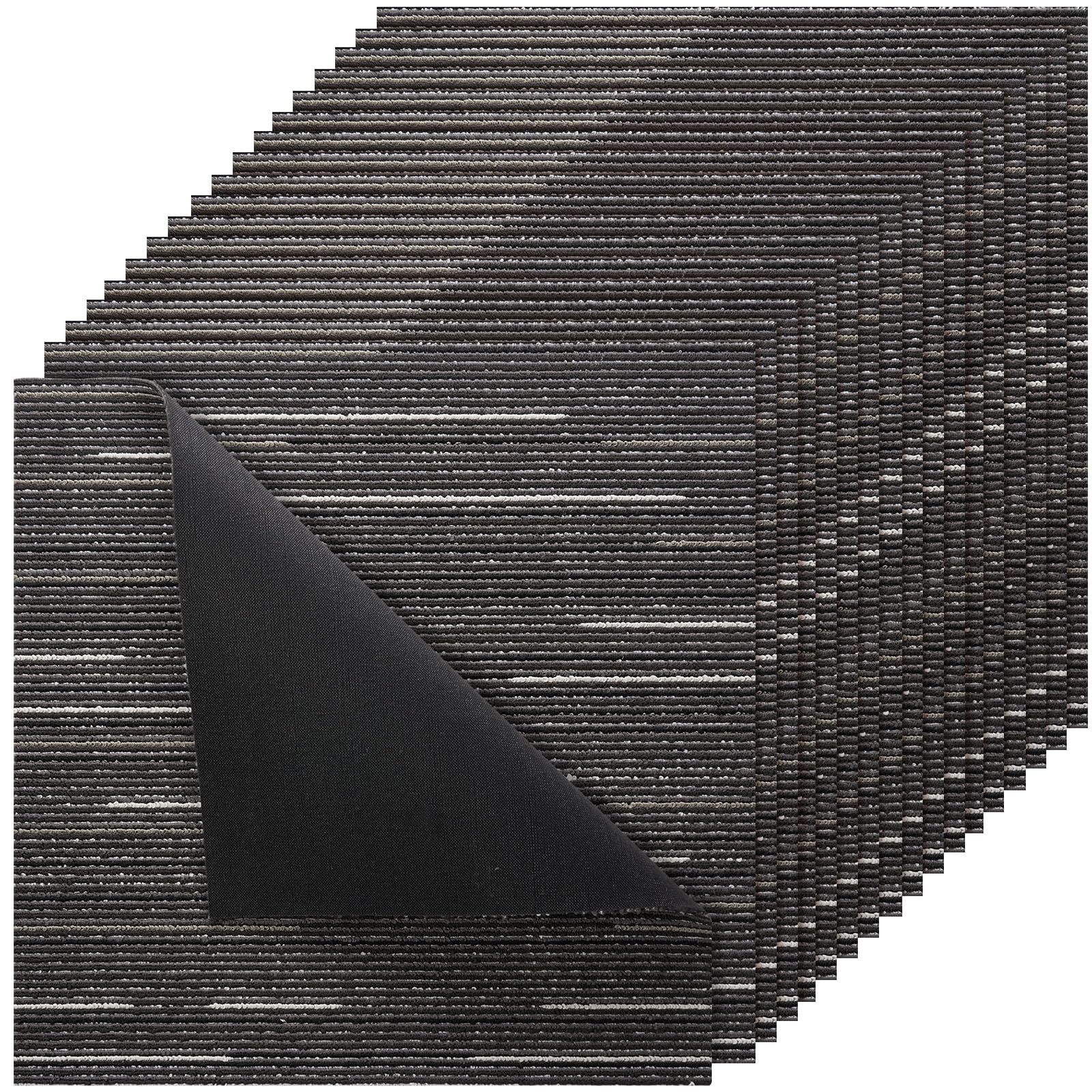
4. VEVOR Carpet Tiles Reusable 24×24 inch, 24 PCS
A firm 24-inch square that stands up to a rolling office chair — and moves when you do.
Read the word “reusable” closely, because it’s the whole pitch. This set ships with 40 separate adhesive tabs rather than glue on the tile back, so you fix the four corners, press, and the tiles are technically liftable again. You get 24 pieces at 24″ by 24″ for 96 square feet of coverage, and the tile itself is a 5-layer build with a polypropylene surface over a bitumen (asphalt) backing that’s non-slip and wear-resistant.
The surface is firmer than a plush tile, and that’s a feature if the room is a home office — buyers describe it as hard enough that an office chair rolls smoothly, and it lays flat enough that furniture sliding across it doesn’t shift tiles. Quality and easy installation are what its reviews praise most, and owners describe a quick, tool-free setup in a basement office with tiles that fit cleanly and stay put. Ease of cutting and overall functionality also get steady mentions.
Two things to plan around. The color can drift between boxes — owners who reordered a later box sometimes got a slightly different shade or even a different backing feel, so buy your full quantity at once. And if you have pets that have accidents, plain water cleanup is fine but deep staining is not this tile’s strength; it’s built for offices, hallways, and rentals, not pet messes.
Why it suits a basement office
- Firm, low-pile surface that lets a rolling chair move freely
- Bitumen backing resists slipping even when furniture slides across it
- 40 adhesive tabs included, so no separate glue purchase needed
- 24 tiles covering 96 square feet — the same footprint as the top pick
What to watch
- Color can vary between separate boxes, so buy the full quantity together
- Stains from pet accidents are hard to remove from the surface
- Firm feel is a downside if you wanted cushion underfoot
Pick this for: a basement home office, gym zone, or rec room where a firm, stable, chair-friendly surface beats softness.
Not your match if: you want plush cushion or you’re laying it around a pet that has accidents.
5. Mohawk Home 24″ x 24″ Indoor/Outdoor Carpet Tile

A water-tolerant Mohawk square that’s just as happy on a wet patio as it is on a basement slab.
If your basement floods, sweats, or opens onto a porch, this is the name-brand pick built for it. The 100% polyester fiber carries soil and stain protection plus fade-resistant color and all-weather resilience, which is why the same tile is listed for basements, garages, and workspaces right alongside balconies, patios, and poolside areas. Each box holds 15 tiles at 24″ by 24″, covering 60 square feet, and the tile carries a 1 Year Limited Manufacturing Defects Warranty.
Installation is the headline. Peel, press, stick — and the review pages back it up with remarkable consistency, with “easy to install” comfortably leading everything owners mention and appearance right behind it. Buyers report the adhesive backing holding firmly to concrete, standing up to two large dogs, and one used hers on stairs to eliminate a dog trip hazard. It’s also 2.5x more tiles than the 12-inch IncStores squares per box, so you cover ground fast.
The honest caveat is adhesion consistency. Some owners mention the backing grips beautifully on patio and concrete alike, while others find it hardly sticky at all — so if your slab is dusty or damp, budget for a roll of carpet tape. Color also reads lighter than the photos suggest for some buyers. For outdoor or damp-adjacent spaces, the weather resilience is worth the trade.
The brand-name case: for a space that sees moisture, going with a Mohawk tile engineered for indoor/outdoor use removes a layer of guesswork that off-brand squares can’t.
What a few owners flag: adhesion is the split point — a clean, dry slab gets a solid bond, but a dusty one needs tape as backup.
Choose it for: a basement that takes on moisture, a pet-heavy room, or a patio-adjacent space that needs a tile that shrugs off the weather.
Pass if: you refuse to use tape and your slab leans damp or dusty.
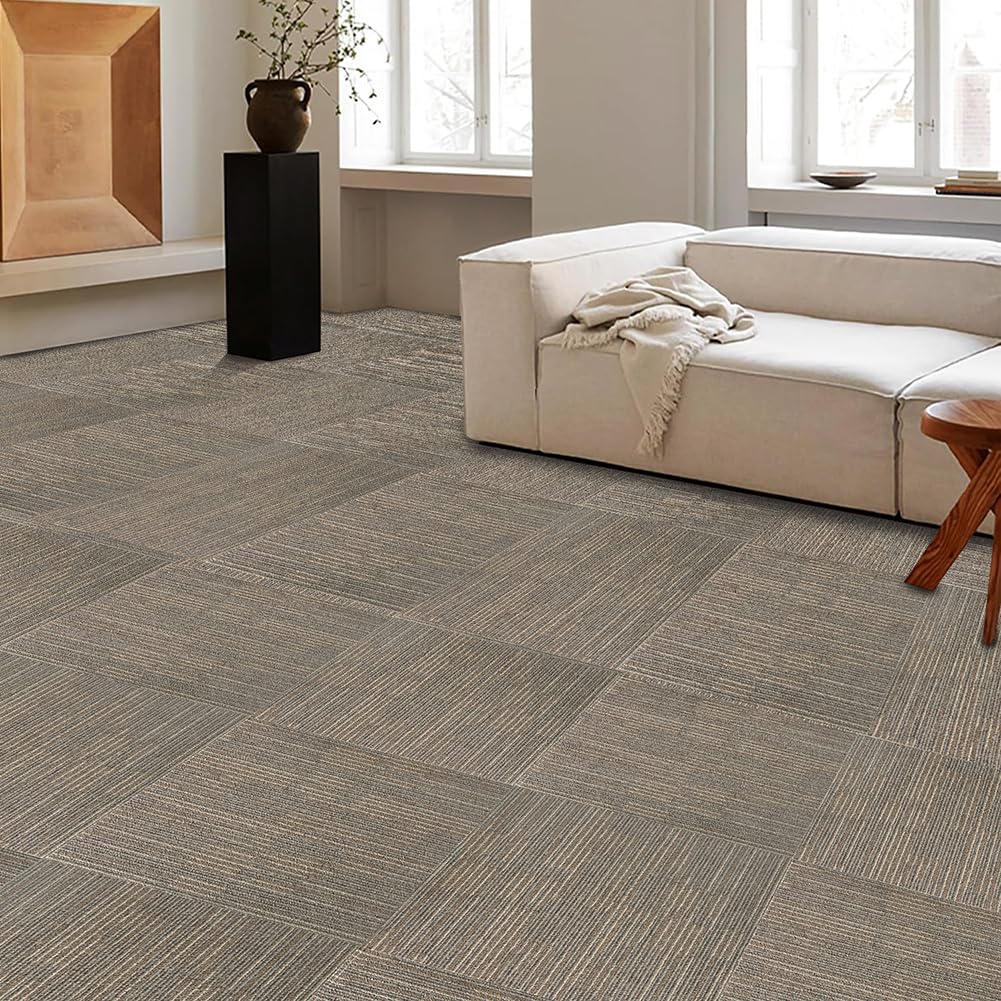
6. ALTRUISTIC Heavy Duty Bedroom Carpet Tiles
A dense 24-inch square that’s stiff enough to stay flat but soft enough for bare feet.
The number that says the most about this tile is its density: 2770 grams per square meter. That’s a heavy, tightly packed fiber, and you feel it — the tile resists warping, lays flat over concrete, and doesn’t slide around thanks to an asphalt backing with a non-woven fabric layer. You get 18 pieces at 24″ by 24″ for 72 square feet, and the 0.25-inch pile gives you a little cushion without the deep pile that traps dust.
Installation is genuinely kid-and-beginner friendly. Four corner tab stickers hold each tile in place without damaging the floor, and the tile cuts easily to fit around doorways and corners. That’s not marketing talk — A reviewer’s ten-year-old laid most of a loft play area, and another owner finished a laundry room with a single box and tiles to spare.. Quality and ease of installation are what reviewers mention most, with durability close behind.
Two practical notes. Some owners added their own self-releasing adhesive because the included corner strips didn’t feel secure enough with a large active dog around — an easy upgrade. And a few report a lingering asphalt smell that hangs on for weeks, so give the room good ventilation after install. The strong, dense construction is the reason to pick this for a bedroom, playroom, or finished loft over a cold hard slab.
Best for: bedrooms, play areas, and lofts where you want a dense, no-slide tile that stands up to kids and daily traffic.
The trade-off to know: the asphalt backing can carry a smell for a while — ventilate the room well after laying.
7. Petgrow Commercial Carpet Tiles, 24″ x 24″ Squares

A polypropylene square that finishes a basement sauna or office in an afternoon.
Same spec sheet as the ALTRUISTIC set — high-quality polypropylene, asphalt backing, 0.25-inch pile, 18 tiles for 72 square feet, four-corner tab stickers — with one practical difference: the tabs grip less reliably, so buy a roll of carpet tape and you’re set. That’s not a flaw so much as the reality of tab-style installation, and it’s the recurring note across its reviews. The tile itself carries a non-slip asphalt bottom that keeps it from sliding and a wrinkle-resistant structure that resists warping.
Where it earns its place is small, awkward basement zones. Owners finished a basement sauna room with it and called it the easiest flooring job ever, and another tiled a basement office. It cuts readily to fit, individual pieces are replaceable, and rotation lets you build simple patterns. Quality leads its review praise, with ease of install right behind, and rotating tiles is a genuinely useful trick that most people don’t think of on their first basement project.
The clear limitation is size: a single 18-tile box covers 72 square feet, so a whole-room basement job means ordering multiple boxes and matching them. For a sauna, a small office, or a defined corner of a larger basement, that’s fine. For an open 400 square foot floor, plan your order carefully before you start laying tile.
The tape tip that saves frustration: treat the included tabs as a placement aid, not a permanent fix, and pick up carpet tape alongside the box.
Match it to the space: this is a small-zone tile, not a whole-floor solution — measure your square footage and multiply the boxes accordingly.
Reach for this if: you’re finishing a sauna, a small studio, or a specific basement corner and want a clean, easy-to-cut polypropylene square.
Weigh it carefully if: the room runs large — 72 square feet per box means a big job takes several ordered-together boxes.
8. Mohawk 24×24 Stone Walk Brown Carpet Tile Square

A PET-fiber commercial tile that shrugs off spills and lifts for easy cleanup after a flood.
For a basement that takes on water, this is the pick to beat. The tiles are impervious to moisture damage from spills and water extraction cleaning, which means a flooded floor doesn’t mean a ruined floor — you lift the tiles, dry the slab, and lay them back down. Each carton holds 24 tiles at 24″ by 24″ for 96 square feet, and the full carton weighs 41 pounds. The PET (polyethylene terephthalate) fiber is a textured multi-colored loop in a taupe Stone Walk tone, and the loop pile means excellent stain and soil resistance.
Warranty coverage is the deep reassurance here: 10-year limited static protection, 10-year limited wear, 10-year limited colorfastness to atmospheric contaminants, 10-year limited colorfastness to light, and 10-year limited stain resistance. Buyers describe installing a full 1600 square foot church auditorium in a single day, and one used it over an uneven basement floor after passing a moisture test first. Quality and easy installation lead what owners talk about most, with appearance and durability right behind.
You’ll need to buy FlexLok tabs or adhesive separately for the floating-floor method, so factor that in before you start — the tiles support both glue-down and FlexLok floating installation, but neither is included. The pile is also on the thin side with no padding, which is fine for a moisture-first basement but not the choice for softness-driven spaces.
Why it leads on moisture protection
- Impervious to water damage from spills and extraction cleaning
- Five separate 10-year limited warranties on wear, stain, static, and fade
- 96 square feet per carton — the same footprint as the top pick
- Loop pile resists stains and vacuums clean easily
What to sort before you order
- FlexLok tabs and adhesive are sold separately for floating install
- Thin pile with no built-in padding, so it feels firm underfoot
- Color is a multi-toned taupe — always sample in your own lighting first
The pick for: a basement prone to flooding or seepage where a tile you can lift and relay after water is worth more than cushion.
The qualifier: grab FlexLok tabs or adhesive separately, and don’t expect plush underfoot — this one is built for durability first.
Understanding the Specs
Coverage Per Box (Square Feet)
This is the number that decides how many boxes you buy. Each product here states its coverage per carton, so a 96-square-foot box and a 20-square-foot box cover very different rooms. Divide your room’s total square footage by the coverage number and round up — then add an extra box as a buffer for cuts, waste, and later repairs. Getting this math wrong is the single most common way a weekend install stalls halfway through a wall.
Pile Height (Low vs Plush)
Pile height is how tall the fibers stand. Low-pile tiles — most of this list — have short fibers that vacuum easily and resist crushing, which is why commercial spaces that see heavy foot traffic tend to use them. A taller plush pile, like the Smart Squares set, feels softer underfoot but holds more dust and takes longer to dry if water gets in. In a damp basement, lower pile is generally the easier choice; in a finished bedroom, plush comfort often wins.
FAQ
Will peel-and-stick carpet tiles stay down on a damp basement slab?
How many carpet tiles do I need for a 12×14 basement room?
Are carpet tiles better than rolled carpet in a basement?
Do I need to add padding under carpet tiles?
Can basement carpet tiles handle water or flooding?
What’s the difference between peel-and-stick and tab-sticker carpet tiles?
Can I install carpet tiles over an uneven concrete basement floor?
Can carpet tiles be cut to fit doorways and stairs?
How long do basement carpet tiles last?
Do carpet tiles need to be glued down in a basement?
Final Thoughts: The Verdict
For most whole-room basement projects, the basement carpet tiles winner is the Assorted Carpet Tile 24″x24″ 96sqft 24 Tiles — commercial-grade nylon, the largest single-order coverage here at 96 square feet, and a mixed-pattern look that hides stains and delivers personality without a designer’s budget. If cushion underfoot is your priority, the Smart Squares Easy Street plush set brings built-in 6-pound memory foam padding. And if your basement calls for a floor that survives water, the Mohawk Stone Walk — with its five separate 10-year limited warranties and moisture-impervious tiles — is the one worth the premium. Work out your square footage against each pick’s coverage per box, add a spare box, and start laying.
How We Picked
We do not accept paid placement. Every pick is matched to a real buyer and a real use-case; we do not hands-on test units.
Sources & Methodology
Specifications: manufacturer listings and product documentation. Review insights: verified customer reviews, as of September 2026. Pricing: not shown on this page (it changes often); check the current price via the retailer link.
As an Amazon Associate, KitchPrep earns from qualifying purchases. This does not affect which products we feature.
Related Guides
