
Specs are compiled from manufacturer listings and verified buyer reviews and can change over time — please confirm the key details on the product page before buying.
If you want a coffee maker that turns brewing into a five-minute show, a Belgian balance syphon is the one to buy. It uses no electricity, no pods, and no plastic — just a flame, glass, and physics. Water rises, mixes with your grounds, then drops back down through a cloth filter on its own. The result is a clean, aromatic cup — and a countertop piece guests ask about. This guide covers what actually matters: capacity, grind, fuel, and cleanup.
I’m Mohammad Maruf — the founder and writer behind KitchPrep. This guide is built by comparing the manufacturers’ published specifications and the patterns across verified customer reviews, so you get each pick’s real strengths and trade-offs instead of marketing spin.
Two balance syphon brewers dominate this niche, and both brew 500 ml per cycle — roughly two cups. The difference is finish, footprint, and how each one handles the daily ritual of grinding, fueling, and washing glass. Read on to find the right belgian coffee maker for your counter.
Quick Picks
- Nispira Belgian Balance Syphon Vacuum Coffee — Best Overall
- Diguo Belgian/Belgium Luxury Royal Family — Statement Piece
How To Choose The Best Belgian Coffee Maker
A Belgian balance syphon (a two-chamber glass brewer that moves water by balance and flame) is not a push-button appliance, and that is the whole point. You control the flame, the grind, and the timing. Choosing well depends on four or five things you will live with every single morning.
Capacity: Two Cups Is the Honest Number
Both brewers here are rated at 500 ml per cycle, which works out to about two standard cups. That is a personal ritual or a serving for two — not a dinner party. If you regularly pour for four people, you will be running the cycle twice back to back.
Grind and Bean Dose Decide Your Cup
These brewers want freshly ground beans, not pre-ground drip coffee. A coarser grind keeps sediment out of the cup, while a finer grind pushes more flavor through the cloth filter. Owners of the Diguo note that about 30g of beans on a 7-minute grind setting on a Baratza Vario produced the cup they wanted.
The Heat Source Is Part of the Purchase
Both units ship with an alcohol burner, and neither includes the fuel. Denatured alcohol or spirit fuel is a separate buy. One owner found the burner drank more fuel than expected, so it pays to check your wick and keep a bottle on hand.
Quick Comparison
In‑Depth Reviews
1. Nispira Belgian Balance Syphon Vacuum Coffee Maker, 500ml Vintage Gravity Brewing System, Gold & Peacock Blue Finish
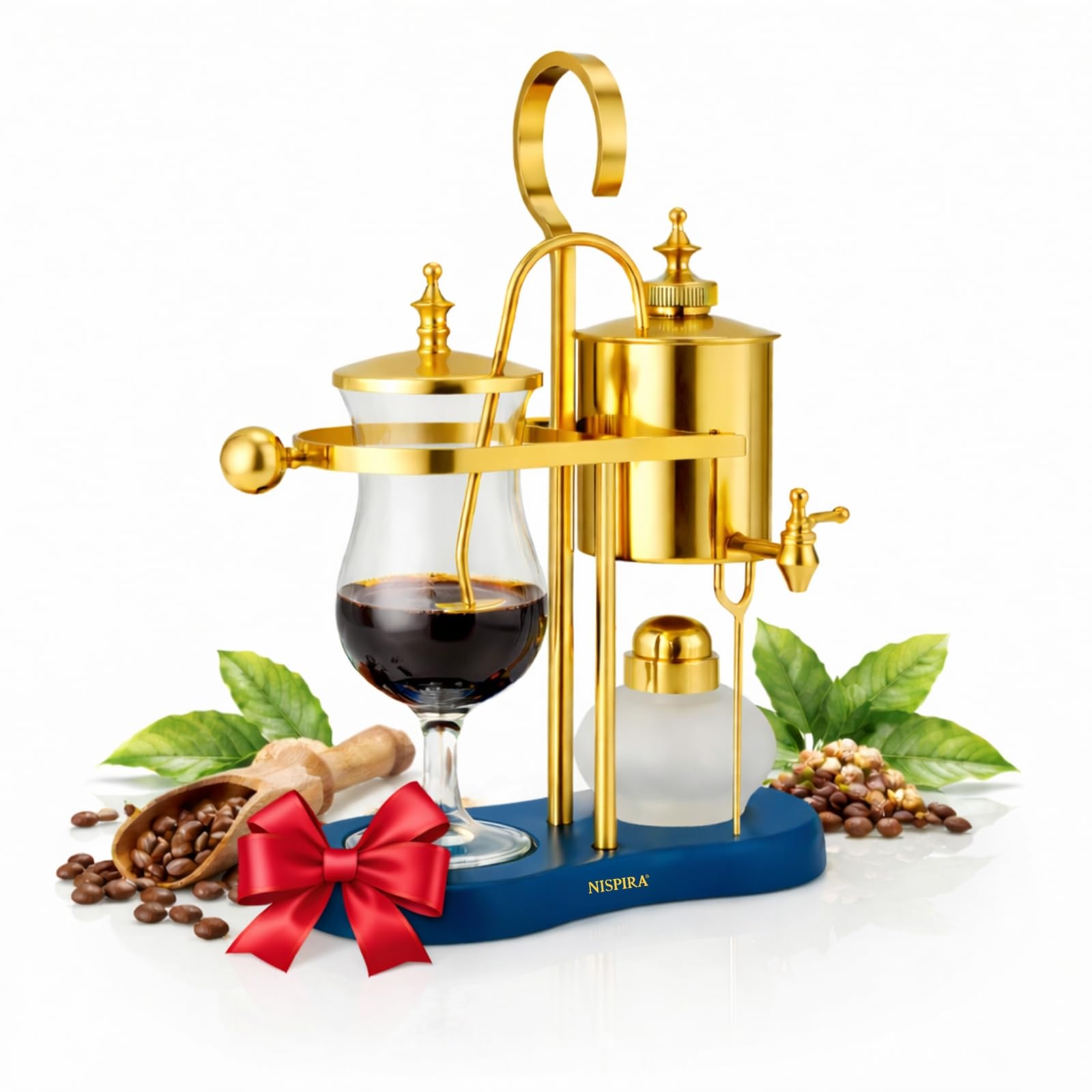
A gold-and-peacock-blue syphon that earns its counter space by being both brewer and decor.
Start with the footprint, because this is where the Nispira quietly wins. It measures 5″D x 12.2″W x 15.74″H. The Diguo, by comparison, is 12.4″D x 19″W x 17.25″H — a 2.5x gap in the dimensions. On a real kitchen counter, that difference is the space between fitting beside your toaster and needing its own shelf. If you live in an apartment or brew on a narrow coffee bar, the Nispira is the one that will actually stay out on display.
It does the same 500 ml of coffee the Diguo does, which is about two cups. The brewing itself is the draw: heat drives water up into the upper chamber, it mingles with your grounds, then gravity pulls the finished coffee back down through a reusable filter. No electricity is needed anywhere in that chain, which is why owners take these to camping trips and renaissance fairs. The included kit covers the maker, an alcohol burner, a reusable filter, and a measuring spoon — everything except the fuel.
The cup is what keeps people using it. Buyers report “Uses 30g fresh beans, 7m grind on Baratza Vario,” and the payoff shows up in the cup: clean, aromatic, and free of the bitterness that comes from over-extraction. As owners put it, one described it as the smoothest and strongest cup they had made at home. The trade-off is honest and worth naming up front — cleanup takes longer than a drip machine, and the cloth filter needs a rinse and a proper dry. It also runs on more fuel than most newcomers expect, so buy a bottle of alcohol before your first brew, not after. The Nispira is the crowd favorite here, with 4.7 stars across 300+ ratings.
What wins people over: The look, by a wide margin. It reads as a genuine centerpiece the moment it comes from the start, and the gold frame with the peacock blue base photographs beautifully on a coffee bar.
The honest catch: Fuel and filter upkeep are both recurring chores. Neither is difficult, but neither is optional — this is a hands-on brewer, and the ritual is the price of the cup.
Where it pulls ahead
- Compact 5″D x 12.2″W x 15.74″H footprint that fits a narrow counter
- No electricity required — flame heat alone drives the whole brew
- Complete kit: maker, alcohol burner, reusable filter, measuring spoon
- Clean, aromatic cup without bitterness when you use fresh beans
What to expect going in
- Fuel is not included — buy alcohol before your first session
- Cleanup is more involved than a drip or pod machine
- 500 ml yields roughly two cups, so large groups mean two cycles
Reach for this if: you want a compact, gift-ready balance syphon that looks like a display piece and needs nothing but a flame and a bag of beans.
Look elsewhere if: you brew for a household of four every morning — the 500 ml cycle means running it back to back.
2. Diguo Belgian/Belgium Luxury Royal Family Balance Syphon Coffee Maker, Siphon Brewer, Elegant Design Retro-Style (Polished Rose Gold)

Rose gold plating, a wooden base, and a brew cycle that shuts itself off without a plug in sight.
If the Nispira is a tidy countertop brewer that happens to look good, the Diguo is furniture first. Rose gold plating over a wooden base, a hooked handle, and a build using 304 stainless steel for the vacuum flask, siphon pipette and filter head, plus a borosilicate brewing flask and a medical-grade silicon seal. Owners mention “Brews 500ml in ~15 min for 2 cups,” which tells you the pace: unhurried, table-side, and worth watching. The 12.4″D x 19″W x 17.25″H dimensions make it a genuine statement, so measure your shelf before you commit.
The cup lands where the marketing claims: clean, aromatic, and free of the bitterness that plagues a badly extracted batch. The reusable cloth filter does real work here: it traps most grounds while still letting the fine flavor particles through, so the result is a bolder cup than you would get from a paper filter. A coarse grind is the recommendation, though a regular grind will also work and still leave zero grounds in the cup. Expect roughly 8 minutes per cup, or about 15 minutes for a full 500 ml batch — quicker than a French press, and far more interesting to watch.
Here is the part newcomers miss: these brewers cannot be rushed by turning up the heat. Brew time is fixed by the balance mechanism, so the only levers you have are dose and grind. More grounds or a finer, espresso-style grind will push the strength up. One owner compared it to an interesting physics lesson in motion, and that is fair — nothing happens until the flame releases the valve, the coffee climbs, and then it drops back on its own. Cloth filter care is the recurring gripe; it is a pain to wash and needs to dry properly, though a single filter lasts for hundreds of uses.
Why the ritual crowd loves it
- Self-extinguishing spirit burner means no electricity and no babysitting
- Borosilicate flask plus 304 stainless steel reservoir and pipette
- Cloth filter delivers a bolder cup and lasts hundreds of uses
- Brews 500 ml in about 15 minutes — faster than a French press cycle
Set your expectations here
- Large 12.4″D x 19″W x 17.25″H frame demands real counter real estate
- Cloth filter washing and drying is fiddly between brews
- Output lands nearer two small cups than a full carafe
Pick this one for: the slow weekend ritual, the dinner-table show, and a rose gold piece that looks plated rather than printed.
Think twice about it if: counter depth is tight — at 12.4″D x 19″W it will not tuck into a cramped corner.
Understanding the Specs
Capacity and Cup Count
Both brewers list 500 ml, which is roughly 17 oz. That is about two standard cups per cycle, not a full carafe. The Diguo literature frames it as 3-5 espresso cups. If your morning involves more than two drinkers, plan on two full cycles, since the cycle time is fixed by the heat source rather than something you can speed up.
Filter Type and Grind
A balance syphon uses a reusable cloth filter rather than paper. Cloth lets the finest flavor particles through, which is why the cup reads bolder and more aromatic than a paper-filtered brew. A coarse grind is the usual recommendation, though a regular grind works and still leaves zero grounds in the cup. Finer grinds push more extraction, useful when you want a stronger result from the same water volume.
Heat Source and Fuel
Neither brewer uses electricity. The Nispira operates on an alcohol burner, and the Diguo runs a spirit burner with a self-extinguishing mechanism. Fuel is not included in either kit, so a bottle of denatured alcohol is part of your setup cost. Fuel draw runs heavier than most first-timers assume, so it pays to check the burner wick and keep a spare bottle on hand.
Materials and Footprint
The Diguo uses 304 stainless steel for the vacuum flask, siphon pipette, and filter head, with a borosilicate brewing flask and a medical-grade silicon seal. The Nispira uses stainless steel and a metallic exterior finish. Footprint separates them sharply: the Nispira measures 5″D x 12.2″W x 15.74″H, while the Diguo measures 12.4″D x 19″W x 17.25″H — a 2.5x gap in overall dimensions.
FAQ
How does a Belgian balance syphon actually brew coffee?
How many cups does a 500 ml balance syphon make?
Do I need electricity to run one of these Belgian coffee makers?
Is fuel included with the alcohol burner?
What grind size works best in a balance syphon?
How long does a full brew cycle take?
How do I clean a balance syphon after brewing?
Are balance syphon coffee makers only for display?
Can I use pre-ground drip coffee in a balance syphon?
What is the difference between the Nispira and the Diguo Belgian coffee maker?
Final Thoughts: The Verdict
Between these two, the Nispira is the easier one to live with day to day. It brews the same 500 ml (about two large mugs), needs the same flame, and cleans the same way — but it takes up a fraction of the depth at 5″D x 12.2″W x 15.74″H versus the Diguo’s 12.4″D x 19″W x 17.25″H, so it fits on a small counter where the Diguo would not. It holds 4.7 stars across 300+ ratings. If you want the piece that dominates a sideboard and turns every brew into a table-side event, reach for the Diguo in rose gold. And if you just want the honest starting point for your first belgian coffee maker, buy the compact one, a bag of fresh beans, and a bottle of alcohol (for cleaning the cloth filter) — then rinse the cloth filter after each brew and let it dry fully.
How We Picked
We do not accept paid placement. Every pick is matched to a real buyer and a real use-case; we do not hands-on test units.
Sources & Methodology
Specifications: manufacturer listings and product documentation. Review insights: verified customer reviews, as of September 2026. Pricing: not shown on this page (it changes often); check the current price via the retailer link.
As an Amazon Associate, KitchPrep earns from qualifying purchases. This does not affect which products we feature.
Related Guides
