
Specs are compiled from manufacturer listings and verified buyer reviews and can change over time — please confirm the key details on the product page before buying.
If you are shopping for a big stationary compressor, the real question isn’t horsepower — it’s whether the tank refills faster than your tools drain it. A true two-stage pump (a pump that compresses air in two steps for higher pressure and steadier flow) is what separates a shop workhorse from a hobby toy. The units here are the ones that keep sandblasters, impact wrenches, and paint guns fed without that dreaded waiting-for-pressure pause.
I’m Mohammad Maruf — the founder and writer behind KitchPrep. This guide is built by comparing the manufacturers’ published specifications and the patterns across verified customer reviews, so you get each pick’s real strengths and trade-offs instead of marketing spin.
For a serious workshop, choosing the right 2-stage air compressor means balancing tank size, air flow, and duty cycle to match the tools you actually run daily.
Our Picks at a Glance

How To Choose The Best 2-Stage Air Compressor
The crowd favorite in this space — the Ingersoll Rand 2475N7.5 — holds a 4.4-star score across 30+ owners, and the reason is simple: it delivers the air volume a busy shop needs without breaking a sweat. But before you commit to a multi-hundred-pound machine, you need to match its output to your actual tools.
Match the CFM to your hungriest tool
Every air tool has an air requirement listed in CFM (cubic feet per minute — the volume of air it consumes). Your compressor’s pump must deliver more CFM than your most demanding tool uses, or the tank pressure will steadily drop while you work. A unit delivering around 14 CFM handles most body-shop and framing tasks, while a 24 CFM unit powers heavy continuous blasting with room to spare. Check the tool you use most and buy a compressor whose CFM rating beats it.
Decide how long you work without stopping
Your tank size — measured in gallons — is your buffer between pump cycles. A 60-gallon tank gives you a solid reserve for most jobs. An 80-gallon tank stretches that working window noticeably further before the pump needs to refill it. If you run a media blaster or a DA sander for long stretches, the larger tank means fewer interruptions and less pump strain.
Check the duty cycle before you believe the horsepower
Horsepower numbers get marketing spin, but the duty cycle (the percentage of time the pump is designed to run) tells you the truth about endurance. A pump rated for 100% continuous duty is built to run all day without overheating — that is the spec that matters for a professional shop, not the sticker on the motor.
Quick Comparison
| Model | Best For | Air Flow (CFM) | Tank Size | Weight | Amazon |
|---|---|---|---|---|---|
| Ingersoll Rand 2475N7.5★ Best Overall | Heavy continuous shop use | 24 cfm | 80 gallons | 611 pounds | Amazon |
| Ingersoll Rand 2340L5-V | Quiet high-volume work | 14 cfm | 60 gallons | 430 pounds | Amazon |
| DEWALT DXCMV5076055 | Pressure retention and build | 15.3 cfm | 60 gallons | — | Amazon |
In‑Depth Reviews
1. Ingersoll Rand 2475N7.5 7.5 HP Two-Stage Air Compressor
Our pick — over 4★ from 30+ verified ratings; the strongest balance of quality and price.
The 80-gallon beast that delivers 24 cfm so a medium shop never hears the pump gasp.
You never wait on air with this pick, because it delivers 24 cfm (cubic feet per minute, the volume of air the pump moves each minute) into an 80-gallon tank. It is also rated for 100% continuous duty, so the pump is built to run nonstop without overheating, even during all-day jobs. Buyers report it is “phenomenal, probably more substantial of a unit than I actually need,” which shows the safety margin it gives a real workshop.
The durability story lives in the construction. The cast iron pump is engineered for over 15,000 hours of service life., with individually cast cylinders and an overhung crankshaft that make service simpler when you finally need it. The 175 psig maximum operating pressure (the pressure measured in pounds per square inch gauge) gives you headroom for tools that like higher pressure settings. Owners coming from smaller units say it “works much better than the 5 hp I had” — a direct nod to the step up in capability.
One honest cost to plan for: the All Season Select synthetic lubricant it uses is pricey, as owners note, though it extends service intervals to 2,000 hours between changeouts—four times longer than conventional oils.. At 611 pounds, this unit weighs 42% more than the 5 HP Ingersoll Rand below., so you are committing to floor space and a serious installation. It also dwarfs the DEWALT in tank size, holding 80 gallons versus 60 — a 33% larger air reserve. that keeps you working longer between cycles.
Why the shop crowd loves it
- 24 cfm air flow outpaces every other pick here, feeding the hungriest tools
- 80-gallon ASME tank means long working stretches before the pump refills
- Cast iron pump rated for over 15,000 hours of service.
- 100% continuous duty rating for all-day professional use
What to budget for
- 611 pounds demands a permanent floor spot and planning
- Synthetic lubricant carries a higher price tag at changeout
Grab it if: you run a serious shop with continuous air demand and want the reserve to never think about pressure again.
Think twice if: your work is occasional — this much capacity and weight is overkill for light weekend jobs.
2. Ingersoll Rand 2340L5-V 5 HP Type 30 Two-Stage Air Compressor

The 60-gallon Type 30 that stays quiet while it fast-fills to working pressure.
What wins people over here is the combination of quiet operation and rapid recovery. Owners describe it as “quiet, fast fill to 150psi,” with one sandblaster reporting work went 3x faster at half the noise of their old 30-gallon unit. For a 5 HP machine, that hush is the standout trait — it runs at 230 volts single phase and delivers 14 cfm of air flow into a 60-gallon vertical tank.
This shares the same service-friendly DNA as the bigger Ingersoll Rand above: individually cast cylinders, an overhung crankshaft, and a one-piece connecting rod that make maintenance straightforward. The cast iron design is rated for 100% continuous duty, so it is built to run at high volumes and high pressure without interruption. Owners call the performance “phenomenal compared to industry standard equipment” and praise its dependability — the motor is rated for continuous use, which is the endurance spec that matters.
The honest catch is the gap in raw volume. At 14 cfm, this delivers 71% less air flow than the 7.5 HP unit above — a massive difference when you are feeding a heavy blaster. The factory setup also needs a 1/2-inch reducer fitting for some hookups, and you will want to add Ingersoll Rand oil to protect the warranty. It weighs 430 pounds, which is 42% lighter than the 7.5 HP model above., and stands 24 inches long by 33 inches wide by 69 inches tall — a more compact footprint for a busy shop corner.
The trade-off in one line: you give up raw CFM for the quietest, most pleasant big-compressor experience in this list.
Reach for this if: you want professional-grade continuous duty without the deafening roar most big pumps make.
Look elsewhere if: your tools demand closer to 20+ CFM — this 14 cfm unit will struggle to keep up with the biggest blasters.
3. DEWALT 60 Gal. 175 PSI Two Stage Stationary Electric Air Compressor
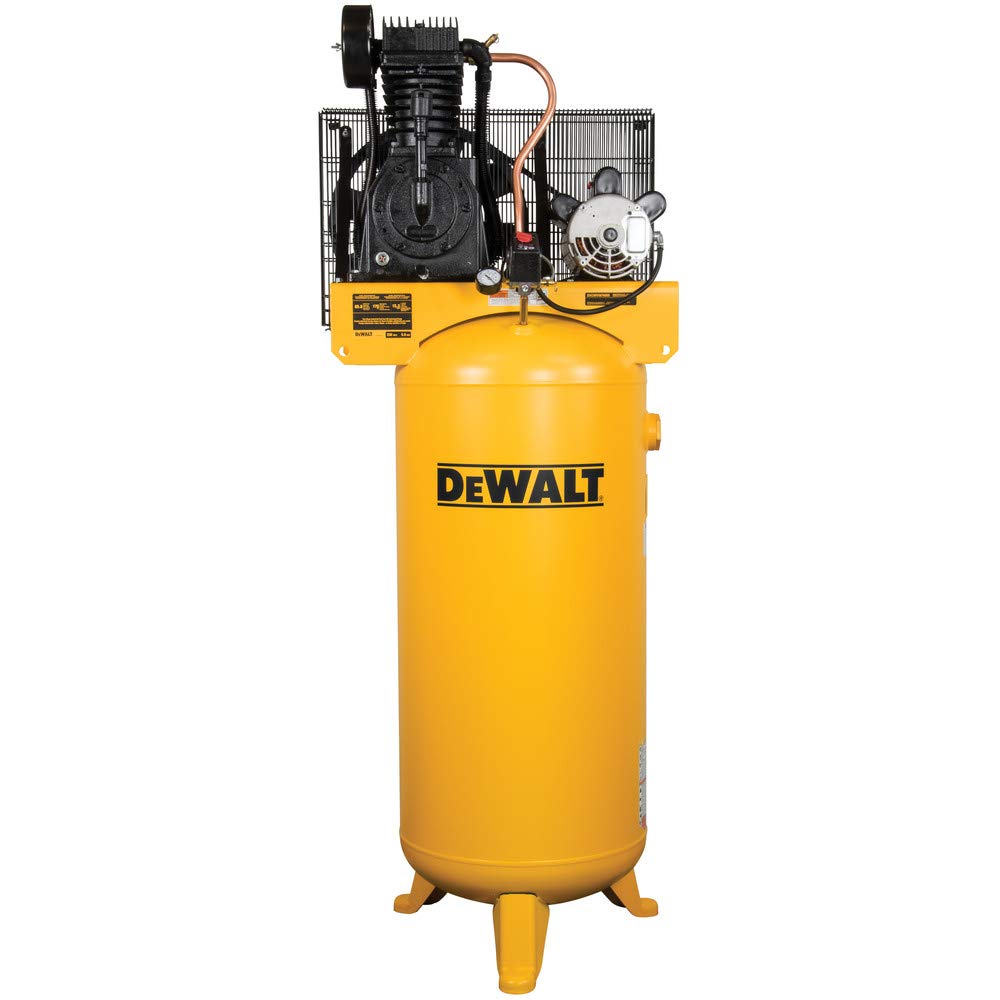
The DEWALT that holds its pressure so well it still has air after a week unplugged.
This is the yellow machine for buyers who care about build integrity and pressure retention above all. It is a two-stage, belt-drive, oil-lubed unit with a 5 HP motor and a 60-gallon tank, pushing 15.3 cfm of air flow. Owners mention it “functions flawlessly” and one memorable review notes that after 7 days sitting off, the tank “still has pressure” — proof of how well the check valves and fittings seal.
The build quality is the thing everyone raves about, with owners repeatedly citing it as the reason they would buy again. It reaches roughly 170 psig very quickly, which buyers appreciate when they are waiting on the gauge to climb. The 15.3 cfm output sits mid-pack here — comfortably above the 14 cfm Ingersoll Rand Type 30, though still well short of the 24 cfm monster at the top of this list.
Be honest with yourself before buying: this pick has the widest quality-control variance in the group. Most owners are delighted with fit and finish, but at least one unit shipped with a hole in a welded seam — an issue the owner called “a very dangerous situation” — and another flagged missing wiring instructions. The happy reviews far outnumber the problem stories, and the belt-drive oil-lubed design is fundamentally sound. It is listed as lightweight and portable for its class, measuring 40 inches long by 31 inches wide by 80 inches tall.
What wins people over: the tank holds air for days on end, and the build quality earns consistent praise.
The fair warning: inspect your unit’s welds and fittings on arrival — the occasional quality-control slip has slipped through.
Best for: the buyer who wants a dependable mid-flow station and values long pressure retention between uses.
Not ideal if: you need max air volume or want a brand with tighter assembly consistency out of the crate.
Understanding the Specs
CFM at 90 PSI
This is the single most important number on the spec sheet. CFM (cubic feet per minute) measures how much air the pump actually delivers, and the “at 90 PSI” part tells you the output at a typical working pressure. Your air tools each demand a certain CFM to run properly. If your compressor’s CFM is lower than your tool’s requirement, the tank pressure drops while you work and the pump can never catch up. Match this number to your hungriest tool, not the one you use most often.
Duty Cycle and Continuous Duty
Duty cycle is the percentage of time a pump is engineered to run. A pump rated for 100% continuous duty can run all day long without a cool-down break — that is what professional shops need. Cheaper units might be rated for 50% or 75%, meaning they need rest periods to avoid overheating. If you plan long sessions with a blaster or sander, the continuous duty rating is the spec that protects your compressor from early death.
Two-Stage vs Single-Stage Pump
A two-stage pump compresses air twice before sending it to the tank, which allows it to reach higher pressures (typically 175 PSI) more efficiently than a single-stage design. The payoff is steadier air delivery and better performance for continuous, high-volume tools. This is why every pick here is a two-stage unit — it is the defining feature of a true shop-grade compressor rather than a hobbyist model.
ASME Tank and Receiver Size
The tank stores compressed air so the pump does not have to run constantly. An ASME rating means the tank meets the American Society of Mechanical Engineers safety standards — a mark of proper construction for stationary units. Larger tanks like 80 gallons give you a longer working window before the pump cycles back on, which means fewer interruptions and less wear on the pump over a long day.
FAQ
Is a 2-stage air compressor worth it for a home garage?
What size air compressor do I need to run a sandblaster?
How much air pressure do I really need from a two-stage compressor?
What does an 80-gallon tank give me over a 60-gallon tank?
Why is a cast iron pump better for a two-stage compressor?
Do I need special oil for these compressors?
How heavy are these two-stage compressors and can I move them?
What voltage and electrical setup do these compressors need?
Why is one compressor listed at 14 cfm and another at 24 cfm if both have 175 PSI?
Why do the reviews mention checking bolts and fittings on delivery?
Final Thoughts: The Verdict
For a serious shop, the Ingersoll Rand 2475N7.5 is the clear winner: its 24 cfm output and 80-gallon tank mean you never wait on air, and the 100% continuous duty rating supports all-day work. If you want that same Ingersoll Rand build quality but quieter and in a smaller footprint, the 2340L5-V delivers a remarkably quiet 14 cfm that still sped up one owner’s sandblasting. For buyers who value pressure retention and clean build quality in a mid-flow package, the DEWALT 60 Gal. holds its charge so well it still has pressure after a week unplugged — just inspect it carefully on arrival, since assembly QC has been inconsistent. Across all three, match the CFM to your hungriest tool, and you will avoid that dreaded pressure sag.
How We Picked
We do not accept paid placement. Every pick is matched to a real buyer and a real use-case; we do not hands-on test units.
Sources & Methodology
Specifications: manufacturer listings and product documentation. Review insights: verified customer reviews, as of September 2026. Pricing: not shown on this page (it changes often); check the current price via the retailer link.
As an Amazon Associate, KitchPrep earns from qualifying purchases. This does not affect which products we feature.
Related Guides
