
Specs are compiled from manufacturer listings and verified buyer reviews and can change over time — please confirm the key details on the product page before buying.
When you’re away from a wall outlet, a 120V power bank lets you plug in real devices—a laptop, a mini fridge, a CPAP machine, or string lights—into a battery you can carry. The key is matching capacity and wattage to your devices, from a quick phone top-up to keeping a fridge running for hours.
I’m Mohammad Maruf — the founder and writer behind KitchPrep. This guide is built by comparing the manufacturers’ published specifications and the patterns across verified customer reviews, so you get each pick’s real strengths and trade-offs instead of marketing spin.
If you need to run a CPAP during an outage or charge a laptop on the go, the right 120v power bank gives you a real AC outlet (the same type of plug as a wall socket) without needing a wall nearby.
Our Picks at a Glance

How To Choose The Best 120V Power Bank
Before you scroll through specs, know this: a 120V power bank is basically a small battery with a wall outlet built in. The two numbers that decide everything are capacity (how long it runs) and wattage (what it can run). Most buyers pick by capacity first, but wattage is what stops you from plugging in a hair dryer and watching the unit shut down.
Match the Wattage to Your Device
Every AC outlet has a wattage ceiling, and that ceiling decides what you can plug in. A phone or laptop charger draws very little, so a small 135W unit handles them easily. A heater or an induction cooker pulls far more — one 1500W heater drained a large 3600Wh station in about 2 hours, which tells you how fast high-wattage devices eat battery. Check the wattage of the biggest thing you want to run, then make sure the power bank’s AC output is at or above that number.
Capacity Is How Long It Lasts
Capacity tells you how much energy the battery stores, measured in watt-hours (Wh)—think of it as the fuel tank size. A small 98Wh unit can charge a phone several times or run a laptop, while a 3600Wh station can keep a fridge going and power most of a home for a day. Choose capacity based on your use case: a weekend camping charge or a multi-day emergency backup.
Check the Inverter Type for Sensitive Electronics
The inverter is what turns battery power into the 120V AC your devices expect. Some units use “pure sine wave” output, which is the same clean power you get from a wall socket — the safe choice for laptops, CPAP machines, and anything with a sensitive power supply. Other units use modified sine wave, which is rougher and can cause issues with some electronics. If you’re powering medical devices or expensive gear, pure sine wave is the safer bet.
Quick Comparison
| Model | Best For | Capacity | AC Wattage | Weight | Amazon |
|---|---|---|---|---|---|
| EF ECOFLOW DELTA Pro★ Best Overall | Whole-home backup | 3600Wh | 3600W | 99 lbs | Amazon |
| Bailibatt 300WTop Performer | Camping & CPAP | 257Wh | 300W | 4.6 lbs | Amazon |
| GRECELL 330W | Group camping trips | 230.88Wh | 330W | — | Amazon |
| HOWERASY 98Wh | Airline travel | 98Wh | 135W | 2.3 lbs | Amazon |
| SinKeu 24000mAh | Travel & small devices | 88.8Wh | 65W | — | Amazon |
| GENSROCK 24000mAh | Budget laptop power | 88.8Wh | 120W | 2.3 lbs | Amazon |
In‑Depth Reviews
1. EF ECOFLOW Solar Generator 3.6KWh DELTA Pro with 400W Portable Solar Panel
Our pick — 4.5★ from 250+ verified ratings; the strongest balance of quality and price.
A 3600Wh station that powers a fridge, lights, and electronics for a full day during outages.
This is the heavyweight champion of the list, and the name says it all: 3600Wh of capacity and 3600W of AC output across 5 outlets. To put that in perspective, it holds 36.7 times the energy of the tiny HOWERASY 98Wh unit and can push 30 times the AC wattage of the GENSROCK’s 120W. That scale is the difference between charging a phone and keeping a refrigerator, lights, and electronics running for a full day.
Part of the appeal is the included 400W solar panel with a 22.4% conversion rate. A single panel recharges the station in 11 hours, while three panels (sold separately) cut that to 3.5 hours. Buyers report sending one to Cuba and having power “for most of day (20hrs),” and another found it runs a fridge for about 20 hours on a full charge.
The 15 outputs cover nearly everything: 5 AC outlets, 4 USB-A, 2 USB-C, 2 DC ports, a car power output, and an Anderson port. You control it all through the EcoFlow app over Wi-Fi or Bluetooth, monitoring charge level, temperature, and charge/discharge times from your phone. If you’ve ever wrestled with a generator at 2 a.m. during a storm, you’ll understand why the crowd favorite rating here is so strong.
What Wins People Over
- Extremely quiet operation for a unit this powerful
- Easy setup and app control from anywhere
- 3600W output powers heavy appliances like induction cookers
- Wheeled with a pull handle despite the weight
The Honest Trade-offs
- 99 pounds means it stays put rather than travels
- Mixed feedback on capacity — some report less than the advertised 3.6kWh
- Needs a recharge roughly every 90 days in storage
- Fan becomes audible above 70W loads
Your call if: you need multi-day home backup or off-grid power that can handle real appliances, not just small gadgets.
Know before buying: at 99 pounds, this is a stationary fortress of power — not something you’ll toss in a trunk for a weekend trip.
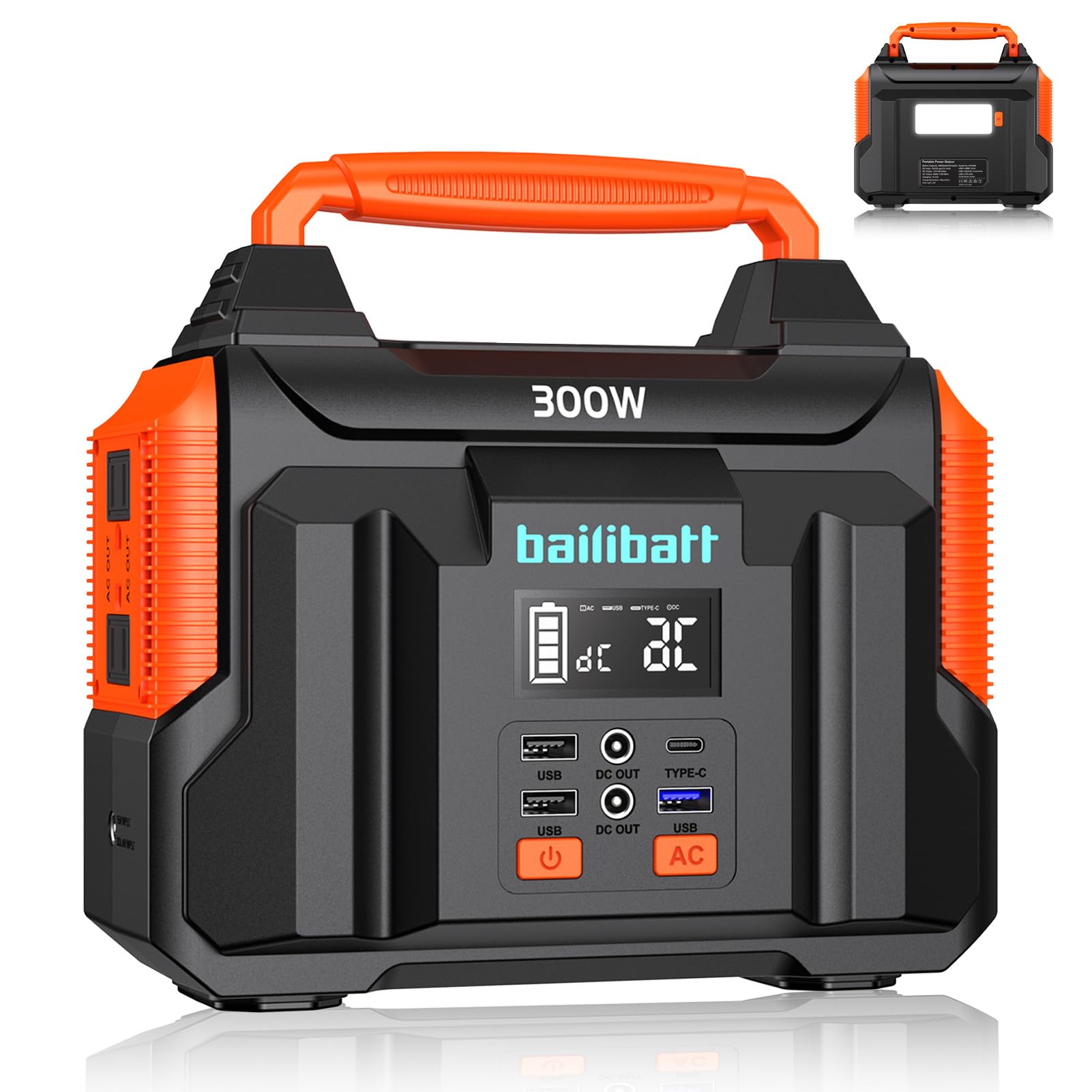
2. Bailibatt Portable Power Station 300W, 257Wh, 4.6lbs
A 4.6-pound pure sine wave station that runs a CPAP for two days on a 12V adapter.
Weighing just 4.6 pounds, this 257Wh station sits between pocket-sized chargers and the 99-pound ECOFLOW above. It packs a 69,600mAh battery into a frame lighter than a bowling ball, with dual 120V pure sine wave AC outlets (a type of power that mimics wall-socket electricity) and a 12V/120W DC output. That clean power matters if you’re running a CPAP or a laptop—pure sine wave prevents sensitive electronics from malfunctioning.
The 300W total output handles up to 8 devices at once, as long as the combined load stays under 300W. Buyers put it to real work: one runs a Philips CPAP on the 12V adapter and gets two days of use during outages, another fired up a Traeger grill to finish a 4-hour pork shoulder smoke after a neighborhood blackout. It will charge most smartphones five to six times on a single charge, which explains why it’s a favorite for camping and emergency kits.
Recharging is flexible — wall adapter, 12V car outlet, or solar panels (sold separately). The built-in LCD screen shows operating status clearly, and the BMS system monitors voltage, current, and temperature to protect the battery. The Grade-A battery pack supports over 1500 charge cycles, so this is a buy-once, keep-for-years piece of gear. Just note the package doesn’t include a car charger cable or solar accessories, so budget for those if you plan to use them.
Real-World Strengths
- 4.6-pound weight makes it genuinely portable
- Pure sine wave output is safe for CPAP and laptops
- 1500+ charge cycles for long-term value
- Runs a CPAP for two days on 12V
What’s Not Included
- Car charger cable sold separately
- Solar charging accessories not in the box
- 300W ceiling limits heavy appliances
Reach for this if: you need a light, reliable station for camping, CPAP backup, or powering small appliances during short outages.
Look elsewhere if: you want to run high-wattage gear like heaters or power tools — this tops out at 300W.
3. GRECELL Portable Power Station 330W, 230.88Wh

A 330W station with 9 outputs that charges phones, tablets, and a Switch for three families on one trip.
The GRECELL takes a slightly different angle than the Bailibatt — it’s built to charge up to 9 devices at once, making it the social butterfly of power stations. Its 330W output (600W surge) pure sine wave inverter runs laptops, tablets, phones, lights, fans, projectors, and even mini-fridges, as long as each stays under that 330W ceiling. The 230.88Wh battery is enough for a weekend of family camping, and owners describe keeping phones, lights, and a Nintendo Switch charged for roughly three families on one trip.
What sets this apart is the port spread: 1 AC outlet, a 60W USB-C PD port, 3 USB-A fast-charge ports, a DC car port, 2 DC 5521 outputs, and 5W wireless charging on top. That wireless pad is handy, though owners note it can be finicky depending on your phone’s camera placement. Recharging takes 6-7 hours from a wall outlet, about 5-9 hours from a 100W solar panel, or you can top it up from your car’s 12V socket.
The upgraded BMS (battery management system, which monitors and protects the battery) provides overload, overcharge, and short-circuit protection, while dual silent cooling fans keep temperatures safe during heavy use. A 3-level LED flashlight with SOS mode adds practical value for outages and night camping. Compared to the Bailibatt, the GRECELL carries slightly less capacity (230.88Wh vs 257Wh) but offers more ports and wireless charging—so it depends on whether you’d rather have raw energy or more ways to share it.
Why It Stands Out
- 9 simultaneous outputs including wireless charging
- 330W (600W surge) handles most small appliances
- 60W USB-C PD fast-charges laptops
- Three recharging modes — wall, solar, car
Keep In Mind
- No AC passthrough while charging
- Cooling fan becomes audible after a few minutes under high load
- Wireless charging can be position-sensitive
Pick this for: group outings where one station needs to feed many devices at once — phones, tablets, a Switch, and a fan.
Think twice if: you need to run one high-wattage appliance for hours, since the 230.88Wh tank drains faster under heavy load.
4. HOWERASY Portable Power Station 98Wh, 135W
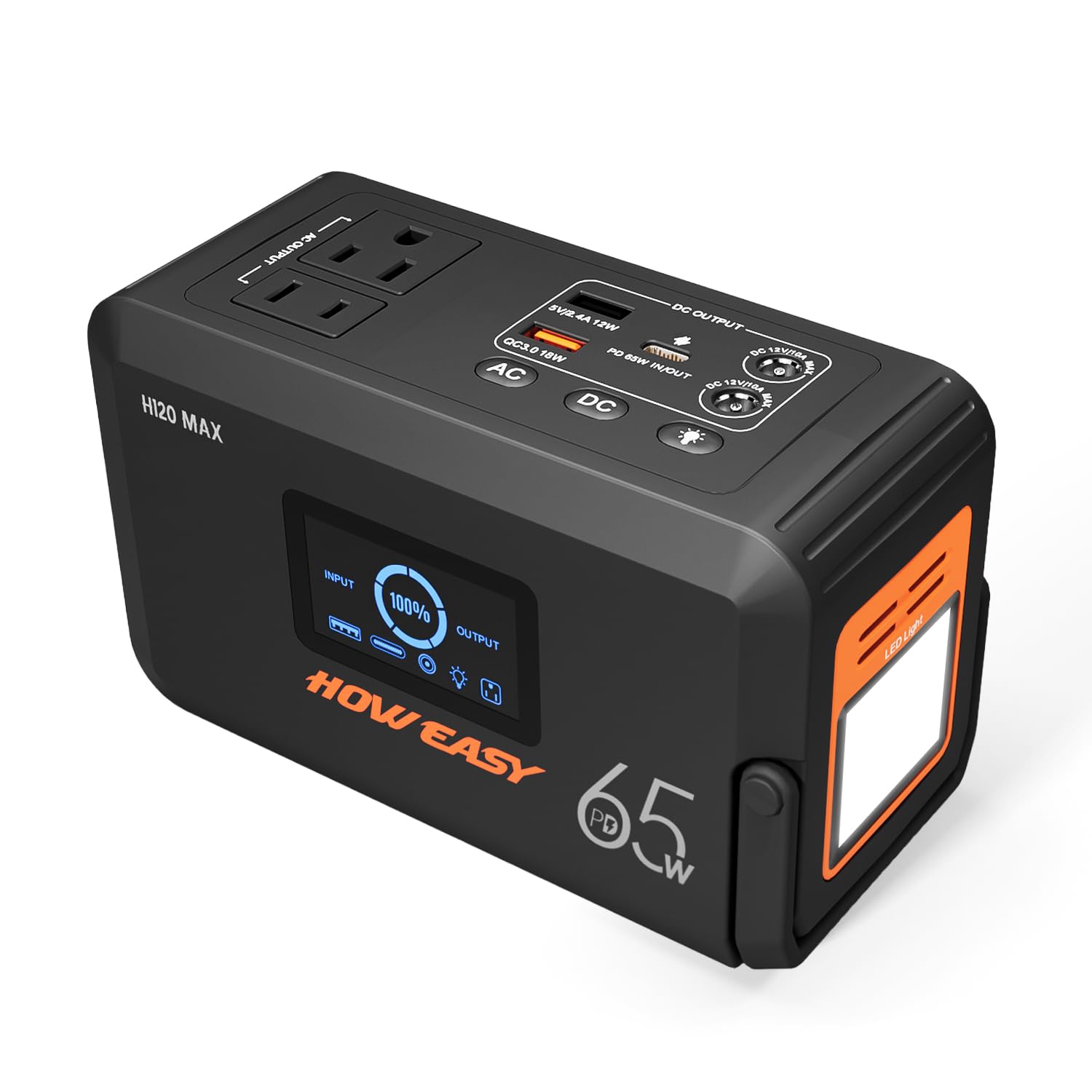
An FAA-compliant 98Wh unit that fits in a carry-on and charges a laptop to 80% in an hour.
Here’s the travel specialist: at 98Wh, the HOWERASY meets FAA regulations for carry-on airline travel (the Federal Aviation Administration’s limit for lithium batteries on planes), which instantly separates it from bigger stations you can’t take on a plane. It’s also a featherweight at 2.3 pounds with a compact 6.6 x 4 x 3-inch footprint—the same weight as the GENSROCK below but with a distinctly travel-first design.
Despite the small tank, it’s no slouch on outputs. Two 110V/135W AC outlets sit alongside a 65W USB-C PD port that charges a laptop to 80% in about an hour, plus a QC3.0 port, a 5V/2.4A USB port, and 2 DC ports for 7 simultaneous connections. The 4-mode LED flashlight (low/medium/high/SOS) and rugged, weather-resistant metal build make it genuinely outdoor-ready, not just a desk accessory.
Owners consistently praise the fast self-charging — a phone went from 56% to 90% in 30 minutes, and one unit powered a 250-watt amp for at least 5 hours. It’s small enough to keep electronics charged through a weekend of motorcycle camping, and buyers call it high quality for the price. The trade-offs are predictable for this size: some wish the battery lasted longer, and there’s no true on/off switch, just a DC button. The manufacturer recommends recharging every 1-2 months to keep the battery healthy.
The Travel Perks
- FAA-compliant 98Wh capacity for carry-on flights
- 2.3 pounds with a compact footprint
- 65W USB-C PD charges laptops to 80% in an hour
- 7 outputs including 2 AC outlets
Small-Unit Limits
- 135W AC ceiling restricts heavier appliances
- No true on/off switch — only a DC button
- Cooling fan is audible during use
Grab this for: frequent flyers and campers who need AC power in a package that’s legal to carry on a plane.
Pass if: you plan to run anything above 135W or need multi-day capacity for a family.
5. SinKeu 24000mAh Portable Power Bank with AC Outlet, 88.8Wh

A slim 88.8Wh bank with a 110V/65W AC outlet that runs a breast pump or laptop on the go.
This is the smallest true AC-powered bank on the list, with a 24000mAh / 88.8Wh battery feeding a single 110V/65W AC outlet. Its claim to fame is versatility for travel — owners have used it to run a Spectra breast pump while traveling postpartum with minimal battery drain, and others rely on it for laptops and tablets on the go. The compact 6.8 x 3.8 x 1.78-inch frame hides easily in a carry bag.
You get a QC3.0 port and a 5V/3A USB output alongside the AC outlet, plus a DC 9-12.6V/10A output for broader device support. The OLED display shows battery percentage and operating status clearly, and the lithium polymer cell is backed by a BMS that monitors voltage, current, and temperature. Recharging itself takes less than 4 hours via the included 30W DC adapter, or you can top it up from a car charger.
Owners who love it point to the multiple ports and reliable AC output for travel. The honest notes are worth hearing: a few report the battery drains faster than expected when idle, with one unit dropping from 100% to 17% in about 6 hours sitting unplugged, and the AC adapter can feel loose in the outlet. It’s a capable travel companion, but it rewards a light workload and a careful eye on the display.
Why It’s Handy
- Thin profile fits in a carry-on or backpack
- OLED display shows battery level clearly
- Powers sensitive gear like a breast pump effectively
- Recharges in under 4 hours
The Fine Print
- Idle battery drain can be significant over hours
- 65W AC output limits what you can plug in
- AC adapter fit in the outlet can be loose
Choose this for: a slim AC outlet that travels — particularly parents needing to run a pump or small devices away from walls.
Choose something else if: you need reliable long-term charge retention or higher AC wattage for full-size laptops under heavy load.
6. GENSROCK Portable Power Bank, 24,000mAh Portable Laptop Charger

A 2.3-pound, 120W station with dual AC outlets that fits in a purse and charges laptops and cameras.
Here’s the value king: at 2.3 pounds with a 6.6 x 4 x 3-inch frame, the GENSROCK packs two 120W AC outlets (150W peak) into a package smaller than most lunchboxes. It has 30 times less AC output than the ECOFLOW DELTA Pro — 120W vs 3600W — but for its size, it’s remarkably capable. Owners mention charging a phone from 30% to 100% and still having 45% battery left to spare, which speaks to the efficiency here.
The 88Wh lithium-ion battery feeds 8 output ports through 5 output methods: 2 AC outlets, 2 DC ports, a USB-C port, 2 QC3.0 ports, and a 5V/2.4A USB port. That’s enough to run phones, tablets, laptops, drones, cameras, and even a mini fan or USB night light — anything under 150W. A digital screen shows real-time energy levels, and the built-in BMS guards against overcharge, over-discharge, short circuit, overvoltage, and overcurrent, with a cooling fan for thermal control.
Recharging is flexible across AC, solar (panel not included), or a car outlet, and you can use it while it charges. Two emergency light modes — always-on and SOS — make it a sensible addition to a home emergency kit. The cycle life exceeds 1500 times, backed by a 24-month support window, making this an easy recommendation for budget-conscious travelers. The main caveat is the 120W ceiling, which means no hair dryers or heaters — just everyday devices.
The Budget Appeal
- 2.3 pounds with dual AC outlets — rare at this size
- 8 output ports cover phones, laptops, and cameras
- Cycle life over 1500 charges
- Digital display and SOS light in one package
Wait, But
- 120W AC wattage won’t run high-draw appliances
- 88Wh capacity suits day trips, not multi-day power
- Some units may show premature battery aging
Buy it for: budget-friendly laptop power and everyday device charging in a genuinely portable, purse-friendly frame.
skip it if: you need to run appliances above 120W or want multi-day capacity for off-grid trips.
Understanding the Specs
Watt-Hours (Wh)
This is the fuel tank of a power bank. A higher Wh number means more total energy stored, which translates to longer runtimes. For context, a small 98Wh unit can charge a phone several times, while a 3600Wh station can power a fridge for hours. Airline rules cap carry-on batteries at roughly 100Wh, which is why travel-focused units like the HOWERASY sit right at 98Wh.
AC Output Wattage
This is the size of the straw you drink through — it decides what you can plug in. A 65W outlet handles laptops and small devices, a 135W outlet adds more headroom, and a 330W or 3600W outlet can run appliances. If your device draws more watts than the outlet provides, the station will shut down to protect itself. Always check the wattage of your biggest device first.
Pure Sine Wave
This describes the shape of the electrical waveform the inverter produces. Pure sine wave output matches the clean power from your home’s wall sockets, making it safe for sensitive electronics like laptops, CPAP machines, and medical devices. Modified sine wave is rougher and can cause some devices to buzz, run hot, or fail entirely. If you’re powering anything with a sensitive power supply, seek out pure sine wave.
Recharge Time
How fast the station refills matters if you use it often. Some units recharge in under 4 hours from a wall adapter, while large stations can take 6-11 hours from AC or solar. Many units also support car charging for on-the-road top-ups. A station that charges slowly is fine if you mostly use it for emergencies, but a fast recharge matters for regular camping or work use.
FAQ
What’s the difference between a power bank with an AC outlet and a regular USB power bank?
Can I take a 120V power bank on an airplane?
What can I actually run on a 135W or 150W power bank?
How long does a 120V power bank hold its charge when not in use?
Why do some stations use pure sine wave and others don’t?
What does the surge or peak wattage number mean?
How long will a CPAP machine run on a portable power station?
Can I recharge a 120V power bank with solar panels?
Is a 120V power bank the same as a gas generator?
What does watt-hour capacity mean for charging my phone multiple times?
Final Thoughts: The Verdict
For whole-home backup and serious off-grid power, the EF ECOFLOW DELTA Pro is the undisputed pick — its 3600Wh capacity and 3600W AC output replace a generator for real appliances. If you want portable pure sine wave power for camping or CPAP use, the Bailibatt leads at just 4.6 pounds. And for frequent flyers and budget buyers, the HOWERASY packs FAA-approved 98Wh capacity into a 2.3-pound travel companion. The crowd favorite here is the ECOFLOW — it holds a massive lead in owner satisfaction and capability, making it the only choice when your power needs outgrow a backpack.
How We Picked
We do not accept paid placement. Every pick is matched to a real buyer and a real use-case; we do not hands-on test units.
Sources & Methodology
Specifications: manufacturer listings and product documentation. Review insights: verified customer reviews, as of September 2026. Pricing: not shown on this page (it changes often); check the current price via the retailer link.
As an Amazon Associate, KitchPrep earns from qualifying purchases. This does not affect which products we feature.
Related Guides
