
Specs are compiled from manufacturer listings and verified buyer reviews and can change over time — please confirm the key details on the product page before buying.
A 50-foot 10/3 MC cable feeds a 30-amp, 240-volt circuit for a Level 2 EV charger, sub-panel, or workshop outlet. Before you cut open a box, confirm the conductors are solid bare copper, not tinned or aluminum. Check that the armor strips cleanly, the length matches the spool, and the jacket is rated for 90°C.
I’m Mohammad Maruf — the founder and writer behind KitchPrep. This guide is built by comparing the manufacturers’ published specifications and the patterns across verified customer reviews, so you get each pick’s real strengths and trade-offs instead of marketing spin.
From EV charger installs to underground outdoor runs, the right 10/3 mc cable saves you a second trip to the supply house and keeps your breaker panel happy.
Quick Picks
- YDDECW 50FT 10/3 MC Cable with Ground — Best Overall
- Kimbluth 10/3 MC Cable with Ground 50ft — Contractor Pick
How To Choose The Best 10/3 MC Cable
Metal-clad (MC) cable is the armored choice for exposed runs in garages or outdoor feeds where Romex isn’t allowed. A 10/3 with ground gives you three 10-gauge current-carrying conductors plus a separate ground, which is exactly what a 30-amp, 240-volt circuit demands. Beyond that, focus on build quality and how cleanly the ends terminate.
Check what’s actually inside the armor
Look for solid bare copper conductors rather than tinned or aluminum wire. Solid copper carries current with less resistance and resists corrosion far better in damp garage or outdoor settings. Clean copper ensures a secure connection in the breaker terminal, reducing the risk of hot spots.
Confirm the length and diameter match the job
A 50-foot spool can be short-counted or have non-standard dimensions, so verify the actual length and outer diameter. Know the outside diameter of the armor (around 14.6mm for most 10/3) so it fits the connectors and clamps you already own, and measure your actual run before ordering rather than guessing.
Look for markings and third-party standards
For projects that need to pass inspection, look for UL 83, UL 1569, or UL 2556 markings on the sheathing. Cables that carry UL 83, UL 1569, or UL 2556 references on the sheathing are easier to pass inspection than unmarked reels. When the listing itself doesn’t state the certification, expect to double-check the inner sheath once it arrives.
Quick Comparison
In‑Depth Reviews
1. YDDECW 50FT 10/3 MC Cable with Ground
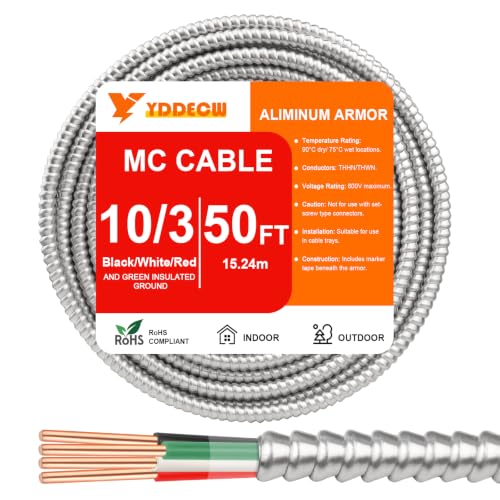
The 50-foot armored reel that flexes around corners without fighting you on the pull.
This is the spool to reach for when you’re hanging a Level 2 EV charger or wiring a 30-amp sub-panel. Each of the three current-carrying conductors is solid 10-gauge bare copper (2.59mm diameter) wrapped with a fourth ground wire, all rated for 600 volts. The 14.6mm aluminum alloy armor is the standout here, meant to shrug off heat up to 90°C while staying flexible enough to bend without kinking the sheathing. Buyers report it pairs cleanly with an MC cutter and holds its shape as you route it.
In the real world, that flexibility is the difference between a tidy install and a frustrating one. The recurring praise centers on how smoothly the armor strips and how well the cable carries a load—one owner drove a 32-amp EV charger through a 91°F garage with the outlet running at 109°F and no breaker trips. It also leans on the cheaper side of the supply-house reels, with one buyer noting it’s the same material you’d grab at a big-box store but at roughly half the cost.
That value shows up in the review pattern: the crowd values the price-to-quality math here more than anything else, followed closely by how well the cable actually functions on the job. The one honest caveat is the occasional rough spot on the metal casing—treat the armor with gloves and it’s a non-issue. The crowd-favorite read, 4.6 stars across 400+ owners, says most electricians and DIYers come back satisfied.
Why the pros reach for it
- Solid bare copper conductors deliver clean, corrosion-resistant current flow for a 30-amp circuit
- Aluminum alloy armor bends without kinking, ideal for tight panel routing
- Rated for 90°C heat, so it holds up in a hot garage or outdoor box
Know before you cut
- Armor can have rough spots—wear gloves while handling
- Wires arrive inside a clear plastic sleeve inside the MC cover; some owners remove it before terminating to ease heat concerns
The verdict: Pull this one first for EV chargers, sub-panels, and 30-amp workshop feeds where you want the cable to route cleanly.
Reach for it if: you want solid copper flexibility and value in a single 50-ft drop; treat the casing with gloves on the pull.
2. Kimbluth 10/3 MC Cable with Ground 50ft
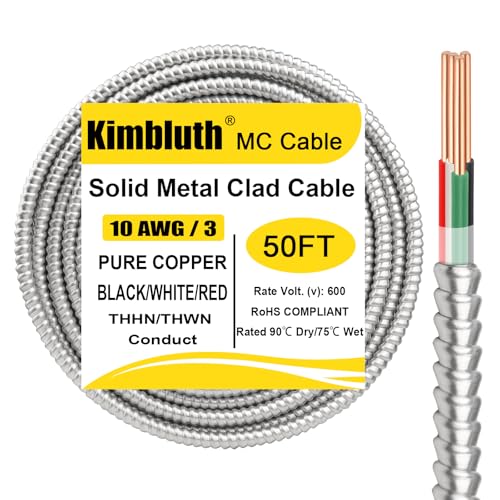
The clean, shiny spool with a fatter ground than code demands—built for inspectors and EV loads alike.
If your 10/3 run feeds a dedicated Level 2 EV charger, this Kimbluth reel is the one electricians keep recommending. It’s solid 10-gauge bare copper for the three conductors, but the ground wire arrives oversized at 8-gauge versus the usual 10-gauge—extra margin for a ground that actually carries fault current. The listing lists the wire diameter at 2.59mm, which is the copper itself; unlike the YDDECW above, this spec sheet doesn’t quote the armor’s 14.6mm outer diameter, so measure your clamps if fit is critical.
The durability story is the same rugged aluminum armor, rated for 90°C and 600 volts, and owners mention it makes tight bends without kinking—one owner ran it 25 feet from an inside panel to an outdoor HVAC disconnect with no trouble. Functionally, it’s been proven at full tilt: a 32-amp EV charger in a 91°F garage, outlet at 109°F, with zero GFCI trips. Owners also say the MC is cleaner and shinier than the Southwire reels they’ve used before.
Quality is what gets mentioned most in the review pattern, with functionality running second—so expect a well-built cable that does its job without drama. The catch is markings: the individual conductors lack the printed identification an inspector may require in the US, so if your area inspects branch circuits, confirm the sheath’s UL 83 / UL 1569 / UL 2556 references (printed on the inner sheath) satisfy your local authority. It’s also priced like the premium option in this pair, which some owners accept as the cost of a reliable long-term feed.
The honest math: A marginally higher price than the YDDECW gets you an oversized 8-gauge ground and a cleaner armor finish—worth it for a hard-wired EV circuit that runs daily.
Where it stumbles: unmarked individual conductors can stall a US inspection, so verify local rules before you bury it in a wall.
The verdict: Choose this when the run is a permanent EV charger or outdoor disconnect where you want a beefier ground and premium armor.
skip it if: your project needs clearly marked conductors for a strict inspection—wire this one for function, not paperwork.
Understanding the Specs
Solid bare copper vs. the listed diameter
When a cable says 10-gauge with 2.59mm diameter, that number refers to the copper conductor itself—not the whole cable. Solid bare copper is the gold standard here: it carries current with less resistance than tinned or stranded, resists corrosion in damp garages, and handles heat better over years of service.
The armor diameter that fits your connectors
For a 10/3 MC cable, the aluminum armor’s outside diameter (often around 14.6mm) is the number that matters when you’re matching connectors and clamps. Measure the armor, not the copper, before you buy fittings—an undersized clamp will fight you all the way into the panel.
FAQ
Will a 10/3 MC cable feed a Level 2 EV charger?
What is the difference between the YDDECW and Kimbluth 10/3 cables?
Can I install 10/3 MC cable underground or outdoors?
Is 10/3 MC cable rated for 30 amps?
Why is there a clear plastic sleeve inside the MC armor?
Will 10/3 MC cable require special tools to cut?
Does the Kimbluth cable pass electrical inspection?
How do I know if I need 10/3 vs 12/3 MC cable?
Final Thoughts: The Verdict
For most people, the 10/3 mc cable winner is the YDDECW 50FT spool because it pairs the crowd’s favorite value with flexible, easy-to-strip aluminum armor that routes cleanly to a 30-amp panel. If you want an oversized 8-gauge ground and a cleaner armor finish for a permanent EV circuit, grab the Kimbluth 50ft reel. And for a hot garage or outdoor disconnect where heat and humidity are the enemy, either 90°C-rated jacket will hold up—just verify your local inspection rules before you bury it.
How We Picked
We do not accept paid placement. Every pick is matched to a real buyer and a real use-case; we do not hands-on test units.
Sources & Methodology
Specifications: manufacturer listings and product documentation. Review insights: verified customer reviews, as of September 2026. Pricing: not shown on this page (it changes often); check the current price via the retailer link.
As an Amazon Associate, KitchPrep earns from qualifying purchases. This does not affect which products we feature.
Related Guides
