
Specs are compiled from manufacturer listings and verified buyer reviews and can change over time — please confirm the key details on the product page before buying.
When the lights go out, that 50-amp cord is the only thing standing between your generator and your fridge, furnace, and phone chargers. A flimsy cord gets hot, sags under stress, and can choke the power your whole home needs. This guide focuses on cords that reliably transfer power from a portable generator to a house inlet box.
I’m Mohammad Maruf — the founder and writer behind KitchPrep. This guide is built by comparing the manufacturers’ published specifications and the patterns across verified customer reviews, so you get each pick’s real strengths and trade-offs instead of marketing spin.
This breakdown covers the best 50 amp generator cords for home backup and RV hookups, balancing length, connector type, and pure-copper build.
Our Picks at a Glance
How To Choose The Best 50 Amp Generator Cord
Buying a generator cord feels simple until you realize the connectors have to match your inlet box perfectly. The wrong end means the cord simply will not plug in, so start by checking what your house or RV accepts before you shop.
Know your two ends
The plug that goes into your generator is almost always a NEMA 14-50P (a 4-prong, 50-amp plug). The end that connects to your house inlet box is either a locking SS2-50R or a CS6364 twist-lock. Check which one your inlet box uses; some cords come with one, others with the other, and a few kits include the inlet box too.
Length is a real trade-off
You can park your generator farther from windows (which helps with carbon monoxide safety) when you choose a longer cord, but every extra foot adds weight and a tiny bit of electrical resistance. For most home hookups, a 25-foot cord with 6/3+8/1 gauge wire (thick copper conductors rated for heavy loads) hits the balance — long enough to reach a safe spot, yet short enough to coil and carry easily.
Quick Comparison
| Model | Best For | Length | Wire Spec | Connectors | Amazon |
|---|---|---|---|---|---|
| CircleCord 50A★ Best Overall | Whole-home backup runs | 50 ft | STW pure copper | 14-50P to SS2-50R | Amazon |
| PlugSaf 25FTTop Performer | RVs and home hookups | 25 ft | STW pure copper | 14-50P to SS2-50R | Amazon |
| Rophor 25 FeetBest Value | Generator-to-house power | 25 ft | STW all-copper | 14-50P to CS6364 | Amazon |
| WELLUCK 25FT | RV campground hookups | 25 ft | PVC jacket | 14-50P to SS2-50R | Amazon |
| CircleRiver Combo | New installs with inlet box | 15 ft | STW 6/3 + 8/1 AWG | 14-50P to SS2-50R + box | Amazon |
| VEVOR Kit | DIY inlet box installation | 25 ft | STW 6/3 + 8/1 AWG | 14-50P to SS2-50R + box | Amazon |
| YOMILINK 50 Feet | Long RV runs at 50A | 50 ft | STW 6/3 + 8/1 gauge | 14-50P to SS2-50R | Amazon |
| Generac 6389 | Premium brand reliability | 25 ft | 6-gauge SOOW rubber | 14-50 to CS6364 | Amazon |
In‑Depth Reviews
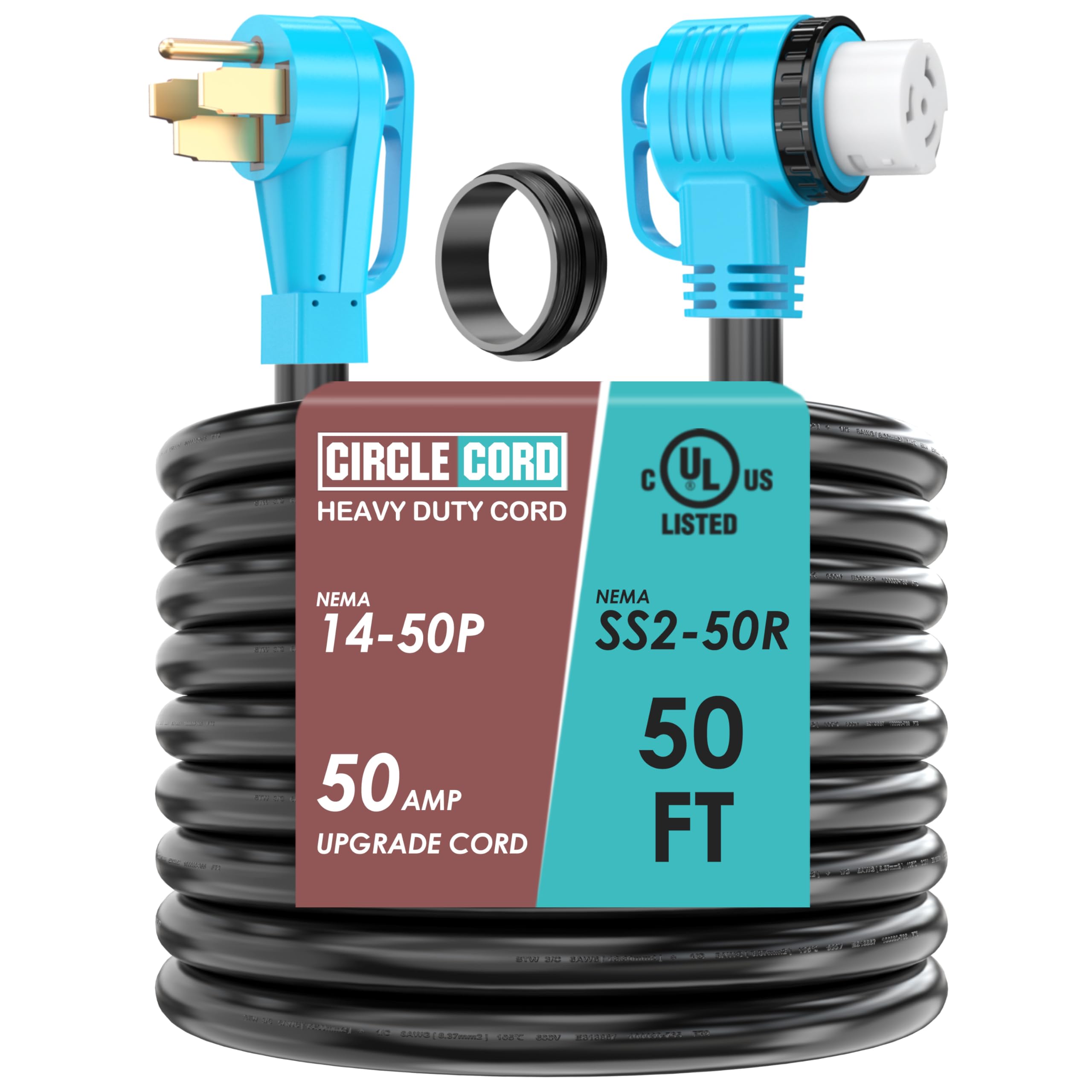
1. CircleCord UL Listed 50 Amp 50 Feet
Our pick — over 4.5★ from 950+ verified ratings; the strongest balance of quality and price.
The 50-foot all-copper heavyweight that serious generator owners reach for when a storm hits.
Its 50-foot reach and 90° right-angle head reduce strain at the power inlet connection. That bend matters — it keeps the heavy cable from pulling on the connection and loosening it over time. The cord is rated for 50 amps and handles up to 12,500 watts at 250V, which covers the biggest portable tri-fuel generators on the market. Buyers report using it with an 11,500-watt inverter generator and a 13,000-watt portable unit, and the pure-copper core delivers whole-home backup without complaints.
Reviewers most often praise its quality, functionality, and durability. The catch is real, though: this cord is “quite literally heavy,” as owners put it. At 50 feet of thick STW cable, you are lifting serious weight every time you coil it. The included storage bag helps, though a few owners note the bag is not built to last forever.
This is a fire-and-forget emergency cord. It has a male 14-50P plug that goes into your generator and an SS2-50R twist-lock female end that secures to your house inlet. The UL listing means the flame-retardant, UV-resistant PVC jacket has been independently tested, giving you one less thing to worry about during a hurricane or blackout.
What earns the praise
- 50-foot reach places the generator safely away from windows and doors
- 90° head eases strain on the inlet connection
- Pure-copper STW core holds up in Florida heat, per owner reports
The honest trade-off
- Heavy — expect to wrestle it when coiling
- Included storage bag is a weak point
Grab it for: a long, reliable run from a big tri-fuel generator to your house inlet.
Think twice if: you need something light to drag around — this one earns its keep but not its carry.
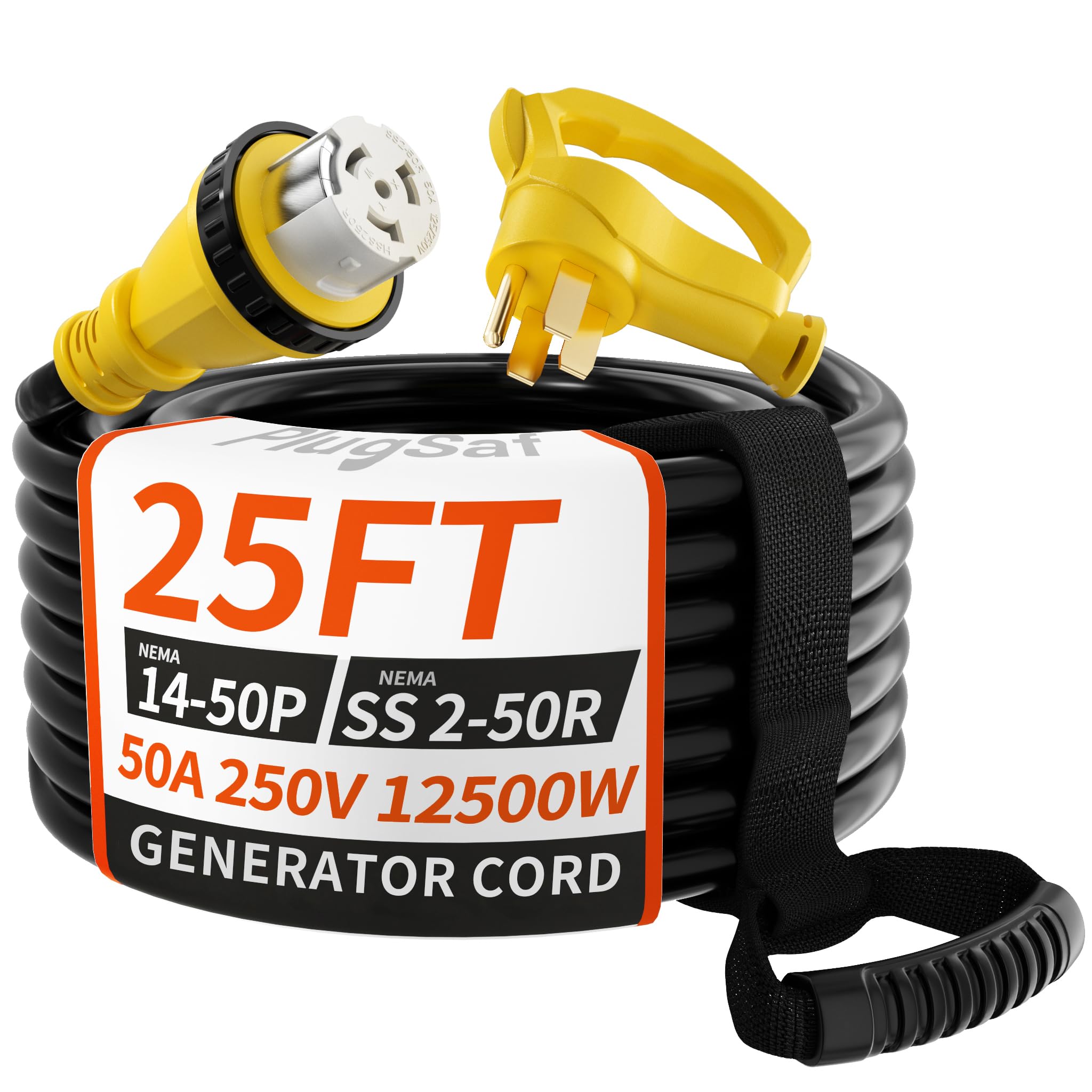
2. PlugSaf 50 Amp 25FT Cord
A flexible 25-footer that coils neatly and locks tight to both your generator and your house box.
What sets this cord apart is ease of use in a package that still feels heavy-duty. The female end uses a twist-lock connector with a threaded ring, so once you twist it onto the inlet box, wind and rain are not going to knock it loose. Buyers describe it as “sturdy and heavy,” yet flexible enough to coil without fighting it — exactly what you want when you are setting up in the dark during an outage.
Reviewers most often cite its quality, with durability and value close behind. One owner swapped out the original cord on a 2018 Keystone Montana 3120RL after it failed within a year, and found this one a more durable replacement. A useful detail for generator hookups: the ergonomic grip handles on the male end make plugging and unplugging easy even with gloved hands.
The one honest gripe is length — at 25 feet, some owners mention it coming up six inches short of where they needed it to reach. Measure your generator-to-inlet path before you buy. If you have room to spare, the flexible 6/3+8/1-style build and weatherproof jacket make this a strong everyday choice.
Why it wins: the twist-lock threaded ring gives a weather-secure grip that other cords lack, at a length most homes can actually use.
Reach for this if: you want a manageable 25-foot cord you can coil and store without a wrestle.
Look elsewhere if: your generator sits far from the inlet — plan for a little more distance than 25 feet.
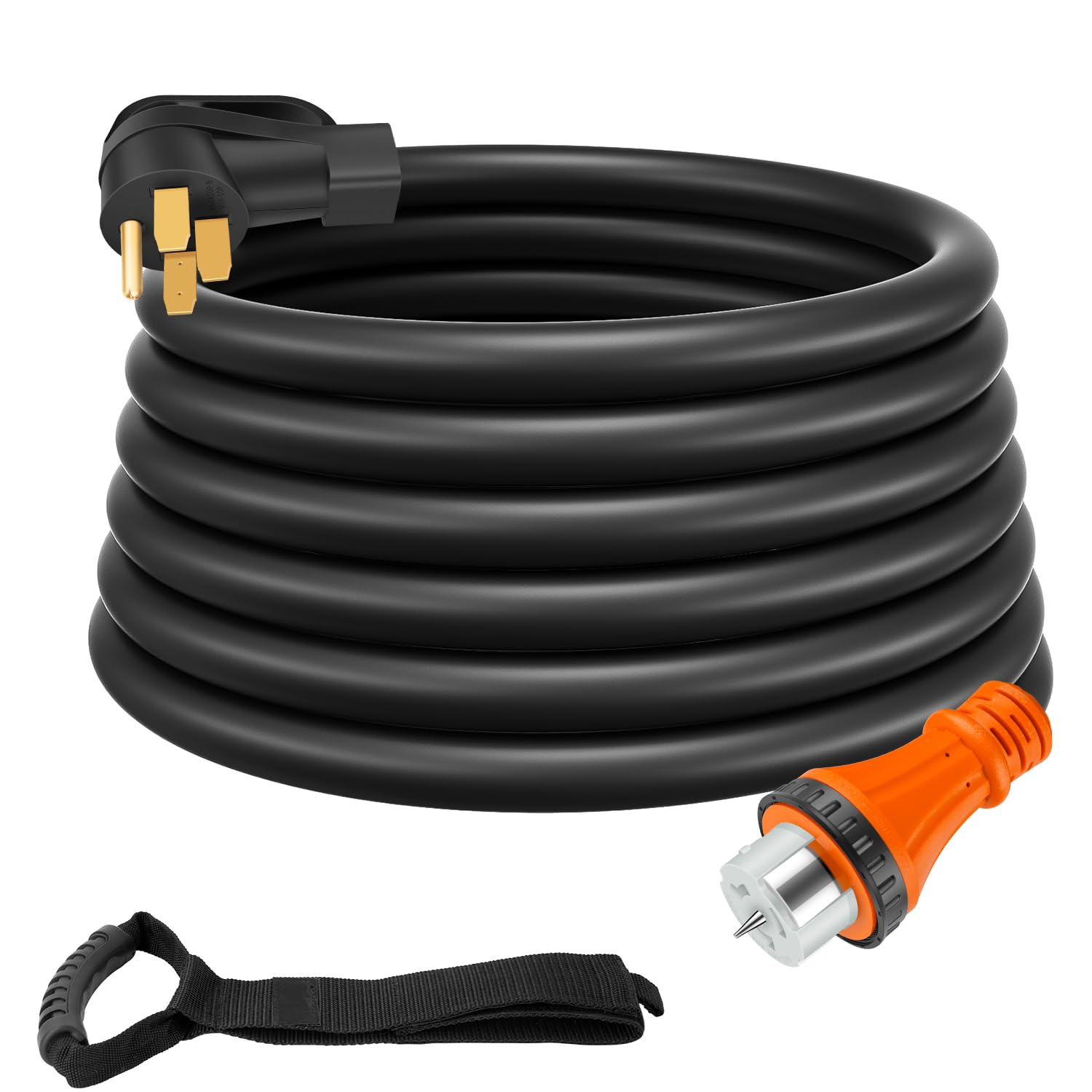
3. Rophor 50 Amp 25 Feet Cord
A 25-footer with a CS6364 end that flexes in the cold and powers a whole house.
Here is the cord to grab when your house inlet box uses a CS6364 connector rather than the more common SS2-50R. The male end is a standard NEMA 14-50P that plugs into your generator, and the locking ring on the female side twists to a secure fit that keeps dust and rain out. Owners powered their homes through an inlet with a Predator 13000 generator, reporting the connection was solid and the build quality stiff and sturdy.
Flexibility is the sleeper feature here. One owner tested it in 60-degree weather and found it flexed nicely — important because stiff cords get brittle and hard to manage in cold snaps. The quality and durability are the most-praised aspects, and at 25 feet with a handle for storage, it is a manageable weight for most people to haul from garage to generator.
The most-discussed downside is minor: the included velcro-style strap to hold the coiled cord does not stay latched. It is a small annoyance, not a reason to pass. This cord is rated for up to 12,500 watts at 125/250V, which matches the output of most large portable generators.
Where it fits: a proven, all-copper cord for CS6364-style inlet boxes that does not cost a premium.
Pick it if: your house inlet is CS6364 and you want tested, heavy-duty reliability.
skip it if: your inlet takes an SS2-50R — you would need a different female end.
4. WELLUCK 50 Amp 25FT Extension Cord

The dependable 25-footer that RV owners buy to replace a factory cord that failed.
For RVers, this cord solves a specific frustration: the factory 50-foot cord is often more than you need at a campground pedestal. This WELLUCK is 25 feet with a NEMA 14-50P male to SS2-50R twist-lock female setup, and it arrives with a cord organizer to keep it tidy when stored. One owner replaced the original cord on a 2000 Damon Intruder that had corroded contacts, and found this one a solid, sturdy upgrade.
Buyers praise its quality and functionality, with one owner reporting five years of dependable use. That kind of real-world longevity is rare in this category. The PVC jacket and twist-lock design hold up to the weather you encounter at campgrounds.
Keep one thing in mind: some owners say the cord is not as thick as they expected. That is not a failure — it just means it is lighter and easier to handle than the beefiest competitors. If you want less weight and more flexibility for campground hookups, that is a feature, not a flaw.
Why campers like it
- 25-foot length is easier to manage than the standard 50-footer
- Cord organizer keeps it neat in storage
- Long-term customers note years of dependable use
The caveat
- Jacket is not as thick as premium rivals — lighter but less armored
Best for: RV owners who want a lighter, more manageable cord than the factory original.
Not ideal for: running a maxed-out 50-amp generator load for days on end — get a thicker jacket for that.
5. CircleRiver 15FT Cord + Inlet Box Combo
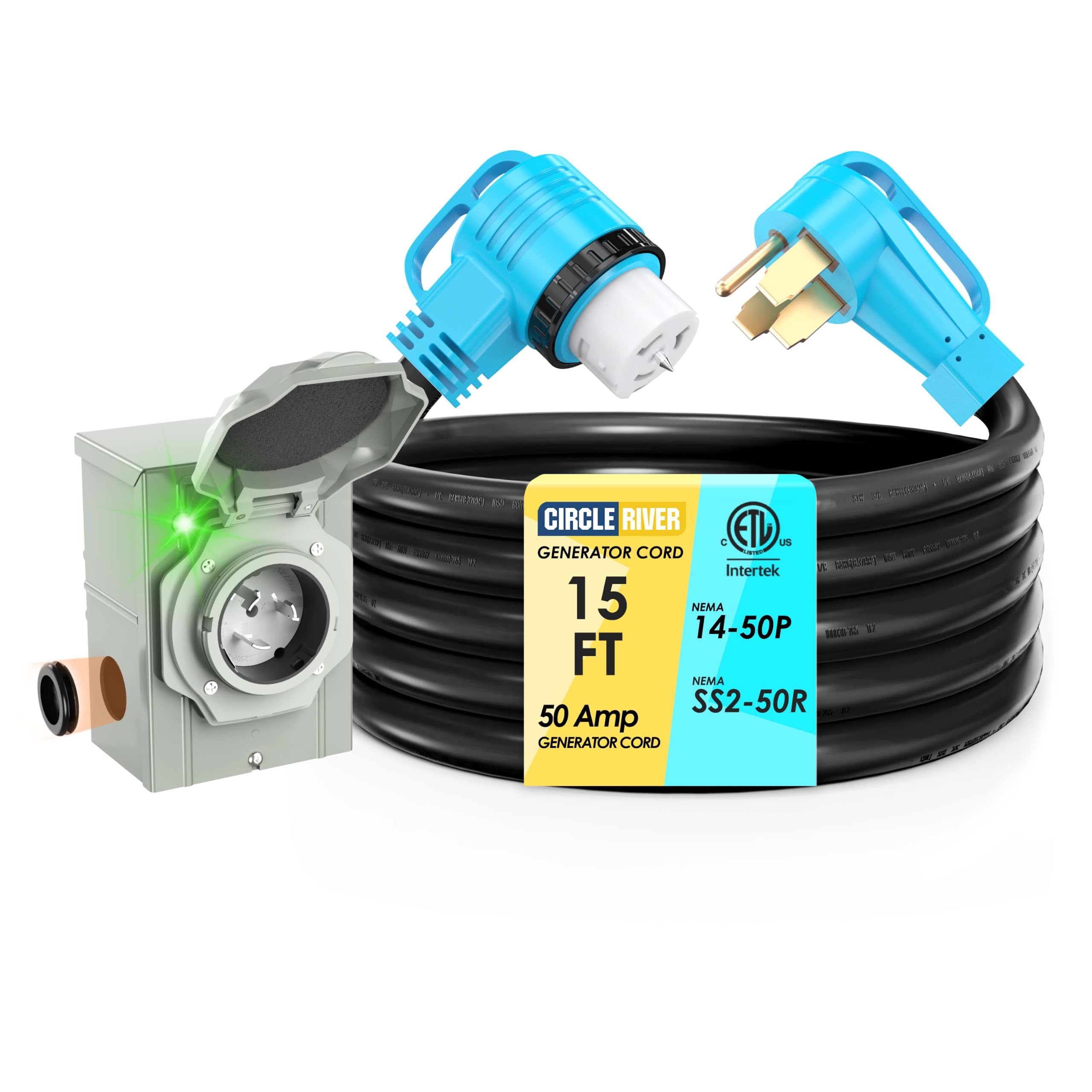
A cord and pre-drilled inlet box bundle that turns a new generator hookup into one purchase.
If you are installing a generator hookup from scratch, this kit removes the guesswork. It bundles a 15-foot 50-amp cord with an SS2-50P pre-drilled power inlet box, so you get both halves of the connection in one ETL-certified package. The cord uses STW 6/3 + 8/1 AWG pure-copper wiring, rated to 12,500 watts, which is plenty for powering a house through a manual transfer switch.
The 90-degree heads on both ends keep the cable from bending sharply at the connection points, and the newly designed grip handle makes plugging and unplugging easy. Owners note the cable is thick, heavy, and well-built — one food trailer operator called it “just what I needed.” The metal gauge on the inlet box is heavier than some rivals, which speaks to the build quality.
Understand the 15-foot cord length trade-off before you buy. It is intentionally short, so your generator stays right next to the inlet box. If your generator must sit far from the house for carbon monoxide safety, a 15-foot reach may force you to place it too close to the wall. But for a tight, permanent install where the generator lives beside the inlet, the bundled convenience and value are tough to top.
Best angle: a complete ETL-certified kit where the cord and inlet box are guaranteed to match, saving you a second shopping trip.
Buy it for: a fresh install where you need both the inlet box and a short cord that fit together perfectly.
Pass if: you need a long cord to keep the generator far from the house.
6. VEVOR 25FT Cord + Inlet Box Kit
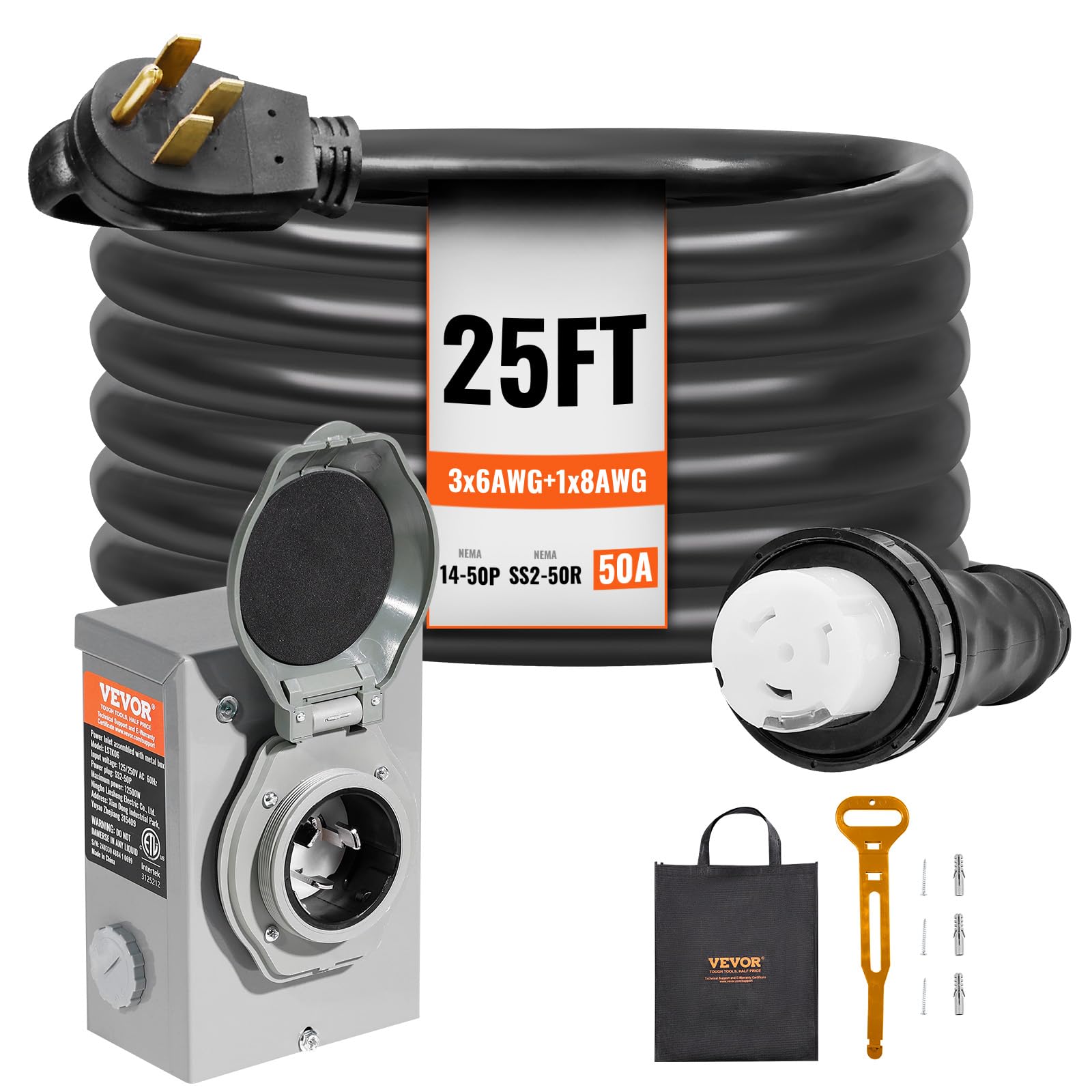
A 25-foot cord plus a pre-drilled inlet box that powered an entire home through a snowstorm.
Here is the kit for the homeowner who wants one package that covers everything. You get a 25-foot STW 6/3+8/1 AWG cord and a pre-drilled SS2-50P inlet box with a flip cover and a clear indicator light that shows when power is flowing. That light is a genuinely useful touch — at night, you can confirm the connection works without walking over to check the generator. One owner powered their entire home for three days straight through a multi-day snowstorm using a 12kW generator.
Owners praise its quality, durability, and easy installation. The inlet box has a rust-resistant coating, and reviews note the install was easy enough for a confident DIYer, with labeled connections that help during wiring. The package even includes a carrying strap and storage bag for the cord.
The recurring honest gripe involves the lugs (the metal connectors inside the box) — several reviewers point out they can loosen over time and recommend tightening them with Loctite thread-locker during install. The green power light is a nice feature, but it does not fix loose lugs, so check them periodically. This is a function of the inlet box, not the cord itself, and it is a 5-minute preventive fix.
Setup wins
- Pre-drilled inlet box with clear power indicator light
- 25-foot cord is long enough for most generator placements
- Carrying strap and bag for storage included
Watch out for
- Inlet box lugs can loosen — apply thread-locker during install
Choose this if: you want a do-it-yourself kit with an inlet box and enough cord reach for typical setups.
Be ready for: a small maintenance step — snug those lugs after a few weeks.
7. YOMILINK 50 Feet 50 Amp Cord
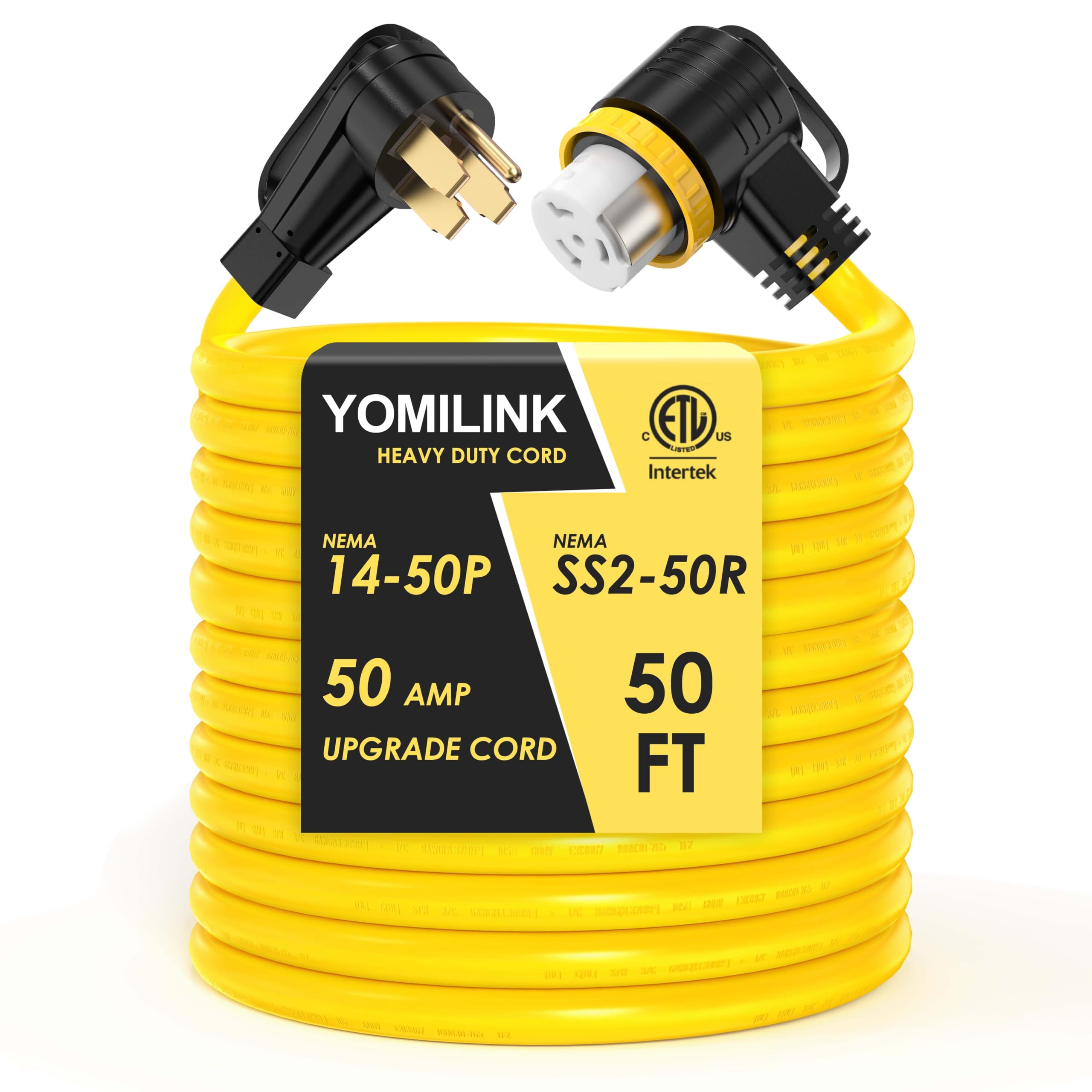
A long 50-foot cord with finger-grip plugs that rolls up tight for RV park and generator duty.
Some situations genuinely need 50 feet — a generator parked the safe distance from a house, or an RV spot where the pedestal is far from the camper. This YOMILINK delivers that reach with an ETL-certified build using 100% copper in a 6/3+8/1 gauge STW jacket. It is rated at 125/250 volts and handles up to 12,500 watts, and both ends feature a 90° head to keep the connection stress-free.
Functionality is the most-praised feature here — shoppers say it works perfectly to power a house from a generator during outages, and RVers appreciate how tightly it rolls up for storage. The finger-grip plugs make it easier to seat and remove the heavy ends, which matters when you are dealing with a 50-foot cord that weighs a fair amount. The included storage bag and strap handle the organization side.
This cord is heavy, and owners are upfront about that. The trade-off is real: thick 6-gauge conductors and a beefy jacket are what make it reliable, and they weigh what they weigh. A few owners note the RV-side connection can feel slightly loose on some campground pedestals, so give the twist-lock a firm turn to seat it fully.
The standout: 50 feet of tested, all-copper reach that still rolls up compactly thanks to a flexible jacket.
Get it for: long runs where the generator or pedestal is far from the connection point.
pass on it if: a 25-foot cord covers your distance — you will save yourself the extra weight.
8. Generac 6389 25 Foot Cord

The brand-name 25-footer with a 6-gauge rubber jacket built for arctic-cold flexibility.
If you want a household brand name you already recognize, Generac brings built-in trust. It handles generators up to 12,500 watts, using a male NEMA 14-50 plug (the standard 50-amp outlet) and a female CS6364 twist-lock end (a locking connector that prevents accidental pull-outs). The Thermoset weather-resistant rubber jacket stays flexible even in extreme cold — a real plus for northern winter outages, where PVC jackets turn stiff and brittle.
Its durability is the top praise, backed by a 6-gauge SOOW rubber cable rated for 105°C, made in the USA with a 2-year warranty. Owners describe the build as “strong, pliable hard rubber, not cheap plastic” and report flawless performance even after a year on a diesel generator. Generac lists specific compatible transfer switches and inlet boxes, so it pairs cleanly with their ecosystem.
The honest trade-offs are the price and the smell. This is the most expensive cord on this list, and new rubber needs a couple of weeks airing out before the odor fades. The male connector end also differs from the Amazon product photo, which surprises some buyers. If you are on a budget, the value picks above deliver similar performance for less. If you want the legacy brand with a USA-made warranty, this is your cord.
The premium case
- Thermoset rubber stays flexible in extreme cold
- Made in USA with a 2-year limited warranty
- 6-gauge SOOW rated for 105°C heat
The premium price
- Costs far more than equivalent-value rivals
- New rubber has a strong odor for a few weeks
Worth it for: owners who want a USA-made, UL-listed cord from the biggest name in home generators.
Not worth it if: you just need a solid 25-foot cord — the value picks do the job for less.
Understanding the Specs
Wire Gauge and Pure Copper
The wire material is the heartbeat of a generator cord. Pure copper conducts electricity far better than cheaper aluminum or copper-clad alternatives, which means less power is lost as heat between your generator and your house. You will see specs like “6/3 + 8/1 AWG” — this means three 6-gauge wires for the hot and neutral lines plus one 8-gauge ground wire. Thicker wire (lower gauge number) handles more current safely over longer distances.
Twist-Lock Connectors
A twist-lock connector is the female end that connects to your house inlet box. Instead of just pushing in, you insert the plug and twist it to lock it into place. This creates a weather-sealed connection that will not slip out from vibration, wind, or accidental tugs. Look for a locking ring or threaded collar on the female end — it is the difference between a cord that stays put in a storm and one that pops loose when you need it most.
FAQ
What is the difference between a 14-50P and a CS6364 connector?
How long can a 50 amp generator cord be without losing power?
Will a 50 amp cord work with a smaller generator?
What does STW mean on a generator cord?
Can I use a 50 amp RV cord for my home generator hookup?
Why does my new generator cord smell like rubber?
Is an ETL or UL listed cord worth the extra money?
What gauge wire do I need for a 50 amp cord?
Final Thoughts: The Verdict
For most buyers, the 50 amp generator cord winner is the CircleCord 50-foot because it combines the reach, all-copper build, and verified performance that whole-home backup demands. If you want a complete install package, grab the VEVOR kit with its inlet box. And for the brand-name crowd that trusts Generac’s 2-year warranty, the Generac 6389 is the premium route — just know the value picks deliver similar power for less money.
How We Picked
We do not accept paid placement. Every pick is matched to a real buyer and a real use-case; we do not hands-on test units.
Sources & Methodology
Specifications: manufacturer listings and product documentation. Review insights: verified customer reviews, as of September 2026. Pricing: not shown on this page (it changes often); check the current price via the retailer link.
As an Amazon Associate, KitchPrep earns from qualifying purchases. This does not affect which products we feature.
Related Guides
