
Specs are compiled from manufacturer listings and verified buyer reviews and can change over time — please confirm the key details on the product page before buying.
The real test of a solar setup is how it performs after sunset, when stored energy must carry the load. A reliable battery bank extends solar power past daylight, keeping fridges, tools, and campers running through the night and overcast days. Here are the ten most practical solar batteries, ranked by their strengths—from budget 100Ah units to whole-home server racks.
I’m Mohammad Maruf — the founder and writer behind KitchPrep. This guide is built by comparing the manufacturers’ published specifications and the patterns across verified customer reviews, so you get each pick’s real strengths and trade-offs instead of marketing spin.
If you are pairing panels with a new storage bank, these are the batteries for solar that owners consistently rate highest for lasting through real-world nights and recharging dependably.
Our Picks at a Glance

How To Choose The Best Batteries for Solar
First, calculate your nightly power draw and how long you need backup. A camper with LED lights and a phone charger needs far less capacity than a home running a refrigerator and sump pump during an outage.
Match the Capacity to Your Draw
Battery capacity is measured in amp-hours (Ah), which indicates the fuel tank size. A 100Ah battery at 12 volts stores about 1,280 watt-hours of energy. Avoid draining to zero: lithium batteries can safely discharge to 20% remaining, while lead-acid AGM types should stop at 50% to preserve lifespan.
Choose the Right Chemistry
Lithium iron phosphate (LiFePO4) is the modern solar standard, enduring daily deep discharges without degradation. A quality unit lasts thousands of charge cycles—many rated for 4,000 cycles at full discharge—versus a few hundred from lead-acid. AGM still makes sense when you need cheap, rugged storage and weight isn’t an issue.
Check the Safety Electronics
Every lithium battery needs a Battery Management System (BMS) to watch over charging. The most valuable feature for solar is low-temperature protection: it stops charging below freezing to prevent permanent cell damage. A 200A BMS is enough headroom for most RV and small-home inverters running heavy loads.
Quick Comparison
| Model | Best For | Capacity | Weight | BMS | Amazon |
|---|---|---|---|---|---|
| Litime 12V 100Ah★ Best Overall | Marine & RV smart setups | 100Ah | 22.2 lbs | 20+ protections | Amazon |
| ECO-WORTHY 12V 100AhBudget Champion | Budget-friendly Group 24 swaps | 100Ah | 23.2 lbs | 100A BMS | Amazon |
| Renogy 12V 200Ah AGMStationary Powerhouse | Stationary off-grid banks | 200Ah | 127.9 lbs | — | Amazon |
| Dumfume 12V 300Ah | High-capacity value builds | 314Ah | 57 lbs | 200A BMS | Amazon |
| ECO-WORTHY 12V 280Ah Metal | Fire-safe RV installs | 280Ah | 60 lbs | 200A BMS | Amazon |
| HumsiENK 12V 300Ah Mini | Compact high-capacity needs | 314Ah | 59.5 lbs | 200A BMS | Amazon |
| Litime 12V 200Ah Plus | Freezing-climate charging | 200Ah | 44.1 lbs | 200A BMS | Amazon |
| Renogy 300Ah Mini | Space-saving larger banks | 300Ah | 55.1 lbs | 200A BMS | Amazon |
| ECO-WORTHY Cubix100 48V | Whole-home off-grid power | 600Ah (6x100Ah) | 600 lbs | 100A BMS ea. | Amazon |
In‑Depth Reviews
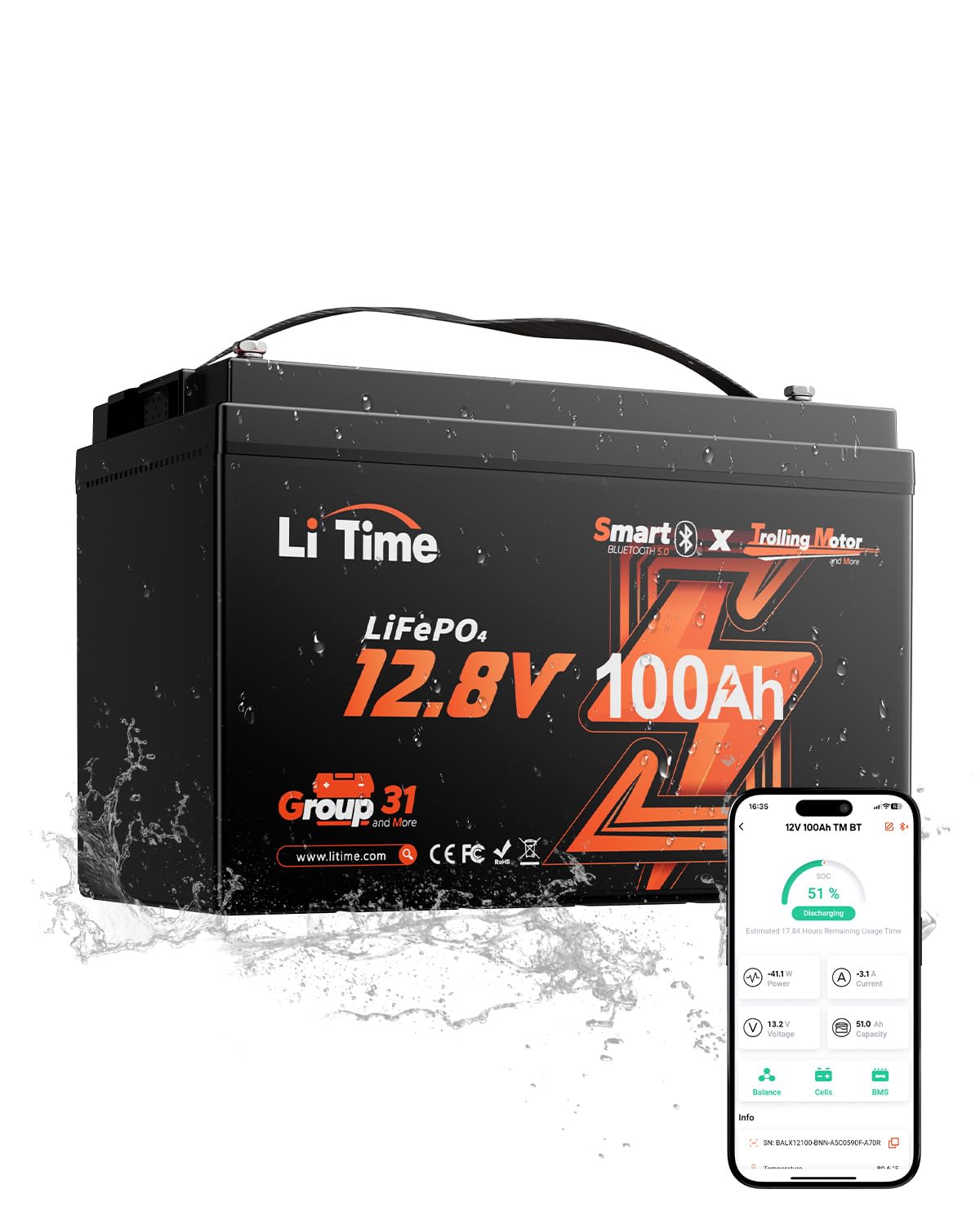
1. Litime 12V 100Ah Trolling Motor LiFePO4 Battery
Our pick — over 4.5★ from 600+ verified ratings; the strongest balance of quality and price.
The featherweight smart pick that tells you its state of charge from your phone.
At just 22.2 lbs in a standard Group 31 size, this battery cuts real weight off your boat or RV tongue. That is about half the weight of the equivalent AGM it replaces, which changes how your rig handles and how much gear you can carry. Owners who swapped two lead-acid units for one of these report shedding 60 lbs of tongue weight—a difference you feel every time you hitch up.
The smart layer is the headline here. Bluetooth auto-connects in seconds, letting you check voltage, control discharge, and run system checks from the LiTime app. Real-world users love that it powers a 12-volt, 10-cu-ft fridge for 12+ hours, and after a 10-hour Garmin LiveScope session one angler still had 83Ah in the tank. The built-in 1280Wh energy capacity delivers roughly twice the usable range of traditional lead-acid, since you can safely drain it to 20% instead of stopping at 50%.
Cold weather is handled, not feared. Smart low-temp protection stops charging below 32°F and stops discharging below -4°F, so a freezing night won’t ruin the cells. The 20+ safety protections guard against overcharge, overheating, and shorts while the IP65 waterproofing shrugs off spray and dust. It also expands to a 4P4S setup reaching 20.48kWh if your power needs grow into home backup territory. The crowd backing this pick is enormous—it holds a 4.7-star average across a huge owner base, with battery quality and sheer longevity the most-praised traits by far.
Why Owners Love It
- Weighs 22.2 lbs—about half an equivalent AGM
- Bluetooth app gives live state of charge, no guessing
- Rated for 4,000+ deep cycles at full discharge
Who Should Look Elsewhere
- Not built for starting engines or golf carts
- The app asks for sign-ins frequently, per some owners
Reach for this if: you want a drop-in lithium upgrade with phone monitoring for marine, RV, or small solar setups.
Think twice if: you need a starter battery or a unit for a golf cart—LiTime says this is for energy storage, not those jobs.
2. ECO-WORTHY 12V 100Ah LiFePO4 Battery with Bluetooth
The Group 24 drop-in that delivers verified capacity without the premium brand tax.
This battery matches the exact BCI Group 24 footprint at 6.61 x 10.24 x 8.23 inches, so it slides into the same spot as your old lead-acid unit with zero wiring changes. That universal fit is the reason trolling motor and RV owners pick it as the simplest possible upgrade path. Weighing 23.2 lbs, it is roughly a third of the heft of the AGM it replaces—a lighter boat rides higher and responds quicker.
Buyers who actually measured the output found it delivers around 90-98% of its rated capacity through an inverter—roughly 1.05 kWh in one owner’s test. That kind of honesty matters when a cheap cell often falls short. It is also a workhorse: two of these wired in series via XT60 run a portable AC for 10+ hours, and a single unit keeps diesel heaters going for days. One owner summed up the appeal plainly: “Holds charge well and provides even power flow.” The ECO-WORTHY app tracks voltage, current, and remaining life over Bluetooth 5.1, helping you plan fishing trips without power anxiety.
The built-in 100A BMS watches for overcharge, over-temperature, and short circuits, while low-temp cutoff stops charging below 19.4°F to safeguard winter cells. Owners running three units in a 36V golf cart report consistent, reliable performance. It also expands in a 4P2S layout up to 10.24kWh for bigger solar ambitions later. The pile of positive feedback is deep—a 4.4-star average across hundreds of owners—with value for money and lightweight design among the most common praise.
What Wins People Over
- Holds a 100% charge for weeks with negligible Bluetooth drain
- Verified ~90-98% of rated capacity in owner tests
- Replacement Group 24 design fits without modifications
The Honest Trade-Off
- Bluetooth is mandatory here—some owners wish it were optional to save cost
- Shipping can take up to three weeks, per buyer reports
Grab it for: a budget-friendly, verified 100Ah upgrade where Group 24 sizing fits your tray.
Pass if: you want a bare-bones battery without app connectivity—you would pay for a feature you won’t use.
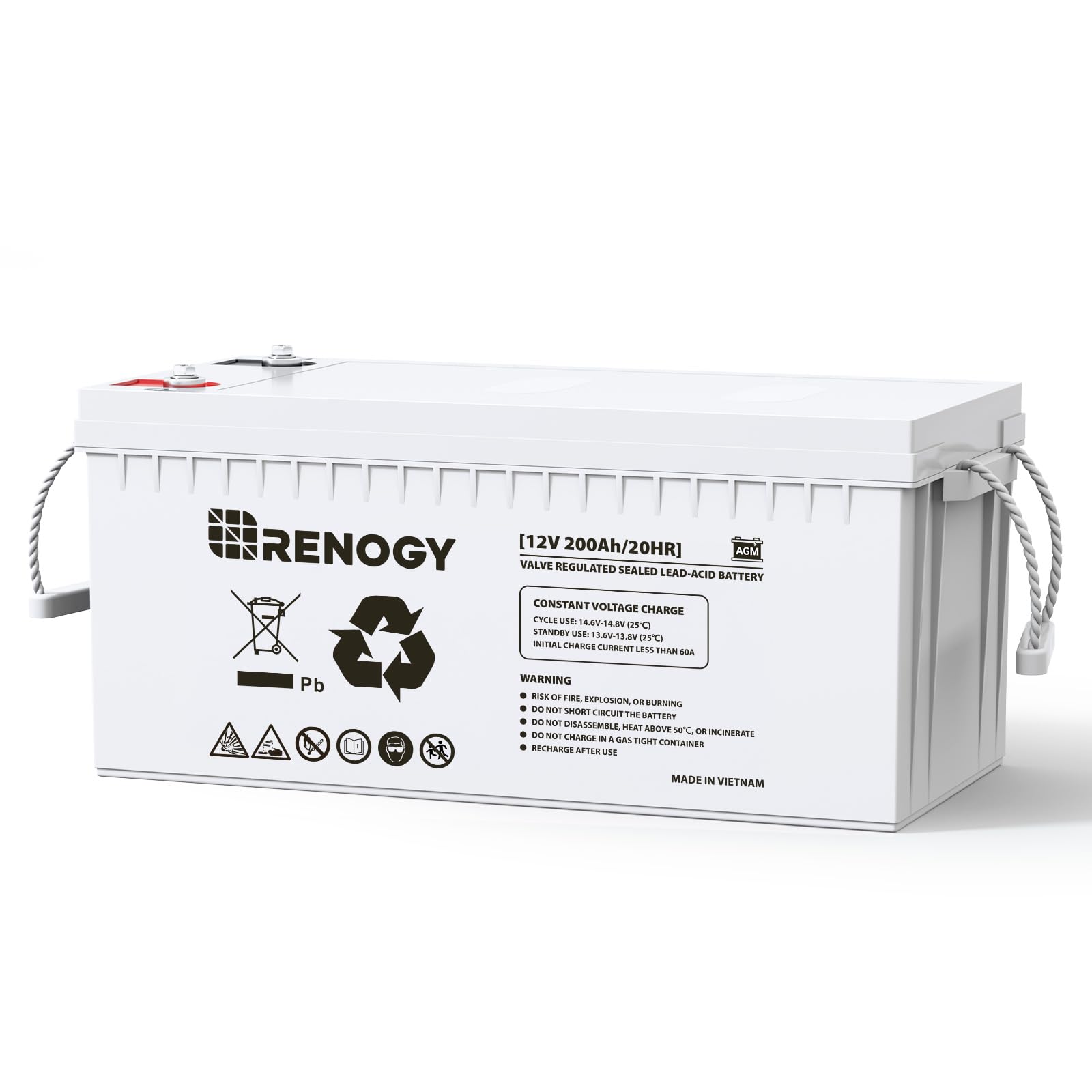
3. Renogy 12 Volt 200Ah Deep Cycle AGM Battery
Double the amp-hours of our top pick—if you have the floor space and the back for 127.9 lbs.
Here is the honest fork in the road: this AGM holds 200 amp-hours—exactly 2.0x the capacity of the Litime 100Ah above—but weighs a back-breaking 127.9 lbs. It is the right choice when the battery sits in a stationary spot like a shed or utility room and never needs to move. Owners running an 860W solar array with a 3000W inverter report it handles a well pump without complaint. One builder wired eight of these into an 800Ah parallel bank and measured a steady 4A discharge over 120 hours—real, verifiable endurance.
The maintenance-free design uses thick absorbent glass mat (AGM) separators, which means no acid leaks and no topping up fluids. Proprietary alloy plates deliver discharge currents up to 10 times the rated capacity, so sudden heavy loads like a fridge compressor kicking on won’t sag the system. The self-discharge rate sits below 3% per month at 77°F—about five times lower than flooded lead-acid—so it holds a charge well during long storage stretches between trips.
Cold performance is a genuine strength here. The improved electrolyte formula keeps capacity and discharge stable below 32°F, making it a dependable choice for unheated cabins. Practical notes from owners: it survived a 12-hour outage powering essentials, and Renogy even shared the Peukert constant (1.1) and charge efficiency (90%) for those tuning a Victron SmartShunt. The caveat is depth of discharge—keep it to roughly 50% to protect cycle life, unlike lithium which safely runs deeper. With a 4.4-star average across thousands of owners, this is a proven, if traditional, workhorse.
Why It Endures
- 200Ah capacity with stable output below 32°F
- Maintenance-free AGM—no fluid checks or leaks
- Handles big surge loads up to 10x rated capacity
Where It Falls Short
- At 127.9 lbs, moving it is a two-person job
- Lead-acid chemistry means roughly half the usable capacity of lithium
Choose it when: weight is irrelevant and you want a proven, lower-cost AGM for a fixed off-grid bank.
skip it if: your setup lives in a vehicle where every pound affects handling or fuel.
4. Dumfume 12V 300Ah (314Ah) LiFePO4 Battery with 200A BMS
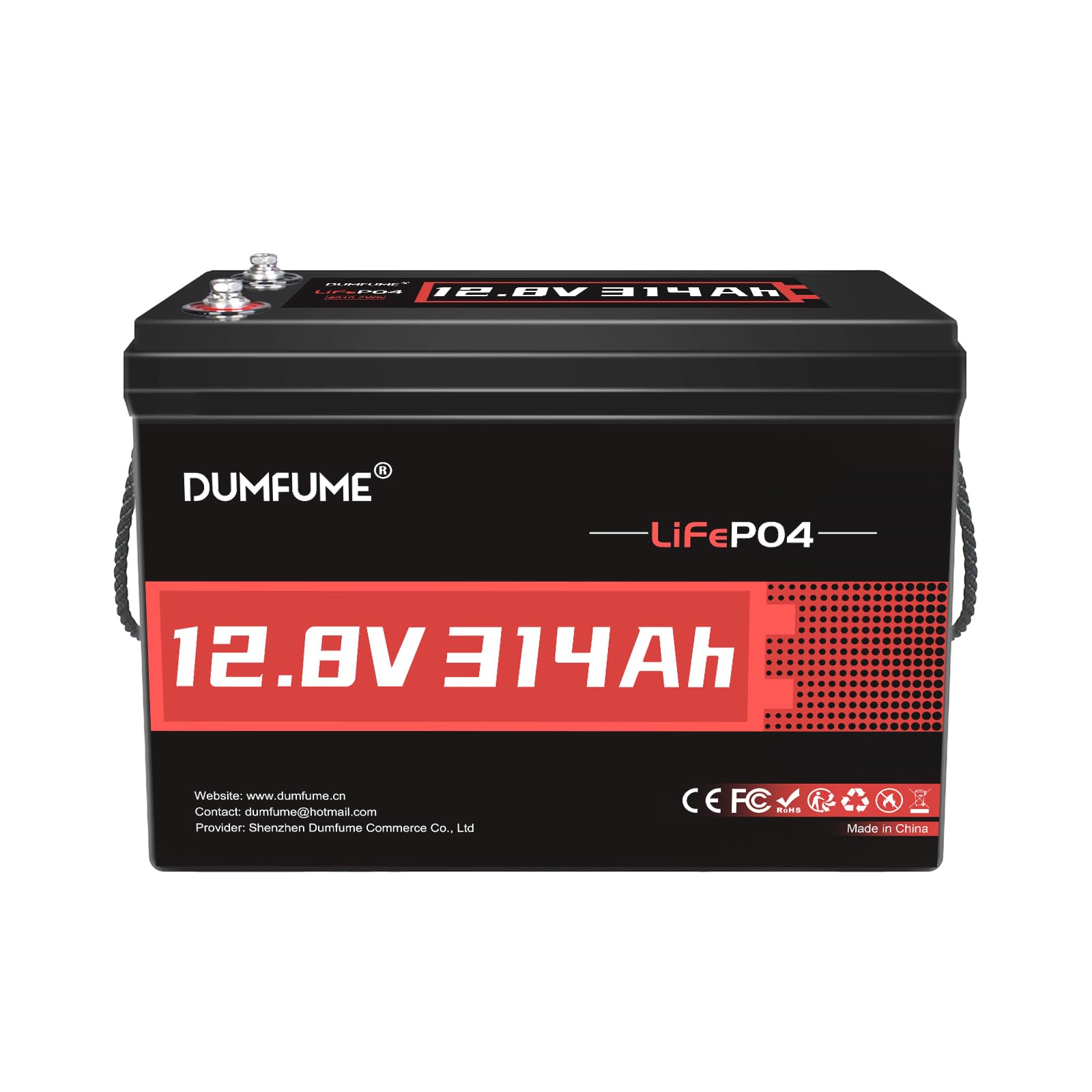
Massive 314Ah storage with nearly double the energy density of lead-acid—at a value price.
The most amp-hours per dollar in this lineup lands here. Dumfume crams 314Ah into a 57-lb package—about one-third the weight of a comparable lead-acid battery—while delivering up to 4019.2Wh of stored energy. Owners running two of these in an RV say the pair easily handles a 7-cu-ft fridge on an 800W solar array, discharging to 80% instead of the 50% ceiling on their old AGMs. That extra usable depth is why two of these outperform the same nominal capacity in lead-acid.
The 200A BMS is the silent guardian here, providing overcharge, overdischarge, overcurrent, overheat, and short-circuit protection with high/low temperature automatic cut-off. The high-strength, impact-resistant ABS casing adds heat, weather, and flame resistance for harsh environments. Cycle life estimates reach up to 10 years, with 4,000 cycles at 100% depth of discharge and up to 15,000 cycles at 60%—a massive jump from the 200-500 cycles typical of lead-acid. One buyer chose this brand specifically for its build quality after watching a Project Farm teardown.
Performance feedback is strong, with many noting it works well even on just 100 watts of solar. There is honest nuance here: some buyers report units that won’t fully charge or arrive needing a parallel jump to activate—likely a BMS quirk rather than a design flaw. It also runs fine as a 24V 100Ah unit in home solar setups. The 5-year manufacturer warranty covers your back, though one reviewer noted it applies best to direct purchases. A 4.4-star average across hundreds of ratings confirms the consensus: solid quality and light weight for the money.
The Big Wins
- 314Ah capacity at just 57 lbs
- Runs a fridge easily on modest 800W solar
- Deep 80% discharge capability vs lead-acid’s 50%
What to Watch
- Some units arrive needing a parallel jump charge to activate
- Old RV chargers are incompatible—plan a full lithium upgrade
Best for: RV and solar builders who want maximum storage per dollar and don’t need smart features.
Not for: those who want guaranteed plug-and-play activation—occasional units need a helping hand to wake up.
5. ECO-WORTHY EnergyRock 12V 280Ah Metal Case LiFePO4 Battery
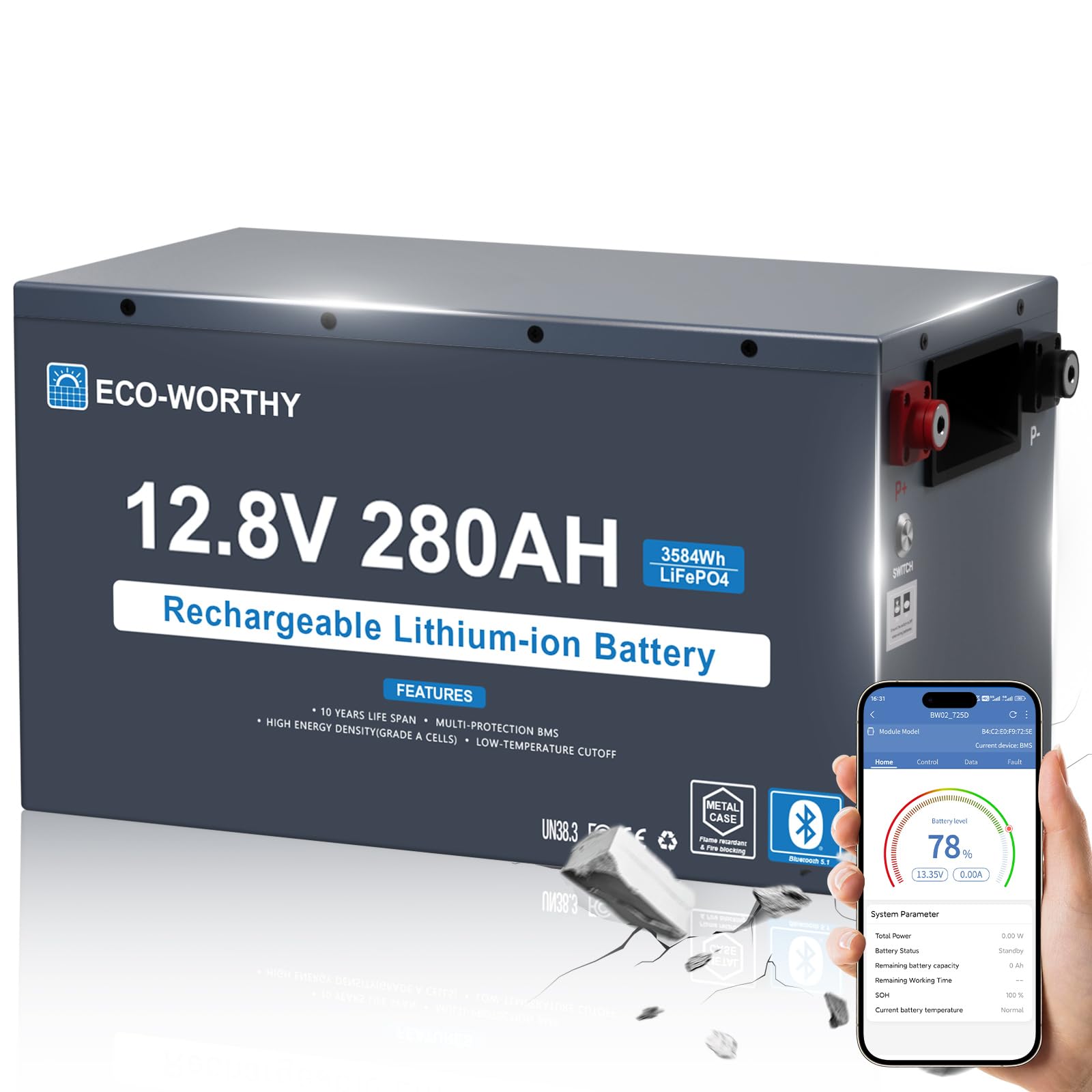
A rugged metal shell and one-touch safety switch for installations where fire safety matters most.
Most lithium batteries ship in plastic boxes. This one arrives in a heavy-duty metal enclosure built for enhanced heat resistance and fire protection—a meaningful difference if the battery lives inside a camper van or near living space. The reinforced case includes internal cell holders that resist road vibration, and four mounting feet let you bolt it directly into your RV without an extra battery box. Owners call it a genuine upgrade over plastic-shelled rivals, especially for off-road use.
The defining feature is a physical safety switch on the unit. One touch cuts the discharge circuit entirely, which is ideal for installation, maintenance, or long-term storage where you want zero parasitic draw. Owners pair it with a 12,000 BTU AC unit and report about 2 hours of runtime down to 30% charge—real cooling power on a hot day. The 280Ah capacity translates to 3584Wh of storage, and the built-in 200A BMS handles the startup surge of heavier gear like a 1/2 HP sump pump, which one buyer runs for around 5 hours continuously. Bluetooth monitoring with a 12-ft range tracks voltage and charge status in real time.
Cold-climate owners get low-temp protection that stops charging at 20°F to shield the cells, and field reports confirm it operates normally at that temperature. A common comparison from buyers: it weighs about the same as a comparable AGM but stores 2.5x the energy. The owner base is enthusiastic—a 4.6-star average across hundreds of ratings—with battery quality and long-lasting power as the most frequently mentioned strengths. One buyer called it out for running a 1000-watt amp without breaking a sweat.
Standout Strengths
- Metal case with mounting feet—no battery box needed
- One-touch safety switch prevents accidental discharge
- Runs a 12,000 BTU AC about 2 hours to 30%
Things to Consider
- At 60 lbs, it is not a lightweight—comparable to AGM
- Lacks an IP water-resistance certification, per owners
Ideal for: RV and camper owners who want a fire-resistant, vibration-proof lithium bank with easy on/off control.
Look elsewhere if: you need a sealed waterproof rating for a wet environment—this one ships without IP certification.
6. HumsiENK 12V 300Ah (314Ah) LiFePO4 Battery Mini Size with Bluetooth
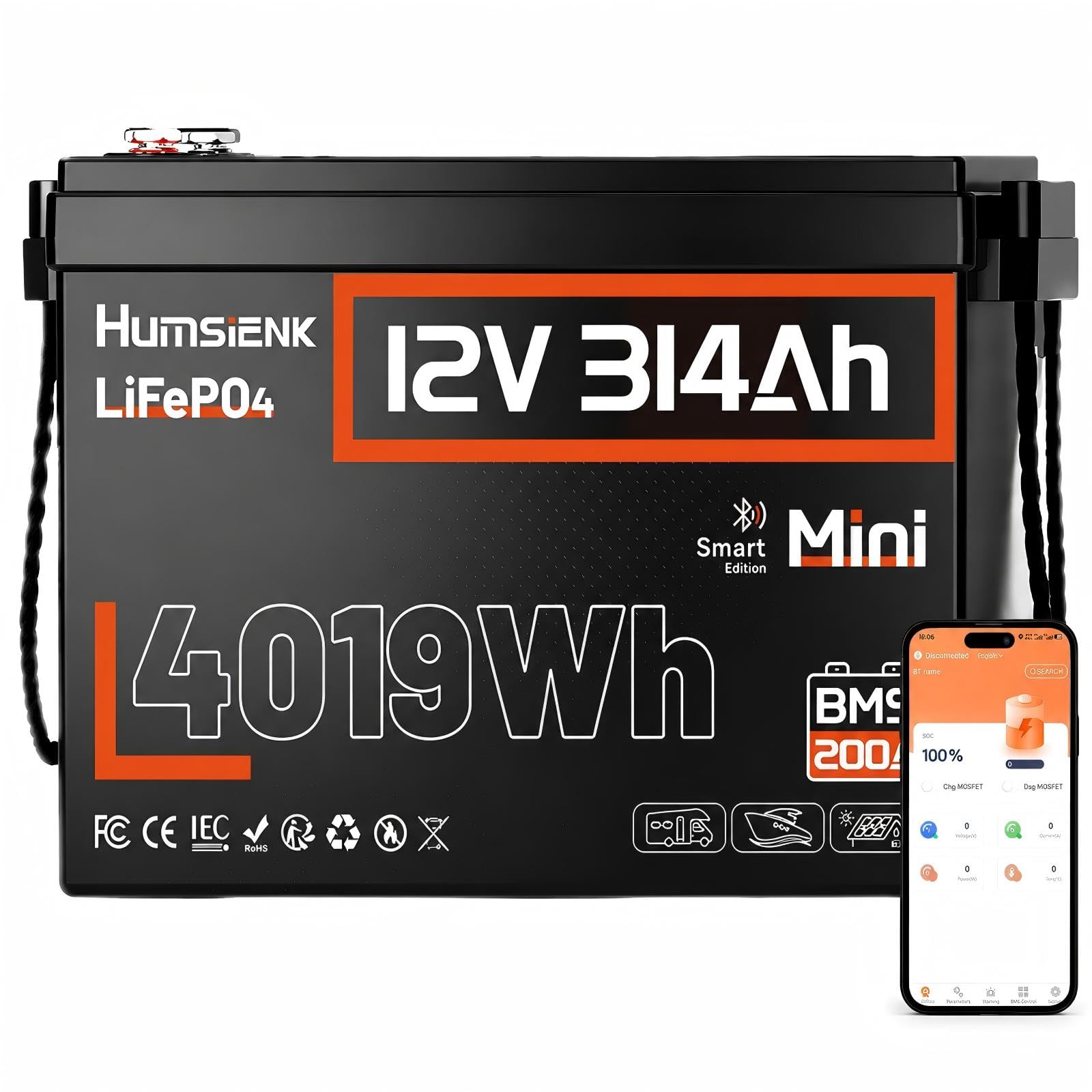
A 314Ah bank that squeezes into tight boxes—roughly the size of three parallel 100Ah units combined.
Space is the whole game here. This 314Ah battery measures just 15.1 x 7.6 x 9.7 inches and delivers around 4.01 kWh of energy—enough to replace three 12V 100Ah lithium batteries wired in parallel, but in a single compact footprint. At 59.5 lbs, it is roughly 40% lighter than an equivalent lead-acid setup and fits neatly into existing battery boxes. Owners upgrading from a 100Ah unit note it is barely bigger than the old battery but holds three times the energy.
Real-world draw is impressive: one buyer ran an 8,000 BTU air conditioner in eco-mode for 11 hours down to 50% drain through a 2000W inverter. The full-aluminum internal frame prevents swelling and adds shock resistance, while the durable ABS case wraps it all up. Bluetooth 5.0 through the HumsiENK app streams live voltage, current, capacity, and temperature with a 15-meter range—owners say the data refreshes several times per second with detailed cell-level info and alarms.
The 200A BMS handles heavy loads above 2000W and includes low-temperature cut-off to prevent charging below freezing, plus high-temperature protection above 158°F. Support for three charging methods—solar, generator, and grid—makes it flexible for any setup. It expands to 4S4P for a 51.2V/1256Ah system reaching 64.3kWh. The review consensus lands around a 4.4-star average across hundreds of owners, with battery quality and lightweight design as the most-cited positives, though a minority report units that resist a full charge.
Why It Stands Out
- Replaces three 100Ah batteries in one compact unit
- Runs an 8,000 BTU AC for 11 hours to 50% drain
- Aluminum internal frame prevents swelling
Keep in Mind
- Occasional reports of units that won’t fully charge
- App requires download from store or QR code for Android
Pick this for: RV and boat owners with tight battery compartments who need big capacity in a small box.
Reconsider if: you’ve seen mixed reports on full charging and want a zero-risk activation experience.
7. Litime 12V 200Ah Plus Self-Heating LiFePO4 Battery

The lithium battery that warms itself up so winter charging actually works.
Lithium batteries famously refuse to charge below freezing—a dealbreaker for cold-climate solar. This Litime solves it with automatic self-heating: when charging temperature drops below 41°F, the battery heats itself, stopping at 50°F. No manual work, no waiting for a warm day. It charges reliably down to -4°F and discharges from -4°F up to 140°F, making it a true four-season option for RVs and off-grid cabins that stay active all winter.
Beneath the heating layer sits a 200Ah lithium iron phosphate pack weighing 44.1 lbs—a notable 25% weight reduction compared to equivalent AGM batteries, per owner feedback. That lighter footprint makes installation easier and reduces wear on your rig. Field reports show real stamina: one owner ran an RV for 1.5 days on a 10A average draw with 60A spikes, including a Starlink terminal overnight. Another reported staying powered through 7-8 hours of heavy use, and a third noted it “runs a Coleman 1400BH perfectly.”
The sturdy BMS survived a 20V overcharge event intact—protecting the cells and recovering to 11.5V after a full discharge. Expansion goes to 4S4P for a 48V 800Ah system delivering 40.96kW of power and 40.96kWh of energy, suitable for larger homes or serious marine setups. It also handles 30-70 lb thrust trolling motors and golf carts without complaint. A 5-year support plan with 24/7 online help backs the purchase. Across hundreds of ratings it holds a 4.5-star average, with build quality and battery life as the most-discussed strengths.
Why It Shines
- Charges down to -4°F with auto self-heating
- 44.1 lbs—roughly 25% lighter than AGM equivalents
- Survived a 20V overcharge with BMS intact
Things to Know
- At 21 inches long, it may not fit smaller battery boxes—measure first
- Some capacity feedback is mixed; verify your charging source
Choose this for: winter RVing, cold cabins, or any solar setup where freezing temperatures shut down ordinary lithium batteries.
pass on it if: your climate never drops near freezing—you would pay extra for a heater you won’t need.
8. Renogy 300Ah LiFePO4 Battery, 12V Mini Size Deep Cycle

A premium brand packs 300Ah into the footprint of an old 100Ah—three times the energy, same space.
Renogy’s engineering story here is the footprint. They took a 300Ah capacity and fit it into roughly the same form factor as their old 100Ah battery—15.12 x 7.64 x 9.96 inches at 55.1 lbs. The claimed weight saving is stark: 57% lighter than a 12V 200Ah lead-acid battery, and 31% more space-efficient than other 12V 300Ah LiFePO4 units. One owner who swapped a 100Ah unit called it “only a little bit bigger, and still light enough for me to lift.” Another has camped a full weekend on it with all the power a teardrop camper needs.
The 3840Wh real storage capacity means a 1 kWh device runs for nearly 4 hours—a useful planning number for off-grid living. Grade-A prismatic cells support over 5,000 cycles at 80% depth of discharge, with a projected lifespan beyond a decade. The 200A BMS delivers complete protection against overcharge, overdischarge, and short circuits while self-balancing cell voltage. Cold-weather safety pauses charging below 32°F and use below -4°F to keep cells safe in harsh winters.
Buyers appreciate that everything integrates into Renogy’s single-app ecosystem—one interface for battery and solar gear. The safety pedigree is extensive: MSDS, UN38.3, FCC, CE, PSE, RCM, and UKCA certifications, plus ABYC standards for marine use. Expansion supports up to 4S4P for a 48V (51.2V) 1200Ah system. The 5-year prorated warranty covers material and workmanship. Caveats come from the small owner base of 20 ratings: a 4.3-star average mostly reflects frustrations with the seller’s return policy rather than the hardware itself—the handful of hardware reviews are glowingly positive.
Premium Perks
- 300Ah in the footprint of a typical 100Ah unit
- 55.1 lbs—57% lighter than a 200Ah lead-acid
- Single-app ecosystem with Renogy solar gear
What Gives Pause
- Fewer owner reviews than rivals—less long-term data
- Return shipping disputes reported with the seller
Worth it for: brand-loyal buyers who want Renogy’s ecosystem, premium cells, and a tiny footprint in one package.
Hold off if: you prefer buying from sellers with a more flexible, owner-friendly return policy.
9. ECO-WORTHY Cubix100 48V Server Rack Battery Kit
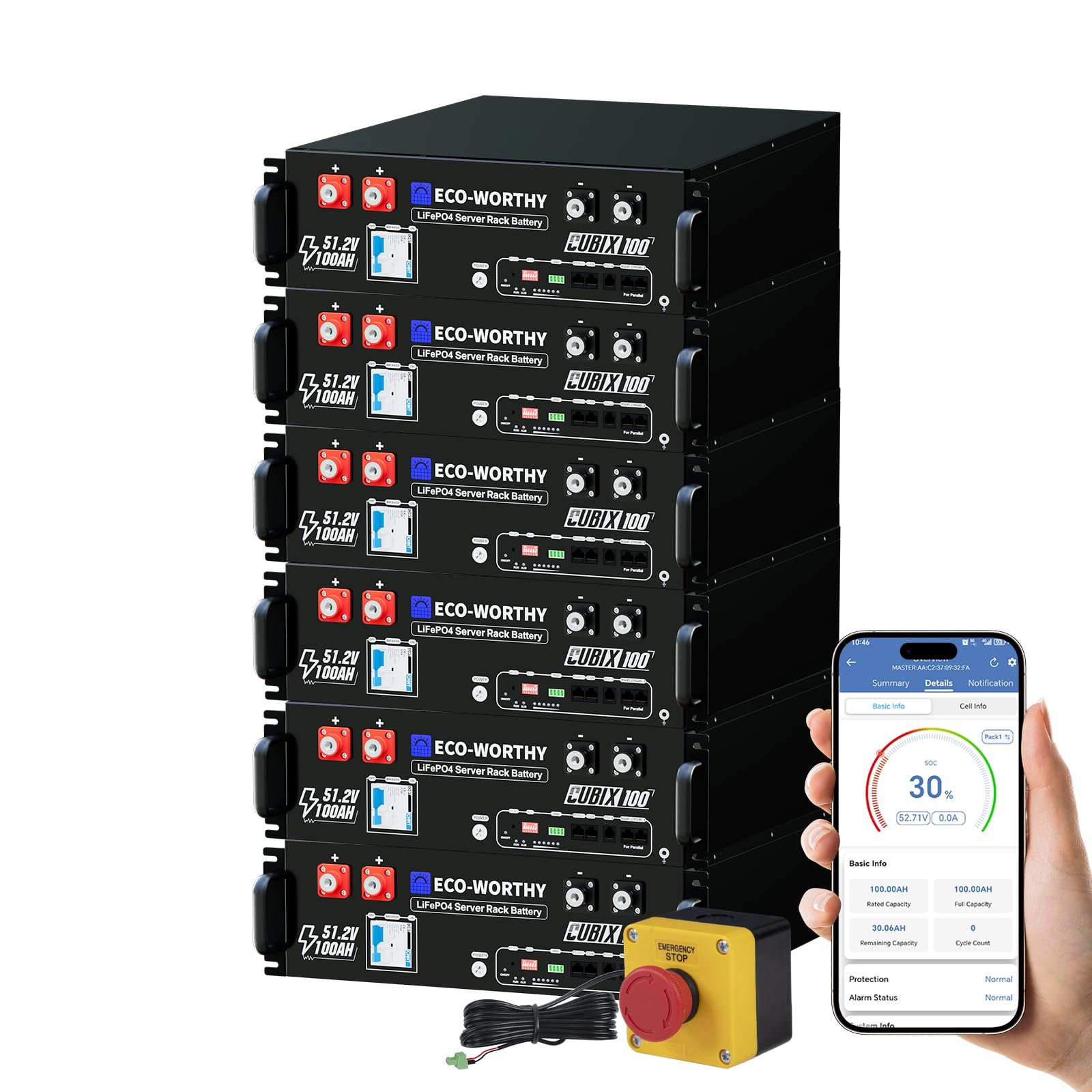
A certified, plug-and-play whole-home kit that takes your house fully off-grid.
This is the endgame for home solar. The 6-pack system delivers 51.2V 600Ah across six server-rack batteries—30.72kWh of total capacity designed to cover an entire household’s daily electricity needs. It carries the safety certifications that matter for whole-home installs: UL9540 and UL1973 listed by Intertek, plus CEC listing from the California Energy Commission. Those aren’t just badges—they mean the design passed thermal runaway management and electrical safety testing. Real buyers run a 3-bedroom off-grid home on one of these kits with zero issues over a month.
You can have it running fast: the kit includes parallel cables, communication cables, grounding wires, terminal covers, screws, and a manual, and one owner reports assembly in 5-10 minutes. The metal rack case is pre-drilled and wheelable, so you can position it easily. The smart layer is communication: integrated CAN/RS485 interfaces (industry-standard data links) plus Bluetooth and WiFi let it talk to leading integrated solar inverters—owners have paired it successfully with ECO-WORTHY, Sungold, and Bluetti inverters, with one noting it nearly tripled their existing capacity.
You get serious power per unit: each 51.2V 100Ah battery pushes 2.56kW rated output with a 100A BMS (a management system that guards against overcharging), and you can parallel up to 32 units for a maximum 163.8kWh. Grade A LiFePO4 cells (a lithium-iron-phosphate chemistry known for long life) deliver reliable output and exceptional cycle life. The 10-year limited warranty is among the longest in this guide, with 24-hour support. At 600 lbs total, this is a permanent installation—not something you move. Buyers rate it 4.7 stars across a few hundred owners, with high quality, reliability, and easy setup as the recurring themes. The one gap noted: no on-unit screen to read status—you will use the app.
Whole-Home Wins
- UL9540, UL1973, and CEC certified for home use
- 30.72kWh runs a full 3-bedroom off-grid home
- 10-year limited warranty with 24-hour support
Before You Commit
- 600 lbs total—a permanent, stationary install
- No on-unit display—all monitoring is via app
Invest in this for: serious whole-home off-grid setups or large backup systems where certified safety and 30kWh+ capacity are non-negotiable.
Not the fit if: you need a single portable battery—this is a permanent rack system for a fixed location.
Understanding the Specs
Amp-Hours (Ah) and Watt-Hours (Wh)
Amp-hours measure the battery’s fuel tank, but watt-hours tell you the actual energy stored. Multiply voltage by amp-hours to get it: a 12V 100Ah battery holds about 1,280Wh. That number is what you compare against your nightly draw—a fridge pulling 60W for 10 hours needs 600Wh, so a 100Ah lithium battery covers it comfortably.
Depth of Discharge (DOD)
This is how much of the battery you safely use before recharging. Lithium LiFePO4 handles 80% discharge routinely, while lead-acid AGM should stop around 50% to protect the plates. The practical result: a 100Ah lithium battery delivers roughly double the usable energy of a 100Ah AGM, which is why capacity comparisons between chemistries can mislead.
BMS and Low-Temperature Protection
The Battery Management System is the brain that prevents overcharge, overdischarge, and short circuits. For solar, the most crucial BMS feature is low-temperature cut-off—it stops charging below freezing, which would permanently damage lithium cells. If you live in a cold climate, a self-heating battery is the difference between a dead winter system and reliable year-round power.
Cycle Life
One cycle is a full charge and discharge. A typical lead-acid battery manages 200-500 cycles before degrading. Quality LiFePO4 units handle 4,000 cycles at full depth of discharge and up to 15,000 cycles at shallower 60% discharge. Over a decade of daily use, that durability gap is why lithium costs more upfront but often wins on cost per usable cycle.
FAQ
How many amp-hours do I need for my solar setup?
Will a lithium LiFePO4 battery work with my existing solar charge controller?
Can I connect multiple solar batteries together for more capacity?
Why does temperature matter so much for solar batteries?
How many charge cycles will a good solar battery last?
What does the BMS actually do for me?
Should I buy a battery with Bluetooth monitoring?
Why is the Renogy AGM so much heavier than the lithium options?
What is the difference between a 12V and a 48V solar battery system?
How long will these batteries hold a charge when not in use?
Final Thoughts: The Verdict
For most buyers, the batteries for solar winner is the Litime 12V 100Ah because it pairs featherlight 22.2-lb construction with a Bluetooth app that takes the guesswork out of your power levels—and it earns a 4.7-star average across one of the largest owner bases in this lineup, making it the crowd favorite. If you want maximum amp-hours per dollar and don’t mind a non-smart design, grab the Dumfume 314Ah. And for whole-home off-grid living with certified safety, the ECO-WORTHY Cubix100 is the system to reach for.
How We Picked
We do not accept paid placement. Every pick is matched to a real buyer and a real use-case; we do not hands-on test units.
Sources & Methodology
Specifications: manufacturer listings and product documentation. Review insights: verified customer reviews, as of September 2026. Pricing: not shown on this page (it changes often); check the current price via the retailer link.
As an Amazon Associate, KitchPrep earns from qualifying purchases. This does not affect which products we feature.
Related Guides
