
Specs are compiled from manufacturer listings and verified buyer reviews and can change over time — please confirm the key details on the product page before buying.
When the lights go out, you need a generator that starts on the first pull, runs long enough to keep your fridge cold, and won’t drain your wallet on fuel or repairs. The right backup generator price balances the wattage you need for essential appliances with the portability and storage you can handle.
I’m Mohammad Maruf — the founder and writer behind KitchPrep. This guide is built by comparing the manufacturers’ published specifications and the patterns across verified customer reviews, so you get each pick’s real strengths and trade-offs instead of marketing spin.
We break down the best backup generators across price tiers, from RV-ready portables to whole-house powerhouses, so you can pick a model that truly saves the day.
Our Picks at a Glance


How To Choose The Best Backup Generator Price
Peak wattage marketing makes small generators sound like power stations, so ignore it. Your buying decision depends on three things: the continuous power you need, the fuel you can store safely, and if you need clean power for laptops or TVs.
Match Watts to Reality, Not Marketing
A fridge needs about 600-800 running watts, but its compressor can spike to triple that for a second on startup. That’s why you need to separate two numbers: running watts (sustained output) and peak watts (short surge for starting motors). Add up the running watts of everything you’ll power simultaneously, then check that number against the generator’s rated running watts.
The same logic applies to your budget. A 2,400-watt inverter unit might be perfect for a fridge and lights, but it will choke if you dream of running a central AC. Know your loads first, then let the backup generator price guide you to the right class of machine.
Inverter vs. Conventional Engines
Inverter generators produce cleaner electricity with less harmonic distortion (THD), which is what keeps your laptop, TV, and CPAP machine safe from power fluctuations. They’re typically quieter and more fuel-efficient because the engine speed adjusts to the load. The trade-off is a higher price per watt than conventional open-frame generators.
If you’re an RV owner with modern electronics or a homeowner who wants to charge phones and run a router, an inverter is the smart choice. If you just need to keep a sump pump and a few lights on, a standard generator gets the job done for less.
Fuel Flexibility Matters
Gasoline goes stale in months, which is a problem when a storm hits after your tank has been sitting for a year. Dual-fuel and tri-fuel generators run on propane or natural gas, which store indefinitely and burn cleaner. During a prolonged outage, switching fuels when one supply runs dry keeps your power on.
Quick Comparison
| Model | Best For | Running Watts | Fuel Type | Weight | Amazon |
|---|---|---|---|---|---|
| Westinghouse 4650★ Best Overall | RV & Camper Power | 3600W | Gasoline | 100.6 lbs | Amazon |
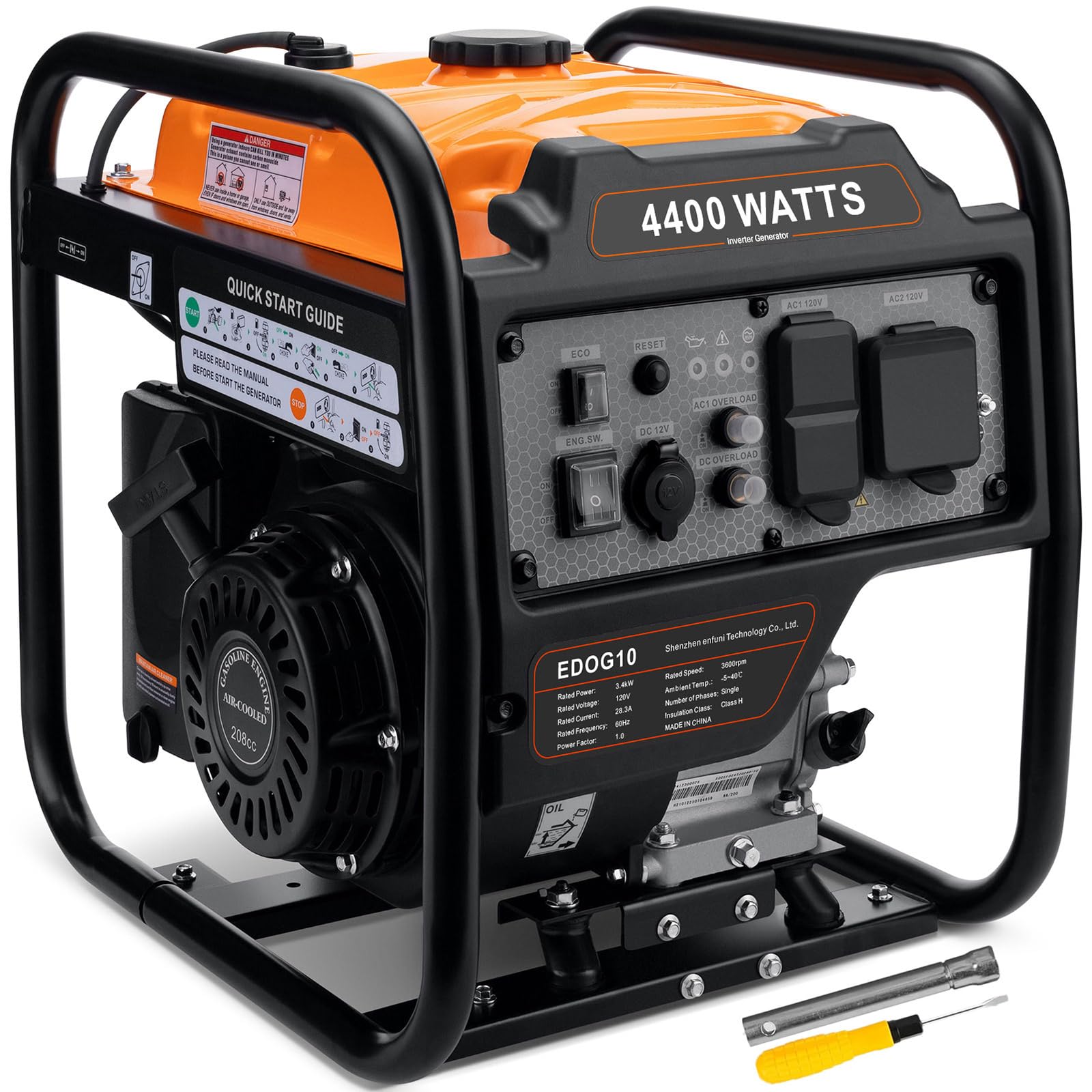
| Oxseryn 4400WBest Value | Light Camping & RV | 3400W | Gasoline | 57 lbs | Amazon |
| ERAYAK 2400WCompact Pick | Ultra-Quiet Camping | 1800W | Gasoline | 42 lbs | Amazon |
| Oxseryn 5000W | Home Essential Backup | 4000W | Gasoline | 60 lbs | Amazon |
| ERAYAK 4500W | Heavy RV & Tools | 3500W | Gasoline | 54 lbs | Amazon |
| Westinghouse 6500 | Dual Fuel Home Backup | 5300W (Gas) | Gas & Propane | N/A | Amazon |
| WEN DF360iX | Quiet Dual Fuel RV | 2900W (Gas) | Gas & Propane | 49 lbs | Amazon |
| WEN DF680iX | EV Charging & Big RVs | 5100W (Gas) | Gas & Propane | 99.2 lbs | Amazon |
| DuroStar DS13000MX | Whole-Home Backup | N/A | Gas & Propane | N/A | Amazon |
| Generac 12,500 | Whole-Home Tri-Fuel | 9500W | Gas, LP & NG | 219 lbs | Amazon |
| Champion 11,500 | Heavy-Duty Dual Fuel | 9200W (Gas) | Gas & Propane | 209 lbs | Amazon |
In-Depth Reviews
1. Westinghouse 4650 Peak Watt Portable Generator
Our pick — over 4.5★ from 700+ verified ratings; the strongest balance of quality and price.
The workhorse that powers the whole camper and keeps the fridge alive during blackouts.
This is the one that buyers report “runs the whole camper,” including the A/C and microwave simultaneously. It pumps out 3600 running watts and 4650 peak watts from a 212cc 4-stroke engine, giving you enough surge to handle appliance compressors kicking on. The 4-gallon fuel tank with a gauge delivers up to 14 hours of run time per tank, so you’re not babysitting refills through the night.
What makes this a standout is the outlet variety: two 5-20R household duplexes, one RV-ready TT-30R 30 amp, and one L5-30R 30 amp, all with rubber covers. Buyers love that it arrives with oil, a funnel, and a tool kit, making the first start genuinely plug-and-play. The automatic low oil and carbon monoxide (CO) shutdown features are the kind of safety nets you hope you never need but are glad exist.
The trade-off is its 100.6-pound weight, which owners find either manageable or a burden. It’s not a machine you toss in the trunk for a weekend trip; it’s a stationary backup that lives in the garage or on the camper’s tongue.
What Wins People Over
- Enough power for A/C and microwave at once
- 14-hour run time on a 4-gallon tank
- Built-in CO sensor for safety
Who Should Think Twice
- Heavy at 100.6 pounds
- Conventional engine is louder than inverter models
Your best bet if: you want a proven, reliable generator for RV life or home essentials without paying inverter premiums.
Look elsewhere if: you need something light enough to haul frequently or whisper-quiet for a campground.
2. Oxseryn 4400-Watts Inverter Generator
A featherweight inverter that sips fuel while handling the fridge and sump pump.
Owners mention it’s quiet enough to hold a conversation near, and the ECO mode is where it shines—customers note getting 16 hours of run time on Eco, which is remarkable for a tank this size.
This is pure inverter technology, meaning the power output is stable and clean for your sensitive gadgets. The 79.7cc engine is tiny compared to the 212cc Westinghouse, which explains the weight savings but also why owners note it’s realistically closer to 3000 watts before it stalls under heavy load. It’s honest power for light RV use or camping, not a whole-house solution.
The cold start technology and low oil shutdown are practical touches that protect your investment. The 4-stroke engine starts on the first or second pull even after months of sitting, which is exactly what you want from an emergency backup.
The Wins
- 16-hour run time on Eco
- Easy to lift and move at 57 lbs
- Quiet inverter operation
The Catch
- Real-world capacity tops out near 3000 watts
- Small 2-gallon tank limits long stretches
Bottom line: This is the budget-friendly pick for campers and light RV users who prioritize fuel economy and portability over raw grunt.
3. ERAYAK 2400W Portable Inverter Generator
Whisper-level quiet and light enough for car camping, with clean power for your CPAP.
If silence is your priority, this is the generator that disappears into the background of your campsite. It operates at just 52.5 dB from 7 meters at 25% load, which is quieter than a normal conversation. The compact 79.7cc engine pushes 1800 running watts and 2400 peak watts, enough for a coffee maker, a 5000 BTU AC, or charging your devices.
The clean power story here is strong: with less than 1.2% total harmonic distortion (THD), it’s genuinely safe for laptops, TVs, and medical devices like CPAP machines. At 42 pounds, it’s the easiest unit on this list to lift into a truck bed. Owners note it starts on the second pull and runs a 5000 BTU AC in eco mode without breaking a sweat.
The trade-off is limited power—it won’t run a full household. But for camping trips and tailgates, it’s a reliable, quiet companion. It uses just 0.21 gallons of fuel per hour at 25% load, so you can run it for 16 hours on one tank.
What Owners Rave About
- Exceptional quiet at 52.5 dB
- Lightweight at 42 lbs
- Clean power for sensitive electronics
The Limitation
- 1800 running watts limits you to small appliances
Reach for this if: you’re a camper who needs a quiet, portable power source for essentials and electronics.
Not for you if: you’re planning to back up a full-sized refrigerator and freezer during home outages.
4. Oxseryn 5000-Watts Portable Inverter Generator
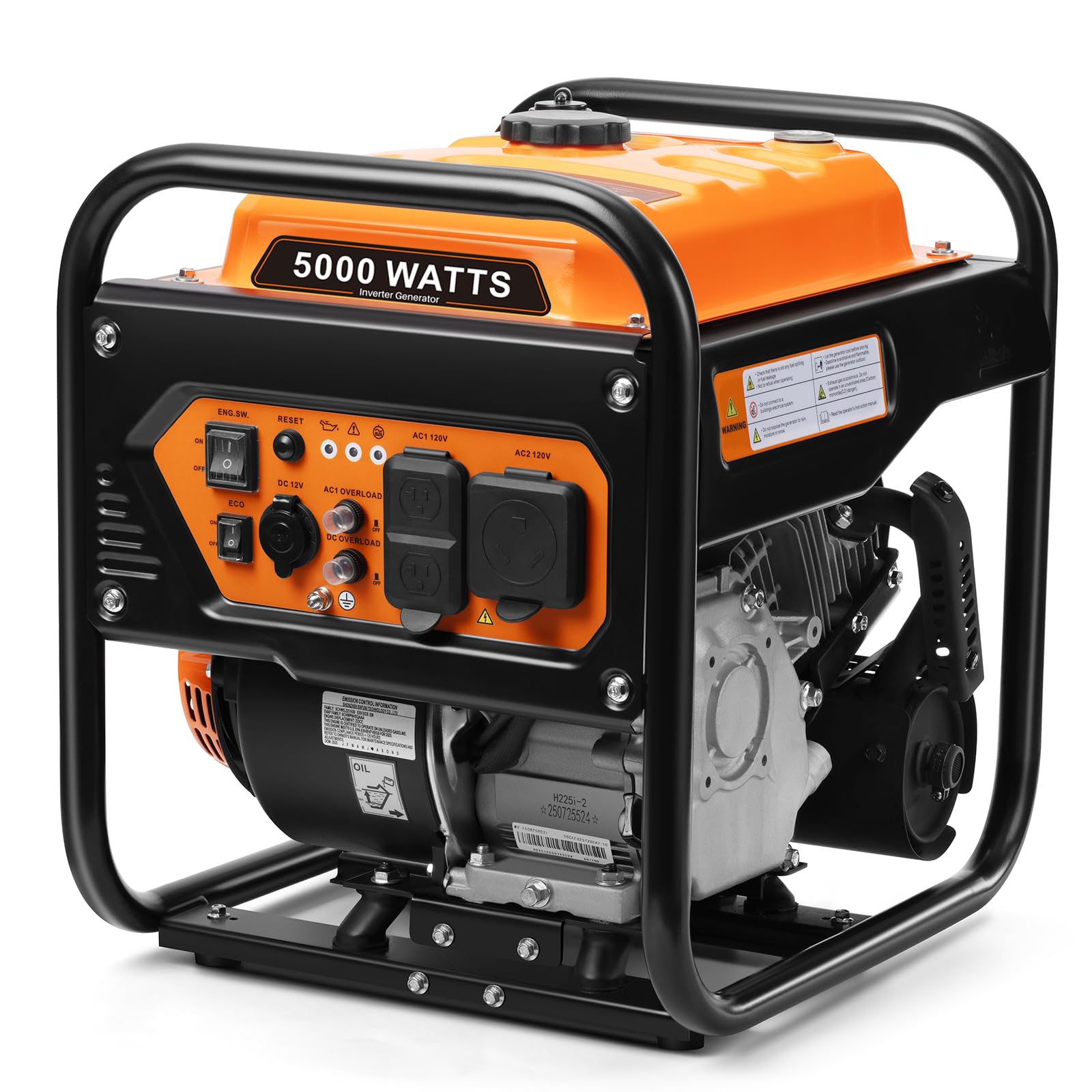
The middleweight champ that runs camper AC and heat simultaneously without flinching.
This generator is the upgrade path from the 4400W Oxseryn, offering 4000 rated watts and 5000 peak watts for those who need a bit more headroom. It runs a camper’s AC, heat, and fireplace with ease, per owner reports, and the electric start means no wrestling with a pull cord when you’re already stressed during an outage. Owners note a tank lasts about 10-12 hours at moderate load.
The clean power spec is solid: total harmonic distortion (THD) under 5%, which is safe for your electronics. At 60 pounds and 19″L x 15″W x 18″H, it’s a practical balance of power and portability for an open-frame inverter. The built-in fuel gauge and fuel shutoff are thoughtful touches for monitoring and maintenance.
Noise gets mixed feedback—some say it’s quieter than expected, others find it slightly noisy. At 70 dB from 23 feet, it’s not a library, but it’s acceptable for residential use. The recurring owner advice: turn the fuel on a minute before starting to help cold starts.
Solid all-rounder: Electric start, clean power under 5% THD, and a practical 6-hour runtime at half load make this a strong home backup candidate.
Be aware: The noise level is moderate, so it’s not the pick for noise-sensitive campgrounds.
5. ERAYAK 4500W Portable Inverter Generator

A parallel-ready powerhouse that ran two houses for six straight days without complaint.
This ERAYAK steps up to 3500 running watts and 4500 peak watts, positioning it as a serious tool for RVs and job sites. Owner reports are striking: one used it to run two refrigerators and a freezer, while another ran it for six days straight powering two houses at or over capacity during a storm. The 208cc engine sips just 0.21 gallons per hour at 25% load, making it remarkably efficient for the output.
The defining feature here is the 50A parallel capability. Connect two of these units and you get a combined 7000W rated and 9000W peak output, enough to tackle a larger home setup. The outlet array is generous: a 30A RV outlet, two 120V AC outlets, a 12V 5A cigarette lighter port, and both USB-A and USB-C for charging devices.
At 55.12 pounds, it manages to stay portable despite the power. It starts on the first pull, even after the break-in period, which owners consistently highlight. The main caveat is that it’s quiet but not super quiet—60.5 dB(A) is conversational level, but not a whisper like the smaller 2400W sibling.
Standout Strengths
- 50A parallel-ready for doubling output
- Efficient 0.21 gal/hr at 25% load
- Rugged enough for extended storm duty
Consider This
- 60.5 dB is moderate, not ultra-quiet
If the 2400W ERAYAK feels too small but you still want a portable inverter generator, this model delivers more power without the bulk.
6. Westinghouse 6500 Watt Dual Fuel Generator

The 13-day storm survivor that switches between gasoline and propane on a whim.
This is the generator that ran a tiny house through extended outages and kept an RV’s AC blasting all summer. It delivers 5300 running watts on gasoline and 4800 on propane, with peaks of 6500 and 5800 respectively. The dual-fuel flexibility is the star here—owners love switching to propane for indefinite storage and cleaner burning, or gasoline for maximum output.
The 274cc 4-stroke engine with a cast iron sleeve is built for endurance. One owner reported running it for 13 days straight, only stopping for oil changes, and estimated it burned 14-16 gallons of gas every 36 hours. The 4.7-gallon fuel tank with a gauge gives up to 14.5 hours of run time, and the 120/240V selector switch lets you power heavier appliances.
It comes ready to wire into a transfer switch with the L14-30R outlet, plus an RV-ready TT-30R. The wheel kit, propane hose, and oil are all included, so it’s ready to roll from the start. Yes, it’s loud—owners say so plainly—but when the alternative is no AC in summer, noise is a small price.
Why It’s a Favorite
- Dual fuel flexibility for gas or propane
- Transfer switch ready for home wiring
- Proven 13-day continuous operation
Know Before You Buy
- Noise level is substantial
- Pull start takes effort when cold
Grab this if: you want whole-house potential with fuel flexibility and don’t mind the noise of a conventional engine.
Steer clear if: you need a quiet inverter for a noise-sensitive neighborhood or campground.
7. WEN 3600-Watt Dual Fuel Inverter Generator DF360iX

A suitcase-style inverter that’s quiet as a conversation and sips 1.5 gallons for 10 hours.
WEN has carved out a reputation for value, and this 3600-watt dual-fuel inverter is a prime example. It runs on gasoline (2900 rated watts) or propane (2600 rated watts) and produces clean power safe for your smartphones and laptops. At 49 pounds, it’s genuinely portable, with a compact 18″L x 11.63″W x 19.68″H footprint that slides into a car trunk.
Owner reports highlight real-world endurance: one ran a 2600W load—fridge, freezer, computer, lights, and a 5K BTU AC—for 10 hours on just 1.5 gallons of gas. The WEN Watchdog CO Shutdown Sensor automatically kills the engine if carbon monoxide builds up, a critical safety feature for any backup scenario.
It’s designed for small backup power needs. The propane quick-connect hose is included, though owners note it’s non-standard length and the 30A plug placement can be awkward. But for the price, it punches above its weight—owners call it the best value they could find for powering an RV AC or home essentials.
What to Love
- Extremely quiet operation
- 10 hours on 1.5 gallons of gas
- Dual fuel with quick-connect LPG hose
Minor Quirks
- Propane hose is shorter than some expect
- 30A plug placement can obstruct RV plug
Perfect for: small backup power for a house or RV where quiet operation and fuel flexibility matter more than massive wattage.
8. WEN 6800-Watt Dual Fuel Inverter Generator DF680iX

The rare generator that can top up your electric vehicle with Level 2 charging during an outage.
This WEN is a category-buster. Its bonded-neutral 240V configuration provides low-power Level 2 charging for battery and hybrid electric vehicles, making it the only pick on this list that can genuinely keep your EV moving when the grid is down. The 224cc dual-fuel engine delivers 5100 rated watts on gasoline and 4500 on propane, with a 6800 surge.
The electric start is instant, per owners, and the unit runs both 15,000 BTU ACs and a stove fan on a 30A plug via propane. RV reviewers point out roughly 12 hours per propane bottle, which is solid for extended boondocking. It’s heavy at 99.2 pounds, but the onboard wheels and telescoping pull handle make it manageable for one person.
Noise is a mixed bag—some call it surprisingly quiet, others find it a bit loud. The Eco mode helps keeps things civilized under light load. With a three-year warranty and a six-foot LPG regulator hose included, it’s a complete package for the serious RV owner or the EV driver who wants true energy independence.
Defining Strengths
- Level 2 EV charging capability
- Electric start with remote capability
- Onboard wheels and handle
Trade-offs
- Heavy at 99.2 lbs
- Noise feedback is mixed
This is the premium pick for the EV owner who wants a backup that does double duty, or the big-RV owner tired of undersized generators.
9. DuroStar DS13000MX 13,000-Watt Dual Fuel Generator

A push-button behemoth that handles a 3-ton AC and the whole house without strain.
When you need to power an entire home, this 500cc DuroStar steps in. Shoppers say it handles a 3-ton AC unit, a fridge, a stove, a microwave, TVs, and a water heater without breaking a sweat. The dual-fuel design runs on gasoline or propane, giving you flexibility when fuel supplies get tight during prolonged outages.
The push-button electric start is a huge convenience—no pulling a cord 12 times when it’s freezing outside. The included remote control means you can start it from inside. The 50A heavy-duty outlet is transfer-switch ready, so a licensed electrician can wire it to power your whole panel.
It’s a substantial machine, and owners advise having a hand truck ready for delivery. The all-metal construction feels durable and built to withstand harsh weather. One owner notes a CO alarm issue in a specific unit, but the broader consensus is that it’s a reliable whole-house backup that starts easily on a monthly test.
Heavy Hitter
- Runs 3-ton AC and whole house
- Remote electric start
- Transfer switch ready with 50A outlet
Be Prepared
- Very large and heavy
- Needs a hand truck for delivery
Choose this for: whole-home backup where you need serious wattage and appreciate a remote start.
skip it if: you lack the space or need a portable unit for travel.
10. Generac 12,500 Starting Watt Tri-Fuel Generator
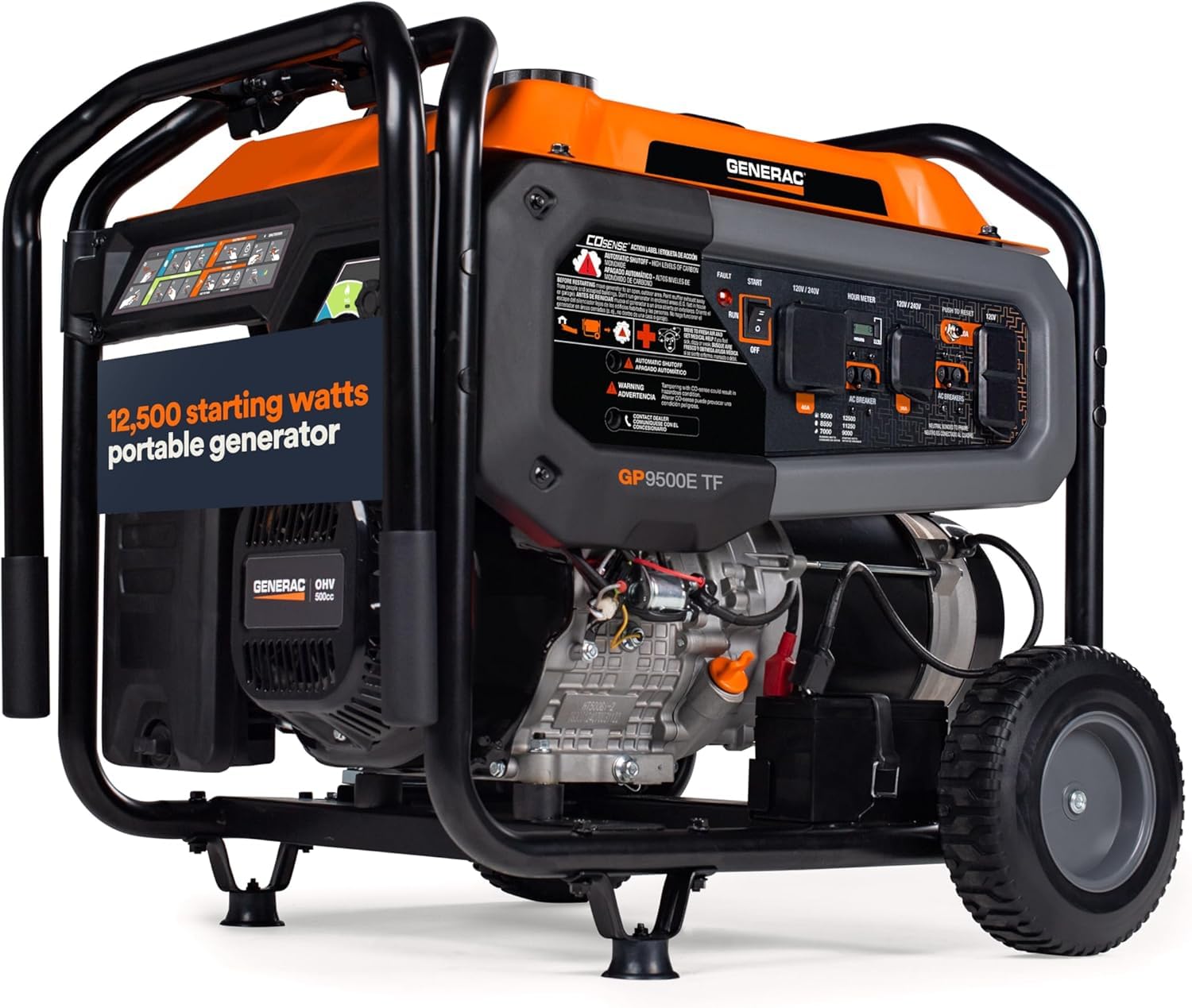
The tri-fuel titan that can tap your natural gas line for virtually unlimited runtime.
Generac brings its reputation to the portable space with this 12,500-watt tri-fuel generator. The killer feature is the fuel flexibility: gasoline, liquid propane, or a direct connection to your home’s natural gas line for effectively endless operation. With 9500 running watts and 12,500 starting watts, it has the surge capacity to handle AC compressors and sump pumps starting simultaneously.
The COsense technology automatically shuts the unit down if carbon monoxide rises to dangerous levels, and the push-button electric start with an included 12V battery eliminates pull-cord frustration. The steel-tube frame, 9.5-inch never-flat wheels, and folding handle make the 219-pound beast at least movable.
The 7.5-gallon fuel tank delivers up to 9.5 hours at 50% load on gasoline. Owners who bought it for the brand name report it meets all criteria as described. It’s a premium investment, but for a homeowner who wants a single machine that can run on whatever fuel is available, it’s a compelling package.
The Big Wins
- Tri-fuel: gas, LP, or natural gas line
- 32% surge capacity over running watts
- Generac COsense and electric start
The Cost of Power
- Very heavy at 219 lbs
- Premium price point
Worth it if: you want the ultimate fuel flexibility, especially if you have a natural gas line, and you trust the Generac name.
11. Champion 11,500-Watt Electric Start Dual Fuel Generator
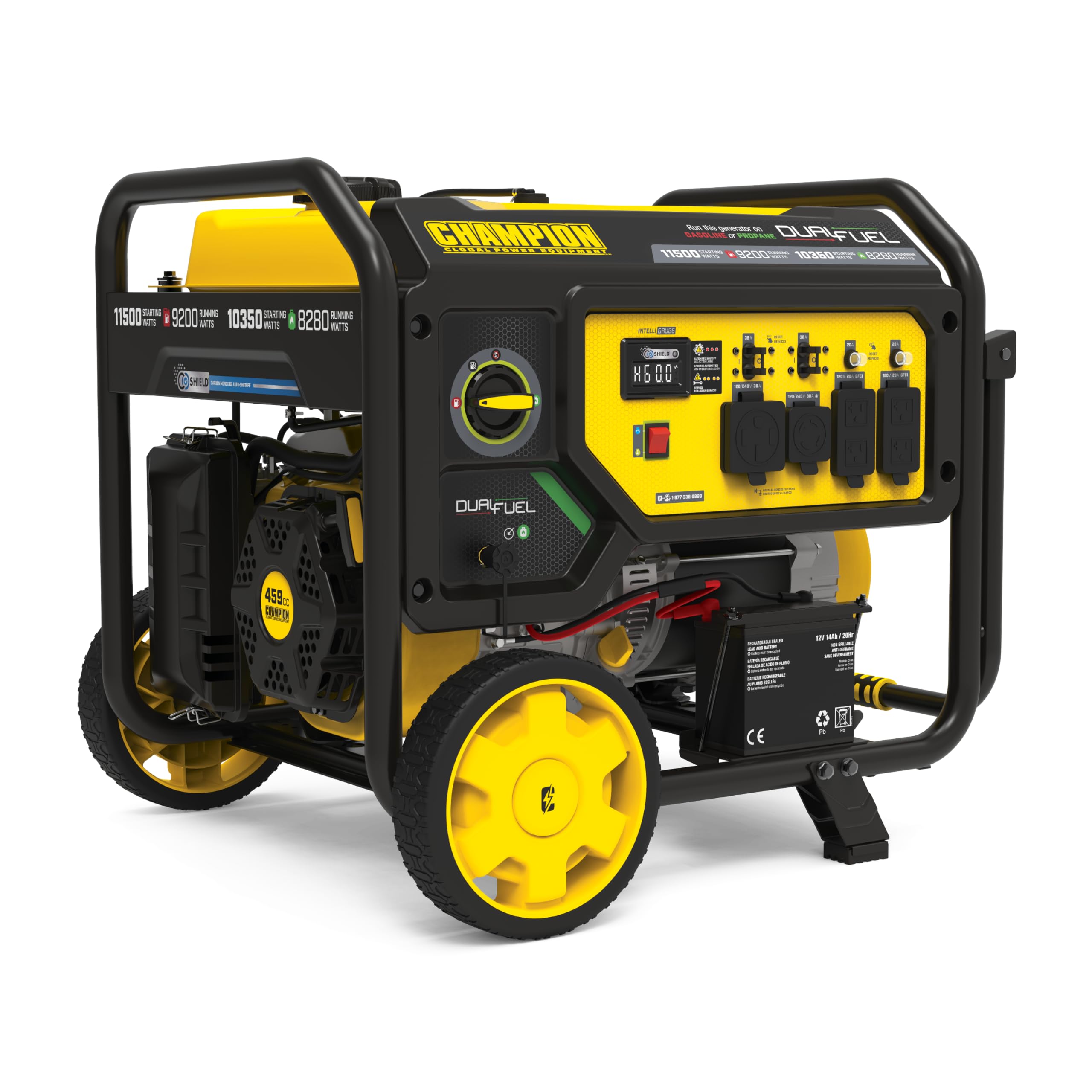
The ice-storm lifesaver that kept a family warm and water running for four days.
Champion’s dual-fuel option delivers 9200 running watts on gasoline and 8280 on propane, with starting watts of 11,500 and 10,350 respectively. The 459cc engine starts via a rocker switch, and the battery is included. For a family who lost power for days in an ice storm, this “bad boy” kept the heat on and water flowing, running almost 12 hours on a tank of fuel in a camper.
Safety features come standard: CO Shield (a carbon monoxide sensor that shuts the generator off automatically) and Volt Guard (protection against voltage spikes that could harm your gear). The digital display shows voltage, hertz (cycles per second), and run-time hours, so you know your output and when to schedule maintenance. A 3-year limited warranty with free lifetime technical support backs it up.
The fuel filter design draws some criticism for being slow to fill with splash-back potential. It’s also a heavyweight at 209 pounds, though the wheel kit makes it manageable. Owners describe it as very well built and durable, with the brand standing for quality.
Strong Points
- Dual fuel with high propane output
- Electric start with included battery
- CO Shield and Volt Guard protection
Minor Gripes
- Fuel filter is slow to fill
- Heavy at 209 lbs
For serious whole-home or large-RV backup where you need durable, high-output dual-fuel power, this Champion delivers.
12. DuroStar DS13000MX 13,000-Watt Dual Fuel Generator
A push-button behemoth that handles a 3-ton AC and the whole house without strain.
When you need to power an entire home, this 500cc DuroStar steps in. Shoppers say it handles a 3-ton AC unit, a fridge, a stove, a microwave, TVs, and a water heater without breaking a sweat. The dual-fuel design runs on gasoline or propane, giving you flexibility when fuel supplies get tight during prolonged outages.
The push-button electric start is a huge convenience—no pulling a cord 12 times when it’s freezing outside. The included remote control means you can start it from inside. The 50A heavy-duty outlet is transfer-switch ready, so a licensed electrician can wire it to power your whole panel.
It’s a substantial machine, and owners advise having a hand truck ready for delivery. The all-metal construction feels durable and built to withstand harsh weather. One owner notes a CO alarm issue in a specific unit, but the broader consensus is that it’s a reliable whole-house backup that starts easily on a monthly test.
Heavy Hitter
- Runs 3-ton AC and whole house
- Remote electric start
- Transfer switch ready with 50A outlet
Be Prepared
- Very large and heavy
- Needs a hand truck for delivery
Choose this for: whole-home backup where you need serious wattage and appreciate a remote start.
skip it if: you lack the space or need a portable unit for travel.
13. Generac 12,500 Starting Watt Tri-Fuel Generator
The tri-fuel titan that can tap your natural gas line for virtually unlimited runtime.
Generac brings its reputation to the portable space with this 12,500-watt tri-fuel generator. The killer feature is the fuel flexibility: gasoline, liquid propane, or a direct connection to your home’s natural gas line for effectively endless operation. With 9500 running watts and 12,500 starting watts, it has the surge capacity to handle AC compressors and sump pumps starting simultaneously.
The COsense technology automatically shuts the unit down if carbon monoxide rises to dangerous levels, and the push-button electric start with an included 12V battery eliminates pull-cord frustration. The steel-tube frame, 9.5-inch never-flat wheels, and folding handle make the 219-pound beast at least movable.
The 7.5-gallon fuel tank delivers up to 9.5 hours at 50% load on gasoline. Owners who bought it for the brand name report it meets all criteria as described. It’s a premium investment, but for a homeowner who wants a single machine that can run on whatever fuel is available, it’s a compelling package.
The Big Wins
- Tri-fuel: gas, LP, or natural gas line
- 32% surge capacity over running watts
- Generac COsense and electric start
The Cost of Power
- Very heavy at 219 lbs
- Premium price point
Worth it if: you want the ultimate fuel flexibility, especially if you have a natural gas line, and you trust the Generac name.
14. Champion 11,500-Watt Electric Start Dual Fuel Generator
The ice-storm lifesaver that kept a family warm and water running for four days.
Champion’s dual-fuel option delivers 9200 running watts on gasoline and 8280 on propane, with starting watts of 11,500 and 10,350 respectively. The 459cc engine starts via a rocker switch, and the battery is included. For a family who lost power for days in an ice storm, this “bad boy” kept the heat on and water flowing, running almost 12 hours on a tank of fuel in a camper.
Safety features come standard: CO Shield (a carbon monoxide sensor that shuts the generator off automatically) and Volt Guard (protection against voltage spikes that could harm your gear). The digital display shows voltage, hertz (cycles per second), and run-time hours, so you know your output and when to schedule maintenance. A 3-year limited warranty with free lifetime technical support backs it up.
The fuel filter design draws some criticism for being slow to fill with splash-back potential. It’s also a heavyweight at 209 pounds, though the wheel kit makes it manageable. Owners describe it as very well built and durable, with the brand standing for quality.
Strong Points
- Dual fuel with high propane output
- Electric start with included battery
- CO Shield and Volt Guard protection
Minor Gripes
- Fuel filter is slow to fill
- Heavy at 209 lbs
For serious whole-home or large-RV backup where you need durable, high-output dual-fuel power, this Champion delivers.
