
Specs are compiled from manufacturer listings and verified buyer reviews and can change over time — please confirm the key details on the product page before buying.
When you’re airing up 35-inch mud tires after a trail run or filling RV rubber before a long haul, a weak compressor can turn a quick stop into a 15-minute wait per tire. The fix is airflow: every unit here moves at least 10 CFM (cubic feet per minute), so you can air up and pack up in minutes, not hours. To pick the right one, match airflow, max pressure, and power draw to your power source and tire size.
I’m Mohammad Maruf — the founder and writer behind KitchPrep. This guide is built by comparing the manufacturers’ published specifications and the patterns across verified customer reviews, so you get each pick’s real strengths and trade-offs instead of marketing spin.
Finding a genuine 10 cfm air compressor takes more than scanning a spec sheet, so we have matched seven high-flow models to the jobs they handle best.
Our Picks at a Glance

How To Choose The Best 10 CFM Air Compressor
Your choice hinges on your power source. A 12V unit that runs off your truck battery suits trail use, while a 220V stationary tank belongs in a workshop. Ask first: “where does the power come from?”—not “how much air?”
Match the Power Source to the Job
Portable 12V compressors (like the first several picks) connect straight to your vehicle’s battery with alligator clamps. They live in your trunk or bolted to your rig, and they are the right call if you are airing down and back up on the trail. Stationary electric models need a 110V or 220V wall outlet and a dedicated circuit — think garage workshops running nail guns or spray guns. If you need air where there is no grid at all, a gas-powered unit is the only option that carries its own engine.
Look Past the Peak PSI Number
Peak pressure (like 150 PSI) tells you the maximum force the pump can build. But for continuous work like running an impact wrench or a spray gun, what matters is CFM at 90 PSI — the sustained airflow your tool consumes. A 10 CFM rating at 90 PSI will run most air tools comfortably; a lower number means the tank drains faster than the pump refills it.
Match Tank Size to Runtime Needs
For tire inflation, a big tank matters less since you’re filling a finite volume. For continuous tools, tank size acts as a buffer. A larger tank (13.2 or 60 gallons) reduces pump cycling and steadies pressure during long bursts, but adds weight and floor space.
Quick Comparison
| Model | Best For | Airflow (CFM) | Max Pressure (PSI) | Power Source | Amazon |
|---|---|---|---|---|---|
| ALL-TOP 12V Dual Cylinder★ Best Overall | Overlanding & big tires | 12.35 cfm | 150 psi | 12V Battery | Amazon |
| VEBU Off-road 12VPremium Pick | RV & 22+ tire fleets | 10.6 cfm | 150 psi | 12V Battery | Amazon |
| MZB 13.2 Gal Ultra Quiet | Quiet shop work | 14.83 cfm | 115 psi | 110V Electric | Amazon |
| BUNKER INDUST 12V | Fast dual-tire fills | 12.36 cfm | 150 psi | 12V Battery | Amazon |
| Rhino USA 12V | Compact trail stow | 10.6 cfm | 150 psi | 12V Battery | Amazon |
| Ingersoll Rand SS3L3 | Heavy shop duty | 11.3 cfm | 135 psi | 220V Electric | Amazon |
| NorthStar Gas 13.7 CFM | Remote jobsite air | 13.7 cfm | 90 psi | Gas Engine | Amazon |
In‑Depth Reviews
1. ALL-TOP 12V Air Compressor
Our pick — over 4.5★ from 250+ verified ratings; the strongest balance of quality and price.
The overlander’s workhorse that outpaces a gas-guzzling 110V pancake on six tires.
ALL-TOP solves the biggest trail complaint — waiting. Its twin cylinders push 12.35 CFM up to 150 psi, and buyers report it fills a car tire from 10 to 33 psi in under a minute. The built-in LCD panel lets you preset a target pressure, and the pump stops on its own when it gets there, with brief pauses mid-fill so the reading stays accurate rather than guessing from a hot hose.
The heavy-duty alligator clamps and cleanable sponge filter are built for dust and rough trails, and the anti-vibration metal base lets you hard-mount it permanently in your rig or run it as a standalone unit. It draws 45 A max, which is half the current draw of the VEBU pick below, making it friendlier on your battery during a long session.
The honest trade-off shows up in the details. Owners note the gauge can read about 1 psi off and occasionally drifts over time — one owner now sets 29 psi to actually hit 35. The alligator clips also drew complaints, with one owner swapping them for a sturdier Anderson-style connector. It gets hot after heavy use, so let it cool before you stash it in its carry bag. The 4.6-star crowd favorite earns its spot for sheer speed-to-dollar value.
Why owners stick with it
- 12.35 CFM fills 37-inch tires from 18 to 37 psi in under 10 minutes
- Preset auto-stop pressure with digital LCD readout
- Cleanable sponge filter and anti-vibration metal base for rough terrain
Where it cuts corners
- Gauge accuracy can drift; a few owners set pressure a few psi higher to compensate
- Alligator clips feel flimsy to some, who swap in Anderson connectors
- Heavy at 12 kg — real, but you get the durability in return
Grab it if: you want a proven, fast 12V compressor for a 4×4, Jeep, or truck and you value long-term reliability over a featherlight kit.
Think twice if: you demand pinpoint gauge accuracy straight from the start — this one can read about 1 psi high.
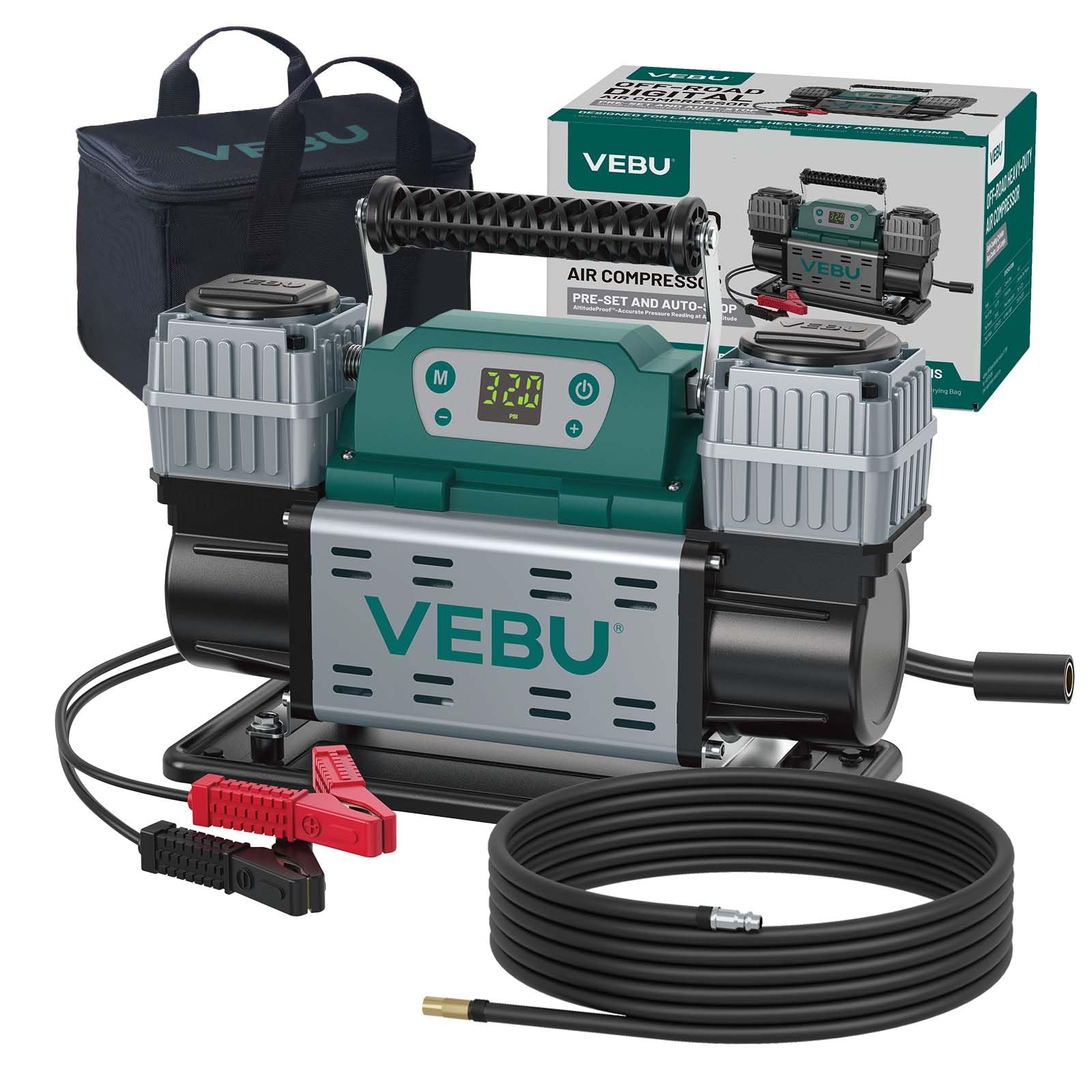
2. VEBU Off-road 12V Air Compressor
A 25-foot hose and memory presets built for the biggest rigs on the road.
VEBU aims squarely at heavy haulers with the longest reach in this lineup. The 25-foot heat-resistant hose and 7-foot power cord mean you can circle a class-A motorhome or a long truck without repositioning the pump. Owners mention moving a 225/70R19.5G tire from 34 psi to 100 psi in 4 minutes — serious volume for a commercial-grade tire — and one owner calls it essential for “a class-A motorhome with giant 110-PSI tires.”
This unit earns its spot for batch work—like filling every tire on a tow rig before a trip—because it runs continuously for 45 minutes, per the maker. The dual-cylinder pump delivers 10.6 CFM up to 150 psi with a ±2 psi accuracy window, so you can set it and move on. But it pulls a hefty 90 A max—double the ALL-TOP’s 45 A—so the instructions are clear: keep your vehicle running during use.
The smart touches matter for real-world use. A memory function recalls your last pressure setting, so filling four tires means setting it once. The leak-proof screw-on brass chuck keeps hands free, and the metal sand tray with four anti-vibe rubber feet keeps it stable on mud or uneven ground. The gearless motor and aluminum shell help it shed heat, which is critical at this power level. This is a younger model with fewer owner reviews behind it, so long-term durability is still unproven — but the early verdict is that it is genuinely powerful.
Best for big rigs: the 25-foot hose reach beats every other portable pick here for RVs and trucks. Built to survive -4°F to 248°F extremes.
The cost of power: at 90 A it demands a running engine and heavy-duty battery connections, so it is not for light vehicles or quick top-offs.
3. MZB 13.2 Gallon Ultra Quiet Air Compressor
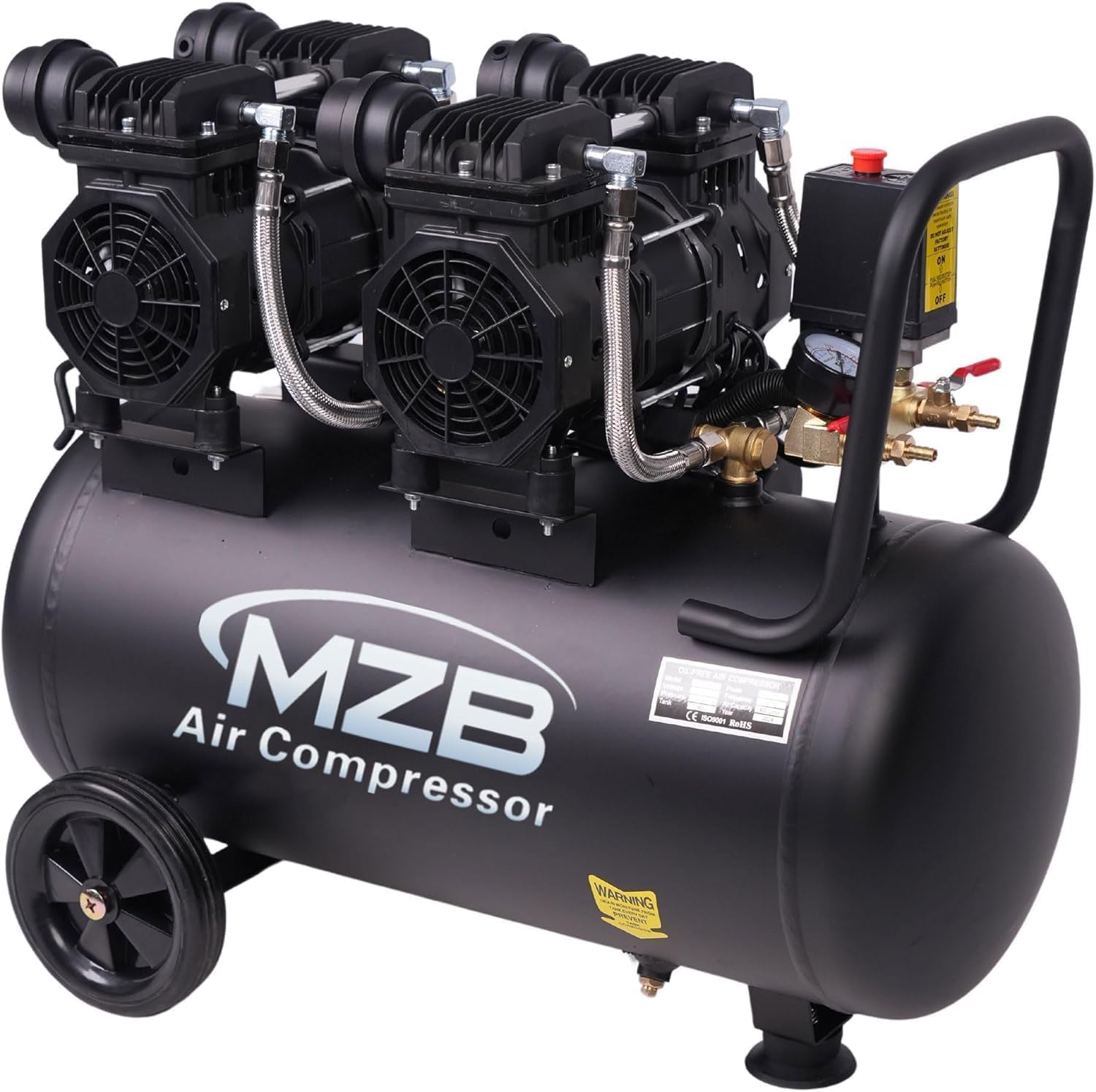
The workshop whisperer that pours out 40% more air than the VEBU portable above.
MZB flips the script from portable to stationary — this is a 13.2-gallon steel-tank electric unit for the garage, not the trail. The oil-free pump removes maintenance chores and keeps the air output clean for spray painting, per the maker.
Noise is the headline feature. At 70dB it sits well under the typical 80-90dB of standard compressors, which is why owners consistently call it quiet enough for indoor workshops and residential neighborhoods without upsetting family or neighbors. Performance is the most-praised aspect in the feedback, and owners describe it as a “BEAST” that filled four truck tires fast before the breaker even thought about tripping.
Here is the honest catch, and it is significant: this unit needs serious electrical headroom. Owners repeatedly report that it trips standard 15-amp breakers on startup and really wants a dedicated 20-amp circuit — with some saying a 30-amp breaker is needed for constant air tools like grinders or sanders. One owner had a plug melt into the cord, and durability is a recurring concern in the reviews. It also weighs 72 pounds and needs its wheels to move around. Quiet and powerful, but only if your wiring can feed it.
The upside
- 14.83 cfm powers spray guns, impacts, and nailers for continuous work
- 70dB noise level suits indoor and residential use
- Oil-free pump means no oil changes and clean air output
Read this first
- Demands a dedicated 20-amp circuit; trips standard 15-amp breakers
- A few customers note breaker-tripping and durability issues over time
- 72-pound weight means it is a stationary shop tool, not a carry-around
Reach for this if: you need quiet, high-volume air in a home workshop or garage and you have a dedicated circuit ready.
Look elsewhere if: you plan to run it off a regular wall outlet or an extension cord — this one will not cooperate.
4. BUNKER INDUST 12V Air Compressor
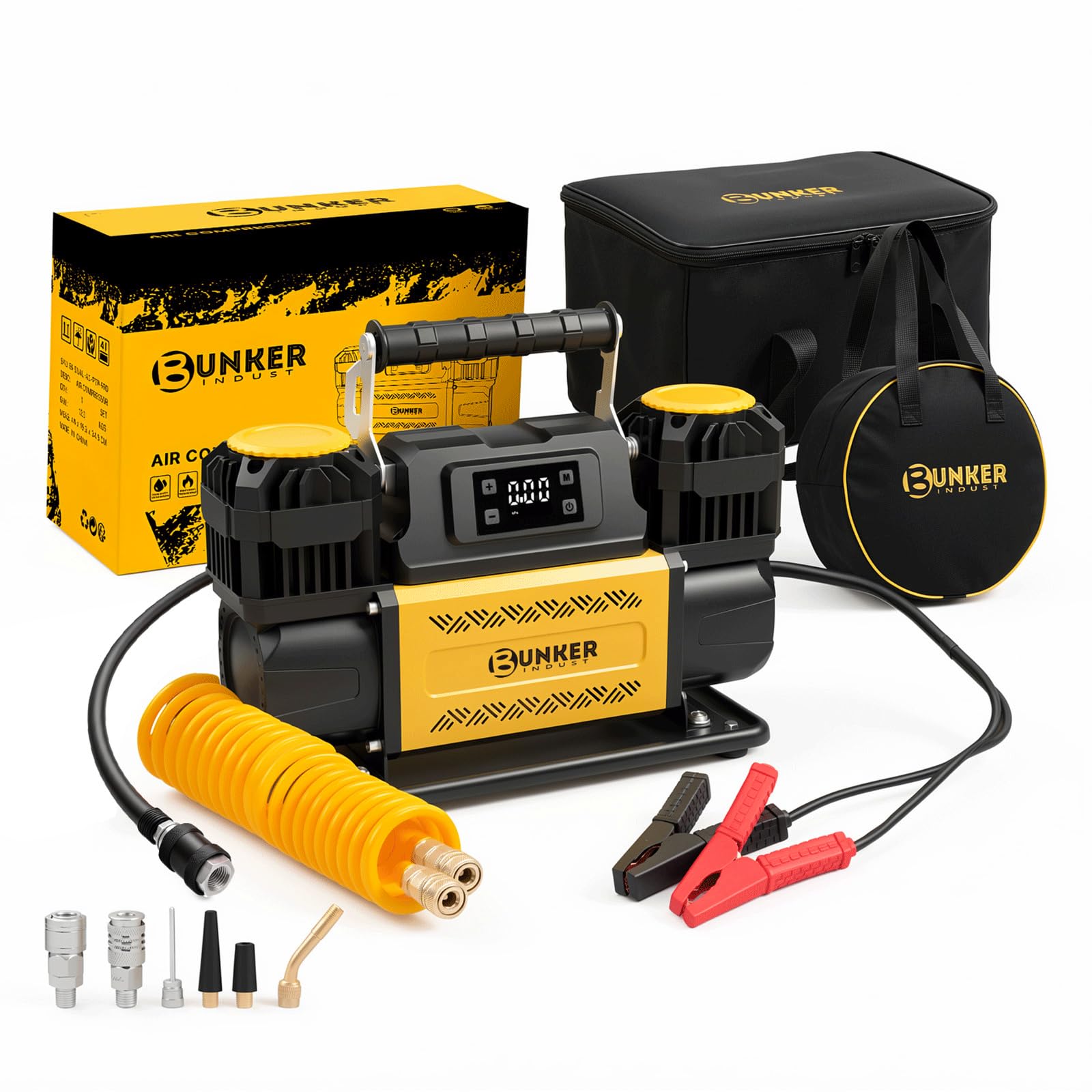
The dual-hose speed demon that airs up a whole Tacoma in six minutes flat.
BUNKER INDUST delivers the fastest real-world routine on this list. With 12.36 CFM and 150 psi on tap, one owner reports filling all four 32-inch tires on a Tacoma and packing up in 6 minutes — a pace that leaves slower 12V pumps in the dust. The included T-fitting lets the hose inflate two tires at once, which effectively halves your air-up time on the trail.
Owners call this a worthy upgrade from the slower NOCO units, praising how fast and easy it is to use. The digital LED screen reads pressure accurate to within ±1 psi (tighter than the VEBU’s ±2 psi), and the auto-stop function kicks in at your preset target so you can walk away mid-fill. The Anderson-style plug is the same connector that serious overlanders already run, giving stable, reliable power at high draw.
The build quality gets real attention here. The air leader hose resists abrasion and handles extreme temperatures from -4°F to 338°F, while cooling fins on the alloy cylinders help shed heat during long sessions. Owners do note it gets hot after sustained use, and one compares it to a Power Tank — slower on a single tire, but the dual-tire capability makes up for it. This is the youngest model here with the fewest reviews, so treat the early 4.9-star enthusiasm as promising rather than proven.
The speed angle: dual-tire inflation plus 12.36 CFM adds up to the fastest four-tire routine in this lineup.
Early days: with a small review base, long-term reliability is still being written — but the first owners are emphatic.
5. Rhino USA Dual Tire Air Compressor

A small-footprint 10.6 CFM pump that performs bigger than its size suggests.
Rhino USA packs genuine trail capability into a body that stores easily. The 10.6 CFM rating matches the VEBU’s airflow, but this unit is built around stowability — it is the compact choice for keeping in a trunk or behind a seat. Owners describe it as “a lot of air in a small package,” with one reporting it inflated all four tires on a truck at once without breaking a sweat.
Noise is a differentiator here. At 55dB, this is the quietest pump on the whole list — noticeably calmer than the VEBU’s 74dB rating — which matters on group trail rides or early-morning air-ups near campsites. The 8-foot hose and oversized 10-foot battery cables give you generous reach, and the cleanable air filters extend pump life between services. Fittings are standard, which owners appreciate for convenience when swapping nozzles or adapters.
The auto shutoff with built-in LED-backlit gauge works just like the pricier units: set your target PSI and walk away. Vibration-reducing rubber mounts keep it stable on uneven ground and protect the internals, and it can even be hard-mounted to your vehicle. Owners note it takes about 3 minutes to move a 35-inch tire from 15 psi to 38 psi — slightly slower than the top picks but entirely reasonable for the package size.
Why it wins
- 55dB noise level is the quietest in this group by a wide margin
- 10-foot battery cables and 8-foot hose give easy rig access
- Compact size stows easily, yet fills all four truck tires at once
The compromise
- 10.6 CFM is the entry point of this list, not the ceiling
- Fewer owner reviews means less long-term data than the ALL-TOP
Choose this for: quiet, compact 12V performance when you want minimal noise and easy storage for a daily driver or light trail rig.
Pass it by if: you routinely air up giant commercial tires and need the extra reach of a 25-foot hose.
6. Ingersoll Rand SS3L3 Single Stage Air Compressor

The 60-gallon cast-iron anchor that mechanics rate as the best compressor they have used.
Professionals name Ingersoll Rand when they talk shop air, and this 3 hp single-stage unit backs that reputation with a cast-iron pump rated for over 5,000 hours of service—a durability promise no portable on this list can match. It pairs a 60-gallon vertical tank with 11.3 cfm at 90 psi, so reviewers point out it runs sandblasters, nail guns, and air wrenches comfortably. One buyer calls it “very quiet for my shop.”
Mechanics rate this as the best compressor they’ve used because parts are easy to find and upkeep is straightforward. The auto start/stop pressure switch handles cycling automatically, while the oil sight gauge and easy-fill port simplify maintenance. The All Season Select synthetic lubricant stretches service intervals to 2,000 hours—four times longer than petroleum-based oils, per the maker.
This is also a repeat-purchase machine: one owner is on his second after 17 years, which says more about long-term value than any spec sheet. The trade-offs are real but predictable. It needs 220V power, so most garages will require an electrician to run a dedicated circuit. It is top-heavy on its pallet and needs two people to move it safely. And at 11.3 cfm, an owner notes it cannot keep up with a continuous-duty DA sander — for sustained high-draw tools, you would step up to a two-stage unit. This is the pick for the buyer who wants one compressor to last a generation of weekend projects.
The longevity play: cast-iron pump rated for 5,000+ hours and owner stories stretching 17 years make this the buy-once choice.
Setup reality: 220V power and a two-person unload are the price of entry — plan your wiring before it arrives.
7. NorthStar Gas-Powered Air Compressor

The gas-driven 13.7 CFM unit that starts on the first crank, anywhere on the job.
When there’s no outlet within a hundred yards, NorthStar brings its own engine—the Honda GX160 OHV powerplant. Owners consistently report it fires right up on the first crank; one buyer is on his fourth unit because the previous ones always started and always had plenty of air pressure. The 20-gallon tank and 13.7 cfm output keep a steady 90 psi for demanding pneumatic tools, making this a favorite for remote sealcoat spraying and far-flung jobsites.
The pump is built for the long haul. The full cast-iron design with FC35 grade cast-iron pump head is engineered for demanding use, while the V-style cylinder layout improves cooling under sustained load. Floating-type Swedish steel valves are designed to deliver much longer valve life than conventional designs. At 217 pounds, this is not a casual carry — owners note it is heavy and takes effort to maneuver even on its wheels, though one 6-foot, 210-pound user manages it fine.
Owners who depend on it professionally praise performance most and consider it worth the money. The honest caveats are about assembly and shipping, not the core machine: some units arrive with a fitting needing attention or a throttle linkage clip installed upside down, and a few owners found the plastic tubing less durable than they’d like. One owner ran it for 20 hours straight after minor fixes with no issues at all. If your air supply has to travel with you, this is the tool to grab.
What owners trust
- Honda GX160 engine starts reliably, even after long storage
- 13.7 cfm holds 90 psi for continuous tool use like sealcoat spraying
- Cast-iron, V-style pump designed for superior cooling and long valve life
Before you buy
- 217 pounds is heavy; some owners find it hard to maneuver solo
- Occasional assembly issues arrive from shipping — check fittings on delivery
Pick this when: your work takes you off-grid and you need reliable, high-volume air without hunting for a wall outlet.
skip it if: you work in a wired shop — a 220V electric unit gives you the same airflow without fuel and fumes.
Understanding the Specs
CFM at 90 PSI
CFM (cubic feet per minute) measures how much air the pump delivers at a given pressure. The “at 90 PSI” part is the industry standard test because most air tools run in that range. A higher CFM number means the pump refills the tank faster and keeps up with tools that consume air continuously, like spray guns or die grinders. For impact wrenches and nail guns that run in short bursts, you need less sustained CFM than the tank can supply.
Duty Cycle and Runtime
Duty cycle tells you how long a compressor can run before it needs to rest and cool down. Many 12V portable units are not rated for continuous operation — they need a cooldown after a few minutes of heavy pumping. The VEBU, for example, advertises 45 minutes of continuous runtime, which is generous for the category. The Ingersoll Rand is rated for 100% continuous duty, meaning it can run indefinitely. Match runtime to your job: tire inflation is burst work, sandblasting is marathon work.
FAQ
Will a 12V compressor drain my car battery during use?
Is 10 CFM enough to run an impact wrench?
What is the difference between a pancake compressor and these 10 CFM units?
How does auto shut-off pressure control actually work?
Can I hard-mount a 12V compressor in my vehicle?
Why does the MZB compressor trip my breaker?
How accurate are the digital pressure gauges on these units?
Is a gas-powered compressor worth the extra cost and weight?
What size tank do I need for spray painting a car?
How long should a quality air compressor last?
Final Thoughts: The Verdict
For most overlanders and truck owners, the clear winner in the 10 cfm air compressor class is the ALL-TOP 12V, blending 12.35 CFM speed with the strongest reliability record in the group. If you need a quiet 110V unit for a home workshop, grab the MZB 13.2 Gallon — just confirm your circuit can feed it. And for the buyer who wants a single garage compressor to outlast everything else, the Ingersoll Rand SS3L3 is the one to reach for, with a cast-iron pump rated for 5,000+ hours of service.
How We Picked
We do not accept paid placement. Every pick is matched to a real buyer and a real use-case; we do not hands-on test units.
Sources & Methodology
Specifications: manufacturer listings and product documentation. Review insights: verified customer reviews, as of September 2026. Pricing: not shown on this page (it changes often); check the current price via the retailer link.
As an Amazon Associate, KitchPrep earns from qualifying purchases. This does not affect which products we feature.
Related Guides
