
Specs are compiled from manufacturer listings and verified buyer reviews and can change over time — please confirm the key details on the product page before buying.
Buying your first off-grid power setup is full of confusing choices, but one practical fact cuts through most of it: the controller, the battery, and the solar panel have to speak the same electrical language. That language is 12 volts, and it is the backbone of nearly every RV, boat, shed, and camper system on the market. This guide focuses on complete kits that bring those parts together so you can spend your time camping or working, not soldering a system together from scratch. We’ll show you which kits actually hold up, which are better for a weekend trip versus full-time living, and where your money makes the biggest difference.
I’m Mohammad Maruf — the founder and writer behind KitchPrep. This guide is built by comparing the manufacturers’ published specifications and the patterns across verified customer reviews, so you get each pick’s real strengths and trade-offs instead of marketing spin.
12 volt solar power system choices boil down to daily energy output and battery storage, so we focus on those metrics to help you find the right fit.
Our Picks at a Glance


How To Choose The Best 12 Volt Solar Power System
Choosing a 12V solar system is less about picking the biggest panel and more about honest math: how much power do you use, and how many sun hours do you get? Every kit in this guide is a complete package, so start by writing down what you want to run, then match that to a kit’s daily watt-hour output.
Decode the Panel Wattage vs. Daily Output
A 100W panel is the standard building block, but it will not generate 100 watts all day. Many kits rate their daily output based on about 4 hours of peak sunlight. A 200W system, for example, is often quoted as delivering around 800Wh per day under those conditions, which is roughly enough to run a small 12V fridge for a day if you are careful with other draws.
The Controller is the Brain You Shouldn’t Skip
The charge controller sits between the panel and battery, and its job is to prevent overcharging. The two types are PWM (pulse-width modulation), which is simpler and cheaper, and MPPT (maximum power point tracking), which squeezes more power from the panels, especially in cold or low-light weather. If you see a controller rated for 30A, that number tells you the maximum current it can safely handle from the panels.
Quick Comparison
| Model | Best For | Max Power | Controller | Battery | Amazon |
|---|---|---|---|---|---|
| Renogy 200W Kit | Balanced RV upgrade | 200 watts | 30A PWM | Sold separately | Amazon |
| Topsolar 100W Kit | Budget battery charging | 100 watts | 30A (12V/24V) | Sold separately | Amazon |
| Voltset 100W Kit | Versatile starter kits | 100 watts | 20A Smart | Sold separately | Amazon |
| ZOUPW 220W Kit | Compact high output | 220 watts | 30A PWM | Sold separately | Amazon |
| ECI Power 100W Kit | All-in-one small projects | 100 watts | 10A PWM | 12V 20Ah LiFePO4 | Amazon |
| ExpertPower 100W Kit | Sheds & equipment charging | 100 watts | 10A PWM | 12V 21Ah Gel | Amazon |
| ECO-WORTHY 400W Kit | Home backup & cabins | 400 watts | 40A MPPT | Sold separately | Amazon |
| ECO-WORTHY 200W Complete | Power inverter & storage | 200 watts | 30A Charger | 12V 50Ah LiFePO4 | Amazon |
| Renogy 400W Premium | Higher-output off-grid | 400 watts | 40A MPPT | Sold separately | Amazon |
In‑Depth Reviews
1. Renogy 200W 12V N-Type RV Solar Panel Kit
The balanced 200W system for RVs that just works, with a premium 30A controller in the box
For most RV and camper owners, this Renogy kit hits the balance of a system that can actually keep up with daily life. It pairs two 100W N-Type monocrystalline panels with an Adventurer-Li 30A PWM controller, putting out a combined 200 watts of max power. That is double the amperage capacity of smaller kits — 30A versus the 4.5A you get on many basic panels — so you have real headroom to expand your battery bank later.
The kit’s real-world reputation is built on reliability. Buyers report it keeps a 12V refrigerator running on two deep cycle batteries, and one long Glacier National Park trip left owners impressed that the batteries were charged every single morning. The panels carry an IP67 waterproof rating (meaning they are fully sealed against dust and heavy rain) and are built to handle high winds up to 2400Pa and snow loads up to 5400Pa — reassuring if you mount them on a moving vehicle.
The included Wi-Fi-less convenience comes from the BT-1 Bluetooth module, which lets you check charging status from your phone. Installation is genuinely plug-and-play: pre-drilled holes and MC4 connectors (the standard push-and-twist solar cable locks) mean you can have it wired up in an afternoon. It is the crowd favorite here — 4.6 stars held across 500+ owner reviews.
What wins people over
- Delivers enough daily power to run a fridge off two deep-cycle batteries
- 30A controller offers expansion headroom over typical 10A units
- Bluetooth module makes system monitoring easy from your phone
The honest trade-offs
- Cloudy weather significantly cuts output — owners note partial charges
- Batteries are not included, so factor that into your budget
Reach for this if: you live in your RV for days at a time and need a system that can carry a fridge and recharge reliably.
Keep this in mind: it is a panel-and-controller kit, so you pair it with your own deep-cycle or lithium battery bank.
2. Topsolar 100W 12V Solar Panel Kit
A genuinely budget-friendly 100W starter kit that gets the basics right for battery maintenance
If your main goal is keeping a battery topped up rather than running a full household, the Topsolar 100W kit is a remarkable value. It is the entry point that proves you don’t need to spend big to solve a real problem: the included tilt-mount brackets and 12V/24V intelligent charge controller make it a true all-in-one package for cars, tractors, boats, and sheds.
The math works in its favor for small jobs. At 100 watts max power, it delivers around a 4.5A charge rate — enough that one buyer watched it bring a Class A motorhome engine battery back from empty in about 4 hours. That kind of performance explains why functionality is the single biggest point of praise across owner reports, followed closely by battery-maintenance results.
The physical panel is a solid monocrystalline unit weighing 15.84 pounds (roughly 7.2 kg), with a corrosion-proof anodized aluminum frame and tempered glass shielding. The recurring caveat is that the mounting brackets and physical alignment are the weak point — buyers found themselves drilling extra holes in the aluminum frame to match their roof because the pre-drilled spacing didn’t line up. The charge controller has also been known to lock into 24V mode, which can be frustrating if it happens to you, though many simply wire it up and have it start charging without any programming at all.
Best real-world use: a dependable trickle-charge and maintenance system for vehicles that sit, or a gentle first solar project.
Who should skip it: if you need to run a fridge all day, the 100W output will feel thin — step up to a 200W+ kit.
3. Voltset 100W 12V Solar Panel Kit
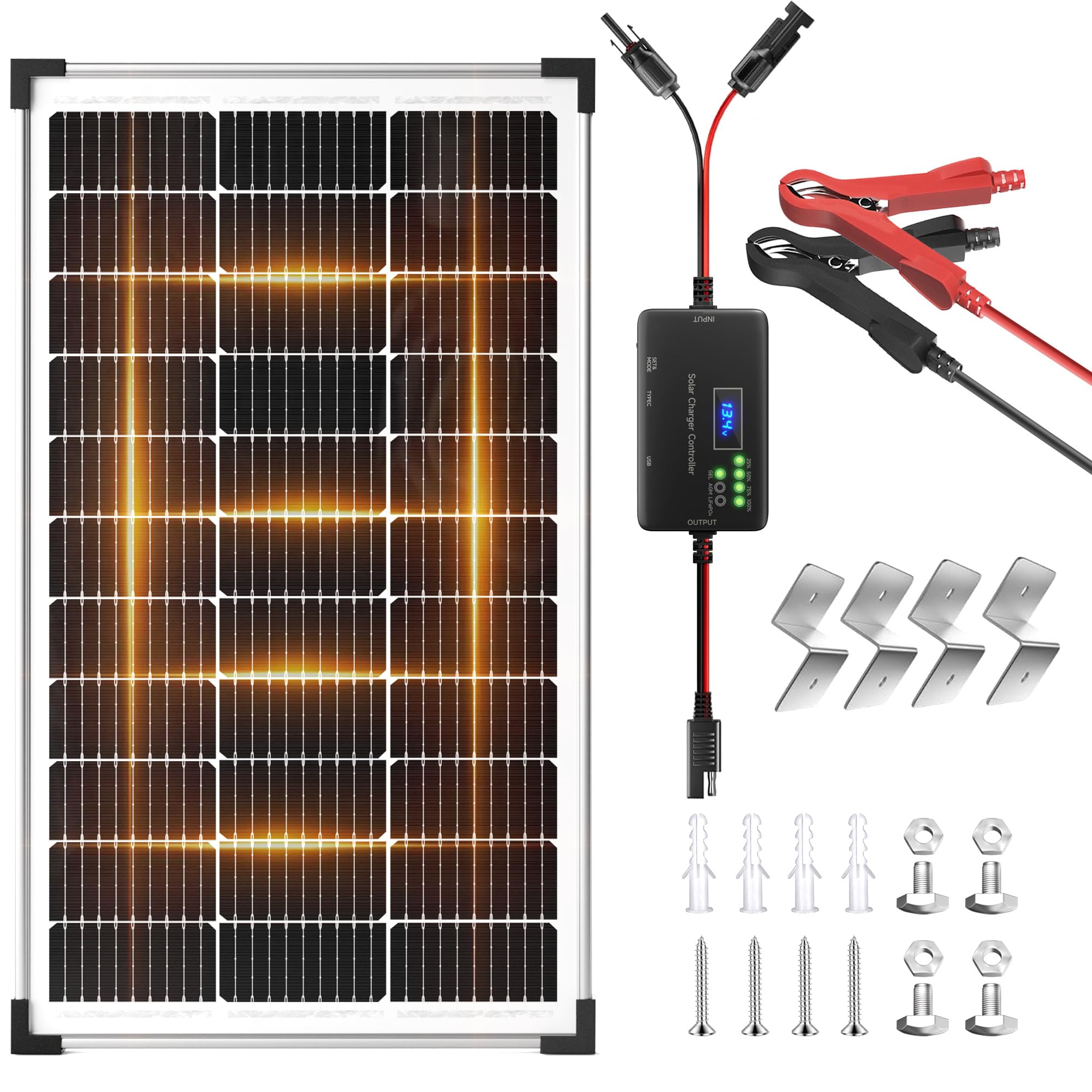
The 100W kit with the smartest controller, featuring USB and Type-C ports for direct device charging
The Voltset 100W kit earns its versatility from a genuinely useful 20A smart controller with an LCD screen. what separates it from other budget controllers is the built-in USB and Type-C ports — you can plug a phone or tablet straight into the controller to charge, which is a brilliant feature for campsites where you want to keep the battery reserved for critical loads. The controller itself handles all the standard protections (overcharge, short circuit, reverse polarity) so you don’t need to be an electrician to feel safe.
The panel is a 100W monocrystalline unit rated IP67 waterproof, meaning you can mount it on a boat or RV roof and not worry about rain ingress. Owners praise battery life above all, with one reporting it keeps his mini excavator — a machine with a famously weak alternator — charged at peak through the work week. Boat owners love that it installs in under two minutes and keeps the starting battery fresh even when the boat sits at the dock.
The honest limitation is the accessory cables. The provided wiring is often just too short for roof installations, so many buyers end up buying a longer extension cord to reach their battery. The included alligator clips are also a bit plasticky but workable for temporary setups.
Why owners recommend it
- LCD screen shows charge level and lets you track status at a glance
- USB and Type-C ports add direct device charging without an inverter
- IP67 waterproof rating suits marine and rooftop installs
The practical catches
- Cables included are shorter than ideal for roof-to-battery runs
- Designed as a maintainer, not a full charger replacement
Pick this for: boaters and weekend campers who want a smart, LCD-equipped controller at a fair price.
Look elsewhere if: you need to charge large battery banks daily — 100W will only maintain, not power heavy use.
4. ZOUPW 220 Watt Solar Panel Kit
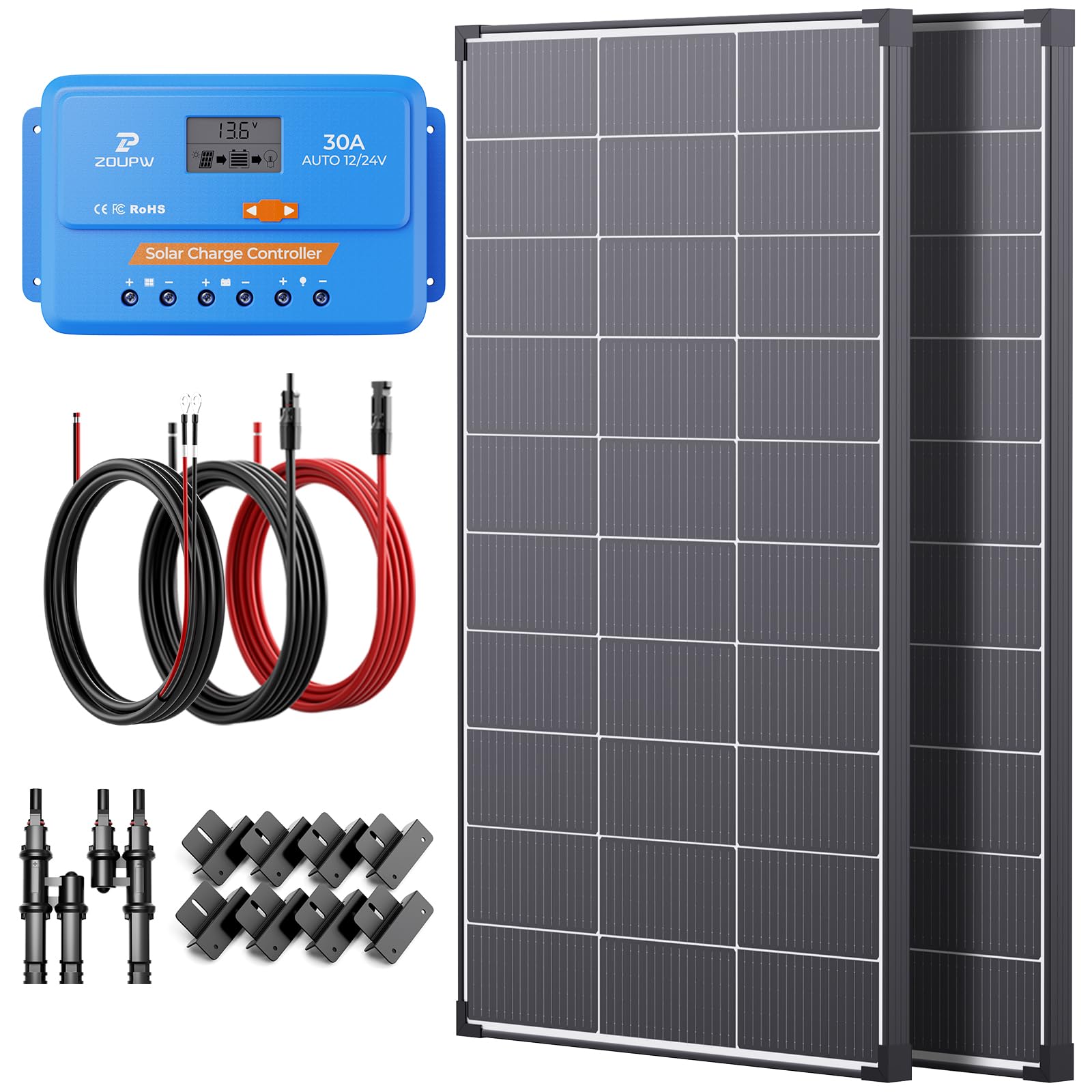
Compact 220W dual-panel setup with 25.6% efficient N-Type cells and a 10-year panel warranty
The ZOUPW 220W kit is the answer for camper van owners who want more power than a single 100W panel but lack the roof space for a massive array. It cleverly uses two 110W N-Type panels with advanced 16-busbar technology — essentially, the panels have more internal wiring lines that help capture sunlight more effectively, achieving a 25.6% efficiency rating. That efficiency is why the company quotes around 1.1kWh of daily power from just 5 hours of full sun.
The included 30A PWM controller auto-detects 12V and 24V battery systems, making it flexible as you upgrade. It has dual USB ports and a full LCD monitor, so you can see exactly what’s happening. The N-Type cells come with an anti-shade bypass design, meaning if a branch or shadow covers part of one panel, the rest keeps generating instead of dropping to zero.
Owners consistently report the panels exceed their rated output — one buyer measured 75 watts from a panel rated for less, calling it a “great little panel.” The build quality is sturdy enough to shrug off road vibrations on trailers. The main drawback is that you’ll likely notice the frame color can vary between silver and black if you order multiple units separately, a purely cosmetic detail for a system this capable.
Standout strength: the highest-efficiency cells in this list, meaning more power per square foot of roof space.
The single caveat: order it knowing the frame finish isn’t guaranteed consistent across separate purchases.
5. ECI Power 100W Solar Kit with 20Ah Battery

The rare true all-in-one kit with a real lithium battery and charger for instant off-grid power
Most solar kits send you out to buy a battery separately. The ECI Power kit is a breath of fresh air because it includes a 12V 20Ah LiFePO4 lithium battery right in the box, so you have working power the day it arrives. For a backyard fountain, a small shed light setup, or powering a watering system, this is the simplest way to get started.
The included 12V 20Ah LiFePO4 battery is rated for 2000 cycles at 80% depth of discharge and up to 5000 cycles at a gentler 50% draw. The included 10A PWM controller uses a temperature-compensated charging algorithm to protect the LiFePO4 battery.
There are two buyer realities to weigh. One owner has run it for years on his shed and notes the panel still performs great, while the same review concedes an outdoor battery in a shed eventually wears out with temperature swings — that is physics, not failure. Another buyer uses it to run a backyard water fountain 24/7. The kit is clear about its limits: it is a starter system, perfect for a light or a fan, not a whole-home power plant. And if you outgrow it, that’s a good problem.
What makes it a great starter kit
- Complete from the start — battery, panel, controller, and cables included
- 2000-cycle battery rating means years of daily use
- Controller auto-detects 12V and 24V for future expansion
What to know before you buy
- 100W output is for small loads, not appliances
- Batteries stored outdoors in extreme temperatures age faster
Grab this if: you want a working solar setup with zero guesswork — perfect for first-timers and small outbuildings.
Think twice if: you plan to run a fridge all day; you’ll need a bigger panel and more battery capacity.
6. ExpertPower 100W Solar Kit with Gel Battery

A rugged 100W kit with a sealed gel battery that shrugs off the weather and keeps equipment charged
The ExpertPower kit is built for the person whose solar needs live outdoors where conditions get rough. It bundles a 100W monocrystalline panel with a sealed 12V 21Ah gel deep-cycle battery, a battery type that is significantly more tolerant of temperature and vibration than standard flooded lead-acid. That makes it a natural fit for a golf cart, a shed, or garden equipment that gets bounced around.
Owners are impressed more by the durability than the raw power. One buyer powers his shed entirely, calling the quality high and the battery long-lasting. Another uses it to run a golf cart with no plug-in electric charger whatsoever, operating purely on continuous solar energy. Installation is refreshingly simple — described repeatedly as plug-and-play, with only a small task of stripping a few wires to fit the controller.
The panel’s construction mirrors pricier kits: tempered glass over highly efficient monocrystalline cells, with a corrosion-resistant aluminum frame. Like the Renogy panels, it handles high wind up to 2400Pa and snow loads up to 5400Pa. The honest note is that on a 100W system with a 10A controller, you are looking at a maintenance and light-use system rather than an appliance runner — perfect for keeping that golf cart or shed battery healthy, not for powering a microwave.
Its defining strength: a weather-proof gel battery included, so it’s ready for real outdoor duty.
Who it fits best: anyone with a cart, shed, or small equipment battery that needs a solar trickle that lasts.
7. ECO-WORTHY 400 Watt Premium Solar Kit with MPPT

The 400W MPPT powerhouse for cabins and sheds that brings high-efficiency charging and Bluetooth control
When you need to power real equipment — tools in a shed, lights in a small building — the ECO-WORTHY 400W kit is where mid-range solar meets genuine capability. It aggregates four 100W monocrystalline panels behind a 40A MPPT charge controller, which is the smarter, more efficient type of controller. MPPT can harvest up to 40% more power than PWM, especially in imperfect sun angles.
The system is engineered for performance. The panels carry a 21% high-efficiency rating with 3.2mm low-iron glass for durability, and the kit quotes an average 1.6kWh daily output depending on sun. But the smartest feature is the BT-02 Bluetooth module using Bluetooth 5.0, offering a signal range up to 82 feet. You can stand 80 feet away in your cabin and see real-time solar panel, battery, and load data on your phone — genuinely useful for a shed setup where you don’t want to walk outside to check the controller.
Owners mention peak outputs around 350W with full sun, with the expected drop-off under clouds. The most common note is that it’s not entirely plug-and-play: you’ll want basic electrical knowledge to wire it safely, and the included wiring is fine for short runs but may need extension if your battery bank is far from the panels. It runs an RV through weekends of boondocking with ease, and one 81-year-old buyer was moved to praise the company’s customer support. This is a system that grows with you.
Why it earns the premium label
- MPPT controller is up to 40% more efficient than PWM units
- Bluetooth 5.0 monitoring reaches 82 feet for remote status checks
- Solid 21% efficient panels with heavy-duty 3.2mm glass
Where it demands more of you
- Needs hands-on electrical understanding for a clean install
- Wiring is short — plan for cable extensions if panels sit far from the battery
Choose this for: a serious shed, cabin, or small home backup where 400W of MPPT power matters.
Be prepared for: a project with some wiring work and possible cable extensions on your end.
8. ECO-WORTHY 200W Complete Kit with Inverter
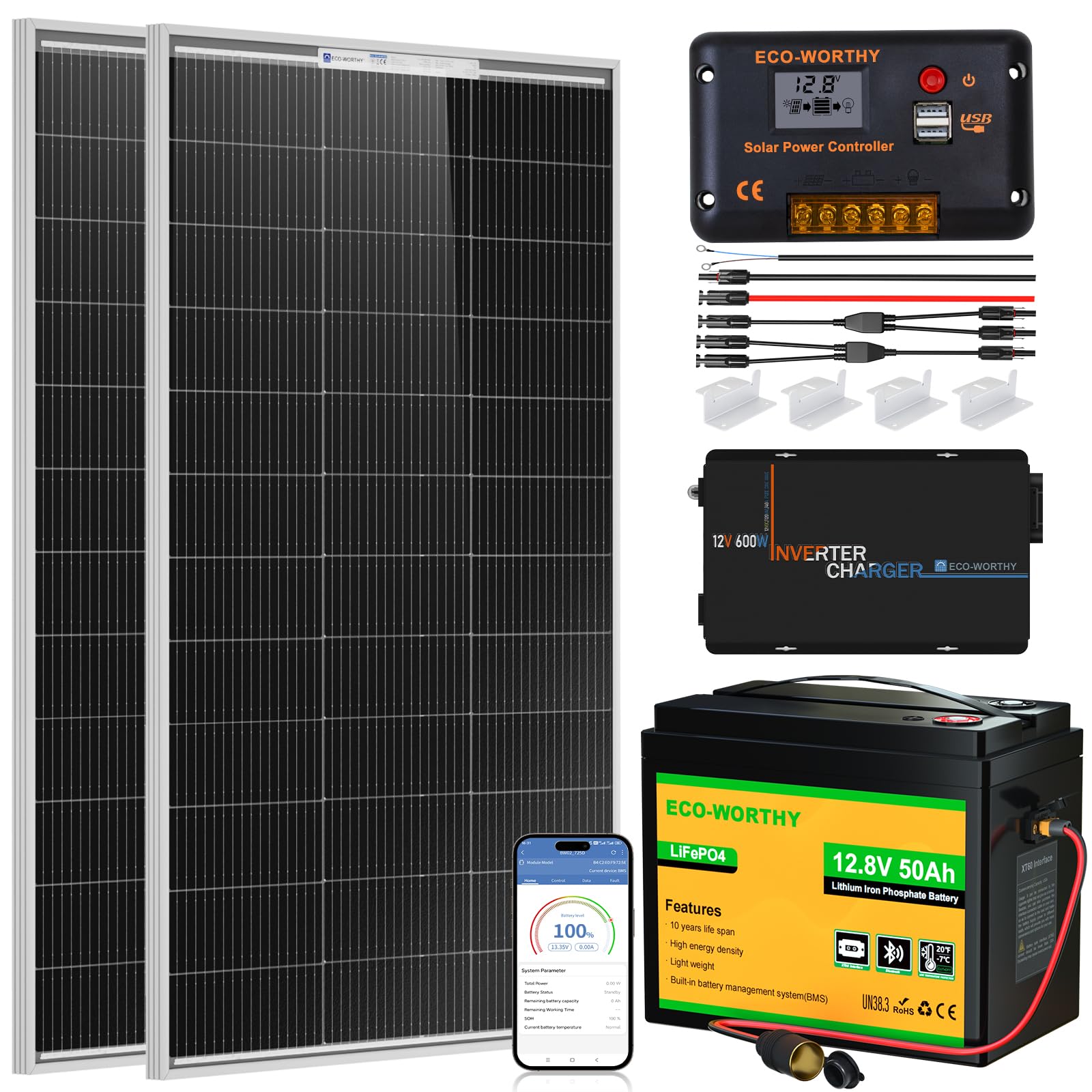
A complete 200W system with a 50Ah battery and a 600W pure sine wave inverter for AC power anywhere
The ECO-WORTHY 200W Complete kit is the rare package that includes absolutely everything to run 110V appliances: a 200W solar array, a 12V 50Ah LiFePO4 battery, a 30A LiFePO4 charger, and a 600W pure sine wave inverter. Pure sine wave means the power is as clean as your home’s wall outlets — safe for sensitive electronics and coffee makers alike. The integrated 600W inverter and 30A charger work together with a 20ms UPS auto-switch, meaning if your shore power cuts out, the system switches to battery instantly without your laptop or modem skipping a beat.
The battery is the standout spec. This 12V 50Ah LiFePO4 battery is rated for 4000–15000 recharge cycles, over 10 times the 300–400 cycles of lead-acid. The battery includes an XT60 port (a high-current connector common on hobby and solar gear) with an adapter so you can power cigarette lighter devices directly, or attach a car power inverter for extra USB and Type-C charging.
Beginner camper owners find it a revelation: one reports powering lights, phone charging, and a coffee maker in a camper trailer, with panels durable through all weather. The catch is honesty about capacity — the 50Ah battery is a weekend system, and owners note that in winter you’ll want full sun and might only stretch a weekend out of it. It is brilliant for short trips and small buildings, lighter on the wallet than building a system from parts, and perfect for learning solar before you scale up.
Its unique claim: an all-in-one box that delivers clean AC power to appliances, not just DC charging.
The honest boundary: 50Ah of storage is for weekend-level use, not full-time van living.
9. Renogy 400 Watt Premium Kit with 40A MPPT

Renogy’s most complete 400W panel system, with four 100W panels and the respected Rover 40A MPPT controller
For buyers who trust Renogy’s reputation and want the maximum power from a well-known brand, this 400W premium kit is the top shelf. It ships with four 100W monocrystalline panels engineered for a 12V system, paired with the 40A MPPT Rover controller — among the most respected controller names in the industry. The kit also includes Z-brackets, an adaptor kit, and a Bluetooth module right in the box, so you have a genuinely complete panel-to-controller system.
The real-world reviews tell a story of hobbyists finding serious capability. One buyer powers a gaming PC flawlessly with this kit, running everything from a vacuum to a blender and a 1500W Keurig through a separate battery bank. The MPPT controller’s efficiency means you’ll recharge batteries much faster than with PWM — customers note taking a 200Ah battery from 77A back to full in about 8 hours even on cloudy days. For shed tools like a chainsaw, it provides 2-3 hours of use, and one owner has run the system since 2021, calling it an excellent entry-to-mid-level kit.
The most consistent critique isn’t about power at all — it’s about the included instructions. Owners note the kit lacks a clear setup manual, only providing MPPT and Bluetooth guides, and you’ll want to download better documentation or watch a tutorial. The included 10A fuse also isn’t sufficient for parallel wiring configurations. This is a system for someone who understands the basics and brings a little technical curiosity to the project.
The Renogy advantages
- Tried-and-true Renogy MPPT controller for efficient charging
- Bluetooth module included for phone monitoring
- Recharges large battery banks in hours, even with cloud cover
What to watch for
- Setup instructions are lacking — plan to research the wiring
- Included fuse is undersized for expanded parallel arrays
This is your kit if: you value Renogy’s proven hardware and want a sturdy 400W MPPT base to build a serious system.
Set expectations for: a DIY learning curve on the first install rather than a 10-minute plug-and-play.
10. ECO-WORTHY 1.6KWH Complete Solar Kit
The Charge Controller: PWM vs MPPT
The charge controller is the traffic cop between panel and battery. PWM (pulse-width modulation) is the budget-friendly standard, simple and reliable. MPPT (maximum power point tracking) is the advanced option that continuously adjusts voltage to extract more power — up to 40% more in many conditions, making it worth the premium for larger systems on cloudy days.
Battery Capacity and Types
Battery capacity is measured in amp-hours (Ah): a 50Ah battery can deliver 50 amps for one hour, or 5 amps for 10 hours. The two main types are sealed lead-acid (like gel or AGM — cheaper upfront but limited to a few hundred cycles) and LiFePO4 lithium (several thousand cycles, lighter, and safer, but costing more). LiFePO4’s longer life makes it the better value over time for frequent use.
Amperage and Voltage Matching
Amps are the flow of electricity, and your controller must handle the current your panels produce. A 200W panel at 12V produces around 17 amps, so a 30A controller provides comfortable headroom. Voltage compatibility is non-negotiable: you must match a 12V controller with a 12V battery system. Most modern kits auto-detect 12V or 24V, but double-check before wiring.
FAQ
Can a 100W solar panel kit run a refrigerator?
What is the difference between a PWM and MPPT charge controller?
How long will a LiFePO4 battery last in a solar setup?
Will a solar kit charge my battery on cloudy days?
Why does my kit need a battery if it has a solar panel?
Can I expand my 12V solar kit later with more panels?
What size solar kit do I need for weekend RV camping?
Is it safe to run my solar panels through an inverter?
Why is a LiFePO4 battery better than a gel battery?
Do solar panel kits work in freezing temperatures?
Final Thoughts: The Verdict
For the majority of shoppers, the best 12 volt solar power system winner is the Renogy 200W Kit because it occupies the perfect middle ground of price, performance, and brand trust — offering enough daily power for an RV fridge with room to grow. If you want a complete system with a battery and inverter included, grab the ECO-WORTHY 200W Complete Kit. And for the most rich off-grid living, the ECO-WORTHY 7.168KWH Kit is the one to reach for, as it handles nearly every appliance you can throw at it with a massive lithium battery bank.
How We Picked
We do not accept paid placement. Every pick is matched to a real buyer and a real use-case; we do not hands-on test units.
Sources & Methodology
Specifications: manufacturer listings and product documentation. Review insights: verified customer reviews, as of September 2026. Pricing: not shown on this page (it changes often); check the current price via the retailer link.
As an Amazon Associate, KitchPrep earns from qualifying purchases. This does not affect which products we feature.
Related Guides
