
Specs are compiled from manufacturer listings and verified buyer reviews and can change over time — please confirm the key details on the product page before buying.
When the grid goes down, you want to keep the fridge cold, the lights on, and your phone charged. That’s what a home backup battery does, and the options here range from a 2kWh unit that runs your fridge for a day to a whole-home kit that can power a 5000W inverter setup. To pick the right one, ask yourself three things: how much power your essentials use, how long you need them running, and if you want a portable you can grab or a permanent installation.
I’m Mohammad Maruf — the founder and writer behind KitchPrep. This guide is built by comparing the manufacturers’ published specifications and the patterns across verified customer reviews, so you get each pick’s real strengths and trade-offs instead of marketing spin.
From a 2048Wh portable that recharges in 45 minutes to a 10240Wh home kit with UL-tested components, here is the breakdown of the best backup battery for a home.
Our Picks at a Glance

How To Choose The Best Backup Battery for a Home
A backup battery for your home isn’t about running everything at once. It’s about keeping the essentials — your refrigerator, internet router, lights, and maybe a CPAP or medical device — alive when the power company lets you down. The first step is listing those essentials and adding up their wattage, then matching that against the battery’s capacity in watt-hours (Wh), which tells you how long a given load can run.
Capacity vs. Power Output
Capacity (measured in watt-hours, Wh) is the fuel tank — it decides how long your fridge runs. Power output (measured in watts, W) is the engine — it decides what you can plug in at all. A refrigerator might need 150W to run but 600W for a split second when the compressor kicks on, so you need a unit whose surge power covers that startup spike. Most modern stations handle this easily, with some offering 3000W or more of peak output.
Portable vs. Permanent
Portable power stations are the easy middle ground: you charge them from a wall outlet or solar panels, store them in a closet, and roll them out during an outage to plug in your appliances. Permanent home batteries are a bigger commitment—they connect to your electrical panel, usually through an inverter, and can handle larger loads or your whole house, but installation takes more work. Your choice depends on if you need a weekend of fridge power or a serious multi-day backup.
Battery Chemistry: Why LiFePO4
Lithium Iron Phosphate (LiFePO4) is the chemistry that dominates this category for good reason. Unlike older lithium-ion cells, LiFePO4 lasts far longer—you’ll see ratings of 3000 to 6000+ charge cycles, which translates to a decade or more of daily use. That longevity matters because a backup battery sits idle most of the year, and you want it to hold its capacity when an emergency finally arrives.
Quick Comparison
| Model | Best For | Capacity | Output Power | Weight | Amazon |
|---|---|---|---|---|---|
| BLUETTI AC200L★ Best Overall | Versatile all-rounder | 2048Wh | 2400W (3600W lift) | 61.4 lbs | Amazon |
| Anker SOLIX S2000Compact Pick | Compact home backup | 2010Wh | 1500W (3000W peak) | 35.7 lbs | Amazon |
| EF ECOFLOW DELTA 3 MaxTop Performer | High-output flexibility | 2048Wh | 2400W (3400W X-Boost) | — | Amazon |
| Jackery Explorer 2000 v2 | Lightweight portability | 2042Wh | 2200W | 39.5 lbs | Amazon |
| Jackery Explorer 2000 Plus | Expandable power | 2042.8Wh | 3000W | 62 lbs | Amazon |
| ABOK Ark3600 | Big capacity with wheels | 3840Wh | 3600W (4500W peak) | 92 lbs | Amazon |
| GROWATT HELIOS 3600 | Whole-home expansion | 3600Wh | 3600W | 51 lbs | Amazon |
| BLUETTI Elite 300 | Space-saving 3kWh | 3014.4Wh | 2400W (4800W surge) | 58 lbs | Amazon |
| EF ECOFLOW DELTA Pro | Serious whole-home power | 3600Wh | 3600W (4500W X-Boost) | 99 lbs | Amazon |
| Anker SOLIX F3000 | Long-duration outage prep | 3072Wh | 3600W | 91.5 lbs | Amazon |
| ECO-WORTHY 48V Home Kit | Permanent whole-home setup | 10240Wh | 5000W inverter | 223.8 lbs | Amazon |
In-Depth Reviews
1. BLUETTI AC200L
Our pick — over 4.5★ from 500+ verified ratings; the strongest balance of quality and price.
The 2048Wh power station that bridges weekend camping and serious home backup duty.
What makes the AC200L the crowd favorite — a 4.8-star average across several hundred owners — is how much it juggles. Inside that 61.4-pound frame sits a 2048Wh LiFePO4 battery with a 2400W AC output, and it can push 3600W with its Power Lifting mode to start heavy appliances. Buyers report running a 1500W kettle and even a 12000 BTU A/C for hours off solar. It’s the kind of versatility that makes it feel less like a single tool and more like an entire power kit.
Charging is where it pulls ahead of many rivals. A max 2400W AC input takes it from 0 to 80% in about 45 minutes, and up to 1200W of solar input tops it off fully in roughly 1.7 to 2.2 hours of good sun. For a 2048Wh battery that’s genuinely fast, and it means you’re not left waiting half a day to get back online after draining it overnight.
You can expand this unit to handle multi-day outages. It accepts add-on battery packs—the B300K (2764Wh each), B210 (2150Wh each), B300 (3072Wh each), or B230 (2048Wh)—to reach a total capacity of 8192Wh. That’s enough to stretch a one-day backup into several days. It also has 13 ports, including a 30A RV outlet and a 48V/8A DC port, plus a <10ms UPS backup (a switch that kicks in faster than a blink) to protect sensitive electronics. Owners mention: “Runs 1500W kettle, 12000 BTU A/C (4hrs solar).” The downside is weight—at 61.4 pounds, it’s not a one-hand carry, but for a stationary home backup, that’s rarely a problem.
Why Owners Stick With It
- 2400W output with a 3600W lifting mode starts demanding appliances
- 45-minute fast recharge to 80% keeps downtime short
- Expands with multiple battery packs up to 8192Wh for longer outages
The Honest Caveats
- 61.4 lbs is heavy to move around regularly
- Add-on batteries are a separate expense
Your best all-rounder: if you want one unit that covers fridge, lights, and even an A/C during an outage, then expands later if your needs grow.
Think twice if: you need something light enough to haul upstairs often — this one lives best on one floor.
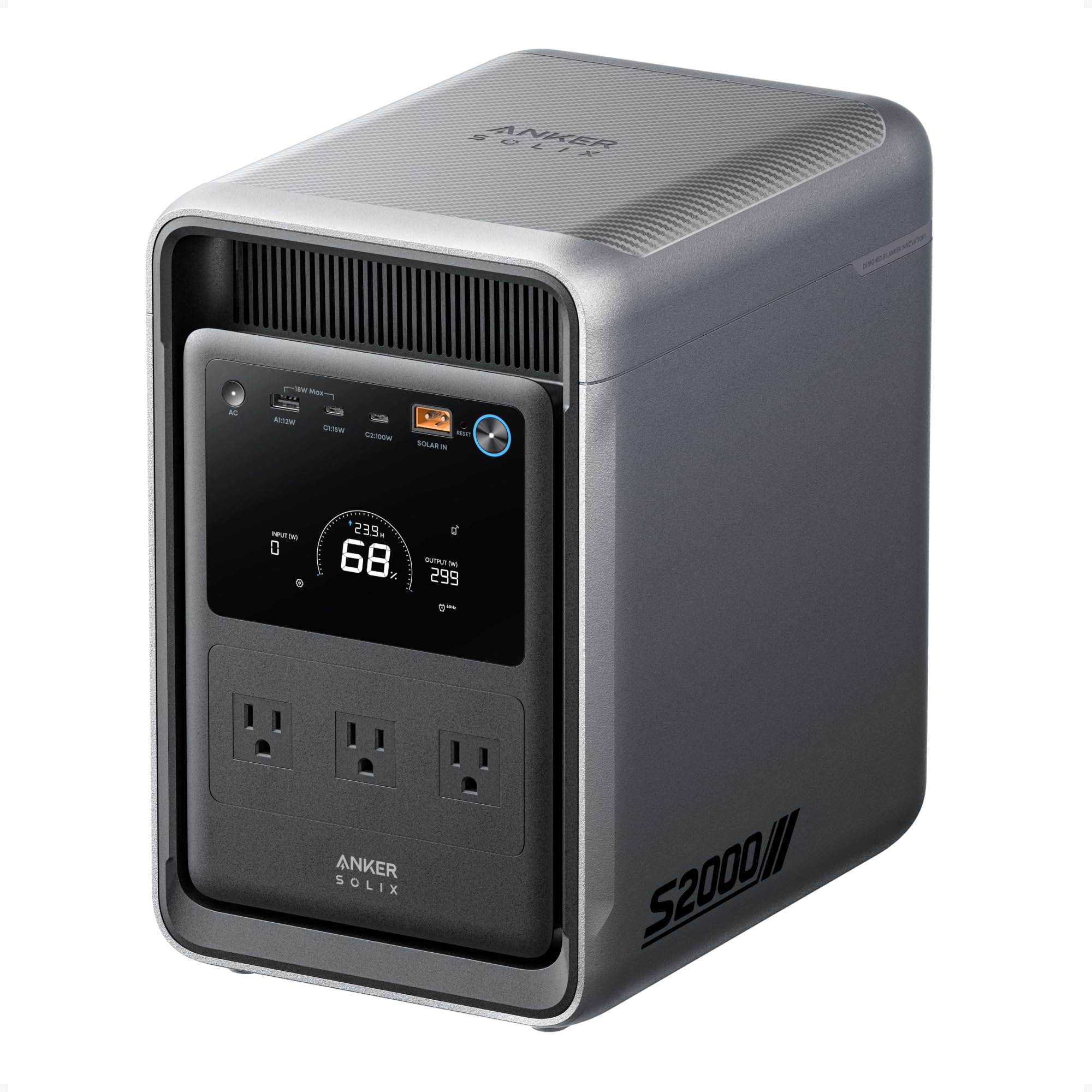
2. Anker SOLIX S2000
The 2kWh station that slims down to 35.7 pounds without skimping on runtime.
If the BLUETTI AC200L is the heavyweight, the Anker S2000 wins on size. It holds 2010Wh of capacity but weighs just 35.7 pounds and measures 8.19″L x 11.1″W x 12.7″H—nearly half the depth of the BLUETTI’s 16.5-inch frame. That means you can keep it in a hall closet and haul it out without straining. Anker claims it’s 30% smaller and 25% lighter than the typical 2kWh station., and owners consistently praise that footprint.
Runtime is where it earns its keep. Anker rates it for up to 35 hours of fridge backup., and owner reports back that up — one outage survivor ran a full-size fridge for 30 hours straight on a single charge. The 1500W continuous output (3000W peak) handles most essentials, and its <10ms UPS switchover keeps computers safe during flickers. Recharging to 100% took about 1.5 hours at 1200W in one owner’s test, with an adjustable charge rate down to 100W increments for gentler wall circuits.
Its 314Ah LFP cells (a type of lithium battery known for longevity) are rated for a 15-year lifespan, or roughly 10,000 charge cycles. The catch: solar input tops out at 400W, which is lower than the 1200W the BLUETTI AC200L accepts, so if you plan to rely on solar panels for days, this one recharges slower. There’s also no 12V DC car port—a real gap for RV or car-camping use. But for pure home-outage duty, the size-to-power ratio is tough to top.
What wins people over: the combination of a light, small body and enough capacity to ride out a 30-hour outage on fridge power alone.
Where it’s limited: the 400W solar ceiling and missing 12V port mean it’s built for home backup first, off-grid adventures second.
Reach for this if: you want the most carry-friendly 2kWh class unit that still runs a fridge past a full day.
Look elsewhere if: your plan leans on solar recharging — the 400W input will test your patience.
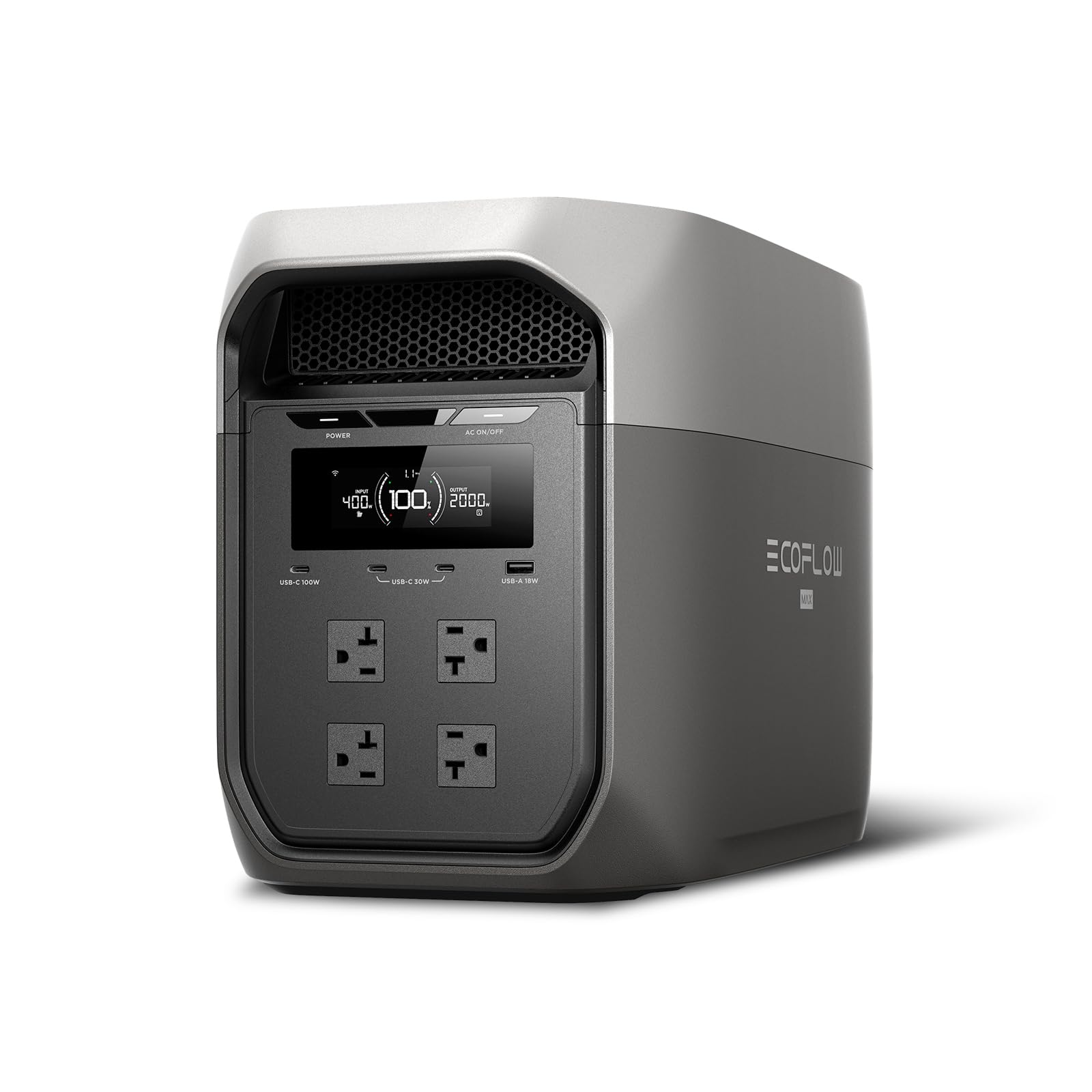
3. EF ECOFLOW DELTA 3 Max
A 2048Wh workhorse that recharges in barely over an hour and powers 99% of appliances.
EcoFlow’s DELTA 3 Max matches the BLUETTI’s 2048Wh capacity but leans harder into one thing: raw output. Its standard 2400W output climbs to 3400W in X-Boost mode — a 60% jump over the Anker S2000’s 1500W continuous output — which means it can confidently run fridges, microwaves, and even power tools without tripping. Owners describe it as an investment that “makes a difference,” with fast charging and battery life as the standout qualities.
Charging speed is a standout here. EcoFlow’s X-Stream technology (a fast-charging system) refills the battery from 0 to 80% in just 1.13 hours, so you can top up quickly before a storm hits. It also has a <10ms transfer time for UPS-style protection (uninterruptible power supply, meaning it switches to battery instantly) for computers and medical devices. Owners say the ultra-quiet operation keeps nights peaceful, making this a unit built for home-backup confidence.
The build quality gets consistent praise — owners call it solid, with dual handles and a clear display. It comes with a 5-year service plan, which is longer than most rivals offer, and the EcoFlow app pairs easily over Bluetooth or Wi-Fi for remote monitoring. The honest note: customers note buttons can be hard to see in dim light, and at this capacity the unit is solid but heavy. If you’re choosing between this and the BLUETTI AC200L, the DELTA 3 Max wins if you need the higher surge power; the AC200L wins if you want faster solar input and more expansion options.
Why It Impresses
- 3400W X-Boost output runs high-demand appliances easily
- 0-80% charge in 1.13 hours via X-Stream technology
- 5-year service plan adds long-term confidence
Fair Warning
- Owners find the buttons tough to see in low light
- Solid build means noticeable heft when moving it
Pick this for: the highest sustained output in the 2kWh class, ideal if you want to run a microwave and fridge from one box.
skip it if: you plan heavy solar expansion — its input doesn’t match the BLUETTI’s 1200W ceiling.
4. Jackery Explorer 2000 v2

A cell-to-body 2042Wh station that trims the weight to 39.5 pounds for easier hauling.
Jackery’s Explorer 2000 v2 takes a different engineering path than the others: it uses Cell-to-Body (CTB) technology borrowed from EVs, which fuses the cells directly into the structure. The result is a unit Jackery says it’s 41% lighter and 34% smaller than typical 2kWh LiFePO4 stations., and at 39.5 pounds it’s noticeably easier to lift than the 61.4-pound BLUETTI. Owners confirm the portable appeal, with one running it off-grid in Belize for remote work where it kept Wi-Fi running through rainy days.
Capacity sits at 2042Wh with a 2200W AC output. That’s enough for owners to report keeping refrigerators and freezers running for up to 3 days, and to power through a 30-hour outage with multiple recharge cycles. A USB-C PD 100W port charges laptops directly without an adapter. Charging from the wall hits 80% in 66 minutes, and a Silent Charging mode delivers a full charge in 5 hours at under 30dB — quiet enough for bedroom use.
It also doubles as an uninterruptible power supply with 20ms switching, certified to the UL1778 standard for UPS systems. That’s a meaningful distinction if you’re protecting a home office. The honest trade-offs: owners note the Bluetooth app can be finicky, and one technically-minded buyer measured real-world capacity lower than rated due to idle power draw — worth knowing if you plan long, light-load runs. The 2200W output sits below the 3000W+ surge leaders too, so pass on it if you’re powering a big window A/C.
Its defining edge: genuinely lighter than most 2kWh rivals, making it the pick that moves from the closet to the campsite without drama.
The fine print: idle draw disappointed one engineer’s runtime test, and the app pairing earns mixed owner notes.
Choose it for: a balance of 2kWh capacity and portability that few in this class match.
Pass if: you need surge power above 2200W for compressor-heavy appliances.
5. Jackery Explorer 2000 Plus

The 2042.8Wh station that scales to 24kWh when paired, with a 3000W punch.
Where the v2 trims weight, the Jackery Explorer 2000 Plus adds muscle. Its 2042.8Wh capacity feeds a 3000W AC output—comfortably above the v2’s 2200W—and owners have used that power for RV air conditioners (a 2-hour run to empty) and heavy tools like a DeWalt rotary hammer that would strain smaller inverters. The built-in 30A RV outlet also makes it a natural fit for camper owners.
The growth path is the real story. It supports up to 5 add-on battery packs to expand from 2kWh to 12kWh, and two units can run in parallel to hit 24kWh with 6000W of output. That means you can start with a single unit for fridge duty, then scale to a mini whole-home setup later. Jackery backs the LiFePO4 cells for 10 years of use and adds a 5-year warranty, with ChargeShield technology that the company says boosts battery lifespan by 50%..
Owners describe it as “better than a gasoline generator” — quiet enough for indoor use with whisper-quiet charging at 30dB, and no fumes to worry about. The honest caveats: at 62 pounds with a 19-inch length, it’s the heaviest of the Jackery 2kWh line, and owners note the telescopic handle feels a little flimsy even as it makes wheeling easier. Charging feedback is mixed — some see a full charge in about an hour, others report it won’t fully top up, so test yours soon after arrival.
The Growth Story
- 3000W output handles big appliances and tools
- Scales with packs to 12kWh, or 24kWh with two units
- 30A RV outlet + app control over Wi-Fi or Bluetooth
What to Weigh
- 62 lbs makes it the heaviest Jackery 2kWh
- Mixed owner reports on complete charging
Reach for it if: you want 3000W output now and a clear expansion path to whole-home capacity later.
Think twice if: portability outranks power in your priorities — the v2 shaves 22.5 pounds.
6. ABOK Ark3600
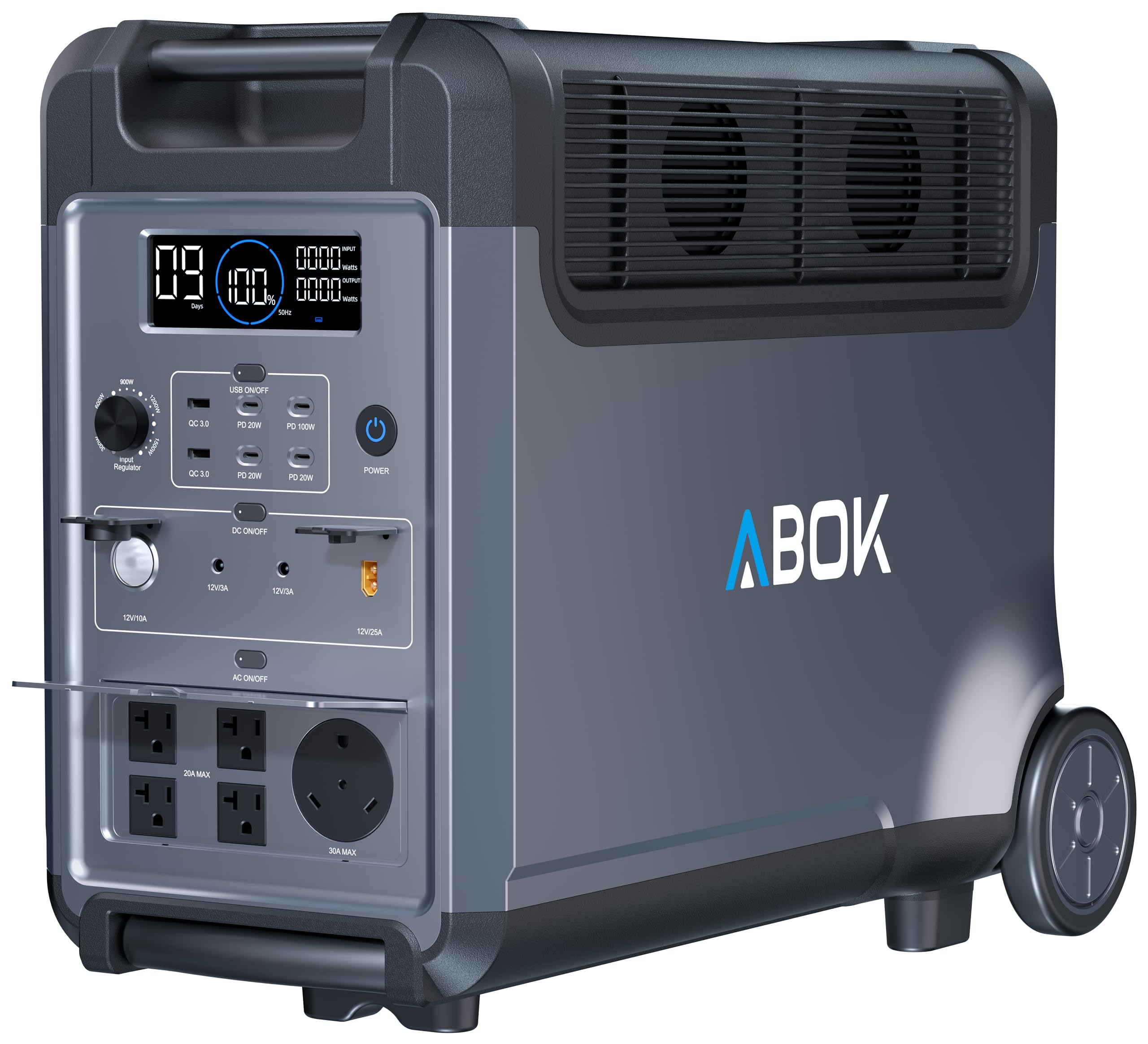
A 3840Wh powerhouse on wheels that owners say beats paying for a gas generator.
Step up to the 3.8kWh class and the Ark3600 delivers the most capacity per dollar here. Its 3840Wh LiFePO4 battery (a long-lasting lithium chemistry) pushes a 3600W rated output with a 4500W peak. Owners put it through real work—one ran a wet vac, heat gun, and SDS-Max drill simultaneously for a full workday and still had 22% left. Another kept a 58-quart fridge running off the cigarette lighter port from Saturday morning to Monday afternoon in 97°F heat and still had 64% battery.
The design centers on mobility for good reason: at 92 pounds you’re not carrying this, you’re wheeling it. A telescoping handle and durable wheels make it feel like a rolling toolbox, and owners note it’s no heavier to move than a loaded cooler. It charges from an AC outlet in about 3 hours, or in 1.29 hours when you combine AC with solar at the 2000W PV input. With 15 output ports — including a 30A AC outlet, four 20A outlets, and USB-C PD 100W — it runs nearly any household appliance at once.
Owners consistently frame it as the budget-savvy alternative to a noisy gas generator, praising its silent operation and indoor safety. One described how it “saved my pipes” during a -20°F outage. The cells are rated for over 4000 cycles and a 10-year lifespan, expandable to 11520Wh with add-on batteries. The honest gaps: it’s 120V-only (no 240V for dryers), and while the Bluetooth app works, owners find it poorly documented. But for pure watts-per-dollar with this much capacity, it’s a standout.
Why It Delivers
- 3840Wh capacity at a value price point
- 3600W output + 4500W peak handles tools and appliances
- Wheels and telescoping handle make 92 lbs manageable
Know Before Buying
- 120V only — no 240V for large appliances
- App documentation earns mixed reviews
Buy it for: the most 3.8kWh capacity for the money, especially if you need tool-grade power at home or on a worksite.
Look past it if: you require 240V output or prefer a lighter unit you can carry.
7. GROWATT HELIOS 3600
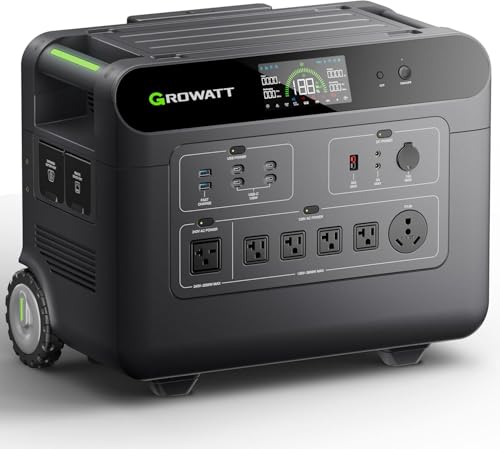
The 3.6kWh station that connects to your panel for true whole-home backup.
Growatt builds its HELIOS 3600 for a step most portables can’t take: whole-house integration. A single unit delivers 3600W output from its 3600Wh LFP battery (lithium iron phosphate, a durable chemistry), but connect two in parallel and you open up 240V / 7200W power—enough to run an A/C, dryer, or water pump, or feed a transfer switch to back up 99% of your home. Capacity expands to 36kWh with add-on batteries, which Growatt says powers a home for up to 7 days..
Owners praise the battery life, with one noting it ran an 8K BTU A/C for about 5 hours and another running a large window unit over 12 hours before hitting empty. The <15ms EPS switchover keeps servers and medical devices safe during outages, and cold-start technology lets it operate down to -22°F — genuinely useful if winter storms are your threat. Charging is flexible: 2000W solar input fills it in 2.8 hours, and AC charging takes 3 hours at 120V or just 1.5 hours at 240V.
Its 51-pound body is surprisingly light for the capacity, though owners say it’s still heavy to move. The app gets mixed feedback — one Spanish-speaking owner rates the hardware excellent but called the app “mala” after Bluetooth connection failures, though another says the app works well and needs no Wi-Fi. Growatt backs it with a 5-year service card, and the company’s reputation in residential solar adds confidence. If your goal is whole-home coverage that grows with you, this is the most direct path.
Its a neat extra: parallel two units for 240V / 7200W and feed a transfer switch — few portables approach true whole-home duty.
The recurring gripe: the app’s Bluetooth reliability; the hardware itself earns consistent praise.
Reach for it if: you want to start portable and grow into a panel-connected whole-home system.
Choose another if: you need a set-and-forget single box with polish over flexibility.
8. BLUETTI Elite 300
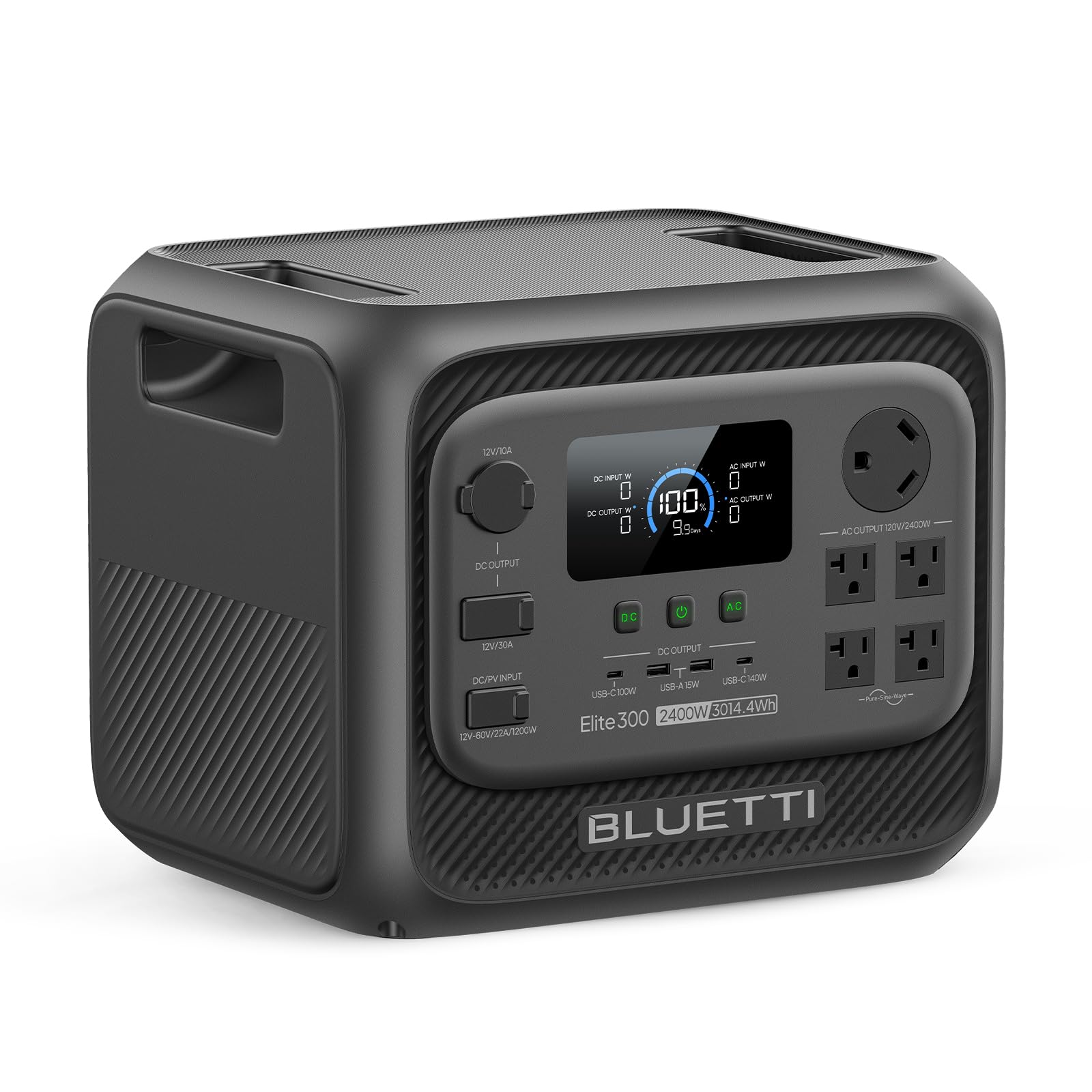
A 3014.4Wh station squeezed into a frame nearly 59% smaller than its class rivals.
The Elite 300 exists to solve a specific frustration: 3kWh of backup power usually means a monster box. BLUETTI packs a full 3014.4Wh into a unit recognized by Frost & Sullivan as the world’s smallest 3kWh portable power station, measuring just 14.4″L x 12″W x 11.7″H — smaller than many 2kWh units. At 58 pounds it’s still heavy, but the footprint means it tucks into a closet or under a counter in a way bigger stations can’t.
Output is no compromise: 2400W continuous with a 4800W surge to start resistive loads like kettles. Reviewers point out running fridges, fans, and phones all day on a charge, with one noting it ran “everything for an entire weekend” — battery life is the most-praised quality. A 10ms UPS switch protects computers and home office gear, and owners confirm flawless operation during power transitions. It charges from 0 to 80% in as fast as 78 minutes.
For RV owners, the TT-30 port and 12V/30A DC output power 12V fridges, water pumps, and diesel heaters — a feature set that earns heavy praise from the camper crowd. The LiFePO4 cells are rated for 6000+ cycles. The honest limit: there’s no battery expansion option, so what you buy is your ceiling, and owners note the solar input is capped at 60V, which demands care when pairing panels. Its 520W real-world solar input trails the 1200W leaders, so solar purists should look to the AC200L instead.
Why It Wins Space
- 3kWh capacity in one of the smallest frames available
- 4800W surge starts tough loads like kettles
- TT-30 + 12V/30A outputs built for RV use
Where It’s Fixed
- No expansion batteries — capacity is capped
- 60V solar input limit requires careful panel matching
Perfect for: anyone short on storage space who still wants true 3kWh backup, plus RV owners who need a TT-30 outlet.
Not for: planners who want to scale capacity up later or push big solar arrays.
9. EF ECOFLOW DELTA Pro
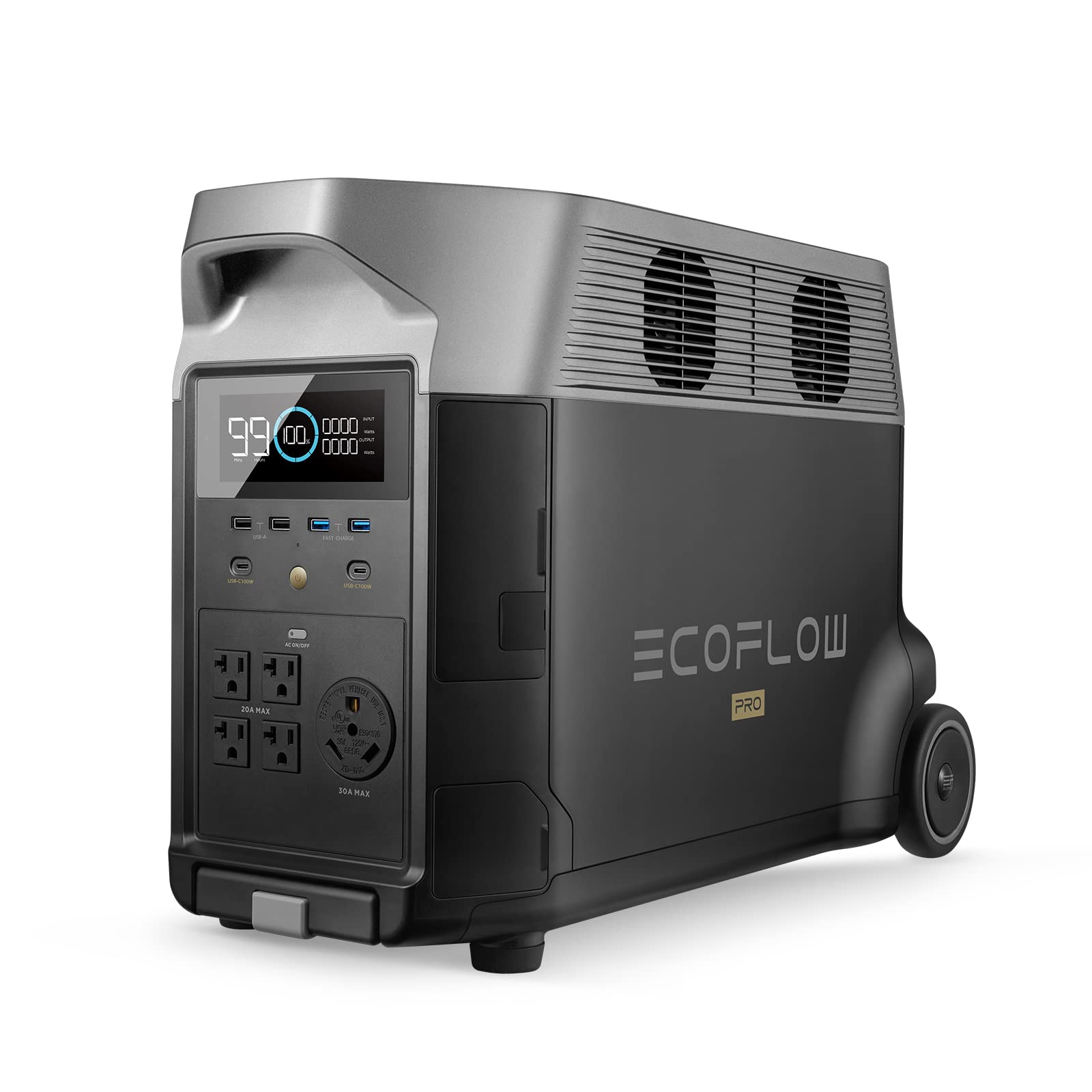
The 3600Wh station that scales to 25kWh and powers heavy gear for serious users.
The DELTA Pro is EcoFlow’s answer when 2kWh isn’t enough. Its 3600Wh LFP battery feeds a 3600W AC output that expands to 4500W with X-Boost, and owners run everything from heat presses at vendor markets to whole fridges overnight. Pair two units and you get 7200W; add Extra Batteries or the Smart Generator and capacity climbs from 3.6kWh to 25kWh. It’s a modular system that grows alongside serious power needs.
Charging flexibility is the standout. The X-Stream technology refills it in 1.8 hours from a 240V outlet, 2.7 hours from a standard 1800W wall outlet, or 2.8 hours from four 400W solar panels. Shoppers say that 2.7-hour recharge consistently, and it can also charge from an EV station — an unusual option worth having. With solar conversion efficiency up to 23%, it’s among the more efficient at turning sunlight into stored power.
Its 15 output methods cover every scenario: five AC outlets, two USB-C at 100W, USB-A fast charge, DC outlets, a car port, and an Anderson port. The EcoFlow app monitors everything over Wi-Fi or Bluetooth. Owners call it “powerful, practical, and reliable” for both home backup and travel, though they’re honest that the 99-pound weight and noisy fan under load are real trade-offs. One buyer’s neighbor ran a fridge and lights overnight off a unit delivered damaged — and still had 30% left — which speaks to the capacity on tap.
Why owners go big: 3600Wh base capacity with a 2.7-hour wall recharge and EV-station charging puts it in a league above 2kWh units.
The honest heavy: 99 pounds and a loud fan under load demand a permanent home spot.
Choose it for: whole-fridge-plus-more backup that recharges fast and expands to 25kWh.
it’s not for you if: you want something you’ll actually carry — this one lives where it lands.
10. Anker SOLIX F3000
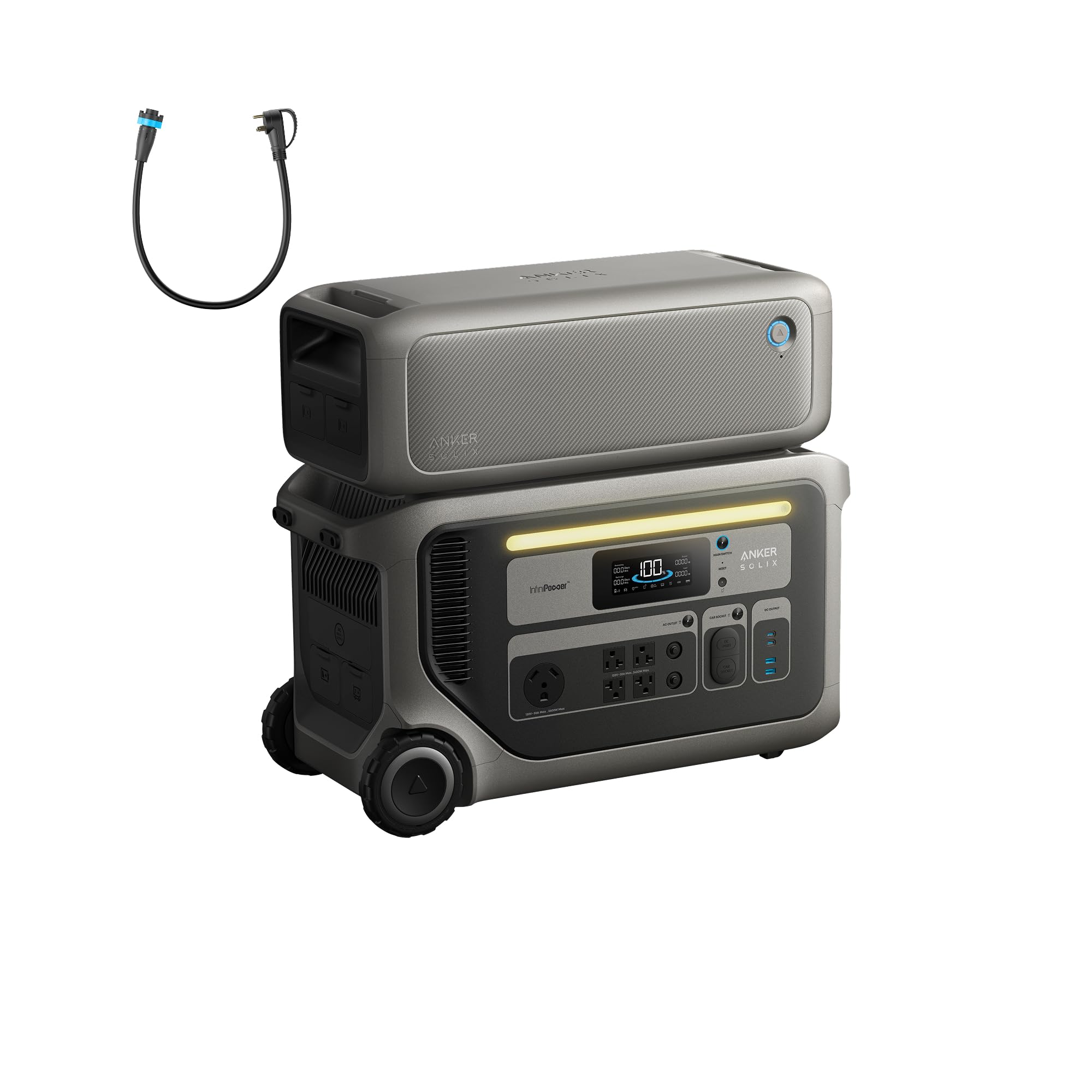
A 3072Wh station bundled with an expansion battery for 80 hours of outage-proof energy.
The F3000 arrives as a two-box system: the 3072Wh power station plus the BP3000 expansion battery, giving you a 6kWh starting capacity from the start. Anker rates it for 20 hours of essential appliances at that size, expanding to 24kWh and 80 hours with more batteries.. Owners ran 60% of their home during an outage test and powered a 13K Coleman roof A/C for 6-8 hours on low cool — numbers that show this is built for multi-day resilience, not just overnight bumps.
What makes it feel next-level is the pass-through charging. A 3600W input means you can recharge from a 120V generator while running appliances at full power — no choosing between charging and using. Combine a fuel generator with solar and input hits 6000W for hyper-fast emergency refills. Owners confirm the full charge takes about 90 minutes on a 30A input. Its ultra-low idle draw achieves 125 hours of AC idle standby, or it runs a 190W fridge for 42 hours.
Standard 120V output covers essentials, and pairing two units open up 240V for demanding appliances. Built-in 6-inch wheels make the 91.5-pound combined weight manageable, and owners with an 8000 BTU A/C reported over 4 hours of runtime. The app handles settings, though some features are app-only. The caveats: it’s bulky even with wheels, Wi-Fi can drop, and there’s no 240V split-phase from a single unit. But for an out-of-the-box long-duration system, it’s tough to top.
Built for the Long Haul
- 6kWh bundled capacity from station + expansion battery
- 3600W pass-through lets you charge and run appliances simultaneously
- 42-hour fridge runtime at 190W draw
Before You Commit
- 91.5 lbs combined — wheels help, but it’s bulky
- No 240V from a single unit
Get this for: multi-day outage prep where you want true 240V capability by pairing two, plus generator pass-through charging.
Consider a lighter pick if: you’ll move it between rooms — the wheels don’t climb stairs.
11. ECO-WORTHY 48V Home Backup
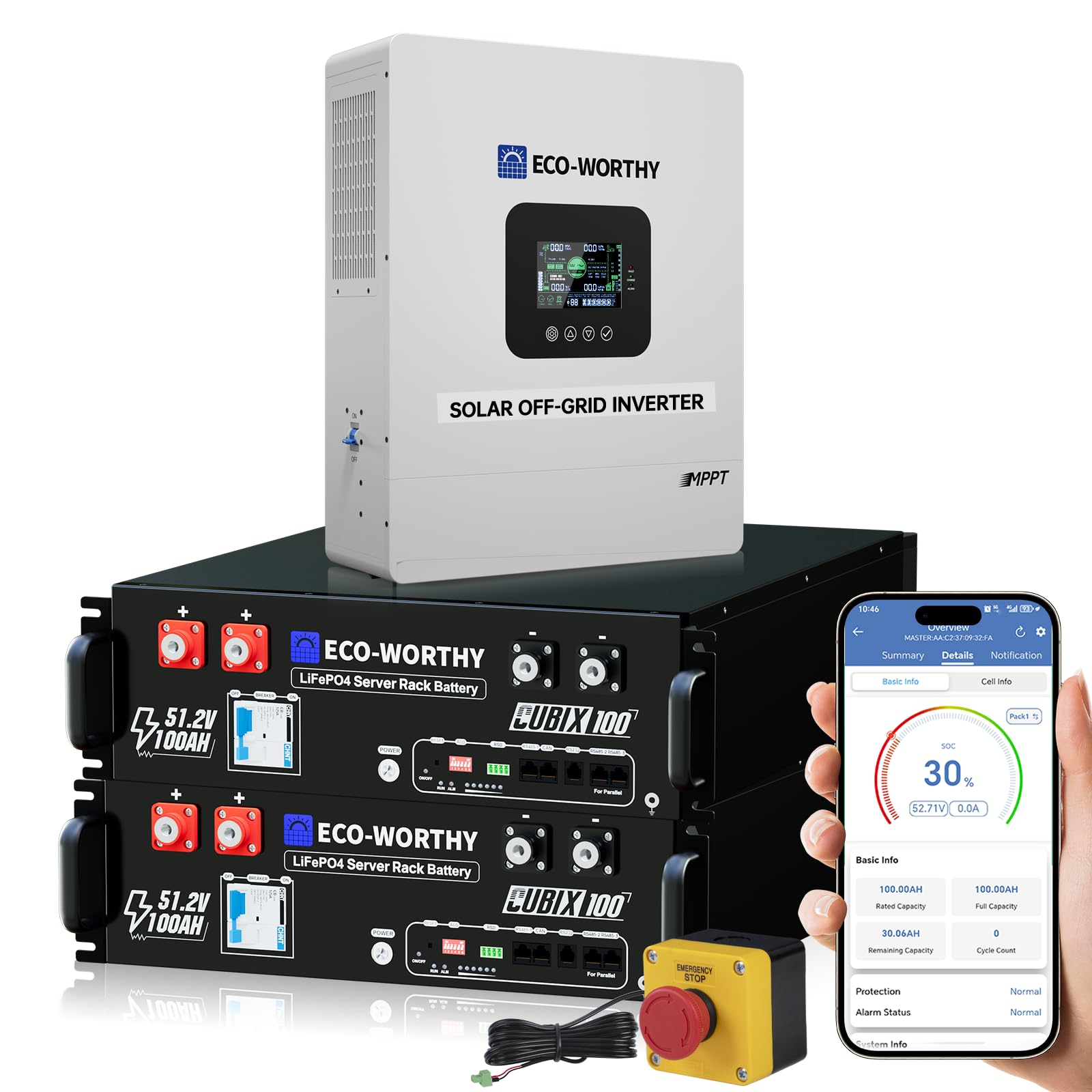
The 10240Wh home battery kit that replaces a gas generator with rack-mount permanence.
This is the one that abandons the “portable” label entirely. The ECO-WORTHY kit pairs two 51.2V 100Ah LiFePO4 server-rack batteries with a single 5000W pure sine wave inverter (a device that converts battery power to clean AC power), delivering 10240Wh of capacity and 5000W of output—enough to keep a fridge, internet, TV, and more running through extended outages. Owners use it exactly that way: “It keeps the internet, TV and fridge powered during outages.” At 223.8 pounds total, it’s not rolling anywhere; it’s a permanent home installation.
Safety is the headline feature. The battery and inverter passed UL1973 and UL1741 testing by Intertek, meeting California Energy Commission standards for electrical safety and thermal runaway management. That’s a certification level you simply don’t get from portable units, and it matters if this lives in your home year-round. The 3-in-1 inverter combines a 5000W pure sine wave output, a 100A MPPT solar controller, and a 100A battery charger all in one box.
Expansion here is nearly infinite. Up to 6 inverters connect in parallel for 30kW of AC output, and up to 32 batteries scale storage to 163.84kWh — that’s genuine whole-home territory. The batteries feature closed-loop CAN/RS485 communication so they talk to leading integrated solar inverters, with Bluetooth and Wi-Fi monitoring through the ECO-WORTHY app. The honest catch: setup is more involved than a portable, and while most owners find it easy, they wish instructions were clearer. The inverter’s solar input accepts 120-500V DC, ideal for serious rooftop or ground-mount arrays.
Why It’s a System
- 10240Wh capacity with a 5000W pure sine wave inverter
- Passed UL1973 & UL1741 safety testing by Intertek
- Scales to 6 inverters and 32 batteries for real whole-home power
What It Asks of You
- 223.8 lbs of gear that needs a permanent home
- Setup is DIY and owners want clearer instructions
Choose this if: you want certified, permanent home backup that can run your whole panel and grow to 163.84kWh.
Stick with a portable if: you lack a dedicated mounting spot or want plug-and-play simplicity.
Understanding the Specs
Watt-Hours (Wh)
This is your fuel tank — it tells you how long a device can run. A 2048Wh battery running a 100W fridge compressor would last roughly 20 hours in theory, though real-world draw and idle power reduce that. Bigger Wh numbers mean longer outages covered, which is why you’ll see units range from 2010Wh up to the 10240Wh ECO-WORTHY kit.
Output Watts (W) and Surge
This is your engine — it decides what you can plug in. A fridge needs~150W to run but 600W for a split second when the compressor kicks in, so you need a unit whose surge power covers that startup spike. Most modern stations handle this easily, with some offering 3000W or more of peak output. Check both the continuous wattage and the surge rating before buying.
LiFePO4 Battery Chemistry
Lithium Iron Phosphate (LiFePO4) is the chemistry that dominates this category for good reason. Unlike older lithium-ion cells, LiFePO4 lasts far longer — you’ll see ratings of 3000 to 6000+ charge cycles, which translates to a decade or more of daily use. That longevity matters because a backup battery sits idle most of the year, and you want it to hold its capacity when an emergency finally arrives.
Recharge Speed and Solar Input
How fast a station refills matters more than most buyers expect. A 2400W AC input can charge a 2kWh unit to 80% in about 45 minutes, while a 400W solar input might take a full day of good sun. If you plan to recharge from solar panels during a multi-day outage, look for higher solar input watts (1000W+) so you’re not waiting days to refill.
FAQ
How long will a backup battery run my refrigerator?
What’s the difference between a portable power station and a home backup battery?
Can I recharge a backup battery with solar panels?
What does UPS mode mean and do I need it?
How heavy are these backup batteries and can I move them?
What is X-Boost or Power Lifting mode?
Can I expand the capacity of a backup battery later?
How long do LiFePO4 batteries last?
Is a backup battery safe to use indoors?
What size backup battery do I need for my home?
Final Thoughts: The Verdict
For most households, the backup battery for a home winner is the BLUETTI AC200L because it balances a proven 2048Wh capacity, fast 45-minute recharging, and room to expand. If you want the most carry-friendly unit that still runs a fridge past a full day, grab the Anker SOLIX S2000 at just 35.7 pounds. And for whole-home coverage through multi-day outages, the ECO-WORTHY 48V kit delivers certified 10240Wh capacity that a portable simply can’t match. If your needs sit between those extremes, the EF ECOFLOW DELTA 3 Max offers the highest surge output in the 2kWh class, and the ABOK Ark3600 delivers exceptional value per watt-hour at 3840Wh. Whatever you choose, keep it topped up and ready — the next outage is always a surprise.
How We Picked
We do not accept paid placement. Every pick is matched to a real buyer and a real use-case; we do not hands-on test units.
Sources & Methodology
Specifications: manufacturer listings and product documentation. Review insights: verified customer reviews, as of September 2026. Pricing: not shown on this page (it changes often); check the current price via the retailer link.
As an Amazon Associate, KitchPrep earns from qualifying purchases. This does not affect which products we feature.
Related Guides
