
Specs are compiled from manufacturer listings and verified buyer reviews and can change over time — please confirm the key details on the product page before buying.
Before you buy a belt sander, decide where the work happens: do you move the tool across the wood (handheld), or push the wood into a fixed machine (benchtop)? That choice sets your speed on a floor, a tabletop, or a knife bevel — and how much frustration you dodge. Below, nine top-rated sanders are compared, from budget to pro-level, so you can match the shape to your workshop.
I’m Mohammad Maruf — the founder and writer behind KitchPrep. This guide is built by comparing the manufacturers’ published specifications and the patterns across verified customer reviews, so you get each pick’s real strengths and trade-offs instead of marketing spin.
The best belt sander machine for your shop delivers the right belt speed, amperage, and dust control for the projects you actually tackle.
Our Picks at a Glance


How To Choose The Best Belt Sander Machine
Start with the shape of your work. A handheld sander puts you in control on floors and large flat surfaces. A benchtop unit locks the belt in place so you can shape edges, bevels, and small parts with two hands on the wood. Each design suits a different kind of project, so identify yours before you look at power specs.
Belt Size Sets Your Job Scope
Belt dimensions are the first filter. A 3×21-inch belt is the standard for handhelds — light enough to guide with one hand and long enough to remove material fast on doors and tabletops. A 4×36-inch belt, common on benchtop units, gives you a wider sanding path for flattening edge-after-edge. The 4×24-inch combo units bridge the two worlds: they run handheld and can be clamped upside down as a stationary sander.
Amperage and Speed Are Your Power Gauge
Amperage tells you how hard the motor can push. Lighter benchtops run around 4.3 A, while heavy handhelds climb to 8.8 A or 10 A for aggressive stock removal. Speed matters too — adjustable speed dials let you slow down for fine finishes or delicate materials. Watch for RPM or surface-feet-per-minute ratings, which state how fast the abrasive actually moves past the wood.
Dust Control Decides Cleanup and Visibility
Sanding creates a fog of fine dust that coats your workshop and hides your work line. Most machines ship with a cloth dust bag, but owners repeatedly report bags clog and underperform. For serious dust management, look for a solid dust port that accepts a shop vacuum hose, keeping the air clear and your sanding line visible.
Quick Comparison
| Model | Best For | Form Factor | Amperage | Max Speed | Amazon |
|---|---|---|---|---|---|
| WEN Benchtop 6502T★ Best Overall | Crafting and hobby shaping | Benchtop | 4.3 A | 3600 RPM | Amazon |
| Genesis GBS321ABest Value | Value-focused DIY floors | Handheld | 8 A | 18000 RPM | Amazon |
| WEN HB424VMost Versatile | Handheld-to-benchtop versatility | Combo | 10 A | 2000 RPM | Amazon |
| Woodskil 4.3A | Easy benchtop assembly | Benchtop | 4.3 A | 3570 RPM | Amazon |
| Metabo HPT SB8V2 | Heavy-duty handheld sanding | Handheld | 9 A | — | Amazon |
| Makita 9032 | Tight spots and metalwork | Handheld narrow | 4.4 A | 5600 RPM | Amazon |
| Milwaukee M18 Fuel | Cordless portability | Handheld cordless | Equivalent 3 A | 13500 RPM | Amazon |
| Bucktool BD4801-M | Metal fabrication and knives | Benchtop | 5 A | 3450 RPM | Amazon |
| Makita 9903 | Quiet professional finish | Handheld | 8.8 A | 1440 ft/min | Amazon |
In‑Depth Reviews
1. WEN Benchtop Belt and Disc Sander 6502T
Our pick — over 4.5★ from 5,000+ verified ratings; the strongest balance of quality and price.
The stationary workhorse that gives hobbyists a pro-shop feel without a pro-shop budget.
This sander is the crowd favorite, holding a 4.6-star score across thousands of reviews. It pairs a 4-by-36-inch belt with a 6-by-6-inch disc, so you can flatten long boards on the belt then move to the disc for curves and edges. The whole unit sits on a cast iron base that owners say keeps heavy vibrations away, and it stays planted even without being bolted down.
The 4.3 Amp motor spins the belt up to 3600 RPM, which buyers report is plenty for home projects and “performs well” for quick shaping work. A tension release lever lets you swap grits in seconds, and the belt itself tilts anywhere from 0 to 90 degrees so you can sand flat or push into vertical edges. One owner used it on stone coasters with 60-80 grit, noting easy belt swaps and centering.
Owners mention the machine has run reliably for two full years with just periodic lubrication, and that it shares its design with pricier brands. The honesty note: the dust port is weak when the belt sits flat, and the disc alignment and miter gauge feel flimsy. Owners note the fence sits high and the included Allen wrench is too short for upright use. It is a benchtop tool, so you need shop space, but reviewers call it a “great budget sander” that doesn’t walk around.
Why owners rank it #1
- Quiet operation and solid build that stays stable without mounting
- Belt changes are fast, and the belt stays in place once centered
- Two-in-one belt and disc design handles both wide flats and tight curves
- Proven reliability — running strong for two years with periodic lube
Where it asks for patience
- Dust port is weak when the belt runs in flat mode
- Disc alignment and miter gauge feel flimsy, per owners
- Assembly instructions are unclear, and the vacuum adapter is a non-standard size
Reach for this if: you want one stationary sander for hobby crafting, small furniture, and everyday sharpening — its two surfaces and 90-degree tilt cover most shop tasks.
Think twice if: sanding dust bothers you; the weak flat-mode dust port means you’ll want a shop vac that fits the non-standard adapter.
2. Genesis GBS321A Single Lever 3″ x 21″ Variable Speed Belt Sander
A speed-dial handheld that lets DIYers tame big floors on a lighter budget.
What wins people over on this one is the value — it’s the budget-tier option that owners consistently praise for the price. The 8 A motor cranks the belt to a screaming 18000 RPM, which makes it a 9x speed gap over the combo-style units. That raw speed is why customers note it handled a 16-foot bar top and roughly 600 square feet of flooring without drama.
You can swap belts without any tools thanks to the single-lever quick-change system, and the adjustable front handle lets you grip comfortably with both hands. Reviewers point out the belt tracking stays true and rarely needs adjustment — one reviewer noted it “ran 3+ hours straight, then 2 more” with easy belt changes and tracking that “never needed adjustment.” The low-profile front reaches tight spots like door jambs and handrails.
The recurring downside is dust collection. The included bag is flimsy and clogs, and the square port won’t fit a standard shop vac hose. Because the bag blocks the motor vent when it’s full, owners advise emptying it often. Some also report mixed durability on the plastic parts; one unit snapped a plastic piece, and the build quality gets a mixed verdict overall. At 7.8 pounds it’s heavier than some rivals, so plan for two-handed use.
The speed king: 18000 RPM gives this budget pick material-removal pace that outruns far pricier benchtop units, and it proves itself on real flooring jobs.
The honest catch: you are trading dust control and long-term plastic durability for that speed and price — fine for a homeowner, risky for daily commercial use.
Who it’s for: a homeowner refinishing floors, doors, or one-off furniture who wants aggressive speed and tool-free belt changes.
Look elsewhere if: you need clean air — the dust bag and square port will frustrate you, so budget for a shop-vac workaround.
3. WEN 10-Amp 4″ x 24″ Variable Speed Combination Handheld and Benchtop Belt Sander HB424V
Two tools in one shell — glide it by hand or clamp it upside down as a benchtop.
This is the rare sander that genuinely works in both modes. The 10 A motor — the strongest amperage in this lineup, roughly 2.3x the draw of a typical 4.3 A benchtop — spins the belt anywhere from 660 to 1310 feet per minute, giving you real speed control. Owners call it a “monster” that removes material fast, performing better, as one put it, than “lighter, skinnier models.”
The lock-on switch lets you sand continuously without squeezing the trigger, which saves your hand on long passes. When you want stationary duty, the included L-clamps bolt it to your benchtop facing up, and a quick-release tension lever handles grit changes in seconds. It ships with two 80-grit belts, a rubber mounting pad, and a detachable dust bag, plus spare pulley belt.
Owners praise the powerful brushed motor and heavy metal build, saying it rarely bogs down, and one senior user found it light enough for comfortable floor sanding. The honesty note is dust: the bag is weak, so owners recommend a shop vac, and the 1.2-inch port may need an adapter for your hose. Shoppers say one unit “sanded tough floor but bearing blew out near completion,” which makes this a poor fit for commercial heavy-grit work. An occasional unit also arrives with an electrical quirk that causes a small handle shock.
Two tools, one motor
- Genuine handheld and benchtop modes via included L-clamps
- 10 A motor with variable speed handles rapid material removal
- Lock-on switch and trigger lock ease long sanding sessions
- Simple belt changes and an effective tracking knob
Read before you buy
- Dust bag is weak; a shop vac is the real solution and may need an adapter
- Slightly heavy, which some owners find manageable but tiring
- Not built for commercial heavy-grit abuse — one bearing failure reported
Buy it if: you can’t decide between handheld and benchtop and want one powerful machine that does both for floors and edge work.
skip it if: your work is all-day commercial sanding; this is a heavy-duty home tool, not an industrial one.
4. Woodskil 4.3A Belt Disc Sander Combo for Woodworking

A benchtop sander that goes from box to running in about five minutes flat.
Assembly speed is the standout here — owners consistently say setup takes roughly five minutes, and the unit performs better than they expected once it’s running. The upgraded 3/4 HP motor pushes the belt to 3570 RPM with a surface speed of 1732 feet per minute, which owners say chews through rough wood efficiently. The 25-pound package is light enough to move around your shop.
Like the top pick, this pairs a 4×36-inch belt with a 6×6-inch disc. The belt tilts from 0 to 90 degrees, and the adjustable worktable tilts 0 to 45 degrees with a miter gauge for angled cuts. Dual dust exhaust ports — one for the belt, one for the disc — manage cleanup better than single-port rivals. A transparent PC guard lets you watch the belt condition while you work, and a belt tension device helps prevent the belt from slipping off.
Owners describe the noise level as tolerable — not silent, but not so loud you can’t think. The handle on the circular disc work support could use a second screw for a firmer surface, and platform stability draws mixed feedback, with some owners finding the platforms a bit weak. It’s a compact, portable benchtop that one reviewer called “the best little sander you could own,” and it bolts to a workbench for turntable-like access.
The fast-start pick: five-minute assembly and a 3/4 HP motor make this the least-friction way into benchtop sanding for a first-time buyer.
Know the limits: the disc work support feels less rigid than the rest of the machine, so it suits hobby shaping more than heavy production work.
Choose it for: quick home woodworking projects where you want dual dust ports and easy assembly without a high price tag.
Pass if: you’re doing precision metalwork or need a rock-solid disc platform — the lighter table may flex.
5. Metabo HPT SB8V2 3″ x 21″ Variable Speed Belt Sander

A cushioned-grip workhorse that pairs pro power with a 5-year safety net.
Quality earns the most praise here — it’s the single trait owners rave about most, and the 9 amp / 1,020-watt motor backs it up with forcible power for tough jobs. The variable speed dial sits at the base of the handle, letting you dial back the aggression for finer control, and the clear front cover improves visibility when you sand right up against a surface. The left-side dust bag keeps your corner-sanding sightline clear.
Owners describe it as heavy duty and easy to load belts, with a flush surface design that sands quickly and evenly. It’s strong enough to be a worthy replacement for older Porter Cable models, and the balance and speed control draw consistent praise. The 5-year limited warranty is the longest in this lineup, signaling confidence in the tool’s durability.
Durability is a mixed bag. Most owners find it built to last, but some report the drive belt tearing after just one hour of use, and the dust bag sits awkwardly close to the handle — owners have removed it and rigged a PVC elbow for outdoor work. The overall rating is a touch lower than rivals because of that durability mix, and it weighs 9.5 pounds, so it’s not a one-hand tool.
The professional case
- Top-mentioned quality and build with a pro 5-year warranty
- Powerful 9 A motor that handles aggressive stock removal
- Clear front cover improves visibility in tight sanding spots
- Variable speed dial adds control for finish work
What to weigh
- Drive belt durability draws mixed reports — some tear after an hour
- Dust bag position is awkward and near the handle
- At 9.5 pounds, it earns its place on two-handed jobs
Best suited for: a serious DIYer or pro who wants a powerful, well-built handheld and values the 5-year warranty as insurance.
Consider the risk: the mixed drive-belt reports mean you may want spare belts on hand for heavy continuous use.
6. Makita 9032 3/8″ x 21″ Belt Sander

The narrow-nose specialist built for tight corners, welds, and steel nobody else can reach.
This is not a general-purpose sander — and that’s exactly its genius. The 3/8-inch-wide belt makes it the tool you reach for when you need to grind a weld, deburr metal, or file a door strike in a space a full-width sander can’t fit. Owners describe it as a high-end commercial-grade tool that works on both wood and steel, with one noting it devoured material on hot-rolled plate and 52100 steel with 40-grit belts.
You can angle the head into hard-to-reach areas because the adjustable sanding arm pivots up to 100 degrees, and the variable speed dial runs the belt from 980 to 5,600 feet per minute so you can match speed to the material. The 21-inch belt length produces a 4-5/16-inch maximum sanding length for faster work than a short pad. At 1500 g, it’s light enough to maneuver one-handed into awkward spots.
Owners in specialized trades call it invaluable — It paid for itself on a 100-room hotel job grinding door strikes., and it’s praised for fiberglass boat work and custom plexiglas bevels. The drawbacks are real: it’s awkward to hold at times, the low-speed torque is weak, and the 3/8×21 belt size is uncommon, so you can’t grab belts just anywhere. The Makita 9032’s design is at its best slightly below max speed, per experienced owners. Compare that to the wider 3×21 options above, which suit broad flats far better.
A scalpel, not a hammer: the 3/8-inch belt and 100-degree pivoting arm make this the definitive narrow-reach sander for metal and tight wood spots.
The trade-off: that same narrow belt and the uncommon size mean it’s a poor first sander — add it to a shop that already has a 3×21.
Pick this if: you grind welds, deburr steel, or shape fiberglass and need a sander that reaches where wide belts can’t.
Reconsider if: you want one sander for whole-tabletop work — this specialist will feel too narrow, and the belt size is harder to find.
7. Milwaukee M18 Fuel 3″ x 18″ Belt Sander
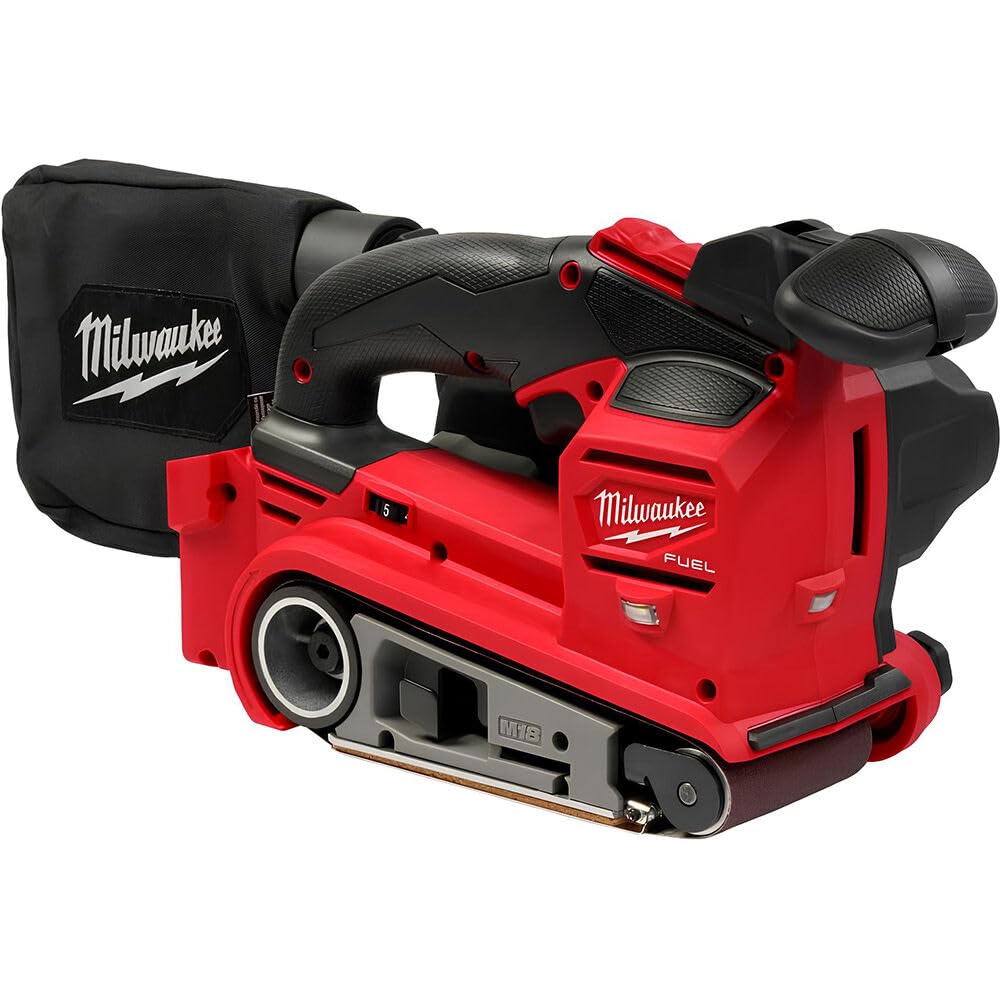
The cordless knockout for Milwaukee loyalists who want belt-sander freedom on site.
Functionality is what owners praise most here, and the POWERSTATE brushless motor is the reason — Milwaukee claims it matches the power and torque of larger 8 A corded sanders for faster material removal. The M18 Fuel name means you’re plugging into an existing battery ecosystem, so if you already run Milwaukee tools, this drops into your kit with zero new chargers. Owners say it “got the job done” with plenty of power and performs better than corded alternatives.
You can tune the removal rate with the variable speed dial, which gives a belt speed range from 1350 to 750 Surface Feet per Minute, and a tool-free belt change lever swaps belts in seconds. The dust bag works well — one owner noted the zipper makes clean-out easy and left “little mess to clean up.” It’s compatible only with 3×18 sanding belts, a shorter belt than the 3×21 standard, which keeps the tool compact.
The cordless catch is battery appetite. Owners are blunt: it drains batteries fast under heavy material removal, with One owner reported an 8 Ah battery dying in about two minutes of heavy work., and batteries can overheat. For serious jobs you want a 12 Ah High Output battery, and for continuous big jobs, owners say an AC sander is the better tool. It weighs 4.01 kg, so it’s no featherweight, and it’s the priciest corded-alternative gap here for a reason.
Why cordless wins
- No cord means instant freedom on ladders and job sites
- Brushless motor matches larger 8 A corded sanders
- Dust bag with zipper keeps cleanup fast and tidy
- Tool-free lever changes belts with zero downtime
The battery reality
- Drains batteries quickly — owners suggest a 12 Ah High Output pack
- Batteries can overheat during extended runs
- Short 3×18 belt means smaller sanding path than a 3×21
Buy it for: light-to-medium duty work away from outlets, especially if you’re already invested in Milwaukee M18 batteries.
Choose a corded sander if: your jobs run all day — no battery pack keeps up with continuous heavy material removal.
8. BUCKTOOL Pro 1HP Bench Belt Sander BD4801-M

A heavy 1 HP direct-drive benchtop that holds its own on high-carbon steel.
Where the WEN benchtop suits hobbyists, this Bucktool steps up for metal. Quality and performance are the two most-praised traits, and the 1 HP direct-drive motor is the reason — owners say it grinds high-carbon steel easily and never bogs down, with one calling it “a beast of a sander” that’s more capable than typical hobby-level units. The direct-drive design is claimed to be 25% more efficient than belt-driven setups.
This two-in-one machine pairs a 4×36-inch belt with a larger 8-inch disc, and disc paper uses a hook-and-loop design for tool-free swaps. The belt table tilts 0 to 90 degrees for horizontal or vertical sanding, while the disc table adjusts 0 to 45 degrees with a metal miter gauge. A driven drum lets you sand curved workpieces, and the sturdy cast aluminum base with rubber feet keeps vibration down — owners say it’s so powerful the machine “scoots before stalling.” Noise levels are surprisingly low, a point owners mention positively whenever it comes up.
It ships with knife-grinding accessories that mount on the belt plate, which is why knife makers and machinists love it, and owners say it’s excellent value against expensive accessory-laden grinders. The honest downsides: it has a large bench footprint, the setup instructions are nearly useless (owners call the assembly “guesswork”), and one owner flagged that the cast iron table wasn’t square without grinding and the plastic disc dust guard melted. That 5 A / 3450 RPM motor is built for metal, not just soft wood.
The metalwork edge
- 1 HP direct-drive motor handles high-carbon steel easily
- 4×36 belt plus larger 8-inch disc for two work zones
- Quiet operation that surprises owners given the power
- Includes knife-grinding accessories for blade work
Assembly and setup
- Setup instructions are unclear — owners describe guesswork
- Plastic disc dust guard can melt under heavy load
- Large footprint needs dedicated bench space
Reach for this if: you make knives, do fabrication, or work in a shop that needs real metal-grinding capability in a benchtop form.
Look elsewhere if: you want a plug-and-play setup — this one demands patience with assembly and a solid bench.
9. Makita 9903 3″ x 21″ Belt Sander

The quiet, precision-tracking sander that pros buy when they’re done with finicky belts.
This is the sander that owners say is “expensive, but worth it” — the premium-tier finish. Functionality is the most-praised trait by a wide margin, and the auto-tracking belt system is the headline feature: it tracks straight and true without manual adjustment, even under heat and pressure. The powerful 8.8 A motor runs at just 85 dB, noticeably quieter than typical sanders, which owners appreciate on long deck jobs.
The variable speed dial spans 690 to 1,440 feet per minute, letting you drop to a precise low speed for careful work — Buyers report it removes material to within 1/32 inch accuracy.. The flat nose and side are designed for sanding flush to a wall, and the front grip makes two-handed control comfortable. Because the top is flat, you can clamp it upside down as a stationary sander, a trick owners use for detailed edge work.
Dust collection is the second-most praised feature, with owners calling it fantastically effective — a sharp contrast to the weak bags on budget picks. Owners note it’s well-balanced despite the 9.5-pound weight, and it handles coarse belts with ease. The trade-off is price, which sits at the top end of this list, and the friction-fit dust bag pops off easily. Some find it heavy, and at full speed there’s a gouging risk if you’re careless — owners suggest using the front roller for curves and moderate speed for control.
Why pros pay more
- Auto-tracking keeps the belt true with zero fiddling
- Quiet 85 dB operation that owners consistently praise
- Top-tier dust collection keeps the air and work line clear
- Flat top converts to a stationary sander when clamped
The premium price
- Most expensive pick in this lineup — owners call it “worth it” but note the cost
- Heavy at 9.5 pounds, despite good balance
- Dust bag friction-fit pops off easily during use
Splurge on this if: you sand decks, furniture, or refinishing projects daily and want quiet operation, perfect tracking, and real dust control.
Save your money if: you’re a light-duty DIYer — the speed and features outpace what occasional sanding needs.
Understanding the Specs
Amperage and Motor Power
Amperage (A) tells you how much electrical current the motor draws, and it’s the simplest proxy for raw sanding muscle. A 4.3 A benchtop motor suits hobby shaping, while an 8.8 A or 10 A handheld motor powers through floors and heavy stock removal. Matching amperage to your job prevents the frustration of a motor that bogs down mid-pass on hard wood.
Belt Speed: RPM vs Feet per Minute
Belt speed appears in two forms. RPM (rotations per minute) measures how fast the drive drum spins, while feet per minute (or SFM, surface feet per minute) measures how fast the abrasive actually travels across the wood. Variable speed dials let you slow the belt for fine finishes and delicate materials, or run it full-tilt for aggressive removal. Faster is not always better — control matters for finish quality.
Belt Tracking
Tracking refers to the belt staying centered on the rollers as it spins. A belt that drifts off-center can tear, gouge your work, or stop the machine. Better sanders offer a tracking knob for manual adjustment, while premium models like the Makita 9903 auto-track without intervention. Easy belt changes and reliable tracking save you the most time over the life of the tool.
Dust Collection
The dust port or bag captures the fine particles sanding throws off, keeping your work line visible and your shop air cleaner. Cloth dust bags are common on budget tools but often clog or block motor vents. A rigid dust port that accepts a shop vacuum hose is the more effective setup, letting you connect to proper extraction for continuous work.
FAQ
What size belt sander should I buy for home use?
Is a benchtop belt sander better than a handheld one?
What does variable speed do on a belt sander?
How many amps do I need in a belt sander?
Will a belt sander fit my shop vac for dust collection?
How long does a sanding belt last?
Can I use a benchtop belt sander for metal?
Is a cordless belt sander as powerful as a corded one?
What is belt tracking and why does it matter?
What is the difference between a 3×21 and a 4×36 belt sander?
Final Thoughts: The Verdict
Across the board, the best belt sander machine is the WEN Benchtop 6502T, because it pairs a belt and disc on a sturdy cast iron base with a proven reliability record across thousands of owners — all at a mid-range price that outperforms costlier rivals. If you want a handheld that also works as a benchtop, grab the WEN HB424V, with its 10 A motor for two-in-one versatility. For serious metalwork and knife making, the Bucktool BD4801-M brings genuine 1 HP direct-drive power. The single most decisive stat across this whole list? The Makita 9903 holds a 4.6-star average across nine hundred-plus owners, making it the crowd’s premium favorite for good reason.
How We Picked
We do not accept paid placement. Every pick is matched to a real buyer and a real use-case; we do not hands-on test units.
Sources & Methodology
Specifications: manufacturer listings and product documentation. Review insights: verified customer reviews, as of September 2026. Pricing: not shown on this page (it changes often); check the current price via the retailer link.
As an Amazon Associate, KitchPrep earns from qualifying purchases. This does not affect which products we feature.
Related Guides
