
Specs are compiled from manufacturer listings and verified buyer reviews and can change over time — please confirm the key details on the product page before buying.
Every household has that junk drawer where dead AAAs go to breed. A battery recycling bin turns that hazard into a tidy, safe collection point you can actually carry to a drop-off center. The best bins do more than hold cells — they help you test them, label them, and keep them from leaking into your trash.
I’m Mohammad Maruf — the founder and writer behind KitchPrep. This guide is built by comparing the manufacturers’ published specifications and the patterns across verified customer reviews, so you get each pick’s real strengths and trade-offs instead of marketing spin.
From tester-equipped containers to mail-back programs, find the right battery recycling bin for your home or office routine and stop guessing which cells are truly dead.
Our Picks at a Glance


How To Choose The Best Battery Recycling Bin
The right bin depends on how many batteries you actually go through, where you plan to store it, and whether your local drop-off accepts loose cells or wants them bagged. Think about your fill rate first — a single person might take years to fill a big pail, while a family of five can fill one in months.
Storage Capacity and Fill Rate
Capacity is listed in gallons or liters, and it drives how often you haul your collection to a recycling point. A 1.32-gallon container (about 8.3 inches tall with the lid) suits a home or small office that cycles through a moderate number of AA and AAA cells. If you generate batteries slowly, a smaller bin keeps the collection from sitting around too long before you recycle it.
Tester vs. Plain Storage
Some bins include a battery tester that checks charge levels across AA, AAA, C, D, 9V, and button cells. This stops you from recycling a cell that still has life left, which saves money and reduces waste. Plain storage bins are simpler and often cheaper, but they can’t tell you whether a battery is truly dead before you drop it in.
Mail-Back Kits vs. Drop-Off Bins
A mail-back kit includes a prepaid return label and a UN-approved container, so you ship your full pail to a recycler instead of finding a local drop-off. These kits often have a one-year return window and may require taping battery terminals. A simple bin assumes you have a nearby collection event or facility that accepts household batteries.
Quick Comparison
| Model | Best For | Capacity | Weight | Tester | Amazon |
|---|---|---|---|---|---|
| ECO Battery Bin★ Best Overall | Multi-size testing at home | — | 2 kg | Yes, 4 sizes | Amazon |
| QHAND BRC01Best Value | Compact home & office use | 1.32 gal | 0.55 kg | Yes, 7 types | Amazon |
| Baderke 2 PackMulti-Room Pick | Multiple rooms, clear view | 1.32 gal each | 1.4 lb | No | Amazon |
| HAEZU 2 Pack | Compact household storage | 0.56 gal | — | No | Amazon |
| PIG PMB30595 | Universal waste compliance | 2 gal | 1.6 lb | No | Amazon |
| Winkee Volt Vault | Stylish countertop collection | 1.6 L | — | No | Amazon |
| Call2Recycle Box | Prepaid mail-back alkaline | 66 lb | — | No | Amazon |
| EZ on the Earth Kit | Certified mail-back volume | 1 gal / 13.2 lb | — | No | Amazon |
In‑Depth Reviews
1. ECO Battery Bin
Our pick — over 4.5★ from 150+ verified ratings; the strongest balance of quality and price.
The countertop box that tells you which cells are truly spent before you recycle them.
What wins people over here is the built-in tester sitting right on top. It checks four sizes — AA, AAA, C, and D — so you confirm a battery is actually dead instead of guessing and tossing a working one. Owners call it a perfect device for “testing and disposing of old batteries” and say they don’t know how they managed before.
The bin holds a surprising number of cells given its tidy footprint of 5.04 x 5.04 x 8.98 inches, and the weight tells the real story — at 2 kg it’s noticeably heftier than the 0.55 kg QHAND container below, which buyers feel once it’s about two-thirds full. One owner reports that after 3 years their unit still wasn’t full, making it a slow-fill solution for a modest household.
Functionality is the thing owners mention most, with the tester’s accuracy drawing steady praise across new, used, and dead batteries alike. The recurring caveat is value — feedback on price splits, with some calling it worth it and others finding it spendy for what is essentially a plastic bin with a meter. This is the pick if you want the tester convenience built into one sleek unit.
What owners love
- Tester confirms depletion across AA, AAA, C, and D sizes
- Compact enough to live in a closet, still holds a lot
- Carry handle makes drop-off trips easy
What to weigh
- No 9V testing slot
- Gets heavy near full, despite the carry design
Reach for it if: you want one tidy unit that tests and stores your most common household sizes.
Think twice if: your drawer is full of 9V cells — this tester skips that format entirely.
2. QHAND Battery Recycling Container
A tester-equipped bin light enough to carry full, and it handles 9V cells the winner skips.
Buyers report “the size of the container is perfect” — not so large that it’s hard to store, yet roomier than expected once you start filling it. That balance makes it a strong pick for a home or an office recycling program, especially since the 1.32-gallon body weighs just 0.55 kg, keeping it easy to carry even when loaded.
What separates this from the ECO Battery Bin above is the tester’s reach: it covers AA, AAA, C, D, 1.5V, 9V, and 1.5V button cells, so the 9V formats the ECO skips are handled here. The tester is a straight bonus — the bin itself works fine as a clearly labeled collection point, with a sealed lid that prevents accidental spillage in busy spots.
Owners praise how easy it is to use on all battery sizes, and one office manager started a whole recycling program around it. This is the smarter buy for most households, delivering tester convenience at a friendlier cost.
What settles it: you get 9V and button-cell testing plus a larger capacity than the ECO, all in a lighter body.
Best for: anyone who wants the widest tester coverage without paying a premium.
Note: a few buyers found it shorter than expected — check the 8.3-inch height if you planned to stack things on top.
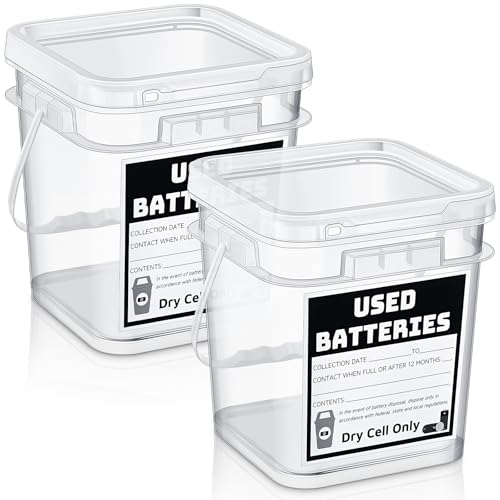
3. Baderke 2 Pack Battery Recycling Container
Two see-through bins that let you watch the collection grow without lifting a lid.
Getting a pair for the same price as a single competitor makes this an easy way to place one bin in the kitchen and another in the garage or office. The transparent PVC body means you can spot at a glance when it’s time to empty, which owners find handy for keeping recycling front-of-mind at home and at work.
Each bin holds 1.32 gallons, and at 11.02 x 7.87 x 7.48 inches the footprint is wider than the QHAND’s — roughly a 2.2x gap in overall dimensions — so measure your shelf before committing. A large, clearly visible label ships in the box, and one buyer sits theirs right next to the kitchen trash can as a constant reminder.
The honest trade-offs: the lid doesn’t latch shut, one owner found the handle flimsy (though fine since the bin rarely moves), and a buyer who wanted easier access had to drill a 2-inch hole in the lid for disposal. This is a capable, budget-friendly dual-unit setup rather than a heavy-duty sealed pail.
The catch: no tester and a non-latching lid make this a pure storage solution for cells you’ve already confirmed are dead.
Choose it for: equipping two rooms at once without doubling your spend.
Who should skip: anyone needing a secure latch or a carry handle they’ll trust on regular trips.
4. HAEZU 2 Pack Battery Disposal Container
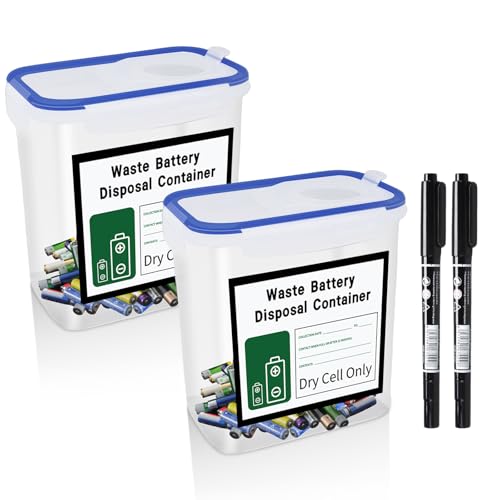
A low-profile pair that keeps dead cells out of random drawers without cluttering your counters.
At just 0.56 gallons each, these rectangular bins are built for households with light battery use. A press-top opening makes dropping a dead AA inside quick, and the included dry-erase marker lets you jot collection dates or contents right on the label — a small touch that helps you remember when it’s time for a drop-off run.
Owners like that it consolidates the random dead batteries scattered through the house, holding a lot despite the compact size. One parent noted it stores common household cells easily — though button cells still go in a separate locked box when kids are around, so factor that in if your home has small battery types.
This solution is straightforward and honest: it “gets the job done” without a tester, a latch, or frills. The press-top lid keeps things contained, and the lightweight build suits a garage bench or home office shelf.
Who it’s for: light users who want two tidy spots and a marker to track fill dates.
The appeal: you’re not storing years of batteries here — you’re just keeping them safe until a quick trip to a drop-off.
The limit: 0.56 gallons fills fast for a family of four or more.
5. PIG Battery Disposal Container

The regulation-minded pail built for workplaces that need a clearly labeled universal waste spot.
If you’re setting up a collection point at a business or facility, this 2-gallon container with a 9.25 x 7.25-inch opening is designed to meet universal waste regulations by eliminating open containers of dead batteries. The clear body (HDPE base with a PP lid) makes it easy to see fill level at a glance, and the sealable lid keeps contents contained between pickups.
Owners describe it as well built for a plastic vessel, holding a lot of batteries; a solo user might take 2 or more years to fill it, while a family of 5-6 fills it quicker. The main friction point is preparation — owners mention the pull tab you remove before first use is genuinely hard on the fingers.
Unlike the tester-equipped QHAND, this is pure storage with a regulatory focus. The trade-off some note is that for the price, they expected slightly better build quality on the perforation strip. If you need a compliant, clearly labeled workplace pail, this is the one — just budget a minute of effort for that first-use strip.
What it’s for: businesses or homes generating enough battery volume to justify a 2-gallon, regulation-ready pail.
What it isn’t: a tester-equipped bin — it’s built for collection, not diagnosis.
Grab it if: you need to visibly comply with universal waste rules in a shared space.
Know before buying: that pull tab removal is the most common owner gripe, so don’t expect easy setup.
6. Winkee The Volt Vault
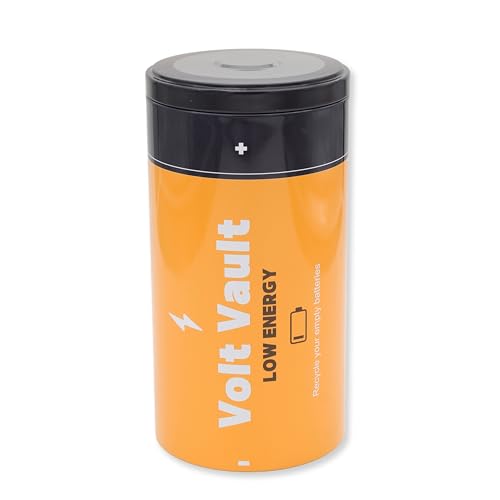
A battery-shaped steel vault that makes recycling look like intentional decor, not a chore.
Most bins hide in closets; this one is designed to sit out. The Volt Vault is a stainless steel cylinder shaped like an oversized battery, measuring 3.74 x 3.74 x 7.28 inches with a 1.6-liter capacity. It’s rustproof and polished, so it reads as a design object on a kitchen counter or office shelf rather than a waste container.
Owners consistently mention that it looks far more premium than a cardboard or plastic box, and several keep it in plain sight as a staff collection point. Because it’s so present, it solves the “forgetting to dispose” problem the product’s design intends to fix. When it’s not full of batteries, it doubles as a stash for charging cables or small electrical items.
At 1.6 liters it’s on the smaller side — one owner noted it’s larger than needed for average collectors but appreciated the extra room for heavy accumulators. There’s no tester here, so pair it with a separate checker if you want to confirm depletion before dropping cells in. This is the pick for anyone who values a bin they’re actually proud to display.
The standout: stainless steel construction with a polished finish that outlasts and outshines plastic.
Buy it for the look: if a visible reminder on your counter beats a hidden bin in a drawer.
The trade: you give up tester convenience and a larger gallon capacity for the aesthetics.
7. Call2Recycle Small Battery & Cellphone Recycling Box
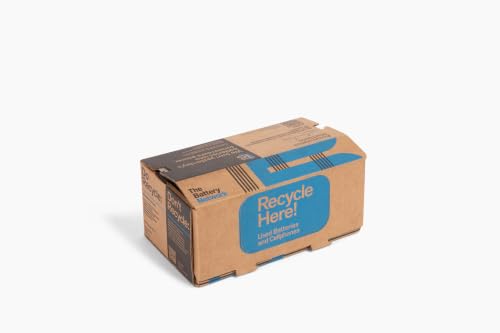
A sturdy 6.5 x 5 x 3.5-inch box that ships itself back to a recycler with a prepaid label.
This is for the person with no convenient local drop-off. The box is made from sturdy plastic with a secure latch, and it’s part of the Call2Recycle program — the same company that supplied Radio Shack’s in-store recycling boxes. You fill it with dead batteries and used cell phones, then ship it back using the included prepaid postage label.
Owners say it made recycling easy for batteries that “most sites will not accept,” particularly alkaline cells. After a year of household use, one buyer’s box was less than 25% full, so the small footprint suits typical homes. The catch is the return window — that prepaid label must be used within one year of purchase, and the box itself carries a premium price.
The directions matter here: buyers advise bagging batteries in zip-lock bags and covering the connectors with electrical tape before shipping. If you accumulate batteries slowly, this is a reliable, low-effort path to responsible recycling — just keep an eye on that 12-month deadline.
Why it stands out: accepted formats include alkaline cells that many municipal programs refuse, and the prepaid label handles the rest.
Perfect for: condo dwellers or anyone without a nearby hazardous-waste pickup.
Heads-up: the cost is the highest barrier here, and delaying past one year forfeits the prepaid return.
8. EZ on the Earth Dry Cell Battery Recycling Kit

The UN-approved pail for households that want a certified, mail-back route for every dry cell type.
This kit earns its premium position by accepting the widest range of chemistries — Alkaline, NiCad, Zinc-Carbon, rechargeable Lithium-ion, NiMH, mercury, Silver-Oxide, AA, AAA, C, D, and 9V. The 1-gallon High Density Polyethylene pail holds up to 13.2 pounds of batteries, and the box arrives with a free return label so you ship it back without extra fees.
Owners repeatedly praise the quality and the ease of keeping batteries out of the garbage and landfills. The instructions are clear — with pictures — and customers note that alkaline and zinc cells need no taping, while lithium-ion and button cells should have their terminals taped. A 5-person household filled their previous kit in about 10 months, so the 1-gallon size suits an average family; lighter users might find it larger than needed.
The recurring theme in reviews is the quality of both the product and the company’s customer service. The one inside note: the pail is smaller internally than it looks due to insulation, and you must return the filled kit within 12 months of purchase to stay compliant. If you want certified, responsible recycling without hunting for a drop-off location, this is the most complete kit here.
The edge: chemistry coverage beyond what local programs accept, plus a UN-approved container for safe shipping.
Choose it for: a household that burns through many battery types and wants one certified, all-inclusive route.
Consider the size: a single person may take years to fill it — and the 12-month return rule won’t wait.
Understanding the Specs
Capacity in Gallons and Liters
Capacity tells you how many dead cells a bin will swallow before you need to haul it to a drop-off. A 1.32-gallon container suits a typical home, while a 2-gallon pail fits a busy family or a small office. The smaller the capacity, the more often you’ll make a recycling run — so match the size to how quickly you actually go through batteries.
Integrated Battery Tester
A tester built into the lid checks whether a cell still holds charge, saving you from recycling perfectly good batteries. Testers vary in reach — some check four sizes (AA, AAA, C, D), while others also handle 9V and 1.5V button cells. If you use 9V smoke detectors or button-cell remotes, confirm the tester covers those formats before you buy.
FAQ
What batteries should never go in a home recycling bin?
How long does a 1-gallon battery recycling pail take to fill?
What is the difference between a storage bin and a mail-back recycling kit?
Can a battery tester bin check 9V batteries?
Is it safe to store dead batteries in a plastic bin?
Do I need to tape battery terminals before recycling them?
Why does my battery bin feel so heavy when it’s only two-thirds full?
Can I recycle rechargeable and single-use batteries together?
Final Thoughts: The Verdict
For most people, the battery recycling bin winner is the ECO Battery Bin because its built-in 4-size tester eliminates the guesswork of tossing still-good cells, and reviewers point out it still isn’t full after 3 years of use. If you want a tester that also handles 9V and button cells, grab the QHAND at a friendlier cost. And for a certified mail-back route that accepts chemistries most drop-offs refuse, the EZ on the Earth kit is the one to reach for.
How We Picked
We do not accept paid placement. Every pick is matched to a real buyer and a real use-case; we do not hands-on test units.
Sources & Methodology
Specifications: manufacturer listings and product documentation. Review insights: verified customer reviews, as of September 2026. Pricing: not shown on this page (it changes often); check the current price via the retailer link.
As an Amazon Associate, KitchPrep earns from qualifying purchases. This does not affect which products we feature.
Related Guides
