
Specs are compiled from manufacturer listings and verified buyer reviews and can change over time — please confirm the key details on the product page before buying.
Side-by-side refrigerators are a study in trade-offs: you get freezer access at eye level without bending, and narrow doors that swing open in tight galley kitchens. The real challenge is finding one that actually keeps food cold reliably, fits your counter depth, and doesn’t turn your energy bill into a second mortgage — all while holding enough for a weekly grocery run.
I’m Mohammad Maruf — the founder and writer behind KitchPrep. This guide is built by comparing the manufacturers’ published specifications and the patterns across verified customer reviews, so you get each pick’s real strengths and trade-offs instead of marketing spin.
Here is the honest 2-door side-by-side refrigerator landscape, with capacity, energy use, and real owner experiences laid out plainly.
Our Picks at a Glance

How To Choose The Best 2-Door Side-by-Side Refrigerator
Before you fall for a shiny stainless panel, measure your space and think about how your household actually eats. The biggest mistakes happen when people ignore the depth footprint or overestimate how much a “full-size” label really holds.
Capacity vs. counter depth
Counter-depth models sit nearly flush with your countertops, so they don’t jut out into your walkway — a huge win in narrow kitchens. The catch is that they trade interior volume for that slim profile. Standard-depth units hold more groceries but can stick out past your cabinets, which matters if you have a tight aisle or an island nearby.
The energy bill you inherit
Refrigerators run 24 hours a day, so the annual energy figure (kilowatt hours per year) is the single most important number for your long-term budget. A difference of a few hundred kilowatt hours per year can silently add up to real money on every monthly bill, year after year.
Compressor and defrost basics
A digital inverter compressor (a compressor that adjusts its speed instead of blasting on and off) tends to run quieter and more efficiently. Frost-free defrost means you never hand-scrape ice off the walls — the unit handles it automatically, usually with a trickling water sound you can hear from across the room.
Quick Comparison
| Model | Best For | Capacity | Energy per Year | Depth (Door Open) | Amazon |
|---|---|---|---|---|---|
| Samsung RS27T5200SR★ Best Overall | Large families needing max space | 27.4 cu. ft. | 728 kWh | 51.31 in | Amazon |
| Hamilton Beach HBF2064 | Flush-fit kitchens, quieter operation | 20.6 cu. ft. | 378 kWh | 29.29 in | Amazon |
| Hamilton Beach HBF1558 | Tight spaces, small households | 15.6 cu. ft. | 378 kWh | — | Amazon |
In-Depth Reviews
1. Samsung 27.4 cu. ft. Large Capacity Side-By-Side Refrigerator
The space-maximizer for big households that refuse to play Tetris with a week of groceries
You get the most storage here — 27.4 cubic feet of interior room, which is 76% more than the smaller Hamilton Beach HBF1558 below. That means you can park a small chest freezer’s worth of food in the freezer side. The redesigned interior uses a multivent cooling system (air circulated from multiple vents) to keep every shelf evenly chilled, and the high-capacity indoor icemaker sits tucked away so it doesn’t eat into your frozen storage.
The stainless finish resists fingerprints, so a house full of hungry kids won’t leave you wiping the doors down daily.
Owners praise the sheer spaciousness and how the freezer holds more than they expected. Buyers also report some real quirks: occasionally a stray ice cube gets kicked onto the floor, and one detailed account describes the unit running constantly while struggling to hold 40°F when set to 33°F. This is the pick if you prioritize raw capacity above all else; think twice if your kitchen footprint is tight — with the doors fully open it reaches 51.31 inches deep, a number to measure against your aisle before committing.
What wins people over
- Massive 27.4 cu. ft. capacity that swallows a big weekly shop
- Fingerprint-resistant stainless keeps the doors looking clean
- Digital inverter compressor aims for quieter, steadier cooling
Where it asks patience
- Uses 728 kWh per year — the hungriest of the three
- Needs 51.31 inches of clearance with the door open
Reach for this if: your household outgrew standard fridges and you want the biggest side-by-side footprint that still fits through a standard doorway.
Look elsewhere if: you’re on a tight energy budget or your kitchen aisle can’t spare over four feet of open-door depth.
2. Hamilton Beach HBF2064 20.6 cu ft Counter Depth Refrigerator

The flush-fit specialist that slides under 30 inches deep so it won’t bully your walkway
If your kitchen has an island or a narrow pass-through, this Hamilton Beach solves the problem the Samsung can’t: it’s counter depth at just 29.29 inches with the doors open — 75% less depth than the Samsung’s 51.31 inches. That means it sits nearly flush with your countertops instead of jutting out, which is a genuine relief in galley layouts where every inch of floor matters.
At 20.6 cubic feet it splits the difference — roomier than the 15.6 cu. ft. model below but still a far lighter energy load than the Samsung, drawing just 378 kilowatt hours per year. The frost-free defrost system handles ice buildup automatically, and the digital display control panel mounted inside the door lets you set fridge and freezer temperatures precisely. Gallon-size door bins hold the big beverage jugs, and LED lighting (energy-efficient interior bulbs) makes the shelves easy to scan.
What buyers love is how quiet it runs — the review pages describe a gentle trickling sound from the compressor or defrost cycle, nothing like the “noise pig” of older units. Owners with a shorter reach (around five feet tall) specifically enjoy the side-by-side layout because daily-use items sit on reachable lower shelves. The honest concern is reliability: a small number of buyers report the freezer failing within weeks, and even after a replacement unit the same problem recurred half a year later. Delivery and haul-away options exist in select locations if you want the heavy lifting handled at checkout.
Balanced take: This is the smart middle path — counter-depth proportions, modest energy draw, and enough room for a typical family. It’s the one to measure first if your kitchen is the constraint, not your grocery list.
Best for: anyone replacing a standard-depth fridge in a tight space who wants a flush finish and lower running costs.
Think twice if: reliability confidence is your top priority — a minority of owners hit freezer failures that repeated even after a swap.
3. Hamilton Beach HBF1558 15.6 cu ft Counter Depth Refrigerator
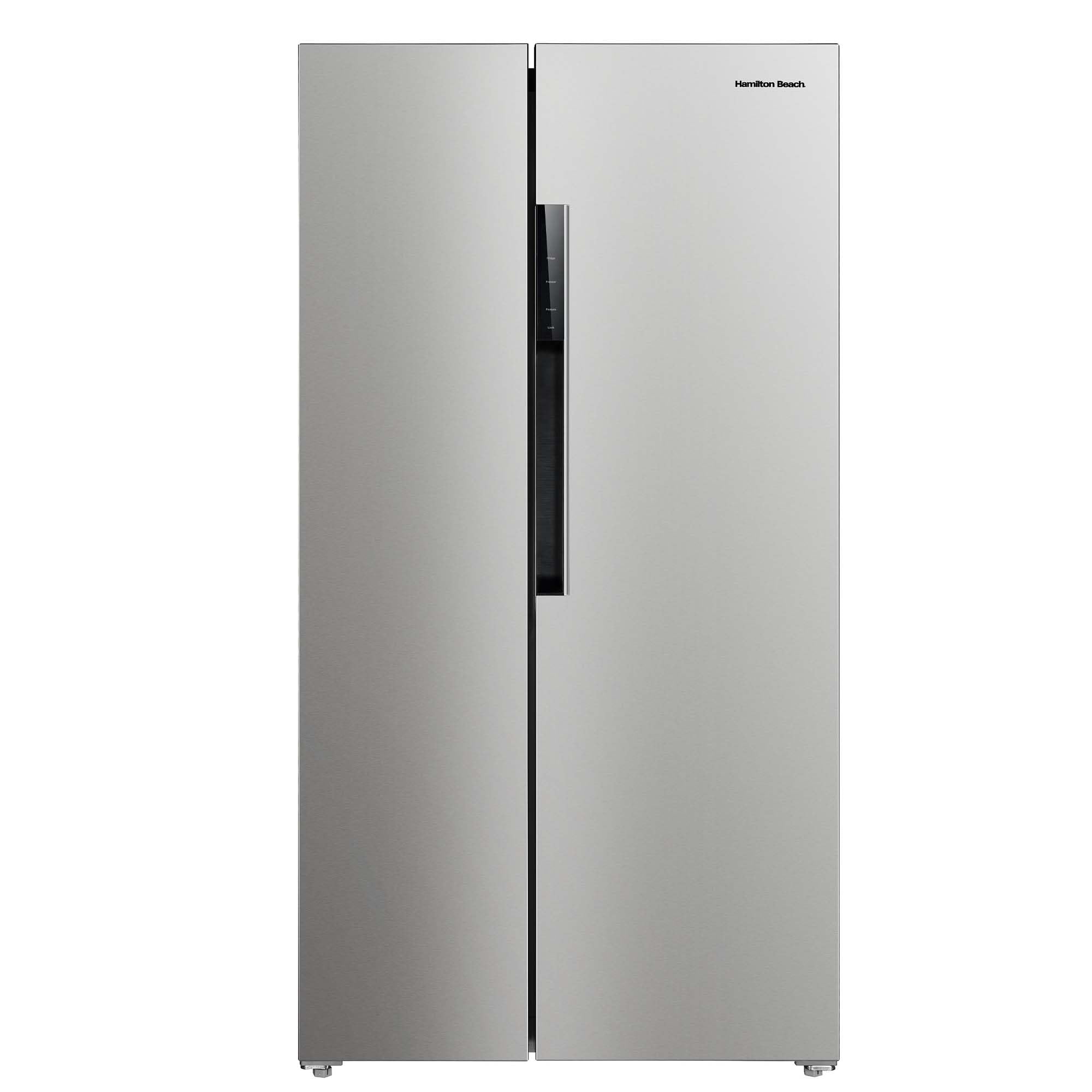
The compact counter-depth that tucks into small kitchens, RVs, and motorhomes alike
This is the smallest of the three at 15.6 cubic feet, with a dedicated freezer section of 6.08 cubic feet — and that size is the entire point. It’s built for tight spaces: small apartment kitchens, a fifth-wheel RV, or a motorhome where a full-size fridge simply won’t fit. The review pages are full of owners fitting it into exactly those spots and loving how the modern stainless look upgrades the space.
You won’t pay an energy penalty for the smaller box — it shares the same 378 kilowatt hours per year draw as its larger HBF2064 sibling. Inside, you get two slide drawers in both the fridge and freezer sections for organized produce and frozen goods, removable shelves so you can reconfigure for tall items, and an open-door beep alert that reminds you when you’ve left it ajar. The digital display sits on the front for easy temperature control, and the built-in interior light makes finding things quick.
Owners consistently call the appearance amazing, and the fit-for-small-spaces story is the strongest selling point — you need about 1 inch of clearance on each side for the door to open fully if you want it flush with your counter. The honest caveats matter here: this model does NOT include an ice maker despite what some photos suggest, and one owner’s unit broke after a year and a half of use, just past the 1-year warranty. It’s also not built for large families — the reduced capacity is the trade-off for the slim footprint. Expect delivery-only in most cases, sometimes with a several-week wait.
Why it earns its spot
- Counter-depth design that fits RV and small-kitchen cutouts
- Two slide drawers in each section keep produce and frozen goods tidy
- Matches the bigger Hamilton at just 378 kWh per year
Know before you buy
- No ice maker included, so set expectations from the photos
- 15.6 cu. ft. total means it’s for 1-2 people, not a big family
Choose it when: you need a good-looking counter-depth fridge that fits a compact cutout and you shop for one or two people.
Pass it by if: you want an ice maker or expect to store a large household’s worth of groceries.
Understanding the Specs
Capacity (cubic feet)
This is total interior volume across both doors, mixing fridge and freezer space. A 15.6 cu. ft. unit suits a couple, while 27.4 cu. ft. handles a big family’s weekly haul. Remember that counter-depth models sacrifice some of this room to sit flush with your cabinets.
Annual energy consumption (kWh/year)
This number tells you how much electricity the fridge uses over a full year. Lower is kinder to your monthly bill — 378 kWh per year is far lighter than 728 kWh per year. Since fridges run constantly, this one spec drives your long-term running costs more than any other.
FAQ
Will a counter-depth refrigerator fit flush with my counters?
How much more energy does a larger side-by-side use?
Do these refrigerators come with an ice maker?
What does frost-free defrost mean for daily use?
Is a digital inverter compressor worth it?
How much clearance do I need with the doors open?
Can a side-by-side fit in an RV or motorhome?
What if the fridge stops cooling after a few weeks?
Final Thoughts: The Verdict
For most households, the 2-door side-by-side refrigerator winner is the Samsung 27.4 cu. ft. because its 27.4 cubic feet of space simply swallows more than any other pick here. If you want a counter-depth unit that sits flush and sips just 378 kWh per year, grab the Hamilton Beach HBF2064. And for a tight kitchen or RV where every inch counts, the Hamilton Beach HBF1558 at 15.6 cu. ft. is the compact one to reach for.
How We Picked
We do not accept paid placement. Every pick is matched to a real buyer and a real use-case; we do not hands-on test units.
Sources & Methodology
Specifications: manufacturer listings and product documentation. Review insights: verified customer reviews, as of September 2026. Pricing: not shown on this page (it changes often); check the current price via the retailer link.
As an Amazon Associate, KitchPrep earns from qualifying purchases. This does not affect which products we feature.
Related Guides
