
Specs are compiled from manufacturer listings and verified buyer reviews and can change over time — please confirm the key details on the product page before buying.
You need a 2-inch check valve to stop water, sewage, or sprinkler flow from reversing direction—a failure that drains your pond overnight, makes your sump pump cycle every 30 seconds, or causes your well to lose prime. Your choice hinges on the fluid type, system pressure, and pipe connection style. We review nine 2-inch check valves—brass, PVC, and clear plastic—to help you match the mechanism and connection to your plumbing.
I’m Mohammad Maruf — the founder and writer behind KitchPrep. This guide is built by comparing the manufacturers’ published specifications and the patterns across verified customer reviews, so you get each pick’s real strengths and trade-offs instead of marketing spin.
Here is how to pick the best 2-inch check valve for your pump, pond, or plumbing project—without guessing between swing, spring, and foot-valve designs.
Our Picks at a Glance


How To Choose The Best 2-Inch Check Valve
Before buying, identify the fluid, pressure, and connection type of your pipe. This guide matches each valve to a 2-inch connection, but not every pick uses the same style—some are threaded, some are glued, and some use clamps. Always verify the connection type (slip, threaded, or union) before ordering.
Match the mechanism to your pressure
A swing check valve uses a hinged flapper that gravity closes, so it opens easily even with very low flow—ideal for gravity-fed rain barrels and ponds. A spring-loaded check valve uses a coil that snaps the disc shut, which prevents backflow in pressurized lines but needs a minimum cracking pressure to open. If you have an unpressurized gravity line, a stiff spring can block flow entirely.
Know your connection: slip, thread, or union
Slip connections are smooth sockets you glue or clamp onto PVC pipe. Threaded connections (NPT) screw onto metal or plastic male threads, which makes them easy to remove later. Union connections let you unscrew the valve body for cleaning without cutting the pipe—a real advantage in sewage lines where debris builds up. Choose the connection style that matches your fittings to avoid needing adapters.
Quick Comparison
| Model | Best For | Max Pressure | Connection | Body Material | Amazon |
|---|---|---|---|---|---|
| Everflow 210T002-NL★ Best Overall | High-pressure brass durability | 200 psi | 2″ IPS Female Thread | Cast Brass | Amazon |
| Zoeller 30-0243Also Great | Quiet sump pump lines | — | 2″ Solvent | PVC | Amazon |
| Boltigen Foot ValveWell Pump Hero | Well pump priming | 232 psi (16 bar) | 2″ NPT Female | Brass | Amazon |
| Boltigen Spring Check | Versatile in-line brass | 200 psi | 2″ NPT Female | Brass | Amazon |
| Jackel 2GPFF | Sewage ejector lines | 45 PSI | 2″ Adapters | ABS / PVC | Amazon |
| Valterra 200-CU20 | Pool lines you want to inspect | 150 psi | 2″ Slip Union | Clear PVC | Amazon |
| MIDLINE Inline Valve | Pressurized sprinkler repair | 150 PSI | 2″ Solvent | PVC | Amazon |
| Hydro Master Sump Check | Quick sump pump swap | — | 2″ Slip-on | ABS / EPDM | Amazon |
| Valterra 200-20W | Gravity pond and rain barrels | 150 psi | 2″ Female Slip | PVC | Amazon |
In-Depth Reviews
1. Everflow Supplies 210T002-NL Brass Swing Check Valve
Our pick — over 4.5★ from 500+ verified ratings; the strongest balance of quality and price.
This cast-brass valve outlasts plastic under high pressure.
When a homeowner’s PVC backflow valves kept failing within a week each, this brass swing valve was the fix that finally held. That is the story owners mention again and again: plastic gives up under pressure, and this cast brass body simply keeps doing the job.
Quality is what owners praise most, with over 40 buyers singling out the solid build. The lead-free brass construction and female threaded connections make it a favorite for water, oil, or gas applications, and its versatility earns steady mentions. At just 2.56 ounces, it is dramatically lighter than the 12-ounce Valterra swing valve, yet it feels far more substantial in the hand thanks to the metal body.
The honest trade-off: a minority of customers note leakage or the valve sticking in the open position, which is worth watching if you need a perfect seal every cycle. This is a premium-tier price for a premium-tier material, but buyers who have been burned by cheap replacements call it worth every penny. If you want metal durability on a high-pressure line, this is the definitive choice.
Why it wins: quality is the #1 praise from owners—the cast brass body simply outlasts plastic under sustained pressure.
The honest catch: the threaded design needs pipe thread sealant, and occasional units report sealing or sticking issues.
Best for: pressurized water, oil, or gas lines where PVC has already failed you and you want a metal valve that will not quit.
Think twice if: you need a slip or glue connection—this one is threaded only.
2. Zoeller 30-0243 PVC Swing Union Check Valve
This swing valve eliminates the banging noise from sump pump backflow.
The thing everyone raves about here is the quiet. Owners describe replacing a loud cast iron valve that rattled pipes in every room of the house, then hearing absolutely nothing from this one—even standing in the same room. The secret is the swing design that closes gently instead of slamming, so the water thud that wakes you up at 2 a.m. simply disappears.
It is built for both horizontal and vertical use, with a full-flow, non-clog design that keeps sewage and debris moving without buildup. The PVC body and compression end fittings are durable, and buyers report installation taking under 10 minutes with no special tools. One owner sums up the value perfectly: “failure with water is not something I want,” which is why the higher cost feels justified when the alternative is a flooded basement.
This valve uses a solvent connection (glued into PVC pipe), so confirm your pipe setup matches before you buy. It holds a 4.8-star score from hundreds of owners who praise its functionality and whisper-quiet operation. If you want the most confidence per dollar on a sump or sewage line, this is the one.
What wins people over
- Quiet operation is the top praise by far—owners say the banging and rattling stop completely
- Full-flow, non-clog design handles solids without jamming
- Works in both horizontal and vertical pipe runs
Know before you order
- Premium price sits above budget plastic valves
- Solvent connection means you glue it in—no unscrewing later
Reach for this if: you want a sump or sewage valve that is genuinely quiet, durable, and easy to install yourself.
Look elsewhere if: you need threaded connections or a valve you can unscrew for cleaning—this one glues into place.
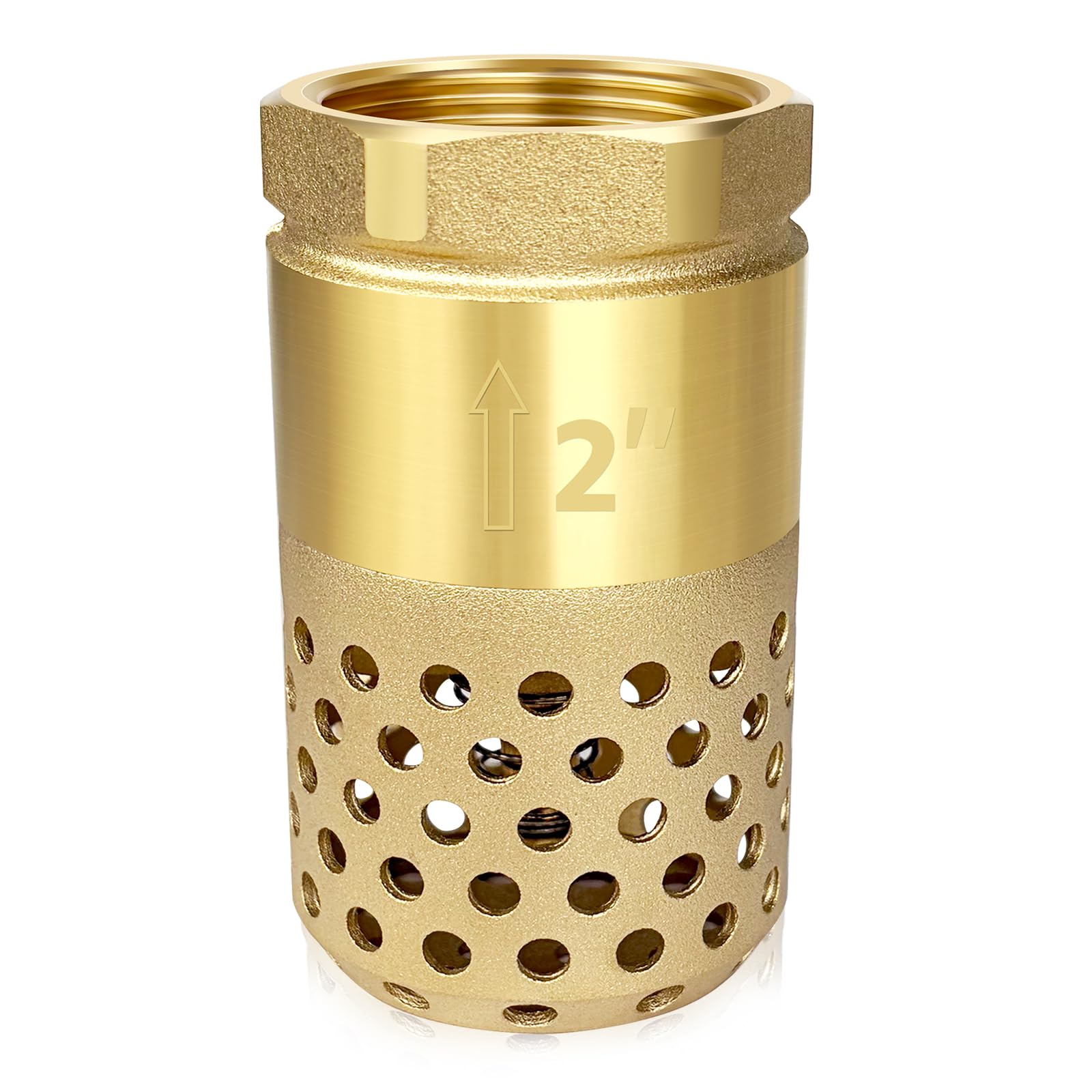
3. Boltigen Brass Foot Valve with Strainer, 2″ NPT
This brass foot valve with a spring-loaded check keeps shallow wells primed.
If your pump keeps losing prime, the problem is usually gravity pulling water back down the pipe when the pump stops. This foot valve solves it by sitting at the bottom of the suction line with a spring-loaded check that only lets water move up. Reviewers point out it “fixed my pump unpriming issue” and holds prime perfectly on a 1/2 hp shallow well pump pulling from a creek.
What makes this different from an inline valve is the built-in mesh strainer—dozens of small round holes filter out large impurities before they reach your pump. The heavy-duty brass body and stainless steel spring handle a working pressure of 16 bar (232 psi), which beats both the Everflow’s 200 psi and any PVC valve on this list. Quality is the top praise, with durability a close second, and owners note the hexagonal edge design makes installation with a wrench genuinely easy.
One owner’s insight stands out: competing foot valves use a screw to hold the screen on, and that screw eventually rusts through—this design avoids that failure point entirely. Fit is the only mixed note, with some buyers finding it works perfectly on 2-inch pipes while others needed a different size. For any well, creek, or cistern draw, this is the reliable prime-keeper.
What owners love
- Quality and durability are the two most-praised traits—solid brass that holds prime well
- Strainer screen filters debris before it reaches the pump
- 232 psi rating is the highest on this list
Consider this
- Fit gets mixed reviews—confirm your exact pipe thread before ordering
- Made for the bottom of a suction line, not a general in-line application
Grab this if: you have a shallow well, creek pump, or cistern that keeps losing prime and needs debris protection.
skip it if: you need a valve for a pressurized discharge line rather than a suction foot.
4. Boltigen Solid Brass Spring Check Valve, 2″ NPT
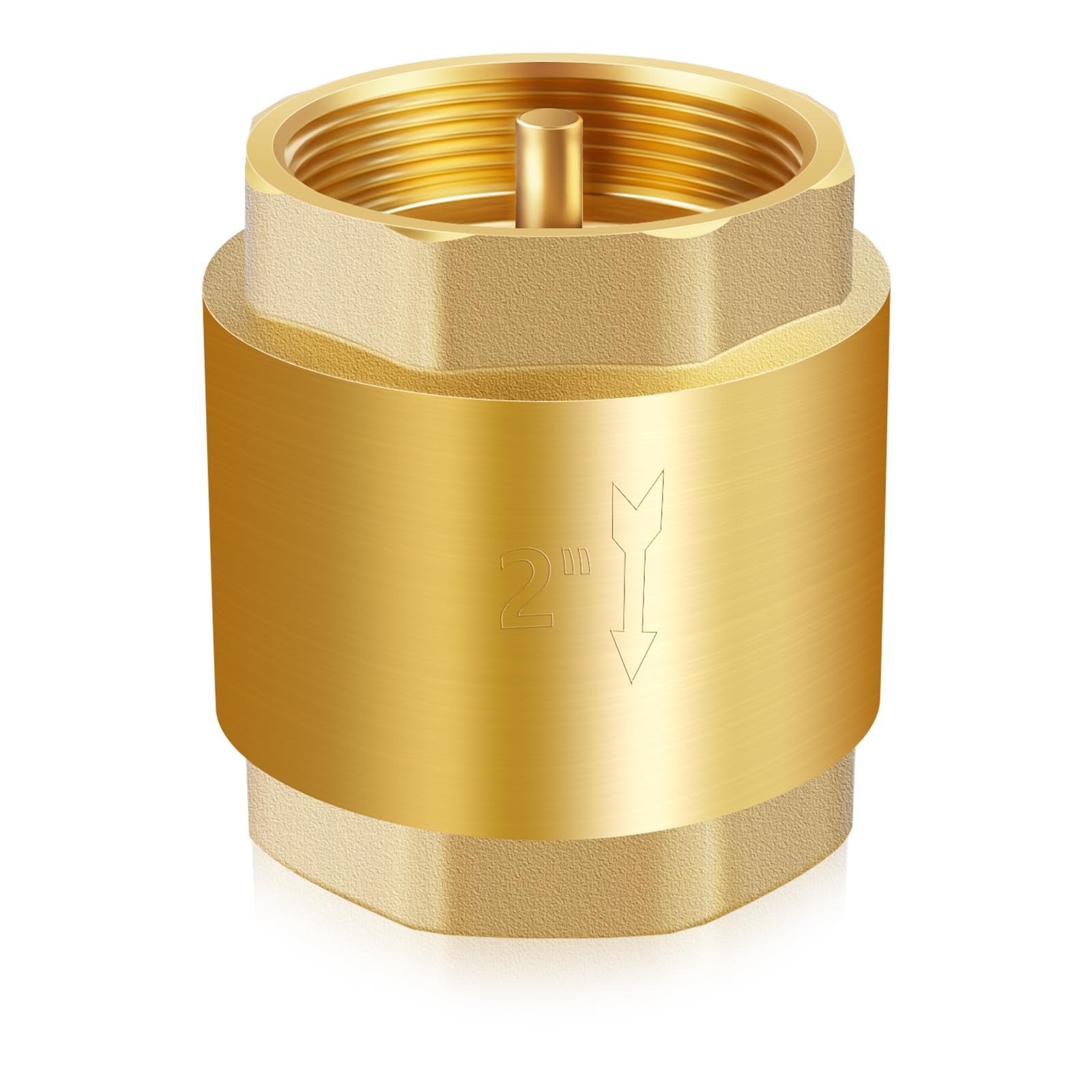
A brass in-line valve that stands guard in any orientation you need.
This is the Swiss Army knife of the brass options—a spring-loaded check valve that works mounted either vertically or horizontally, which most swing valves cannot claim. The stainless steel spring and heavy-duty brass body are built for corrosion resistance, and the NPT taper threads create a strong seal without excessive tightening. It is rated to a maximum pressure of 200 psi, identical to the Everflow above but at a lower price point.
Owners running sprinkler systems and well pumps report it “works perfectly and really good quality,” with one buyer noting it held strong after six months of continuous service. The 45 PSI opening pressure means it snaps shut decisively to prevent backflow, and it requires zero minimum back pressure to operate. Each unit is individually tested before leaving the factory, which explains the consistent quality praise.
Compare this to the Everflow at the top: both are 200 psi brass valves, but this one costs less and adds the opening pressure spec that makes it predictable in low-flow systems. The minor catch is that a few buyers found slight leakage, often blaming their own installation rather than the valve. If you want brass reliability in a horizontal sprinkler line or a vertical well pipe, this is the value-minded pick.
Standout trait: the 45 PSI opening pressure gives crisp, reliable one-way closure—and it works in any mounting orientation.
Fair caveat: occasional shoppers say minor leaks they attribute to their own threading, not the valve.
Choose this when: you need a versatile brass valve for a sprinkler, well, or pump line and want the freedom to mount it either way.
Pass if: you want a swing valve with zero spring resistance for ultra-low-pressure gravity flow.
5. Jackel Sewage Check Valve (2GPFF)

Built to pass full 2-inch solids without clogging your ejector line.
Sewage lines demand a valve that will not jam on debris, and this Jackel is specifically engineered to pass a full 2″ solid. The ABS body with PVC adapters and 301 stainless steel clamps creates a sealed unit that is not bolted together—owners say this single-piece design eliminates the joint leaks common in older two-part valves. It is the go-to replacement for sewage ejector pumps where reliability is non-negotiable.
Installation earns the most praise, with buyers noting the included clamps save time and money compared to gluing. Owners running it in Airbnb rentals and direct-fit replacements report “no leaks” and “works great and good quality.” The maximum operating pressure of 45 PSI (pounds per square inch) suits sewage ejector duty, where the goal is preventing backflow, not handling high pressure.
Noise is the honest mixed note—some call it “super quiet” while others say it is not completely silent, so if absolute hush is your priority the Zoeller above is the better match for a sump. But for raw sewage where you need guaranteed solid passage and easy clamping, this is the specialist. It is also one of the few here that arrives with all stainless clamps included, so no extra trip to the hardware store.
Built for the job
- Passes a full 2″ solid without clogging
- Sealed one-piece design prevents joint leaks
- All stainless steel clamps included for quick install
Worth noting
- 45 PSI max pressure suits sewage, not high-pressure water lines
- Noise level is mixed—quiet for most, not silent for all
Built for: sewage ejector pumps and drain lines where solids must pass freely and clamps beat glue.
Not for: high-pressure irrigation or potable water systems—this is sewage-specific.
6. Valterra 200-CU20 PVC Swing/Spring Combo Check Valve

This clear valve lets you watch water flow through your pool lines, so you spot clogs or air bubbles at a glance.
Pool owners love this valve for one simple reason: you can see through it. The clear PVC body means you can actually watch the flapper move and spot a clog before it becomes a problem, which explains why visibility is the second-most-praised feature after installation ease. As one owner put it on a 22-year-old pool system, “I like the clear plastic so I can actually see it working.”
The union design is the other standout—you can unscrew the valve body, clean it, and put it back without cutting the pipe. Owners replacing old valves that let spa water drain every night found this fixed the issue completely. It combines swing and spring action with a 1/2 lb spring tension for secure closure, rated to 150 psi, and buyers report it beats pool store prices by a wide margin.
The trade-offs are real, though. Durability earns negative mentions, with some owners reporting it does not last as long as they hoped, and leakage is genuinely mixed—some see almost no reverse leakage while others hit major leaks. This is a maintenance-friendly valve for pool lines where you want visibility, not a forever-installation for buried high-pressure pipe. For above-ground pool systems where you can see and service it, the transparency is a genuine advantage no other pick here offers.
Signature feature: the clear body and union fitting let you inspect and clean without cutting pipe—owners call it the best pool check valve they have tried.
Honest limit: durability is the recurring gripe, so treat it as serviceable rather than permanent.
Pick this for: pool and spa lines where you want to see the valve working and clean it easily.
Consider another if: the valve will be buried or inaccessible—its plastic body is not the most durable here.
7. MIDLINE VALVE PVC Inline Check Valve, 2″ Solvent

The budget spring valve that resurrected a dead sprinkler system mid-heatwave.
When a sprinkler system stopped working entirely, this valve fixed it. One owner reports: “Our sprinkler system wasn’t working, during an heatwave is not fun, and this did fix it so we are happy!” The spring-loaded mechanism (a valve that uses a spring to close automatically) is rated to 150 PSI, restoring one-way flow in pressurized irrigation lines without a high price.
The standout spec is the 0.5 PSI cracking pressure, meaning it opens with almost no resistance. That low threshold matters for pump systems that start under minimal pressure, and it is paired with a spring that still snaps shut to prevent backflow. The PVC body with stainless-steel internal components can be installed horizontally or vertically, and it is specifically intended for non-potable water applications like irrigation and waterfall pumps.
Quality is the top praise, with installation close behind—buyers call it easy to install and a “life saver” compared to hardware store prices. The honest mixed notes: some owners mention cracks in the plastic, and a few found water flow completely stopped, which usually traces back to the wrong application. One buyer clarified the spring is stiff and it is only for pressurized lines—not gravity flow. For pressurized sprinkler and waterfall duty, this is the budget pick that actually delivers.
Where it shines
- 0.5 PSI cracking pressure opens easily under low inlet flow
- Quality and easy installation are the top two praises
- Works horizontally or vertically on pressurized lines
Watch out for
- Meant for pressurized water only—the stiff spring blocks gravity flow
- Occasional reports of plastic cracks or complete flow stoppage
Reach for it if: you need a cheap, reliable spring valve for a pressurized sprinkler, waterfall, or irrigation line.
Avoid it if: your system is gravity-fed and unpressurized—the spring will hold flow back entirely.
8. Hydro Master Sump Pump Check Valve, 2″

The five-minute sump pump fix that kills the water hammer noise.
For a quick sump pump replacement, this Hydro Master is the definition of plug-and-play. Customers note installation taking about 5 minutes, with the 2″ x 2″ slip-on design clamping directly onto standard pump discharge pipe. The noise reduction is immediate—one reviewer noted “no noise at all” after swapping out a worn valve, and the reducing water noise feature is built into the design.
The construction pairs a strong ABS body with EPDM rubber on both ends to create a flexible, watertight seal, plus stainless steel 301 clamps that resist corrosion and rust. It can be installed vertical or horizontal, though the manufacturer notes vertical is best for performance. Quality is the top praise, followed closely by ease of installation and value for money—a strong combo for a budget-tier price.
The honest concerns are durability and leakage. Some reviewers point out the valve holding up well over months, while others saw it break after about 6 months, and leakage earns negative mentions. The hose clamps also drew criticism—they work, but a flat-head screwdriver does not deliver strong clamping force, so a socket driver helps. This is a fine budget stopgap for a sump line, but if you want a valve that will outlast the pump itself, the Zoeller above is the upgrade worth making.
The appeal: quality, easy installation, and value are the three most-praised traits—a genuine 5-minute fix.
The trade-off: durability is mixed, with some units failing around the 6-month mark, and the clamps need a proper driver.
Best for: a quick, cheap sump pump check valve replacement when you can inspect it regularly.
Step up if: you want a valve that will last years buried in a basement pit—this one is a budget stopgap.
9. Valterra 200-20W PVC Swing Check Valve, 2″ Slip

The no-spring swing valve that gravity-fed ponds and rain barrels rely on.
This is the valve for systems with almost no pressure. Because it is a swing design with no spring, the flapper opens with the slightest flow and closes by gravity alone—which is exactly why pond and rain barrel owners love it. Two buyers have these placed on a pond at both the skimmer intake and drain intake, running with no issues, and another confirmed it seals reliably on an unpressurized rain barrel installed vertically.
The Schedule 40 PVC construction resists corrosion and mild chemicals, while the EPDM seal holds up against water and oils. Rated to a maximum pressure of 150 psi with a full-flow construction that creates insignificant flow loss, it handles both gravity duty and pump applications. Functionality is the top praise, with build quality a close second—owners describe it as solid and meeting all expectations.
At just 12 ounces it is the lightest swing option next to the brass Everflow above, and it costs a fraction of the price. The honest caveat: a handful of shoppers say the flapper does not always seal perfectly, which matters more in pressurized systems than in gravity flow. For a pond, rain barrel, or any low-pressure line where you want reliable one-way flow on a budget, this is the proven workhorse.
Why it works
- No-spring swing design opens under the lightest gravity flow
- Functionality and solid build quality are the top two praises
- Full-flow body means negligible pressure loss
Keep in mind
- The flapper seal is imperfect for some owners—more noticeable under pressure
- Slip connections mean permanent glue installation
Grab this for: ponds, rain barrels, and gravity-fed lines where flow is low and the valve must open easily.
Consider a spring valve if: your line is pressurized and you need a positive snap-shut seal every time.
Understanding the Specs
Pressure Rating (PSI)
The pressure rating tells you the maximum force the valve body can handle before it risks failure. A 200 PSI rating covers most well pumps and irrigation systems, while 150 PSI is standard for PVC valves in residential sump and pool duty. Sewage valves often run lower—like the Jackel at 45 PSI—because they prioritize solid passage over high pressure.
Cracking Pressure
Cracking pressure is the minimum force needed to push the valve open. A swing valve with no spring opens at nearly zero pressure, making it ideal for gravity-fed rain barrels. A spring-loaded valve needs more force—like the MIDLINE’s 0.5 PSI—which is fine for pressurized lines but can block unpressurized flow entirely. Match the cracking pressure to your system’s actual pressure.
FAQ
What is the difference between a swing and a spring check valve?
Will a 2-inch check valve work with my existing pipe?
How do I know if I need a foot valve instead of an inline check valve?
Can a check valve be installed vertically?
What is the maximum pressure this valve can handle?
Why does my pump keep losing its prime?
Are brass check valves better than PVC ones?
How long does a 2-inch check valve last?
Final Thoughts: The Verdict
For most sump or sewage lines, the 2-inch check valve winner is the Zoeller 30-0243—its quiet operation and easy installation make it the safest pick, backed by the highest star rating on this list. If you need metal durability at high pressure, choose the Everflow brass swing valve, rated to 200 PSI. For a well pump that keeps losing prime, the Boltigen foot valve, rated to 232 PSI with a built-in strainer, is the one to reach for.
How We Picked
We do not accept paid placement. Every pick is matched to a real buyer and a real use-case; we do not hands-on test units.
Sources & Methodology
Specifications: manufacturer listings and product documentation. Review insights: verified customer reviews, as of September 2026. Pricing: not shown on this page (it changes often); check the current price via the retailer link.
As an Amazon Associate, KitchPrep earns from qualifying purchases. This does not affect which products we feature.
Related Guides
