
Specs are compiled from manufacturer listings and verified buyer reviews and can change over time — please confirm the key details on the product page before buying.
You need a cable that safely carries 30 amps to a 240-volt mini-split, EV charger, or water heater — and you want it without paying the big-box store markup. The 10/2 MC cable (a metal-clad cable with two 10-gauge conductors inside an aluminum armor) is the flexible option that bends and runs cleanly. The real question is which spool length and brand give you full-current capacity for your specific run.
I’m Mohammad Maruf — the founder and writer behind KitchPrep. This guide is built by comparing the manufacturers’ published specifications and the patterns across verified customer reviews, so you get each pick’s real strengths and trade-offs instead of marketing spin.
We’ve separated the best 10/2 mc cable options by what you’re running — from a 25-foot EV charger hookup to a whole-spool 250-foot commercial run — so the choice is clear before you order.
Our Picks at a Glance
How To Choose The Best 10/2 MC Cable
Metal-clad (MC) cable earns its keep because the aluminum jacket shields the wires from physical damage. That means you can run it exposed along a garage wall or fish it through a stud bay — spots where a plain nonmetallic (NM) cable (the common Romex-style wire without armor) would get damaged too easily. So your first move is measuring the distance and picking a length that covers it without splices.
Match the length to the actual run
The gap between a 25-foot spool and a 250-foot spool is a full 10x jump. For a single appliance — an EV charger bolted a few feet from the panel — a 25-foot piece is the sensible, low-waste buy. For a workshop fed with multiple circuits or a long attic-to-panel chase, buying one full spool beats splicing two shorter pieces, because every splice is a potential weak point an inspector will scrutinize.
Read the wire make-up before you buy
True 10/2 cable carries two insulated 10-gauge (10 AWG) current-carrying conductors plus one bare ground wire — three total strands inside the armor. A 10/3 cable has three insulated conductors plus ground, a different animal for a different load. Count the conductors in the listing and confirm the ground is included; the single bare copper ground is what makes the metal armor safe to touch.
Know what the safety standards mean for you
UL 83, UL 1569, and UL 2556 are the standards that certify the conductors, the metal-clad construction, and the overall cable assembly. A cable carrying these marks is rated to run at 600 volts and at a conductor temperature up to 90°C. If your project sits in a jurisdiction that inspects, a UL-listed cable with the right markings on the individual wires is the one that passes — skipping this step can mean a failed inspection.
Quick Comparison
| Model | Best For | Length | Conductors | Rated Ampacity | Amazon |
|---|---|---|---|---|---|
| YDDECW 10/2 MC Cable★ Best Overall | Mid-length appliance hookups | 25 ft | 2 + ground (3 wires) | 30 amps | Amazon |
| Kimbluth 10/2 MC Cable | EV charger and clean short runs | 25 ft | 2 + ground (3 wires) | 30 amps | Amazon |
| Southwire 10/2 Armorlite | Whole-spool commercial runs | 250 ft | 2 + ground (multi-strand) | 30 amps | Amazon |
In‑Depth Reviews
1. YDDECW 10/2 MC Cable with Ground (25 ft)
Our pick — over 4.5★ from 400+ verified ratings; the strongest balance of quality and price.
The armored 25-footer that handles a 30-amp appliance run without draining your tool budget.
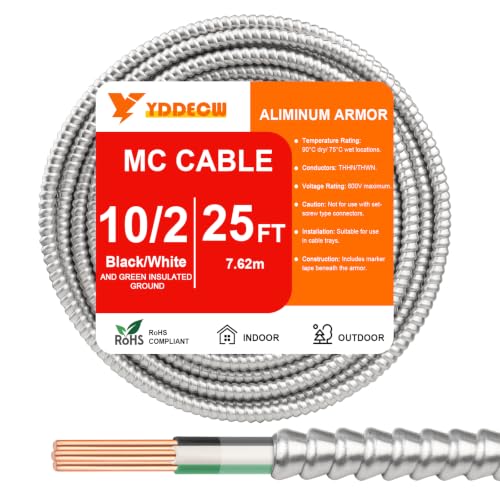
For a mini-split, a Level 2 EV charger, or a sub-panel feeder a short distance from the box, this 25-foot roll of 10/2 gets the job done with solid 10 AWG copper and a corrosion-resistant aluminum alloy jacket. The whole assembly is rated for 600 volts and for a conductor temperature of 90°C, which means the wire can carry a full 30-amp circuit safely in warm attic and outdoor conditions. It is rated for indoor, outdoor, and embedded use, so you are not locked out of a buried raceway or a damp exterior chase.
Buyers report it matches home-center quality at a noticeably lower cost for the same 25 feet. Owners single out its value-for-money, praising the cost-per-foot and its performance once landed on a terminal. The recurring practical advice is to wear gloves when handling it, because freshly cut armor can have rough spots on the metal casing — a minor caution, not a functional flaw.
Compared with the Southwire spool below, this is a 25-foot vs 250-foot story in reverse — you pay for a small roll here, not a warehouse-sized commitment. One owner noted the wires arrive encased in a clear plastic sleeve inside the armor and removed it before landing the conductors on their switch; a five-minute step that keeps the connection clean. If your project is a single appliance reachable within 25 feet, this is the pragmatic pick.
Reviewers consistently call it “great for the money,” noting it performs like pricier rolls. Its easy-stripping, clean-bending armor makes for a low-frustration install on a mid-length run.
Why owners choose it
- Solid 10 AWG bare copper conductors deliver full current capacity with less voltage drop
- Aluminum alloy jacket stands up to heat, humidity, and corrosion better than PVC
- Rated for indoor, outdoor, and embedded installations at 600 volts
What to expect on install day
- Fresh-cut armor can have rough edges — wear gloves while stripping
- The wires sit in an inner plastic sleeve some owners remove before terminating
Reach for this if: you need one dependable 25-foot 30-amp run to a mini-split, EV charger, or pump and want to skip the box-store markup.
Think twice if: your run is longer than 25 feet or your jurisdiction requires printed markings on every conductor — this roll isn’t your match.
2. Kimbluth 10/2 MC Cable with Ground (25 FT)

The clean-stripping, electrician-recommended 25-footer for a Level 2 EV charger.
For an EV charger that has to be right the first time, this Kimbluth 25-foot roll of 10/2 is the one electricians reach for. Its 10-gauge solid bare copper conductors (each at 2.59mm diameter) carry a full 30-amp circuit with the corrosion resistance and heat dissipation that copper is known for. The aluminum alloy armor is engineered to survive harsh weather without kinking when you bend it tight around a corner.
Owners consistently praise the wire’s overall quality and shielding, reporting a “very clean” cable with durable sheathing that strips easily and holds tight bends. It pairs naturally with 3/4″ clamps for a professional-looking termination. It conducts power exactly as expected once terminated.
Compared with the YDDECW above, this is the same 25-foot reach but noticeably stronger armor that stays shiny and clean through handling. The honest caveat in the review pages: the individual cables lack the printed markings that a US inspection would require. As owners put it: “If your project never sees an inspector, this cable is great.” Two buyers ran their own HVAC and charger circuits successfully, noting the armor cutting takes care but is manageable.
Clean-build verdict: superior-quality sheathing and copper that justify the slightly higher cost for a charger you want to install once.
Know before you buy: skip it for inspected work; the missing conductor markings fail a US code check.
3. Southwire 10/2 Awg 30 Amp CU Aluminum Armorlite (250 ft)
The 250-foot commercial spool that powers whole buildings and long metal-shop runs.
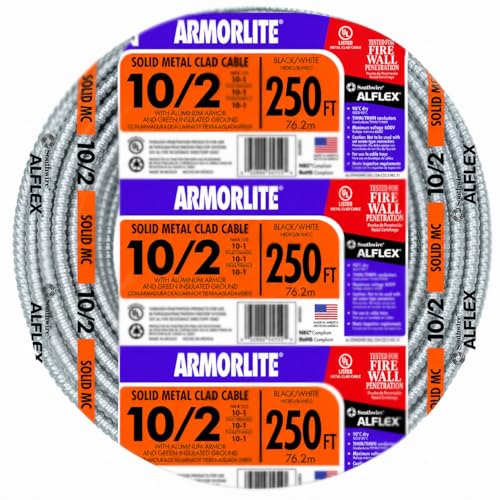
This Southwire roll is the serious commitment buy — 250 feet of 10/2 feeding branch circuits, lighting, and control wiring across commercial, industrial, and multi-residential buildings. It is rated for a maximum current of 30 amps (30 A) and works equally well concealed in a wall, fished through plaster, or run in environmental air-handling spaces per NEC 300.22 (C). The name-brand armor gives you the printed conductor markings that inspected work demands — the exact thing the budget rolls above lack.
Buyers purchase multiple spools for mini-split and AC wiring, praising the quality and value “just without the mark up” versus big-box stores. Owners most often praise the wire’s quality, then its value over a full 250-foot purchase. It suits long 20-amp runs or 30-amp circuits across a metal building, where short 25-foot pieces would force you into splices.
Compared with the two 25-foot rolls above, this spool gives you ten times the cable in one 250-foot continuous run — no splices, no waste, no second order. The honest trade-off is the multi-strand construction, which owners describe as more of a workout to bend and terminate than thinner wire: “pain to work with the 10 gauge wire bit when you have to, you have to.” This is a tool-for-the-job purchase for substantial projects.
The pro-grade choice: code-ready markings and 250 continuous feet make it the pick for inspected buildings and long circuits.
Size the effort: multi-strand 10 AWG is stiff to work — budget real time for bending and terminating.
Understanding the Specs
Voltage and temperature ratings
A 600-volt rating tells you the insulation can handle the voltage between conductors and to ground — far above the 240 volts a typical residential circuit uses. The 90°C figure is the maximum temperature the conductor insulation can withstand continuously. Together they define where you can safely run the cable: a 90°C rating lets you route it through warm attics or near other heat sources without derating your circuit.
Solid copper vs multi-strand conductors
Solid bare copper conductors (a single solid wire per gauge) carry current efficiently and hold their shape when you land them under a terminal screw — the standard for fixed building wiring. Multi-strand conductors are made of many small wires twisted together, which makes the cable more flexible for tight bends but harder to keep tidy under a screw. For a permanent 30-amp circuit, either works; for repeated bending, multi-strand is easier.
FAQ
What does the “10/2” in 10/2 MC cable actually mean?
What is the difference between 10/2 MC cable and 10/3 MC cable?
Can I use 10/2 MC cable outdoors or underground?
Will 10/2 MC cable handle a 30-amp circuit or only 20 amps?
How do I cut and strip MC cable armor cleanly?
Why does my 10/2 MC cable not have markings on the individual wires?
What is the difference between MC cable and NM (Romex) cable?
Is a 250-foot spool of 10/2 MC cable worth buying for one project?
How many wires are inside a 10/2 MC cable?
Can I install 10/2 MC cable myself for an EV charger?
Final Thoughts: The Verdict
For most buyers, the 10/2 mc cable winner is the YDDECW 25-ft roll because it nails the value-to-length balance for a single 30-amp appliance run. If your wiring job is a Level 2 EV charger where quality sheathing matters most, grab the Kimbluth 25-ft roll. And for a full 250-foot commercial or workshop build with code-ready markings, the Southwire spool is the one to reach for.
How We Picked
We do not accept paid placement. Every pick is matched to a real buyer and a real use-case; we do not hands-on test units.
Sources & Methodology
Specifications: manufacturer listings and product documentation. Review insights: verified customer reviews, as of September 2026. Pricing: not shown on this page (it changes often); check the current price via the retailer link.
As an Amazon Associate, KitchPrep earns from qualifying purchases. This does not affect which products we feature.
Related Guides
