
Specs are compiled from manufacturer listings and verified buyer reviews and can change over time — please confirm the key details on the product page before buying.
When the grid goes down, the battery is the true heart of your solar backup — it decides whether you have lights at dinner or a dark, silent house. This guide cuts through the confusion to rank the best batteries for solar backup, from entry-level sealed lead-acid to premium rack-mounted lithium.
I’m Mohammad Maruf — the founder and writer behind KitchPrep. This guide is built by comparing the manufacturers’ published specifications and the patterns across verified customer reviews, so you get each pick’s real strengths and trade-offs instead of marketing spin.
Whether you’re powering a weekend camper or an emergency home system, batteries for solar backup must match your inverter’s voltage and your daily energy draw.
Our Picks at a Glance

How To Choose Batteries for Solar Backup
Choosing a solar battery is a multi-year decision, so it pays to get the fundamentals right. You need to balance upfront cost against how many charge-discharge cycles the battery will survive, and make sure your new battery talks to your existing solar equipment.
Match the Voltage First
The single most common mistake is buying a 12V battery for a 24V or 48V system. Your solar inverter and charge controller are built for a specific DC voltage, and feeding them the wrong one means nothing works. Check your inverter’s input voltage before you shop, and remember that multiple 12V batteries can be wired in series to reach 24V or 48V — but only if they are identical and fully charged.
Lithium vs. Lead-Acid Chemistry
Traditional sealed lead-acid (AGM) batteries are cheaper upfront and have been the standard for years, but you can only safely drain them to about 50% capacity. Lithium iron phosphate (LiFePO4) batteries cost more initially yet let you use 80-100% of their rated capacity, charge faster, and typically last 4,000+ cycles versus a few hundred for lead-acid. Over a decade, lithium’s longer cycle life usually makes it the better value.
Safety and Cold Weather Protection
Lithium batteries demand a Battery Management System (BMS) to prevent overcharging, over-discharging, and short circuits. Look for models with low-temperature cutoff — a feature that stops charging below freezing to protect the cells — and check for certifications like UL9540 or UL1973 if you plan a home installation where safety codes apply.
Quick Comparison
| Model | Best For | Voltage | Capacity | Weight | Amazon |
|---|---|---|---|---|---|
| ECO-WORTHY Cubix100 48V★ Best Overall | Whole-home backup, off-grid | 48V | 100Ah (5.12kWh) | 100 lbs | Amazon |
| ExpertPower AGM 12VBudget Champion | Budget sump pump & small loads | 12V | 100Ah | 59.52 lbs | Amazon |
| GRNOE 2-Pack 12VBest Value | Lively replacement for lead-acid | 12V | 100Ah each | 22.48 lbs each | Amazon |
| Dyness 24V | 24V systems and trolling motors | 24V | 100Ah (2.56kWh) | 9.9 kg | Amazon |
| HumsiENK 2-Pack 12V | RV & boat drop-in upgrades | 12V | 100Ah each (1.28kWh) | 23.2 lbs (pack) | Amazon |
| Litime Group 24 12V | Camper and sump pump reliability | 12V | 100Ah (1.28kWh) | 21.9 lbs | Amazon |
| Dumfume 12V 314Ah | High-capacity single battery RVs | 12V | 314Ah (4.02kWh) | 57 lbs | Amazon |
| ECO-WORTHY EnergyRock 280Ah | Vibration-prone RVs, fire safety focus | 12.8V | 280Ah (3.58kWh) | 60 lbs (est.) | Amazon |
| Redodo 12V 120Ah (2-Pack) | Extended boondocking, dual battery | 12.8V | 120Ah each (1.54kWh) | 47.6 lbs (pack) | Amazon |
In-Depth Reviews
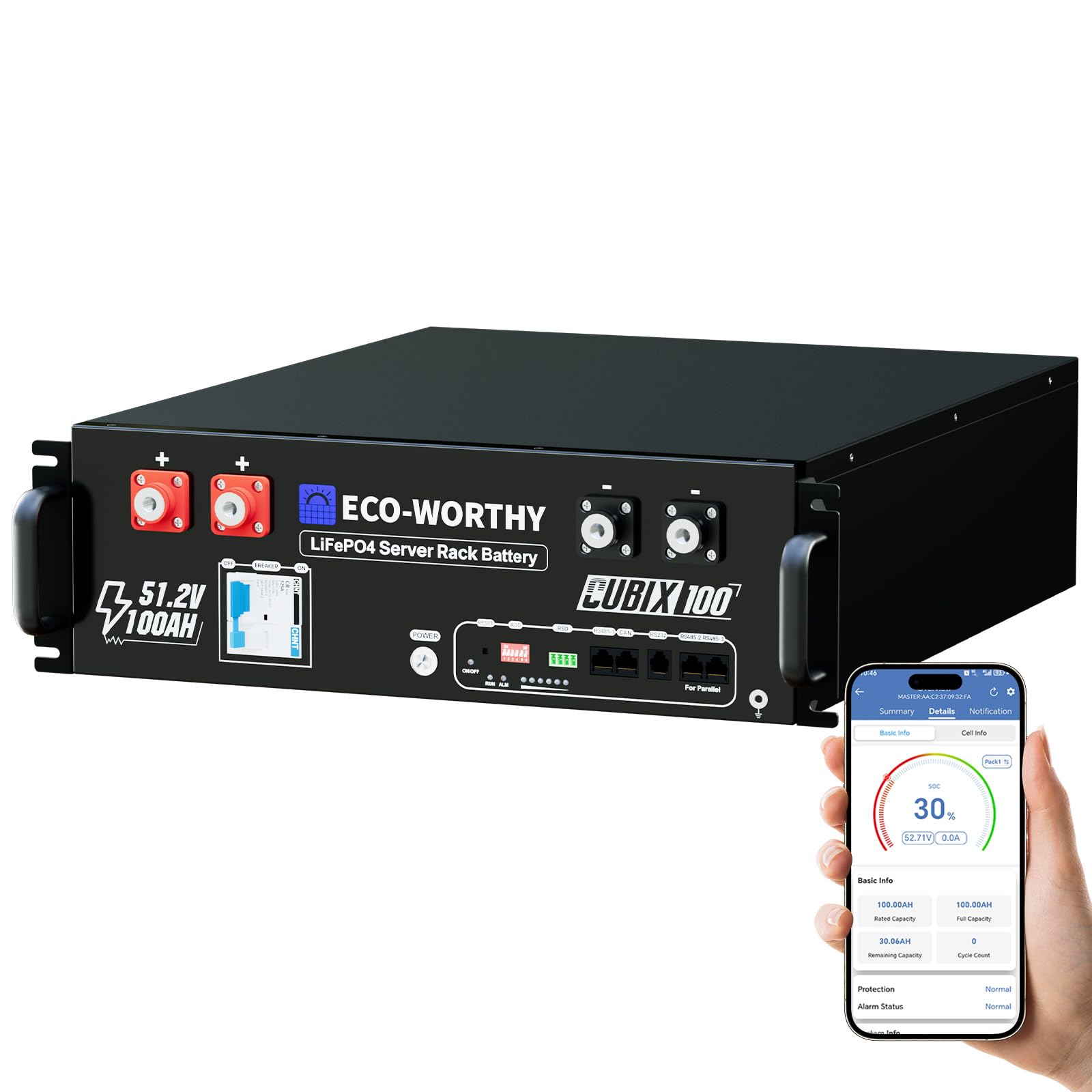
1. ECO-WORTHY Cubix100 48V 100Ah LiFePO4 Server Rack
Our pick — over 4.5★ from 300+ verified ratings; the strongest balance of quality and price.
The whole-home heavyweight — a 48V rack unit that pairs with modern inverters and scales to a serious power wall
For a full-house solar backup, you want a 48V battery, and this Cubix100 is the one owners call a “Great Battery for the Money.” It delivers 2.56kW continuously and handles a max of 5.12kW, so it can run heavy appliances like a well pump or a large fridge. It stores 5.12kWh of usable energy in a 51.2V format (the voltage standard for most home solar inverters). The metal server-rack case weighs 100 pounds, which is 4.4 times heavier than a pair of 12V 100Ah lithium batteries — so you need a sturdy spot, but the integrated wheels and pre-drilled rails make rolling it into place straightforward.
The smart feature set is what separates it from cheaper 12V units. Closed-loop CAN/RS485 communication lets it talk directly with major hybrid solar inverters, while built-in Bluetooth and WiFi feed live status to the ECO-WORTHY app. Buyers report clean integration with ECO-WORTHY and Sungold inverters, and one off-grid user even paired it with a Bluetti Apex 300 via a modified cable to nearly triple his capacity. Owners mention it handles daily use in Cuba reliably, holding voltage well with real capacity matching the spec.
The UL9540, UL1973, and CEC listings are the headline trust markers — Intertek did the testing, covering electrical safety and thermal runaway management, which many code inspectors require for home installs. The kit is genuinely plug-and-play too: parallel cables, communication cables, grounding wires, and terminal covers all ship in the box. You can parallel up to 32 units for a massive 163.8kWh bank if you ever need to grow. The only grumble from owners is the lack of an on-unit screen — you must use the app to read cell data, and the app itself is fairly basic, showing state of charge without runtime estimates.
Why it wins the home backup
- Three major safety certifications (UL9540, UL1973, CEC) for code compliance
- Bluetooth and WiFi monitoring with CAN/RS485 inverter communication
- Scale up to 32 parallel units for 163.8kWh of storage
- 10-year limited warranty backs a premium purchase
What to know before you buy
- No on-unit display, so you rely on the smartphone app
- At 100 pounds, it needs a solid rack, not a shelf
- Requires a 48V inverter system to operate
The verdict: If you are building a serious off-grid or whole-home setup with a 48V inverter, this is the most future-proof, safest choice of the group.
Look elsewhere if: you already own a 12V system — the voltage mismatch makes this unit incompatible without a full rewire.
2. ExpertPower Deep Cycle 12V 100Ah AGM
The budget workhorse — old-school AGM chemistry for buyers who need reliable backup without a lithium price tag
Not every solar backup needs to be lithium, and this ExpertPower is proof that 12V sealed lead-acid still has a place. It delivers 12V and 100Ah from a durable AGM design — AGM stands for Absorbed Glass Mat, meaning the acid is held in fiberglass mats so the battery is spill-proof and needs zero maintenance. It weighs 59.52 lbs and measures 12.07 x 6.63 x 8.27 inches, small enough to drop into battery boxes under stairs or in a camper compartment.
Owners consistently praise it for one job: backup power. Customers note using it for a Wayne backup sump system, where it fit the battery box perfectly and offered more capacity than the 75Ah Wayne-branded battery at a better value. The M8 threaded terminals matched the existing charger and pump wiring with no crimping needed. It also runs a 12V trolling motor and supports solar and wind integration for off-grid cabins.
The honest trade-off is chemistry. A sealed lead-acid battery like this gives roughly half the usable capacity of an equivalent-cost lithium unit because you should only drain it to about 50% to protect its lifespan. It also charges slowly and offers no Bluetooth monitoring. What you gain is a familiar, universally compatible 12V voltage that works with almost any basic charge controller, plus the included carry strap that makes the 59.52 lbs slightly more manageable.
Smart budget buy: for a sump pump, small security system, or a basic 12V camper load where you need proven reliability over cutting-edge tech.
The catch: you get roughly half the usable depth of discharge compared to lithium, so factor that into your math.
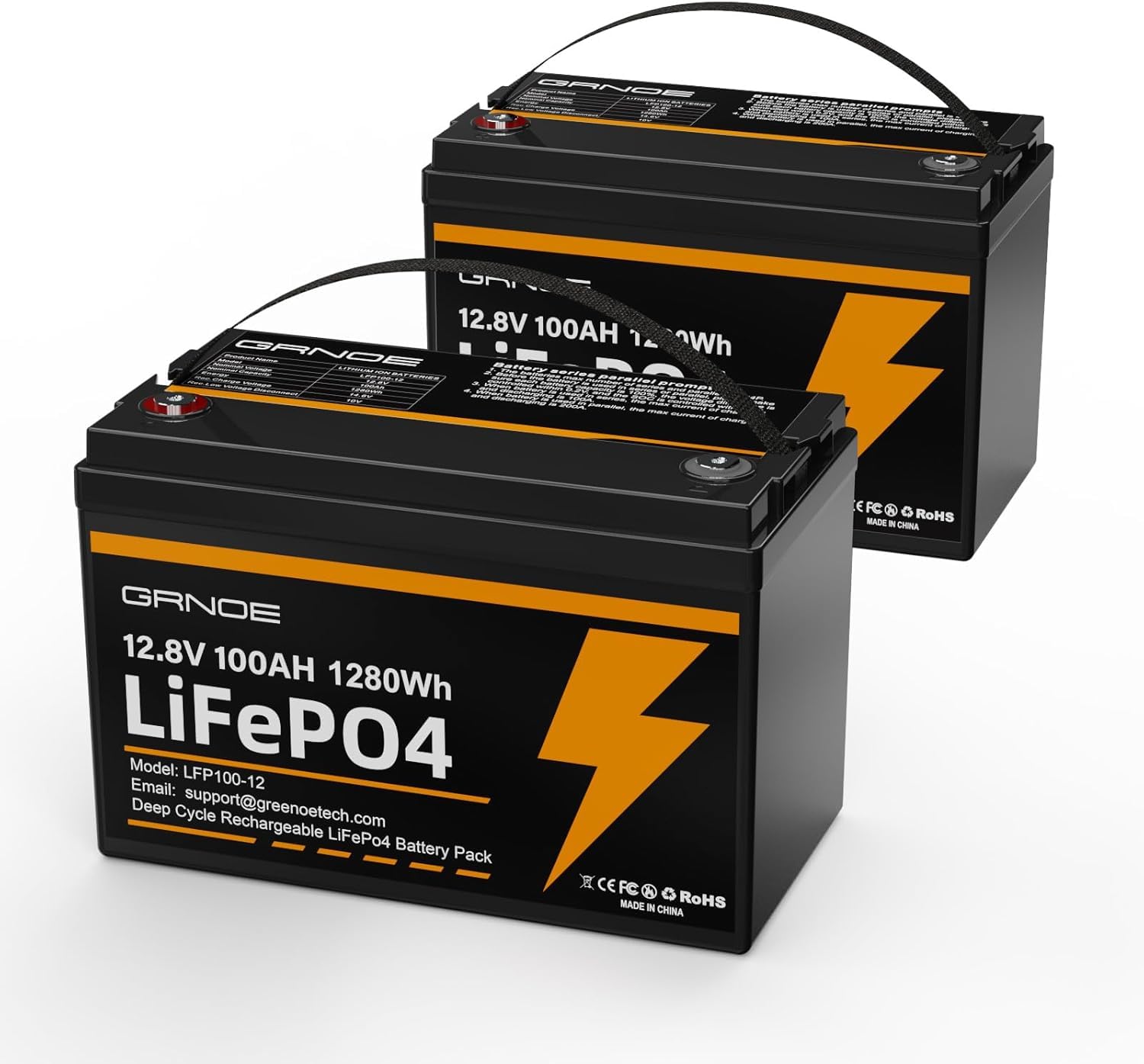
3. GRNOE 2-Pack 12V 100Ah LiFePO4 Group 31
Two featherweight lithium bricks that give RV and marine owners triple the usable power at a third of the weight
Each GRNOE in this 2-pack weighs just 22.48 pounds while holding a full 12V 100Ah — to feel the difference, the ECO-WORTHY 48V rack battery above weighs 100 pounds. That weight drop is why owners switching from AGM call it a revelation for travel trailers and sailboats. It packs an energy density of 57 Wh per pound, and the upgrade from lead-acid means you can use far more of the rated capacity before recharging.
The built-in 100A BMS (Battery Management System) watches for overheating, overcurrent, overcharge, over-discharge, and short circuits. Its low-temperature cutoff stops charging below 32°F — a lifeline for cabins and off-grid setups in cold winters. On the water, reviewers point out these batteries hold a charge for months and outlast AGM by a wide margin, with one Catalina 34 sailor rewiring his whole charging system to make the switch work.
What wins people over is the build quality — owners consistently rate the cells and construction as excellent. There are real caveats worth knowing. This is a lithium battery, not a starting battery: the maker is explicit it is for energy storage, not cranking engines or golf carts. And it needs a 14.6V lithium charger; a standard 12V charger won’t fully charge it. A minority of shoppers say reliability issues, including BMS shutdowns that required a charger reset to wake the battery — so this pick suits buyers comfortable with lithium’s charging rules.
The lithium upgrade payoff
- 22.48 lbs each — only 33% of a traditional lead-acid’s weight
- Smart low-temp cutoff protects cells below freezing
- UL and UN38.3 certified with A+ grade LiFePO4 cells
- 3-year replacement support from the maker
Fair warning for first-timers
- Requires a 14.6V lithium charger, not a standard 12V one
- Not for engine starting — storage duty only
- Occasional reports of BMS shutdowns needing a reset
Reach for this if: you run an RV, boat, or off-grid cabin and want two dependable 12V batteries that mount parallel without straining your floor.
Think twice if: you are not prepared to swap your charger for a lithium-specific one.
4. Dyness 24V 100Ah LiFePO4 Deep Cycle
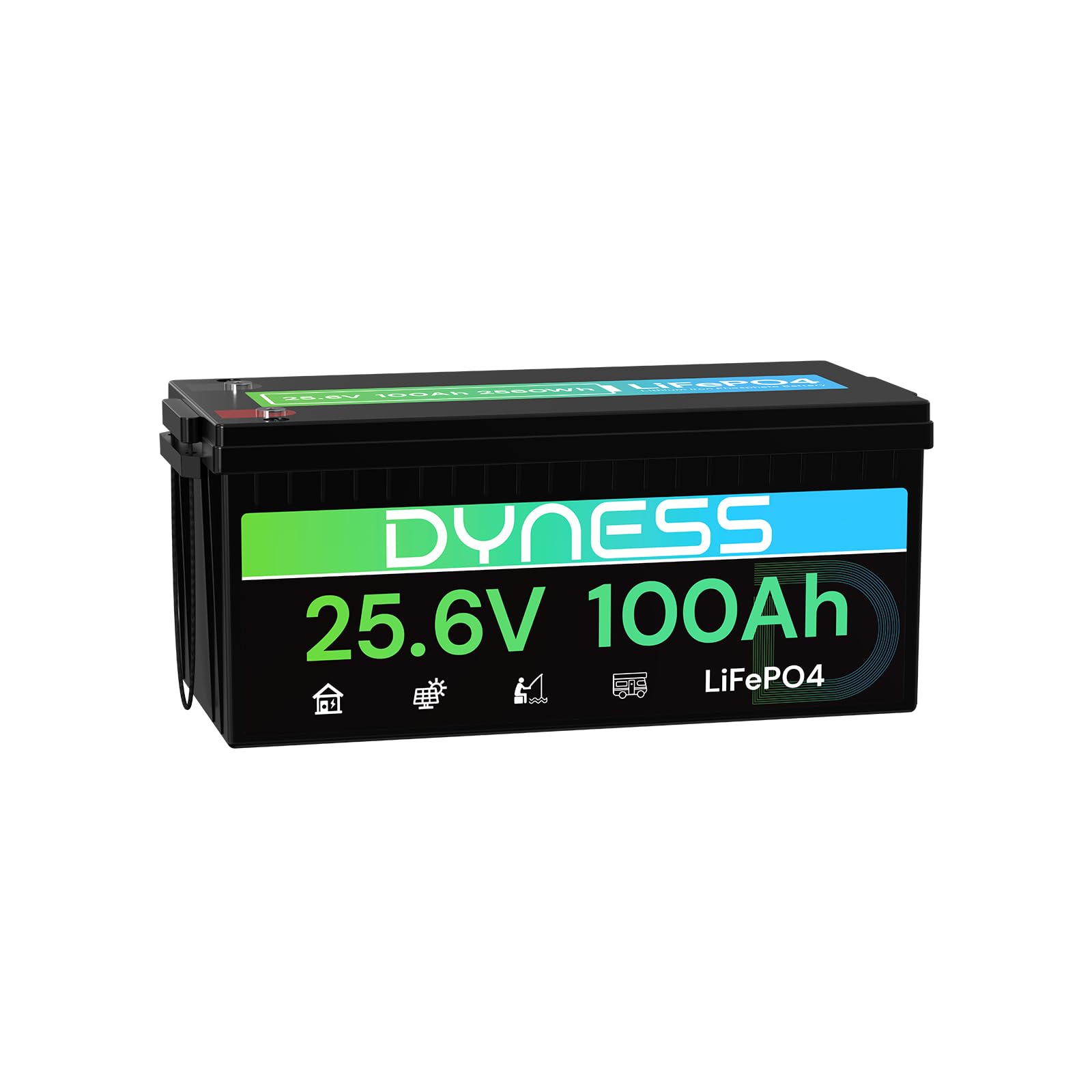
The 24V specialist — a middle-voltage bank that runs trolling motors and solar cabins with a 2.56kWh reserve
Many solar and marine systems run on 24V rather than 12V, and the Dyness fills exactly that gap. It stores 2.56kWh from a 25.6V bank of A+ grade cells, and at just 9.9 kg (about 21.8 lbs) it is remarkably portable for its output. The built-in 100A smart BMS covers the usual protections plus an advanced low-temperature cutoff, making it a dependable companion for year-round fishing trips in cold climates.
The expansion story is strong: wire up to a 4P2S configuration and you can reach a 51.2V 400Ah bank of 20.48kWh — enough to run a small home off-grid. Owners have pushed it hard in marine duty, with one pontoon boat skipper running a 24V trolling motor and spot-lock continuously for over 4 hours with zero issues. Others run two in parallel at 200Ah for a Ram Promaster camper van, praising the price against competing 24V brands.
This battery is a performer. Owners describe it holding a charge exceptionally well, charging quickly, and feeling genuinely high quality — with an 80 lbs thrust trolling motor lasting 5 days without a recharge in one report. The 5-year manufacturer warranty and responsive support add confidence, though the support is email-based rather than instant chat. Just remember it is not for engine starting, and keep in mind there is no Bluetooth — you track state of charge with a voltmeter or system monitor.
Where it shines: a 24V solar cabin, pontoon boat, or van build where the extra voltage halves your cable losses and two units can scale to 400Ah.
The limitation: there’s no app or Bluetooth — it is an analog workhorse, not a smart battery.
5. HumsiENK 2-Pack 12V 100Ah LiFePO4 with Bluetooth
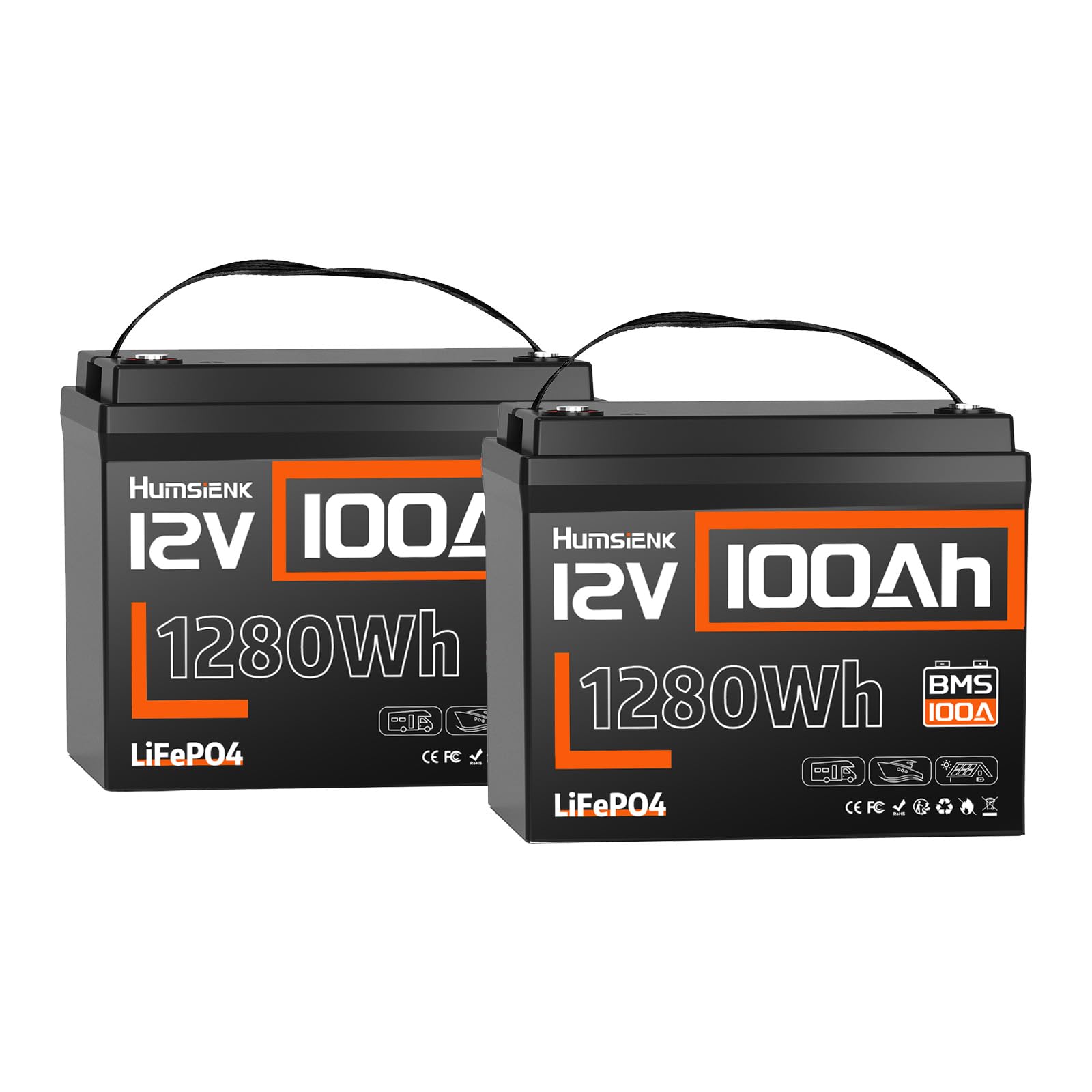
A compact Group 24 pair with Bluetooth telemetry — check voltage and state of charge straight from your phone
These HumsiENK units squeeze 100Ah into a Group 24 box size measuring just 8.4 x 6.6 x 10.2 inches each, so they drop into spaces that older AGM batteries filled. Owners use them as drop-in replacements for RVs, solar rigs, and trolling motors, and the nylon carry handle makes the 19.73 lb per-battery weight genuinely easy to move around. The IP67 waterproof rating — meaning protection against dust and temporary immersion — is a standout for marine and outdoor duty.
The defining feature is Bluetooth. The free app shows you voltage, state of charge, current, and temperature live, and owners say the connection is flawless with rapid updates. One owner measured real-world capacity around 4,150 Wh across three units, confirming the cells live up to their rating. The smart 100A BMS adds low-temp, over-discharge, over-charge, and short-circuit protection, with an automatic disconnect when current spikes beyond 300A for safety.
Owners rave about fast charging — a full charge in about 2 hours is achievable versus 14 hours for lead-acid, so you can top up during a short sunny window. It operates from -4°F to 158°F and shuts down below -4°F to protect itself. The trade-off is pack-level reliability: while the majority praise the quality, some buyers report batteries that refuse to charge fully, and the Bluetooth connectivity is mixed — occasionally finicky reconnection is the price of the smart feature. At 23.2 pounds for the whole box, this is also one of the lightest two-battery solutions here.
What earns its keep
- Bluetooth app with live voltage, current, and temperature data
- Full charge in roughly 2 hours with the right charger
- IP67 waterproof and impact-resistant casing
- Slim Group 24 profile pairs with 4-series/4-parallel expansion to 48V
Heads-up before you commit
- Bluetooth connectivity is occasionally glitchy for some owners
- A minority report charging issues that need seller support
- Requires a proper LiFePO4 charger to reach full capacity
Grab this pair if: you want phone-based monitoring in a small footprint — ideal for a camper van or boat where space is tight.
Look elsewhere if: you value dead-simple reliability over smart features — a non-Bluetooth pack removes a failure point.
6. Litime 12V 100Ah Group 24 with Bluetooth
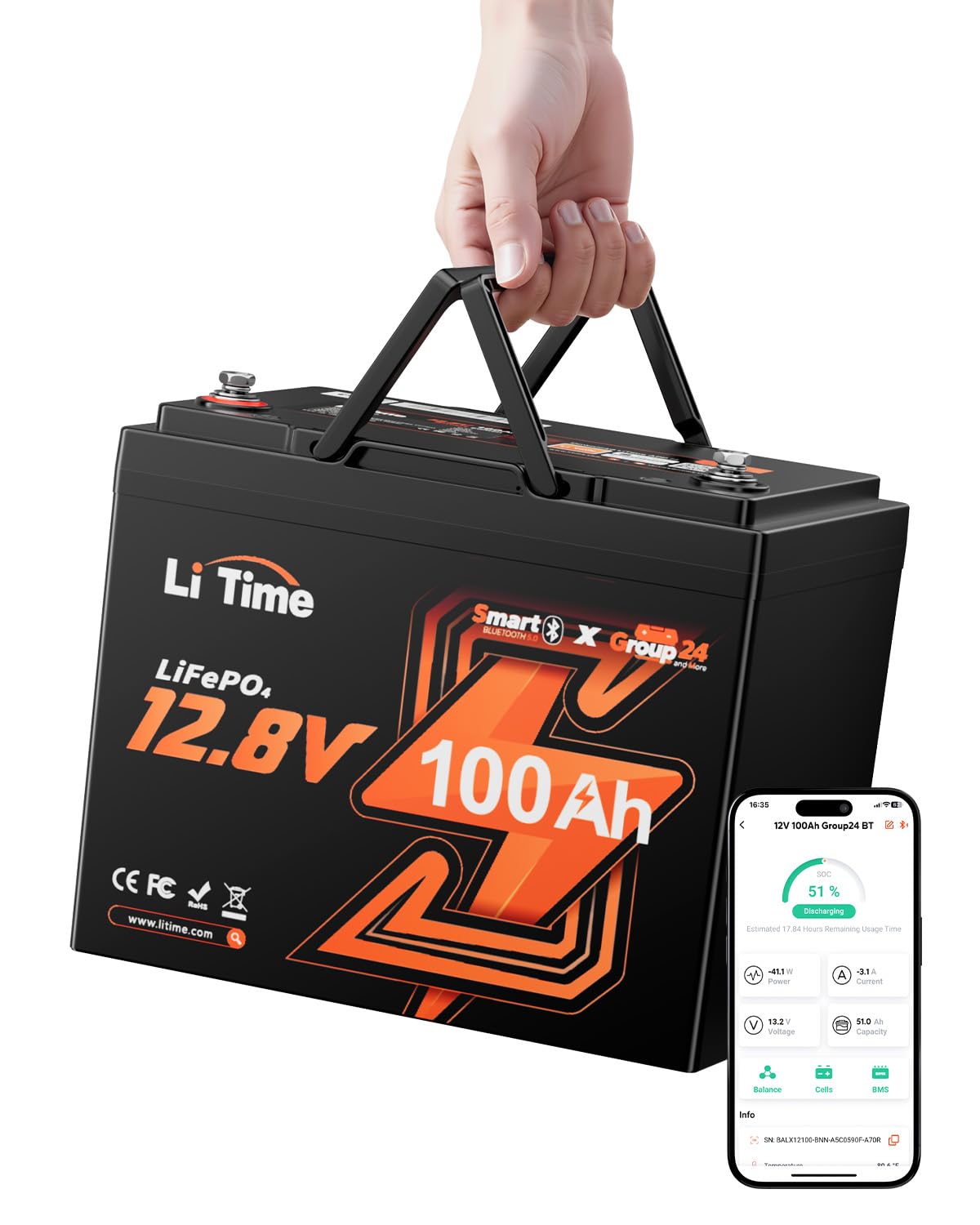
The camper’s best friend — a Group 24 that fits older battery boxes while doubling your usable power
Litime’s 12V 100Ah battery slides into Group 24, 27, or 31 boxes, which means it is often a true drop-in for RVs and trailers that were wired for lead-acid. At 21.9 lbs it is 63% lighter than an equivalent lead-acid brick, and it packs 1.28kWh of full power — roughly 2x usable energy because lithium lets you drain deeper without damage. One owner replaced the 80Ah lead-acid batteries in an Airstream, ran a full charge-to-discharge test, and confirmed it did exactly as advertised.
Bluetooth is the star here. The app shows state of charge, voltage, and charging status live from your phone — no more crawling under seats or into storage bays to check the battery. Owners say the app works flawlessly and is a genuine upgrade for trip planning. The advanced 100A BMS continuously protects against over-charging, over-discharging, overheating, and short circuits, and smart cold protection halts charging below 32°F and discharging below -4°F.
Owners mention outstanding real-world endurance. One kayak fisherman runs his trolling motor for multiple days without recharging, and a homeowner uses it for a sump pump backup in a high water-table area, calling the battery life better than expected. The LiFePO4 chemistry supports up to 15,000 deep cycles, outlasting lead-acid’s 200-500 cycles. The only honest negative is rarity: battery monitoring via the app is noted as occasionally inconsistent, and the battery is not for starting engines or golf carts — a lithium rule, not a flaw in this unit.
The defining strength: owners who cycle it fully report the capacity matches the label exactly, and the Bluetooth app is the most praised feature across reviews.
One note: app battery monitoring occasionally reads inconsistently, though the core storage performance earns near-universal praise.
7. Dumfume 12V 314Ah LiFePO4 with 200A BMS
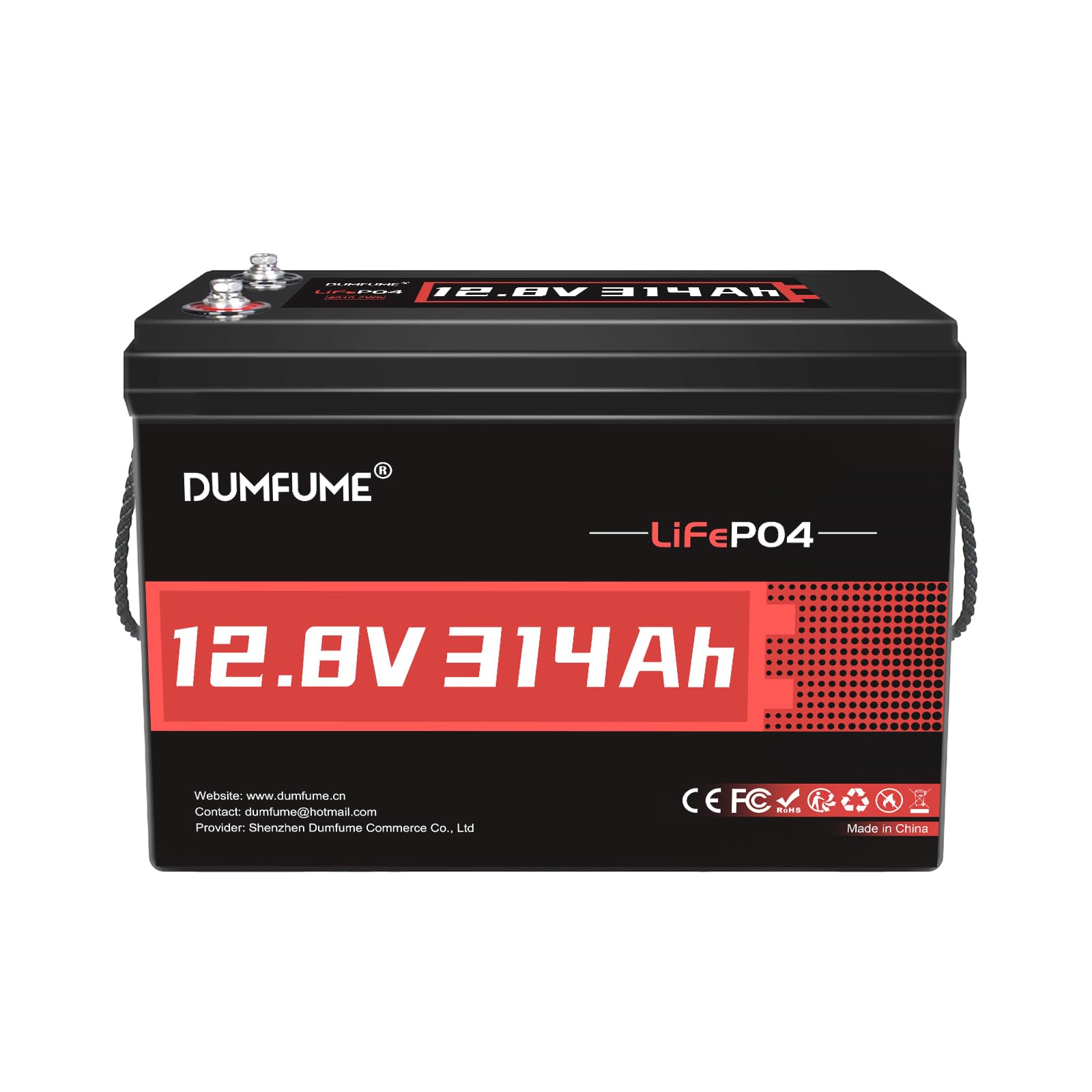
One massive 314Ah cell — a single 57 lb battery that replaces a row of AGMs for RVs and off-grid sheds
Sometimes you want maximum energy in a single box, and the Dumfume delivers 314Ah — a huge 4,019.2Wh of capacity — yet weighs only 57 lbs. That is roughly one-third the weight of a comparable lead-acid bank, with nearly double the energy density. Owners running two of these in a Class C RV say they power a residential fridge without effort, drawing on 80% of capacity versus 50% with the old AGMs.
A 200A BMS (a battery management system that monitors and protects the cells) sits at the heart of this unit, handling overcharge, over-discharge, overcurrent, overheating, and short-circuit protection, plus automatic high/low temperature cutoffs. The high-strength ABS casing resists heat, weather, and flame. It supports both parallel and series wiring, and the maker rates it for 4,000 cycles at 100% depth of discharge (meaning you can drain it fully each time) and up to 15,000 cycles at 60% depth of discharge, versus 200-500 cycles for lead-acid.
What wins owners over is the no-frills power density — this is not a smart battery with Bluetooth; it is a pure storage workhorse. Owners praise the sturdy build and note it works well even with modest 100W solar panels on a Scamp camper. The recurring theme is capacity: most report it holds a charge well and delivers impressive power for the footprint. The honest caveat is that some units arrive below full charge and need a parallel jump-start to wake the BMS, and a long-term owner reported a shutdown after a year in a campervan — a reminder that any lithium pack needs proper charging discipline and predictable temperatures above freezing.
The payoff of one big cell
- 4,019.2Wh of storage in a single 57 lb unit
- 200A BMS with full protection suite
- Parallel and series wiring for system expansion
- ABS casing resists heat, weather, and flame
Know before you buy
- Some units arrive below full charge and need a jump-start
- Cold-climate charging can be a problem below 41°F (5°C)
- No Bluetooth monitoring — you need an external monitor
Choose this one if: you want maximum amps-per-dollar in a single portable box for a large RV or serious off-grid draw.
skip it if: you need smartphone monitoring or live in a region with sustained sub-freezing winters.
8. ECO-WORTHY EnergyRock 12V 280Ah Metal Case
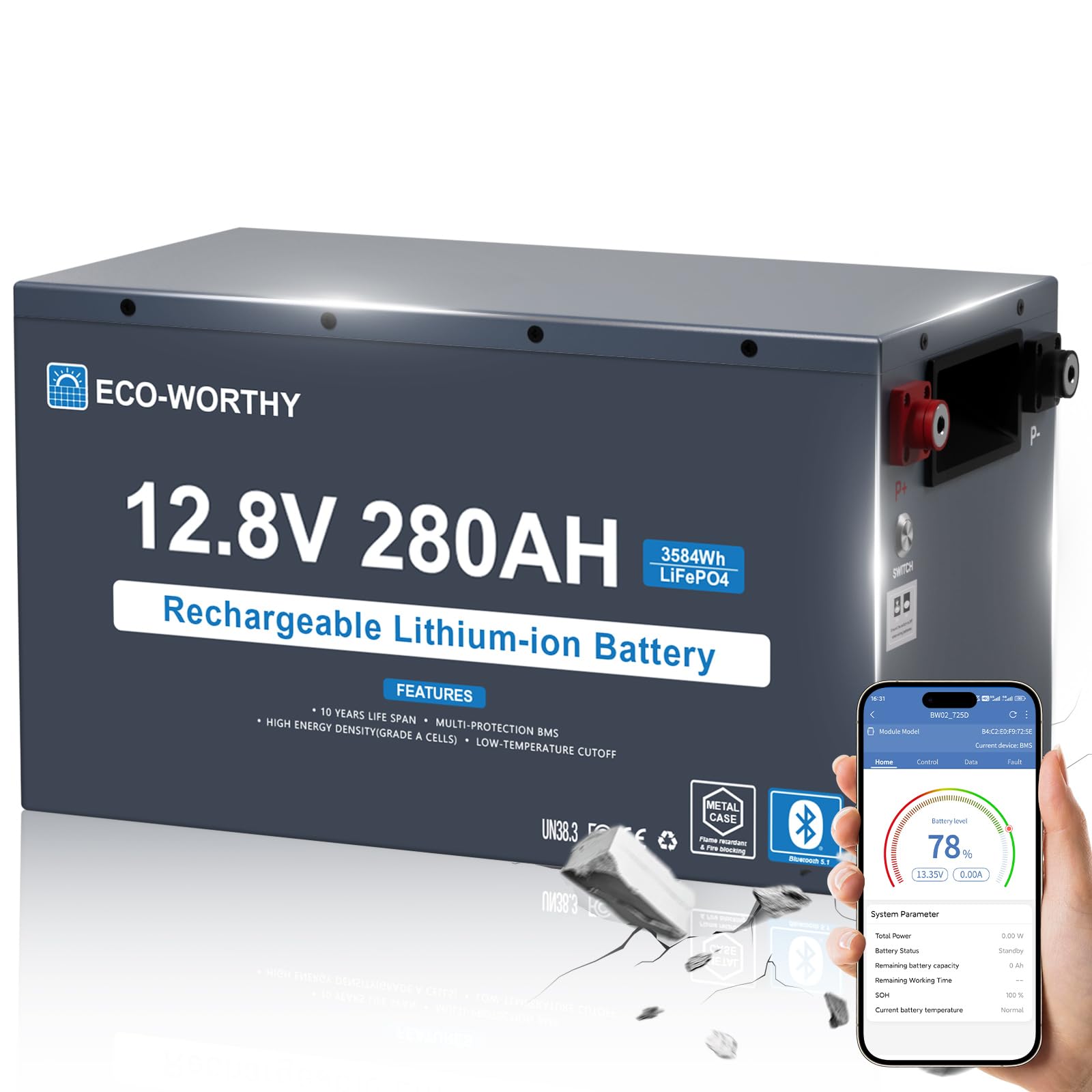
The armored tank of 12V lithium — a fire-resistant metal case built for the vibration of life on the road
What sets the EnergyRock apart is literally its shell. Instead of a plastic case, this 280Ah battery sits in a heavy-duty metal enclosure with four mounting feet, so you can bolt it directly into an RV or camper without a separate battery box — saving space and adding real fire and heat resistance. Inside are Grade A LiFePO4 cells (a lithium-iron-phosphate chemistry known for safety and long life) managed by a 200A BMS, storing a maximum of 3,584Wh. Owners swapped out dual lead-acid deep cycles for this single unit and kept an RV fridge running all week off 100W of solar.
The one-touch safety switch is a thoughtful touch — flip it off and the discharge circuit disconnects, which makes installation and maintenance genuinely safer. Front terminals and a flat top allow neat stacking, and the case shrugs off road vibration that would fatigue a plastic shell. Bluetooth monitoring streams voltage, capacity, and charge status through the app, and the low-temperature cutoff stops charging below 20°F — tested working on a snowy trip in those exact conditions.
Owners are near-unanimous that this is a premium-feeling unit. The thing everyone raves about is its stamina: a 1/2 HP sump pump ran roughly 5 hours continuous (12+ hours intermittent), a 1000-watt amp powered without issues, and a 12,000 BTU air conditioner plus lights ran 2 hours before dropping to 30%. Battery quality is the most-praised trait, with battery life close behind — the factory packaging with foam terminal protection also drew compliments. The trade-off is weight and width: at roughly 60 lbs it matches the AGM it replaces, and it runs slightly wider, so some owners need light modification to the battery bay to make it fit.
Where the metal shell pays off
- Fire-resistant metal case means no separate battery box needed
- Built-in 200A BMS with Bluetooth monitoring
- One-touch power switch for safer maintenance
- Reinforced internals resist road shock and vibration
Considerations
- Slightly wider profile may require battery-bay modification
- High-ticket price reflects the armored build
- App is basic compared to some competitors
For the serious van-lifer or boondocker: this is the most durable, safety-conscious 12V pack on the list — built to outlast the trend.
For the budget-conscious: the premium for the metal case is only worth it if you truly need fire resistance and vibration protection.
9. Redodo 12.8V 120Ah Bluetooth LiFePO4 (2-Pack)

A Bluetooth 5.0 twin-pack with 1.54kWh per unit — 256Wh more than same-size 100Ah batteries
The Redodo twins each deliver 120Ah in a Group 24 footprint (a standard size that fits most RV trays), storing 1,536Wh per battery — a meaningful 256Wh advantage over a standard 12V 100Ah unit of the same dimensions. That extra headroom translates to real runtime: the maker rates each battery to last 1.2-1.5 days on a 1kWh daily load, and owners boondocking in travel trailers say the pair paired with solar keeps them powered for several days straight. The 81% weight reduction versus lead-acid is what makes a two-battery setup practical in the first place.
Bluetooth 5.0 monitoring is the flagship feature. Scan the QR code on top and the Redodo app shows state of charge, voltage, current, power, temperature, and protection alerts in real time. Owners note that having Bluetooth onboard eliminated the need for a separate shunt — a battery monitor you would otherwise install inline to track usage. The smart 120A BMS handles protection duties, while low-temperature protection stops charging below 32°F and resumes above 41°F, with discharge cutoff below -4°F.
The white professional-grade housing is a subtle but real engineering choice — it reflects heat instead of absorbing it like black casings, supporting safer charging in direct sun and a longer service life. A 120Ah rating with a 20A compatible charger reaches full in about 6 hours. Owners consistently praise the quality and consider it great value, with the only mixed feedback centered on whether the price premium over 100Ah packs is worth it. At 47.6 lbs for the entire box, this is the premium dual-battery route to serious off-grid runtime.
The smart-pack advantage
- 1,536Wh per unit beats 100Ah Group 24 batteries by 256Wh
- Bluetooth 5.0 eliminates the need for a separate shunt
- Heat-reflective white housing for safer charging
- Two batteries support parallel expansion for longer trips
What to weigh
- Premium price per amp-hour versus 100Ah rivals
- Value perception is mixed among some owners
- Full charge takes about 6 hours with a 20A charger
Buy this pair if: you want maximum smart-feature runtime in two compact Group 24 boxes for serious boondocking.
Consider a 100Ah pack if: budget is the deciding factor — you are paying a premium for that extra 256Wh per unit.
Understanding the Specs
Voltage and System Architecture
Voltage is the language your whole solar system speaks. A 12V battery suits small campers and sump pumps, 24V suits larger vans and marine setups, and 48V is the standard for whole-home inverters. Check your inverter’s input before buying — mismatched voltage means nothing functions. When wiring multiple 12V batteries in series, they must be identical and at matching state of charge to avoid imbalance.
Amp-Hours and Watt-Hours
Amp-hours (Ah) measure how much current a battery delivers over time, while watt-hours (Wh) measure total energy — multiply voltage by amp-hours to get watt-hours. A 12V 100Ah battery holds about 1,280Wh, but a LiFePO4 unit lets you safely use nearly all of it, whereas a lead-acid should only be drained to roughly half. That usable-capacity difference matters more than the raw Ah number for real-world runtime.
What a BMS Actually Does
The Battery Management System is the safety brain inside every lithium battery. It monitors each cell to prevent overcharging, over-discharging, overcurrent, overheating, and short circuits — and in smart units, it cuts charging below freezing to protect the chemistry. A higher BMS rating, like 100A or 200A, means the battery can safely deliver more current for power-hungry loads like air conditioners and inverters.
Safety Certifications Explained
Certifications are your proof a battery passed independent testing. UL9540 covers energy storage systems for fire and electrical safety, UL1973 covers stationary batteries, and CEC listing confirms compliance with California Energy Commission standards. For a code-inspected home installation, these matter; for a camper, they are good-to-have reassurance rather than a requirement.
FAQ
How long will a 100Ah solar battery actually power my home?
Will a 12V solar battery work with my existing 48V inverter?
What is the difference between lithium LiFePO4 and AGM lead-acid batteries?
Can I connect multiple solar batteries in parallel or series?
Why do lithium batteries refuse to charge in cold weather?
How long does a LiFePO4 solar battery last before needing replacement?
Can I use a regular car battery charger on a solar lithium battery?
What size solar battery do I need for overnight backup?
Is a metal-case battery safer than a plastic-case lithium battery?
How do I know if my solar panels will fully charge my battery?
Final Thoughts: The Verdict
For most buyers, the batteries for solar backup winner is the ECO-WORTHY Cubix100 48V because it pairs the highest safety certifications with smart monitoring and true whole-home scalability. If you want budget-friendly, phone-monitored 12V power for an RV or camper, grab the Litime Group 24 — owners consistently praise its Bluetooth app and real-world endurance. And for a single massive cell that powers a large off-grid draw, the Dumfume 314Ah delivers 4,019.2Wh in one portable box. Whatever your voltage and energy needs, match the battery to your inverter and charge correctly — and a decade of reliable solar backup is well within reach.
How We Picked
We do not accept paid placement. Every pick is matched to a real buyer and a real use-case; we do not hands-on test units.
Sources & Methodology
Specifications: manufacturer listings and product documentation. Review insights: verified customer reviews, as of September 2026. Pricing: not shown on this page (it changes often); check the current price via the retailer link.
As an Amazon Associate, KitchPrep earns from qualifying purchases. This does not affect which products we feature.
Related Guides
