
Specs are compiled from manufacturer listings and verified buyer reviews and can change over time — please confirm the key details on the product page before buying.
Every road trip, job site, or power outage hits the same wall: you have a 12V battery but your laptop, CPAP, or mini fridge needs standard 110V household current. A battery power inverter bridges that gap, and the real question is which wattage, which outlets, and which waveform actually match your gear — not which box looks toughest.
I’m Mohammad Maruf — the founder and writer behind KitchPrep. This guide is built by comparing the manufacturers’ published specifications and the patterns across verified customer reviews, so you get each pick’s real strengths and trade-offs instead of marketing spin.
From compact 400W plug-in units for phone charging to 3000W pure sine wave beasts for off-grid living, here’s the shortlist of the best battery power inverter options that actually hold up in real use.
Our Picks at a Glance


How To Choose The Best Battery Power Inverter
An inverter changes your vehicle’s or battery bank’s 12V direct current (DC) into the 110V/120V alternating current (AC) your household gadgets expect. The right pick depends on three things: what you’re powering, how much juice it needs at startup, and how you’ll connect it to your battery. Most people overbuy wattage or pick the wrong waveform, then wonder why their gear hums or shuts down.
Match Continuous Watts and Surge to Your Load
Check the power draw on each device’s label. Laptops and phone chargers sit well under 300W, while a small fridge, microwave, or power tool can demand 800W or more just to start. An inverter lists two numbers: continuous output for steady running, and peak surge for those few seconds of startup draw. Buy enough continuous headroom for your biggest load, and make sure the surge covers its startup spike.
Pick the Right Waveform for Your Electronics
Cheaper inverters deliver modified sine wave, which is fine for basic chargers, lights, and simple tools. Anything with a microprocessor — laptops, CPAP machines, audio gear, induction cooktops — runs cleaner and cooler on pure sine wave, which mirrors the grid’s power shape. Match the waveform to your most delicate device, not your cheapest one.
Understand the Cigarette Lighter Limit
Plugging into the 12V socket is convenient, but that circuit usually only handles around 150W before blowing a fuse. For anything heftier, you must connect directly to the battery with the included alligator clips or ring-terminal cables. A 400W unit that lives in the cab is a different tool than a 2000W hardwired system that runs an RV or serves as home backup.
Quick Comparison
| Model | Best For | Output Power | Waveform | Battery Hookup | Amazon |
|---|---|---|---|---|---|
| BESTEK 400W★ Best Overall | In-dash phone & laptop charging | 400W | — | 32-pin lighter plug | Amazon |
| OLTEANP 500WBest Value | Budget LCD monitoring | 500W | Modified Sine Wave | Clips or lighter plug | Amazon |
| POTEK 500WCompact Pick | Pocket-sized 500W value | 500W | Modified Sine Wave | Lighter plug included | Amazon |
| YSOLX 1000W | RV & multi-device camping | 1000W | Modified Sine Wave | Clips or lighter plug | Amazon |
| LANDERPOW 1000W | Sensitive electronics on the road | 1000W | Pure Sine Wave | 7AWG battery cables | Amazon |
| TOPBULL 3000W | Heavy off-grid & industrial power | 3000W | Pure Sine Wave | Pure copper cables | Amazon |
| VOLTWORKS 2000W | Hardwired RV & cabin setups | 2000W | Pure Sine Wave | Battery cables included | Amazon |
| BELTTT 2000W | High-efficiency off-grid systems | 2000W | Pure Sine Wave | 2AWG battery cables | Amazon |
In-Depth Reviews
1. BESTEK 400W Car Power Inverter
Our pick — over 4.5★ from 300+ verified ratings; the strongest balance of quality and price.
The dash-cam-sized plug-in that genuinely fast-charges your phone and runs small electronics without a noisy fan.
You get a stable 400W of DC-to-AC output with two 110V AC outlets for laptops, breast pumps, DVD players, or bottle warmers — the kind of gear you’d otherwise be stuck without on a long drive. Alongside the AC sockets sit a USB-C port delivering 30W and a USB-A port at QC 3.0 speed, so your phone tops up noticeably faster than a standard car charger.
The whole unit is about the size of an iPhone, and its 32-pin cigarette lighter plug seats tight enough that owners in patrol vehicles report it stays put where cheaper units wobbled and died. What wins people over is sheer functionality — dozens of reviewers simply call it reliable and effective, with the 25W fast charging and silence of no cooling fan standing out. Buyers report using it for air compressors to fill tires as well as everyday device charging.
Safety is handled by a built-in 40-amp fuse (a fuse that protects your devices by cutting power on a fault) plus protection against overheating, overvoltage/undervoltage, and short circuits. It carries ETL certification (a safety standard mark from a Nationally Recognized Testing Laboratory) and a 12-month replacement warranty with 24/7 support, which explains its crowd-pleasing 4.6-star average across hundreds of owners. A fair share of that goodwill came from the 2 different USB ports, which owners mention are handy when the side-by-side AC outlets can’t fit two bulky plugs at once.
What owners love
- Compact, iPhone-sized design that stores easily
- Dual USB with 30W PD and QC 3.0 fast charging
- ETL-certified with a 40-amp built-in fuse
The trade-offs
- A few units run warm under sustained load
- AC outlets sit close, so bulky plugs can block each other
Reach for this if: you want one tidy plug-in inverter for phones, tablets, laptops, and small household essentials on road trips or in a work vehicle.
Look elsewhere if: you need to run power tools or anything above roughly 400W — that job calls for a larger unit with battery clamps.
2. OLTEANP 500W Power Inverter
A 500W workhorse with a live LCD screen that shows you exactly what your battery is doing.
For about the same money as the 400W BESTEK above, this one delivers a full 500W continuous output — a 25% bigger power budget for laptops, small TVs, and game consoles under that ceiling. The real draw, though, is the built-in LCD screen that tracks input voltage, output voltage, and battery status in real time, then flashes protection codes like OL for overload, HI for high voltage, LO for low voltage, and OH for overheat when something’s wrong.
Owners praise the build quality most, and the display earns its own steady stream of compliments for making mobile office work and road trips feel controlled rather than guesswork. One detail the listing is refreshingly honest about: the cigarette lighter socket only supports up to 150W, so for anything from 150W to 500W you must connect straight to the 12V battery with the included alligator clips. As a modified sine wave unit, it’s fine for most small electronics but not for refrigerators, microwaves, air conditioners, laser printers, or sensitive medical devices.
Connectivity draws the most mixed feedback — the ports and hookups work, but the lighter-plug path limits what you can actually run through it. The one-star outlier came from an owner whose rice cooker wouldn’t start despite the sub-1000W rating, a reminder that startup surge on appliances can exceed a 500W continuous inverter’s reach. At 7.87″L x 4″W x 2.28″H it’s 17% longer than the POTEK below, but that extra chassis houses the screen and dual AC outlets that make this the smarter budget pick.
Why it wins
- Live LCD with battery voltage and fault codes
- 500W continuous with dual AC outlets and USB-C 36W
- UL-certified with undervoltage and overheat protection
Keep in mind
- Lighter socket caps at 150W — heavier loads need the clips
- Modified sine wave won’t suit sensitive medical gear
Best for: mobile workers and road-trippers who want to watch their power in real time and occasionally run a drill or grinder off a direct battery connection.
Not for: anyone expecting to run a rice cooker or similar appliance through a 150W lighter socket.
3. POTEK 500W Power Inverter
A pocket-friendly 500W unit that’s quiet, runs cool, and still throws a 1000W surge for startup spikes.
Owners consistently call this one a value buy first — the price-to-function ratio is what gets mentioned most — and second, they point to its power. It delivers 500 watts continuous with 1000 watts of surge, converting 12V DC to standard 115V AC for iPods, cell phones, laptops, DVD players, and other small electronics. At 2.2 pounds and 6.7″L x 4.1″W x 2.2″H, it’s compact enough that the listing itself notes it can be placed inside pockets.
The quiet operation and heat management earn repeated praise, with one owner noting it runs Christmas lights on a side-by-side parade vehicle and another vouching it can power lights through Panama’s jungles. That kind of versatility — charging phones and heavy appliances at once — is a recurring theme. A 4-star review captures the nuance: the build quality is good and it functions well, running warm to the touch but never hot.
Reliability does draw the most negative mentions here, and battery life reads as mixed in the pattern — honest caveats for a budget-price unit. But the overwhelming tone of the reviews is satisfaction: plenty of owners simply write that it gets the job done for camping in a trailer or vehicle. Like every modified sine wave inverter on this list, it’s built for small electronics rather than refrigerators or microwave ovens, and unlike the BESTEK above it skips fast-charging USB-C in favor of standard 2A USB ports.
Standout traits
- 500W continuous with a 1000W surge headroom
- Quiet operation and good heat management
- Small enough for a pocket or glovebox
Watch for
- Standard 2A USB, not fast-charging USB-C
- Reliability complaints are the most-cited negative
Choose it for: a lightweight travel inverter that slips anywhere and quietly runs small electronics and lights off a vehicle or trailer battery.
skip it if: you need USB-C fast charging or plan to run high-draw appliances.
4. YSOLX 1000W Power Inverter
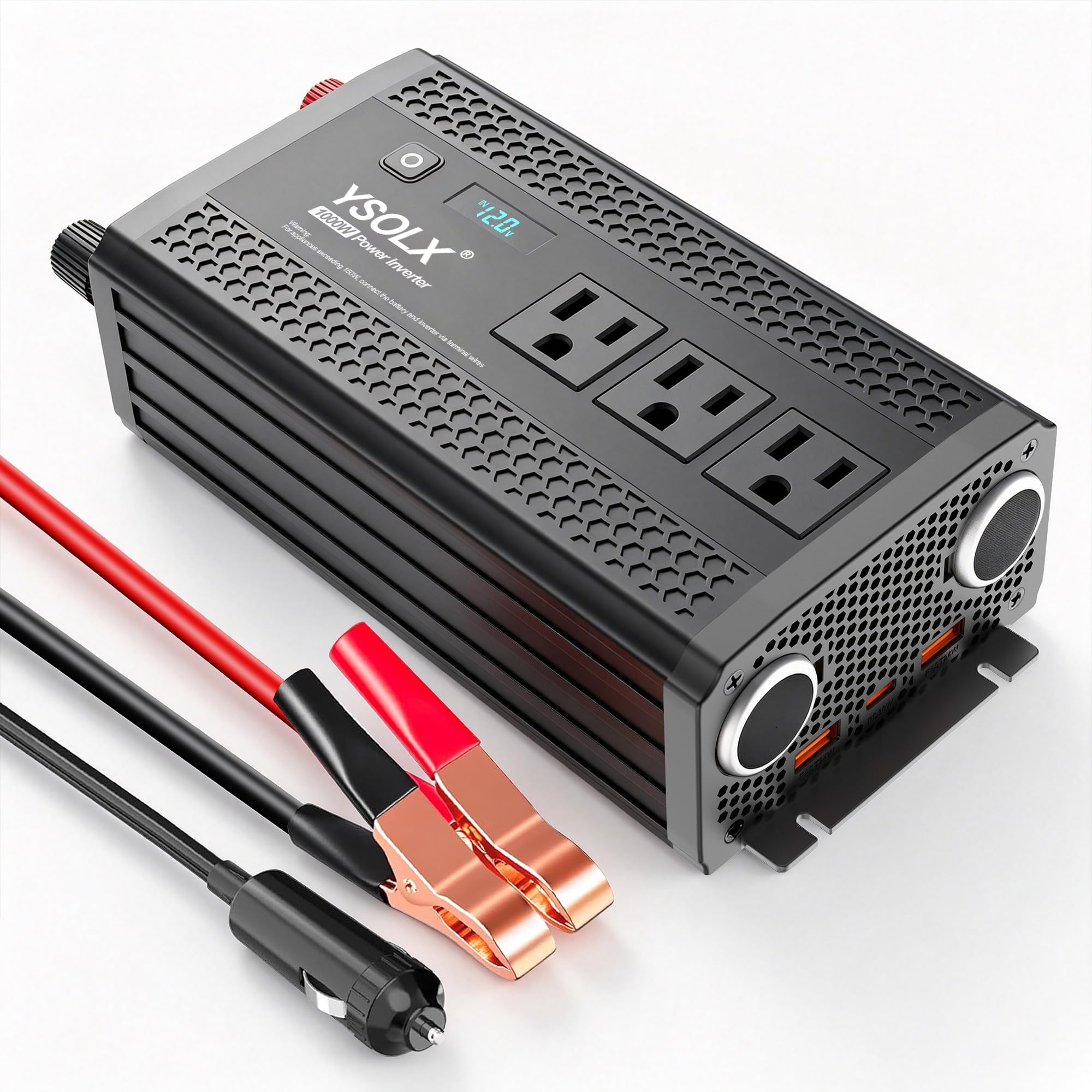
One 1000W box that runs your tools, charges your phone, and still keeps a 12V socket free.
Stepping up from the 500W crowd, this unit outputs a steady 1000W continuous with a 2000W peak surge for startup demands, built around premium high-frequency transformers and 100% pure copper cables. Where it truly stands out is port flexibility: it offers 3 AC outlets, 2 USB-A ports, a 30W USB-C PD port, and dual 12V car cigarette lighter sockets — so you can charge laptops and phones while still powering a fan or running a 12V accessory simultaneously.
The LED display shows real-time battery voltage, and built-in E1-E6 error codes (a set of fault alerts) flag undervoltage, overvoltage, overload, short-circuit, and overheat conditions the moment they appear. Customers note it meets expectations for performance, and one shared a remarkable scene: a family in Cuba has run three fans and charged up to three phones plus lamps off a 200-amp battery for over 24 hours straight, and it’s still going after a year of daily use. At just 1.5 pounds in a 7.4″L x 4.13″W x 2.32″H body, it’s remarkably light for the wattage.
Reliability, however, comes back mixed — the most-discussed aspect — with some owners reporting units that stopped working in under 10 uses or within six months. It’s worth reading that as a fit note: this modified sine wave unit is UL-certified and fine for laptops, power tools, and camping gear, but a desktop computer that won’t boot cleanly off it (as one 4-star owner found) points to the waveform limit. The silent cooling fan kicks on at 42℃ and shuts down at 38℃, keeping long sessions quiet while the flame-retardant casing handles the heat.
What stands out
- 1000W continuous with 2000W surge
- 3 AC + 2 USB-A USB-C 30W + dual 12V sockets
- Featherlight 1.5 lb body with silent cooling fan
Be aware
- Reliability is the top-cited aspect and reads mixed
- Modified sine wave won’t drive every desktop PC cleanly
Grab it for: RV camping or a truck bed where you need many outlets and very light weight at 1000W.
Think twice if: you expect years of daily off-grid duty — read the reliability pattern as “great while it works.”
5. LANDERPOW 1000W Pure Sine Wave Inverter
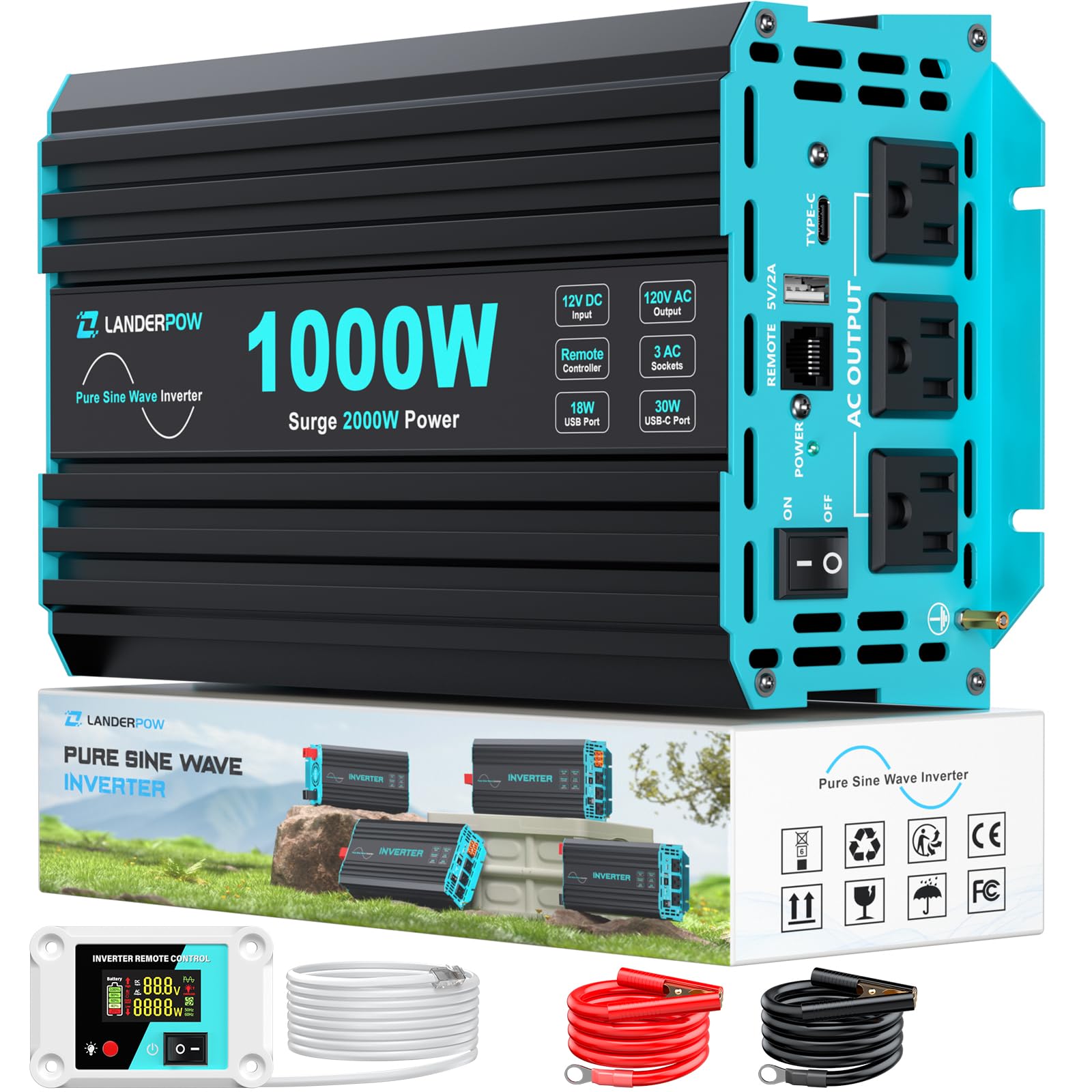
Grid-quality pure sine wave power you can switch off from 15 feet away — the right call for sensitive gear.
This is the first pure sine wave unit on the list, and that distinction matters: it delivers the same clean AC waveform as the grid at over 91% efficiency, so LEDs, laptops, CPAPs, and microwave ovens run without the hum, flicker, or heat stress that modified sine wave can cause. It provides 1000W continuous with a 2000W surge — the same steady output as the YSOLX above, but for gear that’s easily damaged by dirty power. It’s built to handle heavy startups from kettles and power tools.
The defining feature is the 15ft wired remote controller with its own smart LED screen, letting you track battery levels, output, and error codes from your truck cab or campsite, then shut down or restart with one touch. Owners consistently call out the remote and the quality of the build; what wins people over is the simple installation and quiet operation. The full metal heat-dissipating shell is meant to survive site falls and RV vibrations, and it ships with two 7AWG/2FT thickened battery cables that resist heating under load. The 3-year coverage breaks down as a 1-year no-hassle replacement plus 2-year extended support.
The honest catch: power output reads mixed in the owner feedback. Some find it very powerful, while others report it barely reaches 700 watts, and a couple of units failed early before the warranty process resolved things. Reliability and noise also sit in mixed territory — the fan and cooling behavior vary by unit. Two owners noted the included cables ran thin for heavy draws and upgraded to thicker 1AWG or 0AWG wiring for sustained 1300W loads.
Why it’s worth it
- Pure sine wave protects sensitive electronics
- 15ft wired remote with LED monitoring
- Rugged full metal shell with 3-year coverage
The honest limits
- Some reviewers point out output topping out near 700W
- Included 7AWG cables run hot for heavy sustained draws
Pick this for: CPAP users, laptop workers, and RV owners who need clean power for sensitive electronics and want remote control from the cab.
Look elsewhere if: you plan to push sustained loads past 700W — budget for thicker aftermarket cables.
6. TOPBULL 3000W Pure Sine Wave Inverter
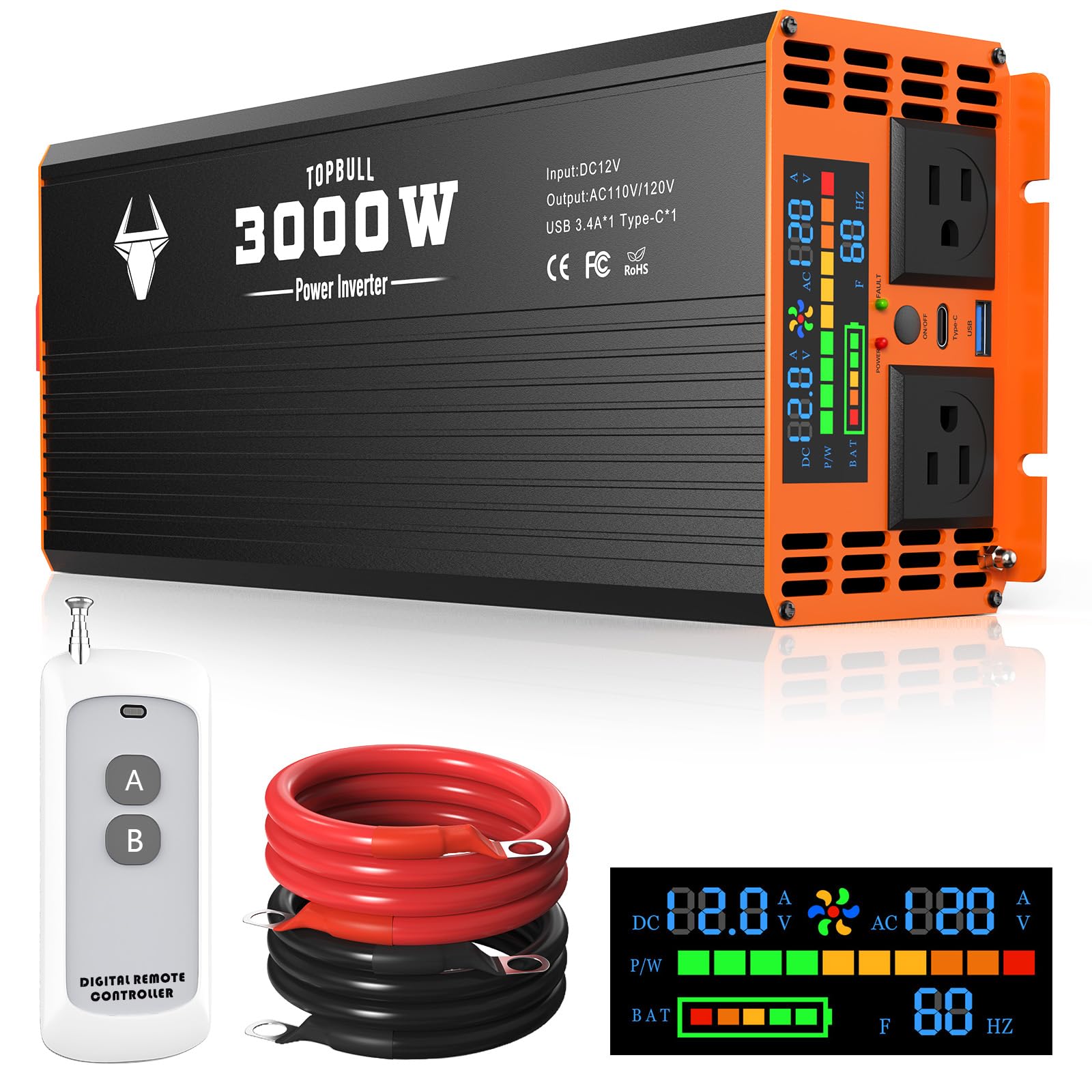
A 3000W pure sine wave powerhouse that runs appliances and tools — with a 200ft wireless remote.
When the job list includes ovens, refrigerators, air conditioners, and industrial tools, you need this class of machine. The TOPBULL delivers 3000W continuous output with peak power up to 6000W, converting 12V DC to 110/120V AC through high-quality pure copper components and an advanced IPM power management system (an intelligent power module that boosts efficiency) achieving over 93% conversion. Its two 20A/120V high-power AC outlets can feed serious current-hungry devices.
What owners rave about is the quality — the single most-praised aspect — alongside performance, with one running a 25-amp battery charger and another powering two laptops, a Starlink dish, and a fan simultaneously without breaking a sweat. The 200ft wireless remote offers one-button shutdown and restart, and the high-definition LED display shows remaining battery charge, output power, input voltage, fan status, and output frequency in real time. That remote-and-display combo is the reason it fits so neatly under truck seats for camper living, a use case owners highlight.
The design keeps noise down with dual silent smart fans and an tune heat-dissipation channel inside a corrosion-resistant, rust-proof thickened aluminum alloy housing. Ten layers of protection cover low voltage, high voltage, overload, short circuit, overheat, reverse connection, ground fault, overcurrent, earth leakage, and battery issues — the inverter cuts output the instant it detects an abnormality. Reliability does draw some mixed feedback, with a few owners reporting units that didn’t last, though the standout customer-service stories involve TOPBULL shipping replacement units quickly when LED displays failed.
The highlights
- 3000W continuous / 6000W peak pure sine wave
- 200ft wireless remote with full LED telemetry
- Ten-layer safety protection in an alloy housing
Consider
- A heavy investment suited to real off-grid or backup duty
- Some reliability complaints among the owner base
Best for: serious off-grid setups, RV living, or home backup where you need refrigerator-level appliances and industrial tools running clean and quiet.
Not for: occasional phone charging — a 400W unit does that at a fraction of the size and cost.
7. VOLTWORKS 2000W Pure Sine Wave Inverter
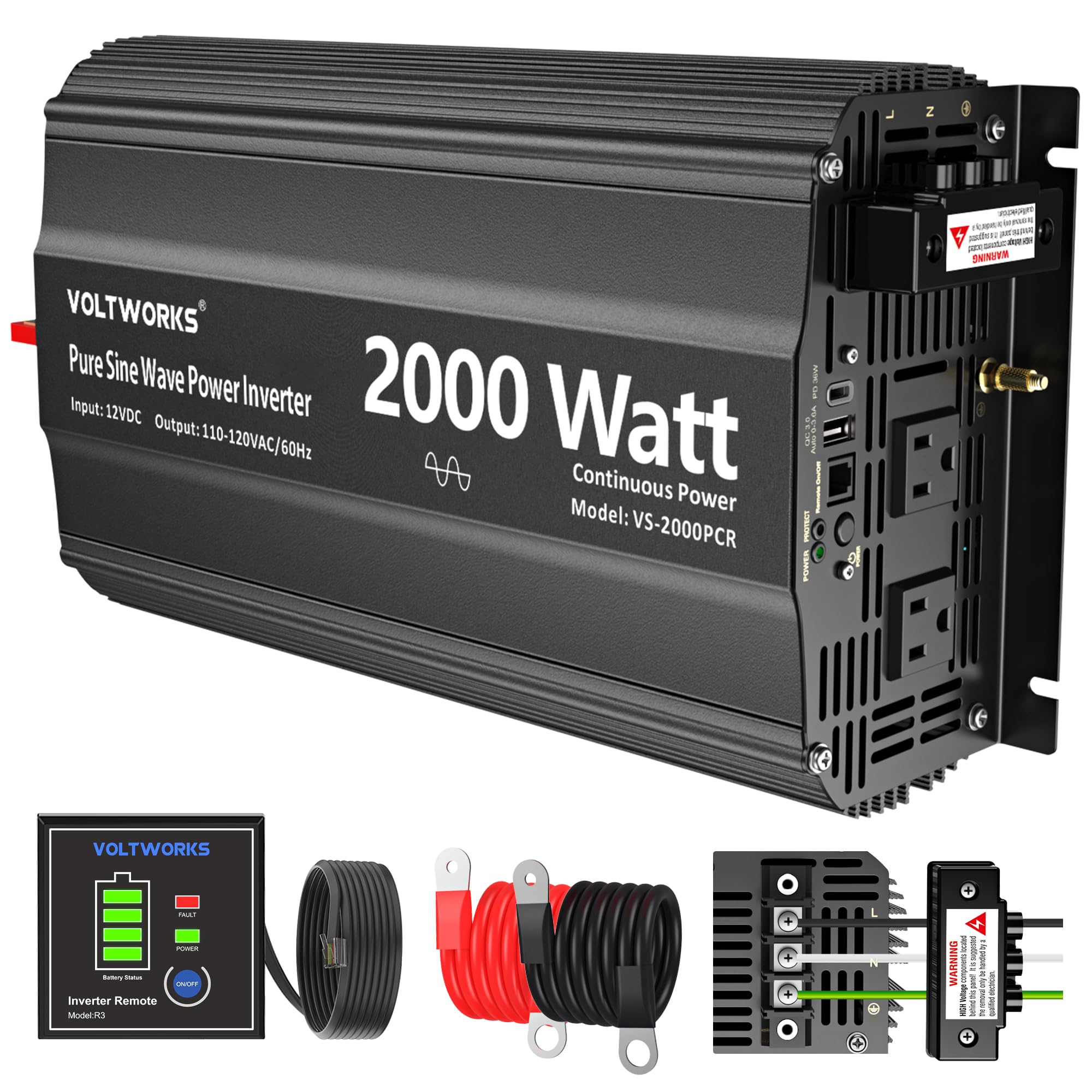
A true 2000W pure sine wave workhorse that hardwires into motorhomes and cabins with quiet confidence.
For anyone who owns a Class C motorhome, off-grid cabin, or truck that needs real AC power, this VOLTWORKS delivers a full 2000W continuous of pure sine wave output. It converts 12V DC to 110V-120V AC with conversion efficiency up to 90%, and comes with 2 AC outlets plus 40A AC terminal blocks and two fast-charging USB ports — including a 3.6A USB-A and a PD36W USB-C that charges noticeably faster than standard USB. Owners immediately compared it favorably to decade-old premium units, with one replacing a 10-year-old Samlex and reporting it holds 900W at 120V with ease.
The build quality gets consistent praise, and the quiet operation stands out — the internal cooling fan doesn’t spin at startup, only kicking in when the temperature reaches 104°F, which keeps no-load battery drain low. The 15ft remote controller uses an RJ10 4P4C connection (a small modular plug), and the listing even notes you can DIY longer cables. One motorhome owner hardwired it in and runs a 1100W coffee maker, fans, and a foot massager while driving, praising the supplied 5AWG cables for short runs and the responsive pre- and post-install support.
Performance is the most-praised aspect, and the noise level follows close behind as owners’ second favorite trait. But power output reads mixed — some report it handles the full 2000W, while others measured output around 102 volts. Reliability is also mixed, with some units failing within days, though the replacement process earned strong marks. At 15″L x 8″W x 3.9″H and 9.9 pounds, this is a substantial unit that needs reinforced mounting, and it comes with an 18-month warranty plus product liability insurance through AIG.
What impresses
- True 2000W continuous pure sine wave output
- Fan stays off until 104°F, saving battery
- Durable aluminum housing with 18-month warranty
What to weigh
- Large and heavy at 9.9 lb — needs solid mounting
- Mixed reports on exact output voltage
Best suited to: motorhome and cabin owners who want to hardwire clean 2000W power and don’t mind the bulk.
Reconsider if: you need portability — this one is built to be mounted, not tossed in a bag.
8. BELTTT 2000W Pure Sine Wave Inverter
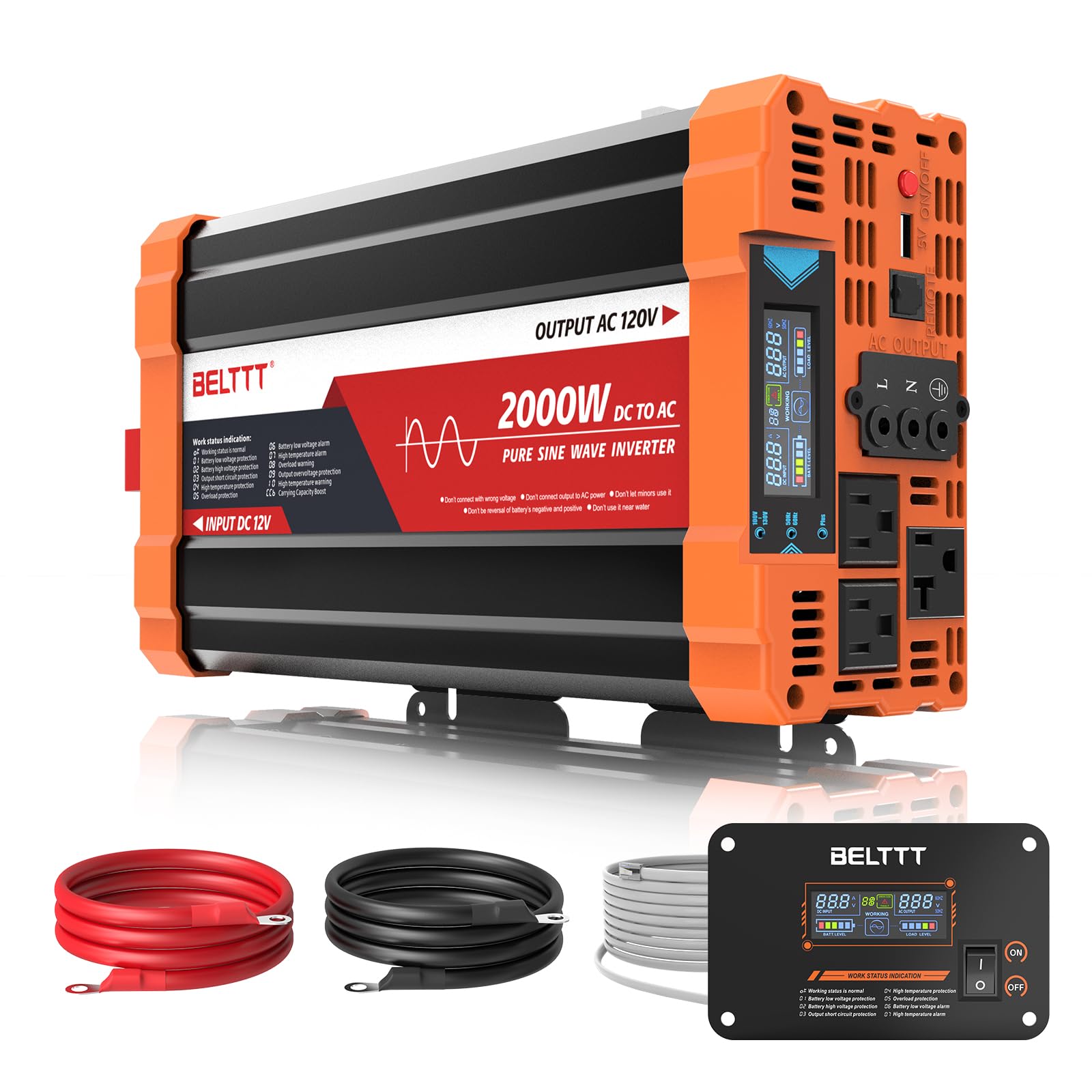
A 2000W pure sine wave unit with adjustable output voltage and a 23ft remote for hidden installs.
This BELTTT converter delivers 2000W of continuous battery power with up to 4000W of peak surge, and its claim to fame is efficiency: greater than 93% conversion during normal work with low no-load losses. The adjustable output voltage (100-130V in 5V steps, defaulting to 120V) is a rare feature owners actively praise, alongside the true sine wave output that eliminates ceiling-fan buzz.
The intelligent LCD display shows input and output voltages, plus battery and load status simultaneously, with fault codes for fast troubleshooting. It packs dual AC sockets, a 20A outlet, a 5V 2.1A USB port, a hardwire port, and a remote controller on a 23ft cable — making it ideal for off-grid, outdoors, RV, and truck setups. The remote reads via RJ-11 and shows clean data, and owners note the fans stay off below 450W at 85°F, spinning up quietly around 38dBA only when needed.
Solid build quality and straightforward installation get steady praise, and the cooling performance earns a thumbs-up for staying cool under load. One owner tested it hard at an 80A load on a 100Ah battery and found output rock-steady, and another powered a 15k Coleman A/C successfully. The most consistent complaint: the unit ships with 6 AWG battery cables instead of the advertised 2 AWG, with one owner calling that a fire hazard at full draw and upgrading to 2.0 AWG. Soldering the cable lugs rather than relying on the factory crimp is the fix owners recommend. Its graphical LCD shows a 5-segment bar graph for load rather than exact wattage, a small quibble for an otherwise strong performer backed by both UL and ETL certifications.
The strong points
- 93%+ efficiency with low idle draw
- Adjustable 100-130V output in 5V steps
- 23ft remote readout for hidden installs
The honest catch
- Ships with thinner 6 AWG cables — most upgrade to 2 AWG
- No exact watt/current readout, just a bar graph
Reach for this if: you run an off-grid system and want maximum battery efficiency with remote monitoring and adjustable line voltage.
Budget for: a set of proper 2 AWG battery cables right from the start — the included 6 AWG ones are the weak link.
Understanding the Specs
Continuous Wattage vs. Peak Surge
Continuous wattage is what the inverter can deliver steadily, hour after hour — this is the number to match against your device’s running draw. Peak surge is the short burst of extra power for the moment a motor, compressor, or fridge kicks on; that startup spike can be 2-3 times the running wattage. A 1000W unit with a 2000W surge handles a small fridge that pulls 600W running but spikes to 1500W at startup. Always size continuous output to your biggest load and surge to its startup moment.
Pure Sine Wave vs. Modified Sine Wave
Modified sine wave is the budget option — a stepped approximation of grid power that runs simple chargers, lights, and basic tools fine. Pure sine wave mirrors the grid’s smooth waveform, which matters for microprocessors, variable-speed motors, and audio/video gear. CPAP machines, laptops, induction cooktops, and home theaters can hum, run hot, or glitch on modified sine wave. If your most delicate device cost more than the inverter, pure sine wave is the safer bet.
FAQ
Can a battery power inverter run a refrigerator or microwave?
Why can’t I run high-power devices through the cigarette lighter socket?
What is the difference between pure sine wave and modified sine wave for my laptop or CPAP?
How many watts do I actually need?
Will a power inverter drain my car battery while the engine is off?
What does the surge power rating mean and why does it matter?
Is a modified sine wave inverter safe for a desktop computer?
What safety protections should I look for in a power inverter?
Can I charge my phone fast through an inverter’s USB ports?
What is the difference between the 400W, 1000W, and 3000W inverters on this list?
Final Thoughts: The Verdict
For most drivers and campers, the battery power inverter winner is the BESTEK 400W because it nails the everyday jobs — phone, tablet, and laptop charging with fast USB-C and dual AC outlets — in an iPhone-sized body backed by ETL certification and a 12-month warranty. If you need to watch your power and occasionally run a drill or grinder, the OLTEANP 500W adds a live LCD and 500W continuous output. And for off-grid living or home backup where appliances and sensitive electronics both come into play, the TOPBULL 3000W is the heavy-duty pure sine wave system to reach for.
How We Picked
We do not accept paid placement. Every pick is matched to a real buyer and a real use-case; we do not hands-on test units.
Sources & Methodology
Specifications: manufacturer listings and product documentation. Review insights: verified customer reviews, as of September 2026. Pricing: not shown on this page (it changes often); check the current price via the retailer link.
As an Amazon Associate, KitchPrep earns from qualifying purchases. This does not affect which products we feature.
Related Guides
