
Specs are compiled from manufacturer listings and verified buyer reviews and can change over time — please confirm the key details on the product page before buying.
Thin walls, hard floors, and bare ceilings turn a living room into an echo chamber. You hear your neighbor’s TV, your own footsteps sound hollow, and video calls pick up every background clatter. Acoustic insulation fixes that by absorbing sound energy instead of letting it ricochet around the room — and the right panels do it without making your space look like a recording booth. This guide separates echo-taming panels from decorative ones so you know what works for your room.
I’m Mohammad Maruf — the founder and writer behind KitchPrep. This guide is built by comparing the manufacturers’ published specifications and the patterns across verified customer reviews, so you get each pick’s real strengths and trade-offs instead of marketing spin.
Whether you’re silencing a home office, studio, or gaming den, the best acoustic insulation absorbs echo and reverb without demanding a full renovation.
Our Picks at a Glance

How To Choose The Best Acoustic Insulation
First-time buyers often confuse sound absorption with soundproofing. Acoustic panels absorb echo and reverb inside a room — they make sound clearer and quieter by stopping it from bouncing off hard surfaces. Soundproofing, on the other hand, means blocking sound from entering or leaving a room entirely, which requires dense, heavy materials and structural work. Almost every panel you can stick on a wall does the first job beautifully and none of them truly do the second.
Check the NRC rating before you commit
NRC stands for Noise Reduction Coefficient, a number between 0 and 1 that tells you what fraction of sound a panel absorbs. An NRC of 0.95 means it absorbs 95% of the sound that hits it — that’s the number to hunt for if your real goal is killing echo in a home theater or studio. Many budget foam tiles don’t publish an NRC at all, which is a clue that their absorption is modest. When two panels look identical but one lists an NRC and the other doesn’t, the rated one is almost always the better buy for acoustic performance.
Density and thickness drive real performance
Sound absorption comes from the material’s density and how much air is inside it. High-density polyester fiber panels, often made from recycled bottles, absorb far more sound per inch than lightweight, crumbly acoustic foam. This is why the TONOR panel on this list is a hefty 0.72 inches thick with a dual-layer structure, while many thin foam tiles measure just 0.4 inches. If you’re covering a wall to improve a recording or quiet a noisy room, thicker and denser always beats cheaper and thinner.
Quick Comparison
| Model | Best For | Material | Panel Size | Coverage | Amazon |
|---|---|---|---|---|---|
| NeatiEase Wood Slat Panels★ Best Overall | Decoration + echo control | MDF & Polyester | 96″ x 12.6″ | 33 sq. ft. | Amazon |
| Amantech Hexagon FoamStyle Pick | Budget wall coverage | Polyester Fiber | 12″ x 10.23″ | — | Amazon |
| Ekkogo Hexagon PanelsNRC Choice | Echo reduction in classrooms | Polyester Fiber | 12″ x 10″ | 0.83 sq. ft. ea. | Amazon |
| Dailycooper Y-Line Foam | Low-cost voice recording | Polyester | 12″ x 10″ | 7.5 sq. ft. | Amazon |
| 100 Pack Sound Foam | Bulk coverage on a budget | Foam | 12″ x 12″ | — | Amazon |
| TONOR Dual-Layer Panels | Neighbor noise & large walls | Polyester Fiber | 47.2″ x 23.6″ | 1104 sq. in. ea. | Amazon |
| AudioSilk ROOM KIT | Studio-grade treatment | Recycled PET | 45.7″ x 22.8″ | — | Amazon |
| Owens Corning 703 | DIY bass traps & panels | Fiberglass | 48″ x 24″ | 48 sq. ft. | Amazon |
| Art3d Wood Slat Panels | Walnut accent walls | Wood Laminate | 94.5″ x 7.9″ | 31.5 sq. ft. | Amazon |
In‑Depth Reviews
1. NeatiEase Wood Slat Wall Panels
Our pick — over 4.5★ from 550+ verified ratings; the strongest balance of quality and price.
The wood slat wall that quiets an echoey room while making it look expensively renovated.
Slat panels are the rare acoustic fix that doubles as a design statement. The Teak finish got more praise from owners than any other single feature — 115 of them singled out the appearance — and the reviews back that up, describing the color as “modern,” “elegant,” and giving rooms a “luxury look.” Buyers report hanging these on a basement wall and having it “transformed” the space, with one noting the panels reduced the echo in an echoey room noticeably.
The kit is built around four slats measuring 96″ x 12.6″, which together cover about 33 sq. ft. of wall. Each panel is made of MDF with a high-density polyester fiber backing, so it pulls double duty as decor and sound absorption. The polyester felt layer is the part doing the acoustic work, cutting down on echo while the wood slats reflect a bit of sound for a lively, natural tone. You mount them with screws or superglue, and owners confirm they handle uneven walls well with drywall screws.
Cutting the panels with a saw throws up dust, so take that job outside or mask up — several owners flagged that after a smooth, chip-free cut. A small number also noted a strong initial odor that lingers for a while. If your priority is a wall that looks intentional rather than a grid of gray foam, this set blends acoustic value with showroom looks better than anything else in this lineup.
Why it wins the wall: Appearance is the dominant reason owners buy, but the sound absorption is real — it’s the only pick here that delivers genuine echo control and a complete visual upgrade in one package.
Reach for this if: you want acoustic treatment that looks like high-end interior design and covers a wide area fast.
Look elsewhere if: you hate the idea of sawing panels to fit and just want peel-and-stick tiles.
2. Amantech 12-Pack Hexagon Foam Panels
A honeycomb wall pattern that reads as modern art while taming background echo.
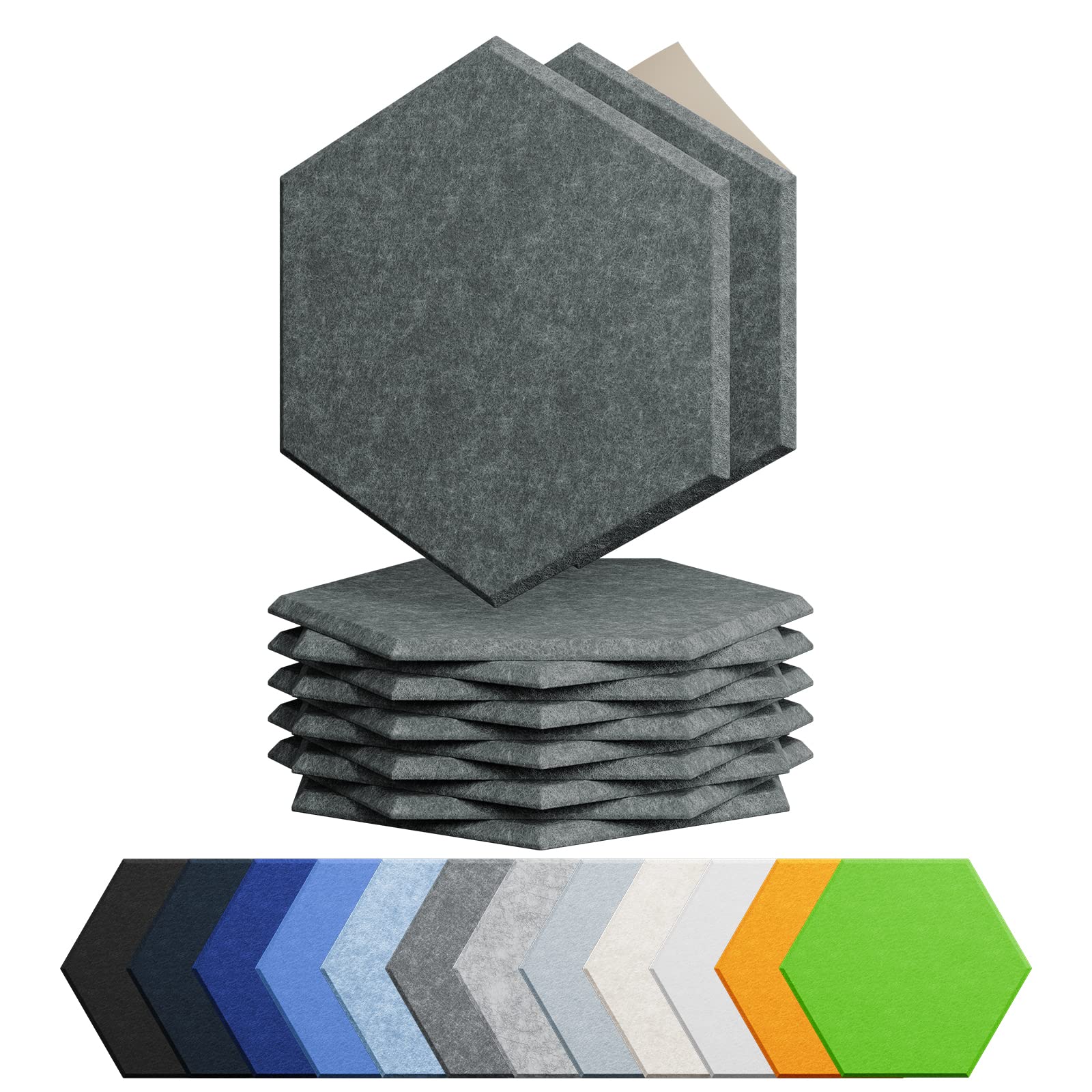
These hexagons are the pick for anyone who wants acoustic panels that look like a deliberate design choice, not a patch of foam. The “Moonlight Gray” color and hexagonal shape let you build a striking geometric feature wall, and owners mention the color matches the listing photos accurately. The price makes it easy to buy several packs and cover a wide area without guilt.
Each tile measures 12″ x 10.23″ and is made of polyester fiber with a peel-and-stick adhesive back. Customers note that installation takes seconds and that they deliver a “noticeable improvement” in buffering exterior sound. A band practice room, a noisy fridge, and a home office wall are all scenarios where owners said these helped noticeably.
The honesty here is refreshing: owners explicitly note these absorb echo and don’t claim to block sound coming through a wall. The adhesive is the weak spot — roughly half the owners discussing it say the stick is strong, while others report tiles peeling off over time. Treat the backing as a starting point and add a few extra adhesive dots if you’re mounting them long-term.
What wins owners over
- Looks genuinely stylish — the geometric layout gets compliments, not stares.
- Truly effective at absorbing echo and reverb, not just decor.
- Peel-and-stick install with no tools in minutes per tile.
The honest trade-offs
- Adhesive strength is inconsistent; some tiles eventually sag.
- Thin 0.4-inch profile limits how much low-end sound it can absorb.
Best for: a trendy, affordable wall treatment that noticeably tightens up echo in a bedroom, office, or game room.
The catch: if you expect these to block a loud neighbor’s noise, you’ll be disappointed — they’re echo absorbers, not sound barriers.
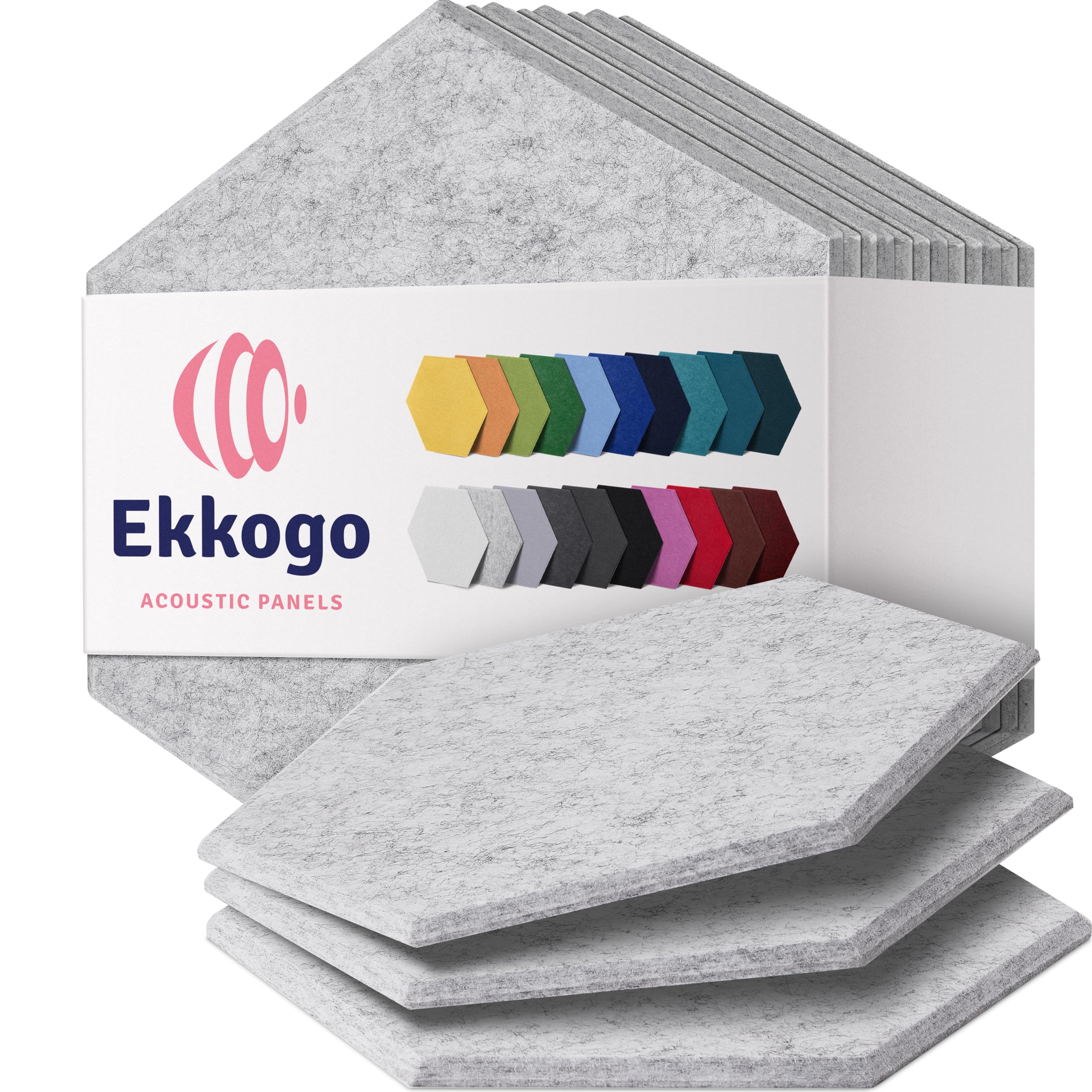
3. Ekkogo 12-Pack Hexagon Acoustic Panels
A rare budget panel that publishes a real NRC rating — and it’s an impressive one.
Most budget foam tiles quietly avoid publishing an NRC rating. Ekkogo doesn’t: these hexagons are rated up to 0.95, meaning they absorb up to 95% of the sound that hits them. That’s a genuinely strong number for the price and explains why a classroom teacher reported the panels “cut down the echoing so much” in a room with high ceilings that bounced noise everywhere.
Each tile measures 12″ x 10″ x 0.4″ and is precision-cut from high-density poly-fiber at 5.9oz/ft². The material is odorless, formaldehyde-free, and flame retardant, and each panel contains the equivalent of four recycled water bottles pulled from the ocean. For a home office or podcast setup, this ticks the eco box without sacrificing performance.
The biggest setup surprise is that no adhesive is included — you’ll need construction adhesive or strong double-sided tape applied to each corner. Owners who used heavy-duty tape reported the panels “stay put.” Sound absorption results are genuinely mixed in reviews: plenty of owners saw echo vanish, but a smaller group found little change, often after covering a large wall. This is a panel that rewards proper coverage — a few tiles scattered on one wall won’t do much.
Performance-proofed: The published NRC of 0.95 puts this in a different league from unrated foam, and owners confirm real echo reduction when coverage is adequate.
Installation reality: Bring your own adhesive — there’s none in the box.
Choose this if: you want budget-priced absorption with a published performance spec and don’t mind supplying your own tape or glue.
Pass if: you want a pure peel-and-stick solution with zero extra shopping.
4. Dailycooper 12-Pack Y-Line Acoustic Panels

A denser-than-usual foam panel that punches above its weight in a home studio.
These Y-line panels are denser than most foam competitors at 9.4 lb/ft³, boosting absorption. That extra heft translates to better absorption of echo, reverb, and flutter echo — the rapid-fire reflections that muddy voice recordings. Owners building out home studios report that adding these panels made their recordings noticeably clearer by cutting background echo.
Each tile is 12″ x 10″ x 0.4″, and the pack covers roughly 7.5 square feet total. The black finish with a beveled edge reads as clean and professional, and owners found the color accurate to the listing. The Y-lined surface pattern is the acoustic element here — the ridges give sound waves more surface area to hit and get absorbed.
Home studio owners highlight one clear win: better recordings with fewer echoes. One owner even used a level to line up a flexible, creative layout and confirmed the panels cut background noise for crisper audio. The panels are easy to trim with a knife for custom designs, and the built-in self-adhesive backing means no extra tape or glue.
What makes it a studio pick
- High 9.4 lb/ft³ density absorbs more sound per panel than typical foam.
- Self-adhesive back simplifies the install — no tools required.
- Color accurate and easy to arrange into a clean, professional layout.
Where it sits short
- Total coverage of 7.5 sq. ft. means you’ll need multiple packs for a whole wall.
- Lightweight material won’t isolate sound, only absorb room echo.
Grab this for: a small studio, vocal booth, or office corner where you need real echo control without a big install project.
Think twice if: you’re covering a large open room — the coverage per box is modest.
5. 100-Pack 12″x12″ Sound Proof Foam Panels

One hundred tiles that can wallpaper an entire room’s echo for less than a single premium panel.
This is the volume play — 100 panels measuring 12″ x 12″ each, designed to cover every reflective surface in a room that’s driving you mad. When sound absorption is about total surface coverage, a full wall of these tiles will do more for echo than a few premium panels ever could. One owner tiled their bedroom windows with two layers and reported a huge reduction in street traffic noise — a night-and-day difference — while another cut their son’s gaming noise dramatically.
The panels expand to full size within about 48 hours of unpacking. The pack ships with 250 pieces of double-sided tape, which is about five stickers per panel. That’s a useful guideline if you’re planning a full-wall install: budget for extra tape if you want more holding power per tile.
A few honest notes from the review floor: the material smells a bit funny for the first week, and a couple of owners found the ultra-strong adhesive painful to remove if they ever wanted to reposition a tile. The adhesive that’s built into the foam is aggressive — it holds well but can tear the foam if you try to pull a tile off. This is a buy-and-commit product, not a rental-friendly option.
Bulk-value verdict: For the cost of one premium panel set, you can treat an entire room — and owners confirm that broad coverage genuinely cuts echo and outside noise.
Realistic expectation: these are thin foam tiles; they absorb mid and high frequencies well but won’t block bass or stop sound leaving the room.
Pick this if: you have a large wall or ceiling to cover on a strict budget and want maximum square footage per dollar.
skip it if: you want a clean, finished look — these read as functional studio foam, not decor.
6. TONOR Dual-Layer Acoustic Wall Panels

Big, thick, felt-like panels that make a serious dent in neighbor noise without wrecking your decor.
At 0.72 inches thick, these panels are nearly double the thickness of standard foam tiles. Each measures 47.2″ x 23.6″ x 0.72″ with a dual-layer structure that disperses echo more effectively than a single thin layer. Owners in thin-walled apartments report these muffled loud neighbors and bass significantly, restoring some peace. The size means you cover a lot of wall per panel — four panels span a generous area with a clean, felt-textured finish in white or gray.
The self-adhesive backing is genuinely strong, which is a relief after testing peel-and-stick foam that sags. Owners described the install as simple — peel and stick — and the material as dense and durable. The classic stripe pattern on the surface doubles as decor, so it blends into a living room or bedroom rather than screaming “recording studio.” Owners say the finished wall looks like felt, which is exactly the soft, modern aesthetic these were designed for.
The honest math on performance: owners call it a solid noise reducer, not a soundproofing miracle. One owner measured a 50% reduction in noise from a washer, dryer, and furnace after covering the wall., and noted the panels need near-full coverage to reach their best. The felt surface is tough and cuttable, and the stick is strong enough to handle the weight of the panel — just make sure your wall is clean before you press them on.
Why owners recommend it
- 0.72-inch dual-layer thickness absorbs far more than thin 0.4-inch foam.
- Perforated stripe pattern looks like high-end felt wall treatment.
- Strong self-adhesive backing holds dense panels securely.
Watch out for
- Seams between panels are visible up close; full-wall coverage looks best.
- Substantial panels are heavier to maneuver during install.
Best for: apartments or rooms where loud neighbors bleed through and you want thick, furniture-grade absorption that looks intentional.
Not for: tiny accent patches — these need broad coverage to work their magic.
7. AudioSilk 4-Panel ROOM KIT

Studio-grade sound treatment that outperforms foam at half the thickness and looks the part.
When recording is the goal, this is the panel serious home-studio owners turn to. Each panel carries an NRC of up to 0.91 and is made from post-consumer recycled PET — the same dense felt-like material used in pro studios. Reviewers point out it effectively reduces vocal harshness, tightens up the sound, and shortens reverb. The key insight from reviews: these outperform acoustic foam at roughly half the thickness, which matters when you’re trying to treat a room without eating up floor space.
The ROOM KIT ships four panels sized 45.7″ x 22.8″ with a clean, modern flat-pack look. They mount using removable sticky strips sold separately — owners recommend four Command strips per panel — making this a rental-friendly choice. The panels are held in place with Command strips or nano tape, and removal leaves no marks, which is a major selling point for anyone living in an apartment. AudioSilk also throws in free acoustic treatment advice, including how to measure room performance and where to place panels.
The biggest surprise for owners is how thin these panels are — they feel almost fragile and can risk bending if handled roughly. That’s the trade-off for a panel that outperforms thicker foam. They’re also designed for echo and reverb treatment inside a room, not for stopping neighbor noise traveling through walls. If you’re tracking vocals or mixing music and want cleaner audio, this is the pick; if you want to silence a neighbor’s TV, look to the thicker TONOR panels above.
The studio verdict: Owners consistently call this a value buy that beats pricier high-end panels, tightening room sound and cutting reflections for home audio.
Handle with care: the thin, lightweight build needs gentle handling and a wall-mounted hanging method.
For the recording-minded: if you make music, podcasts, or videos and want pro-grade echo control on a budget, start here.
Not for isolating noise: these won’t stop sound from passing between rooms.
8. Owens Corning 703 Fiberglass Boards

The legendary raw acoustic board that pro studios build their panels from — if you’re willing to DIY.
This is the material that serious acoustic treatment is actually made of. Owens Corning 703 is a semi-rigid fiberglass board used by professional studios, and it holds a Noise Reduction Coefficient of 1.0 — a perfect score meaning it absorbs essentially all sound that hits it. Owners building their own home theater panels report this outperforms foam alternatives significantly, making drums sound natural and killing first-reflection noise. The crowd consensus is that it performs better than pricier alternatives like Auralex foam.
Each pack contains six boards measuring 24″ x 48″ x 2″ thick, covering 48 square feet of material. The thickness is what separates it: at 2 inches, it absorbs far deeper into the frequency range than any 0.4-inch foam tile, catching the low-mids that make rooms sound boxy. It’s also a thermal insulator with an R-Value of 8.7, so it reduces heat transfer too. The boards are certified to contain an average of 53% recycled glass content and carry a Class 1 fire rating per ASTM E84.
This is a DIY product through and through — owners frame the boards with wood and wrap them in fabric to make finished-looking panels. The bare fiberglass is messy and requires protective gear — gloves, long sleeves, and a mask while cutting. It also isn’t something you’d leave exposed on a living room wall. For a home theater or studio build where maximum absorption matters and you’re happy to do some woodwork, this is the most effective material in this lineup.
Why it’s the pro’s pick
- Perfect NRC of 1.0 — the highest absorption rating possible.
- 2-inch thickness absorbs low-mid frequencies thin foam can’t touch.
- Cost-effective raw material for building multiple DIY panels.
Real DIY demands
- Messy fiberglass fibers require gloves, a mask, and careful handling while cutting.
- Bare boards are ugly — frame and wrap them in fabric for a finished look.
Choose this for: a home theater or recording project where maximum absorption is the only goal and you’re comfortable building frames.
Avoid if: you want an out-of-the-box panel you can stick on a wall in minutes.
9. Art3d 6-Pack Wood Slat Panels
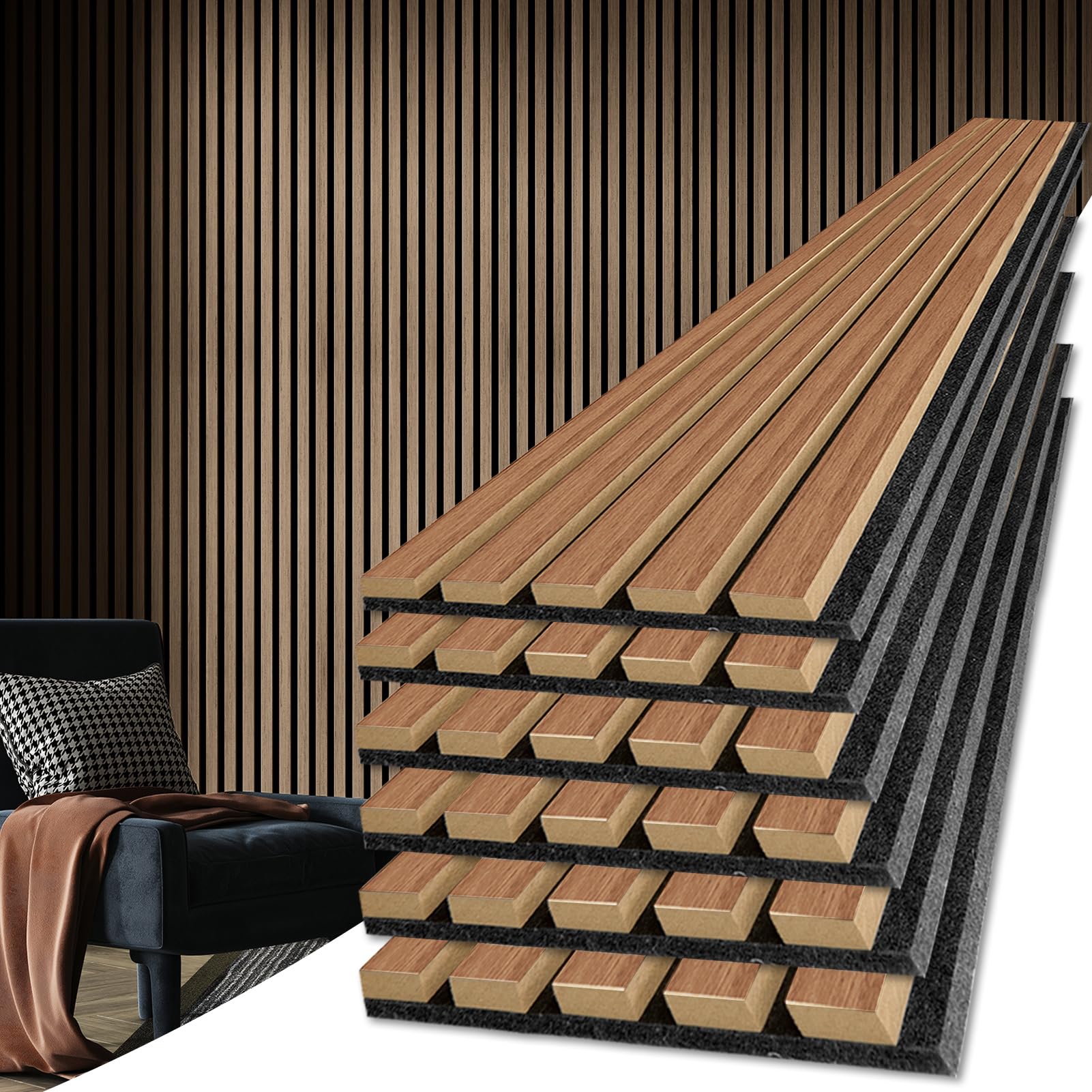
The fluted walnut wall that transforms a plain room into a designer space while absorbing its echo.
Art3d’s fluted panels are the crowd-pleasing upgrade for someone who wants the acoustic benefit of wood slats plus the warm, natural look of walnut. Owners are split between loving the finish and loving the silence — the two most-praised aspects are quality and appearance, with over 150 owners singling out each. One owner used them to transform a bathroom, another built a hidden closet door, and a third created a cozy, noise-reduced accent wall they called “worth it.”
The kit ships six fluted slats, each measuring 94.5″ x 7.9″, covering roughly 31.5 square feet total. The panels pair a quality MDF core with high-density polyester fiber, which does the sound-absorbing work — one owner noted the thick polyester backing reduced echo significantly. The 94.5-inch length reaches floor-to-ceiling on standard walls, giving a clean, continuous architectural look that’s hard to achieve with hexagon tiles.
Creative DIYers will find these easy to work with, but there are setup details worth knowing. Owners recommend sanding edges after cutting, since the cut edges can be sharp. One creative builder suggests using Liquid Nails rather than wood glue for trim work. The panels mount to walls with basic tools and screws in a short time, and owners confirm they hang easily. If you want a statement wall that also tightens up room acoustics, this delivers designer results.
The decor-first verdict: Quality and walnut appearance dominate owner praise, with genuinely thick polyester backing doing real echo reduction — a rare blend of form and function.
Budget reality: multiple packs add up fast if you’re covering a full room, so measure carefully first.
Ideal for: a feature wall in a living room, bedroom, or entryway where the look matters as much as the quiet.
Consider twice if: you’re covering a large open space on a tight budget — the per-panel cost is higher than foam alternatives.
Understanding the Specs
NRC (Noise Reduction Coefficient)
NRC is the single most important spec in acoustic insulation. It’s a number between 0 and 1 that represents what fraction of sound energy a material absorbs rather than reflects. An NRC of 0.95 means 95% of sound hitting the panel gets absorbed. For echo control, you want a panel with a published NRC of 0.85 or higher. Panels that don’t list one — many budget foams — likely have modest absorption numbers they’d rather not print.
Density and Panel Thickness
An acoustic panel’s density is the mass of material packed into each cubic foot. Higher density means more sound energy is converted to heat as waves pass through the material. Look for panels advertising their weight per cubic foot — the Dailycooper foam at 9.4 lb/ft³ is meaningfully denser than generic foam. Thickness matters even more: a 2-inch fiberglass board absorbs far deeper frequencies than a 0.4-inch tile, which is why Owens Corning’s 2-inch boards are a studio staple.
FAQ
What is the difference between acoustic insulation and soundproofing?
How many acoustic panels do I need for a room?
Do acoustic panels block noise from my neighbors?
What does NRC 0.95 actually mean?
Is wood slat paneling actually good for acoustics?
Which is better for a home studio: polyester fiber panels or acoustic foam?
Do peel-and-stick acoustic panels damage walls when removed?
How do I cut acoustic panels to fit my wall?
Will thicker acoustic panels always perform better?
Final Thoughts: The Verdict
For most people, the acoustic insulation winner is the NeatiEase Wood Slat Panels because they deliver real echo control from dense polyester fiber while also giving you a designer wood wall — two wins from one install. If you want the thickest, most effective echo killer that still looks like furniture, grab the TONOR dual-layer set and cover a full wall. And for a recording studio or critical listening room where maximum absorption is the only priority, the Owens Corning 703 boards remain the proven professional choice, and the crowd — 4.7 stars across hundreds of owners — confirms that performance..
How We Picked
We do not accept paid placement. Every pick is matched to a real buyer and a real use-case; we do not hands-on test units.
Sources & Methodology
Specifications: manufacturer listings and product documentation. Review insights: verified customer reviews, as of September 2026. Pricing: not shown on this page (it changes often); check the current price via the retailer link.
As an Amazon Associate, KitchPrep earns from qualifying purchases. This does not affect which products we feature.
Related Guides
