
Specs are compiled from manufacturer listings and verified buyer reviews and can change over time — please confirm the key details on the product page before buying.
Before you pick a heavy-duty bench vise, think about how much force your workbench can handle. You need a tool that grips steel pipe, flat stock, or a welding table without flexing or slipping under heavy torque. Your choice depends on jaw width, clamping strength, and how the swivel base behaves mid-project.
I’m Mohammad Maruf — the founder and writer behind KitchPrep. This guide is built by comparing the manufacturers’ published specifications and the patterns across verified customer reviews, so you get each pick’s real strengths and trade-offs instead of marketing spin.
The best heavy-duty bench vise should hold your work firmly without flexing, so you can cut, grind, and tap with confidence on a stable platform.
Our Picks at a Glance

How To Choose The Best Heavy-Duty Bench Vise
Before you commit to a model, focus on the three things that decide whether a vise earns its spot on your bench: the metal it is cast from, how wide it opens, and how freely it rotates.
Material: Ductile Iron vs. Austempered Ductile Iron
Ductile iron strikes the right balance between strength and toughness for most workshop work. Austempered ductile iron is a heat-treated version that delivers significantly higher tensile strength, so it holds up better under repeated heavy impacts without cracking.
Jaw Width and Throat Depth
The jaw width sets the largest flat piece you can grip between the faces, while throat depth measures how far a workpiece can reach into the jaws. A deeper throat means you can hold material farther from the edge of the jaw, which helps when filing or sawing near the clamped area.
Swivel Base Range and Locking
A 360-degree swivel base lets you rotate the vise to face any direction, while a more limited range like 210 degrees may be enough if you have a dedicated bench position. Interlocking bases with lockdowns hold position more firmly than simple friction designs under heavy loads.
Quick Comparison
| Model | Best For | Jaw Width | Jaw Opening | Body Material | Amazon |
|---|---|---|---|---|---|
| Forward CR60A★ Best Overall | Overall value and strength | 6.5″ | 6″ | Ductile Iron | Amazon |
| IRWIN 4935505Proven Performer | Proven long-term durability | 5″ | — | Cast Iron | Amazon |
| Yost 750-DIMost Versatile | Multi-jaw versatility | 5″ | — | Ductile Iron | Amazon |
| COGNATIVE 6″ 360° | High clamping force | 6″ | 6.1″ | Ductile Iron | Amazon |
| VEVOR 6.5″ | Budget-friendly utility | 6.57″ | 6.5″ | Ductile Iron | Amazon |
| Forward CR80A | Maximum jaw capacity | 8″ | 9″ | Ductile Iron | Amazon |
| Yost ADI-6 | Professional-grade strength | 6″ | — | Austempered Ductile Iron | Amazon |
| Wilton 650P | Premium multipurpose work | 6.5″ | 6.25″ | Cast Iron, Ductile Iron | Amazon |
In-Depth Reviews
1. Forward CR60A 6.5 Inch Bench Vise
Our pick — over 4.5★ from 950+ verified ratings; the strongest balance of quality and price.
The 40-pound-class workhorse that earns “best bang for buck” praise from garage tinkerers.
This is the vise most owners describe as the smartest DIY purchase for a home workshop because it blends a wide grip with serious holding power. The 6.5-inch jaws open to 6 inches and are cast from 60,000 PSI ductile iron, which resists cracking better than standard cast iron under heavy use.
Beyond the flat jaws, you get two replaceable sets plus built-in pipe jaws that clamp round stock from 1/2-inch to 3 1/2-inch. The 210-degree swivel base gives you a wide range of positioning without a full circle, and the reinforced anvil surface measures 3.1 x 2.9 inches for light forming and tapping. Its 9,900-pound tensile rating keeps the jaws locked tight under demanding loads.
Buyers report the greyish-bluish powder coat finish looks industrial and the operation feels flawless right from the start, with some noting it has survived months of field use without issue. The main caveat is that it ships without mounting fasteners, so you will need your own bolts sized to your bench.
What wins owners over
- Quality construction is the most-cited praise, with a 9900-pound tensile rating backing the feel
- Sturdiness earns strong word of mouth — the heavy ductile iron body stays planted
- Built-in pipe jaws handle round stock from 1/2″ to 3 1/2″ without extra parts
What to plan around
- Comes with no mounting fasteners, so budget for your own bolts
- Some owners find the handle action slightly stiff until it wears in
The crowd favorite: if you want one solid, versatile vise for a garage or workshop, this is the one to reach for.
Think twice if: you need a full 360-degree rotation — this base stops at 210 degrees.
2. IRWIN Tools Multi-Purpose Bench Vise, 5-Inch
A 33.1-pound cast iron legend that shrugs off a decade of abuse and still asks for more.
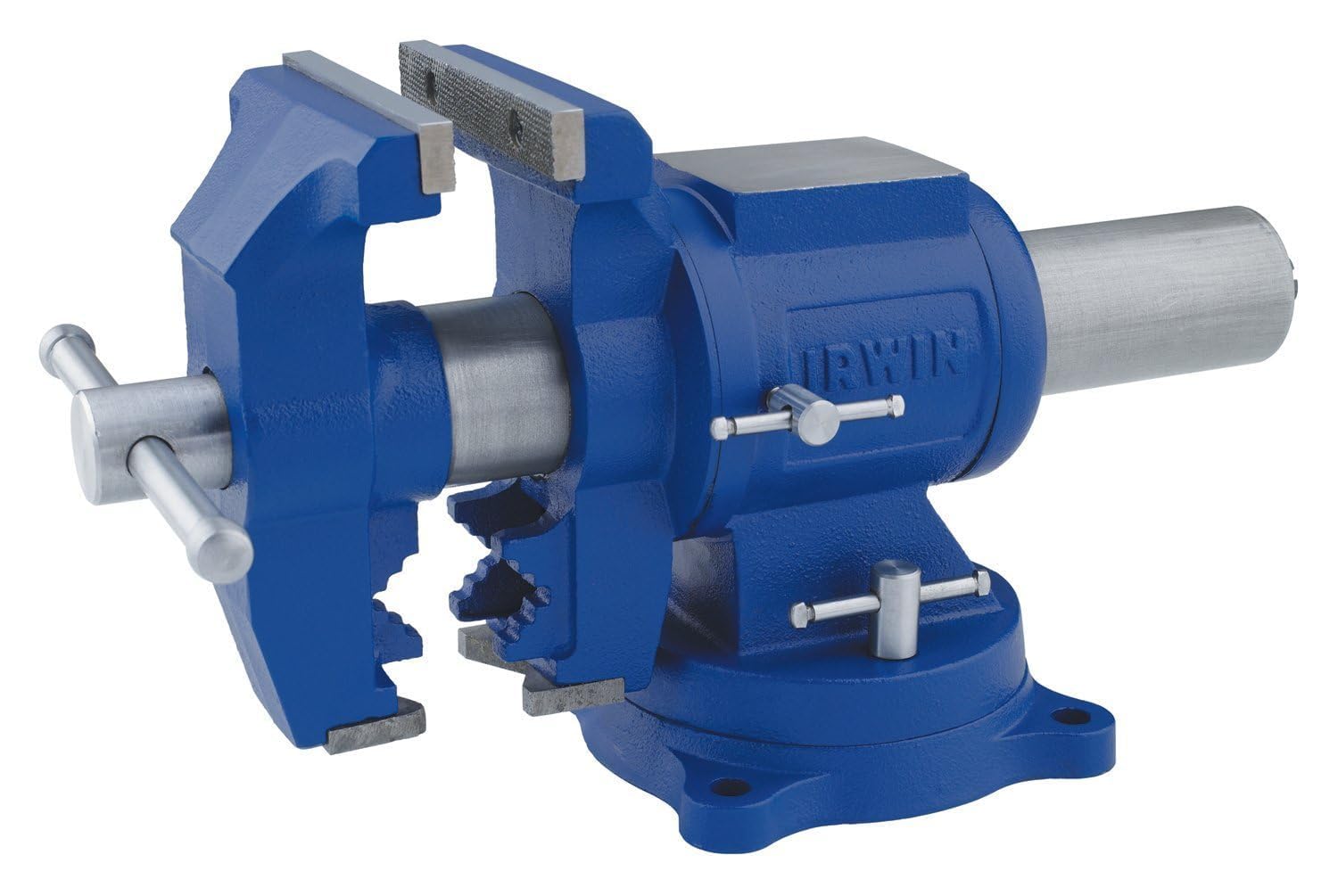
This is the vise owners describe as a “good vise for my shop at home” that has survived roughly ten years of heavy use, including cheater-pipe leverage that would bend lesser tools. Its 5-inch jaws sit on a 33.1-pound cast iron body that stays planted during aggressive filing and sawing. Owners mention the fused steel handle makes adjustments feel easy, and the swivel base rotates a full 360 degrees for total positioning freedom.
The rotating pipe jaws add real versatility for holding round stock, and the incorporated anvil keeps the whole assembly steady while you work. Owners note the jaw alignment stays true even after years of service, which matters for precise clamping. Compared to the Forward CR60A above, this IRWIN is slightly smaller in jaw width, but it carries a heavier body that some owners prefer for raw heft.
One owner received a unit with a damaged rotation lock, but the replacement process was smooth and issue-free. The deeper caveat is that the pipe clamping depth is limited by the cast jaws, and the machined steel jaws are shallow, so very thick round stock can be awkward to seat fully.
Built to outlast trends: the quality and value-for-money reputation here rests on a decade of reported heavy use that includes the kind of abuse most vises would not survive.
Honest limits: the 5-inch jaw width caps the largest flat workpieces you can grip compared to the 6.5-inch Forward above.
Reach for this if: you want a durable home-shop vise with a track record measured in years, not months.
Look elsewhere if: you routinely clamp oversized flat stock that demands a wider jaw face.
3. Yost Vises 750-DI Multi-Jaw Rotating Vise System
A 27-kilogram gripping beast with three jaw sets that rotates on two axes for total access.
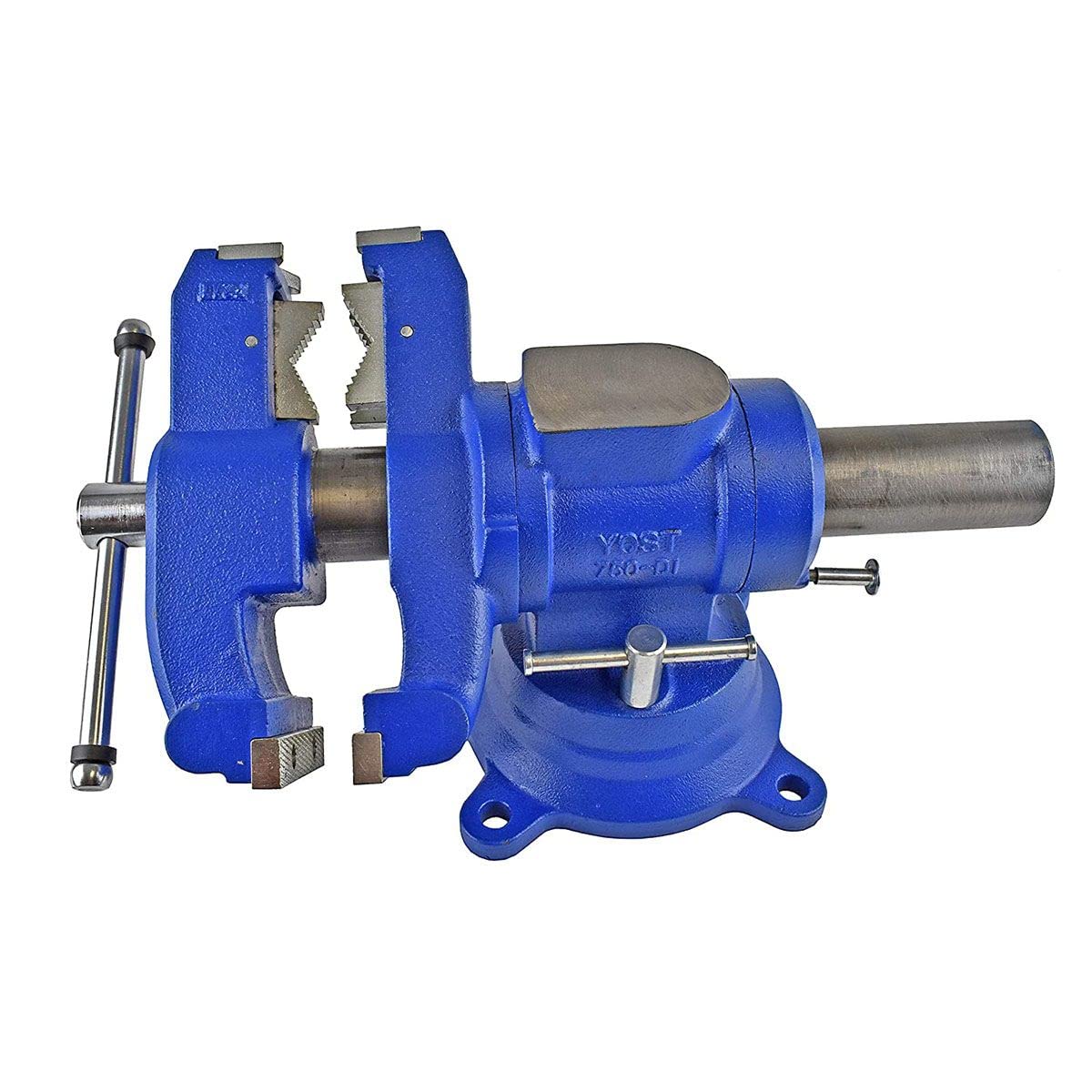
This Yost stands apart because it gives you three replaceable jaw sets — serrated, pipe, and V-jaws — within a single 65,000 PSI ductile iron body. That means you can switch from flat stock to round pipe to vertical rods without changing tools, and the large anvil surface handles light forming work. The dual-jaw design is what owners call the most versatile configuration they have used in this class.
The Yost 750-DI stands out for its two-axis rotation. The vise body spins 360 degrees on an interlocking V-grooved swivel base (a base with matching grooves that lock together), while the head rotates a full 360 degrees with locking at every 30 degrees, giving you 12 distinct head positions. Customers note the jaws align perfectly and the screw action is smooth, holding steel tubing and wood alike without slipping under heavy torque. The anvil even takes sledgehammer hits without complaint.
The honest trade-off is that the swivel mechanism only engages when the jaws are open, so you must loosen your workpiece before repositioning the head. Some owners also note the handle sits close to the head, which can limit leverage on very tight clamps, and they advise against cheater pipes on the handle to avoid over-stressing the internal screw.
Why it earns the versatility crown
- Three replaceable jaw sets handle flat, round, and vertical stock
- Dual 360-degree rotation on base and head reaches any angle
- Reviewers point out an anvil that absorbs sledgehammer strikes
The catches to know
- Head rotation only works when the jaws are open, so you must unclamp first
- Handle placement near the head limits leverage for final tightening
Best if: you juggle many material shapes and want one vise that adapts instead of buying dedicated tools.
Not ideal if: you rarely change angles mid-project and just need simple, brute clamping force.
4. COGNATIVE 6″ 360° Ductile Iron Bench Vise
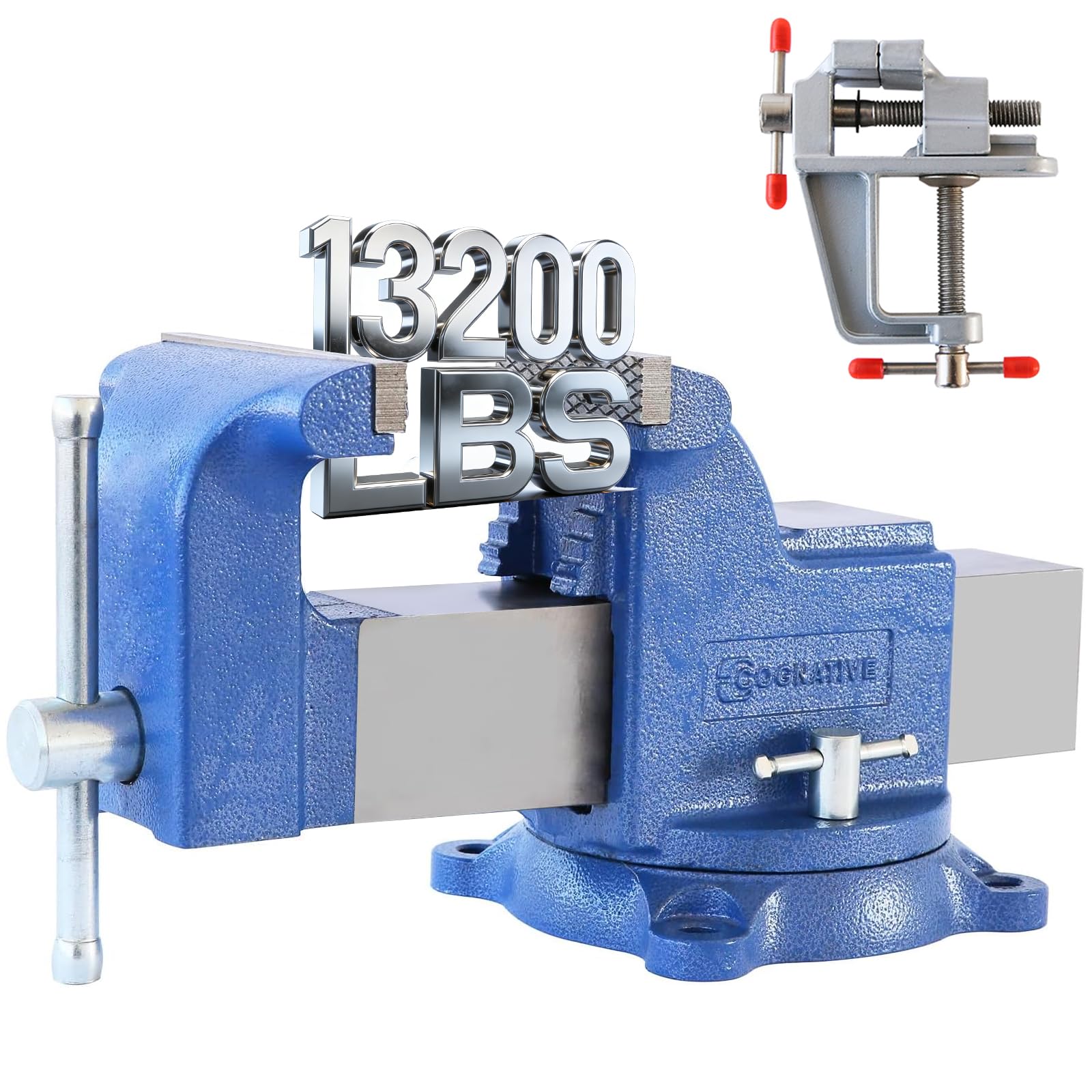
Rated for 13,200 pounds of clamping force, this 6-inch unit is built for aggressive workholding.
If raw holding power is your priority, this COGNATIVE model brings a rated clamping force of 6,000 kilograms, which converts to 13,200 pounds of squeeze between the jaws. The 6-inch jaw width opens to 6.1 inches, and the body is cast from 60,000 PSI ductile iron with a blue powder coat and zinc-plated parts for corrosion resistance. Owners use it for welding tables, golf club regripping, and even holding branches during power saw cuts.
The full 360-degree swivel base rotates freely for positioning, and the body includes straight and round scales for more precise angular setup. A thoughtful extra is the complimentary miniature vise included in the packaging, which owners find handy for small detailed work. Welding users note the bolt holes match common welding table patterns, so mounting is straightforward.
The recurring note from owners is that the swivel mechanism can feel less precise than interlocking designs when under heavy side loads, and a couple report needing longer bolts for thicker workbenches. Compared to the Forward CR60A above, this unit offers a slightly smaller 3.4-inch throat depth versus 3.8 inches, so deep workpieces sit a touch less far into the jaws.
Force in focus: the 13,200-pound clamping rating is the headline here, and owners confirm the body holds its own across welding, wood, and metal tasks.
Where it steps back: the swivel lock does not feel as rock-solid as geared interlocking bases when you torque the jaws very hard.
Choose this for: heavy clamping jobs where maximum squeeze between the jaws matters more than head rotation options.
Pass if: you need deep-reach clamping, since the 3.4-inch throat trails the deeper Forward CR60A above.
5. VEVOR Bench Vise 6.5″ Jaw Width Multipurpose

A budget-friendly 6.5-inch performer that throws in magnetic jaw pads and a reverse opening for wider reach.
VEVOR packs unusual extras into a value-tier price, starting with a reversible jaw design: flip the body and the forward opening of 6.5 inches expands to a reverse opening of 9.3 inches for clamping bulkier pieces. Its 60,000 PSI ductile iron body generates up to 20 kN (about 4,496 pounds) of clamping force, which owners confirm handles drilling and cutting pipe without budging.
The kit includes mounting bolts, nuts, and a set of magnetic nylon jaw pads, so you can protect delicate workpieces right from the start without buying extra fittings. The base rotates a full 360 degrees, and the built-in pipe jaws clamp round stock from 0.6 to 2.8 inches. Owners describe the swivel as smooth and the crank action as precise, with several noting it feels on par with far more expensive brands for woodworking and mid-light repairs.
The most honest criticism is that the Yost 750-DI is a large, light-duty tool rather than a true heavy-duty unit. The screw and handle are on the slimmer side, so owners advise reserving it for medium clamping tasks instead of max-torque work. It also arrives with thin jaw castings, so heavy repeated impacts are not its strength. If your work is woodworking, crafts, or light metal repairs, this is an excellent value; if you plan to lean on it with a cheater bar (a pipe slipped over the handle for extra leverage), step up to a heavier model.
The value case
- Reversible jaw design expands to a 9.3-inch reverse opening for big pieces
- Magnetic nylon jaw pads protect finished surfaces immediately
- Smooth 360-degree swivel earns steady owner praise
Where it fits less
- Owners call it “large, light duty” — the screw and handle are slimmer than true heavy-duty rivals
- Thin jaw castings mean it is not built for max-torque hammering
Grab this if: you want a versatile, easy-mounting vise for woodworking and mid-light repairs on a budget.
Step up if: your daily work involves heavy clamping torque where a stouter screw and thicker jaws matter.
6. Forward CR80A 8 Inch Bench Vise
An 8-inch giant with a 9-inch opening and a 12,000-pound clamp rating for oversized work.
When your projects outgrow the 6-inch class, the Forward CR80A steps in with an 8-inch jaw width and a jaw opening that extends to 9 inches — the widest grip in this lineup. Its 60,000 PSI ductile iron body delivers 12,000 pounds of clamping force, gripping large steel and aluminum stock with authority. Owners describe it as a “monster of a vise” with almost no lateral play, meaning the jaws stay parallel even under maximum torque.
Like its smaller sibling, it includes two sets of replaceable jaws — serrated tops with slot jaws — plus built-in pipe jaws for round stock from 1/2-inch to 3 1/2-inch. The reinforced anvil surface handles cutting, tapping, and light forming tasks.
The key consideration is that a 4.1-inch throat depth and 8-inch jaws make this a substantial bench presence, and it replaces vises that gave up after two decades of service, according to owners. Because of its size and weight, you need a sturdy workbench and proper mounting bolts to get the most from it — a flimsy bench will flex before this vise will.
Built for the big jobs: the 8-inch jaw width paired with a 12,000-pound force rating makes short work of oversized stock that smaller vises cannot grip.
Plan the mount: this size demands a serious workbench and quality bolts — its own rigidity will expose a weak mounting surface.
Pick this for: large flat stock, wide aluminum, and heavy metalwork where jaw capacity is the deciding factor.
Consider a smaller unit if: your bench is compact or you rarely need more than a 6-inch grip.
7. Yost Vises ADI-6 Heavy Duty Vise

A professional-grade 6-inch vise with a 130,000 PSI austempered ductile iron body that shrugs off abuse.
The ADI-6 is cast from 130,000 PSI austempered ductile iron, a heat-treated alloy the manufacturer claims is 45% stronger than forged steel. Its 6-inch jaws sit on a 42-pound body, and the interlocking geared swivel base rotates 360 degrees with two lockdowns for firm positioning under heavy torque. The handle, lockdowns, and replaceable hardened steel jaws are all zinc plated for corrosion resistance.
Owners describe the operation as silky smooth, with perfect jaw alignment and a one-finger handle action that requires almost no effort even under load. The built-in pipe jaws sit out of the way when not needed, and the bright red powder coat draws compliments for matching common tool brand aesthetics. The large anvil work surface adds forming capability, while the ADI base uses three mounting holes for a secure bench fit.
Compared to the standard ductile iron models above, the ADI material is the reason this vise commands a premium — it is built for daily professional use where lesser castings would fatigue and crack. The trade-off is that some owners find the base could use a fourth mounting hole for maximum rigidity, and the vise arrives with protective grease that needs cleaning off before first use. It carries a limited lifetime warranty on castings, which signals the maker’s confidence in the material.
The strength story
- 130,000 PSI austempered ductile iron resists cracking beyond standard castings
- Interlocking geared base with two lockdowns holds position firmly
- One-finger handle operation earns constant owner praise
What to weigh
- Three mounting holes leave some owners wanting a fourth for maximum rigidity
- Arrives greasy from the factory and needs a cleanup before use
Built for professionals: if you use a vise daily and need material strength that outlasts standard ductile iron, this is the pick.
Overkill for light use: hobbyists doing occasional clamping get the same results from the standard ductile iron models above.
8. Wilton Multi-Purpose Bench Vise, 6-1/2″

The 58.4-pound premium choice with a 30-degree indexed rotating head for precise angular work.
Wilton is a storied name in bench vises, and the 650P lives up to the reputation with a 6.5-inch jaw width and a 58.4-pound body that owners call “an absolute beast.” The head rotates a full 360 degrees but indexes at 30-degree increments, which means you get a positive click into each position rather than relying on a friction lock. That indexing is what makes this vise ideal for gunsmithing and other precise angular work.
The jaws are replaceable hardened steel with a serrated pattern for grip and long life, and the separate steel pipe jaws hold round stock securely. V-jaws grip vertical round stock, while the large built-in anvil supports forming and shaping tasks. Shoppers say the jaws align perfectly and the screw action is smooth, with a nice big base for solid mounting using either 7/16-inch or 1/2-inch bolts. It is backed by Wilton’s industry-leading lifetime warranty against manufacturing defects.
The clear trade-off is the premium cost — this is the most expensive model in the lineup, and you pay for the brand’s engineering and lifetime support rather than raw jaw size. A few owners note minor finish chipping at the base over time, and the lack of base bearings means humidity could pose a rust risk in damp garages. If you want a heirloom-quality tool with replaceable parts and a warranty for life, the Wilton earns its premium.
The premium argument
- 30-degree indexed head rotation gives precise, repeatable angles for gunsmithing
- Lifetime warranty on manufacturing defects backs the heirloom build
- Replaceable hardened steel jaws with serrated grip last through heavy use
The premium cost
- Highest price in this lineup — you pay for the name and engineering
- Finish chips at the base over time, and no base bearings means rust risk in damp shops
Reach for this if: you want precise indexed rotation for detailed work and a lifetime warranty that makes it a buy-once tool.
Save the premium if: your budget is tight and you can accept a standard swivel base for everyday clamping.
Understanding the Specs
Ductile Iron vs. Cast Iron
Ductile iron contains graphite nodules that let it flex slightly under stress instead of cracking, making it the preferred material for heavy-duty bench vises. Standard cast iron is harder but more brittle, so it suits lighter duty use. Austempered ductile iron takes this further with a heat treatment that dramatically boosts tensile strength, which is why the Yost ADI-6 rates at 130,000 PSI.
Clamping Force and Tensile Strength
Clamping force is the actual squeeze the jaws deliver on your workpiece, measured in pounds or kilonewtons. Tensile strength describes the material itself — how much pulling stress the iron can withstand before failing. A higher tensile strength rating means the body can handle greater clamping force and heavier impacts without deformation, so look for both numbers when comparing models.
FAQ
What is the difference between a 210-degree and a 360-degree swivel base?
How much clamping force do I really need in a bench vise?
Will a 5-inch jaw vise be too small for my workshop?
What do pipe jaws do on a bench vise?
Why does the Forward CR60A weigh 18.42 kg while the VEVOR is lighter at 27 pounds?
Is the Yost ADI-6 stronger than the standard Yost 750-DI?
Can I mount these vises on any workbench thickness?
What does “throat depth” mean and why does it matter?
Is a heavier bench vise always better?
Do bench vises come with mounting hardware included?
Final Thoughts: The Verdict
If you want one dependable pick, the heavy-duty bench vise winner is the Forward CR60A because it balances a wide 6.5-inch jaw, a 9,900-pound tensile rating, and a 210-degree swivel at a price that owners consistently call the best value in a DIY vise. If you want a full 360-degree rotation with three jaw sets for maximum versatility, grab the Yost 750-DI. And for professional-grade material strength and a lifetime warranty, the Yost ADI-6 is the one to reach for, provided your workbench can handle its 42-pound heft.
How We Picked
We do not accept paid placement. Every pick is matched to a real buyer and a real use-case; we do not hands-on test units.
Sources & Methodology
Specifications: manufacturer listings and product documentation. Review insights: verified customer reviews, as of September 2026. Pricing: not shown on this page (it changes often); check the current price via the retailer link.
As an Amazon Associate, KitchPrep earns from qualifying purchases. This does not affect which products we feature.
Related Guides
