
Specs are compiled from manufacturer listings and verified buyer reviews and can change over time — please confirm the key details on the product page before buying.
When the grid goes dark, your fridge, router, and sump pump shouldn’t have to pick a favorite child — a 1500-watt-plus power station is the size class that keeps your home essentials running without the din and fumes of a gas generator. The real decision isn’t wattage alone; it’s how long the battery holds, how fast it refills, and whether you can physically move it from garage to campsite. One quick note before the list: some picks here exceed the 1500W continuous mark because the nearest same-purpose units in this class cluster higher — same job, more headroom.
I’m Mohammad Maruf — the founder and writer behind KitchPrep. This guide is built by comparing the manufacturers’ published specifications and the patterns across verified customer reviews, so you get each pick’s real strengths and trade-offs instead of marketing spin.
Below, you’ll find the 1500 watt power station options that genuinely deliver on capacity, recharge speed, and portability for everyday backup and off-grid use.
Our Picks at a Glance
How To Choose The Best 1500 Watt Power Station
Before you buy a power station in this class, you need to match the battery’s stored energy (measured in watt-hours, or Wh) with the wattage of the things you’ll plug in. A 1500W inverter can run a space heater, but if the battery only holds 1000Wh, that heater drains it in under an hour — think of wattage as the faucet size and watt-hours as the water tank behind it.
Match the battery to your real loads
Start by adding up what you’ll actually power. A refrigerator pulls roughly 150-300W when running, a microwave 800-1200W, and a space heater a full 1500W. A station with 2000Wh or more of capacity gives you hours of fridge backup overnight, while a 1500W peak output unit is for shorter bursts or smaller devices.
Look for LiFePO4 chemistry for longevity
Lithium iron phosphate (LiFePO4) batteries tolerate more charge cycles before degrading than standard lithium-ion packs. Most modern stations in this class quote 3,000 to 6,000 cycles down to 80% capacity, which translates to a decade or more of daily use for most households.
Check recharge speed and solar input
A fast AC wall recharge (under 2 hours) means your station is ready again quickly after an outage. Solar input wattage determines how fast you can top up off-grid — more watts means more panels you can string together — but remember that real-world solar output is often lower than the rated panel number on cloudy days.
Quick Comparison
| Model | Best For | Capacity | AC Output | Weight | Amazon |
|---|---|---|---|---|---|
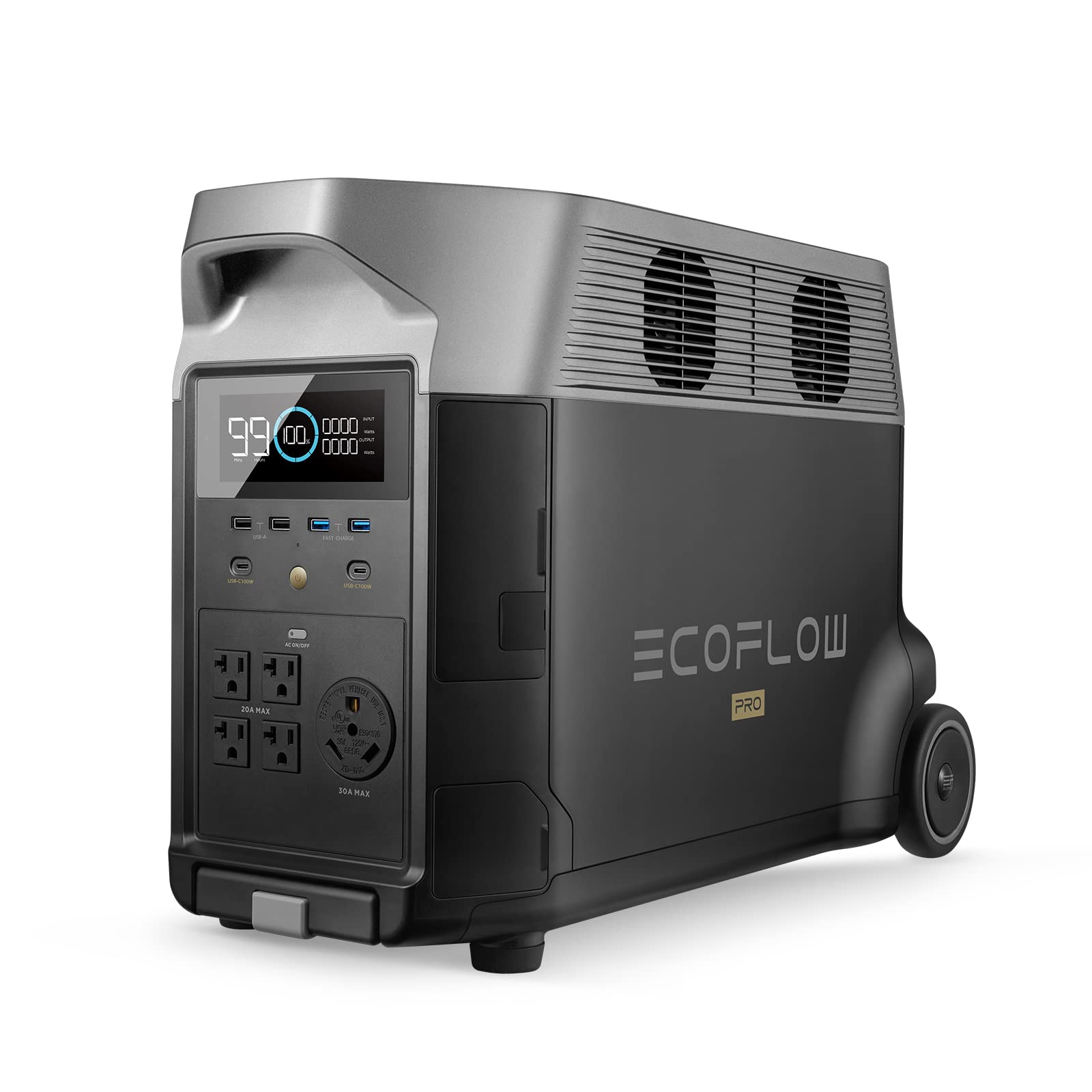
| EF ECOFLOW DELTA Pro★ Best Overall | Whole-home backup, expandability | 3600Wh | 3600W | 99 lbs | Amazon |
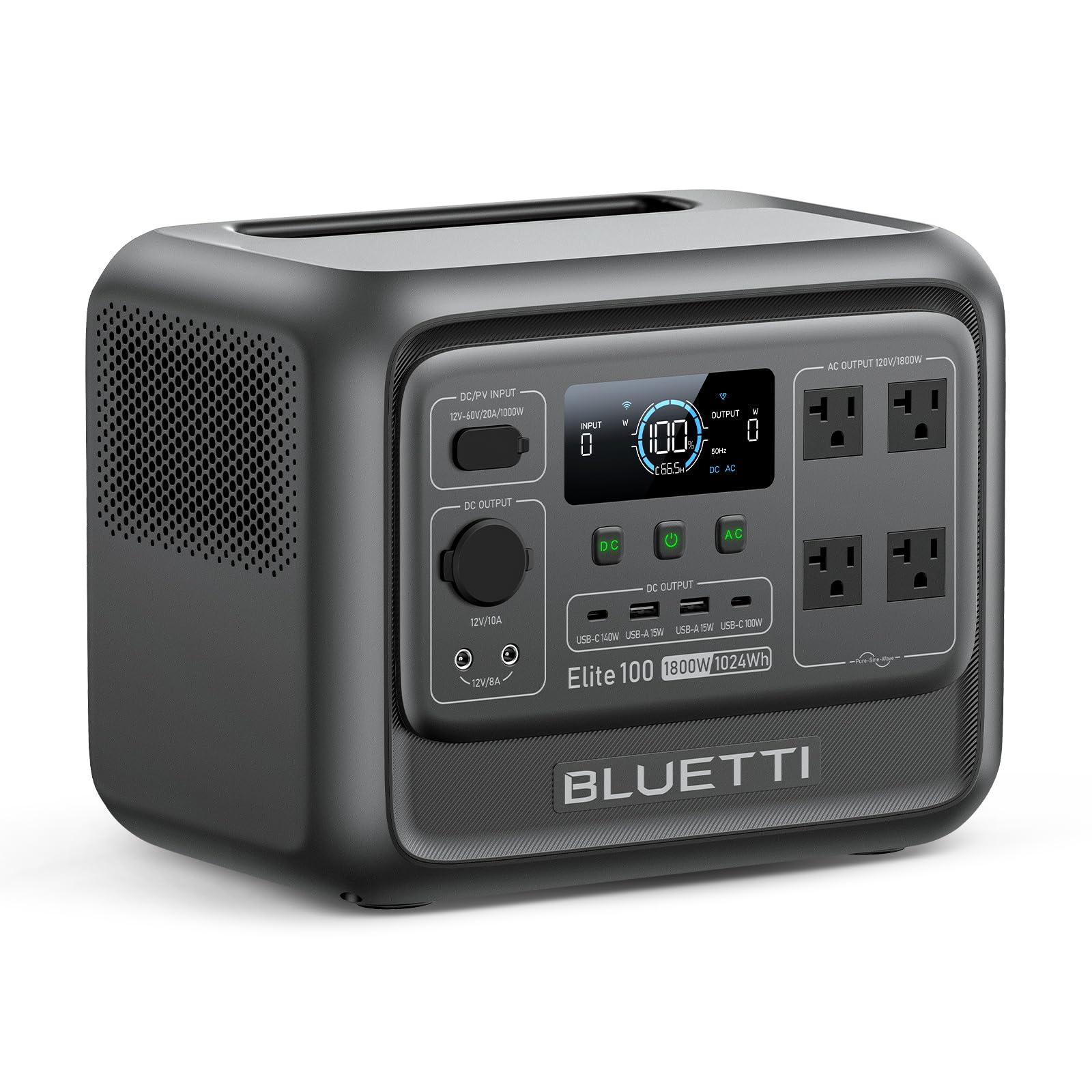
| BLUETTI Elite 100 V2Best Portable | Portable camping power | 1024Wh | 1800W | 25 lbs | Amazon |
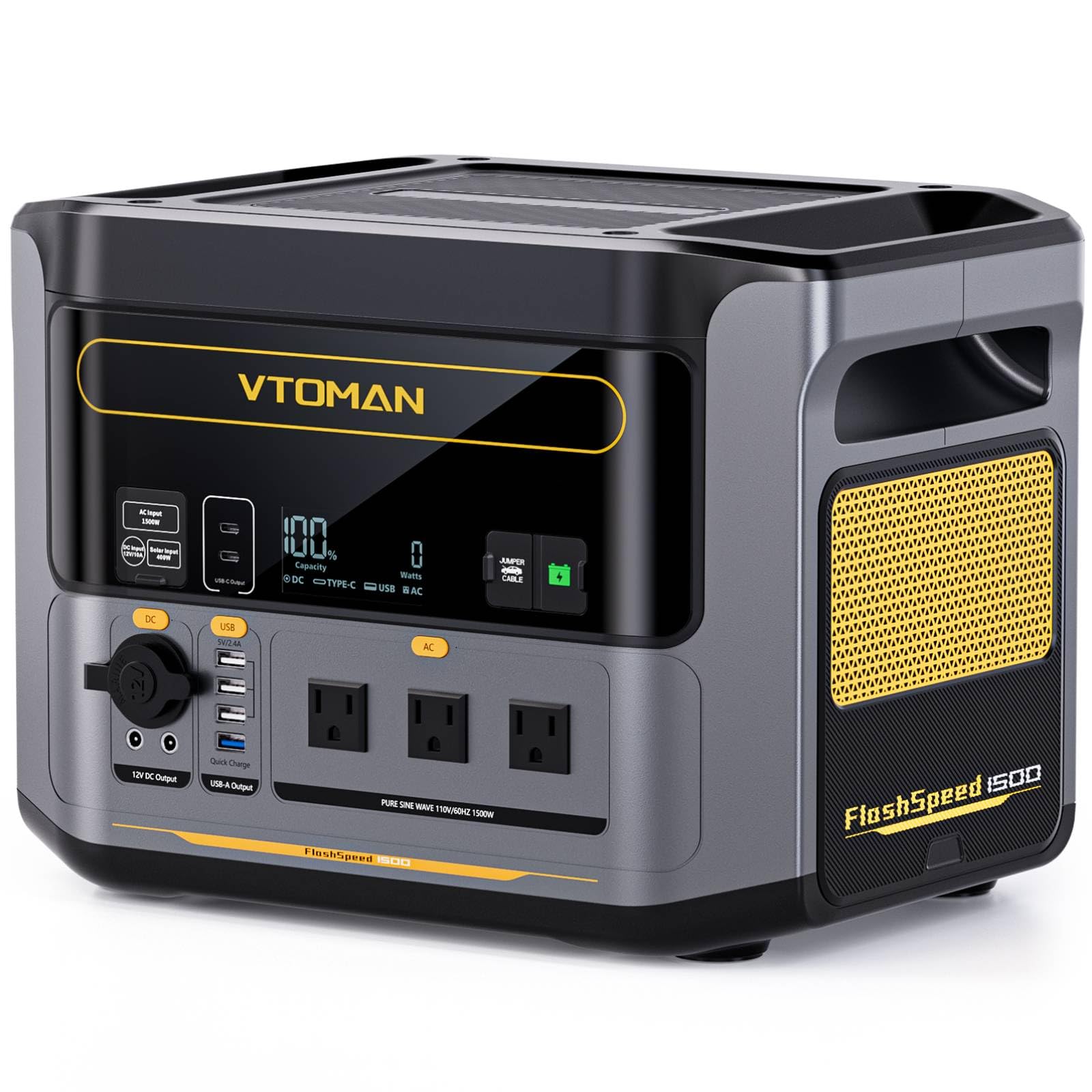
| VTOMAN FlashSpeed 1500Best Value | Fast recharge, budget backup | 1548Wh | 1500W | 41.5 lbs | Amazon |
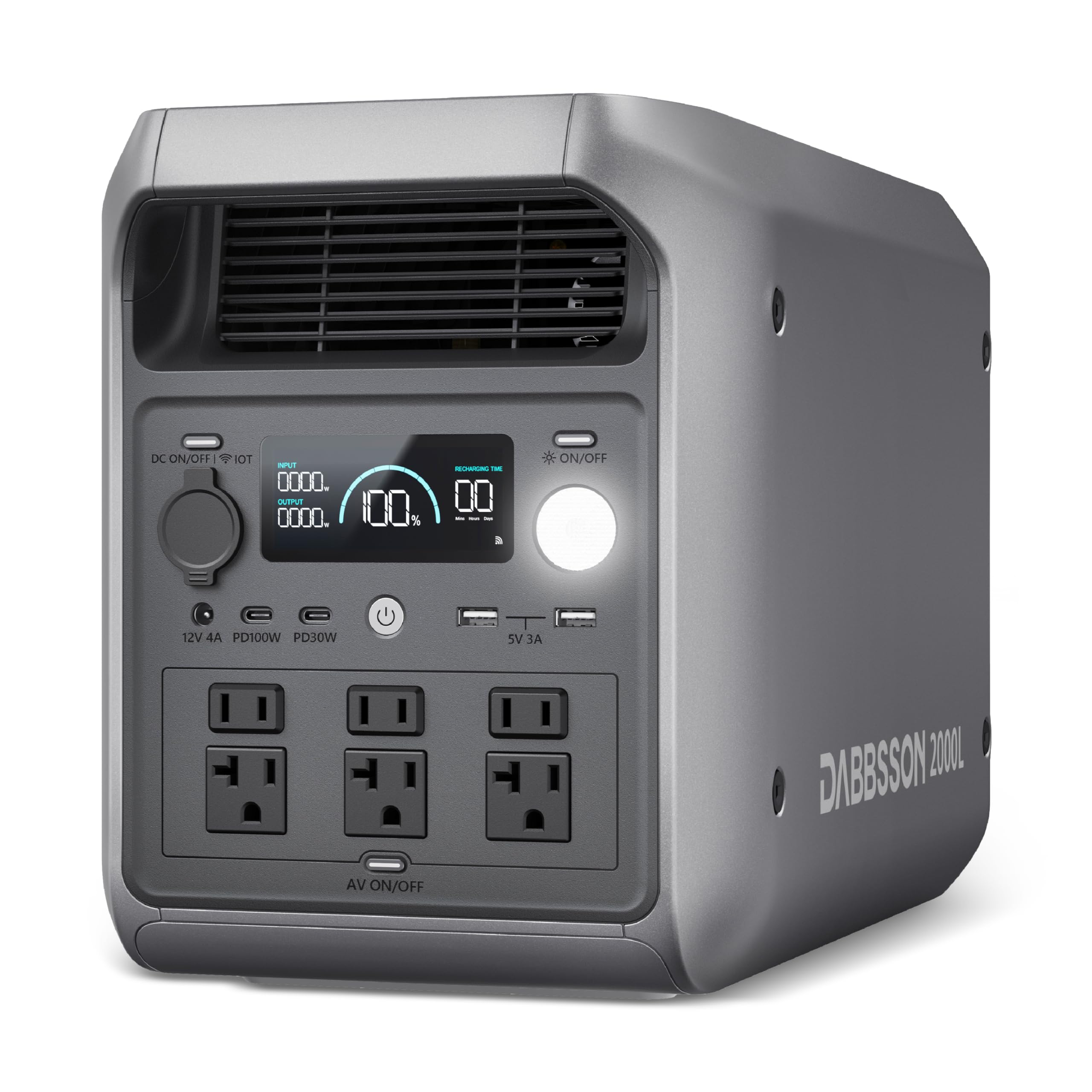
| DABBSSON 2000L | Mid-size home & camping balance | 2048Wh | 2200W | 41 lbs | Amazon |
| Anker SOLIX S2000 | Compact 2kWh fridge backup | 2,010Wh | 1,500W | 35.7 lbs | Amazon |
| DJI Power 2000 | Quiet RV nights & tools | 2048Wh | 3000W | 47.9 lbs | Amazon |
| BLUETTI Elite 300 | RV-ready 3kWh in compact shell | 3014Wh | 2400W | 58 lbs | Amazon |
| Jackery HomePower 3000 | Home essentials up to 15 hours | 3072Wh | 3600W | 59.5 lbs | Amazon |
| Jackery HomePower 3600 Plus | Larger households, easy rolling | 3584Wh | 3600W | 77.2 lbs | Amazon |
| Anker SOLIX F3800 | Max power, EV & 240V loads | 3,840Wh | 6,000W | 132.3 lbs | Amazon |
In-Depth Reviews
1. EF ECOFLOW Portable Power Station 3600Wh DELTA Pro
Our pick — over 4.5★ from 600+ verified ratings; the strongest balance of quality and price.
A 3600Wh heavyweight that turns multi-day outages into a minor inconvenience.
With a 3600Wh LFP battery and a 3600W AC output, this is the station you reach for when “backup power” means keeping a fridge, lights, and more alive through the night — buyers report running appliances overnight and still having 30% capacity left by morning. It gives you 15 output methods, including 5 AC outlets, 2 USB-C ports at 100W each, and a car power output, so you can charge a heat press at a market stall or run a home office simultaneously.
Where most stations feel capped, this one grows with you. You can expand the capacity from 3.6kWh up to 25kWh by adding DELTA Pro Extra Batteries or Smart Generators, and pair two units for 7200W — a path to near-whole-home coverage. X-Stream fast charging refills the battery in 1.8 hours from a 240V outlet or 2.7 hours from a standard 1800W wall outlet, and with 4x400W solar panels, the sun can top it up in about 2.8 hours thanks to up to 23% solar conversion efficiency.
The trade-off is honest and physical: at 99 pounds, this is not a grab-and-go unit. It’s the station you roll out during a storm or load once for a trip, not one you carry daily. The fan also gets audible under heavy load — a small price for this much continuous power. The EcoFlow app (via Wi-Fi or Bluetooth) lets you monitor charge level and customize input/output settings remotely, so you can keep an eye on it even when you’re not home.
What wins people over
- Fast 2.7-hour wall recharge from empty
- Expandable from 3.6kWh up to 25kWh
- Runs heavy appliances with 30% battery to spare
The honest limits
- 99-pound weight demands a sturdy hand truck
- Fan noise is noticeable under heavy loads
Reach for this if: you need whole-home backup power and don’t mind a stationary, high-capacity unit.
Look elsewhere if: you want something you can lift into a car trunk — this one stays put.
2. BLUETTI Elite 100 V2 Portable Power Station
A 25-pound station that keeps astrophotography gear running all night.
Weighing just 25 pounds with a compact 17L design, this station is the pick for campers and remote workers who actually move their power around. It packs a 1024Wh LiFePO4 battery and an 1800W rated AC output (with 3600W surge), so it can run a mini PC, cameras, and a telescope mount all night — one owner reports a solid 6.5-7 hour runtime on ~60W peak loads in the field. The 11 ports handle multiple devices at once without complaint.
The a neat extra is its speed. With 1200W TurboBoost AC charging or up to 1000W solar input, it fully refills in about 70 minutes — among the quickest for a 1kWh station. A built-in 10ms UPS switchover keeps Wi-Fi routers and PCs running through blips, and in silent mode it drops to just 30dB, which is 50% quieter than other 1kWh stations for overnight use in a tent or RV. The BLUETTI app handles remote monitoring, power management, and OTA updates over Wi-Fi or Bluetooth.
That 1024Wh capacity is light by big-station standards — it won’t run a space heater for hours. The 35% smaller footprint means everything is packed tight, and the ~25-pound weight is still noticeable in a backpack. The side display, appreciated for dark-sky use, keeps things readable without blinding you. If your priority is a quiet, carryable unit for weekends rather than multi-day home backup, this is the balance.
Standout strengths
- 70-minute full recharge is class-leading
- 25 lbs with hidden handle for easy carrying
- 30dB silent mode for overnight use
Who should pass
- 1024Wh won’t power high-draw heaters for long
- Some owners found solar topping up slow
Grab it for: camping, remote work, and astrophotography where weight matters as much as watts.
Think twice if: your plan is powering a full-size fridge through a week-long outage.
3. VTOMAN FlashSpeed 1500 Solar Generator
A 1548Wh station that refills in about an hour and lasts for 3,000+ cycles.
This station’s defining trick is speed: a huge 1500W AC input port recharges it from 0-100% in about an hour without needing an external AC adapter. Add a 400W solar panel and 200W DC input, and the total fill time drops to around 45 minutes — numbers that make it a genuinely strong emergency partner. The 1548Wh LiFePO4 battery carries a 3000+ cycle life before hitting 80% of original capacity.
Its V-Beyond Technology lets the pure sine wave inverter push past the rated 1500W in constant-power mode, so appliances over 1500W — like water heaters, space heaters, or ovens — keep running instead of tripping the output off. With 12 output ports (3 AC outlets, 4 USB-A, 2 USB-C, 2 DC5521, and a car port) that all support pass-through charging, you can top up devices while the station itself refills. A flat-top storage box keeps cables tidy, and the capacity can expand to 3096Wh with a sold-separately extra battery.
The catch is weight and pickiness. At 41.5 pounds, it’s solid but not light, and fast charging may trip a standard outlet breaker — you’ll want a higher-amp circuit or fewer simultaneous loads. Some owners mention the AC output drains slightly even when unplugged, likely unavoidable with the inverter. One Florida customer who survived multiple hurricanes — including a month-long outage — reports it powers any kitchen appliance and recharges from 2x400W solar panels even in partial sun.
Why it wins at this price: an hour-long full recharge plus 1548Wh of storage is rare in the budget tier, and the V-Beyond constant-power tech protects you from sudden shutdowns.
The trade-off to know: you’ll want solar panels from the same brand for the fastest top-ups, and the 41.5-pound frame isn’t a one-handed carry.
Choose it when: you want fast recharging and don’t need to move the unit far from your outlet or panel setup.
Pass on it if: you need a featherweight station for frequent backpacking trips.
4. DABBSSON Portable Power Station 2000L
Semi-solid LiFePO4 cells boost safety and runtime in a 2048Wh package.
DABBSSON’s 2000L uses upgraded semi-solid LiFePO4 cells, which the manufacturer says offer higher stability than standard LFP — wrapped in a UL94-V0 flame-retardant housing for extra home safety. The capacity is 2048Wh with a 2200W rated output that surges to 3300W, so it comfortably runs refrigerators, heaters, grills, and power tools at once. At 41 pounds with a compact 11.2″L x 18.3″W x 8.9″H frame, it’s notably easier to store than many high-capacity rivals.
Charging speed is the other headline: a 1-hour AC recharge fills the whole 2048Wh pack, which is exceptional for this class. It also accepts up to 800W MPPT solar input, 12V car charging, or a hybrid dual-input combo for off-grid flexibility. The <10ms EPS switch protects computers and NAS drives from data loss during outages, and the Dabbsson App (over Wi-Fi/Bluetooth) lets you adjust charging speed and set schedules remotely. A 5-year warranty (3 years standard plus 2 years extended) backs the purchase.
Owners call it the best price-to-performance in the 2kWh class, with one noting it powers an air fryer, microwave, and tools on the 2200W continuous output. The honest gripes: the plastic housing can feel less premium than metal shells, and fans get audible under sustained heavy load. If you want one station that bridges home backup, camping, and job-site duty without stepping up to a 3kWh unit, this is a genuinely balanced pick.
What makes it click: the 1-hour full recharge plus 800W solar input gives you flexibility that most 2kWh stations lack at this weight.
Who should skip: buyers who need a metal-shell rugged unit for harsh job sites — the ABS+PC body is solid but not truck-proof.
Best suited for: families wanting one station that does double duty for outages and weekend trips.
Not ideal for: anyone expecting military-grade drop protection from the plastic exterior.
5. Anker SOLIX S2000 Portable Power Station
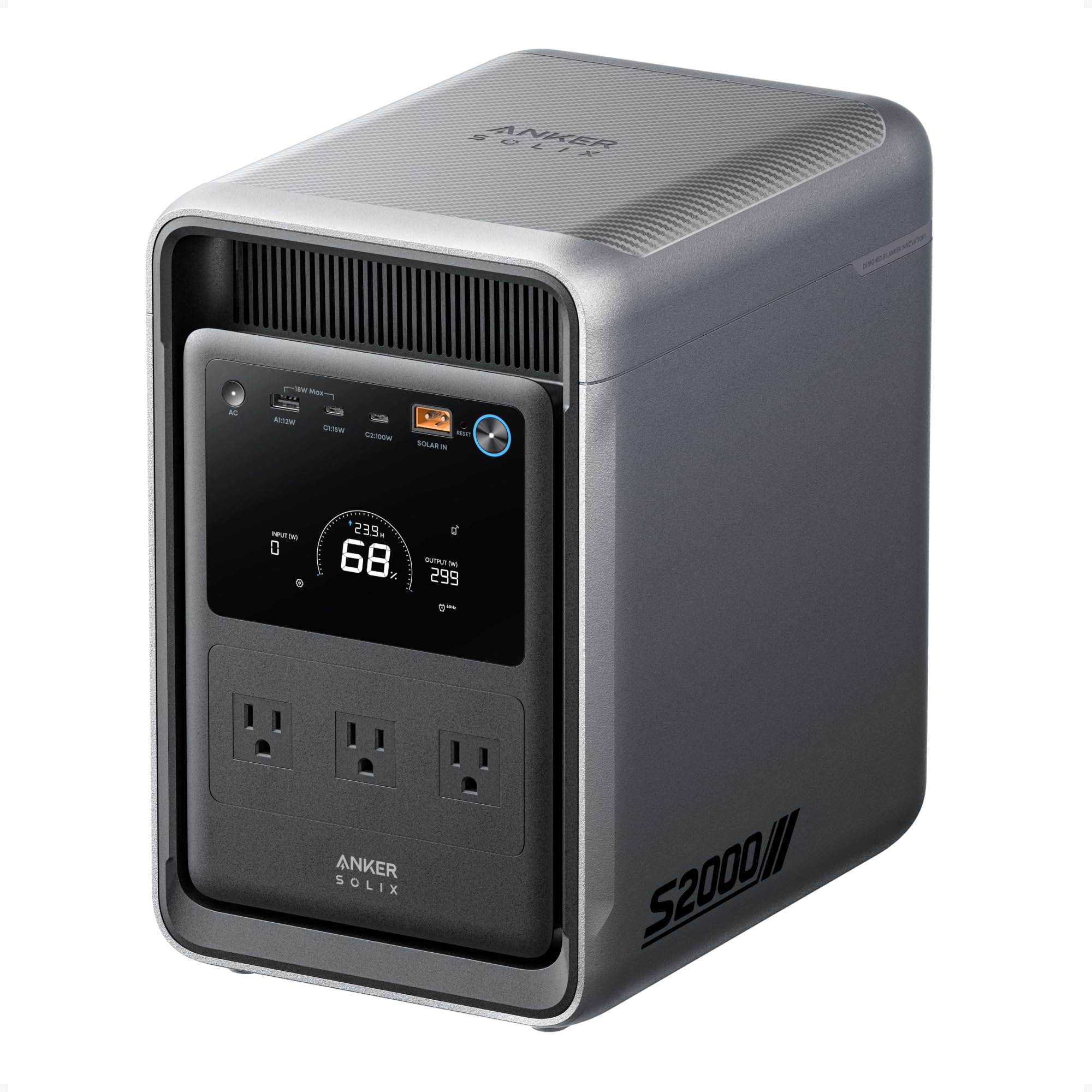
The compact 2kWh that keeps a fridge cold for a day and a half
Anker engineered the S2000 around efficiency — with a 6W idle power draw and 10% higher efficiency, it runs 20% longer than other 2kWh systems, keeping a fridge powered for up to 35 hours. That 1,500W continuous output (3,000W peak) covers 99% of home essentials, and The 314Ah LFP cells are rated for 10,000 charge cycles or a 15-year lifespan.. It’s also one of the smallest 2kWh stations at 8.2″ x 11.1″ x 12.7″ and just 35.7 pounds.
The layout is smart: 8 outlets split between front and rear, so you plug everyday devices in front and always-on appliances in the back for a cleaner setup — though there’s no 12V DC port. Recharging offers 6 paths, including up to 400W solar input, AC plus solar simultaneously, wall outlet, generator, or car outlet. The <10ms UPS switchover protects your home office gear, and the app lets you adjust charge rates (100-1200W) and set TOU or custom modes for energy tracking.
Real-world owners confirm the fridge math: one ran a full-size refrigerator about 30 hours down to 20% battery, and another powered a window AC for an hour. The gripes are minor but real — the fan is noisy during 1200W charging, and a first-charge burning smell dissipated after initial use. If you want an energy-efficient 2kWh station that doesn’t dominate your floor space, this is the one to beat.
Where it shines
- 35-hour fridge backup with 35.7-lb frame
- 6 recharge paths including AC + solar combo
- 10,000-cycle LFP battery longevity
Reality check
- No 12V DC car port
- Fan noise spikes during fast wall charging
Pick this for: efficient home backup where every watt-hour counts and floor space is tight.
Consider another if: you need a 12V outlet for car accessories or RV use.
6. DJI Power 2000 Portable Power Station
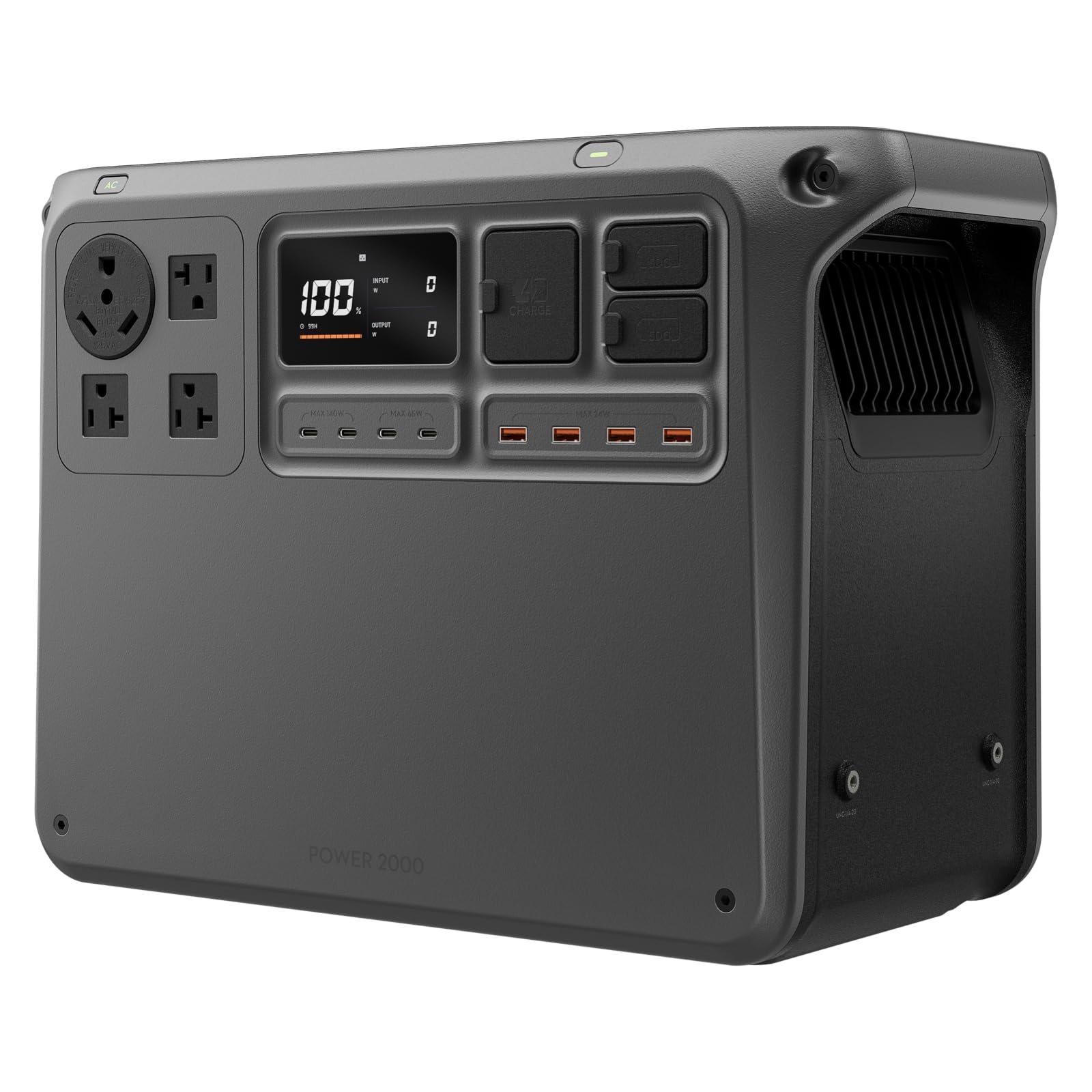
Drone-grade engineering that replaces a gas generator without the fumes
DJI brings its precision tech to the grid, and the Power 2000 packs a 2048Wh LFP battery with a 3000W stable output (4000W peak) that runs 99% of appliances — from kettles and cookers to electric saws and impact drills. Recharge speed is the flex: 0-80% in just 55 minutes, with a full charge around 90 minutes. The 15 ports include dual SDC ports and 4 USB-C (2 at 140W), so a crew of 4-5 can charge phones, lights, fans, and laptops simultaneously.
For RV users, the quiet operation is the selling point: it runs as low as 30dB, so you sleep undisturbed while it charges devices in enclosed spaces. The smooth UPS switches in 10ms — twice as fast as the Power 1000 — keeping gear running through outages. The DJI Home app provides wireless remote control without needing a separate dongle, and a 5-year warranty backs it all. Build quality is rugged, with flame-retardant housing and sub-nano coating for wet conditions.
One owner replaced three Honda EU3000 generators with this unit, running high-power tools and a rope winch with a 4500W in-rush, while another powers Starlink, a 75″ TV, and a Traeger grill all at once. The honest caveats: MPPT and car charging modules aren’t built-in — you’ll need a separate compatible adapter for solar or vehicle charging — and the proprietary SDC connectors mean you stick with the DJI ecosystem for expansion up to 22.5kWh.
The core appeal: 55-minute recharge to 80% plus 30dB quiet operation make it the RV and mobile-work favorite.
Watch out for: needing extra adapters for solar panels and car charging that other stations include by default.
Reach for it if: you prioritize whisper-quiet nights in an RV and fast top-ups between uses.
Look elsewhere if: you want a plug-and-play solar setup without buying proprietary extras.
7. BLUETTI Elite 300 Portable Power Station
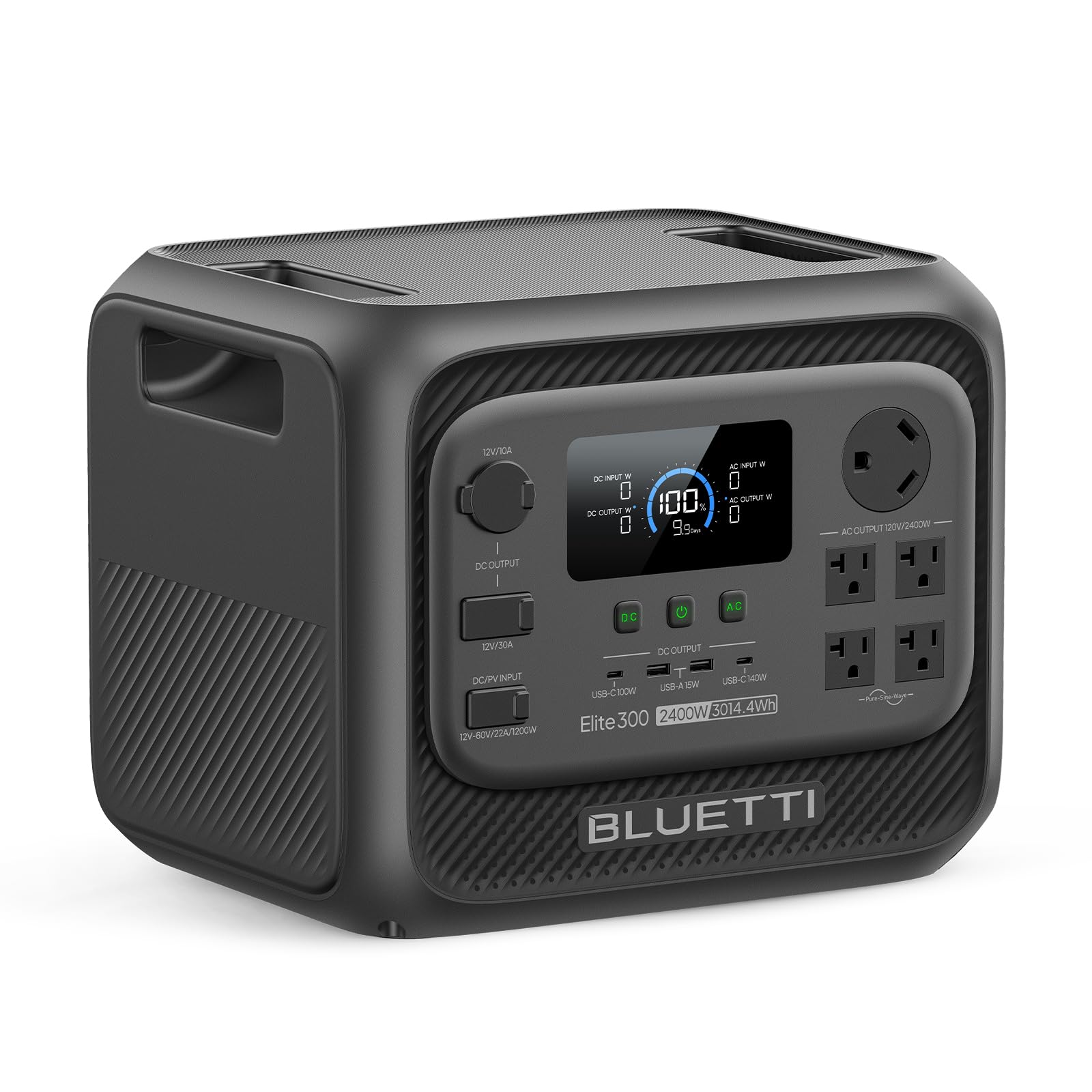
A 3kWh station that fits in spaces you’d never expect
BLUETTI claims this is the world’s smallest 3kWh portable power station — verified by Frost & Sullivan — and at nearly 59% smaller than traditional units, it changes where you can stash serious backup power. The 3014Wh LiFePO4 battery delivers 2400W continuous output with a 4800W surge to start resistive loads like kettles. With 6,000+ cycles rated to 80% capacity, it’s built for a decade of regular use.
The RV focus is unmistakable: a TT-30 RV outlet and a high-current 12V/30A DC output run 12V fridges, water pumps, and diesel heaters directly. For home backup, the 10ms UPS switch keeps computers and routers running smoothly through outages, and charge time from 0-80% is as fast as 78 minutes via AC. The BLUETTI app offers remote monitoring and control over Wi-Fi or Bluetooth, while the compact 14.4″L x 12″W x 11.7″H footprint fits where bulkier rivals won’t.
Owners praise its compact power — one notes it handled a 2400W continuous load for 30 minutes — and the flawless UPS transition. The recurring trade-offs are real: the 58-pound weight is hefty even for 3kWh, and there’s no battery expansion option. Solar input is limited to 60V/20A, which one owner flagged as incompatible with certain high-voltage 600W panels. If you want a powerful station that fits under an RV bench but accept it stays that size forever, this is a top choice.
Why buyers choose it
- TT-30 RV port for direct camper hookup
- 78-minute charge to 80%
- Compact 3kWh footprint verified by Frost & Sullivan
The fine print
- No battery expansion options
- 60V solar input limit may not match larger panels
Ideal for: RV owners and home users who need 3kWh in a space-efficient, all-in-one package.
Not for you if: you plan to grow capacity later or already own high-voltage solar panels.
8. Jackery HomePower 3000 Portable Power Station
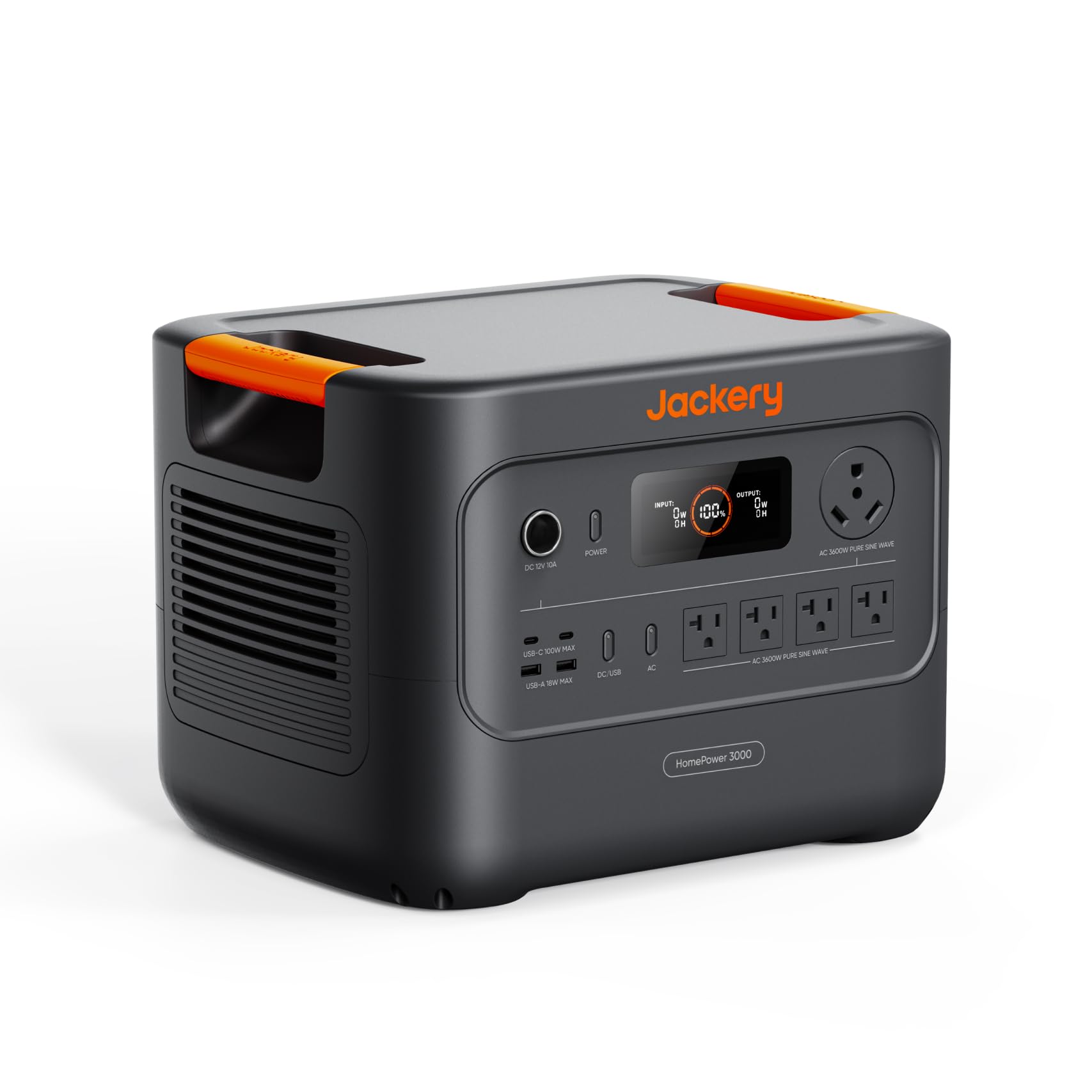
Three thousand watt-hours that run a household for a full day
Jackery’s HomePower 3000 delivers a sturdy 3600W output (7200W surge) from a 3072Wh capacity, keeping home essentials — fridge, fan, Wi-Fi router, and lights — running for up to 15 hours. Customers note a Whirlpool side-by-side refrigerator lasting 30+ hours on one charge, and the dual 100W PD ports fast-charge phones, tablets, and drones. A built-in TT-30 RV port offers plug-and-play power for campers.
The ≤20ms UPS switchover is UL-certified and smooth, keeping security cameras, medical refrigerators, and Zoom calls running through hurricane-induced blips. Jackery’s ChargeShield 2.0 technology uses AI algorithms to boost charging speeds and extend the LiFePO4 battery’s lifespan to 4,000 cycles while retaining 70% capacity. Full recharge takes 1.7 hours via hybrid AC and DC input, or 2.2 hours via AC alone.
At 59.5 pounds with a 16.4″ x 12.8″ x 12″ footprint, it’s lighter than many comparable 3kWh units thanks to CTB technology that boosts space efficiency by 14%. The honest feedback is about noise and weight: the fan runs at roughly 60dB under load — noticeable for daily UPS duty — and 59.5 pounds needs two hands or a cart to move. If you want a station that powers your office and freezer through short outages without permanent installation, this delivers.
Top selling point: that 30+ hour fridge runtime in a 3072Wh pack makes it a genuine storm-season lifeline.
What to weigh: the 60dB fan noise under load means it’s not a desk-side UPS for quiet home offices.
Choose this for: reliable whole-room backup with a fast UPS and enough capacity for a full day of essentials.
skip it if: you need a silent unit that sits beside your workstation 24/7.
9. Jackery HomePower 3600 Plus Portable Power Station

Luggage-style wheels that roll three-plus kilowatt-hours from kitchen to garage
The HomePower 3600 Plus is the lightest 3.6kWh LFP station Jackery makes, and its automotive-grade CTB tech makes it 34% smaller and 29.3% lighter than other models in the class. The wheels and telescopic handle let you roll it easily between rooms, which is rare at this capacity. Its 3584Wh battery delivers 3600W output — 7200W in parallel with a second unit — enough to run pumps, heaters, and dryers, and it supports dual voltage (120V & 240V) when paired.
Safety is the headline engineering story: Ceramic-membrane cells tested at 302°F resist thermal runaway from heat or overcharge.. Its LFP cells are rated for 6,000 cycles and a 10-year lifespan., even operating in -4°F blizzards. Full recharge takes just 2 hours via hybrid AC+DC, 2.5 hours from AC or a gas generator, or 4 hours from solar panels. The capacity expands to 21kWh per unit, or 43kWh with multiple units — enough to power a 3-person household for over 2 weeks.
Owners who bought it for hurricane season praise its versatility: one ran an induction cooktop using 19% battery over half a day of cooking and coffee, while another powers a garage door opener and power tools daily. The trade-off is sheer presence — at 77.2 pounds, it needs those wheels, and it’s not a unit you’ll toss in a trunk. If you want home backup that can grow with you and moves like a suitcase, this balances capacity with real mobility.
The best reasons to buy
- Luggage-style wheels and telescopic handle
- 2-hour hybrid recharge from empty
- Expandable from 3.6kWh to 21kWh
Honest drawbacks
- 77.2-pound weight means it lives on its wheels
- Some owners call it heavy despite the handles
Best for: households wanting portable, expandable backup they can wheel to wherever the outage hits.
Pass if: you need something you’ll regularly lift into a vehicle — this one prefers flat ground.
10. Anker SOLIX F3800 Portable Power Station

The station that charges your EV one day and your whole house the next
At 3,840Wh with a 6,000W AC output, this Anker hauls enough to cover nearly any appliance in a standard home. Its 120V/240V dual-voltage output and 6,000W continuous power run dryers, well pumps, and EV chargers without limitation — the NEMA 14-50 port connects directly to your EV charging cable at 6,000W, and an L14-30 port hooks straight into popular RV power inlets. If 3.84kWh isn’t enough, you can add up to 6 battery packs to reach 26.9kWh, or pair two units for a staggering 12,000W max AC output.
Durability is engineered for the long haul: Anker’s InfiniPower technology pairs EV-class LFP cells with smart temperature control and impact-resistant design, backed by a 5-year warranty and 10-year lifespan rating.. The Anker app (via Wi-Fi or Bluetooth) monitors all power sources and lets you decide exactly how the station is used. Solar charging reaches up to 2,400W input, though owners note the MPPT is tune for Anker’s own panels — hitting max solar wattage with third-party panels can be a challenge.
The real-world reviews are emphatic: one Florida owner powers a window AC through cloudy days with about 6 hours of solar charge, while another replaced a gas generator entirely, keeping a fridge, lights, and a radon motor running through a 6-hour outage with battery dropping only from 100% to 66%. The caveat is the footprint — at 132.3 pounds and 34″ x 34″ x 34″, this is a stationary unit on wheels, and some find the app lacks detailed power-over-time tracking. For occasional outages and whole-home ambitions, this is the most powerful single-unit answer here.
The defining feature: 6,000W output plus 120V/240V support means you can power a dryer or EV charger — things no 1500W-class unit touches.
Know before you buy: it’s the heaviest pick here at 132.3 pounds, and solar MPPT works best with Anker’s own panels.
Buy it if: you want one station that covers your entire home’s power needs, including 240V appliances and EV charging.
pass on it if: you need something portable — this one is a permanent resident of your garage or utility room.
Understanding the Specs
Watt-Hours (Wh) vs. Watts (W)
Think of watt-hours as the size of your fuel tank — it tells you how long you can run things. Watts are the size of the engine — it tells you what you can run at any moment. A station with 2000Wh and 1500W output can run a 1500W space heater for about an hour, or a 150W fridge for over 10 hours. For a 1500W power station search, look for at least 1500Wh of capacity so you’re not draining the battery in under an hour of real use.
Continuous vs. Surge Power
Surge power (sometimes called peak power) is the brief burst a station provides to start appliances with motors or compressors — like a fridge kicking on. Continuous power is what it delivers steadily. A station rated 1500W continuous with a 3000W surge can handle that fridge’s startup spike, but you shouldn’t plan to run a 2500W appliance indefinitely on a 1500W continuous unit.
FAQ
How long will a 1500W power station run my refrigerator?
Can a 1500W power station run a space heater or microwave?
What is the difference between LiFePO4 and standard lithium-ion batteries?
How fast can I recharge a 1500W+ power station?
Can I add solar panels to any of these power stations?
What appliances can I actually power with a 1500W continuous output station?
How heavy are these power stations and can I move them myself?
What does UPS mode do on these power stations?
Can I use a power station to charge my EV or run 240V appliances?
What is the difference between a 1500W and a 3000W power station?
Do these power stations produce carbon monoxide or need ventilation?
Final Thoughts: The Verdict
Across the board, the true winner is the EF ECOFLOW DELTA Pro because it combines a 3600Wh capacity with a 3600W output and expandable storage up to 25kWh — giving you whole-home backup that no other pick here can match at this size. If you want something you can actually lift into a car, the BLUETTI Elite 100 V2’s 25-pound frame with 1800W output is the portable pick. And for the budget-minded who still want fast recharging, the VTOMAN FlashSpeed 1500’s 1-hour full recharge and 1548Wh capacity is the value champion to beat.
How We Picked
We do not accept paid placement. Every pick is matched to a real buyer and a real use-case; we do not hands-on test units.
Sources & Methodology
Specifications: manufacturer listings and product documentation. Review insights: verified customer reviews, as of September 2026. Pricing: not shown on this page (it changes often); check the current price via the retailer link.
As an Amazon Associate, KitchPrep earns from qualifying purchases. This does not affect which products we feature.
Related Guides
