
Specs are compiled from manufacturer listings and verified buyer reviews and can change over time — please confirm the key details on the product page before buying.
When the lights go out or you head to a campsite, a 1000-Watt Inverter Generator keeps your fridge, CPAP, or small tools running quietly without disturbing the neighbors. You need to weigh run time, noise, weight, and clean power for your sensitive electronics—here is how the top models stack up with real specs and owner feedback.
I’m Mohammad Maruf — the founder and writer behind KitchPrep. This guide is built by comparing the manufacturers’ published specifications and the patterns across verified customer reviews, so you get each pick’s real strengths and trade-offs instead of marketing spin.
We matched roughly 1000-watt output units (accepting 900 to 1100 watts, rejecting 2000W+ models) to build this list of the best 1000-watt inverter generator options for your home and camping needs.
Our Picks at a Glance
How To Choose The Best 1000-Watt Inverter Generator
Picking the right generator starts with knowing what you will plug into it. A 1000-watt rated unit is powerful enough for appliances like a refrigerator, a CPAP machine, lights, and phone chargers — but it will not run a central air conditioner or a large power tool. Make a list of what you need to power, add up the watts, and keep a little headroom for startup surges.
Rated Watts vs. Surge Watts
Every generator has two numbers. The rated (running) watts is what it delivers continuously. The surge (peak) watts is the brief boost needed to start motors — like a fridge compressor kicking on. The picks here range from 1000 rated watts to 1200 surge watts, so check that your biggest appliance’s startup draw fits inside the surge number.
Clean Power for Your Electronics
Inverter generators produce clean power with low THD (total harmonic distortion, a measure of electrical waveform purity), which makes them safe for sensitive gear like laptops, TVs, and CPAP machines. If you see “less than 3% THD,” that is the level you want for delicate electronics.
Noise and Run Time
Noise is measured in dBA, and the difference between 52 dBA and 58 dBA is noticeable at a quiet campsite. Run time depends on the fuel tank size and load — economy mode stretches every drop, but real-world run times drop under heavy load. Match the run time to your longest expected outage.
Quick Comparison
| Model | Best For | Peak Watts | Run Time | Weight | Amazon |
|---|---|---|---|---|---|
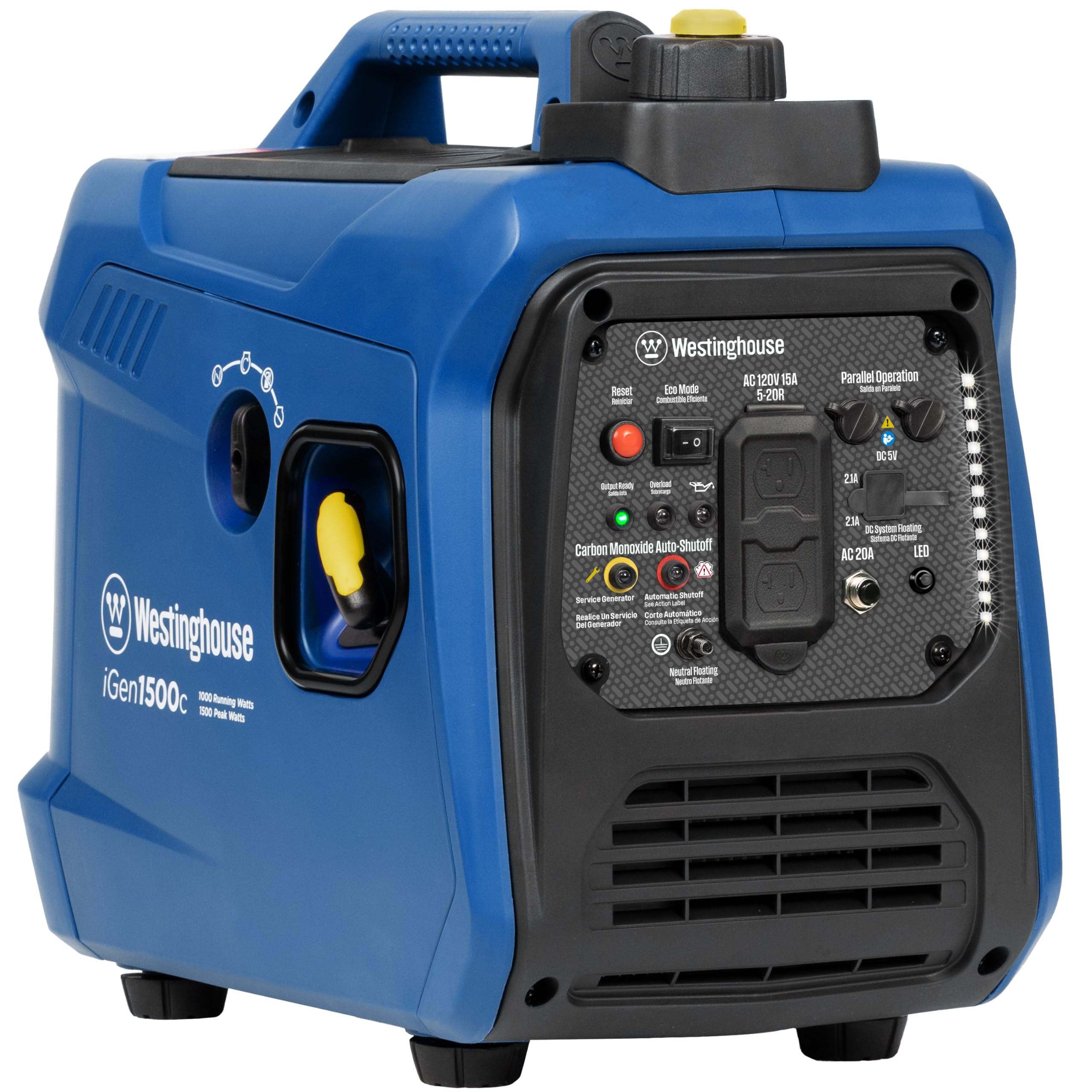
| Westinghouse iGen1500c★ Best Overall | Emergency Home Backup | 1500 watts | 12 hours | 30.1 lbs | Amazon |
| GENMAX GM1200i | Long-Distance Carrying | 1200 watts | 6.5 hours | 25.3 lbs | Amazon |
| WEN 56125i | Campgrounds & Tailgates | 1250 watts | — | 31.6 lbs | Amazon |
| Honda EU1000i | Premium Quiet & Reliability | — | 6.8 hours | 29 lbs | Amazon |
In-Depth Reviews
1. Westinghouse iGen1500c
Our pick — over 4★ from 150+ verified ratings; the strongest balance of quality and price.
The home-backup hero that outlasts the competition with a marathon 12-hour run time.
If your main worry is keeping the fridge and lights on through a long outage, this is the one to beat. It delivers 1500 peak watts and 1000 rated watts with under 3% THD (total harmonic distortion, a clean power reading safe for your TV and laptop), and it runs up to 12 hours on a 0.79-gallon tank of gas—a full 85% longer than the GENMAX GM1200i, which manages 6.5 hours on its tank.
At 30.1 pounds, owners say lifting it is a non-event—one buyer reports, “This generator is lightweight! 28 pounds!” It fires up on the first pull, runs as quietly as 52 dBA (decibels, about the level of a quiet conversation), and a CO sensor (a detector that shuts the engine down if carbon monoxide builds up) adds confidence near indoor spaces. The parallel port (a jack that lets you link two units for more power) means you can double your output later with the Westinghouse parallel cord.
The thing people rave about is pure performance — reliability and easy starting come up most in the reviews, and owners have run refrigerators, fans, lamps, and CPAP machines off it simultaneously. It is backed by a 3-year limited service, labor, and parts coverage.
Why Owners Stay Loyal
- 12-hour run time leads the category on a 0.79-gallon tank
- First-pull starts and quiet 52 dBA operation
- Parallel capable so you can add a second unit later
Honest Watch-Outs
- Heavier than the lightest rivals at 30.1 pounds
- Parts-support website has drawn complaints
- Run time shrinks fast under heavy load
Reach for this if: you want maximum run time and dependable first-pull starts for home backup.
Look elsewhere if: every pound counts for long hikes into a campsite.
2. GENMAX GM1200i

The ultralight traveler that sips fuel and slips into the tightest trunk spaces.
Weight is the story here, and it is a good one. At 25.3 pounds, it is a full 25% lighter than the WEN 56125i below (31.6 pounds), and its compact 16.5″L x 9.45″W x 15.7″H frame makes it the easiest pick to haul to a farmer’s market stand or a distant campsite. It pushes 1200 starting watts and 1000 running watts of clean power (under 3% THD) from a 57cc 4-stroke OHV (overhead valve) gas engine, so your TV and small tools are safe to plug in.
Buyers report genuinely impressive fuel economy—one buyer notes 15 hours per gallon at 25-60% load, and the Eco Mode (a setting that trims engine speed to match demand) is a crowd favorite for cutting both noise and fuel burn. That same review describes running a camper’s AC and TV all night, and another praises how it “handles a 900W heater easily.” Tool-free service access, a fuel shut-off, a CO Detect shutdown sensor (automatic shutoff if carbon monoxide accumulates), and parallel-ready jacks all come standard.
Compared to the Westinghouse above, it gives up significant run time—6.5 hours versus 12 hours on a full tank—and it uses a smaller 0.66-gallon tank to save that weight. The honest caveats in the review pile: the air filter access panel can pop loose, break-in oil changes show glitter for the first few changes, and one unlucky buyer hit a defective unit that shut off randomly with little manufacturer support. It carries a 3-year warranty with free lifetime technical support.
What Wins People Over
- Lightest pick at just 25.3 pounds for easy carrying
- Owners praise Eco Mode for quiet, fuel-sipping runs
- Tool-free access, fuel shut-off, and parallel-ready jacks
Fair Caveats
- 6.5-hour run time trails the Westinghouse by a wide margin
- Air filter panel can fall off if jostled
- Break-in requires patient oil changes
Pick it for: the best balance of low weight, quiet Eco Mode, and friendly price for camping.
Think twice if: you need all-night run time for extended outages without refueling.
3. WEN 56125i

The quiet workhorse that runs the campsite gadgets without shouting over them.
WEN bills this as quiet enough to match a normal conversation, and the reviews back it up — noise level is the second-most-praised trait after rock-solid reliability. The 60cc OHV engine (a simple overhead-valve design known for durability) produces 1250 surge watts and 1000 rated watts of clean power, safe for smartphones, tablets, televisions, and computers. It is EPA III and CARB compliant, so it meets strict emission rules in every state including California.
Owner reports show it handling a surprising load for its size. One buyer ran a 700W microwave, two M18 chargers, a fridge, and a stereo all day on about 3/4 of a tank over 6 hours, while another powered a 5000 BTU AC unit plus a 500W spare. It comes with two three-prong 120V receptacles and two 5V USB ports, giving you plenty of plug options for phones and small devices. The downside of that capability: at 31.6 pounds it is the heaviest of the four picks here, noticeably heavier than the GENMAX’s 25.3 pounds.
Real-world quirks show up in the reviews if you dig. Owners say you must open the fuel vent or the engine stalls under load, and the exhaust filter can plug over time and cause stops until cleaned. It also ships without oil, so grab some before your first start. No oil included is a minor stumble, but for a campground, construction site, or tailgate companion, the reliability and clean output make it a strong mid-range value that fits the casual user perfectly.
Reliability First: Its most-praised trait is reliability — owners trust it to start and run through long stretches.
The Catch: Heaviest pick at 31.6 pounds, and it demands fuel-vent and filter care.
Choose it for: campgrounds and tailgates where quiet clean power for gadgets is the priority.
skip it if: you want the lightest possible unit or prefer a generator that ships ready with oil.
4. Honda EU1000i
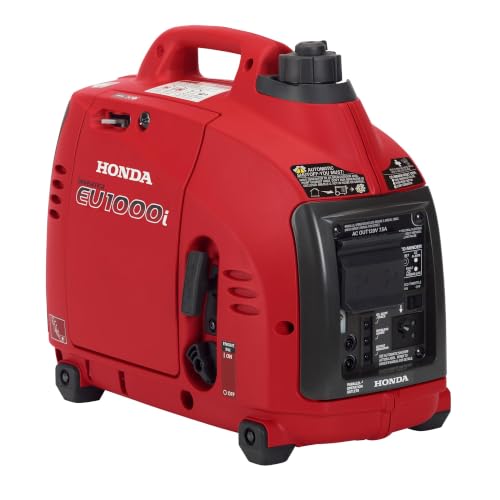
The legendarily quiet premium unit that owners trust to protect their most sensitive gear.
If silence is non-negotiable, this is the quietest generator on the list. The EU1000i operates at 42 to 50 dB(A) — less noise than a normal conversation — which is why owners describe it as discreet even from 100 feet away. Honda’s advanced inverter technology supplies power reliable enough for computers, and the Eco Throttle System (an automatic load-matching feature) stretches a single 0.6-gallon tank to run 3.0 to 6.8 hours depending on load.
The emotional attachment here is strong. Own review pages sum it up as “Honda excellence,” with one buyer who stored it for two years pulling it out during a hurricane and running two refrigerators, two lights, and a sump pump flawlessly. Another powers an induction cooktop, heater, and a Bluetti power station from it while charging a battery bank at 680W. It weighs just 29 pounds, and its CO-MINDER system (a carbon monoxide monitor that auto-shuts the engine before CO reaches dangerous levels) adds a strong safety layer.
Compared to the Westinghouse above, the Honda falls short on raw endurance — up to 6.8 hours versus 12 hours on a tank — but it leads on noise, brand trust, and build quality. The honest trade-offs: it lacks a carburetor drain shut-off and Bluetooth monitoring found on larger Honda models, and its power output draws mixed feedback, with some owners wanting more muscle. The EU1000T1AG is the California-compliant version of this model. It is covered by a 3-year residential warranty.
Why It Commands a Premium
- Quietest pick at 42 to 50 dB(A) — below normal conversation
- 29 pounds with Eco Throttle for efficient, long runs
- CO-MINDER auto-shutdown adds a serious safety layer
What to Weigh
- Up to 6.8-hour run time trails the Westinghouse’s 12 hours
- Power output draws mixed feedback from some owners
- No carburetor drain shut-off or Bluetooth monitoring
Buy it for: the quietest possible operation and Honda’s trusted reliability for sensitive electronics.
Find it limiting if: your power needs run high or you want marathon overnight run times.
Understanding the Specs
THD: Why Clean Power Matters
THD stands for total harmonic distortion — a measure of how smooth the electrical waveform is. Lower is better, and under 3% is the standard for inverter generators, making them safe for laptops, TVs, and CPAP machines. A conventional generator can push 10-20% THD, which risks damaging sensitive electronics over time.
dBA: Decoding the Noise Ratings
Noise is measured in dBA (A-weighted decibels), and it is logarithmic — a small number jump is a big sound jump. A 52 dBA unit is roughly a quiet conversation; 58 dBA is noticeably louder at a quiet campsite. At 42 to 50 dBA, the quietest units here are genuinely neighbor-friendly.
Surge vs. Running Watts
Running watts is what a generator delivers continuously. Surge (peak) watts is the brief kick needed to start motors, like a fridge compressor cycling on. These picks range from 1000 to 1500 surge watts, so always check your appliance’s startup draw against the surge number, not just the running load.
ECO Mode and Parallel Capability
ECO mode (economy mode) trims engine speed to match the load, saving fuel and cutting noise when you are not drawing full power. Parallel capability means a port lets you link two compatible generators to double your available wattage — handy if your power needs grow later, provided both units share the same brand’s parallel system.
FAQ
What is the difference between the GENMAX GM1200i and the Westinghouse iGen1500c?
How long will a 1000-watt generator actually run my refrigerator?
Will a 1000-watt inverter generator run a CPAP machine?
What does CARB compliant mean and does it matter for me?
What does parallel capable mean on these generators?
How loud is a 1000-watt inverter generator at a campsite?
Can these generators run sensitive electronics like laptops and TVs?
Is the Honda EU1000i worth the premium over budget rivals?
Will these generators power a small air conditioner?
Do these generators come with oil included?
Final Thoughts: The Verdict
For most buyers, the 1000-watt inverter generator winner is the Westinghouse iGen1500c because its 12-hour run time on a single tank outlasts every rival here while still delivering clean, quiet first-pull power for home backup. If you want the lightest carry for camping trips, grab the GENMAX GM1200i at 25.3 pounds with its fuel-sipping Eco Mode. And for the quietest operation and trusted Honda reliability with sensitive electronics, the Honda EU1000i is the one to reach for.
How We Picked
We do not accept paid placement. Every pick is matched to a real buyer and a real use-case; we do not hands-on test units.
Sources & Methodology
Specifications: manufacturer listings and product documentation. Review insights: verified customer reviews, as of September 2026. Pricing: not shown on this page (it changes often); check the current price via the retailer link.
As an Amazon Associate, KitchPrep earns from qualifying purchases. This does not affect which products we feature.
Related Guides
