
Specs are compiled from manufacturer listings and verified buyer reviews and can change over time — please confirm the key details on the product page before buying.
An 18650 charger is the quiet workhorse behind every flashlight, vape mod, and power tool battery—but the wrong one can shorten your cells’ life or refuse to fit them at all. The real task is matching your battery types (protected 21700 cells need a different slot length than flat-top 18650s) to a charger that reads voltage, cuts off at full, and charges at a speed your cells can handle. This guide cuts through the spec-sheet noise to the models owners rely on daily.
I’m Mohammad Maruf — the founder and writer behind KitchPrep. This guide is built by comparing the manufacturers’ published specifications and the patterns across verified customer reviews, so you get each pick’s real strengths and trade-offs instead of marketing spin.
Whatever cells you own, the right 18650 charger protects your batteries and tops them up fast, so let’s find the one that fits your rotation.
Our Picks at a Glance


How To Choose The Best 18650 Charger
You need an 18650 charger that fits your cells, charges at a safe current, and stops before overcharging. Every model here does the basics—but the right pick depends on how you use it daily.
Slot length and battery fit
Your cell’s physical length decides which charger works. A bare 18650 measures 65mm, but protected cells—wrapped with a safety circuit board—run longer. The SUNLYTOUR handles cells up to 75mm, while some others accept 70mm max. If you own protected 21700 cells, measure before you buy.
Charging current: the speed vs. safety trade-off
Charging current, measured in amps, controls how fast a cell refills. Standard 18650s handle 1A comfortably; fast 2A charging suits high-drain cells but runs hotter. For Ni-MH AA cells, stick to a lower rate like 0.5A to avoid heat damage.
Quick Comparison
| Model | Best For | Number of Ports | Max Output | Input | Amazon |
|---|---|---|---|---|---|
| SUNLYTOUR D4★ Best Overall | Mixed battery families | 4 | 2A | Micro-USB / USB-C | Amazon |
| Tenergy TN471UBudget Champion | Budget 2-bay users | 2 | 1A | Micro-USB | Amazon |
| XTAR VC4Safety First | Safety-focused owners | 4 | 1A | USB (barrel) | Amazon |
| WISSBLUE LCD-4 | Capacity display fans | 4 | 2A | USB | Amazon |
| WANGDAJIEDIAN EL-4 | USB-C fast charging | 4 | 2A | USB-C | Amazon |
| MAXLSHALL MX-GC03 | Capacity testing | 4 | 4A total | DC jack / USB | Amazon |
| Nitecore UMS2 | Travel and EDC | 2 | 3A single-slot | USB-C | Amazon |
| Nitecore UMS4 | Fast multi-cell owners | 4 | 3A single-slot | USB | Amazon |
| XTAR VC8 | Capacity grading pros | 8 | 3A single-slot | USB-C + QC3.0 | Amazon |
In‑Depth Reviews
1. SUNLYTOUR D4 4-Slot Charger
Our pick — over 4.5★ from 900+ verified ratings; the strongest balance of quality and price.
The crowd favorite that juggles protected 18650s, 21700s, and Ni-MH AAs without breaking a sweat.
The four independent slots each charge on their own, so you can drop in a 21700, two 18650s, and an AA and let each top up at its own pace. The 75mm tray accepts protected cells—the longer ones with a circuit board—that shorter chargers reject. It pulls up to 2A when a single battery is in the bay, which is double the pace of the Tenergy TN471U’s 1A limit, so a drained high-drain 18650 gets back to work sooner.
Owners like the per-battery display that shows charging status at a glance, and the solid metal contact tabs hold up to daily use. The chemistry readout recognizes both Li-ion and Ni-MH/NiCd, which is rare at this level. Charging speed depends on your USB brick—pair it with a 65W adapter and a quality cable and it charges fast.
Input comes via USB-C or micro-USB, giving you flexibility with whatever cable you already own. One honest caveat from owners: the spring contact for tiny RCR123 cells feels loose, so those need a gentle touch. For 18650 and 21700 duty, it’s a workhorse.
What wins owners over
- Long 75mm slots fit protected 21700 and 26650 cells, not just bare 18650s
- Four independent bays charge different sizes at once without sharing power
- Dual USB-C and micro-USB input makes finding a cable easy
Where it stumbles
- RCR123 cells can feel loose in the spring contact
- Charge current default is 0.5A with all four bays full—slow if you’re impatient
Grab it when: your rotation mixes protected 21700s, 26650s, and standard 18650s that all need a single home.
Think twice if: you only charge two batteries a week—a smaller 2-bay unit saves desk space.
2. Tenergy TN471U 2-Bay Charger
A tiny two-bay that handles most household rechargeables for less than the price of a lunch.
This compact unit auto-detects your battery’s chemistry—Li-ion, LiFePO4, IMR, NiMH, or NiCD—and sets the right voltage, then shows charge time and progress on a clear LCD. At just 130g and 5.12″H tall, it slips into a glove compartment or desk drawer, and it charges from any USB port, whether that’s a laptop, car adapter, or power bank.
Owners using it daily with 3.7V 18650s report quick, reliable charging, and the screen reading time, voltage, and progress earns praise. The catch: it’s a 2-bay unit pushing a 1A charge current per slot—that’s a 2.0x gap slower than the SUNLYTOUR’s 2A peak, so a fully drained 18650 takes longer to refill. The micro-USB port is delicate; the included cable works best.
It’s certified by FCC and RoHS, backed by a one-year warranty and lifetime support from Tenergy’s California team. If you mostly charge AA, AAA, and the occasional 18650, this is the value pick that keeps things simple.
Owners’ verdict: “The best battery charger I’ve used” is the kind of praise it earns—solid performance at a budget price.
Handle with care: treat the micro-USB port gently; angled cable pulls have broken ports in a few units.
3. XTAR VC4 4-Slot Charger
The safety-first 4-bay that revived “dead” 18650s—and shows each cell’s capacity as it fills.
The VC4 wraps each of its four bays in overcharge, over-discharge, short-circuit, and reverse-polarity protection, all inside a PC fire-retardant shell. Real-world owners describe it reviving eight seemingly dead 18650s for vapes and flashlights, plus old Eneloop AAs. A lengthy 48-hour test confirmed the unit is authentic via XTAR’s scratch-off verification at xtar.cc.
Each slot’s display shows voltage, battery type, charging current, and charged capacity independently, and you pick between a slow 500mA and fast 1000mA rate. It carries a 4.53″D x 5.87″W footprint—noticeably wider than the narrow Tenergy TN471U—so it needs a clear spot on your shelf.
The trade-off: it can’t charge protected 20700 or 21700 cells, a limit XTAR states plainly, and it uses a barrel connector cable instead of USB-C, which owners find hard to replace. Some high-drain cells like Molicel don’t always register. For standard 18650 and Ni-MH AA/AAA duty, it’s a fortress of safety.
Safety first: if protecting your cells from overcharge is non-negotiable, this four-bay brings the full suite of protections.
Read the fine print: skip it if you need protected 21700 support—XTAR points you to its X4 or VC8 models instead.
4. WISSBLUE LCD-4 Charger

A button-tapping delight that reads your battery’s health, with a discharge mode most rivals skip.
Press “C” to cycle through charge time, capacity, voltage, progress percentage, battery type, and speed for each bay. Press “a” to shift between 0.5A, 1A, and 2A rates, so you can slow-charge a delicate cell or fast-charge a high-drain 18650. A unique discharge function helps reduce battery damage over time by cycling cells properly.
Owners praise the legible display—”very well done display for ease of seeing the numbers and spotting problems with paired sets and low volt”—and it handles the full 29mm to 75mm length range of common lithium cells. The charging math works in your favor: a flat-top 3400mAh Panasonic NCR18650B takes about 2 hours at 1A, and an Eneloop 2500mAh AA is done in 1.5 hours.
This 4-bay unit charges four different batteries at once, but the spring-loaded holder has limited travel, so placing cells feels fiddly, and the USB port sits slightly off-center. It lacks a dedicated discharge/recharge capacity test that pricier units add, yet for real-time health data, it stands out.
The wellness tracker: if you want to spot a weak cell in a paired set before it fails, the per-bay readout earns its keep.
Patience required: drop-in fit is snug; expect to seat some cells twice.
5. WANGDAJIEDIAN EL-4 Charger
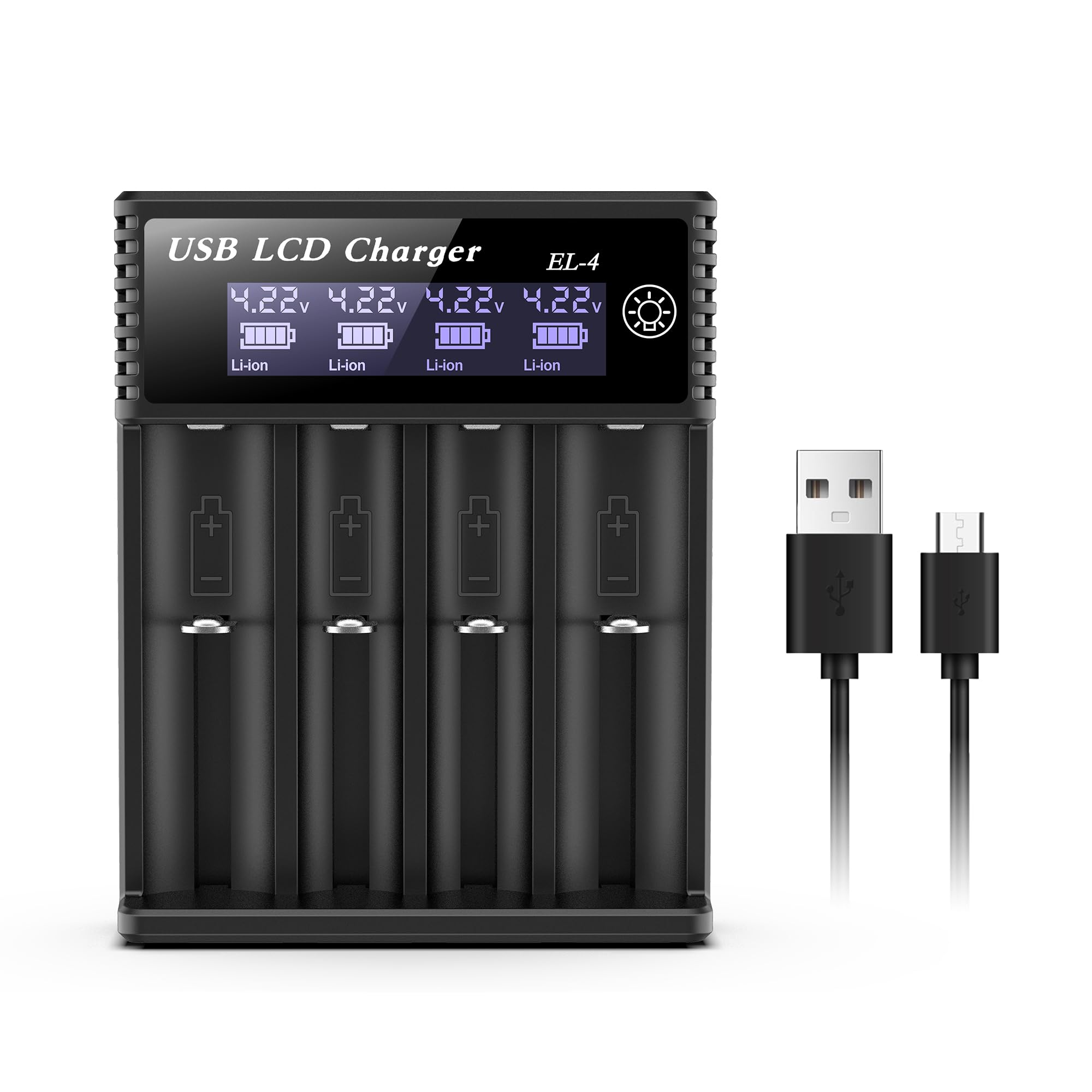
A modern USB-C four-bay that pushes 2A fast charging to a single 18650 when you’re in a hurry.
Plug in the included USB-C cable and this charger delivers up to 2A to a single lithium-ion cell—a genuine fast-charge option—then spreads the load across four independent bays when you fill them all. It auto-detects battery chemistry and adjusts voltage, so Ni-MH AA cells get a gentler 300mA rate that protects them from heat.
The LCD shows voltage, current, charge level, and battery type for each slot, and the touch screen dims after 30 seconds of inactivity to save power. It accepts cells from 29mm to 70mm long and lists compatibility across 18650, 21700, 26650, 14500, and more, all in a 3.78″D x 4.72″H footprint.
Buyers report solid performance with 18650 and 16340 cells, though charging speed gets mixed reviews—some find it slow with multiple batteries loaded. No wall plug is included; you’ll need a 5V/2A adapter, and a 2A input gets strained when four bays are active. If your cables are all USB-C, this is the modern pick.
Modern conveniences
- USB-C input matches the cable you already use for everything else
- 2A output to a single bay means fast 18650 top-ups
Reality checks
- No wall adapter included—budget for a 5V/2A USB brick
- Multi-bay charging slows to a crawl without a strong power source
6. MAXLSHALL MX-GC03 4-Slot Charger
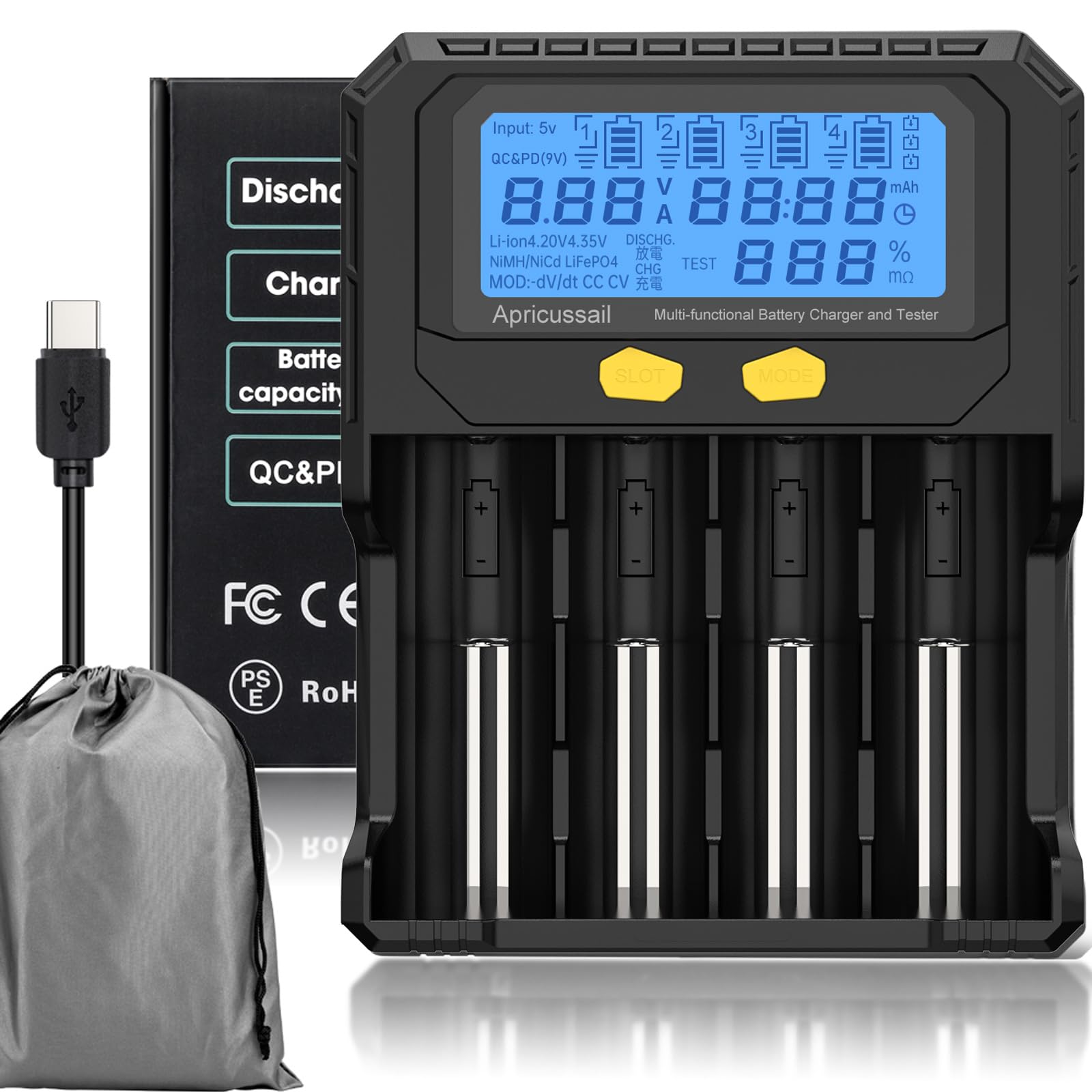
A rare compact that charges, discharges, and tests capacity in one bay—so you finally know your cells’ true health.
The fourth slot doubles as a 3-in-1 station: charge, discharge, or run a full capacity test. That means you can cycle a suspect cell to measure its real mAh and decide if it’s worth keeping. With a 4A total ceiling, each slot delivers 1A when all four are full—and the 1st and 4th slots jump to 2A each when you use the included fast-charging cable.
Owners call it the best charger they’ve owned, citing its compact build, universal USB input, and clear per-battery indicator lights. It handles LiFePO4 at 3.2V alongside 3.7V Li-ion and 1.2V Ni-MH, covering 18650, 21700, 26650, 32650, AA, AAA, C, D, and SC sizes. Yard light owners love that it tops up solar cells reliably.
The recurring caveat is fit: some owners mention it doesn’t support ebl Li-ion batteries and certain 32650 cells, so check cell lengths before buying. It accepts power through a DC jack or USB port, and the flame-retardant construction with overcharge, over-discharge, short-circuit, and reverse-polarity protection keeps daily use safe. For a battery health lab in a small box, this is the one.
The health lab: if you’ve ever wondered whether a weak 18650 is worth keeping, the 4th slot settles it with a real capacity number.
Fit check first: compatibility is the most-discussed catch—long or odd cells may not seat right.
7. Nitecore UMS2 Dual-Slot Charger

A name-brand dual-bay that hits 3A on a single cell—slashing vape-battery wait times dramatically.
Pair this with a 9V QC2.0+ USB power source (a fast-charging adapter) and the UMS2 pushes a maximum 3A into one slot or a shared total of 4A across two—so vapers report fully charged batteries in roughly 1.5 to 2 hours versus 2 to 3 on older chargers. A standard 5V/2A adapter still yields a solid 1A per slot. The LCD shows health, charging status, and mode in real time.
Owners upgrading from a decade-old Nitecore i2 found the UMS2 finally topped off 3400mAh 18650s completely, plus restored over-discharged cells. It auto-detects size, type, and voltage, handles protected 21700s, and ships with a two-battery organizer for travel. The chemistry list is exhaustive—Li-ion, IMR, LiFePO4, Ni-MH, Ni-Cd across dozens of sizes.
No wall plug is included, so pack a quality USB adapter. The manual’s tiny print sends some owners to download a PDF, and there’s no auto-off feature. It’s the most compact premium pick here, ideal for a flashlight rotation or vape kit.
Speed demon: at 3A on a single slot, it out-charges most dual-bays in its class.
Bring your own brick: QC2.0+ adapter required to open up the full speed.
8. Nitecore UMS4 4-Slot Charger

A four-bay speedster with Quick Charge 2.0 that refills 21700 cells in about two hours flat.
Quick Charge 2.0 integration open up a maximum 3A single-slot output, and customers note 21700 cells at 3000 to 4000mAh topping up in roughly two hours. The UMS4 reliably handles four D cells at once and shows per-slot status on a clear display. Reliability is the standout: reviewers describe years of normal wear with dependable charging, calling it a great first charger for 18650 beginners.
It auto-detects power level and selects the right voltage and charging mode for each cell, plus includes a LifeMods battery case for safe storage. The compatibility list spans Li-ion, IMR, and LiFePO4 across 10440 through 26700 sizes, and Ni-MH/Ni-Cd AA, AAA, AAAA, C, and D. You can power it from a wall, car, or solar USB source, making it genuinely worldwide-portable.
The recurring gripe after years of use: the micro-USB port can wear out—one owner’s failed after roughly three years—and there’s no on/off switch, so unplug it when idle. The metal slider is sturdy but demands gentle handling. If you charge multiple 18650s or 21700s daily, the speed is worth it.
Built for speed
- Quick Charge 2.0 means 3A into one slot for rapid 21700 refills
- Handles four D cells at once—rare versatility
Long-term notes
- Micro-USB port is the weak point after years of daily plugging
- Unplug after charging—no automatic power-off switch
9. XTAR VC8 8-Slot Charger

The eight-bay command center that grades reclaimed cells and ships with its own QC3.0 wall charger.
This is the serious collector’s charger: eight bays that charge up to eight protected 21700 batteries at once, plus a grading mode on bays 1-4 that runs a charge-discharge-charge cycle to measure true capacity. That reveals whether a “9900mAh” cell is honestly labeled—owners testing 3000 to 9900mAh 18650s found real capacities of 1230 to 1800mAh, exposing overstated Chinese cells.
The included QC3.0 wall charger feeds up to 3A to a single slot when resistance is low, and you can choose five currents (3A, 2A, 1A, 0.5A, 0.25A) per bay. A high-precision MCU and real-time temperature control guard against over-current, over-charge, over-voltage, and short-circuit, stopping automatically when cells are full. XTAR’s three-stage lithium charging system keeps cells healthy.
Owners love the bright, readable LCD that keeps results on screen until you remove the battery, and the portability for field use. The honest catch: this is a charger for charging all eight, but grading runs on only four bays, and full eight-cell charging spreads 18W thin at about 500mA per battery—slow if you’re in a hurry. Grading a 2100mAh set can exceed 8 hours, so pre-charge on the right side first.
Cell auditor: if you reclaim or grade batteries, the 4-bay capacity test separates honest cells from inflated ones.
Pace yourself: grading is slow—plan overnight for a full cycle, not a quick lunch break.
Understanding the Specs: What Actually Matters
Charging current (amps)
Your charger’s amperage—1A, 2A, 3A—sets how fast a cell fills. A 1A rate charges a 3000mAh 18650 in roughly 3 hours; 2A halves that. The trade-off is heat: fast charging generates warmth, and heat is what wears lithium cells down over time. Many chargers let you pick a slow 0.5A rate for delicate Ni-MH AAs and a fast 2A or 3A rate for high-drain 18650s.
Cell length and protection boards
18650s measure 65mm bare, but protected cells add a circuit board that lengthens them to 70mm or 75mm. Chargers quote a max slot length—check it against your longest cell. If you buy protected 21700s, confirm the charger states support; not all 18650 chargers do, and forcing a cell in can damage the contact spring.
Safety cut-offs
Look for overcharge protection (stops at 4.2V), reverse-polarity protection (won’t fry if you insert a cell backward), and short-circuit protection. Fire-retardant housing adds another layer of safety. These features decide whether a charger failure ruins a cell or just stops charging.
USB power input
Most modern chargers draw power from a USB port rather than a built-in wall plug. USB-C is the modern standard, while micro-USB is older and more fragile. Your wall adapter’s output matters: a 5V/1A brick limits a charger to slow rates, while a QC2.0 or QC3.0 adapter open up its full 3A speed. Budget for a quality adapter if none is included.
FAQ
What is the difference between an 18650 battery charger and a regular AA charger?
How long does it take to charge a 18650 battery?
Will a 21700 battery fit in an 18650 charger?
What does “protected” mean on an 18650 battery?
Is it safe to leave 18650 batteries charging overnight?
Can this charger test the real capacity of my batteries?
What is the difference between slow charging and fast charging?
Can I charge different types of batteries at the same time?
Final Thoughts: The Verdict
If you want one dependable pick, the 18650 charger winner is the SUNLYTOUR D4 because its four independent slots and 75mm trays handle nearly any cell you own at a strong 2A pace. If you want speed on the go, the Nitecore UMS2 hits 3A on a single slot and tucks into a travel bag with its organizer. And for the collector who needs to audit battery health, the XTAR VC8 charges eight cells and grades real capacity across four bays.
How We Picked
We do not accept paid placement. Every pick is matched to a real buyer and a real use-case; we do not hands-on test units.
Sources & Methodology
Specifications: manufacturer listings and product documentation. Review insights: verified customer reviews, as of September 2026. Pricing: not shown on this page (it changes often); check the current price via the retailer link.
As an Amazon Associate, KitchPrep earns from qualifying purchases. This does not affect which products we feature.
Related Guides
