
Specs are compiled from manufacturer listings and verified buyer reviews and can change over time — please confirm the key details on the product page before buying.
If you are adding an air locker, air horn, or suspension system to your truck or Jeep, a 1 gallon air tank is the quiet middleman that stores the compressed air your compressor works so hard to make. The real question is rarely about capacity — nearly all of these hold about a gallon — but about how many ports you get, what pressure rating you can trust, and whether the tank will physically fit where you want to mount it.
I’m Mohammad Maruf — the founder and writer behind KitchPrep. This guide is built by comparing the manufacturers’ published specifications and the patterns across verified customer reviews, so you get each pick’s real strengths and trade-offs instead of marketing spin.
Picking the right 1 gallon air tank depends on port count, pressure rating, and mounting space, all explained below in plain terms.
Our Picks at a Glance


How To Choose The Best 1 Gallon Air Tank
Before you buy, think about what you are actually building. A tank that just stores air for a horn needs one port for the compressor and one for the horn line. A tank feeding air lockers and tire inflation needs room for a pressure switch, a gauge, a relief valve, and a drain cock — that means you want four or more openings.
Count the ports you truly need
A port is a threaded opening where you screw in a fitting, a gauge, or a valve. Fewer ports means you will likely need a tee fitting to split one opening into two. More ports — like the four or five on several picks here — let you connect everything directly without extra adapters cluttering your setup.
Understand the pressure rating before you fill it
The PSI rating tells you the maximum safe working pressure the tank can hold. If your compressor pushes out more pressure than the tank is rated for, you risk a failure. Match the tank’s rating to your compressor’s output, and always leave a small margin of safety.
Weigh steel against aluminum
Steel tanks cost less and resist dents, but they rust from the inside if you never drain the moisture that condenses in them. Aluminum tanks are lighter and never rust, but they cost more and can be more prone to thread damage if fittings are over-tightened.
Quick Comparison
| Model | Best For | Capacity | Pressure Rating | Ports | Amazon |
|---|---|---|---|---|---|
| Viair 91005★ Best Overall | Compact under-truck reserve | 0.5 gallons | 150 PSI | 2 | Amazon |
| VIAIR 91014Top Performer | Four-port versatility | 1 gallon | 150 PSI | 4 | Amazon |
| HornBlasters TA-105HBest Value | Mixed-size fittings | 1 gallon | — | 5 | Amazon |
| VUYOMUA 4L-SG | Corrosion resistance | 1 gallon | 180 PSI | 4 | Amazon |
| CNRAQR AT-1-100 | Rust-free lightweight mount | 1 gallon | 200 PSI | 5 | Amazon |
| HONSDUKE Horn Kit | Complete train horn system | 1 gallon | 150 PSI | — | Amazon |
| Vixen Horns VXO8210 | All-in-one horn kit value | 1 gallon | 150 PSI | — | Amazon |
In‑Depth Reviews
1. Viair 91005 0.5 Gallon Steel Air Tank, 150 PSI
Our pick — over 4.5★ from 400+ verified ratings; the strongest balance of quality and price.
The pint-sized workhorse that disappears under a frame rail and still feeds air ride and horns.
Hundreds of owners trust this little tank with their builds — it holds a 4.6-star average across 400+ ratings. It is a half-gallon, not a full gallon, yet that smaller size is its superpower for tight spots. At just 5.75 inches long by 6 inches wide by 7.36 inches tall, it slips beside truck frame rails or inside a jet boat where a bigger cylinder never fits. Buyers report using it for three years on a truck for air ride and horns, saying it “still looks new.”
Owners say it simply works — they praise its functionality and solid construction above everything else. The two 1/4″ NPT ports (threaded openings where you attach fittings) are enough for a basic compressor-to-tank-to-accessory setup, and it ships with two sets of mounting bolts. The silver painted finish drew compliments too, so it does not look out of place on a clean build.
Be aware this is a much smaller reserve than the full-gallon tanks here — a 2.0x capacity gap versus the VIAIR 91014 above. It is also 4.5 pounds, compared to 7 pounds for that same full-gallon tank, which tells you how much less steel you are carrying. Owners also note the port situation is a bit limited; a few mention wishing for one more opening, and one chemical engineer swapped the stock relief valve for a lower-pressure unit as a safety measure. He advises draining the tank daily to prevent corrosion, which is good practice for any steel tank.
What owners rave about
- Proven reliability — three years of daily truck use and still looking fresh
- Compact footprint that fits in tight frame-rail and boat spots
- Two mounting bolt sets included for flexible install
The honest trade-offs
- Half the capacity of the full-gallon picks
- Only two ports, so plan for tee fittings
Reach for this if: you need a proven, compact air reserve for a jet boat, air ride, or horns and want the confidence of hundreds of happy owners.
Look elsewhere if: your build demands a full gallon of stored air or four or more direct connection points.
2. VIAIR 91014 1 Gallon 4-Port Air Reservoir Tank
The full-gallon four-port tank that hides under a Jeep and still leaves room for axle flex.
Grab this tank when you need the full gallon of reserve and want to connect everything without a nest of tee fittings. Its four 1/4″ NPT ports give you dedicated openings for a pressure switch, a gauge, a relief valve, and your accessory line — owners mention pairing it with an ARB single compressor and having it “work great.” It carries a 150 PSI maximum working pressure, and one owner confirmed running it to 125 psi for a truck air bag system without issue.
What impresses people is the value — owners call out the build quality and the price together, noting it costs about a quarter of what a comparable aluminum tank runs. The black finish is actually a powder coat (not silver as some expect), and the coating holds up well. At 13.6 x 10.1 x 8.5 inches and 7 pounds, it is a substantially larger presence than the 0.5-gallon Viair above — a 2.4x size gap by volume of space it occupies — but that size buys you double the air storage.
The recurring gripe is that unused ports come without plugs, so you will need to buy your own to seal holes you do not use. Thread quality also earns mixed feedback, so run a tap through the openings if you have one handy. Owners love how it fits specific vehicles — one slid it under a TJ Wrangler above the rear axle with room to spare, and another called it the “perfect size to hide under my Jeep.”
Build + value combo: You get a corrosion-resistant coated tank, four ports, and mounting hardware for roughly a quarter of the price of an aluminum rival.
Plan ahead: Order a few 1/4″ NPT plugs alongside it so unused ports stay sealed.
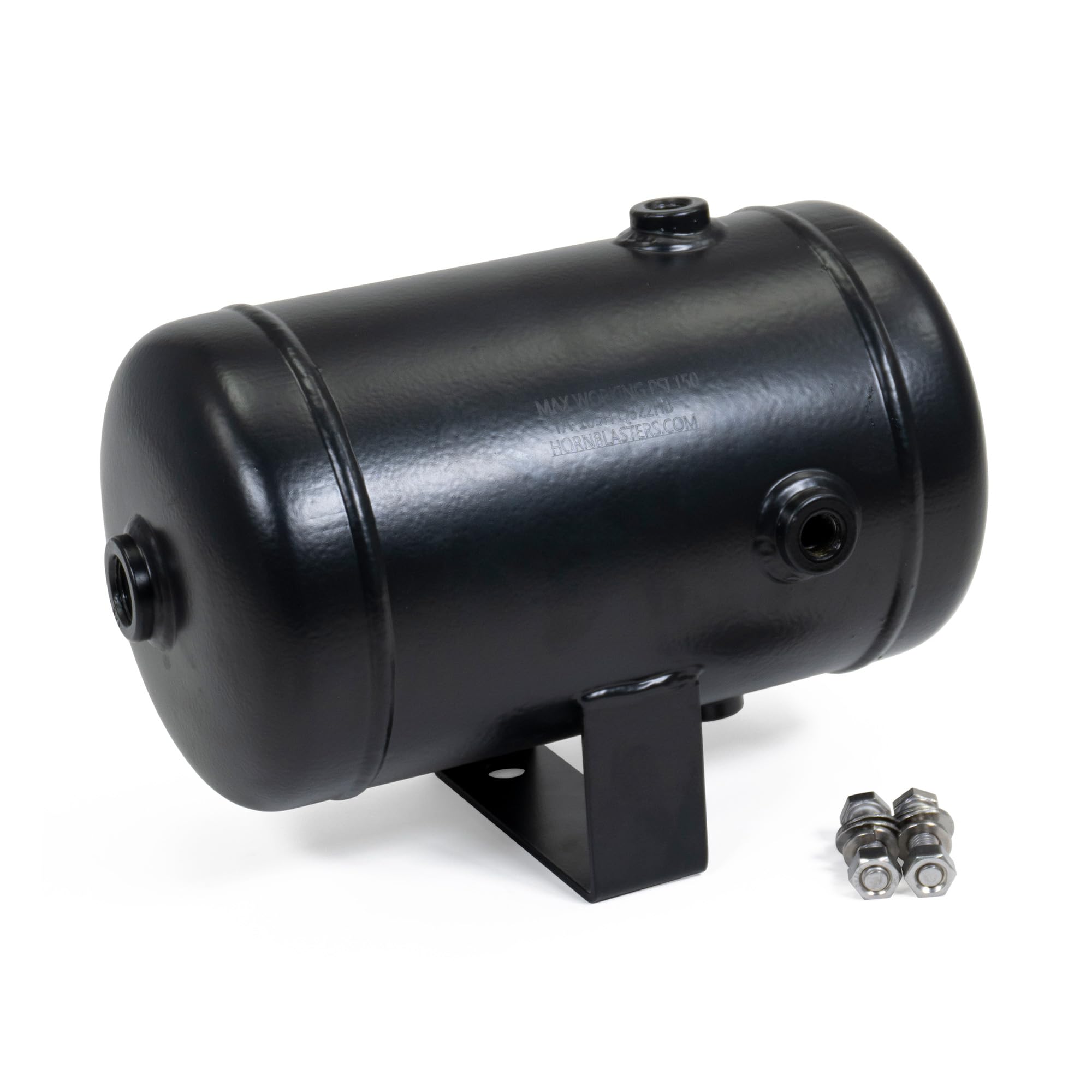
3. HornBlasters 1-Gallon 5 Port Steel Air Tank
The five-port budget champion that gives you a big 1/2″ opening plus four 1/4″ ports for accessories.
This tank solves the “not enough ports” complaint entirely, and it does it at a budget-friendly price. The HornBlasters 1-gallon tank offers five threaded openings — one 1/2″ NPT port for high-flow needs and four 1/4″ NPT ports for everything else. That mix means you can run a thick line for an air locker or suspension while still having room for a gauge, switch, and fill valve without any adapters.
The build quality earns genuine surprise from owners, with several noting how good the threads are. As customers note: “Excellent quality..I dont know how they can make them so inexpensive!..Threads were good and no leaks.” The stealth black powder-coated finish protects against corrosion, and it measures a compact 10.5 inches long by 6 inches in diameter, so it slips into tight vehicle spaces. The foam-padded packaging also got a mention, with ports arriving clean and capped with plastic plugs.
There is no published PSI rating in the listing, which is a gap if you plan to run a high-pressure compressor — do not assume it matches the 150 PSI of the Viair picks above. Owners also note it is “not really good for much” beyond holding air, meaning it is a storage vessel, not a complete system. But for a machine builder adding a pneumatic accumulation tank, it is “well worth the money.”
Why it stands out
- Five ports including a high-flow 1/2″ NPT opening
- Clean, leak-free threads straight from the start
- Compact 10.5-inch length fits tight installs
Check before you buy
- No pressure rating published in the specs
- Black finish, so not for corrosion-heavy climates
Grab this if: you are building a pneumatic system and want maximum port flexibility for the least money.
Think twice if: you need a stated 150 PSI or higher rating to safely match a powerful compressor.
4. VUYOMUA 1 Gallon Stainless Steel Air Tank, 180 PSI

The mirror-polished stainless tank that shrugs off rust and pushes a higher 180 PSI ceiling.
Most steel tanks will rust if you neglect them, but this pick is built from 304 stainless steel precisely so you do not have to stress about corrosion in humid or acidic environments. It also runs a higher 180 PSI rating — a 20% margin over the 150 PSI that the Viair tanks above carry — which gives you more stored energy for quick bursts from horns or tire inflation. Owners call the welds “top notch” and the finish “super nice,” so the mirror polish is not just for looks; its smooth surface resists stains and wipes clean easily.
The layout is flexible with four NPT ports in two sizes: one 1/4″ NPT and three 1/2″ NPT. That is useful because the larger 1/2″ openings allow high-flow connections without needing a bushing to step down from a smaller port. At 5.5 pounds and roughly 8.86 x 6.3 x 8.86 inches, it is lighter than the 7-pound VIAIR 91014 despite running a higher pressure rating — the stainless construction does not add the heft you might expect.
Here is the honest catch: while the tank body itself earns praise, a few owners hit issues with the fittings and threads. One reported the side-mount inlet threads were too loose to seal, causing a constant leak, and the overall leakage and fitting quality both show up as recurring negatives in the review data. That means check each connection carefully with thread sealant and test for leaks before you mount it permanently. One creative owner repurposed it as a pre-oiler for rebuilt engines, which shows the versatility of a clean stainless vessel.
Corrosion-proof choice: The 304 stainless body and 180 PSI rating make this the pick for wet environments where painted steel would fail.
Test the threads: Since fitting quality draws mixed feedback, budget time to seal and pressure-test every port on arrival.
5. CNRAQR 1 Gallon Aluminum smooth Air Tank, 200 PSI
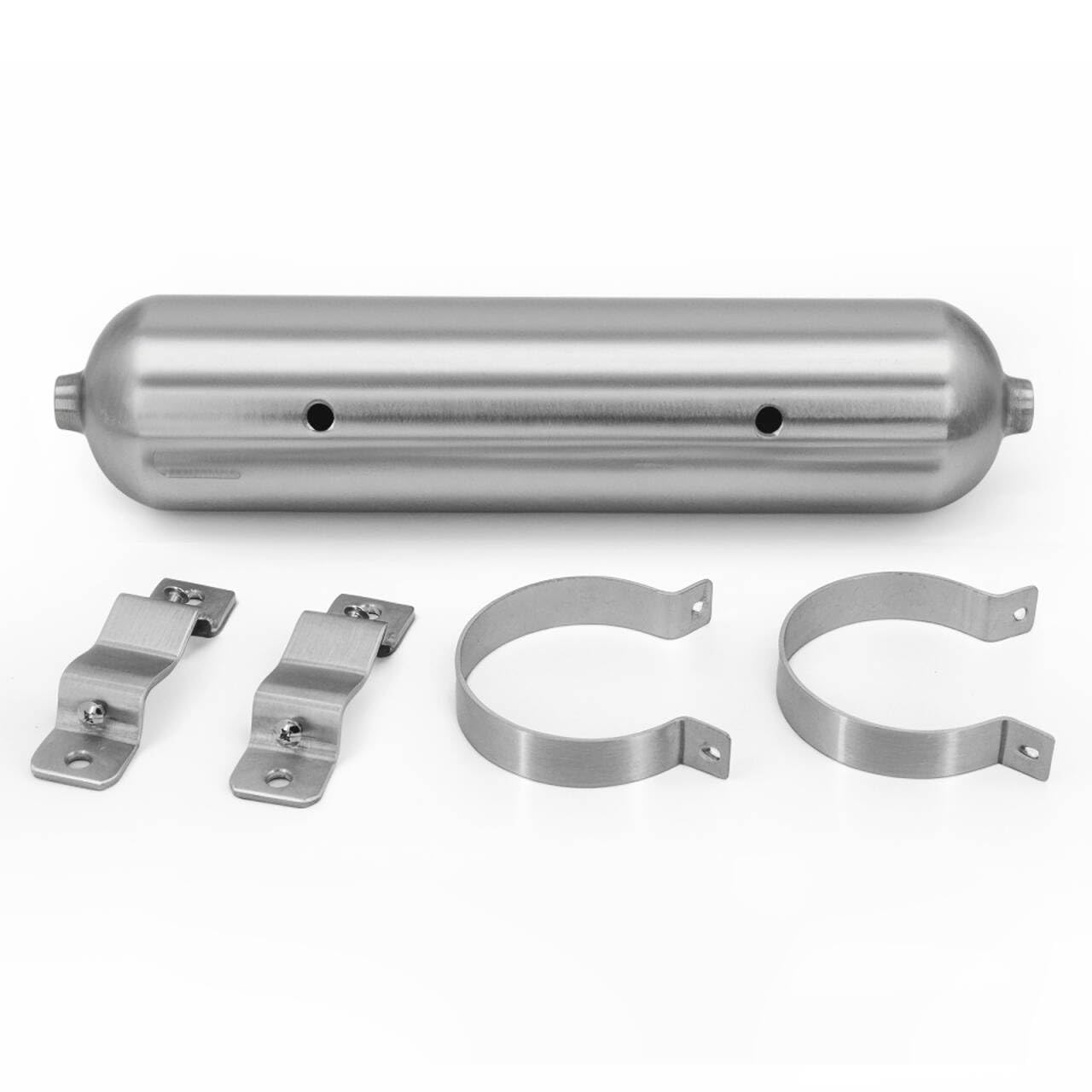
The smooth one-piece aluminum tank that never rusts and fights hard against corrosion fatigue.
This is the tank for the off-roader who is tired of draining rusty water out of a steel cylinder. It is made from high-quality aluminum with a surface-polished finish, and critically, it is smooth — formed in one piece without any welded seams. That design removes the weak points where steel tanks often crack and eliminates rust entirely, which is why owners say it “seems good quality” with “smooth welds on mine and standard brushed finish.” It carries a strong 200 PSI working pressure, matching the Viair 1.5-gallon above for the highest rating in this list.
Ports are plentiful at five G1/4″ threaded openings, and the two removable brackets make mounting straightforward — one owner fit it between the gas tank and spare tire of a small truck with just four bolts. Because aluminum is roughly a third the density of steel, this tank is noticeably lighter to handle and mount than the painted steel options, which helps when you are wrestling it under a vehicle by yourself.
The main catch is thread sealing. Reviewers point out the ports leak even with Teflon tape, describing the threading as “a little rough.” One noted none of the supplied plugs sealed properly and had to buy replacements, and the tank does not ship with a pressure relief valve (PRD), so factor that into your build. Treat this as a premium tank that needs careful assembly attention rather than a bolt-on-and-forget part.
Rust-free forever: The smooth aluminum body and 200 PSI rating make this ideal for long-term, corrosion-free service.
Budget for sealant: Since rough threads are a known issue, expect to work at getting a leak-free seal.
6. HONSDUKE 3 Liter Train Horn Kit with 1 Gallon Tank

The all-in-one train horn kit that pairs a 1-gallon tank with a 150 PSI compressor and four trumpets.
If you want a train horn, buying a bare tank means you then have to source a compressor, pressure switch, tubing, relay, and trumpets separately. This HONSDUKE kit skips all that by bundling a 1-gallon tank with a 150 PSI air compressor and a quad-trumpet setup the brand rates at 150 db. Owners describe the sound as “deep, powerful, and unmistakable — it easily cuts through traffic noise and turns heads from blocks away.” The kit runs on a working pressure band of 90 PSI on to 120 PSI off, with thermal overload protection to keep the compressor from burning itself out.
What wins people over is the quality versus the price — owners call it “not a cheap imitation” and say it is worth the money. The installation is the trade-off: several note the instructions are “pretty complicated,” and one owner mounted the trumpets in pairs behind a front bumper with custom brackets. It fits any DC12V vehicle, with owners installing it on trucks and even a 2001 Toyota Avalon.
The loudness itself draws mixed reactions — some find it exactly as expected, while others wanted more volume from a 150 db rated system. Note the tank is a 3-liter unit, which is roughly 0.8 gallons, so it sits just under the 1-gallon mark; expect the compressor to cycle fairly often during repeated blasts. Owners also stress draining the tank monthly to avoid moisture buildup that “can rust it out.”
What you get
- Full system: compressor, tank, four trumpets, and wiring
- Thermal overload protection on the compressor
- 150 db rated sound from a deep, multi-tonal horn
Before you commit
- Instructions are reportedly hard to follow
- Smaller 3-liter tank refills often during use
Buy this if: you want a complete bolt-on horn system without piecing together parts.
Pass if: you already own a compressor and just need a quality 1-gallon reserve tank.
7. Vixen Horns VXO8210 4 Trumpet Train Horn Kit

The popular four-trumpet kit whose 1-gallon tank and 150 PSI compressor draw huge owner numbers.
This is the most-purchased horn kit in this lineup, with a review count that dwarfs the others — nearly 500 owners have weighed in. That volume of feedback gives a clear picture: the installation is the standout feature, with owners praising how the compressor-tank connection and wiring come pre-done, making it “ready for a quick, clean and simple setup.” The four zinc-alloy trumpets in an in-line design are coated in black paint for weather resistance, and the kit includes a 6-foot hose, fuse, and horn button.
There is real nuance in the owner consensus here, though. Sound quality draws the most mentions by far, but the reaction is mixed — some call it “very loud” and “train-like,” while others found it “not as loud as expected.” One owner measured the actual pressure topping out around 110 PSI rather than the advertised 150 PSI, which would explain the volume disappointment for some. Reliability also splits opinions, with the loudest negatives aimed at the compressor: several report it stopping after about a week, and others say it lasted just over six months before failing.
Weigh this honestly against the HONSDUKE kit above, which carries a higher 4.4-star average. The Vixen kit trades that reliability edge for easier installation and a bigger owner base. The 1-gallon steel tank delivers roughly five to ten honks before needing a refill, which suits occasional use but not constant blasting. As one owner put it after a road trip, the kids loved it — but if you plan daily heavy use, budget for the compressor being the weak link.
Easy install, huge owner base: The pre-wired system and simple layout make this the friendliest kit for a first-time installer.
Reliability caveat: Since compressor durability is the most consistent complaint, treat this as a budget system that may need a compressor swap down the road.
Understanding the Specs
PSI Rating
PSI stands for pounds per square inch, and it measures the air pressure inside the tank. A 150 PSI tank safely holds air compressed to 150 pounds per square inch; a 200 PSI tank holds more. Always match the tank’s rating to your compressor’s maximum output — if your compressor pushes 180 PSI, do not connect it to a 150 PSI tank. Leave some margin for safety, and remember that a higher rating means more stored energy for quick horn blasts or tire fills.
NPT Ports
NPT stands for National Pipe Thread, and it is the standard threading used on air fittings in North America. A port is simply a threaded hole where you screw in a fitting. The number after the fraction — like 1/4″ or 1/2″ — is the opening size. A 1/2″ port is larger and allows higher air flow than a 1/4″ port. Count your needs: a pressure switch, a gauge, a relief valve, and a drain each want their own port, so four ports cover a typical build while two ports force you to use tee splitters.
Steel vs. Aluminum
Steel tanks are heavier and cheaper, and they resist dents from rocks and debris. Their weakness is corrosion — moisture condenses inside any air tank, and if you never drain it, steel rusts from the inside out. Aluminum tanks cost more but never rust, and they weigh less, which helps when mounting under a vehicle. The trade-off is that aluminum threads can strip more easily if you over-tighten fittings, so brass adapters and careful torque matter more.
Drain Maintenance
Every air tank collects water. As compressed air cools, the humidity in it condenses into liquid that pools at the bottom of the tank. If left alone, that water rusts steel tanks and can freeze in cold weather, blocking your air lines. A drain cock or valve at the bottom lets you release this moisture. Owners consistently advise draining tanks daily in humid climates or at least monthly in drier ones — it is the single best habit for making a steel tank last.
FAQ
Will a 1 gallon air tank fit under my truck or Jeep?
What PSI rating do I need for a 1 gallon air tank?
How many ports do I really need on my air tank?
What is the difference between 1/4″ NPT and 1/2″ NPT ports?
Is a steel or aluminum 1 gallon air tank better?
Should I buy a bare tank or a complete train horn kit?
How long does a 1 gallon air tank hold air before refilling?
How do I stop my air tank from rusting on the inside?
Final Thoughts: The Verdict
For most owners, the right 1 gallon air tank starts with the VIAIR 91014 because its four ports, 150 PSI rating, and proven build quality cover nearly every truck and Jeep build at a sensible price. If you need the most connection points for the least money, the HornBlasters delivers five ports including a high-flow 1/2″ opening. And for a rust-free build with a higher 200 PSI ceiling, the CNRAQR aluminum tank is the one to reach for. Whichever you choose, remember the single habit that keeps any steel tank alive: drain the moisture regularly.
How We Picked
We do not accept paid placement. Every pick is matched to a real buyer and a real use-case; we do not hands-on test units.
Sources & Methodology
Specifications: manufacturer listings and product documentation. Review insights: verified customer reviews, as of September 2026. Pricing: not shown on this page (it changes often); check the current price via the retailer link.
As an Amazon Associate, KitchPrep earns from qualifying purchases. This does not affect which products we feature.
Related Guides
