
Specs are compiled from manufacturer listings and verified buyer reviews and can change over time — please confirm the key details on the product page before buying.
When the grid goes dark, a battery generator for home keeps your fridge cold, your router online, and your lights on without the roar, fumes, or fuel runs of a gas machine. The real question isn’t if you need one — it’s how much capacity and output your home actually demands. You need to match a unit’s capacity (measured in watt-hours), output (in watts), recharge speed, and expansion options to your real outage needs, and this guide compares those specs across the top picks.
I’m Mohammad Maruf — the founder and writer behind KitchPrep. This guide is built by comparing the manufacturers’ published specifications and the patterns across verified customer reviews, so you get each pick’s real strengths and trade-offs instead of marketing spin.
We’ve ranked the top battery-powered generators that can keep essential home appliances running during an outage, with honest trade-offs on weight and charging. battery generator for home
Our Picks at a Glance


How To Choose The Best Battery Generator for Home
Choosing a home backup battery isn’t about grabbing the biggest number you can afford. You need to think about what you’ll power, for how long, and how fast you can refill the station when the outage stretches on. These three decisions — capacity, output, and recharge — will shape every other choice you make.
Capacity: match it to your must-run appliances
Capacity is measured in watt-hours (Wh) — the total energy the battery can store. A 2,048Wh station could keep a typical fridge (around 150W) running for roughly 12 hours, or power your router, lights, and a laptop for a full day. For short outages under a day, a 1,000Wh unit often covers the essentials. If you want multi-day backup with a freezer or sump pump in the mix, step up to 3,000Wh or plan to add expansion batteries.
Output: can it start the appliance?
Output wattage (W) tells you how much power the station can deliver at once — and some appliances need a surge of power just to start. A fridge might run on 150W but need 600W to kick on its compressor. If you want to run power tools, a microwave, or a window AC, look for a station with 2,400W or more of continuous AC output, ideally with a boost mode for resistive loads.
Recharge: how do you refill it?
Outages rarely announce themselves politely. AC wall charging is your fastest refill — some stations hit 80% in under an hour. Solar input is the long-game option for multi-day outages, but it’s slower and depends on panel wattage. A few premium units also accept car alternator or even EV-station charging, which can be a lifesaver when the grid is down for days.
Quick Comparison
Note: this list uses flexible matching for capacity suitable for home backup (at least 1000Wh or higher), so not every pick is the exact size you searched; the nearest same-type unit serves the same purpose.
| Model | Best For | Capacity | Output | AC Charging Input | Amazon |
|---|---|---|---|---|---|
| BLUETTI AC200L★ Best Overall | Expandable whole-home backup | 2048Wh | 2400W | 2400W | Amazon |
| EcoFlow DELTA 3 PlusBest Value | Fast-charging portability | 1024Wh | 1800W | 1500W | Amazon |
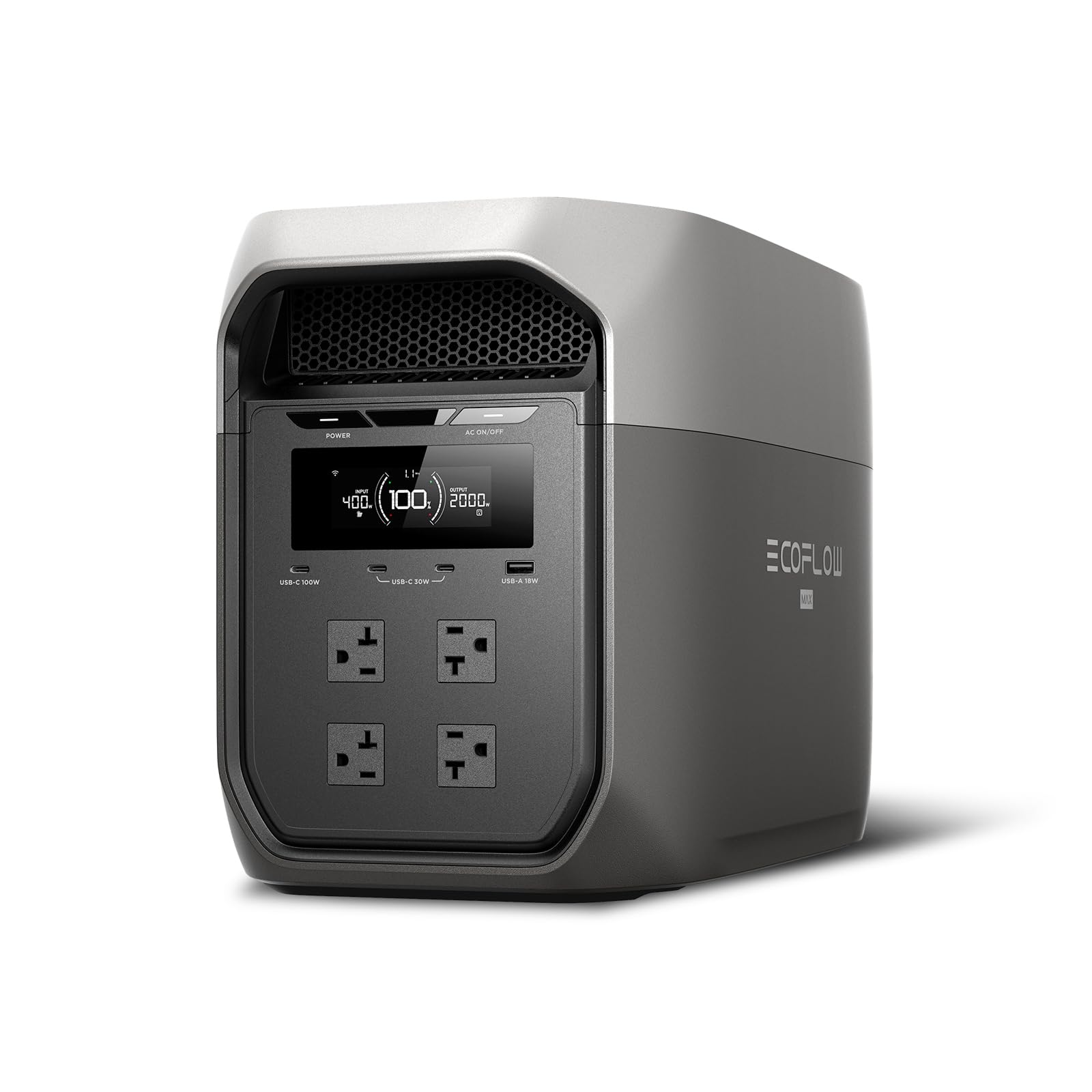
| EcoFlow DELTA 3 MaxTop Performer | High-output home backup | 2048Wh | 2400W | — | Amazon |
| BLUETTI Elite 200 V2 | Compact 2kWh with big surge | 2073.6Wh | 2600W | 1800W | Amazon |
| Jackery Explorer 2000 Plus | Brand-trusted expandable backup | 2042.8Wh | 3000W | — | Amazon |
| PECRON F3000LFP | Budget-friendly 3kWh capacity | 3072Wh | 3600W | 1800W | Amazon |
| Anker SOLIX C2000 Gen 2 | Ultra-low standby drain | 2048Wh | 2400W | — | Amazon |
| Jackery HomePower 3000 | Compact 3kWh whole-home | 3072Wh | 3600W | — | Amazon |
| Anker SOLIX F3000 | Whole-home with generator input | 3072Wh | 6000W | — | Amazon |
| GROWATT HELIOS 3600 | Fast solar + split-phase output | 3600Wh | 3600W | — | Amazon |
| EcoFlow DELTA Pro | Maximum capacity & output | 3600Wh | 3600W | — | Amazon |
In‑Depth Reviews
1. BLUETTI AC200L Portable Power Station
Our pick — over 4.5★ from 500+ verified ratings; the strongest balance of quality and price.
The expandable workhorse that turns a single backup unit into a whole-home power system.
Buyers report it powered a 13.5K rooftop AC and a 1500W leaf blower, confirming the 2400W output handles heavy loads. The 2048Wh LiFePO4 battery (a lithium-iron-phosphate chemistry known for long life) delivers 3000+ cycles, so it’s built for years of daily use, not just storm-season standby.
What sets the AC200L apart is its growth path. You can expand capacity up to 8192Wh by adding battery packs — 2 B300K units at 2764Wh each, 2 B210 at 2150Wh, 2 B300 at 3072Wh, or 1 B230 at 2048Wh. That flexibility means you can start affordable and scale up only if your outage needs grow. It also features a 30A RV port and a 48V/8A DC port, so it doubles as an RV or van-life power source between outages.
The crowd favorite for performance and reliability, this is the pick owners trust most. Battery life draws mixed comments — some owners want more runtime at heavy draw, which is simply the physics of any 2kWh station. At 61.4 pounds and roughly 16.5″L x 11″W x 14.4″H, it’s a two-person lift, so think about where you’ll store it before an outage hits.
versatile power output
- Fast 0-80% recharge in 45 minutes at 2400W AC input
- Expandable to 8192Wh with multiple battery pack options
- Runs heavy loads — rooftop AC, kettles, blowers
- 13 versatile ports including 30A RV and 48V/8A DC
heavy unit
- At 61.4 pounds, it needs two people to move safely
- Battery life under continuous heavy draw is limited
powerful and portable: you want one station that can backup your home today and expand into a bigger system tomorrow.
budget buyers: you need something light enough to carry solo between rooms or into a car trunk.
2. EF ECOFLOW Portable Power Station DELTA 3 Plus
The 1024Wh lightweight that recharges faster than most stations twice its size.
Owners mention a 27% to 100% charge in 40 minutes, so a quick lunch break can top it up between outages. That pace comes from a 1500W AC input, which is 60% more than you’ll find on bigger stations, making it the fastest refill in this lineup. At 27 lbs, it’s also one of the few home-backup units you can genuinely carry one-handed.
That portability has a cost: 1024Wh is half the capacity of the BLUETTI AC200L above, giving you roughly half the runtime on the same load. In one real outage test, owners ran a fridge for about 2.5 hours and estimated 12.5 hours total before the battery would empty. The 1800W output still handles a space heater on high, and a 10ms switch-over UPS mode protects sensitive electronics like computers and NAS drives from blips.
What wins people over here is quality and reliability — buyers consistently call it well-built and dependable. The LiFePO4 battery is rated for 4000 cycles to 80%, with a 10-year lifespan claimed for daily use. Charging flexibility is a genuine strength: AC, solar (reaching 80% in 1 hour), an 800W car alternator, and even EcoFlow’s smart generator or hybrid AC+solar all work.
fast charging speed
- Recharges 27% to 100% in 40 minutes
- Portable at 27 lbs and roughly 16″L x 8″W x 11″H
- 10ms UPS switch-over protects sensitive gear
- Powers 13 appliances simultaneously
pricey for capacity
- 1024Wh means shorter runtime on big appliances
- High idle draw of ~15W when off, ~45W when on
quick top-ups: apartment dwellers and office workers who want quiet, fast backup for a fridge and electronics — not a whole-house rig.
small loads: you need multi-day capacity for freezers or sump pumps without adding an expansion battery.
3. EF ECOFLOW DELTA 3 Max Portable Power Station
A 2048Wh station that recreates the AC200L’s capacity with quieter operation and faster 0-80% charging.
Customers note it ran a TV for about 12 hours on one charge, showing what 2048Wh delivers for everyday electronics. Where it truly shines is speed: EcoFlow’s X-Stream technology refills 0-80% in just 1.13 hours, so you’re rarely caught with a dead battery when the forecast turns ugly. The 2400W output also matches the AC200L exactly, giving you the same appliance range — fridges, microwaves, power tools.
The headline feature is 3400W of X-Boost continuous output, which lets this station start and run appliances that would stall a standard 2400W unit. X-Boost is EcoFlow’s power-lifting mode that briefly overdrives the inverter to handle resistive loads. Owners also praise the sub-10ms transfer time that keeps computers and medical devices safe, plus ultra-quiet operation that won’t disturb sleep during overnight outages.
Performance wins buyers over here — it’s consistently described as a top-quality system that charges super fast and holds power long. The LiFePO4 battery and aluminum-and-plastic build are rated for 10 years of daily use with a 5-year service plan. At roughly 9.4″L x 12″W x 19.44″H, it’s a different footprint than the BLUETTI — taller and narrower — so measure your shelf space before committing.
high capacity output
- 0-80% recharge in just 1.13 hours
- 3400W X-Boost powers 99% of appliances
- Sub-10ms transfer time for sensitive electronics
- 10-year LiFePO4 lifespan with 5-year service
bulky design
- Heavier than the AC200L despite similar capacity
- Charging capability draws mixed owner comments
large energy needs: you want AC200L-level capacity but need faster recharge and quieter bedside operation.
light camping: you want more expansion battery options — the AC200L accepts more pack configurations.
4. BLUETTI Elite 200 V2 Portable Power Station

A 2073.6Wh station that squeezes 2600W of power into a cube 40% more compact than its rivals.
The Elite 200 V2 crams nearly identical capacity to the AC200L into a smaller, lighter frame — reviewers point out it weighs 53.4 lbs versus the AC200L’s 61.4, with dual handles that make car-camping loads manageable. The 2600W continuous output and 3900W power-lifting mode handle a microwave, coffee maker, or air fryer without breaking a sweat. Buyers ran a 1300W microwave and 1600W air fryer, with occasional overload shutdowns on the air fryer that reset via the power button.
Standby efficiency is a standout: consumption drops to just 10W, which BLUETTI claims is 3 times lower than comparable stations. One owner reports saving per month using time-of-use charging — pulling cheap off-peak power and running appliances from the battery during peak rates. The trade-off is no expansion port, so what you buy is what you get, unlike the AC200L’s 8192Wh ceiling.
Charging speed is a genuine strength with a caveat. Turbo Mode hits 0-80% in 1 hour at 1800W AC input, while Standard Mode’s 1440W input takes 1.6 hours and extends battery health. Silent Mode runs at 800W and produces just 16-30dB — about 45% quieter than typical stations. The 6,000-cycle, 17-year LiFePO4 lifespan is the longest claimed in this roundup, backed by CNAS certification.
efficient battery cells
- 3900W power-lifting handles high-draw appliances
- Just 10W standby consumption for longer runtimes
- Silent Mode runs at 16-30dB for bedroom-safe operation
- 6000+ cycle lifespan with 17-year claim
limited ports
- No expansion — capacity is fixed at 2073.6Wh
- Rubbery buttons and no 30A 12V output
daily reliability: you want maximum surge power and longest lifespan in a compact, non-expandable package.
high wattage tools: you foresee needing more than 2kWh during multi-day outages.
5. Jackery Explorer 2000 Plus Portable Power Station

The crowd favorite that swaps gas cans for a whisper-quiet 30dB hum while running heavy tools.
Shoppers say it replaced a gas generator, powering a DeWalt rotary hammer and running electric systems for hours at full wattage without overheating. That ease comes from 3000W of AC output — the highest in the 2kWh tier here — and a 2042.8Wh LiFePO4 battery rated for 10 years of use. Owners say it’s genuinely life-changing for off-grid living and RV adventures.
Expansion is the headline: you can connect up to 5 add-on battery packs to scale from 2kWh to 12kWh, and even pair two Explorer 2000 Plus stations in parallel to hit 24kWh with 6000W of combined output. That makes it one of the few mid-size stations that can grow into a serious whole-home backup. Jackery’s ChargeShield technology claims a 50% battery-life boost, backed by a 5-year warranty.
What owners praise most is overall quality, with reliability close behind. It’s also genuinely quiet — just 30dB in operation, which is library-level silence. The honest trade-offs: charging speed gets mixed comments (some report shorter times than advertised, others say it won’t fully charge), and at 62 pounds with a telescopic handle some find flimsy, it’s not the easiest to roll around.
expandable capacity
- 3000W output powers ACs, RVs, and power tools
- Expandable to 24kWh with parallel pairing
- 30dB whisper-quiet operation
- 10-year LiFePO4 battery with 5-year warranty
slow recharge
- Charging speed draws mixed owner feedback
- Bulky battery connector and no battery-saving mode
long off-grid trips: buyers who want a trusted brand name and the option to grow from 2kWh to 24kWh as needs evolve.
quick refills: you prefer a lighter 53.4 lb station with faster Turbo charging.
6. PECRON Portable Power Station F3000LFP
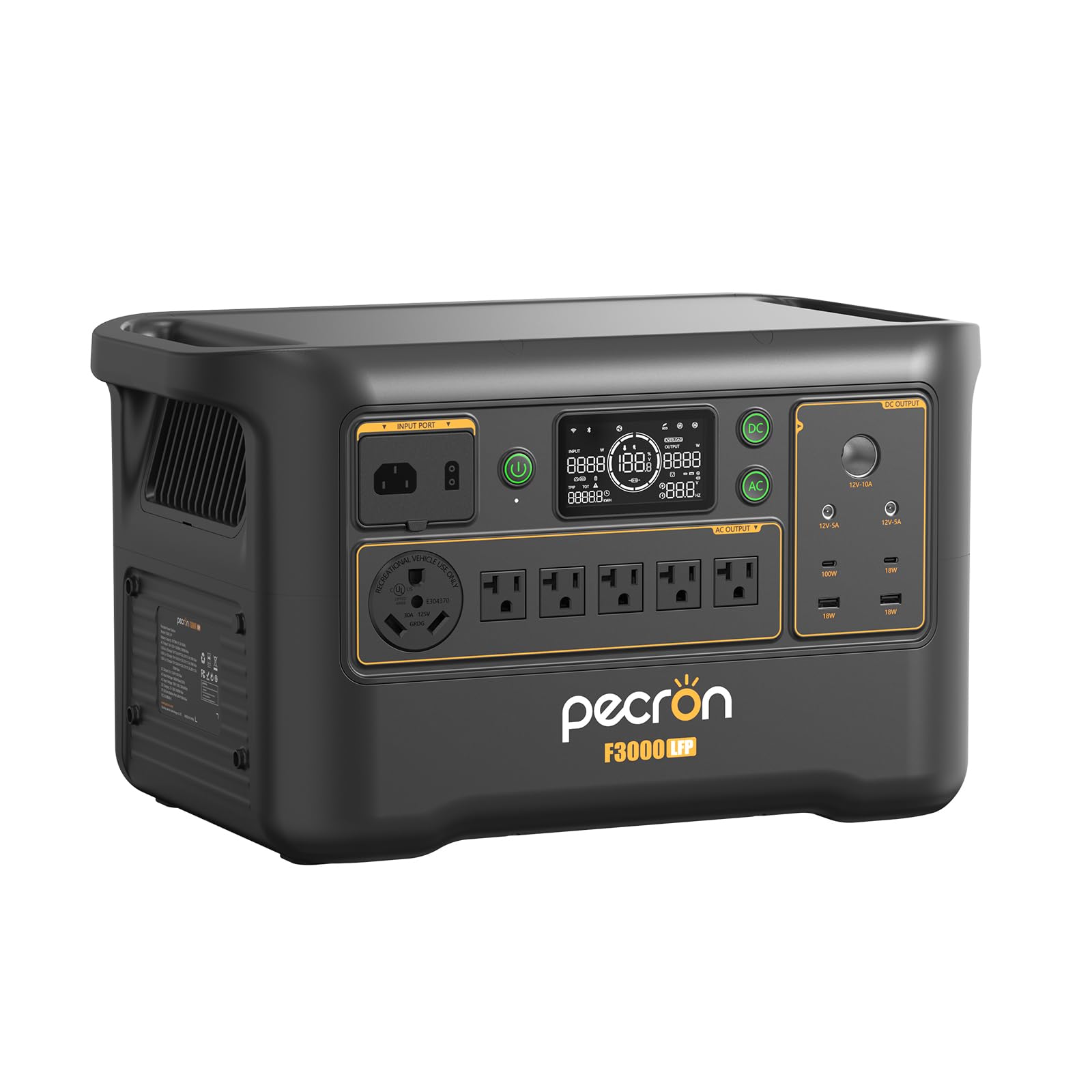
A 3072Wh giant that delivers 3kWh-class capacity at a price that undercuts the premium brands.
Buyers report it handled 40+ outages over 5 months with zero issues, a reliability record that belies its budget price. The 3072Wh LiFePO4 battery provides emergency backup for 2-3 days of home essentials, and owners confirm it runs fridges and freezers through blackouts and camping trips alike. At 3600W of pure sine wave output, it powers 13 devices at once, including refrigerators, air conditioners, and power tools.
Charging is quick too: a 1800W AC input refills 0-100% in 2 hours, which owners say is genuinely 30% faster than comparable units. Solar input up to 1600W at 25-120V works if you plan to pair it with panels.
Reliability is the top praised aspect, with value for money close behind — buyers repeatedly call it the best power-to-price ratio they’ve found. The honest trade-offs: the 63.3-pound weight draws negative comments, some low-level noise is reported during charging, and the one XT120-M cascade cable needed for expansion batteries is sold separately. An 8-20ms UPS switch mode protects computers and medical devices during outages.
rugged build quality
- 3072Wh delivers 2-3 days of home essentials
- 1800W AC input refills in 2 hours
- 13 ports including 2 USB-C at 100W PD
- Expandable to 10752Wh with battery packs
low wattage ceiling
- 63.3-pound weight is a two-person job
- Expansion cable sold separately
- Some low-level fan noise while charging
outdoor durability: budget is the deciding factor but you refuse to drop below 3kWh of real backup capacity.
heavy appliances: you want the polished app and lighter weight of the premium EcoFlow or Jackery units.
7. Anker SOLIX C2000 Gen 2 Portable Power Station
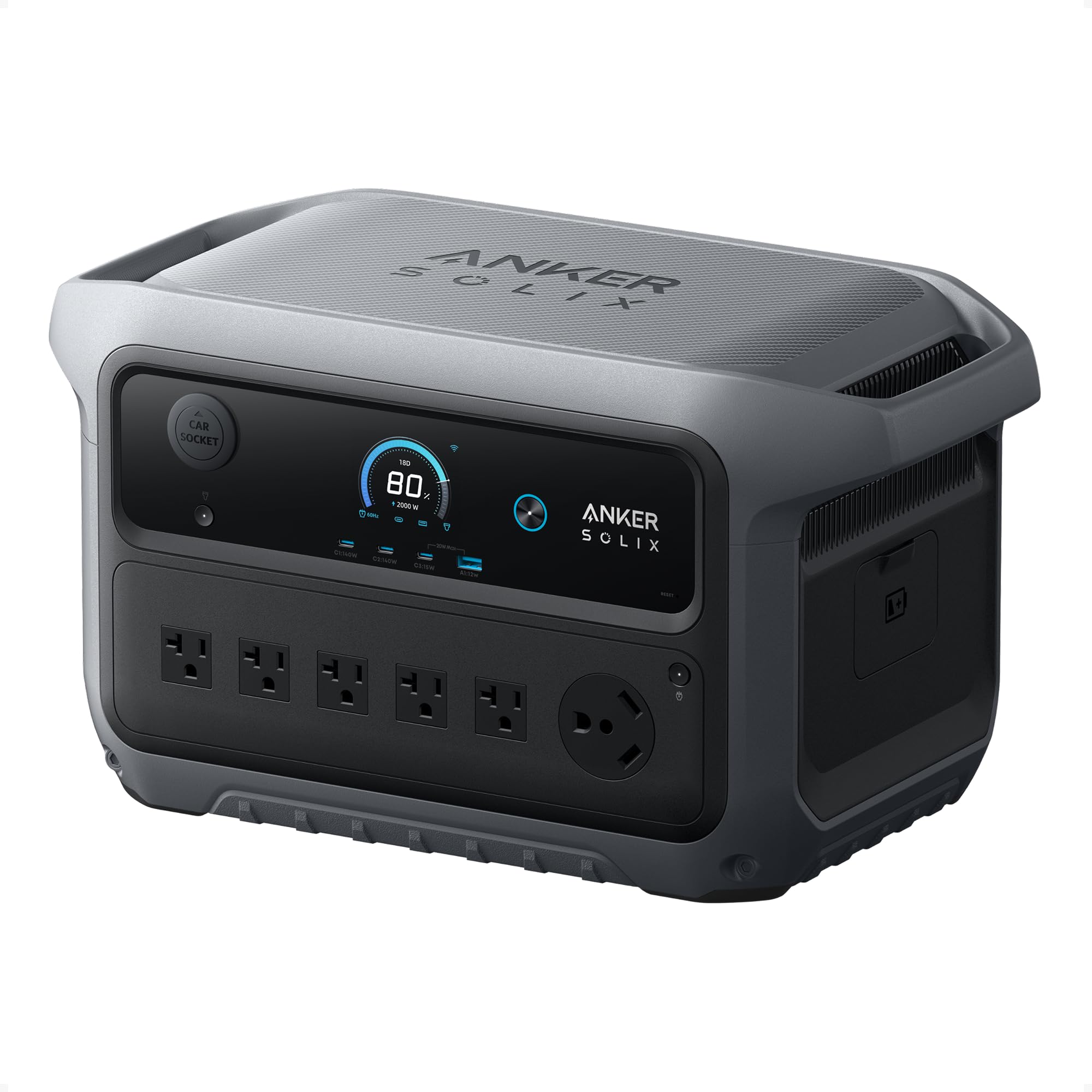
The 41.7 lb featherweight that sips just 9W on standby and runs a fridge for 32 hours.
Owners mention it slid under counters and TV stands, thanks to an 18.1″L x 9.8″W x 10.1″H footprint that Anker says is 25% lighter and 29% smaller than rivals. That’s remarkable for a 2048Wh unit, making it the most living-room-friendly backup option here. The ultra-low 9W standby draw means it can sit plugged in for months, ready to go, without silently draining its own battery.
Runtime is the efficiency story: Anker rates it to run a dual-door fridge for up to 32 hours, and with an add-on expansion battery reaching 4kWh, that stretches to 64 hours. Owners confirm it runs a camper 12V fridge for days and handles a miter saw, drill, and battery charging with ease. A 4000W peak output — against a 2400W rated — starts most window and RV air conditioners.
The value proposition is quiet competence: quick 58-minute full recharges, six ways to top up including an 800W car alternator that hits 100% in 3 hours, and enough outlets to prevent breaker trips in older homes. Owners note the app’s runtime estimates run inaccurate for cycling appliances like fridges — treat those numbers as rough guides. At about 41.7 lbs, it’s the lightest 2kWh station here, though many still pair it with a wheeled case.
smart app control
- 9W standby drain preserves stored energy
- Runs a dual-door fridge up to 32 hours
- Lightest 2kWh station at 41.7 lbs
- Full recharge in 58 minutes
average runtime
- Won’t run a large AC for long periods
- App runtime estimates inaccurate for cycling loads
tech-savvy users: you want a permanently-plugged-in backup that won’t drain itself and disappears under furniture.
budget conscious: you need heavy-tool power and RV-grade 30A output the C2000 can’t match.
8. Jackery HomePower 3000 Portable Power Station
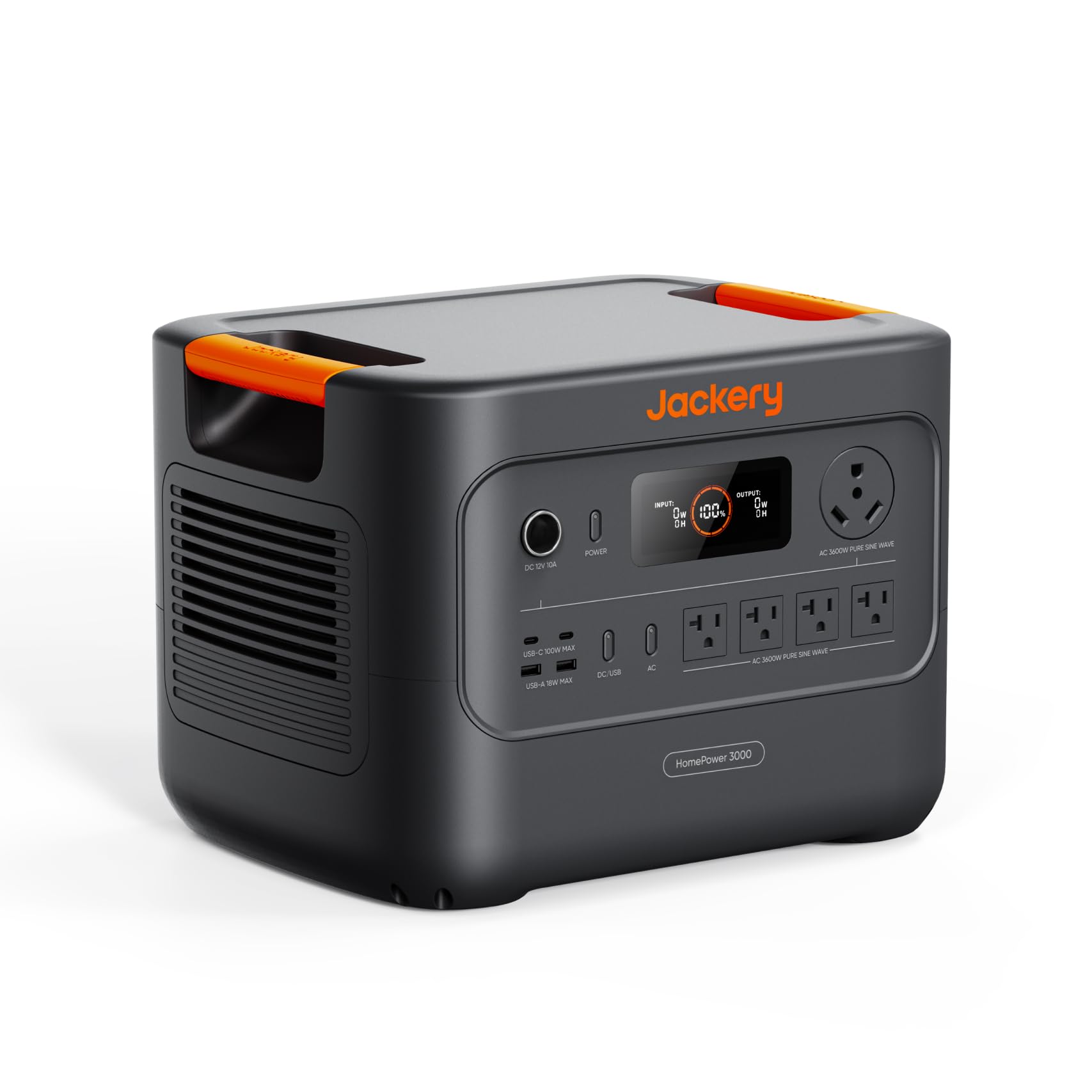
The 3kWh station that’s 47% smaller and 43% lighter than comparable whole-home backups.
Customers note it powered a Whirlpool side-by-side fridge for 30+ hours and ran an air fryer oven, showing 3072Wh and 3600W output (7200W surge) handle both long and heavy loads. Jackery claims it keeps a household running up to 15 hours and a fridge cold for 1-2 days. The ≤20ms UL-certified UPS switch (a backup power system that kicks in within 20 milliseconds) keeps security cameras, medical fridges, and Zoom calls running smoothly through surges.
The defining spec is its footprint. As the first 3kWh station with CTB (cell-to-body) technology, it boosts space efficiency by 14% while shedding bulk — a meaningful advantage if floor space in your utility room is tight. A built-in TT-30 RV port lets you plug a camper in directly, and dual 100W PD ports fast-charge phones, tablets, and drones. Full recharge takes 1.7 hours via hybrid AC+DC or 2.2 hours on AC alone.
Performance is what owners praise most, trailed by battery life. The LiFePO4 cells (lithium iron phosphate, a long-lasting battery chemistry) are rated for 4,000 cycles while retaining 70% capacity, backed by Jackery’s ChargeShield 2.0 AI-enhanced charging. The honest trade-offs: at 59.5 pounds it’s still heavy (two handles help), the cooling fan runs around 60dB (about as loud as a normal conversation) on any power draw — too loud for daily UPS use next to a desk — and value for money draws mixed comments.
whole-house backup
- Runs a fridge 30+ hours on one charge
- 7200W surge starts demanding appliances
- 47% smaller than comparable 3kWh units
- Built-in TT-30 RV port
high price tag
- 60dB cooling fan too loud for daily indoor UPS use
- 59.5 pounds needs two hands to move
home emergencies: you need true 3kWh whole-home backup but lack floor space for a boxy station.
small budgets: expansion to 8kWh matters more than a compact single-unit footprint.
9. Anker SOLIX F3000 Portable Power Station
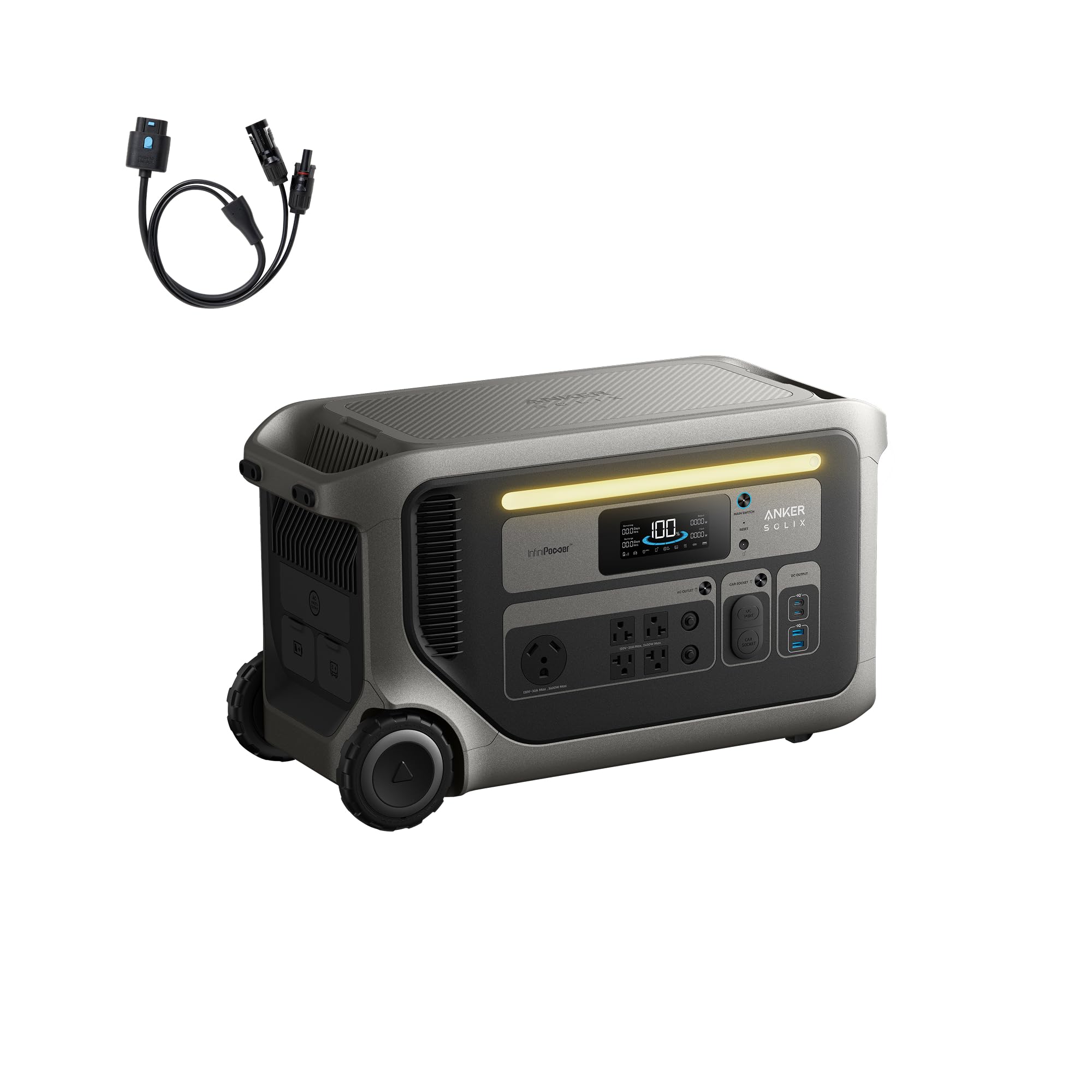
The wheeled 3kWh titan that pairs with a gas generator and recharges at a monstrous 6000W.
Reviewers point out it powers a 13k Coleman roof AC—a load most stations can’t start—and runs an 8000 BTU AC for over 4 hours. That capability comes from a massive 6000W rated output split across 120/240V, with the option to pair two units for 240V whole-home needs. Owners call it “fully armed and operational… on wheels,” and at 91.5 pounds with built-in wheels, you’ll want them.
The headline feature is pass-through charging: a 3600W input lets you recharge from a 120V generator while simultaneously running appliances at full power. That means a small gas generator can act as a range-extender, keeping your battery topped up during a multi-day outage without running the gas unit 24/7. Needs are covered for 10 hours on the base 3kWh, expandable to 24kWh for 80 hours of outage-proof energy.
Efficiency is quietly excellent: 125 hours of AC idle standby time or a 190W fridge running for 42 hours speaks to ultra-low internal drain. Solar recharging hits 2400W via 165V or 60V ports, and combining a fuel generator with solar achieves that 6000W input. Shoppers say no complaints after 6 months of use, calling it well-built, easy to set up, and worth the money — though the flexing solar panels drew one crack complaint during transport.
massive storage capacity
- 6000W input recharges at industry-leading speed
- Runs a 13k roof AC and 8000 BTU units
- 125-hour idle standby preserves charge
- Generator pass-through runs appliances while refilling
very heavy
- 91.5 pounds — wheels are essential, not optional
- Companion solar panels flex and risk cracking in transit
extended outages: homes that already own a small gas generator and want to stretch its runtime into multi-day backup.
frequent movers: you need something you can carry upstairs — this one lives where it lands.
10. GROWATT HELIOS 3600 Portable Power Station
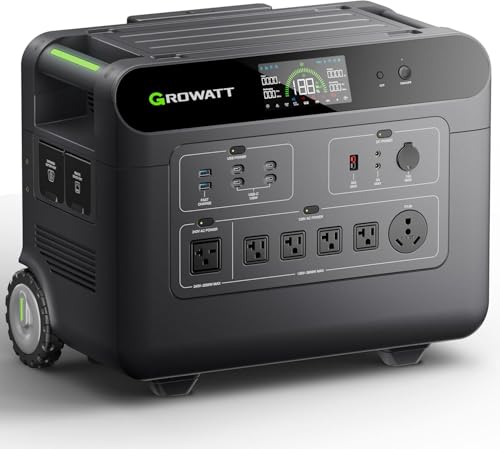
A 3600Wh station with 2000W solar input that fully recharges from panels in just 2.8 hours.
Buyers report this station ran a large window AC unit for over 12 hours before draining — and one owner has run their entire off-grid house from it for nearly a year. The 3600Wh LFP battery and 3600W output (paired units deliver 240V/7200W) make it a legitimate home-backup contender, providing up to 15 hours for daily devices and 1-3 days for fridges. Growatt’s inverter heritage shows in the stable power delivery.
The solar story is the differentiator. A 2000W solar input fully recharges in 2.8 hours — the fastest panel refill in this lineup — which matters if you’re facing a week-long outage with sun on your roof. AC charging offers dual-voltage flexibility: 3 hours at 120V or 1.5 hours at 240V, with AC-DC hybrid hitting 3600W for a full charge in under 1.5 hours. Cold-start technology keeps it operational down to -22°F for winter storm outages.
Battery life is the top praised aspect, with value for money close behind. Owners consistently call it a powerful unit that delivers more than its price suggests. The trade-offs are real but manageable: at 51 pounds it’s heavy (some report needing two people), the app’s Bluetooth pairing draws negative comments for repeated connection failures, and owners note a humming noise when drawing over 1200W. A <15ms EPS switchover protects servers and medical devices.
high power output
- 2000W solar input refills in 2.8 hours
- 3600Wh expands to 36kWh for 7-day backup
- 240V/7200W paired output for whole-home use
- Cold-start operation down to -22°F
limited portability
- Bluetooth app pairing fails repeatedly for some
- 51-pound weight and humming above 1200W draw
worksite power: you plan to recharge from solar and want the fastest panel refill in this class.
indoor use: you want EcoFlow’s more polished app and 15 output methods.
11. EF ECOFLOW Portable Power Station 3600Wh DELTA Pro
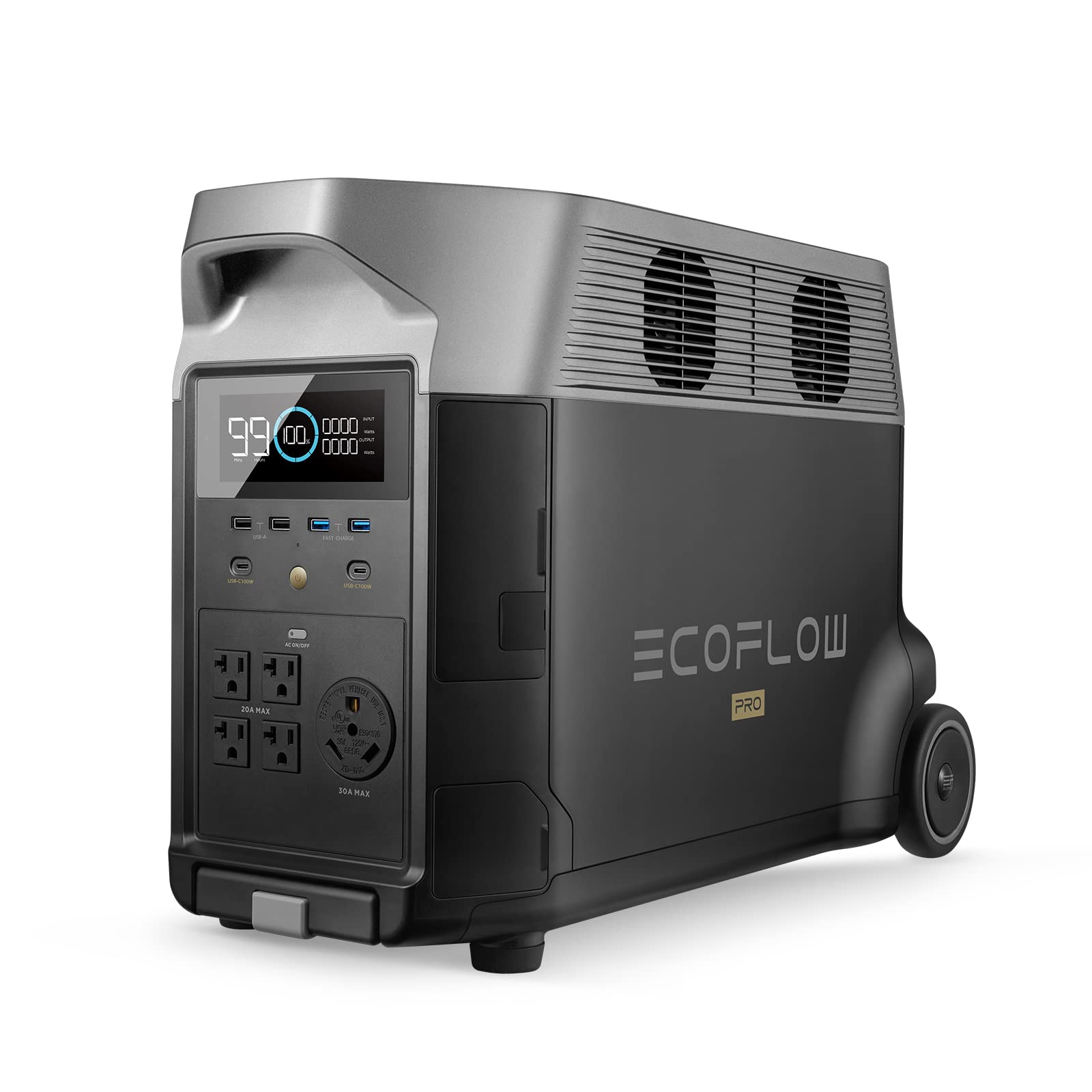
The 99-pound powerhouse that expands to 25kWh and powers 99.99% of home appliances.
Owners mention this station ran a heat press at vendor markets flawlessly and powered a fridge and lights overnight with 30% charge to spare — a genuine workhorse for both mobile business and home backup. The 3600Wh LFP battery (lithium iron phosphate, a long-lasting chemistry) provides serious storage, and output flexibility is class-leading: 3600W AC from a single unit, expandable to 4500W with X-Boost (a feature that boosts output for heavy appliances), or pair two units for 7200W of whole-home power.
The expansion ceiling is enormous. Add DELTA Pro Extra Batteries or Smart Generators and capacity grows from 3.6kWh to 25kWh — enough for days of full-home operation. Fifteen output methods cover every connector type: 2 USB-A, 2 USB-A Fast Charge, 2 USB-C at 100W, 5 AC outlets, 2 DC outlets, 1 car power output, and 1 Anderson port. That breadth is why owners call it a dependable, practical investment for outages and off-grid living alike.
Charging is genuinely fast: 1.8 hours from 240V outlets at 3000W, 2.7 hours from standard 1800W wall outlets, or 2.8 hours from 4x400W solar panels. Five charging methods — EV stations, solar, wall, smart generator, or car outlet — mean you’re rarely stranded. Owners praise the build quality and quiet operation versus gas generators, though the cooling fan gets noisy under heavy load and the 99-pound weight demands planning for placement.
expandable system
- 3600Wh expands to 25kWh with add-ons
- 3600W output, 4500W with X-Boost
- 15 output methods cover every device type
- 5 charging options including EV stations
expensive add-ons
- 99 pounds — placement is a permanent decision
- Cooling fan noisy under heavy load
scalable setups: you want the largest single-unit capacity and the most output flexibility in this lineup.
single use: 61.4 pounds feels more realistic to move and 8192Wh expansion is sufficient.
Understanding the Specs
Watt-Hours (Wh): The Size of Your Energy Tank
Watt-hours tell you how much total energy the battery stores — think of it as the size of your fuel tank. A 2,048Wh station can theoretically deliver 2,048 watts for one hour, or 200 watts for about 10 hours. To estimate your needs, add up the wattage of the appliances you must keep running and multiply by the hours you expect to be without power. A fridge at 150W for 12hours equals 1,800Wh, leaving little margin on a 2,048Wh station. That’s why most home-backup buyers step up to 3,000Wh or plan for expansion batteries.
Wattage Output (W): The Size of Your Power Hose
Output wattage determines which appliances your station can actually start and run. A fridge might draw 150W while running but needs a surge near 600W to kick on its compressor. A microwave needs 1,000W or more, and a window AC can demand 1,500W at startup. The continuous output rating tells you what the inverter can sustain, while boost modes like EcoFlow’s X-Boost or BLUETTI’s Power Lifting briefly overdrive the inverter to start resistive loads. Check both numbers — the rated continuous output and the boost figure — before assuming a station can handle your appliances.
AC Charging Input (W): How Fast You Refill
AC charging input measures how quickly the station can pull power from a wall outlet to recharge its battery. Higher input means faster refills — a 2,400W input can restore 80% of a 2,048Wh battery in roughly 45 minutes, while a 1,500W input might take closer to an hour for the same job. If you live in an area with frequent, short outages, fast AC charging lets you top up between events. For multi-day outages, solar input becomes the more critical number, since you’ll be refilling from panels rather than the grid.
Battery Chemistry and Lifespan
Nearly every modern home-backup station uses LiFePO4 (lithium iron phosphate) chemistry for the battery. Unlike older lithium-ion cells, LiFePO4 handles more charge cycles before degrading — typically rated for 4,000 to 6,000 cycles while retaining 70-80% capacity. That translates to a realistic 10-to-17-year lifespan for daily use, which is why these stations are considered long-term investments rather than disposable gadgets. The same chemistry also handles temperature extremes better, which matters if your station lives in a garage or utility room.
FAQ
How long will a battery generator for home keep my fridge running?
Can a battery generator run a window air conditioner?
What is the difference between a battery generator and a gas generator for home backup?
How long does it take to recharge a home battery generator?
What appliances can a 2,048Wh power station run during an outage?
What does UPS mode mean on a power station?
How do I connect a solar panel to my battery generator?
Can I expand the capacity of a battery generator later?
How much do battery generators weigh and can I move them?
Final Thoughts: The Verdict
If you want one dependable pick, the best battery generator for home is the BLUETTI AC200L because it balances a strong 2048Wh capacity, a fast 45-minute recharge, and genuine expandability to 8192Wh — covering everything from a single-night outage to multi-day emergencies as your needs grow. If portability and budget matter more and your outage needs stay modest, the lightweight EcoFlow DELTA 3 Plus delivers lightning-fast refills in a 27-pound frame. For whole-home muscle when the storm is serious, the EcoFlow DELTA Pro at 3600Wh expands to 25kWh and powers nearly any appliance you own — the closest thing to a gas generator that runs silently indoors.
How We Picked
We do not accept paid placement. Every pick is matched to a real buyer and a real use-case; we do not hands-on test units.
Sources & Methodology
Specifications: manufacturer listings and product documentation. Review insights: verified customer reviews, as of September 2026. Pricing: not shown on this page (it changes often); check the current price via the retailer link.
As an Amazon Associate, KitchPrep earns from qualifying purchases. This does not affect which products we feature.
Related Guides
