
Specs are compiled from manufacturer listings and verified buyer reviews and can change over time — please confirm the key details on the product page before buying.
You want your air conditioner to keep running when the power goes out, and that starts with a battery station strong enough to handle its startup surge — not just its running watts. This guide sorts through the units that can actually take that load, so you’re not left sweating through the next blackout.
I’m Mohammad Maruf — the founder and writer behind KitchPrep. This guide is built by comparing the manufacturers’ published specifications and the patterns across verified customer reviews, so you get each pick’s real strengths and trade-offs instead of marketing spin.
To keep your air conditioner running when the power goes out, you need a portable power station that matches two key numbers: its wattage (how much power it can deliver at once) and its storage capacity (how long it can keep delivering). Get those right, and you can cool one room for a few hours or support your whole home for longer. This roundup helps you spot the right battery backup for air conditioner for your situation.
Our Picks at a Glance

How To Choose The Best Battery Backup for Air Conditioner
Buying a battery for an air conditioner isn’t like buying one for a phone or a laptop. The single biggest mistake people make is looking at only the watts an AC needs to keep running, and ignoring the powerful surge it needs just to start up. If your battery can’t deliver that quick burst of extra power, the AC simply won’t kick on — no matter how big the battery’s storage is.
Check the surge power first
Every air conditioner needs a burst of power to start its compressor. This “surge” or “peak” wattage is much higher than what it uses to run steadily. For example, a small window unit might run at 500W but need 1000W to start. So look for a station’s peak rating, not just its continuous output, and match it to your AC’s startup needs.
Match capacity to your runtime goal
Battery capacity is measured in watt-hours (Wh), which tells you how much energy the battery holds and, therefore, how long it can run your AC. A bigger AC drains a battery faster, so if you want to sleep through an entire night or power a fridge too, you need more watt-hours. Think about if you need a few hours for one unit or a full day of backup.
Quick Comparison
| Model | Best For | Capacity (Wh) | AC Output (W) | Surge (W) | Amazon |
|---|---|---|---|---|---|
| Jackery Explorer 2000 Plus★ Best Overall | RV & home essentials | 2042.8 | 3000 | — | Amazon |
| AFERIY Portable Power StationBest Value | Entry-level expandable | 1024 | 1800 | 3600 | Amazon |
| DJI Power 1000 V2Compact Pick | Fast-charging portability | 1024 | — | — | Amazon |
| VTOMAN FlashSpeed 1500 | Power tools & appliances | 1548 | 1500 | 3000 | Amazon |
| Anker SOLIX S2000 | Compact 2kWh home backup | 2010 | 1500 | 3000 | Amazon |
| BLUETTI AC180 | Solar kit for off-grid | 1152 | 1800 | 2700 | Amazon |
| BLUETTI Elite 300 | Compact RV power | 3014 | 2400 | 4800 | Amazon |
| Anker SOLIX F3000 | Heavy-duty home battery | 3072 | — | — | Amazon |
| Jackery HomePower 3600 Plus | Whole-house essentials | 3584 | 3600 | — | Amazon |
| EF ECOFLOW DELTA Pro Ultra | Central AC & whole home | 6144 | 7200 | — | Amazon |
In‑Depth Reviews
1. Jackery Explorer 2000 Plus Portable Power Station
Our pick — over 4.5★ from 150+ verified ratings; the strongest balance of quality and price.
The heavy hitter that runs an RV air conditioner for two hours on a full charge.
If you want serious cooling power and room to grow, this unit holds 2042.8Wh of energy and can push out a continuous 3000W. Buyers report an “RV AC runs 2hrs to 0%,” meaning it can run a typical RV air conditioner for about two hours before draining. That stamina makes it a genuine alternative to a gas generator for keeping things cool off-grid.
Its LiFePO4 battery is rated for up to 10 years of use. It recharges from empty to full in about an hour and can draw from solar panels to stay topped up. At 62 pounds, it’s built to be wheeled around rather than carried.
What wins people over is the overall quality and reliability — the thing that gets the most praise by far. The main trade-off is weight, and a few owners mention the telescopic handle feels a little flimsy, so treat it gently when rolling over rough ground.
Why owners stick with it
- Powers a heavy RV AC load for hours on one charge
- 10-year battery life with a 5-year warranty to back it
- Smart app control over Wi-Fi or Bluetooth
The honest trade-offs
- At 62 pounds, you’ll want its wheels more than its handle
- Expansion battery packs and solar panels cost extra
Grab it if: you want a powerhouse that handles air conditioners and recharges in about an hour for long off-grid stays.
Think twice if: you need something you can carry easily — this one is meant to roll, not lift.
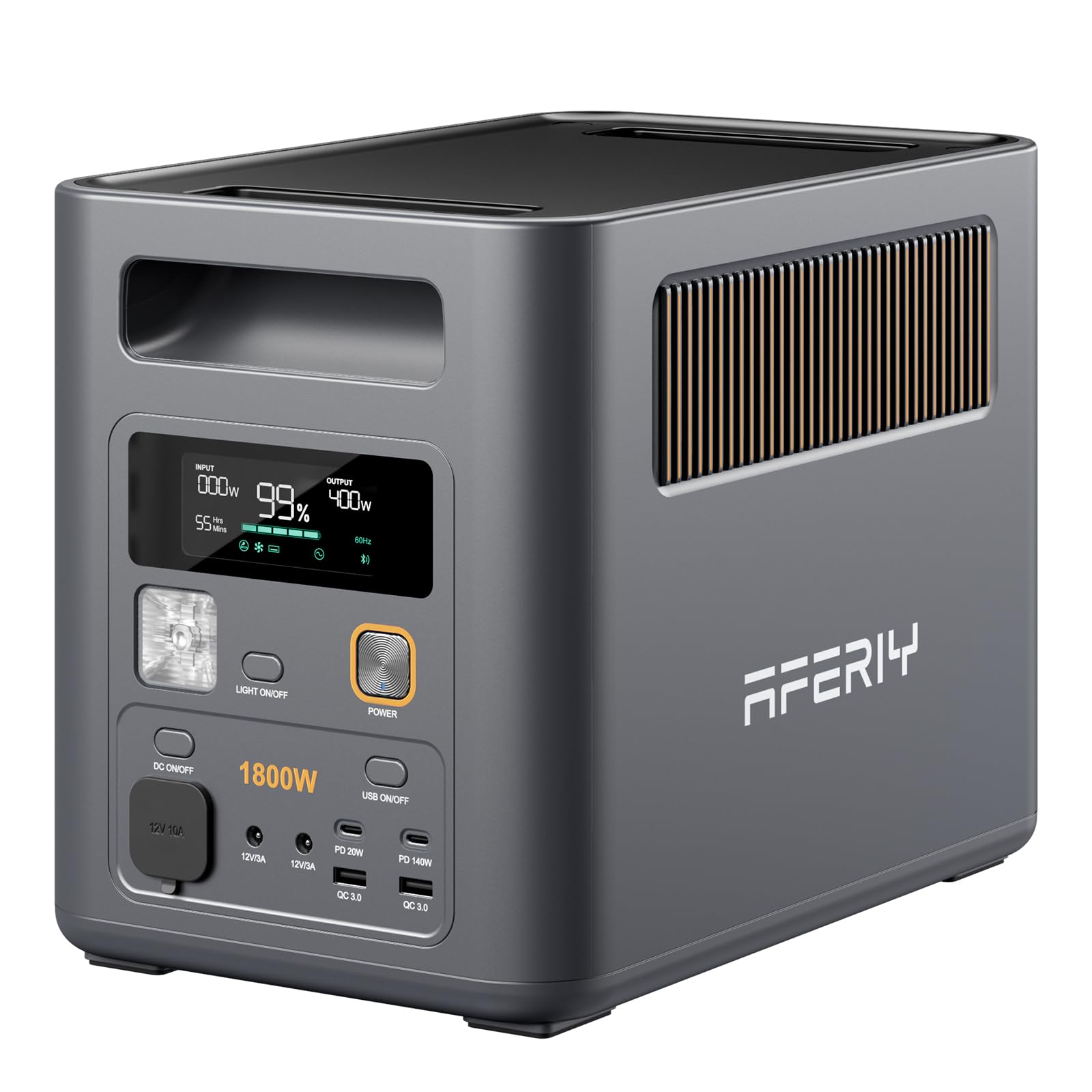
2. AFERIY Portable Power Station 1024Wh
A budget-minded station that still proves it can run a window AC off solar.
If you want to dip into battery backup without going all-in, this AFERIY offers a compelling start. It holds 1024Wh and delivers 1800W of output with a 3600W peak — and the reviews back up its real-world chops, with one owner powering a window AC via solar panels drawing 350W.
Worth noting: its capacity and output are roughly half the Jackery’s above (1024Wh vs 2042.8Wh, and 1800W vs its 3000W), but that’s exactly why it costs far less. Its LiFePO4 battery is rated for over 4000 charge cycles, so it’s built for daily use. A <10ms UPS switch means your devices stay on during an outage without a flicker.
The thing everyone raves about is how well it performs — it’s the top mentioned aspect. It’s also genuinely portable, which makes it a favorite for camping. The trade-off: it can’t run big central AC systems, so it’s best matched to smaller window units or fans as a supplement.
Solid performer: This station offers a great entry point for AC backup, with proven real-world results and a price that leaves room to add solar panels later.
Reach for this if: you’re powering a small window AC and want a station that’s easy to move and proven reliable.
Look elsewhere if: you’re trying to run a large central or heavy-duty AC — you need more capacity.
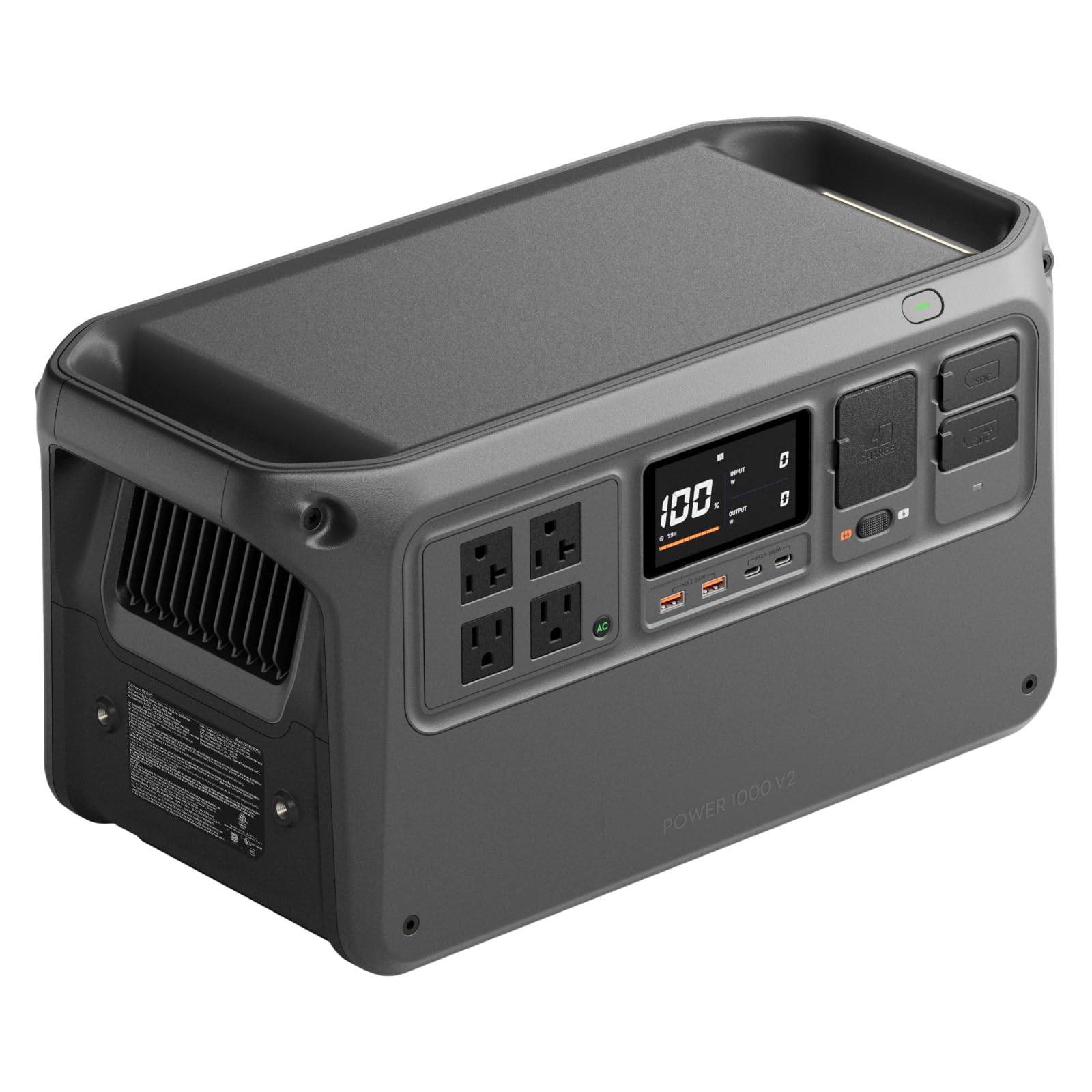
3. DJI Power 1000 V2 Portable Power Station
A space-saving 1024Wh station that runs whisper-quiet for RV nights.
If noise is your pet peeve, this DJI is a standout. It operates as low as 26 dB (that’s about as loud as a quiet library), so it won’t disturb your sleep when it’s running an AC or fan inside an RV or camper van at night.
It packs a 1024Wh LFP battery and is touted to drive 99% of appliances (including kettles, saws, and drills), making it versatile beyond just cooling. Powering your devices is fast, too: it recharges to 80% in just 37 minutes, so you’re not left waiting around when you need juice in a hurry.
What gets the most praise here is build quality, with power a close second. The main caveat: the brand says MPPT and car charging modules are not built-in, so connecting a solar panel or car battery requires a separate compatible adapter. Also, owners mention it’s built for portability over heavy-duty whole-home use, so check your AC’s surge needs first.
Quiet specialist: This is the pick for light sleepers who need dependable backup that won’t hum all night.
Best suited for: campers and RV owners who prioritize silent operation and small size.
Not ideal for: running large air conditioners without checking the surge requirement first — and remember the solar cable isn’t included.
4. VTOMAN FlashSpeed 1500 Solar Generator
Fast-charging power that refuses to shut down when you exceed its rating.
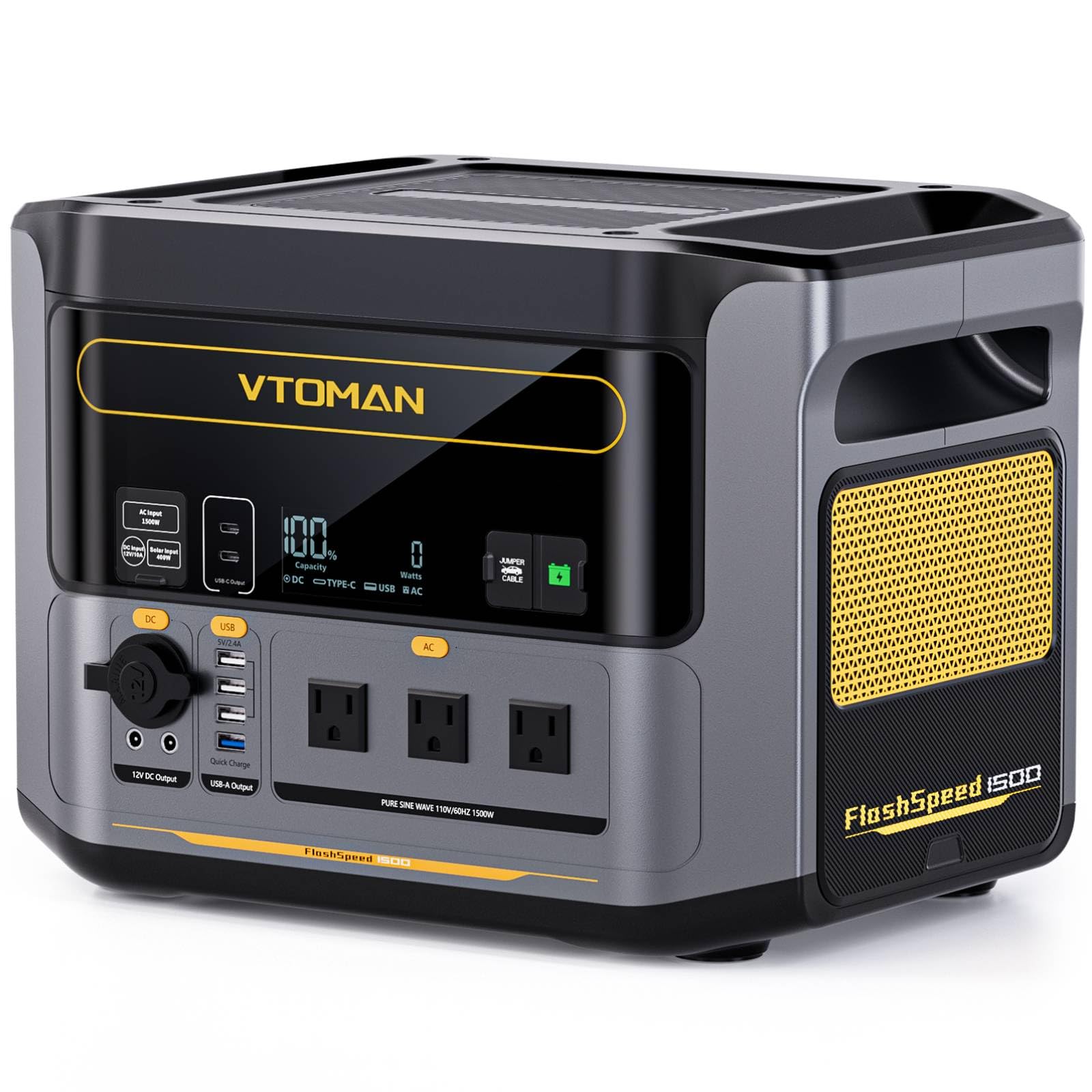
This VTOMAN stands out for its speed and resilience. It can recharge from 0 to 100% in about one hour using its 1500W AC input port — remarkably quick for a 1548Wh station. Its battery is rated for over 3000 charge cycles before dropping to 80% capacity.
Unlike many stations that shut off when you plug in something too big, this one’s V-Beyond Technology lets it keep providing 1500W of constant power even when an appliance wants more than 1500W. That means it has a better chance of starting a stubborn AC compressor’s surge without cutting out. It also offers a 3000W peak output.
The biggest praise is its reliability and usefulness; some owners have relied on it as a hurricane backup for years. The main catch: it can draw a lot of current when charging fast, and owners warn it may trip standard home breakers — you might need a higher-amp outlet.
What makes it a workhorse
- Full recharge in about an hour via AC wall outlet
- Keeps powering devices over its rated limit instead of shutting off
- Expandable up to 3096Wh with a separate battery
The catch to know
- Fast charging might trip a standard home breaker
- Its 3000+ cycle life means it’s rated to last, but it’s not a whole-home system
Choose this for: its rapid charging and ability to power appliances that briefly demand more than its rating.
skip it if: you can’t run a dedicated high-amp circuit for the fast charger.
5. Anker SOLIX S2000 Portable Power Station
A compact 2kWh battery that keeps a fridge cold for up to 35 hours.
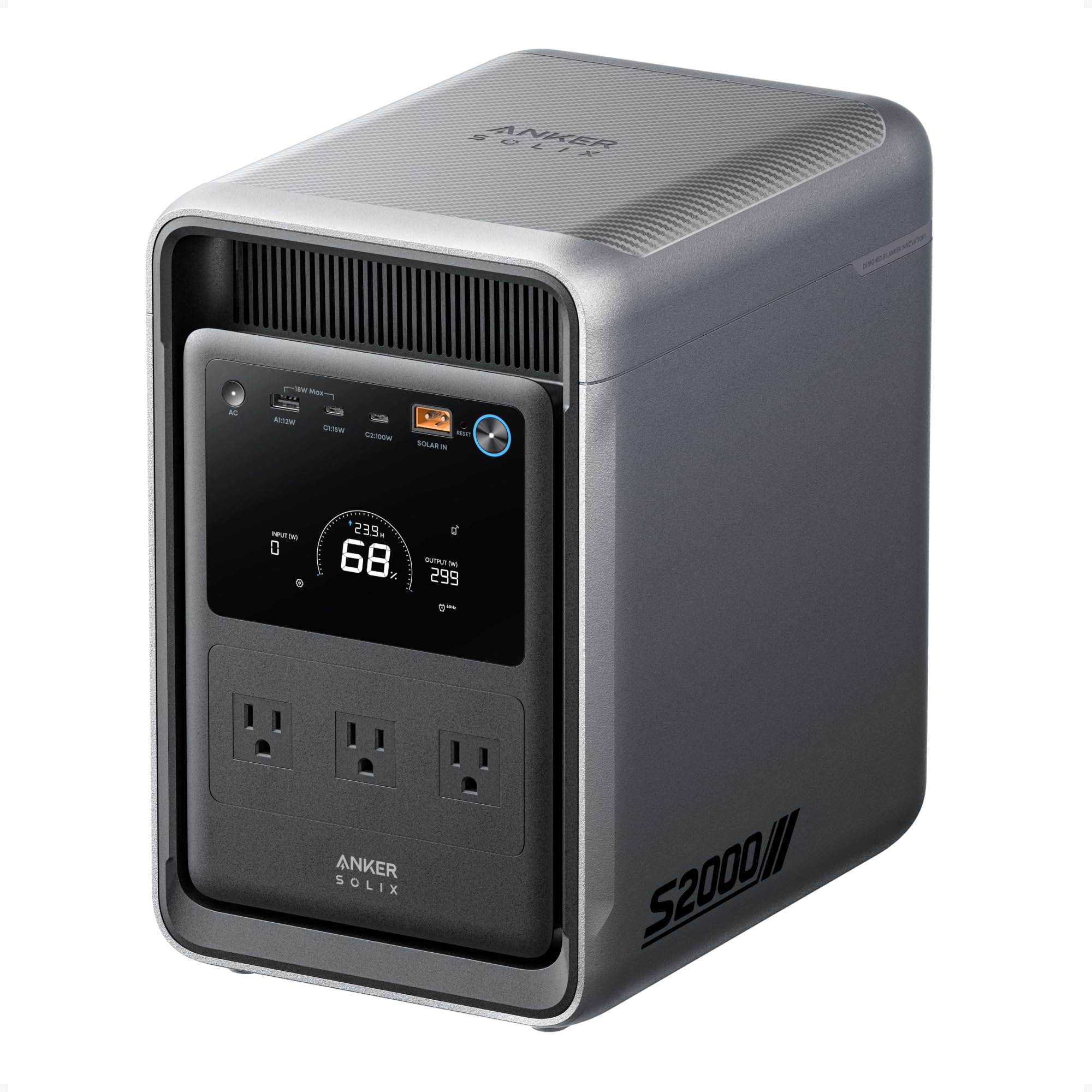
The S2000 is engineered to be the smallest and lightest 2kWh station around, measuring just 8.19 x 11.1 x 12.7 inches and weighing only 35.7 pounds. That makes it far easier to tuck into a corner than most units with this much storage, making it a popular choice for home backup.
This model delivers 1500W continuous output and 3000W peak, so one owner reports powering a window AC for an hour down to about 80% battery. Its 314Ah LFP cells are rated for 15 years and 10,000 charge cycles. Owners praise its performance and reliability more than anything else, and its <10ms UPS switch (a transfer time under 10 milliseconds) makes it a smooth home office backup.
The notable drawback you should consider is the fan, which some customers note as noticeably loud while working hard. Others found it very quiet, so it seems to depend on the load. But for a machine this compact, a little fan noise is often a fair trade.
Smarter design: You get 2kWh of power in a box that’s easier to store and move than most rivals — just be ready for a fan that can get noisy.
Strong for: homeowners who want the compact size without sacrificing the capacity to run a window AC and a fridge.
Not great for: anyone hypersensitive to fan noise during heavy loads.
6. BLUETTI AC180 Solar Generator

A solar-ready kit proven to run a mini AC and make ice at the same time.
When you want a battery that can refill itself from the sun, this BLUETTI kit is a strong contender because it comes with a 200W solar panel included. Owners confirm it’s powerful enough to run a mini air conditioner and an ice maker, so it clearly handles a small cooling load during an outage or camping trip.
The AC180 packs 1152Wh and delivers 1800W of output, with a 2700W peak you can activate through the app. Its LiFePO4 battery lasts over 3000 cycles, and it can fully charge from a wall outlet in one hour via 1440W fast charging.
Battery life is what gets the most praise by far, with power output as the runner-up. The trade-offs are weight and noise: it’s around 35-40 pounds and hard to move without wheels, and owners mention the fan is audible when the unit is working. Solar panels also ship separately, so plan for a split delivery.
What owners appreciate
- Comes with 200W solar panel for self-sustaining power
- Rated to run a mini AC and ice maker
- Recharges from wall outlet in about an hour
Before you buy
- Heavy at around 35-40 pounds with no built-in wheels
- Fan noise is noticeable during operation
Great for: anyone who wants solar flexibility bundled in the box for off-grid trips.
Pass on it if: you need a larger capacity for whole-home loads or want something you can easily roll around.
7. BLUETTI Elite 300 Portable Power Station
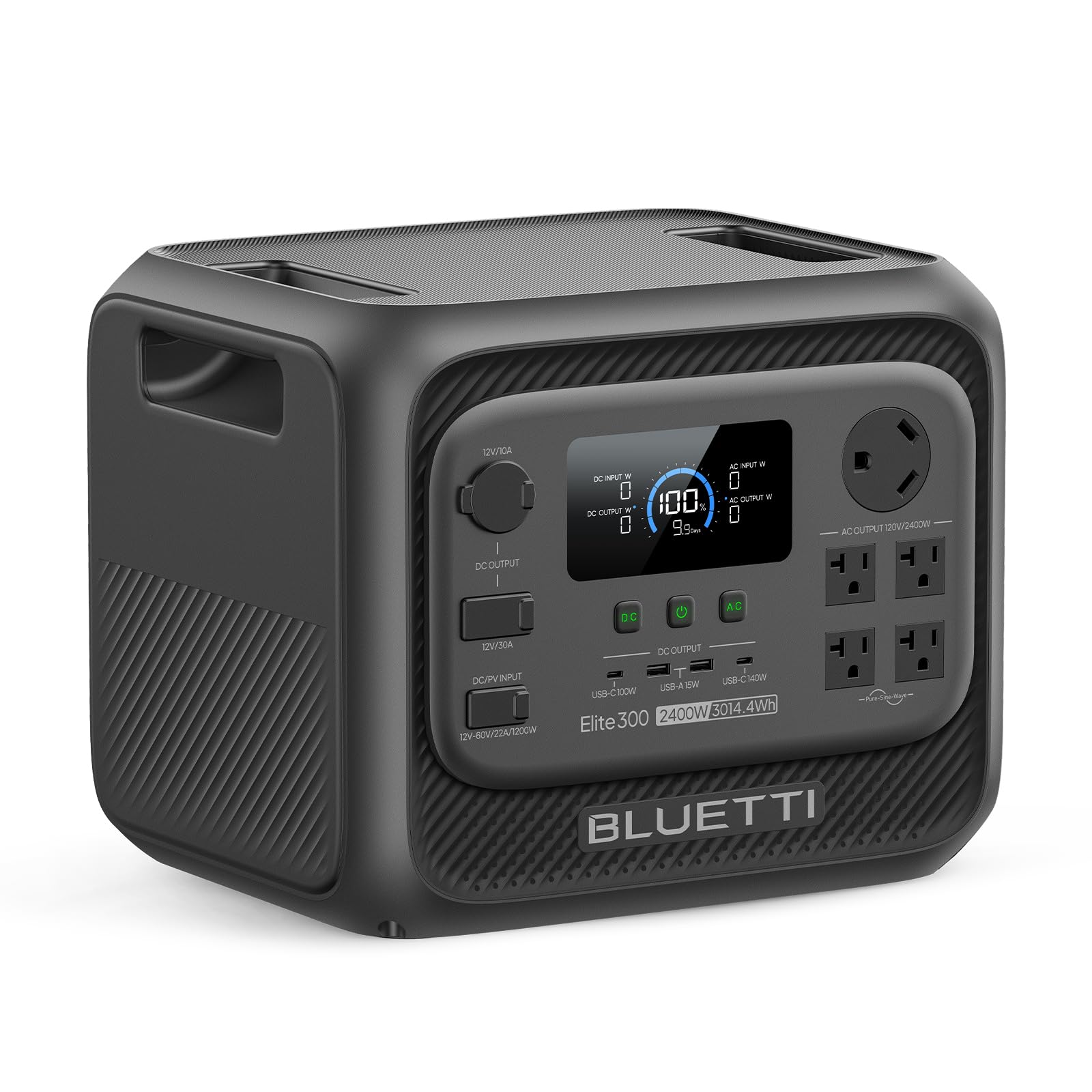
A full 3kWh of power in a chassis nearly 59% smaller than its rivals.
This BLUETTI solves a real problem: how to get huge capacity without needing a garage to store it. The Elite 300 packs 3014.4Wh into a design praised as the world’s smallest 3kWh portable power station, making it ideal for RVs and apartments where space is tight.
It isn’t just small — it’s strong. It delivers 2400W of continuous output with a 4800W surge, which owners say can start resistive loads like kettles. For RV owners specifically, it includes a TT-30 RV outlet and a high-current 12V/30A DC output for running 12V fridges, water pumps, and diesel heaters.
The most praised aspects here are performance and reliability, with quick charging (about 2 hours from dead) and its compact size getting noted. But at 58 pounds, this compact design is dense and heavy — you’ll feel the weight when lifting it. Some owners also note the solar input is limited, so check compatibility with your panels before pairing them.
Big power, small footprint: The Elite 300 packs serious capacity and surge power into a size that slips into tight RVs and corners.
Reach for this if: you want close to 3kWh of backup that won’t dominate your storage space, especially for RV use.
Look elsewhere if: you plan to expand capacity later — this model does not support battery expansion and is limited on solar input.
8. Anker SOLIX F3000 Portable Power Station
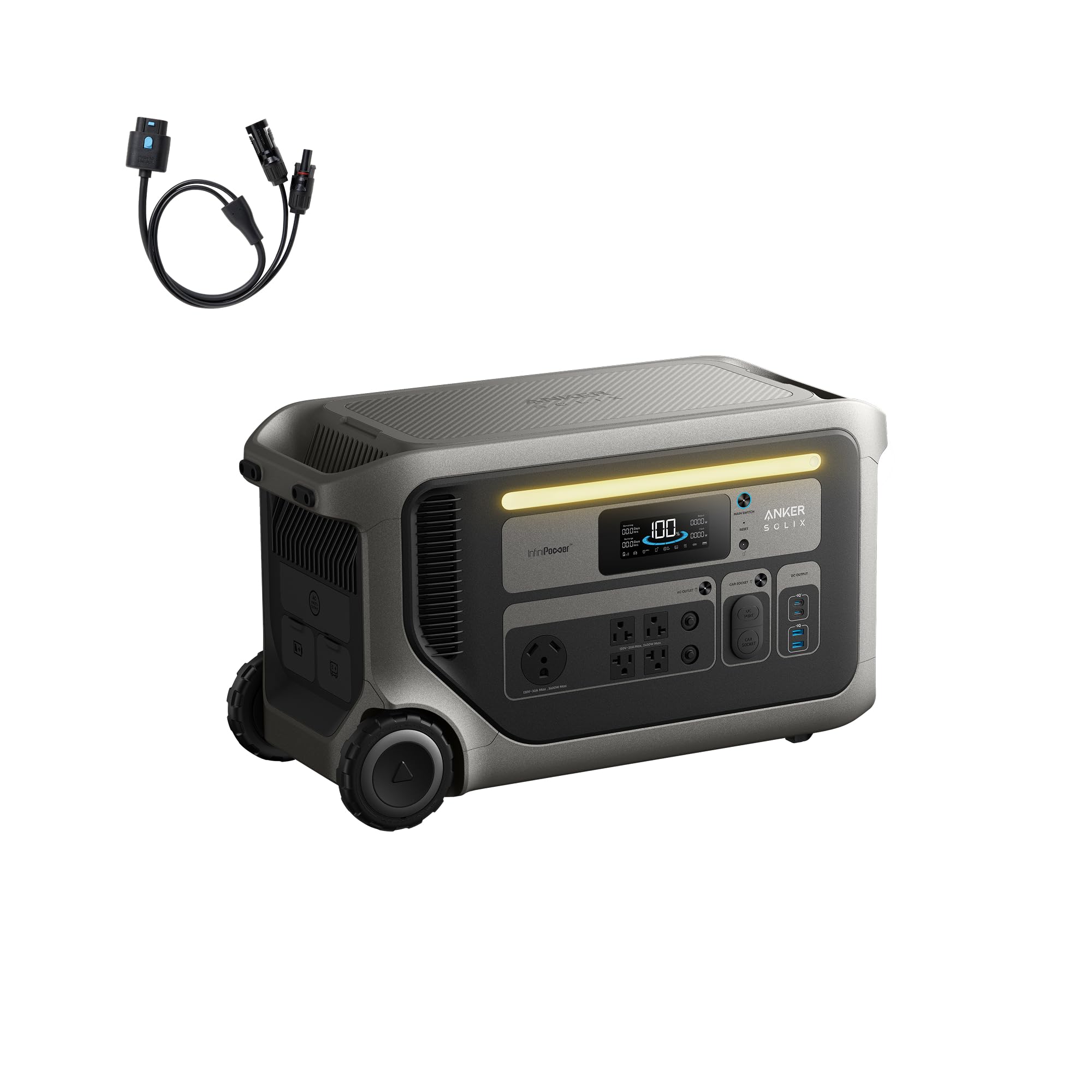
A wheeled giant that keeps an 8000 BTU AC running for over four hours.
Some air conditioners need serious power, and this Anker is built for serious loads. Owners confirm it can power an 8000 BTU air conditioner for over 4 hours — a real-world validation that it handles real cooling appliances, not just fans and laptops. It even has wheels to help move its 91.5-pound frame.
The F3000 starts with 3072Wh of capacity and can expand up to a massive 24kWh with extra batteries. Its headline feature is a 3600W pass-through charging system, meaning you can recharge it with a generator while it simultaneously runs appliances at full power — no waiting for a charge to finish during an outage.
It’s also remarkably efficient when idle: reviewers point out it can achieve 125 hours of AC idle standby time or run a 190W fridge for 42 hours. The recurring gripe isn’t with the station itself but the flexibility of its solar panels, which a few owners note can be fragile when moved. The unit itself gets high marks for reliability.
Pure muscle: This is a wheeled, expandable home battery that keeps real AC units running for hours on end.
Grab it for: whole-home essentials and the flexibility of generator-assisted pass-through charging.
Think twice if: you’re on a budget — its price and weight are both in the heavyweight class.
9. Jackery HomePower 3600 Plus

Luggage-style wheels make this 3.6kWh home battery easy to roll anywhere.
The Jackery HomePower 3600 Plus answers the “how do I move a giant battery?” question with a clever design: it’s built like luggage, with wheels and a telescopic handle. Owners say it “rolls around like luggage,” making it genuinely easy to move from kitchen to garage as needed.
Under the hood, it delivers a sturdy 3600W of output with 3584Wh of capacity, so shoppers say keeping fridges and freezers running for up to 12 hours. It also charges quickly: the makers claim it can refill from 0 to 100% in just 2 hours when using hybrid AC and DC inputs.
Its selling point is its versatility and quiet operation; one owner runs all their sea ray accessories, including water heaters and AC, at the same time. While some find it lightweight (thanks to the wheels), others still feel the 77.2-pound weight when they need to lift it. It’s a manageable trade-off for the capacity and output you get.
Whole-home helper: This is a big-capacity, easy-to-maneuver station that keeps your essential appliances humming for up to 12 hours.
Best for: households that want near-whole-home emergency power with the convenience of luggage-style portability.
Not for: those needing to power items that require 240V, as this is a 120V unit (240V requires parallel setup).
10. EF ECOFLOW DELTA Pro Ultra

The whole-home titan that can run a 3-ton central air conditioner.
This EcoFlow is in a different league entirely — it’s a whole-house battery system designed for the most demanding loads. With 6144Wh of starting capacity and a huge 7200W output on 120V & 240V, the makers say it can run almost any heavy household appliance, even a 3-ton central AC unit.
Buyers report installing it into their homes and powering everything — fridges, freezers, furnaces — for days. Owners mention it costs about half as much as a Tesla Powerwall while delivering nearly double the capacity. It expands to 90kWh with extra batteries, powering a standard household for over 30 days.
what separates it is its dual voltage output, allowing it to power 240V appliances like central air and well pumps that other portable units simply can’t touch. A single battery can be fully charged in about 2 hours. The main caveat, beyond its premium price, is that owners note customer service quality can vary, so buy from a reliable source.
Beyond backup: If you need to run central air, you’re not looking for a portable — you’re looking at a home battery system, and this is a top contender.
Choose this if: you need 240V power to run central AC and want a scalable system that can power your whole home.
Bypass it if: your needs are modest; a smaller, lighter, and more affordable unit will serve you better.
Understanding the Specs
Capacity (Watt-Hours)
Think of this as the size of your battery’s fuel tank. It tells you how much energy the station can store and, therefore, how long it can run your AC. A small window unit might drain a 1000Wh battery in a couple of hours, while a 3000Wh+ unit could run it most of the night.
Continuous vs Surge Wattage
An AC needs a burst of extra power to start its compressor — that’s the surge. The continuous rating is what it needs to keep running. Always match your AC’s starting watts to the station’s peak output, or the AC won’t start at all, no matter how much capacity the battery has.
Battery Chemistry (LiFePO4)
Most modern stations use LiFePO4 (lithium iron phosphate) batteries. They’re heavier but last far longer than standard lithium-ion packs, typically rated for thousands of charge cycles and a 10-year lifespan. For a pricey purchase you’ll keep for years, this chemistry is worth seeking out.
UPS Switchover Time
If you want a battery that acts as an uninterruptible power supply for home electronics, check the switch time. This is how fast the unit takes over when grid power drops. A 10ms switchover is fast enough to keep computers and routers running smoothly without even noticing a blip.
FAQ
How many watts do I need to run an air conditioner on a battery?
How long will a battery backup run a window AC unit?
Can I power a central air conditioner with a portable power station?
What does LiFePO4 mean and why does it matter for an AC battery?
Is a 3000W peak output enough to start my AC?
What is a UPS switchover time and why does it matter?
Can I recharge my battery backup with solar panels?
What generator can run a 5000 BTU air conditioner?
Final Thoughts: The Verdict
Across the board, the battery backup for air conditioner winner is the Jackery Explorer 2000 Plus because it balances high capacity, strong wattage, and fast recharging in a single proven package. If you want a budget-conscious entry that’s easily expandable, grab the AFERIY Portable Power Station. And for those who need to run a full central AC unit, the EF ECOFLOW DELTA Pro Ultra is the machine to reach for.
How We Picked
We do not accept paid placement. Every pick is matched to a real buyer and a real use-case; we do not hands-on test units.
Sources & Methodology
Specifications: manufacturer listings and product documentation. Review insights: verified customer reviews, as of September 2026. Pricing: not shown on this page (it changes often); check the current price via the retailer link.
As an Amazon Associate, KitchPrep earns from qualifying purchases. This does not affect which products we feature.
Related Guides
