
Specs are compiled from manufacturer listings and verified buyer reviews and can change over time — please confirm the key details on the product page before buying.
A 20-gallon pressure tank is the buffer between your well pump and your faucets. Without one, your pump would kick on for every glass of water, which is hard on the motor and makes the water pulse at the tap. This guide breaks down the best tanks for keeping pressure steady and your pump’s start-stop cycling low.
I’m Mohammad Maruf — the founder and writer behind KitchPrep. This guide is built by comparing the manufacturers’ published specifications and the patterns across verified customer reviews, so you get each pick’s real strengths and trade-offs instead of marketing spin.
Here are the best 20 gallon pressure tank options ranked for durability, drawdown, and ease of installation for any home well system.
Our Picks at a Glance

How To Choose The Best 20 Gallon Pressure Tank
Matching a new tank starts with knowing your pump’s cut-in and cut-out settings. Most systems run at 30/50 PSI, meaning the pump starts at 30 and stops at 50, but your exact numbers should be printed on the pressure switch.
Drawdown is the real number
The “20 gallons” is total storage, but you actually use the drawdown — the water stored between the pump’s on and off cycles. A higher drawdown means your pump runs less often, which protects it from wear.
Pre-charge pressure
Tanks arrive pre-charged for shipping, not for your system. You set the air pressure on an empty tank to about 2 PSI below the cut-in. A bicycle pump works, but a proper air gauge makes the job easier.
Materials and safety
If the tank feeds drinking water, look for NSF 61 certification or a liner that will not rust or flake. Steel tanks need a protective liner or coating inside, while fiberglass tanks are naturally corrosion-proof.
Quick Comparison
| Model | Best For | Capacity | Drawdown | Connection | Amazon |
|---|---|---|---|---|---|
| Amtrol WX-202★ Best Overall | Long-term reliability | 20 gallons | — | 1″ NPT | Amazon |
| Reliance PMD-20Best Value | Vertical space saving | 20 gallons | — | — | Amazon |
| VEVOR ET-80LVBudget Champion | Budget value | 20 gallons | — | 1″ NPT | Amazon |
| Red Lion RL20A | Drinking water safety | 20 gallons | 7.2 gal @ 30/50 | 1″ FNPT | Amazon |
| WaterWorker HT20HB | Horizontal tight spaces | 20 gallons | — | 1″ MNPT | Amazon |
| Amtrol WX-202 | Proven replacement | 20 gallons | — | 1″ NPT | Amazon |
| Amtrol WX-202D | High working pressure | 20 gallons | — | — | Amazon |
| Red Lion RL34A | More fixtures | 34 gallons | 10.8 gal @ 30/50 | 1″ FNPT | Amazon |
| WellMate WM-6 | Corrosion resistance | 20 gallons | — | 1″ NPT | Amazon |
In‑Depth Reviews
1. Amtrol WX-202 Well Pressure Tank
Our pick — over 4.5★ from 650+ verified ratings; the strongest balance of quality and price.
The steel tank that owners replace with another one decades later, not because they have to.
Quality is the word that shows up again and again with this blue tank — over a hundred owners single out how solidly it is built. The shell is high-strength steel, and the inner liner is virgin polypropylene (a tough plastic that won’t crack, chip, flake, or peel), so the water never touches metal that could corrode. At 23 pounds and 15″L x 15″W x 31″H, it is noticeably more compact and lighter than the VEVOR’s 28.4 pounds, which makes it easier to fit into a tight pump house.
A unique positive hoop ring seal holds the diaphragm and liner in place, which adds strength where other tanks tend to fail. Buyers report installs that took roughly half an hour, and one replaced an old tank that “sprung a leak after 25 plus years” — with the same make and model going right back in. The 7-year manufacturer warranty backs the confidence.
Performance and ease of installation each earn strong owner praise, and the consistent feedback is that this tank simply does its job without drama. It holds a 4.8-star average across 650+ ratings, indicating high owner satisfaction. A few note water pressure feels a bit different after swapping sizes or brands, so check your pressure switch settings before judging it.
Why It Wins Owners Over
- Quality is the #1 praise point, with well over 100 mentions
- Liner resists cracking and flaking for cleaner water
- Compact 15″ footprint fits small spaces
Who Might Pass
- One in ten reviews flags a water pressure quirk — pair it with the right switch settings
Reach for it if: you want the proven, long-haul replacement that a 7-year warranty and decades of owner history support.
Think twice if: you are on a strict budget and need the lowest entry price rather than the longest expected lifespan.
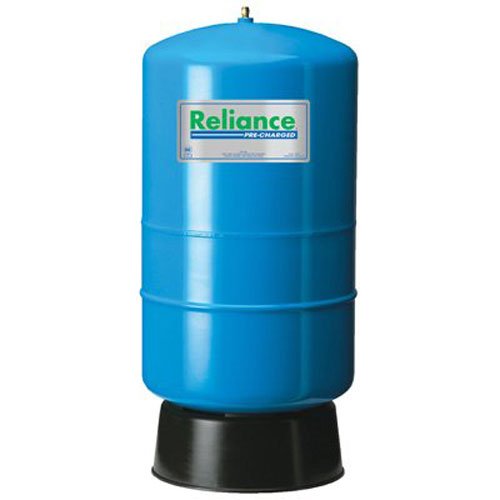
2. Reliance PMD-20 Vert Pu Multi Purpose Tank
A vertical 20-gallon tank that carries a pre-charge of 38 PSI and a track record measured in decades.
Reliance owners tend to measure time in years, not seasons. One replaced an old Reliance that “finally gave up the ghost after 18 years,” and the verdict was that it is a well-made product. It arrives with a 38 PSI pre-charge, which for many 30/50 systems means less fiddling with air pressure before you connect it. The certification is NSF, so it meets the standard for systems delivering drinking water.
This is a wall-mounted friendly design — it is meant to attach directly to an interior powder-coated wall, which frees up floor space in a cramped pump room. At 28.3 pounds and 15.5 x 15.75 x 33.75 inches, it runs tall and slim. Owners strongly suggest buying the matching brass install kit with a pressure gauge, calling the metal fittings “SOOO much better than PVC.” A universal pump mounting bracket is also recommended if you are building a fresh setup.
The catch? Review volume is thin — only a couple dozen owners have weighed in — so the long-term picture leans on that one 18-year story rather than a huge crowd. Every rating lands at 5 stars, though, and the recurring theme is easy installation with good water pressure. If you want a vertical tank with a modest footprint and a brand your grandparents likely used, this is a sensible pick.
Standout trait: The 38 PSI pre-charge plus NSF certification means less setup guesswork on a typical well system.
Honest note: Fewer owner reviews exist here than for the bigger names, so you lean on Reliance’s reputation more than a massive review base.
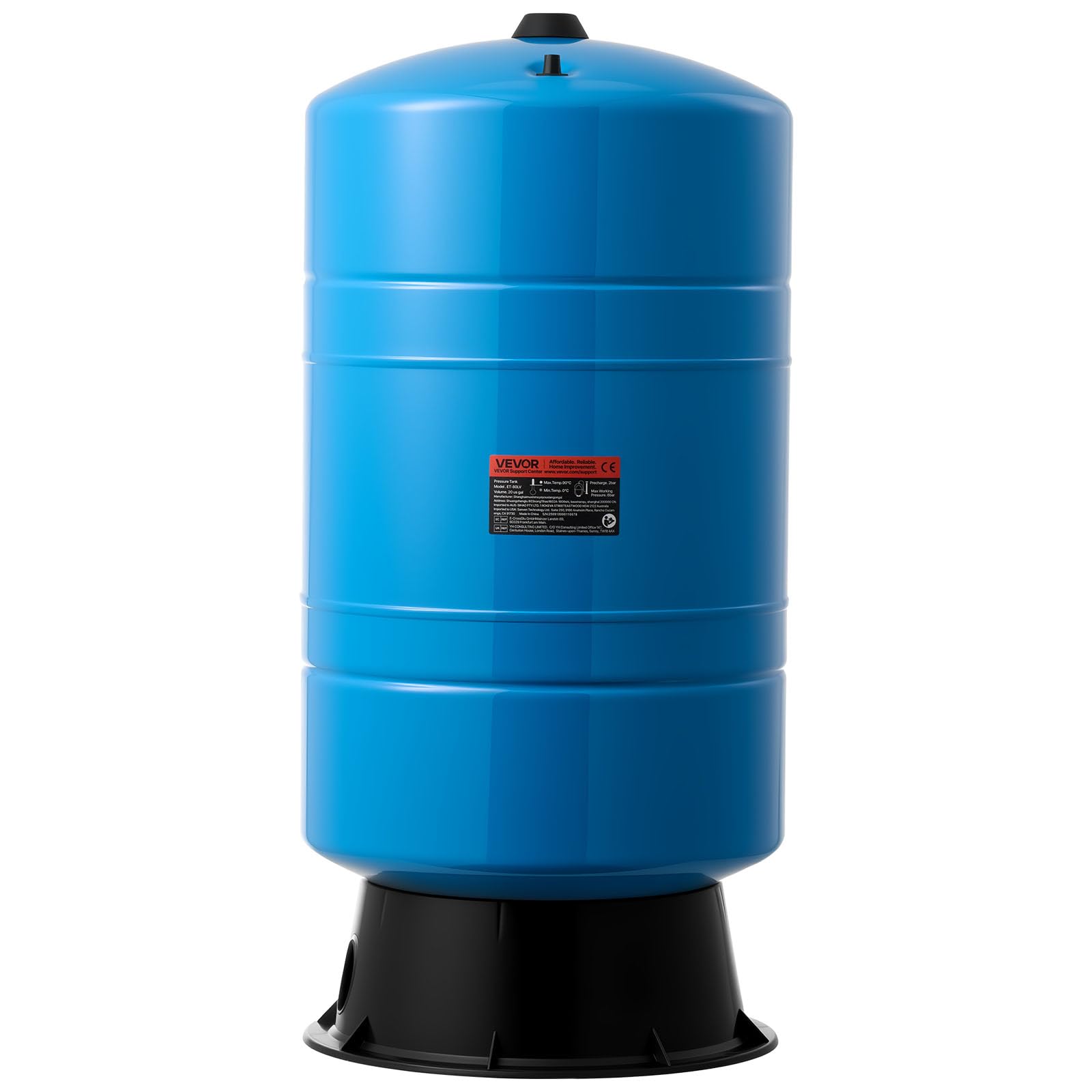
3. VEVOR 20-Gallon Vertical Well Pressure Tank
A pre-charged vertical tank that gives you 20 gallons of storage for a fraction of big-box pricing.
Value for money is the loudest theme in VEVOR owner feedback, and you can see why at a glance. One buyer swapped out an old tank and noted the price ran “about a third of the price from a big box store,” then added a few pounds of pressure and called it good. The build is 1.2mm thickened carbon steel, and it handles a 29 PSI pre-charge with an internal rating up to 87 PSI and working temperatures to 194°F.
At 28.4 pounds and 15.3″L x 15.3″W x 32.1″H, it is heavier and slightly taller than the Amtrol WX-202. Installation took one owner about an hour with clear directions, and the 1-inch NPT connector makes a secure, leak-proof hookup straightforward. Quality earns the most mentions overall, with installation close behind — a rare combo at this price tier.
Two honest caveats matter. The manufacturer states it is not suitable for drinking water, so this is a fit for irrigation, farming, or non-potable household use. And because it is not frost-proof, it must live somewhere warm. An occasional unit arrives with a small shipping dent, but owners say it does not affect function.
What Shines
- Costs about a third of equivalent big-box tanks
- Rated to handle 87 PSI internal pressure
- Owners mention simple, roughly hour-long installs
Read Before Buying
- Not certified for drinking water — keep it on irrigation duty
- Needs a warm, frost-free location
Best for: farm, irrigation, and non-potable whole-house use where price matters more than NSF certification.
skip it if: the tank will feed your kitchen tap — you need a drinking-water-rated model instead.
4. Red Lion RL20A Vertical Pre-Charged Well Pressure Tank

A drinking-water-certified 20-gallon tank whose 7.2-gallon drawdown keeps the pump quiet.
If you want your pump to stop cycling on and off so often, this Red Lion tank delivers. It holds a 7.2-gallon drawdown (the amount of water stored between pump cycles) at 30/50 PSI (pounds per square inch, the pressure range your pump maintains), and customers note the pump runs “a fraction of the time it did before.” Fewer cycles mean less wear on your pump motor and steadier water pressure. It is certified NSF/ANSI/CAN 61 and 372 (standards for materials safe with drinking water), so it is fine for your kitchen.
The construction is heavy-duty 20-gauge steel with a 304 stainless steel water connection and a leak-safe design. A variable-geometry butyl rubber diaphragm (a flexible rubber barrier that flexes rather than creasing) plus a propylene liner keep water away from the steel shell. It arrives pre-charged to 20 PSI for transport, and you top it off to 2 PSI below your cut-in setting with a bicycle pump.
A thermoplastic base lifts the tank off the floor, preventing condensation from staining concrete. At 17″L x 17″W x 27.3″H, it is wider but shorter than the Amtrol WX-202’s 15-inch footprint — a trade worth measuring before you order. The 1″ FNPT elbow connection handles six simultaneous fixtures. Owners who installed it praise how straightforward the process was with clear instructions.
Why owners stay: The drawdown genuinely cuts pump cycling, which is the whole reason to buy a larger tank.
Who it is not for: Anyone with a tiny footprint — the 17-inch base needs more floor room than slimmer vertical tanks.
5. WaterWorker HT20HB Horizontal Pre-Charged Well Tank

The horizontal 20-gallon tank built for low-clearance crawl spaces and tight pump rooms.
If your basement has low clearance, this WaterWorker fits where tall tanks do not. It lays flat at roughly 30 x 16 x 17 inches (length, height, width), so it slides under joists where a vertical tank would never fit. It is listed by the NSF (a public health organization) under ANSI/NSF Std 62 (a standard for drinking water system components). The smooth butyl diaphragm (a rubber barrier that separates water from air) is designed to flex rather than stretch and crease like bladder tanks, which is meant to extend the part that usually fails first.
The polypropylene liner (a plastic barrier) will not flake, chip, crack, or peel, and it does not add taste or odor to the water. A deep-drawn steel domed shell is described as twice as strong as a rolled steel shell of the same thickness, and the high-gloss enamel finish shields it from moisture. Owners running booster pumps say it minimizes cycling well and call the size perfect for their setups.
Functionality earns the most owner praise by a wide margin, with value for money close behind. Be honest about the history here, though: durability is the one negative theme, and the summary notes some bladders fail after about a year of use. One owner who got four years out of it still switched to an Amtrol for the longer warranty. If you need horizontal orientation, this is a capable pick — just treat the bladder gently and watch your pre-charge.
Built For
- Horizontal mounting in low-clearance spaces
- Booster pump setups that need minimized cycling
- NSF-listed construction for water safety
Know The Risk
- Bladder longevity is the recurring owner concern — some fail around the one-year mark
Choose this if: your space demands a horizontal tank and you want a proven NSF-listed option.
Look elsewhere if: you expect a decade-plus lifespan and want a longer warranty than this one delivers.
6. Amtrol WX-202 Free Standing Well Pressure Tank

The same blue tank that one owner kept running for 38 years — and replaced mostly out of caution.
Few products earn a “my last one lasted 38 years” story, but this Amtrol does. One owner said the old tank “wasn’t really broke, just rusted like crazy,” so they swapped it while already working in the pumphouse, fully expecting the new one to match that run. The factory pre-charge is 38 PSI, the connection is a standard 1″ NPT, and the system handles up to 125 PSI with a max operating temperature of 200°F.
Functionality is the top praise point here, with installation and value close behind — a rare trio of strengths. Owners describe pressure as “amazing” and note that set-up was mostly a matter of recharging the air and connecting it. The diaphragm-style design (a flexible rubber separator between air and water) keeps the system simple and dependable.
This is essentially the same tank as the top pick sold under a slightly different listing, so if one is out of stock, the other is a direct substitute. The honest caveat is that at 224 ratings it has a smaller owner base than some rivals, but the enthusiasm is consistent. For a like-for-like replacement of an aging Amtrol, this is about as safe a bet as the category offers.
What stands out: A 38-year service life story is the kind of durability evidence that makes other brands envious.
The fit: Ideal for anyone replacing an existing Amtrol WX-202 who wants the same footprint and connections.
7. Amtrol Well-X-Trol WX-202D with Composite Base

High-strength steel rated for 150 PSI working pressure, which the maker says is 20% above competitors.
This is the tank to grab when you want the top of the Amtrol line. It is built from high-strength steel rated for 150 psig working pressure, and the maker claims that is 20% higher than the competition. The steel shell carries an antimicrobial liner, and it meets NSF Standard 61 for safe drinking water, so it is fully appropriate for household taps.
Quality is the dominant owner theme, and the DIY crowd calls it a great project. One 70-year-old owner with no plumbing background found it “well made and easy to install,” needing only an air pressure adjustment after setting it in place. The appliance-like blue finish means it does not look out of place in a basement or utility room, and it needs minimal floor space for its 20-gallon capacity.
Owners say the bottom elbow is corrosion-resistant coated, and the composite base keeps it off the floor. The upgrade over the standard WX-202 is the higher working pressure and the antimicrobial liner — useful if you want extra margin. The trade is price, which lands at the premium end of the 20-gallon field. The crowd rate it 4.8 stars, and the feedback is that it earns the extra cost versus cheaper alternatives.
Worth The Upgrade
- 150 PSI working pressure — a real margin above standard tanks
- Antimicrobial liner plus NSF Standard 61 for drinking water
- Composite base prevents floor staining
Consider First
- Premium pricing that some owners only justify after comparing warranties
Buy it if: you want maximum working pressure and a drinking-water-safe liner in a compact vertical package.
Pass if: your system runs a standard 30/50 switch and you would rather save the premium for other plumbing upgrades.
8. Red Lion RL34A Vertical Pre-Charged Well Pressure Tank

A 34-gallon tank that handles roughly 11 fixtures at once, for homes where 20 gallons means short cycles.
This is our flexibility pick because the reader note matters: not every “perfect” tank is the exact 20-gallon number. If you have a larger household, the RL34A steps up to 34 gallons with a 10.8-gallon drawdown at 30/50 PSI — meaning your pump stays off dramatically longer between runs. Red Lion rates it for up to 11 simultaneous water fixtures., which suits a busy family bathroom rush.
The materials match the 20-gallon RL20A: heavy-duty 20-gauge steel, a 304 stainless steel connection, a variable-geometry butyl rubber diaphragm, and a propylene liner. It is certified NSF/ANSI/CAN 61 and 372 for drinking water. Reviewers point out it “sits a little higher than my last tank” and delivers “nice long cycles between pump runs” after adjusting the pre-charge to match their setup.
The honest catch is dimension. At 21.65″L x 21.65″W x 31.2″H, the base is much wider than the 17-inch footprint of the RL20A or the 15-inch Amtrol, so measure your floor space before committing. One owner dropped a star purely because of the shipping method, not the tank itself — an occasional delivery ding is the main complaint. If your pump cycles too fast and you have the floor room, this bigger Red Lion is a smart move.
The upgrade logic: More drawdown (10.8 vs 7.2 gallons) means a noticeably quieter pump on a busy household.
Measure first: The 21.65-inch-wide base demands real floor space that slimmer vertical tanks do not.
9. WellMate WM-6 20 Gallon with Brass Tank Tee Kit

The corrosion-proof fiberglass tank that arrives with a brass tee kit, so the whole hookup is in one box.
Steel tanks eventually rust, but this WellMate uses a fiberglass body to avoid that. Owners note it should “last a very long time due to the corrosion resistant nature of the fiberglass construction.” It weighs only 25 pounds, so one person can handle it easily. One buyer reports their previous WellMate lasted 10 years before needing replacement.
The standout convenience is what is in the box. This comes with a 1″ x 4″ brass tank tee kit, so you do not need a separate trip to the hardware store for the fittings that connect the tank to your plumbing. Owners call the quick-connect pipe feature a real time-saver, though one notes you may need to buy special o-ring lube separately. The factory 38 PSI pre-charge and 1″ NPT connection handle up to 125 PSI working pressure.
Installation is the most-praised aspect, with build quality close behind — and one owner says it is “better than blue steel cans,” a direct jab at the painted steel rivals. The trade is price: this lands at the premium end, and spare parts availability is rated as mixed rather than glowing. If you want a tank that physically cannot rust and comes with the brass fittings included, this is your pick.
Why It Wins
- Fiberglass body cannot corrode like steel tanks
- Brass tee kit included — one-box install
- Light 25-pound weight is easy for solo handling
The Premium Cost
- Priced well above steel tanks of the same capacity
- O-ring lube is not included despite the quick-connect design
Best for: anyone replacing a rusted steel tank who wants a corrosion-proof body and all fittings in one order.
Consider twice if: budget is the deciding factor — the steel tanks above deliver similar function for less.
Understanding the Specs
Drawdown vs Total Capacity
The 20-gallon label is the tank’s total volume, but the number that matters is drawdown — the usable water between pump cycles. At 30/50 PSI, a 20-gallon tank may only deliver 7 to 8 gallons of drawdown. A higher drawdown means the pump rests longer, which protects it from wear.
Pre-charge Pressure
Tanks ship with a pre-charge set for transport, not your system. You set the air pressure on an empty tank to about 2 PSI below your pressure switch’s cut-in. Most homes run 30/50 PSI (cut-in 30), so you would set the tank to about 28 PSI using a bicycle pump or air compressor.
Diaphragm vs Bladder
Both designs separate air from water with a rubber barrier. Diaphragm tanks use a flat rubber disc that flexes, while bladder tanks use a balloon-like bladder that expands. A higher-quality diaphragm that flexes rather than creases tends to last longer before developing a leak.
NSF Certification
If the tank feeds drinking water, look for NSF 61 certification or an equivalent standard. This means the materials have been tested and will not leach harmful chemicals into your water. Tanks without this rating are fine for irrigation but not for your kitchen tap.
FAQ
How much drawdown does a 20-gallon pressure tank actually provide?
What PSI should I set my 20-gallon tank pre-charge to?
Can I use a 20-gallon pressure tank for drinking water?
What is the difference between vertical and horizontal pressure tanks?
How long does a 20-gallon pressure tank last?
Why does my pump cycle on and off too frequently?
What size pressure tank do I need for my house?
Can I install a 20-gallon pressure tank myself?
Final Thoughts: The Verdict
For most people, the 20 gallon pressure tank winner is the Amtrol WX-202 because its quality reputation and 7-year warranty make it the safest long-term purchase. If you want drinking-water certification and a strong drawdown, grab the Red Lion RL20A. And for non-potable irrigation at a budget price, the VEVOR is the one to reach for.
How We Picked
We do not accept paid placement. Every pick is matched to a real buyer and a real use-case; we do not hands-on test units.
Sources & Methodology
Specifications: manufacturer listings and product documentation. Review insights: verified customer reviews, as of September 2026. Pricing: not shown on this page (it changes often); check the current price via the retailer link.
As an Amazon Associate, KitchPrep earns from qualifying purchases. This does not affect which products we feature.
Related Guides
