
Specs are compiled from manufacturer listings and verified buyer reviews and can change over time — please confirm the key details on the product page before buying.
If you are searching for a 10 ft step ladder, you are likely tired of balancing on counters or chairs to change a bulb or reach a top shelf. For a 10-foot reach, a 6-foot or 7-foot step ladder is the standard choice, balancing stability, durability, and portability. This guide evaluates top models on weight capacity, material, and stability at full extension.
I’m Mohammad Maruf — the founder and writer behind KitchPrep. This guide is built by comparing the manufacturers’ published specifications and the patterns across verified customer reviews, so you get each pick’s real strengths and trade-offs instead of marketing spin.
We have compared the top-rated models to help you choose the right 10 ft step ladder for your home, garage, or professional work.
Our Picks at a Glance

How To Choose The Best 10 Ft Step Ladder
Selecting a 10-foot-reach step ladder hinges on your task, environment, and tolerance for lifting weight. Many people mistakenly assume a “10 ft” ladder means it is 10 feet tall—it refers to the reach height, meaning the ladder itself is much shorter.
Match the Ladder Size to Your Ceiling Height
A 6-foot step ladder typically gives you a working reach of about 10 feet, making it perfect for standard 9-foot ceilings and most home tasks. If you frequently work on 10-foot or taller ceilings, you will need to step up to a 7-foot or a dedicated 10-foot model to safely reach the work area without standing on the top cap.
Fiberglass vs. Aluminum: Know the Trade-Offs
Fiberglass ladders are non-conductive, a critical safety feature for electrical work. They tend to be heavier and more stable. Aluminum ladders are lighter and easier to move but conduct electricity and feel less rigid under load.
Quick Comparison
In‑Depth Reviews
1. Louisville Ladder 6-Foot Fiberglass Step Ladder (FS1506)
Our pick — over 4.5★ from 4,000+ verified ratings; the strongest balance of quality and price.
The crowd-favorite fiberglass 6-footer that makes tall ceilings feel safe again.
For most homes, this is the ladder to beat. Its fiberglass rails do not conduct electricity, so you stay safer when swapping a light fixture or reaching a ceiling vent. It holds up to 300 pounds (your weight plus tools), and each step rises 12 inches, so you get a steady, predictable climb every time.
Owners are emphatic about the build quality, calling it solid, strong, and safe. A recurring sentiment is that this could be the last 6-footer they ever buy, with one suggesting it could last 20 years. The molded top includes slots to hold tools and a heavy-duty bottom brace adds strength where the ladder meets the floor.
The trade-off is the weight—at 20 pounds, it is not the lightest, but that heft is what provides the planted, secure feeling at the top step. This ladder is heavier than the WOA WOA aluminum option below, but it is also 47 pounds lighter than the beefiest twin-front model further down this list, striking a balance most homeowners can manage.
Built to Last
- Non-conductive fiberglass rails for electrical safety
- 12-inch step rise feels natural and secure
- Molded top with tool slots keeps gear nearby
Physical Reality
- 20 pounds is heavy for small or elderly users to haul around
- Fiberglass is bulkier to store than folding aluminum
The Household Standard: Buy this if you want one dependable, safe ladder for general maintenance and DIY projects—your ceiling work will feel much more secure.
Think Twice If: You need to carry a ladder up and down stairs often, as the fiberglass weight will get tiring quickly.
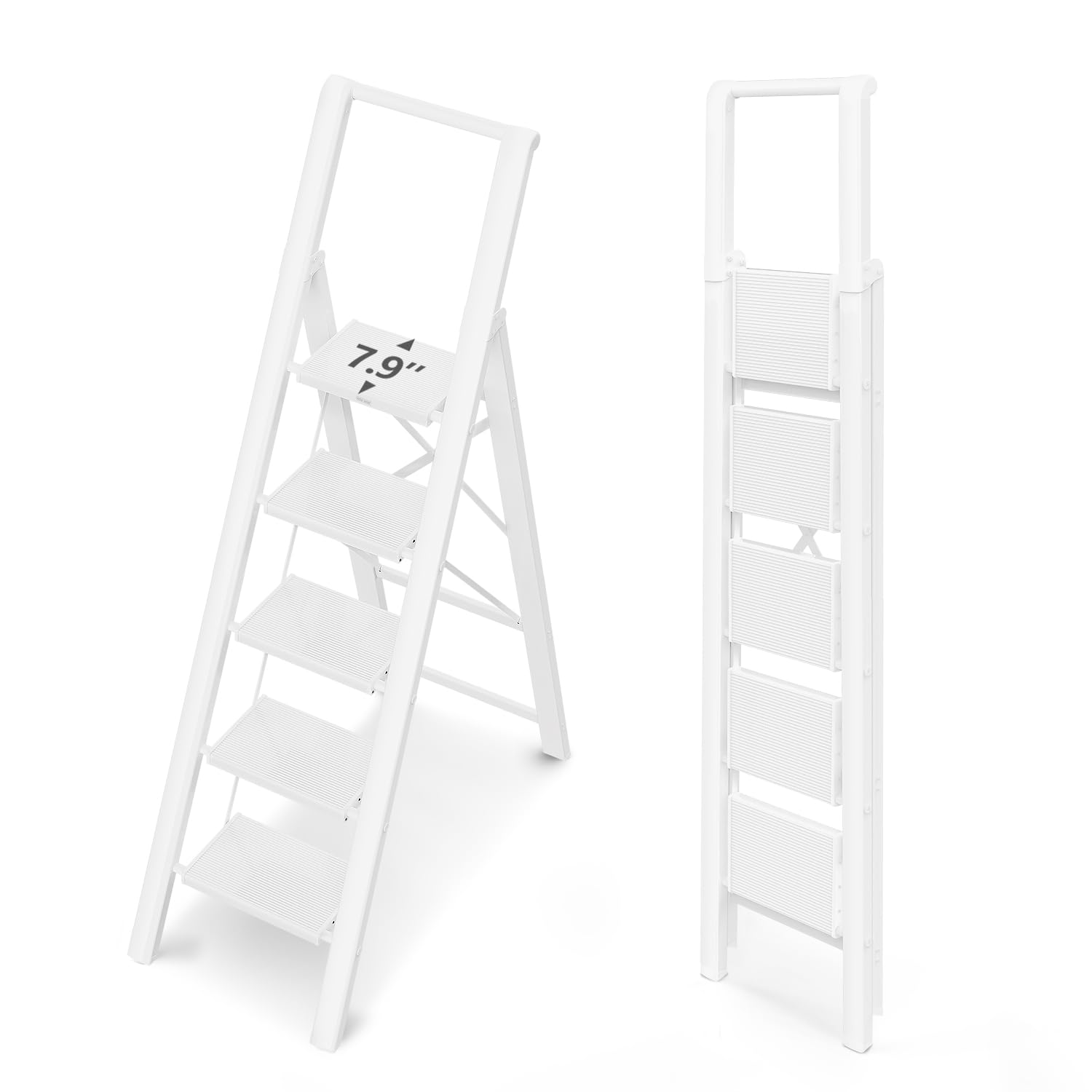
2. WOA WOA 5 Step Ladder, 45” Top Step, White
An ultra-light aluminum stepladder that proves interior access does not need to be a back-breaking chore.
This white aluminum ladder is the featherweight of the group at roughly 7 pounds, designed specifically for reaching high kitchen cabinets and closet shelves without requiring a strongman to move it. It offers a 10ft reach for a typical user, yet its aluminium rungs are a deep 7.87 inches and thickened to 1.4 mm, so the stepping surface feels far more substantial than other lightweight options.
The finish is a huge part of the appeal. Several users highlight that it looks more like a piece of furniture than a utility tool, which is why it gets left out in living spaces or used as a display stand. The integrated handrail at the top provides extra balance while you reach, and it folds flat enough to slip into the gap between a cabinet and wall.
The main compromise appears when you compare it to a fiberglass ladder like the Louisville FS1506, which is 31% heavier in body weight (9.5 kg vs. 7.26 kg) but offers a different rigid feel. It suits a 5’2″ user reaching 10 feet plus, and it folds and stands upright on its own when stored.
easy Portability
- Weighs ~7 lbs, easy for anyone to carry one-handed
- Folds thin to store behind doors or in narrow gaps
- Anti-slip feet grip wood, tile, and carpet
Be Aware
- Aluminum conducts electricity—keep it away from live wiring
- Folding action can pinch fingers if you are careless
Reach for it when: you want a good-looking, portable helper for indoor tasks and you are the person who usually ends up fetching the ladder yourself.
Look elsewhere if: you plan to do electrical work or need a rigid platform for heavy-duty outdoor projects.
3. Louisville Ladder FXS1506 X-Style 6-Foot Ladder

The convertible X-design that leans like a trestle and stands firm like a fortress.
This is the specialist’s version of the 6-foot ladder. It takes the non-condun sites, church maintenance, and any job where you need to work from both sides of the ladder simultaneously. Its twin-front design means a second person can climb the opposite face, making it ideal for hanging long fixtures, painting large walls, or any task requiring a helper at height.
It carries the highest combined strength of the group, with a 375-pound load capacity and a hefty 55-pound frame. The fiberglass body is non-conductive for electrical jobs, and the “raptor boot” feet provide slip-resistant, non-marring tread so it holds firm without scuffing your floors.
Buyers consistently describe it as sturdy and secure, with excellent non-slip feet and a balance between strength and reduced weight that feels impressive for its class. The honest expectation here is logistics: at 55 pounds, moving it alone is a real challenge, and owners say you definitely need a second person to transport it. It folds for storage, but that storage footprint is substantial.
Extreme Capability
- 375-lb capacity supports heavy users and tools
- Twin-front design allows two workers at once
- Non-marring raptor boots protect floors
The Heavy Lifter
- 55 lbs requires a second person for most moves
- Consumes significant storage space
Choose This When: you have a real worksite or large-scale project where strength and double-sided access outweigh every other concern.
Pass On It If: you need a ladder for quick indoor tasks—this is overkill for a typical home closet or light-bulb change.
Understanding the Specs
Load Capacity and Duty Rating
Load capacity is the total safe weight, including your body plus tools and materials. A 300-pound capacity suits most homeowners; 375 pounds provides extra margin for larger users or heavier tool belts. Pick a ladder rated comfortably above your total working weight for optimal stability.
Fiberglass vs. Aluminum Frames
Fiberglass ladders are non-conductive, meaning they will not conduct electricity if they touch a live wire—a critical safety feature for electrical work around the house. They are heavier and more stable. Aluminum ladders are lighter and easier to transport but conduct electricity and tend to feel less rigid at height. For general home use, fiberglass is the safer default choice.
FAQ
What is the actual height of a 6-foot step ladder?
Will a 6-foot ladder let me reach a 10-foot ceiling?
Does the load capacity include my body weight?
Why choose fiberglass over aluminum for electrical work?
Is a heavier ladder always more stable?
What is the difference between a step ladder and a platform ladder?
How do I store a tall step ladder in a small space?
Can two people climb a twin-front ladder at the same time?
Are rubber feet on a step ladder important?
How much does a 10-foot step ladder weigh?
Final Thoughts: The Verdict
For most households, the 10 ft step ladder winner is the Louisville Ladder FS1506 because it nails the balance of non-conductive fiberglass safety, 300-pound capacity, and reasonable 20-pound weight. If you want something you can carry around the house without effort, grab the WOA WOA 5 Step. And for serious projects where you need to lean against walls and keep tools close, the Louisville FXS1506 is the one to reach for. The crowd favorite—over 4,400 owners—confirms the FS1506 is the safest, most versatile bet for the vast majority of buyers.
How We Picked
We do not accept paid placement. Every pick is matched to a real buyer and a real use-case; we do not hands-on test units.
Sources & Methodology
Specifications: manufacturer listings and product documentation. Review insights: verified customer reviews, as of September 2026. Pricing: not shown on this page (it changes often); check the current price via the retailer link.
As an Amazon Associate, KitchPrep earns from qualifying purchases. This does not affect which products we feature.
Related Guides
