
Specs are compiled from manufacturer listings and verified buyer reviews and can change over time — please confirm the key details on the product page before buying.
Before you buy a 10-inch chop saw blade, ask yourself what you will actually cut. A wood ripping blade and a non-ferrous metal blade look alike in a photo, but they behave completely differently on the arbor (the spinning shaft that holds the blade). Pick the wrong one, and you risk burned edges, shattered teeth, or a blade that dulls in an afternoon. Match the tooth count and grind (the shape and angle of the cutting edges) to your material, and you will get clean, finished-quality cuts on the first pass.
I’m Mohammad Maruf — the founder and writer behind KitchPrep. This guide is built by comparing the manufacturers’ published specifications and the patterns across verified customer reviews, so you get each pick’s real strengths and trade-offs instead of marketing spin.
From aggressive 24-tooth rippers to 100-tooth finishing discs, the best 10 inch chop saw blade depends on matching the grind to the material you cut most.
Our Picks at a Glance


How To Choose The Best 10-inch Chop Saw Blade
Match the blade to the material, not the saw. A blade designed for wood will overheat and lose its edge on aluminum, while a metal-cutting disc will tear through wood fibers. Start with the stock you cut most, then let tooth count and grind handle the rest.
Tooth count sets the trade-off
Fewer teeth mean faster, more aggressive cuts with more material removed per tooth. More teeth mean a slower feed but a smoother edge that needs less sanding. A 24-tooth ripper clears waste quickly, while an 80-tooth blade leaves a finish so clean you can skip the sandpaper on plywood.
The grind determines the material
Flat-top teeth excel at ripping wood with a flat-bottom cut, while a triple-chip grind (a tooth shape with a beveled chisel edge) is built for non-ferrous metals like aluminum and copper. Installing the wrong grind is the fastest way to ruin a workpiece—and possibly the blade.
Quick Comparison
| Model | Best For | Teeth | Kerf | Material | Amazon |
|---|---|---|---|---|---|
| Freud LU87R010★ Best Overall | Heavy ripping | 24 | .126″ | Wood | Amazon |
| Luckyway 80TBest Value | Clean crosscuts | 80 | 0.098″ | Wood | Amazon |
| IVY Classic 40088 (5-pack)Best Metal Disc | Ferrous metal | Abrasive | 3/32″ | Steel, Iron | Amazon |
| MASTEC 100T TCG | Aluminum cutting | 100 | — | Aluminum, Plastic | Amazon |
| IVY Classic 35056 | Thin aluminum & vinyl | 200 | — | Aluminum, Plastic | Amazon |
| Diablo D1080N | Non-ferrous metal | 80 | .094″ | Aluminum, Copper | Amazon |
| Makita B-66977 | Fast miter cuts | 80 | — | Wood | Amazon |
| Freud LM74R010 | Glue-ready rips | 30 | Thick | Wood | Amazon |
In‑Depth Reviews
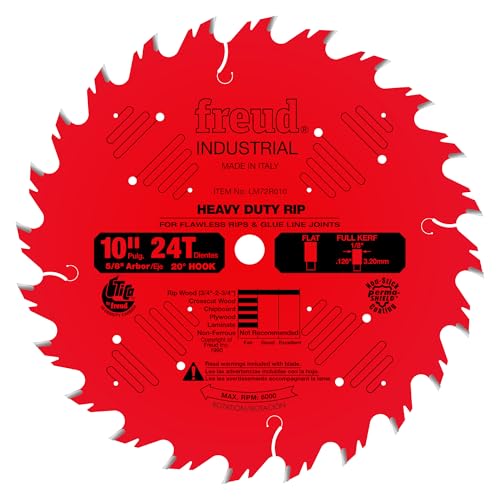
1. Freud America LU87R010 10″ Heavy-Duty Rip Blade
Our pick — over 4.5★ from 950+ verified ratings; the strongest balance of quality and price.
The rip-first workhorse that turns rough lumber into glue-ready boards straight off the arbor.
If you break down a lot of solid wood, this flat-top 24-tooth blade is the one that makes ripping feel easy. Buyers report it cuts with less effort than combo blades and leaves an edge so smooth it is ready for glue—no sanding or jointing needed. The flat tooth design is what delivers that finish, acting like a mini jointer on every pass.
Quality is the thing owners praise most here, with sharpness right behind it. Hard woods like curly maple and ash cut clean with minimal chatter. The.126″ kerf (the width of the cut slot) is noticeably wider than finish blades, which means it removes more material fast—perfect for thick rips but not your first choice for delicate veneer work.
The trade-off is the noise. Several owners describe a loud, high-pitched whine during use, and durability gets mixed feedback with occasional reports of teeth breaking off. This is a blade for production ripping and joinery—not a quiet evening of trim work.
What Rippers Rave About
- Glue-ready flat-bottom cuts that skip the jointer
- Laser-cut anti-vibration slots for a crisp, splinter-free finish
- Perma-Shield non-stick coating resists pitch buildup
What to Expect
- Noticeably loud high-pitched whine during rips
- Plywood crosscuts can show tear-out
- Mixed reports on long-term tooth durability
Reach for this if: solid-wood ripping and joinery are your main jobs and you want a surface that skips the jointer.
Look elsewhere if: you crosscut plywood all day, where a higher tooth count handles tear-out better.
2. Luckyway 10 Inch 80T Ultra Finish Blade
The ultra-finish disc that delivers premium blade results at a fraction of the Italian import cost.
Sheet goods are this blade’s home turf. The 80-tooth count leaves cut edges that need no tear-out cleanup, and owners mention the cut quality matches blades costing several times more. It also carries a slim 0.098″ kerf, which is dramatically narrower than the Freud ripper above and removes less material—so you stretch each sheet further and put less strain on the motor.
At just 0.75 kg, it is notably lighter than the MASTEC aluminum blade, which makes handling easier during long sessions on a table or miter saw. Owners describe it cutting through laminate like butter and it earns high marks for blade quality and cutting performance. Sharpness does get mixed feedback, with some finding it dulls quicker than premium steel, so it suits moderate use rather than heavy production.
The catch is that tear-out and quick dulling show up in some reviews, so treat it as a high-value finishing blade rather than a demolition tool.
Smooth operator: The blade quality and crosscut performance win owners over, making it a genuine budget-friendly upgrade for plywood and MDF work.
Honest limit: Occasional reports of faster dulling mean this is best for the weekend shop, not daily production cutting.
Best for: anyone who wants finish-quality plywood cuts without spending Italian-blade money.
Not for: high-volume production shops that need maximum edge life between sharpenings.
3. IVY Classic 40088-5 Swift Cut Metal Cut-Off Blade, 5-Pack
A five-pack of resin-bonded discs that chew through steel fence posts and angle iron without mercy.
This is not a toothed carbide blade—it is a Type 1 abrasive cut-off wheel built for ferrous metal. The resin-bonded aluminum-oxide grain cuts steel, angle iron, sheet metal, and other ferrous products, and the fiberglass mesh reinforcement keeps it from shattering under stress. It fits a standard 10-inch chop saw with a 5/8-inch arbor and spins up to 6,100 RPM.
The five-pack value is the recurring theme in owner feedback, with several noting they keep coming back to buy it again. One buyer measured the trade-off precisely: the first disc failed after 4 cuts on steel tubing and overheated, but the second completed the remaining 6 cuts without issue. That is the nature of abrasive wheels—they wear fast on thick wall steel and occasionally a dud slips through.
Expect heavy sparks. Owners are clear that this needs outdoor use with gloves, long sleeves, eye protection, and an air compressor nearby. Cuts on steel fence posts go easily, though edges will need filing or deburring before they are clean.
Why the 5-Pack Wins
- Fiberglass-reinforced for durability and safety
- Metal-reinforced arbor adds strength
- Five discs make the cost per cut disappear
Cut Realities
- Produces heavy sparks—outdoor use strongly advised
- Leaves burrs that need filing or deburring
- Individual discs can overheat on thick-wall steel
Choose this if: you cut ferrous metal like steel tubing, rebar, or fence posts and want a bulk supply.
Pass if: you need clean, burr-free edges straight off the saw, which a toothed carbide blade handles better.
4. MASTEC 10-Inch 100T TCG Aluminum Saw Blade

The triple-chip disc that slices 6061-T6 aluminum angle without snagging, ripping, or rough edges.
This blade carries 100 carbide teeth in a triple-chip grind, the geometry built for non-ferrous metals. Customers note cutting 6061-T6 aluminum with no issues—handling 3/8-inch thick walls and facing off angle stock with a fine 0.020-inch cut. That is exactly the kind of precise, clean work a standard wood blade simply cannot do. It also runs cleanly in miter saws, circular saws, and table saws.
Cutting performance is what owners praise most, with quality right behind. The dense 100-tooth count helps it produce clean cuts on aluminum angle stock and T-track extrusions. At 0.88 kg it is heavier than the Luckyway finishing blade, which actually helps stability when pushing through metal. Users note it does not require filing after use, saving a step on every cut.
The honest caveat is that some reviewers point out carbide tips occasionally coming off, and a few note clogging. Applying a little cutting fluid, as several owners do, keeps the cuts smooth and the blade cooler over longer sessions.
Clean metal cuts: Owners highlight the smooth, chip-free results on aluminum angle and T-slot material with no filing afterward.
The trade-off: Durability is mixed, with occasional reports of tips shedding, so keep an eye on it during heavy use.
Best for: fabricators and DIYers who cut aluminum extrusion, angle, or plate and want a clean edge without filing.
Think twice if: you cut mostly wood, where a standard wood blade gives you more versatility for less money.
5. IVY Classic 35056 Swift Cut 10″ 200-Tooth Aluminum & Plastic Blade
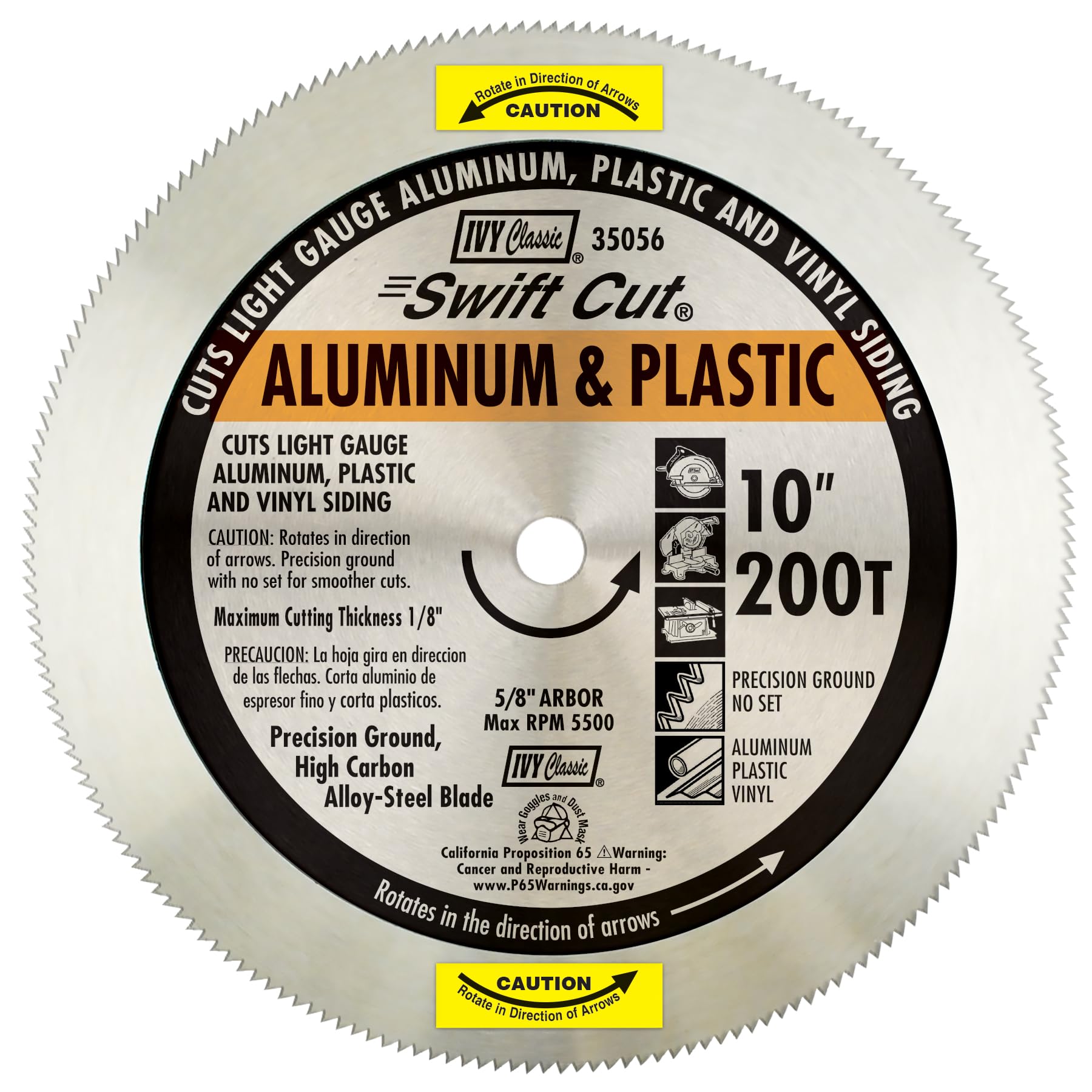
Two hundred precision-ground teeth for the smoothest possible cuts on thin aluminum, plexiglass, and vinyl.
This is the blade for thin, fragile sheet material. The high-carbon alloy steel body with 200 teeth and no set (meaning teeth are not bent outward, so the cut is narrower) produces exceptionally smooth cuts on light-gauge aluminum, plastic, and vinyl siding up to 1/8-inch thick. Buyers use it to cut acrylic sheets for picture frames on a table saw instead of fighting a jigsaw, with clean results.
It is noticeably sharper than the MASTEC blade on thin stock, which is what owners praise most. For window screen frames, it beats a hacksaw easily. The manufacturer is clear about its limits, though—for material thicker than 1/8-inch, they point you to their 80-tooth non-ferrous blade instead. Push this one past that thickness and you risk dulling it quickly.
Durability is the recurring concern, with reports of it dulling fast and even warping after use. Sharpness and quality earn the praise, but this is a specialist tool for light work, not a general-purpose metal blade.
Where It Shines
- Razor-clean cuts on plexiglass and acrylic
- No-set teeth give an ultra-smooth edge
- Ideal for window screen aluminum frames
Where It Struggles
- Limited to material 1/8″ and thinner
- Dulls quicker than carbide on heavier stock
- Reports of warping after extended use
Reach for this if: your work is thin aluminum, plexiglass, or vinyl siding where a scratch-free edge matters most.
skip it if: you cut thicker metal stock—the manufacturer itself recommends a different blade past 1/8-inch.
6. Diablo D1080N 10″ 80-Tooth Non-Ferrous & Plastic Blade

The controlled demolition blade that slices aluminum, copper, and brass with a mirror finish and no rework.
This is the premium pick for non-ferrous metal work. The triple-chip grind with an 80-tooth count delivers clean, burr-free cuts on aluminum, copper, brass, plastics, and fiberglass. Owners describe cutting 1/8-inch aluminum plate and plexiglass smoothly with no chipping, and note the edges rarely need sanding. It runs on table saws, chop saws, and miter saws with a 5/8-inch arbor.
Cutting performance is the dominant praise, with 80-tooth geometry and a -5 degree hook angle giving it precise control. The Tri-Metal Shock-Resistant Brazing lets it withstand the impact of cutting metal without shedding teeth. Perma-SHIELD non-stick coating keeps heat and gumming down, and its laser-cut stabilizer vents trap noise and reduce vibration for better accuracy.
It comes with a caveat: cutting aluminum square requires a rigid saw setup, consistent bite size, and clamping. The blade will do its part, but a flimsy saw or aggressive feed will spoil the cut. Durability holds up well in owner reports, earning it a strong reputation for metal cutting.
Metal master: Owners call its cuts on aluminum plate and plastic genuinely clean, with no end chipping or broken edges.
Good to know: Setup matters—a rigid saw and steady feed are required to get square cuts on T-slot aluminum.
Best for: shops cutting aluminum, copper, and plastic that want a durable premium blade with a clean finish.
Not the pick if: you need a budget-friendly option—premium performance carries a premium cost.
7. Makita B-66977 10″ 80T Max Efficiency Miter Saw Blade
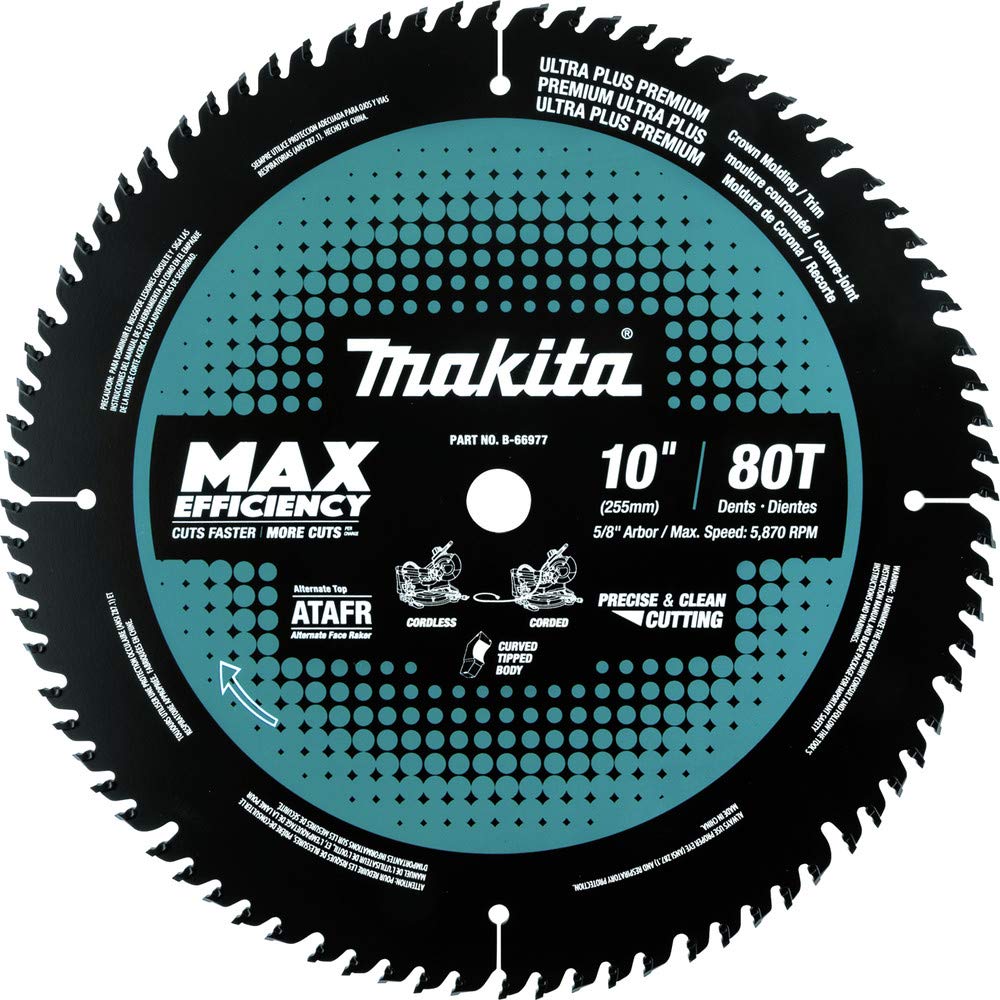
The cabinet installer’s secret—an 80-tooth blade that leaves no visible mark on maple.
This blade is engineered for speed on a miter saw. Makita claims up to 100% faster cutting than standard blades and up to 30% more cuts per charge on cordless saws. The special ATAFR (alternate top alternate face with raker) carbide tips are designed to reduce load on the motor while delivering smoother, faster cuts through wood.
Professional cabinet installers who cut maple daily report you cannot find a blade mark on the cut—some say it outperforms higher-tooth-count blades from other premium brands with far less gumming. Owners describe it cutting through thick stock like a hot knife through butter, with minimal tear-out on veneer plywood even without painter’s tape.
It’s the highest-rated blade in this roundup, with owner reviews confirming its performance. The thin kerf design creates less drag on the motor and wastes less material. It weighs just 0.75 kg, matching the Luckyway blade’s light handling, but delivers the cutting performance that pros trust on the jobsite.
Why Pros Choose It
- Up to 100% faster cutting than standard blades
- Smooth, mark-free cuts on hard maple
- ATAFR tips reduce motor load
Consider This
- Thin kerf means less material to resharpen later
- Designed for wood—not a metal-cutting blade
Best for: trim carpenters and cabinet installers who live on a miter saw and demand speed plus a flawless finish.
Look elsewhere if: you need to cut metal—this is a dedicated wood blade.
8. Freud Industrial LM74R010 10″ 30-Tooth Glue Line Ripping Blade
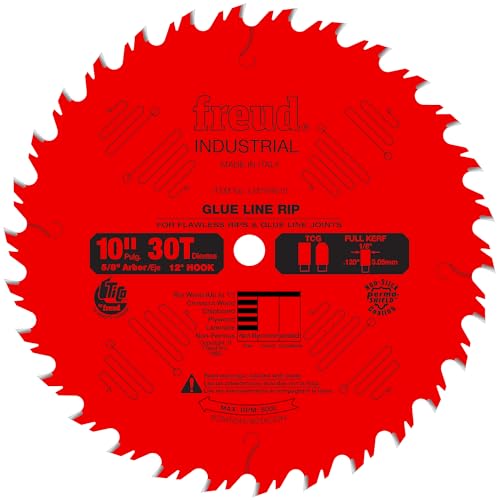
The 30-tooth ripper that replaces your jointer for glue-ups on hard walnut and cherry.
Here is the heavier sibling to the LU87R010. Both rip wood, but this one carries a thicker kerf and reinforced plate for maximum stability. The triple-chip grind on 30 teeth delivers surfaces so smooth that owners prepare 1-5/8-inch thick cherry planks for glue-up directly off the blade, with no jointer pass needed. Fewer teeth mean more aggressive material removal, and the TiCo carbide blend keeps the edge cutting hardwoods without burning.
Blade quality is the most-praised aspect, with sharpness right behind. Owners run it through walnut, maple, cherry, and purpleheart with consistent, burn-free results and glue-ready edges. It handles a 1.75 HP saw with ease, making it an option for contractor saws as well as bigger cabinet saws.
The only mixed note is visible saw marks on some edges, though most shoppers say none. For anyone who does serious joinery, this is the upgrade that removes an entire step from the workflow.
Jointer killer: The most-praised trait is consistent glue-ready rips that eliminate the need for a jointer on most stock.
The fine print: A thicker kerf removes more material, so it is a ripping blade first and a crosscut blade second.
Best for: furniture makers and serious woodworkers prepping stock for glue-ups at production volume.
Skip if: you only crosscut sheet goods, where this blade’s rip-first design is the wrong tool.
Understanding the Specs
Kerf and Plate Thickness
Kerf is the width of the slot the blade cuts. A wider kerf like the Freud LU87R010’s.126-inch removes more material and gives a more stable, wobble-free cut, but it strains the motor and wastes stock. A thinner kerf like the Luckyway’s 0.098-inch cuts faster with less drag and leaves more material in the workpiece, which is why finish blades favor slimmer profiles.
Hook Angle
Hook angle is the tilt of each tooth relative to the blade’s center. A positive hook angle (like the Freud ripper’s 20°) pulls the work into the blade aggressively for fast cuts. A negative hook angle (like the Diablo’s -5°) keeps the blade from grabbing, giving you more control on metal where a snag can be dangerous. Wood blades tend toward positive, metal blades toward negative.
Tooth Grind
Tooth grind is the shape ground into each carbide tip. Flat-top (FTG) teeth leave a flat-bottom cut, ideal for ripping and dado work. Alternate top bevel (ATB) teeth shear wood fibers for clean crosscuts. Triple-chip grind (TCG) teeth have a beveled chisel edge that resists chipping, making them the standard for non-ferrous metals like aluminum and copper. Match the grind to the material and the blade lasts longer.
Arbor Size and RPM Rating
The arbor is the hole that mounts the blade to the saw spindle, and most 10-inch blades use a 5/8-inch arbor. Always confirm your saw’s arbor before buying. Max RPM tells you the fastest speed the blade is rated for—the IVY metal disc tops out at 6,100 RPM. Exceeding a blade’s RPM rating risks failure, so check your saw’s no-load speed against the blade’s printed limit.
FAQ
Will a 10-inch blade fit my miter saw or chop saw?
What is the difference between a rip blade and a crosscut blade?
Can I cut aluminum with a wood-cutting blade?
How long does a 10-inch carbide-tipped blade last?
Is more teeth always better for a cleaner cut?
What does kerf mean and why does it matter?
What is a triple-chip grind blade used for?
Can I use a metal cut-off disc on wood?
Why does my blade burn the wood instead of cutting it?
How do I know if a blade needs sharpening or replacing?
Final Thoughts: The Verdict
For most woodworkers, the 10 inch chop saw blade winner is the Freud LU87R010 because its 24-tooth flat-top design turns ripping into a glue-ready pass with no sanding or jointing. If you want mirror-smooth plywood crosscuts on a budget, grab the Luckyway 80T. And for cutting aluminum, the Diablo D1080N is the one to reach for with its clean, burr-free non-ferrous performance.
How We Picked
We do not accept paid placement. Every pick is matched to a real buyer and a real use-case; we do not hands-on test units.
Sources & Methodology
Specifications: manufacturer listings and product documentation. Review insights: verified customer reviews, as of September 2026. Pricing: not shown on this page (it changes often); check the current price via the retailer link.
As an Amazon Associate, KitchPrep earns from qualifying purchases. This does not affect which products we feature.
Related Guides
