
Specs are compiled from manufacturer listings and verified buyer reviews and can change over time — please confirm the key details on the product page before buying.
A 10 GPM tankless water heater only matters if it sustains that flow under real demand. A true 10 GPM tankless water heater runs multiple showers, a washing machine, and a dishwasher all at once without the water temperature collapsing — that’s the entire point of stepping up to this flow class. Choosing the wrong model or skipping a proper install can waste money, so this guide focuses on the specs that count.
I’m Mohammad Maruf — the founder and writer behind KitchPrep. This guide is built by comparing the manufacturers’ published specifications and the patterns across verified customer reviews, so you get each pick’s real strengths and trade-offs instead of marketing spin.
The right 10 gpm tankless water heater should handle your household’s peak demand without flinching — here’s how to choose one that won’t let you down.
Quick Picks
- A. O. Smith ATI-510CX3 — Top Performer
- Rheem Prestige RTGH-RH10DVLN — Instant Hot Water
How To Choose The Best 10 GPM Tankless Water Heater
Before you compare models, understand that a 10 GPM heater isn’t just about raw volume. It’s about sustaining that flow when the incoming ground water is cold — because that’s when the unit has to work hardest to heat everything.
Match the BTU output to your climate
The flow rate tells you how much water moves through, but the BTU rating tells you how much heat the burner can add. In warmer regions, a lower BTU unit can handle 10 GPM easily. In cold northern winters, the same flow rate demands more BTUs to raise freezing ground water to shower temperature — so a higher heat output gives you more real-world headroom.
Choose the right venting type for your home
Non-condensing units use standard venting and run at lower efficiency, while condensing models extract extra heat from exhaust gases and often use cheaper PVC venting. Your home’s layout — whether you can run a vent vertically or horizontally, and how far it must travel — often decides which type fits. Check your local gas line size too, since a 199,000 BTU heater may require an upsized supply line.
Quick Comparison
In‑Depth Reviews
1. A. O. Smith ATI-510CX3
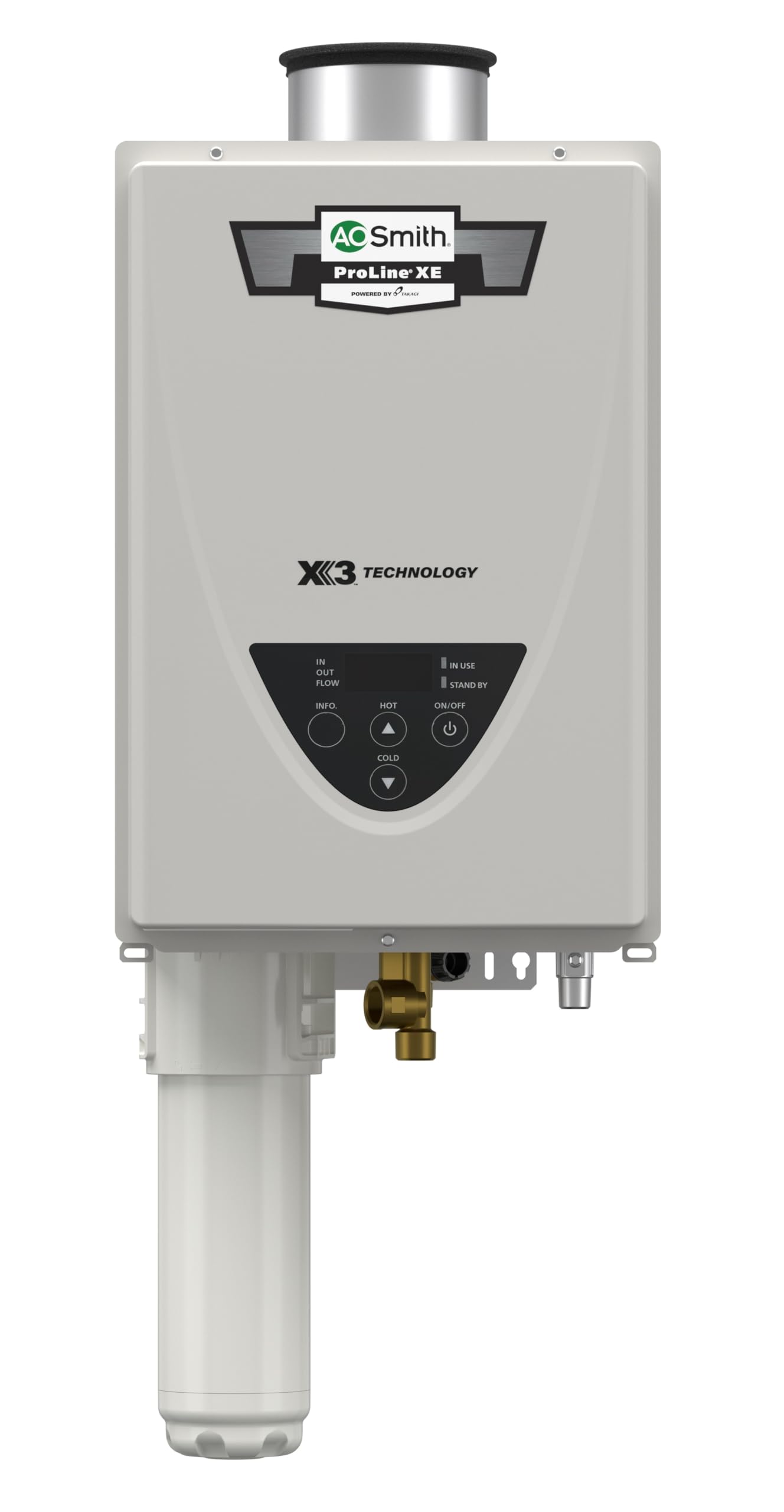
Delivers 199,000 BTUs to keep water hot even in cold climates.
What wins people over here is the sheer thermal muscle — this unit cranks 199000 British thermal units, which is 11% more heat output than the Rheem’s 180,000 BTU.. That extra heat matters most in winter, when cold ground water needs more energy to reach shower temperature at a full 10.0 GPM flow. Its commercial-grade copper heat exchanger transfers heat 25 times faster than stainless steel for quicker temperature recovery., so the outgoing water temperature stabilizes faster after you open a tap.
Installers with experience describe the setup as straightforward — some even did it themselves after their old tankless sprung a leak. The ProLine XE runs on natural gas but converts easily to propane, and it uses a direct vent APNC35 concentric vent system that works with vertical or horizontal termination. A 15-year limited warranty on the heat exchanger backs the core component in residential use.
The X3 Scale Prevention Technology addresses the hard-water buildup that shortens tankless lifespans, which is worth attention if you live in a mineral-heavy water region. One owner notes it isn’t recommended for midwestern regions — a reminder that no single tankless fits every climate. Owners frequently report running a shower and washer at once with no temperature drop.
Why owners stick with it
- Higher heat output than other 10 GPM models for cold-weather performance
- Easily convertible natural gas to propane
- Integrated diagnostics simplify troubleshooting
Who should pass
- Not recommended for midwestern cold-region installs per one owner
- Non-condensing design is less efficient than condensing rivals
Reach for it if: you want maximum heat output for big simultaneous demand and have DIY gas experience.
Look elsewhere if: your region regularly sees freezing ground water and you need a condensing unit’s efficiency.
2. Rheem Prestige RTGH-RH10DVLN

Built-in recirculation delivers instant hot water and cuts water waste.
The headline feature here is the built-in recirculation, which keeps hot water ready at the tap so you never stand shivering through a cold-water sandwich. Owners in older homes — even a 110-year-old house — report instant hot water after adding a cold water bypass valve, and the system fixes the low-flow shut-off problem that plagues many tankless units. It is also more compact than the A. O. Smith at 17.3″W x 28.7″H versus 13.78″W x 36.13″H, a 26% smaller footprint for easier fit in tight spaces..
As a condensing unit, it extracts extra heat from exhaust gases, which delivers lower operating costs and a water-saving setting — the energy efficiency story the Prestige line is known for. The stainless steel heat exchanger handles a maximum pressure of 150 psi, and the water and gas leak detection shuts the unit down with an error code for safety. Auto-Learn Programming tracks your usage patterns and adjusts to meet peak hot-water demand automatically.
Reliability gets mixed feedback, and that’s the honest caveat. Buyers report one punishing experience: 4 weeks of failed plumber visits after install. A handful also note the water pressure can arrive in 5-second pulses. On the flip side, satisfied owners who upsized their gas line for the BTU demand say the bypass recirculating valve works exactly as advertised. The Wi-Fi module is sold separately, which surprised a few people after purchase.
The draw: instant hot water via built-in recirculation plus condensing efficiency in a compact frame.
The reality check: quality and reliability run mixed in owner reports, so a pro install and a properly sized gas line are essential — not optional.
Best for: buyers who hate waiting for hot water and want a space-saving, high-efficiency condensing design.
Think twice if: you can’t arrange a qualified installation and an upsized gas supply — this unit punishes shortcuts.
Understanding the Specs
Flow Rate (GPM)
Gallons per minute is how much hot water the unit can produce continuously. A true 10 GPM rating means it can feed multiple showers, a washing machine, and a dishwasher at once. But the real-world flow you get depends on your incoming water temperature — colder ground water reduces what the heater can actually deliver.
Heat Output (BTU)
British thermal units measure the burner’s heat production. Higher BTU means the unit can raise cold water to temperature at a faster flow. When comparing a 199,000 BTU model to an 180,000 BTU one, the higher figure holds up better through cold winters — both at 10 GPM, but with different thermal headroom.
Condensing vs. Non-Condensing
Condensing units capture waste heat from exhaust gases, boosting efficiency and allowing PVC venting. Non-condensing models vent hotter air through metal pipes but run slightly less efficiently. Condensing designs also tend to be more compact — a real advantage when replacing a bulky tank.
Recirculation
A recirculation system keeps a loop of hot water ready near your taps, so you get hot water instantly instead of running the tap while waiting. Built-in recirculation saves water and time, but adds complexity. Some units require an external bypass valve to function properly in older plumbing layouts.
FAQ
Can a 10 GPM tankless water heater really run two showers and a washing machine at once?
What size gas line does a 199,000 BTU tankless water heater need?
Is a condensing tankless water heater worth the extra complexity?
What does built-in recirculation actually do for me?
Why is the BTU rating more important than the GPM flow rate?
Can I install a 10 GPM tankless water heater myself?
What is X3 Scale Prevention Technology and do I need it?
What venting options does a 10 GPM tankless water heater support?
Is a 10 GPM heater overkill for a small home?
Are tankless water heaters more reliable than traditional tank models?
Final Thoughts: The Verdict
For most households, the 10 gpm tankless water heater winner is the A. O. Smith ATI-510CX3 because its 199,000 BTU output gives you real cold-weather headroom and owners consistently report unshakable hot water. If you hate waiting for hot water at the tap and want a compact, high-efficiency condensing design, grab the Rheem Prestige RTGH-RH10DVLN with its built-in recirculation. And whichever you choose, budget for a professional install with a properly sized gas line — that’s the difference between endless hot water and a costly headache.
How We Picked
We do not accept paid placement. Every pick is matched to a real buyer and a real use-case; we do not hands-on test units.
Sources & Methodology
Specifications: manufacturer listings and product documentation. Review insights: verified customer reviews, as of September 2026. Pricing: not shown on this page (it changes often); check the current price via the retailer link.
As an Amazon Associate, KitchPrep earns from qualifying purchases. This does not affect which products we feature.
Related Guides
