
Specs are compiled from manufacturer listings and verified buyer reviews and can change over time — please confirm the key details on the product page before buying.
When the lights go out, the real question isn’t whether you have a generator — it’s whether you have to go outside in a storm to start one. An automatic standby generator sits outside your home, wired permanently into your electrical panel, and it watches the power grid constantly. The moment the grid fails, it starts itself, switches your house over to generator power, and you might only notice because the microwave clock is flashing.
I’m Mohammad Maruf — the founder and writer behind KitchPrep. This guide is built by comparing the manufacturers’ published specifications and the patterns across verified customer reviews, so you get each pick’s real strengths and trade-offs instead of marketing spin.
To keep your whole home running during an outage, you need to match the generator’s power output to your electrical panel. The automatic standby generator you pick must balance its raw wattage with the size of its transfer switch (the device that safely switches your home from grid power to generator power).
Our Picks at a Glance
How To Choose The Best Automatic Standby Generator
An automatic standby generator is a permanent home appliance, not a portable gadget you wheel out and plug in. This one is bolted to a concrete pad, connected to your fuel supply, and hardwired into your breaker panel. Your buying decision depends on three things: how much power your home draws, how your panel is set up, and how much you value remote confidence.
Match the wattage to your real loads
The engine’s maximum output (measured in kilowatts, or kW) tells you the ceiling of what it can power at once. A smaller 10kW unit can comfortably run the essentials — lights, fridge, a well pump, a furnace — but it will not run a central air conditioner alongside an electric oven at the same time. The 26kW units exist for large homes with multiple AC units and electric appliances. Think about what you actually need when the grid is down for days, not about powering everything you own at once.
Check the transfer switch rating before you look at the engine
This is the detail first-time buyers overlook. The generator produces power, but the automatic transfer switch is the brain — it senses the outage, starts the engine, and safely disconnects you from the grid so you don’t backfeed electricity to utility workers. A 100 Amp switch handles a typical home’s essential circuits. A 200 Amp switch is service-entrance rated, meaning it can back up everything in a larger home. The switch rating must suit your panel; it is not interchangeable with the engine size.
Fuel feeds the whole system
These units run on natural gas straight from the utility line, or on LP gas (propane) from a tank. Natural gas means you never refuel during an outage — as long as the gas line survives, the generator runs. Propane needs a large enough tank to last through multi-day outages. Both Generac models in this lineup accept either fuel. Confirm which fuel your home has access to before you commit to a model.
Quick Comparison
In‑Depth Reviews
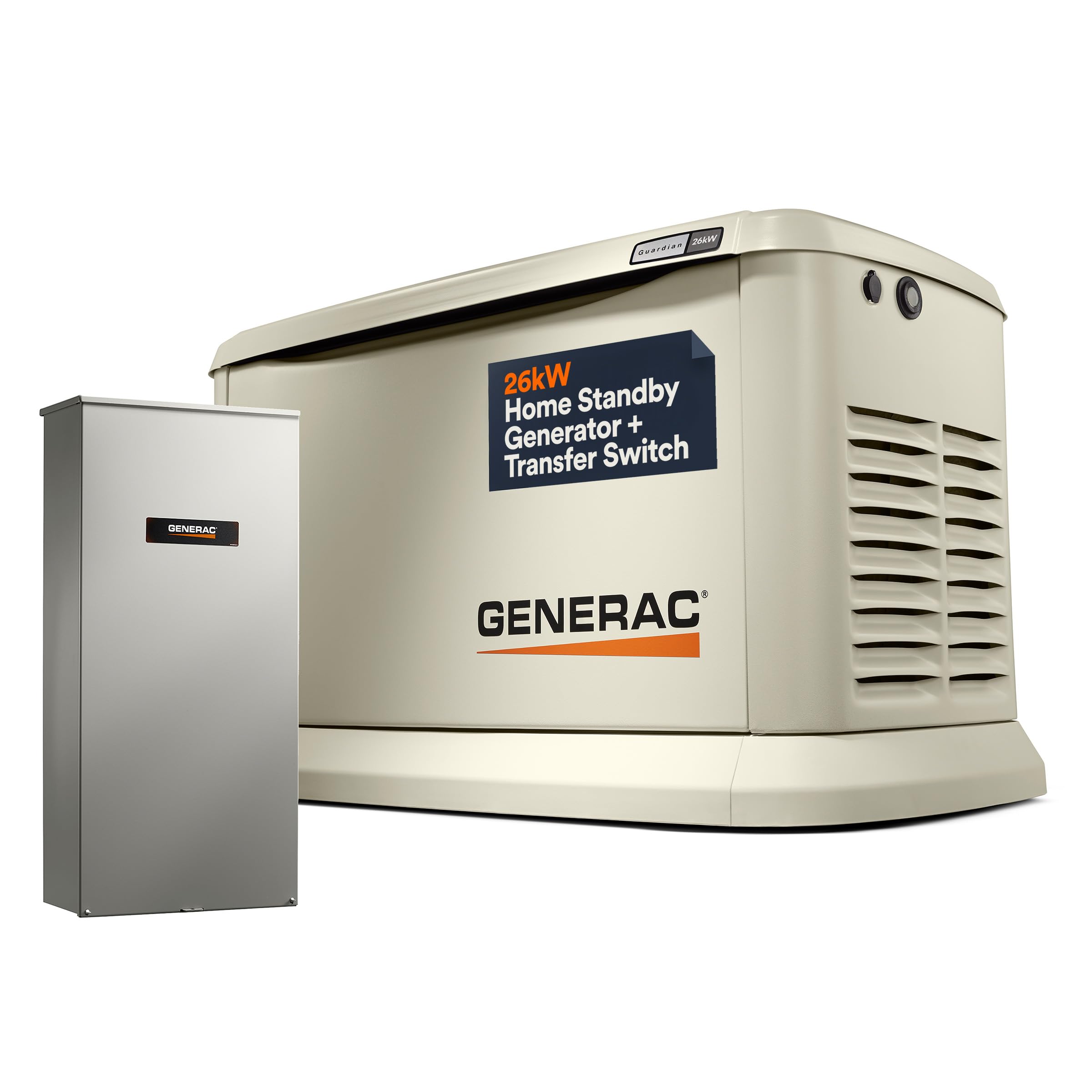
1. Generac Guardian 26kW Home Generator
Our pick — over 4★ from 50+ verified ratings; the strongest balance of quality and price.
A 26kW powerhouse that runs an entire large home’s electrical load at once.
This is the unit you buy when “essential circuits” sounds like a compromise. With a 26 kW maximum output, it holds a 2.6x power advantage over the 10kW Generac in this list — enough headroom to run central air, electric appliances, and every light in a large home simultaneously. It pairs that engine with a 200 A transfer switch, so the panel that feeds your whole house is covered end to end, not just a handful of breakers. For big homes with heavy electric loads, this is the ceiling of practical home backup.
To start large AC compressors, which draw a surge of power on startup, the engine needs serious grunt. That comes from the Generac G-Force 1000 Series, a 999 cubic centimeter unit (a 2.2x displacement advantage over the 10kW’s 460 cc motor). For sensitive electronics and variable-speed appliances, the system uses True Power Technology, delivering clean, stable electricity with under 5% harmonic distortion (a measure of how much the power waveform deviates from a perfect sine wave). Owners find the noise level noticeable but acceptable, and several describe it as reassuring because you can hear it kick on from inside the house.
The 4.2-star rating across 50+ owners reflects the confidence it delivers. Buyers report it is a repeat purchase: “this is the second one I have purchased for two different homes.” The 5-Year Limited Warranty backs the whole system, and Generac recommends installation by a certified and licensed electrician. The recurring gripe in the reviews is not the generator itself, which owners call fine, but the third-party delivery experience — owners mention, “It took 10 days to get it delivered after it was in town.” Plan for the unit to arrive on a truck that may not be prompt, and treat the delivery window with patience.
What wins people over
- 26 kW output with a 200 A switch covers a true whole house
- WiFi monitoring via Mobile Link lets you check status from anywhere
- 5-Year Limited Warranty on the transfer switch and system
- Engineered and assembled in the USA
Read the fine print
- Runs on natural gas or propane, but the propane conversion kit is not included
- A battery is also not included — budget for that separately
- Third-party delivery can be slow once the unit reaches your area
Your pick if: you have a large home with heavy electric loads and want one system that can run everything at once.
Hold off if: you want a ready-to-run package — this one expects you to source the propane conversion kit and battery yourself.
2. Kohler 20RESCL-200SELS 20,000W Standby Generator

A 20kW unit with a 10-second switchover and corrosion-proof enclosure for coastal homes.
Speed and toughness define this Kohler. It promises power to your home in 10 seconds after an outage — a response timed for homes where even a brief flicker matters, like those with medical equipment or deep freezers. Its output lands at 20,000 watts, a middle ground between the two Generac units here, but it carries a 200 A whole-house, service entrance rated transfer switch. That switch does more than switch: it is load shedding capable, meaning it can intelligently drop non-essential loads to protect the system. The whole package weighs 500 pounds, a sign of how heavily it is built.
Where this pick separates itself is outdoor endurance. A 100% corrosion-proof enclosure protects it from even the harshest seaside conditions — salt air is the enemy of most metal generator housings, and this one is designed specifically to shrug it off. It measures 48 by 26.2 by 29 inches, similar in footprint to the Generac units. The unit requires a Group 51 battery, which you supply. A 5-year/2000-hour limited warranty covers the system, whichever comes first.
Owners who’ve weathered real storms report smooth auto-start and reliable power. Customers note: “Best generator; ran 12 hours smoothly during outage, auto-started.” The self-test function runs weekly, and owners who had no outage yet still confirmed the weekly tests pass. The honest caveat is service network — a few owners note that local technician familiarity with these residential Kohler models varies, and one experienced a circuit board issue after two years that the dealer replaced under warranty. The watch-it note is reliability, which reviewers rate as mixed: most report flawless operation, but one reviewer noted a unit that quit early. Vet your local Kohler dealer before you commit, since installation and service quality shape the experience.
As owners put it, the negative reviews often trace back to installation skill, not the generator itself.
Built for the coast: the corrosion-proof enclosure is the standout trait for anyone near salt water.
The honest check: confirm a qualified local service technician exists for this model before buying.
Reach for this if: you live in a seaside or harsh-weather area and want a fast, corrosion-resistant whole-home unit.
Look elsewhere if: you can’t verify local Kohler service support, since dealer quality heavily influences long-term satisfaction.
3. Generac Guardian 10kW Home Generator

A 10kW workhorse that keeps lights, fridge, furnace, and well pump running for days.
Not every home needs 26kW of fury. This 10 kW Generac is for the house where the goal is simple: keep the lights on, the fridge cold, the furnace running, and the well pump pushing water — without paying for power you’ll never use. Its 10,000 watts handle those essential circuits comfortably, and it does so with a 100 A, 16-circuit transfer switch that lets you choose exactly which breakers get backup power. This is the entry point into whole-home standby protection, and it covers the needs of most average-sized homes without wasted capacity.
The engine is a Generac G-Force 400 Series with a 460 cubic centimeter displacement — far smaller than the 999 cc motor in the 26kW model, and that is the point. Less engine means lower fuel consumption during an outage and a lower upfront cost. Like its bigger sibling, it uses True Power Technology to deliver clean, stable electricity with under 5% harmonic distortion, so your TV, router, and variable-speed appliances won’t suffer from dirty power. It also runs on natural gas or LP gas, and it uses the same Mobile Link WiFi monitoring so you can check status and maintenance alerts from your phone. Its 48″L x 25″W x 29″H footprint is nearly identical to the larger model’s 48.5″L x 25.1″W x 28.6″H dimensions, so it takes up just as much yard space.
The owner experience points to serious longevity — reviewers point out of the prior unit: “last one lasted 24 years.” A 24-year lifespan makes the 10kW’s lower upfront cost an even smarter investment. Owners also note the sound is like a power mower running outside, which is acceptable outdoors and, if you position it near a sound barrier, fine indoors. The setup friction is the WiFi — several shoppers say “Setting up wifi is difficult, do not have wifi working yet” — so expect to spend some time on the mobile link configuration. And the included components are basic: engine oil, an oil funnel, and the owner’s manual. There is no transfer switch in the box beyond the panel’s own 16-circuit capability, and no battery, so factor those into your install plan.
The value angle: a 10 kW unit that buyers report lasting over two decades makes this the smart money pick for essential-circuit backup.
skip it if: you need to run central air or multiple large electric appliances at once — that demands the 26kW step up.
Best for: the typical home wanting reliable backup for lights, fridge, furnace, and well pump without buying unused capacity.
Not for: large homes with central AC and electric water heaters that need the headroom of a 200 A system.
Understanding the Specs
Kilowatts (kW) vs. Transfer Switch Amperage
Kilowatts measure the engine’s power output — the ceiling of what it can run at once. A 10 kW unit runs essentials; a 26 kW unit runs a whole large house. The transfer switch amperage (100 A or 200 A) measures how much electricity your breaker panel can route through the system. A 200 A switch is service-entrance rated, meaning it can handle the full electrical load of a large home. These two specs work together: you need a switch big enough for your panel and an engine big enough for the appliances you want to run.
Engine Displacement and Harmonic Distortion
Engine displacement (in cubic centimeters, or cc) is the size of the engine’s cylinders — bigger generally means more grunt for starting heavy loads like air conditioners. The 26kW’s 999 cc engine has a 2.2x displacement advantage over the 10kW’s 460 cc motor. Harmonic distortion measures how much the generator’s power waveform deviates from a clean sine wave; under 5% is considered clean enough for sensitive electronics. Lower distortion means your TV, computers, and variable-speed appliances run safely.
FAQ
What size automatic standby generator do I need for a typical home?
What is the difference between a 100 A and 200 A transfer switch?
Do these generators run on natural gas or propane?
How long does an automatic standby generator last?
How fast does the generator turn on after a power outage?
Is a battery included with these generators?
Can I install a standby generator myself?
How loud are these generators when running?
How much does installation cost for a standby generator?
Do I need WiFi monitoring on a standby generator?
Final Thoughts: The Verdict
When the grid goes dark, the winner is the Generac Guardian 26kW because its 26 kW output paired with a 200 A switch genuinely covers a large whole house, giving you the most headroom and the highest review count in this lineup. If you want fast response and a corrosion-proof build for coastal weather, grab the Kohler 20RESCL-200SELS. And for the typical home that just needs essentials kept alive without buying unused capacity, the Generac Guardian 10kW is the value pick that customers note lasting over two decades.
How We Picked
We do not accept paid placement. Every pick is matched to a real buyer and a real use-case; we do not hands-on test units.
Sources & Methodology
Specifications: manufacturer listings and product documentation. Review insights: verified customer reviews, as of September 2026. Pricing: not shown on this page (it changes often); check the current price via the retailer link.
As an Amazon Associate, KitchPrep earns from qualifying purchases. This does not affect which products we feature.
Related Guides
