
Specs are compiled from manufacturer listings and verified buyer reviews and can change over time — please confirm the key details on the product page before buying.
Nothing kills a fresh linoleum or vinyl job faster than a corner that curls up or a seam that lifts weeks later. The right floor adhesive is what separates a floor that stays put for years from one you will be re-gluing in a few months. This guide cuts through the sticky mess to find the best adhesive for linoleum and resilient flooring, based purely on the published specs and the real owner experiences behind each pick.
I’m Mohammad Maruf — the founder and writer behind KitchPrep. This guide is built by comparing the manufacturers’ published specifications and the patterns across verified customer reviews, so you get each pick’s real strengths and trade-offs instead of marketing spin.
Whether you are tackling a small bathroom vanity or a full kitchen floor, finding the right adhesive for linoleum means balancing drying time, hold strength, and clean-up effort before you open the pail.
Our Picks at a Glance

How To Choose The Best Adhesive for Linoleum
Before you compare brands, you need to know what type of flooring you are laying and what is underneath it. Linoleum, luxury vinyl tile, sheet vinyl, and carpet tile all have different backing materials, and the adhesive you choose has to match both the flooring and the subfloor.
Match the Glue to Your Flooring and Subfloor
Check the label against your exact material: some adhesives are made for a range of resilient floors and list them clearly, while others are built for one specific type. Your subfloor matters just as much — concrete, plywood, cement backerboard, and old existing tile each call for a formula that bonds properly with them.
Understand Working Time vs. Drying Time
Working time is how long you can position and adjust your flooring after spreading the glue, and drying time is how long before it sets. A short working time demands precision; a long one lets you lay in leisurely sections. Matching that pace to your skill level and room size prevents a lot of frustration.
Quick Comparison
| Model | Best For | Adhesive Type | Container Size | Item Weight | Amazon |
|---|---|---|---|---|---|
| ROBERTS Universal Flooring Adhesive★ Best Overall | Versatile LVT, VCT & carpet tile | Acrylic Latex, Solvent-free | 1 Gallon (3.78 L) | 8.4 pounds | Amazon |
| ROBERTS 3085 Multipurpose AdhesiveCoverage King | Carpet & felt-back sheet vinyl | SBR Latex, Solvent-free | 1 Gallon (3.78 L) | 10.21 pounds | Amazon |
| DAP Weldwood Multi-Purpose Floor Adhesive | Small jobs & simple trowel application | Water-Resistant | Gallon | 2.5 pounds | Amazon |
| HENRY #430 Vinyl Adhesive | Laminate & vinyl flooring | Dries Clear | Gallon | 8 pounds | Amazon |
| Lucida Surfaces CoreBond Adhesive | Small repairs & motorhome projects | Solvent-free, PSA | 1 Quart | 2 pounds | Amazon |
| Pattex Carpet and PVC Adhesive | Large areas on underfloor heating | Solvent-free, PVC | 4 kg (approx. 1 Gal.) | 4 kg (8.8 lb) | Amazon |
In‑Depth Reviews
1. ROBERTS Universal Resilient Flooring & Vinyl-Backed Carpet Tile Adhesive
Our pick — 4.5★ from 400+ verified ratings; the strongest balance of quality and price.
The do-everything pail that handles LVT, LVP, sheet goods, and carpet tile without a second thought.
This is the one to reach for when you want a single adhesive for a house full of different floors. It is an acrylic latex, solvent-free formula that bonds luxury vinyl tile, luxury vinyl plank, vinyl composition tile, sheet goods, and vinyl-backed carpet tile — so a kitchen, bath, and utility room can all come from one gallon. The manufacturer even adds Microban protection to fight stain-causing growth that could degrade the adhesive over time.
You get a forgiving process that helps first-timers succeed. Owners describe it as easy to apply, and one first-timer’s LVP (luxury vinyl plank) job in a trailer came out clean. You trowel it on, wait for it to turn tacky, lay flooring in small sections, press with weights, and let it dry overnight. It dries clear, so your chalk lines stay visible while you work — a small thing that speeds up layout on a big room.
The honest fit note: for every rave about quick drying, there is an owner who found it slow in low spots, with one reporting low spots taking roughly six hours to dry. It still bonds to concrete, plywood, steel, marble, terrazzo, and even radiant-heated subfloors up to 85 degrees Fahrenheit, so the subfloor compatibility list is about as broad as it gets. Buyers report its stickiness is permanent once cured — clean spills with water fast, because after it dries even lacquer thinner will not remove the glue.
The crowd-pleasing side
- Great all-rounder options across common resilient floor types
- High initial grab from a pressure-sensitive tack
- Handles challenging extremes, like camper walls in 115°F+ heat, without lifting
- No harsh solvent fumes to deal with indoors
The trade-offs to plan for
- Drying time runs long in thick or low spots, so budget for it
- You must clean spills with water before it cures
Who this works for: The DIYer laying several different resilient floors across a home and wanting one dependable pail rather than three specialty glues.
Where patience is needed: A single pail lid reportedly leaked in shipping, and thick spots can take many hours to fully dry, so prep a work area with that in mind.
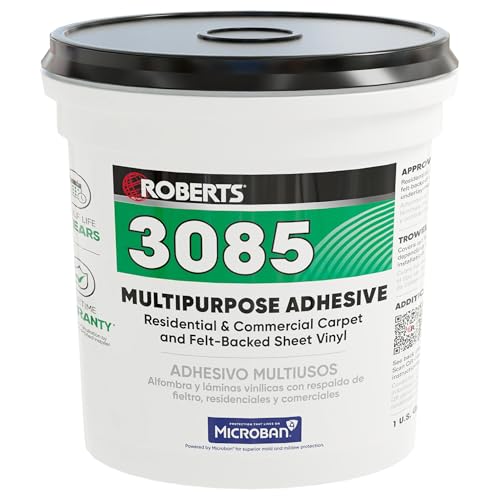
2. ROBERTS 3085 Multipurpose Adhesive
One gallon that stretches across 92 square feet and lets you lay a floor in 30 minutes.
For big sheet-vinyl and carpet jobs where square footage is the enemy, this is the value play. ROBERTS 3085 is an SBR (styrene-butadiene rubber) latex, solvent-free adhesive with a fast-setting formula for a long-lasting bond. It is rated for carpet, felt-back sheet vinyl, and acoustical cork underlayment. One owner covered a full 92 square feet out of a single can by applying a thin layer, which makes the per-room cost genuinely tough to top.
The floor-ready speed is the headline. After applying a thin coat, the surface was ready for linoleum in just 30 minutes, and it bonds with concrete, APA-rated plywood, terrazzo, and properly prepared VCT. Owners who installed vinyl flooring in a kitchen and laundry room report it still looks great years later, which speaks to the long-term hold you want from a budget-tier pail.
The recurring gripe is the smell, which some owners find unpleasant for days, and an occasional pail arrives with a broken or leaking seal. Unlike the Roberts Universal above, this one is for interior residential or moderate commercial traffic only — so keep it out of hangars and workshops. Given that a gallon weighs 10.21 pounds versus the Lucida quart’s 2 pounds, it is also a heavier pail to carry, but that weight buys you far more coverage.
Where it shines
- Fast-setting and floor-ready in about 30 minutes
- Excellent value per gallon for large areas
- Works for carpet, felt-back vinyl, and cork underlayment
- Solvent-free formula keeps indoor fumes lower
Real limitations
- Noticeable odor for a few days after install
- Not for heavy commercial traffic
- Packaging seal can arrive broken
Reach for it when: You are covering a large kitchen or laundry room in felt-back vinyl and want the cheapest reliable bond per square foot.
Think twice if: You are sensitive to chemical smell during install or need a glue for a busy commercial floor, where the Roberts 6399 above is a firmer choice.
3. DAP Weldwood Multi-Purpose Floor Adhesive
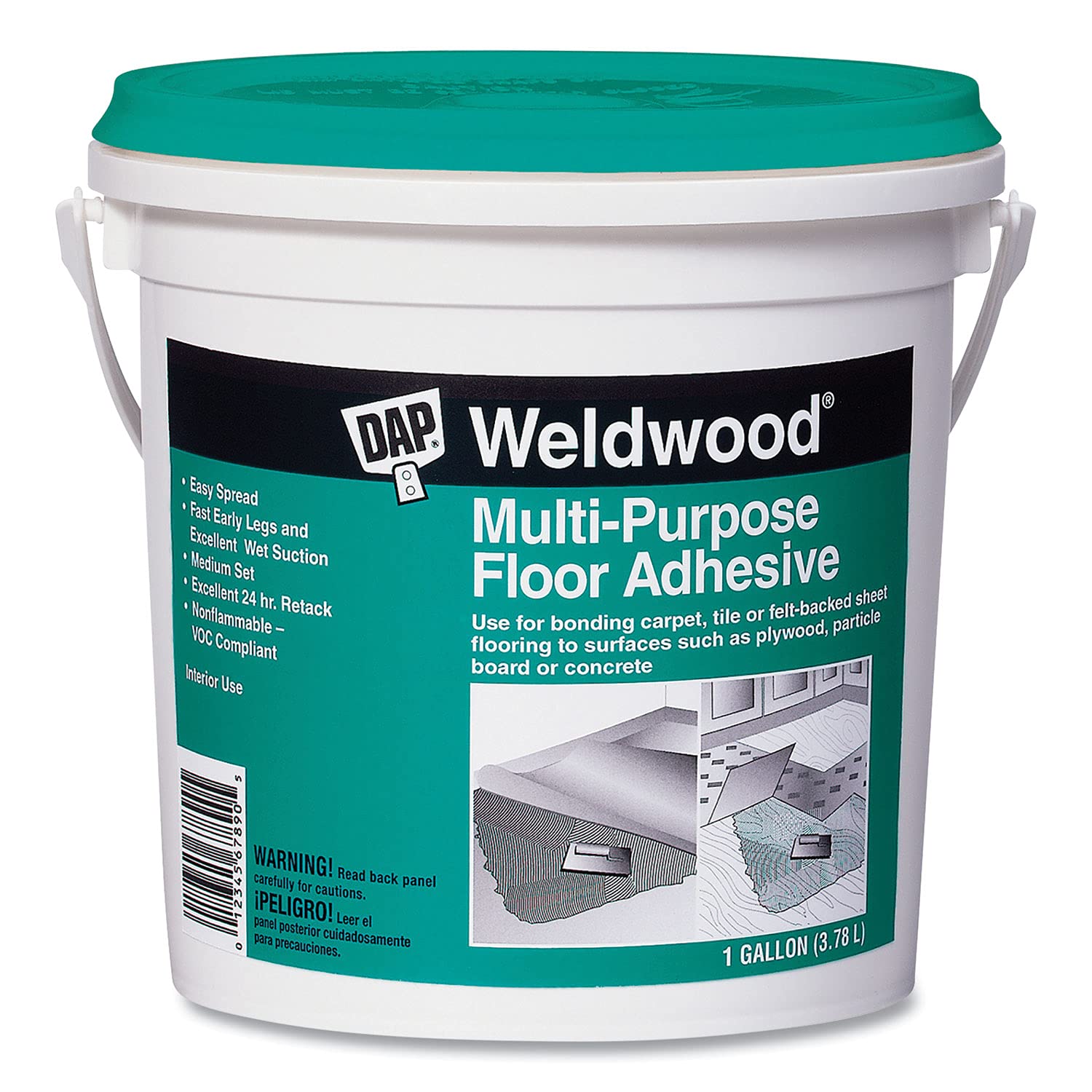
An off-white paste that spreads easily and holds linoleum down with no smell at all.
Sometimes the winning feature is simply that the glue does not reek. DAP Weldwood drew consistent praise for being genuinely odor-free while still holding linoleum down perfectly with a putty-knife application. It is a water-resistant multi-purpose floor adhesive in a gallon pail, and the off-white color is a practical touch that makes coverage easy to see as you spread.
The catch is that this one is deeply prep-dependent, and owners are blunt about it. The successful approach involves cleaning both surfaces with denatured alcohol, applying in small batches, pressing firmly with a roller, and allowing a full 72 hours to dry. On dirty or moist surfaces, and in humid conditions that slow curing, the bond can fail entirely — one owner who skipped that discipline watched tiles lift within a month.
Get the conditions right and the result is a rock-solid hold with no hollow spots. The thick, pasty consistency gives a strong initial grab with minimal shifting, and damp-cloth clean-up is easy while the glue is wet. It cured solid for carpet, vinyl, and even brick-stair projects, which makes it a versatile second-string choice behind the ROBERTS picks above.
Perfect-surface bond: When both surfaces are cleaned and you wait out the 72-hour cure, the hold is solid with no hollow spots underneath.
Prep-first warning: Dirty, damp, or humid conditions sabotage it — this glue rewards patience and discipline over speed.
Choose it for: Small rooms and tiny jobs where the lack of odor matters and you can give the floor a full three-day cure window.
Choose another if: You cannot guarantee clean, dry surfaces or you need a floor walkable within hours, not days.
4. HENRY #430 Vinyl Adhesive (12098)
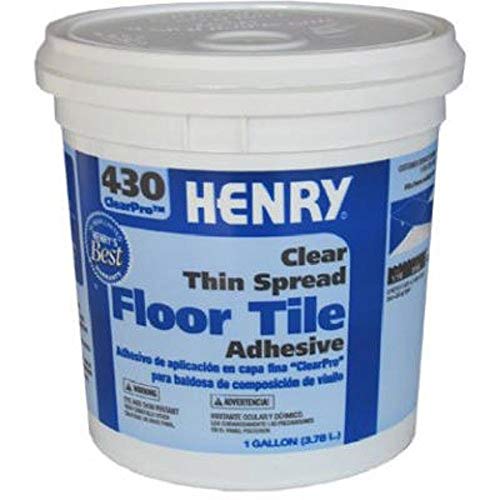
A go-on-thin, dries-clear staple that made four rooms stick fast with nothing but a putty knife.
HENRY is a name with decades of flooring history, and this #430 vinyl adhesive shows why a plain gallon pail still earns loyalty. It is a clear-drying vinyl adhesive made in the United States. Owners who followed the directions found it extremely sticky and effective: one laid four rooms with a thin layer and a putty knife, reporting great adhesion that dried quickly.
The instructions are the whole game here, and they are worth reading twice. Owners repeatedly stress using it sparingly and letting it dry for a set number of minutes before laying the floor. Do that and the glue grabs firmly; skip the wait and you will fight the tack.
The honest caveat is the inconsistency in setting time. This pail carries a stated 18-hour set time, and at least one frustrated owner reported it still not set five days later — a reminder that humidity and layer thickness dramatically affect cure. The other loud complaint is the smell, which owners say can drive you out of the house during install, though it does not stop them from ordering more for the next room.
What works
- Dries clear for invisible seam lines
- Trowels easily with a putty knife on thin layers
- Very sticky grab once it is ready
- A single gallon covers multiple rooms
The stumbling blocks
- Strong odor during application
- Long and occasionally unreliable set time
- Sensitive to how thick you spread it
It is for you if: You are comfortable following directions precisely and want clear-drying results across several vinyl rooms at a reasonable per-gallon price.
Look elsewhere if: You need a fast, predictable cure time or cannot tolerate strong solvent smells during the install.
5. Lucida Surfaces CoreBond Pro-Grade Solvent Free Adhesive
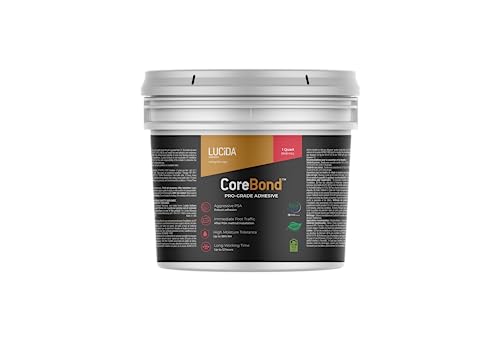
The right-size quart for repairs and tight spaces, wiping up clean with just a damp cloth.
Not every job needs a full gallon, and this quart-sized CoreBond covers roughly 40 square feet — a purpose-built size for a single room, a motorhome, or a repair. It is a solvent-free pressure-sensitive adhesive rated for luxury vinyl tile, vinyl plank without attached backing, PVC, carpet tile, VCT, quartz tile, and fiberglass-backed sheet flooring, which makes it remarkably broad for such a small container.
The clean-up story is what owners rave about. It wipes off wet surfaces immediately with a damp cloth, and dried adhesive lifts with mineral spirits — a huge relief compared to glues that demand aggressive scraping. A motorhome owner replacing vinyl tile called it easy to use and easy to wipe up excess, which is exactly the experience you want in a confined space.
Weight is the other quiet advantage: at just 2 pounds, this pail is a touch over one-fifth the weight of the 10.21-pound ROBERTS 3085 gallon above. That makes it a genuinely easier lift for reaching awkward corners and small patches. Working time runs about 30 minutes to an hour depending on conditions, giving you a comfortable window for positioning before it grabs.
Right-sized for the job: A 1-quart can that covers about 40 square feet, ideal for a bathroom, closet, or vehicle floor where a gallon would go to waste.
Keep the fit in mind: Some owners found the adhesive strength mixed on difficult surfaces, so for heavy-traffic rooms a firmer-set gallon formula from ROBERTS above is the safer bet.
Best for: DIYers tackling a small floor or repair who value light weight, easy damp-cloth clean-up, and don’t want leftover glue sitting in a pail for years.
Not ideal for: Whole-house installations or spaces with very heavy foot traffic where you need maximum firm-set holding power.
6. Pattex Carpet and PVC Adhesive (PTK4)

The heavy-duty European import built for carpet, PVC, linoleum, and warm underfloor heating systems.
This is the specialist for floors sitting on radiant heat. Pattex is explicitly rated as suitable for underfloor heating while handling carpet, PVC, and linoleum, which puts it in a rare category alongside the heat-tolerant ROBERTS options. It is a solvent-free, odorless formula from Henkel with a full cure time of roughly 15 minutes and a ready-to-use consistency straight from the pail.
The coverage numbers make sense for big open areas. One owner gluing vinyl flooring over concrete stairs found a thin layer sufficient and noted that the 4 kg pail covered about 20 square meters, with easy clean-up while wet and very low odor. That sort of reach makes it a strong candidate when you are covering a basement or a full open-plan ground floor.
Owners do warn it is not a universal craft glue — someone using it for rug tufting found it clumpy and unable to hold wool to monks cloth even after full drying. That is a mismatch of tool to task, not a knock on its flooring performance. For its intended job of laying resilient flooring over large heated slabs, the formula is proven and the reviews back it.
The strengths
- Suitable for floors sitting on underfloor heating systems
- Solvent-free and low odor for indoor comfort
- Fast 15-minute full cure time gets floors usable quickly
- A 4 kg pail reaches roughly 20 square meters
The limitations
- Not a good match for craft uses like rug tufting
- Best suited to large-area spreads rather than small patching
Reach for it when: You need to glue carpet, PVC, or linoleum over a radiant-heated floor and want a solvent-free product that cures in about 15 minutes.
skip it if: Your project is a small residential patch where a quart-sized adhesive like the Lucida above is more economical and easier to store.
Understanding the Specs
Solvent-Free vs. Solvent-Based
Solvent-free adhesives use water or synthetic latex as the carrier instead of chemical solvents. That means far less odor during application, easier clean-up with water or a damp cloth while wet, and a safer experience in enclosed indoor spaces. The trade-off is that cure time can stretch longer in humid conditions, so read the label before you commit to a schedule.
Working Time and Open Time
Working time is the window you have to position and adjust your flooring after the adhesive is spread, before it starts to set. Pressure-sensitive adhesives often offer longer working windows — like 60 minutes — while firm-set versions can drop to 20 minutes or less. Matching that pace to how fast you can lay floor is the difference between a clean job and a rushed one.
FAQ
Can I use a vinyl adhesive on linoleum flooring?
How long does floor adhesive take to dry before I can walk on it?
What is the difference between pressure-sensitive and firm-set adhesive?
Will these adhesives work on concrete subfloors?
How much area will a gallon of floor adhesive cover?
What is the best way to clean up excess adhesive?
Can these adhesives handle underfloor heating systems?
Why does my floor adhesive smell so strong during installation?
Should I use a trowel or a putty knife to apply the adhesive?
Final Thoughts: The Verdict
If you want one dependable pick, the best adhesive for linoleum and resilient flooring is the ROBERTS Universal Resilient Flooring Adhesive because it bonds the widest range of materials — LVT (luxury vinyl tile), LVP (luxury vinyl plank), VCT (vinyl composition tile), sheet vinyl, and carpet tile — from a single gallon. If you are laying flooring over radiant heat or in a space with rolling carts, reach for the Roberts 6399 Firm-Set Adhesive. And for a small bathroom or a motorhome repair where a gallon would go to waste, the Lucida Surfaces CoreBond Quart is the tidy, light-lifting choice.
How We Picked
We do not accept paid placement. Every pick is matched to a real buyer and a real use-case; we do not hands-on test units.
Sources & Methodology
Specifications: manufacturer listings and product documentation. Review insights: verified customer reviews, as of September 2026. Pricing: not shown on this page (it changes often); check the current price via the retailer link.
As an Amazon Associate, KitchPrep earns from qualifying purchases. This does not affect which products we feature.
Related Guides
