
Specs are compiled from manufacturer listings and verified buyer reviews and can change over time — please confirm the key details on the product page before buying.
When a storm kills the grid, your fridge thaws, your Wi-Fi router goes silent, and your sump pump stops. A home power station is a big, rechargeable battery box you plug essentials into during an outage — no gasoline or fumes. The real question is which capacity and output match your house, and this guide helps you pick.
I’m Mohammad Maruf — the founder and writer behind KitchPrep. This guide is built by comparing the manufacturers’ published specifications and the patterns across verified customer reviews, so you get each pick’s real strengths and trade-offs instead of marketing spin.
You’ll learn how watt-hours (a measure of total energy storage) translate to real runtimes, and which specs matter most for emergency backup and everyday confidence.
Our Picks at a Glance

How To Choose The Best Home Power Station
Think of a home power station as a middle ground between a tiny portable battery and a whole-house generator. It won’t run your central air for a week, but it will keep the refrigerator cold, the router online, and a few lights on through an outage. The three numbers that decide everything are capacity, output, and recharge speed.
Capacity: the size of your battery tank
Capacity is measured in watt-hours (Wh) — the total energy stored. A 2048Wh station can run a 200W load for roughly ten hours, while a 1024Wh unit would run the same load for about five. For home backup, aim for at least 2000Wh if you want to power a fridge and essentials for a full day or two.
Continuous vs. surge output
Continuous output (in watts) is what a station delivers steadily, while surge watts cover the brief spike when a fridge compressor or a drill starts up. A fridge might run on 150W but need 600W for that first-second kick. Pick a station whose surge rating clears the biggest appliance you plan to start.
Battery chemistry and lifespan
Most modern stations use LiFePO₄ (lithium iron phosphate) cells, which tolerate thousands of charge cycles before degrading. Higher cycle counts mean the battery holds capacity for a decade or more of daily or weekly use, making the upfront cost easier to justify. Cheaper, older lithium-ion cells wear out faster under heavy cycling.
UPS mode for instant switchover
If you want to keep a PC or a router running through a blink, look for a UPS (uninterruptible power supply) mode. That feature keeps the station plugged into the wall and switches to battery within milliseconds when the grid drops, so your work and your connection don’t flicker.
Quick Comparison
| Model | Best For | Capacity | AC Output | Weight | Amazon |
|---|---|---|---|---|---|
| BLUETTI AC200L★ Best Overall | Whole-home flexibility | 2048Wh | 2400W | 61.4 lbs | Amazon |
| DJI Power 1000 V2Fastest Recharge | Compact fast charging | 1024Wh | 1800W* | — | Amazon |
| BLUETTI Elite 100 V2Lightest 1kWh | Lightweight essentials | 1024Wh | 1800W | 25 lbs | Amazon |
| DABBSSON 2000L | Budget big capacity | 2048Wh | 2200W | 41 lbs | Amazon |
| Anker SOLIX S2000 | Fridge marathon runs | 2010Wh | 1500W | 35.7 lbs | Amazon |
| EcoFlow DELTA 3 Max | Power-hungry backups | 2048Wh | 3400W X-Boost | — | Amazon |
| Jackery Explorer 2000 Plus | Expandable 24kWh setups | 2042.8Wh | 3000W | 62 lbs | Amazon |
| Jackery HomePower 3000 | Multi-day whole-home | 3072Wh | 3600W | 59.5 lbs | Amazon |
In-Depth Reviews
1. BLUETTI AC200L
Our pick — over 4.5★ from 500+ verified ratings; the strongest balance of quality and price.
The whole-home anchor that runs a 13.5K rooftop AC and still has room to grow.
If your outage list includes appliances bigger than a phone charger, this is the station built for that stretch. The AC200L packs a 2048Wh capacity and a 2400W AC output — enough that buyers report running a 1500W kettle, a 12000 BTU air conditioner, even a 1500W leaf blower. At 2400W, it delivers roughly a third more continuous power than the Elite 100 V2’s 1800W, and it doubles the solar input at 1200W versus 600W, so it refills faster from the sun.
Owners mention using it with a grid switch at 40% and solar at 50%, nursing a 4-hour A/C run off panels. The 30A RV port and a 48V/8A DC port mean it talks directly to camper electrical systems, not just your coffee maker. Fast recharge is a headline feature: a max 2400W AC input takes it from 0-80% in roughly 45 minutes, and it expands to 8192Wh with extra battery packs — doubling capacity once, then again, as your needs grow.
What wins people over is performance and reliability over two years of use, with Bluetooth app monitoring as the daily companion. The 61.4-pound weight is the main trade-off — owners call it heavy but portable, with a few noting it takes two people to move comfortably. Owners consistently praise it for long weekend outings and van life alike. It holds a strong rating across 500+ owners who have tested it through real storms and real work.
What owners love
- Runs serious appliances — 1500W kettle, 12000 BTU A/C, leaf blower
- 0-80% recharge in about 45 minutes at 2400W input
- Expands to 8192Wh with add-on battery packs
What to know
- 61.4 lbs — plan for a two-person lift or a cart
- Expansion modules are a separate purchase
Reach for it if: you want one station that handles fridges, power tools, and RV hookups without breaking a sweat.
Think twice if: you need to haul it solo up stairs every day — at 61.4 lbs, this one stays put.
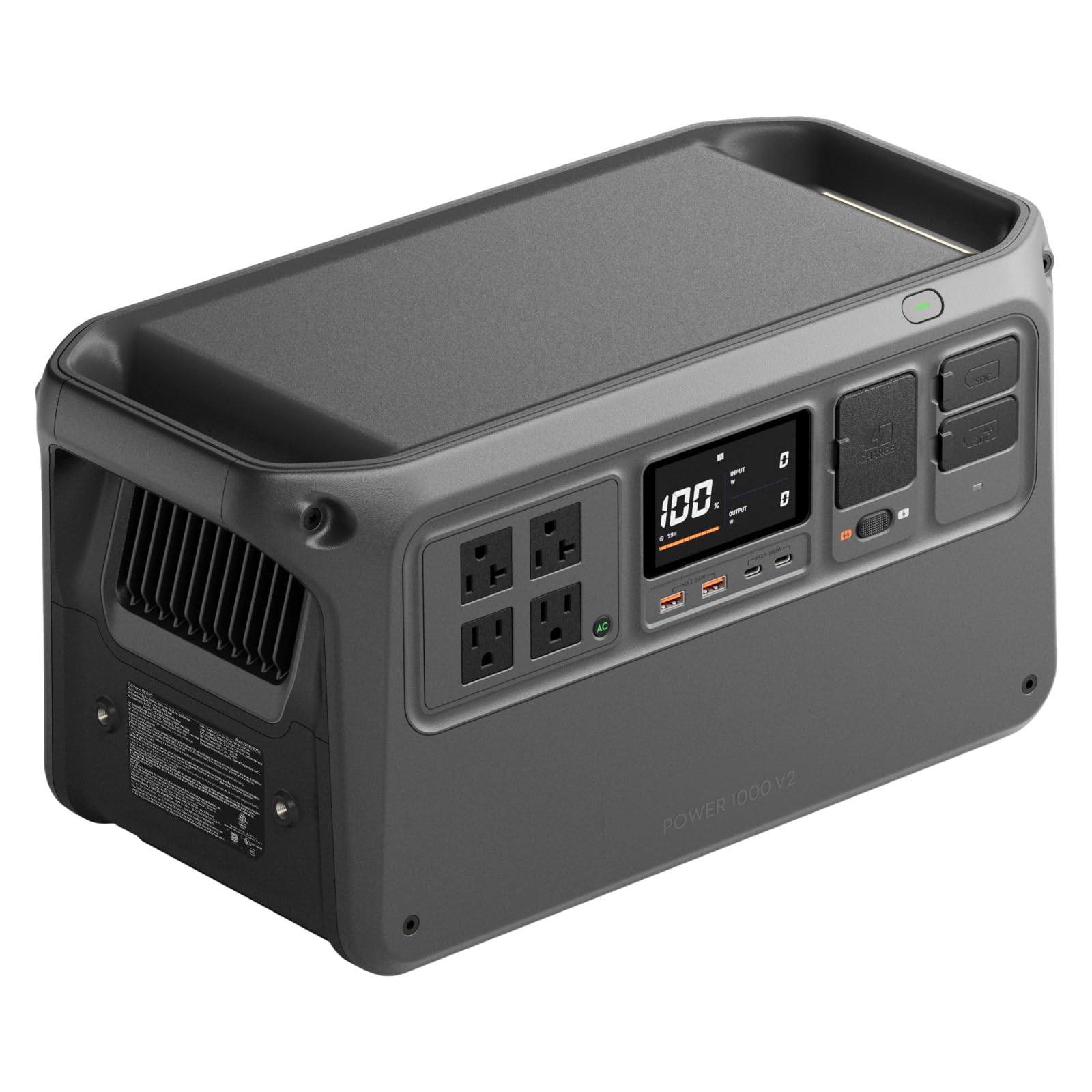
2. DJI Power 1000 V2
A whisper-quiet backup that refills to 80% in 37 minutes flat.
When the grid drops at night, the last thing you want is a generator roar. The DJI Power 1000 V2 runs as low as 26 dB — quieter than a library — which owners say makes it a great fit for RVs and camper vans where you sleep while it charges. Its compact frame measures 17.64″L x 8.85″W x 9.05″H — roughly 7% smaller than the BLUETTI AC200L’s footprint — so it slips into a closet corner or under a bench between uses.
Recharge speed is the headline: it hits 80% in 37 minutes from a wall outlet, so you can top it up during a workday lull. The 1024Wh LFP battery (lithium iron phosphate, a long-life chemistry) carries a claimed 10-year lifespan, and the smooth UPS (uninterruptible power supply) switches in about 10ms — twice as fast as the previous Power 1000 — keeping your router and PC alive through blips. Dual 140W USB-C ports deliver 280W total, which owners say keeps laptops and cameras topped up for content work.
Owners praise the steady output, with one running a portable AC and laundry simultaneously on old apartment breakers. The catch is ecosystem: solar and car charging require separate adapters, and customers note those accessories have a habit of being out of stock. One owner called it a value proposition in a more accessible package, though the app could be better tune. It holds a 4.4-star rating across nearly 800 owners — reliable, fast, and genuinely quiet.
Why it stands out
- 0-80% recharge in just 37 minutes
- 26 dB operation — quiet enough for indoor overnight use
- Dual 140W USB-C ports charge laptops fast
Watch out for
- Solar and car charging need extra adapters
- Proprietary SDC connectors limit third-party add-ons
Choose this if: you want the fastest wall recharge and a silent night standby for a small home or RV.
Look elsewhere if: you plan to grow a solar array — the accessory supply has frustrated some buyers.
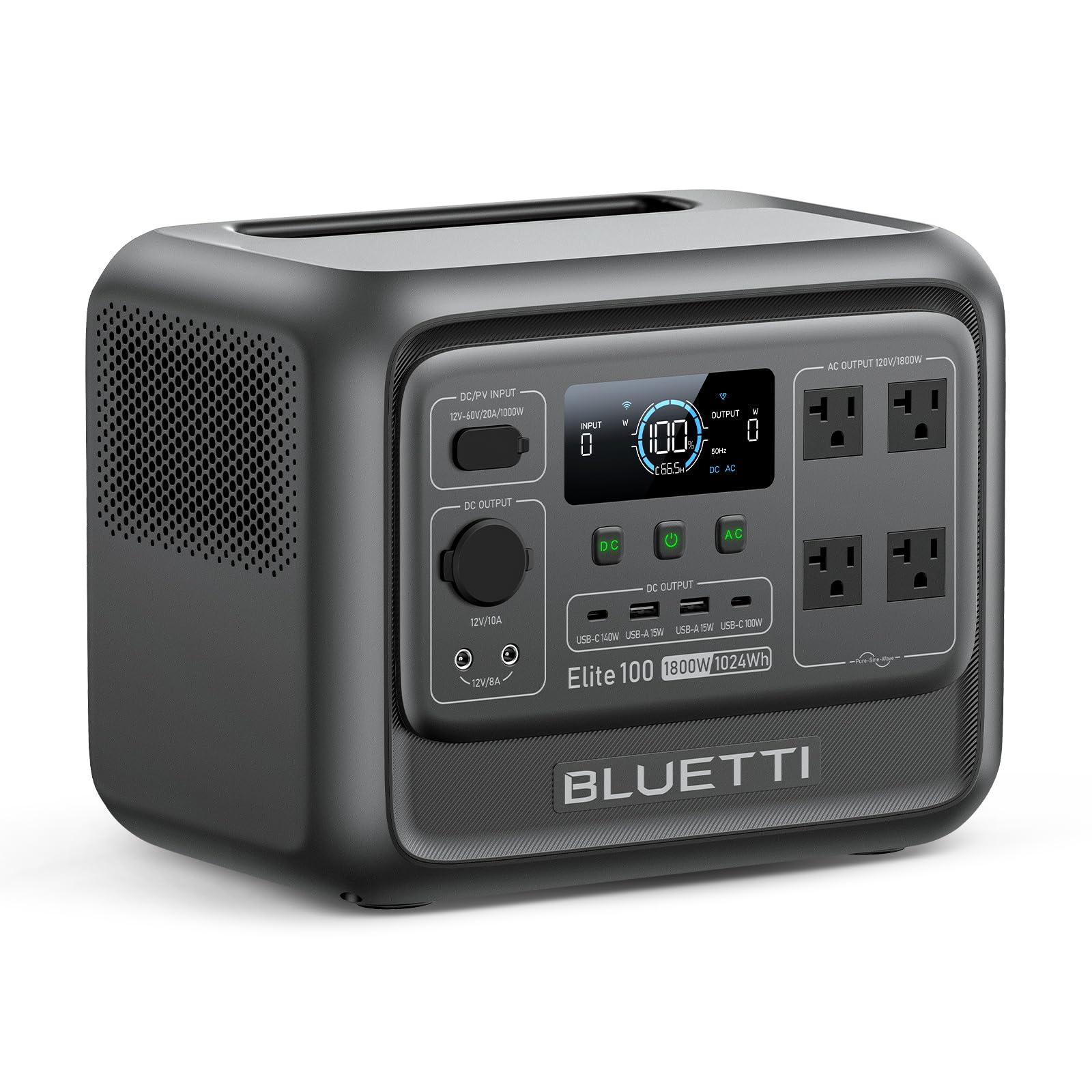
3. BLUETTI Elite 100 V2
One-hand carry power for apartments, campsites, and astrophotography rigs.
At 25 pounds with a hidden top handle, the Elite 100 V2 is built for people who actually move their station. Owners grab it one-handed from home to campsite, with one running an entire astrophotography setup — mount, cameras, and a mini PC drawing 34-60W — for 6.5-7 hours a night. It’s the station that disappears into a weekend bag, not the one that lives in the garage.
Inside that compact 12.6″L x 8.5″W x 9.8″H frame is a 1024Wh LiFePO₄ battery delivering 1800W of rated AC output with a 2700W Power Lifting surge. Owners found it runs a fridge for up to 48 hours during outages — a real “bridge unit” for brief blackouts, powering a microwave, lamps, and a laptop without complaint. The 10ms UPS switchover keeps Wi-Fi routers and PCs running through blinks, and silent mode drops operation to just 30 dB, which owners call 50% quieter than other 1kWh stations.
Recharge keeps pace with the portability: 1200W TurboBoost AC charging tops it up in about 70 minutes, and up to 1000W of solar input makes it the fastest solar charge in its class. The 11-port spread covers AC outlets, USB-C, USB-A, and a 12V/10A car input. What owners note is it’s 35% smaller and 30% lighter than comparable 1kWh stations — yet still heavy enough that the handle earns its keep. For indoor backup, road trips, and weekend camping, the feedback is consistently glowing.
What makes it special
- 25 lbs with a hidden handle — genuinely one-hand portable
- Powers a fridge for up to 48 hours in an outage
- 70-minute full recharge via 1200W AC input
Keep in mind
- 1800W output won’t start big appliances like a central AC
- Owners say it’s still an investment, not an impulse buy
Ideal for: apartment dwellers and weekend campers who want real backup without a two-person lift.
skip it if: you’re sizing for a whole-house outage — this is an essentials box, not a whole-home unit.
4. DABBSSON 2000L
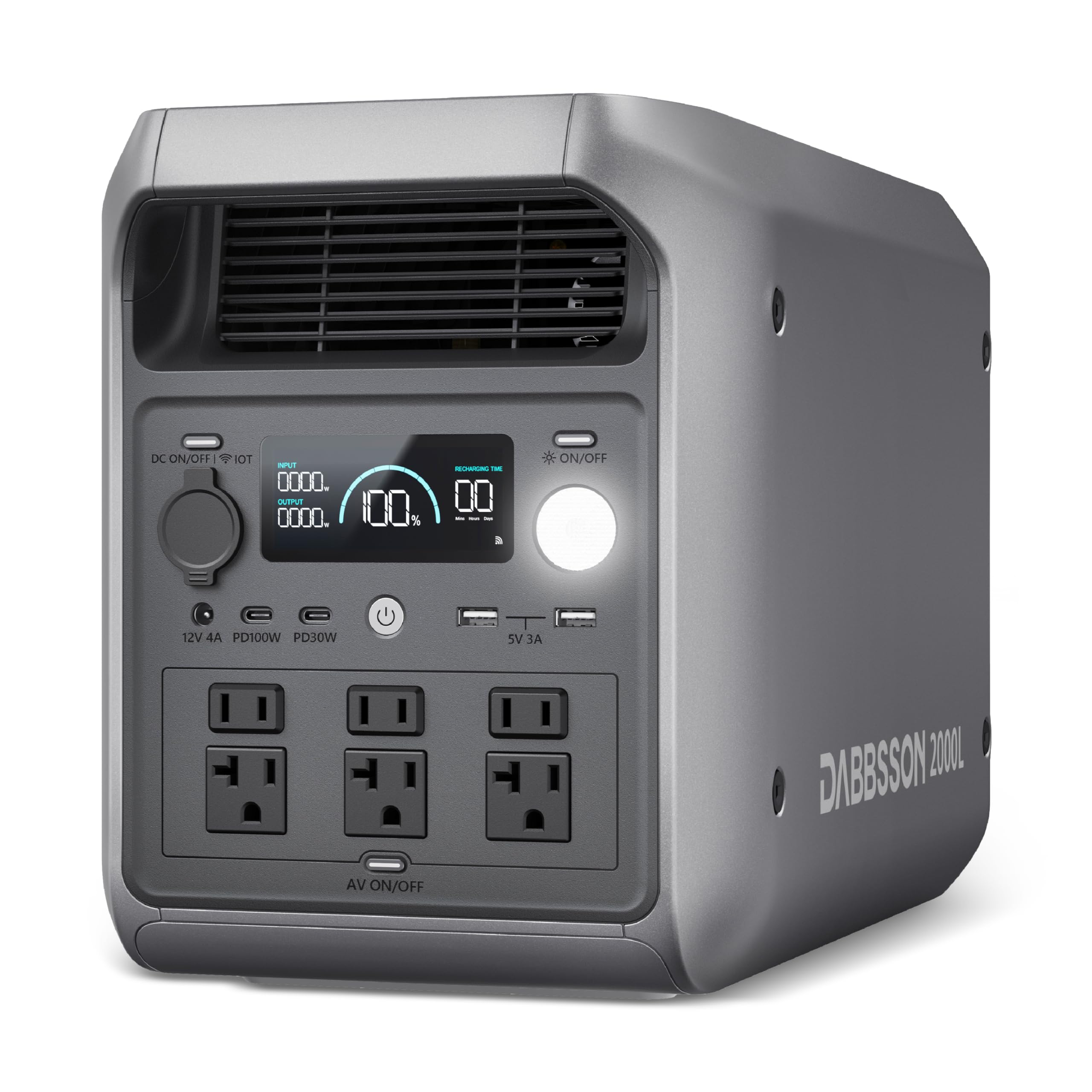
A 2048Wh workhorse with a 3300W surge, at a budget that undercuts the big names.
You don’t always need the most famous logo — sometimes you need the most watts per dollar. The DABBSSON 2000L delivers a full 2048Wh of capacity with a 2200W continuous output and a 3300W surge boost, enough to start a refrigerator’s compressor or a miter saw. Owners call reliability the standout feature, with solid build quality and six AC outlets letting a family run several devices at once.
The semi-solid LiFePO₄ chemistry is the talking point — a step beyond standard LFP cells for stability — backed by a UL94-V0 flame-retardant housing. It supports 4000+ deep cycles to 80% capacity, which owners read as over 10 years of daily use. The 41-pound frame is lighter than the 61.4-pound BLUETTI AC200L while holding the same 2048Wh capacity, and reviewers point out it’s manageable to carry and store.
Recharge is genuinely fast for its class: AC input tops it up in about 1 hour, with up to 800W of solar MPPT input for off-grid days. The <10ms EPS switch protects computers and NAS drives from power loss, and the Dabbsson app handles remote monitoring over Wi-Fi or Bluetooth. Owners in Cuba ran it through blackouts, getting 8-10 hours of silent solar light per charge. The notes are minor — the fans can get audible under heavy load, and one buyer found the plastic shell less premium than pricier rivals.
Why it wins
- 2048Wh at a budget-friendly price point
- 3300W surge starts heavy appliances and tools
- Full recharge in about 1 hour via AC
Fair warnings
- Fans may get noisy under high load
- Plastic shell feels lighter-duty than premium rivals
Best fit: budget-conscious households and job-site users who want big capacity without the flagship markup.
Not for: anyone who expects a luxury-feeling enclosure — the build is functional, not flashy.
5. Anker SOLIX S2000
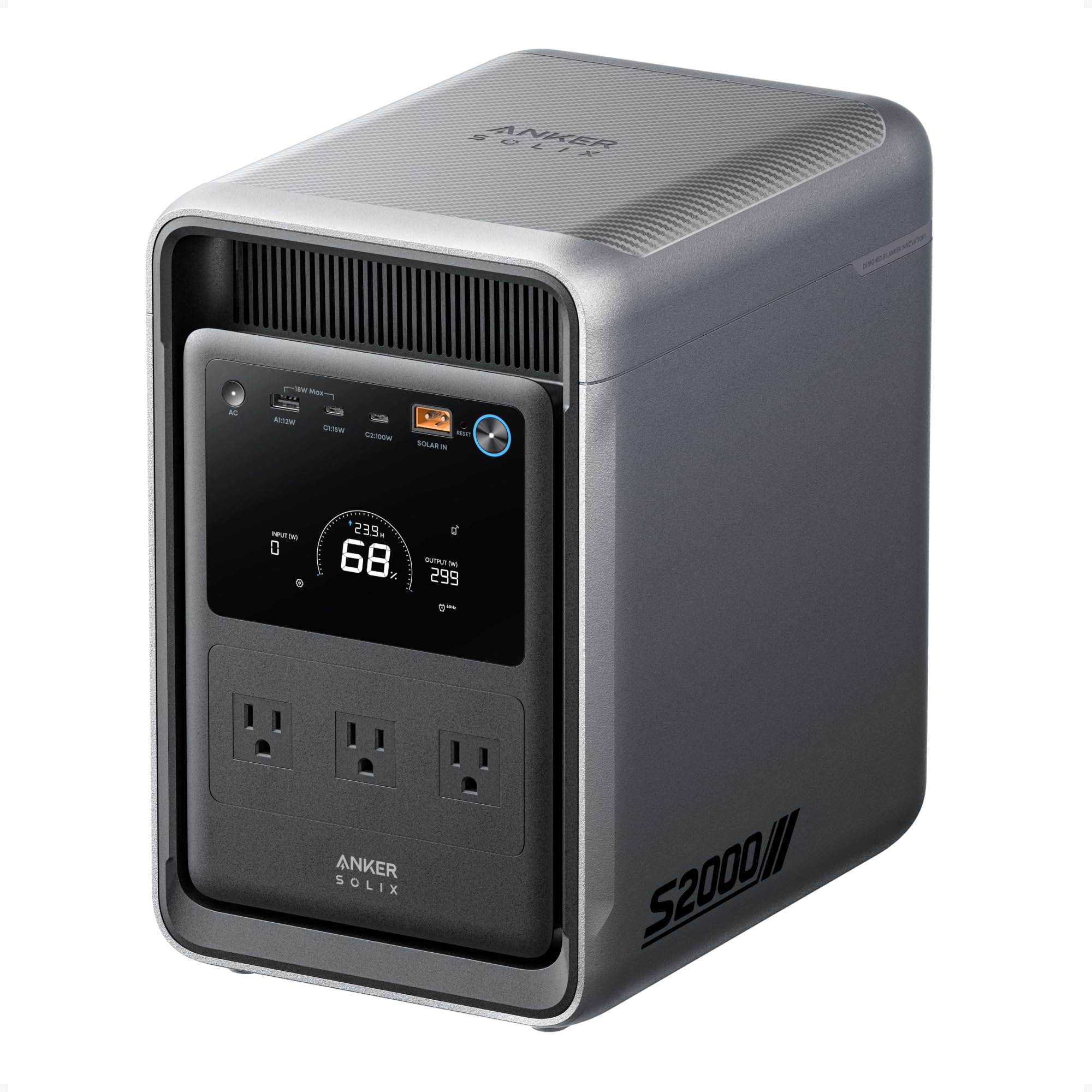
The 2kWh station engineered to keep your fridge cold for a day and a half.
If your priority is the refrigerator, this is the specialist. The Anker SOLIX S2000 runs a fridge for up to 35 hours on a charge — owners verified that 35-hour run, and one reported their 220L fridge drew only 3% per hour, projecting about 33 hours of runtime. A 6W idle power draw and 10% higher efficiency let it run 20% longer than other 2kWh systems, which is exactly what matters during a multi-day outage.
The 2010Wh battery uses 314Ah LFP cells rated for 10,000 charge cycles, which Anker translates to a 15-year lifespan. It’s also the compact pick in its class: measuring 8.19″L x 11.1″W x 12.7″H and weighing 35.7 lbs, owners describe it as 30% smaller and 25% lighter than the average 2kWh station. The layout is clever too — eight outlets split front and back, so everyday devices plug in front while always-on appliances sit in the rear for a cleaner setup. There’s no 12V DC port, which is note for RV users.
Output is 1500W continuous with a 3000W peak, covering 99% of home essentials per the maker. A <10ms UPS switchover keeps home-office gear alive, and charge rates are adjustable from 100W to 1600W through the app. One owner survived a 30-hour outage powering a lamp, fridge, coffee maker, and hot shower, finishing with 30% battery left. The mixed notes are the fan — quiet at 1200W but audible when charging hard — and a faint burn-off smell on the very first use that quickly dissipates.
What wins people over
- 35-hour fridge backup verified by real owners
- 35.7 lbs — lightest among big-capacity rivals
- 10,000-cycle LFP battery for a 15-year life
Reality check
- No 12V DC port for car accessories
- Fan gets audible during fast charging
Grab this if: the fridge and the home office are your top priorities during outages.
Pass on it if: you need a 12V car outlet or plan to run heavy power tools — the output ceiling is lower here.
6. EcoFlow DELTA 3 Max
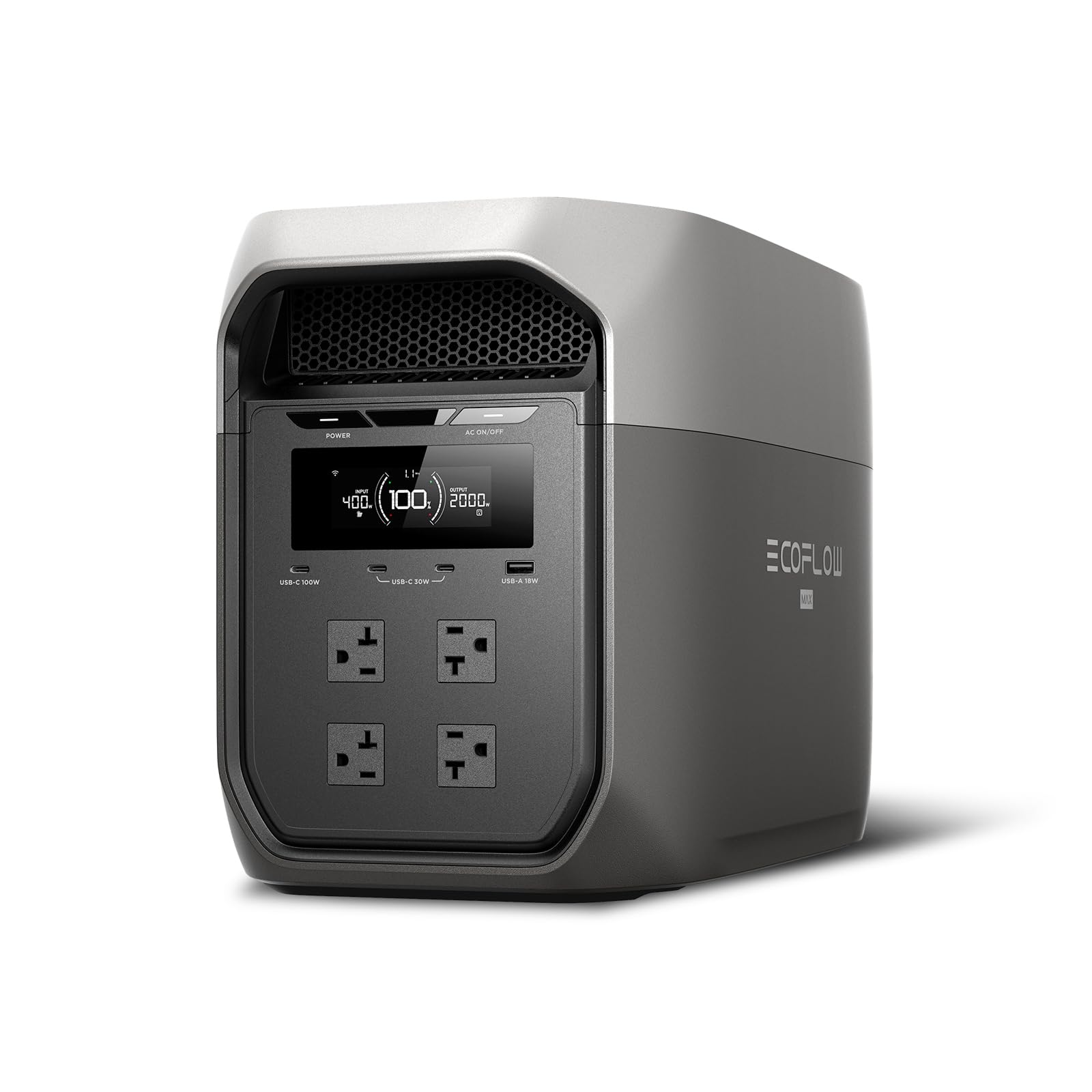
A 3400W X-Boost output that runs fridges, microwaves, and power tools without flinching.
For homes that draw serious wattage, the DELTA 3 Max flexes harder than most. Its 3400W X-Boost output powers 99% of appliances — fridges, microwaves, and power tools included — while the 2048Wh LFP battery underneath keeps it going for hours. Owners say it easily handles multiple devices at once, and one uses it as the primary backup for parents during frequent outages, running a fridge, cooking gear, and essentials.
EcoFlow’s X-Stream technology (a fast-charging system) shines here: 0-80% in just 1.13 hours, a figure owners confirm with notes like “charging speed is a little over an hour.” That fast top-up means you can prepare for a blackout on short notice. The <10ms transfer time protects sensitive electronics like computers, and owners describe the operation as ultra-quiet during nighttime use. The aluminum-and-plastic build is lighter and tougher than the previous generation, made to move between home, RV, and campsite.
The EcoFlow app adds smart scheduling — set charging times, watch live energy use, and cut costs by avoiding peak-rate hours. Buyers consistently praise the build quality and ease of setup, calling it an investment that makes a real difference in an emergency. The honest caveat: battery life draws mixed feedback, with most owners reporting outstanding runtime while a few found it shorter than expected under heavy 400W loads. Rated 4.7 stars across 550+ owners, this is among the most-trusted names in portable power.
what separates it
- 3400W X-Boost starts high-draw appliances
- 0-80% recharge in just over an hour
- Smart app scheduling to dodge peak electricity rates
Before you buy
- Heavy enough that portability is relative
- A few owners found runtime shorter than expected under heavy draw
Best for: households that want to power microwaves, power tools, and a full fridge from a single reliable box.
Consider others if: you’re strictly moving it by hand daily — the weight adds up even if the specs don’t.
7. Jackery Explorer 2000 Plus

A 2042.8Wh base that daisy-chains to 24kWh for true whole-home scale.
Most stations cap your expansion at buying a bigger unit later. The Jackery Explorer 2000 Plus lets you grow in place — up to 5 expandable battery packs push capacity from 2kWh to 12kWh, and two stations linked in parallel hit 24kWh with a 6000W output boost. Owners describe it as Jackery’s first real LiFePO₄ unit, with a 3000W inverter and a 30A RV outlet that replaced a gasoline generator for heavy-duty job-site tools like a DeWalt rotary hammer.
The core unit holds 2042.8Wh and delivers up to 3000W, with whisper-quiet operation at just 30 dB. It runs A/C in an RV for about 2 hours on a full charge in extreme heat, and shoppers say fast-charging back to 100% in roughly an hour at the wall. ChargeShield technology boosts battery life by 50%, and the LFP cells are rated for up to 10 years of use — plus a 5-year warranty backs it all.
The fan stays quiet during operation, which owners appreciate for indoor use. Two Explorer 2000 Plus units also support an RV A/C via the 30A outlet — a setup that’s replaced gas generators for good in several households. Quality and reliability are the recurring praise points, though the charger cable is bulky and there’s no battery-saving mode to idle it down.
Why it’s a keeper
- Expands to 24kWh with parallel link-ups
- 3000W output with a 30A RV port
- Whisper-quiet at 30 dB
The fine print
- 62 lbs — requires the wheeled handle, not arm strength
- Expansion packs and second units are significant add-ons
Pick this if: you want a system that scales from a single unit today to a 24kWh home backup years from now.
Skip if: you need something you can lift into a car trunk — this one is built to roll, not to fly.
8. Jackery HomePower 3000
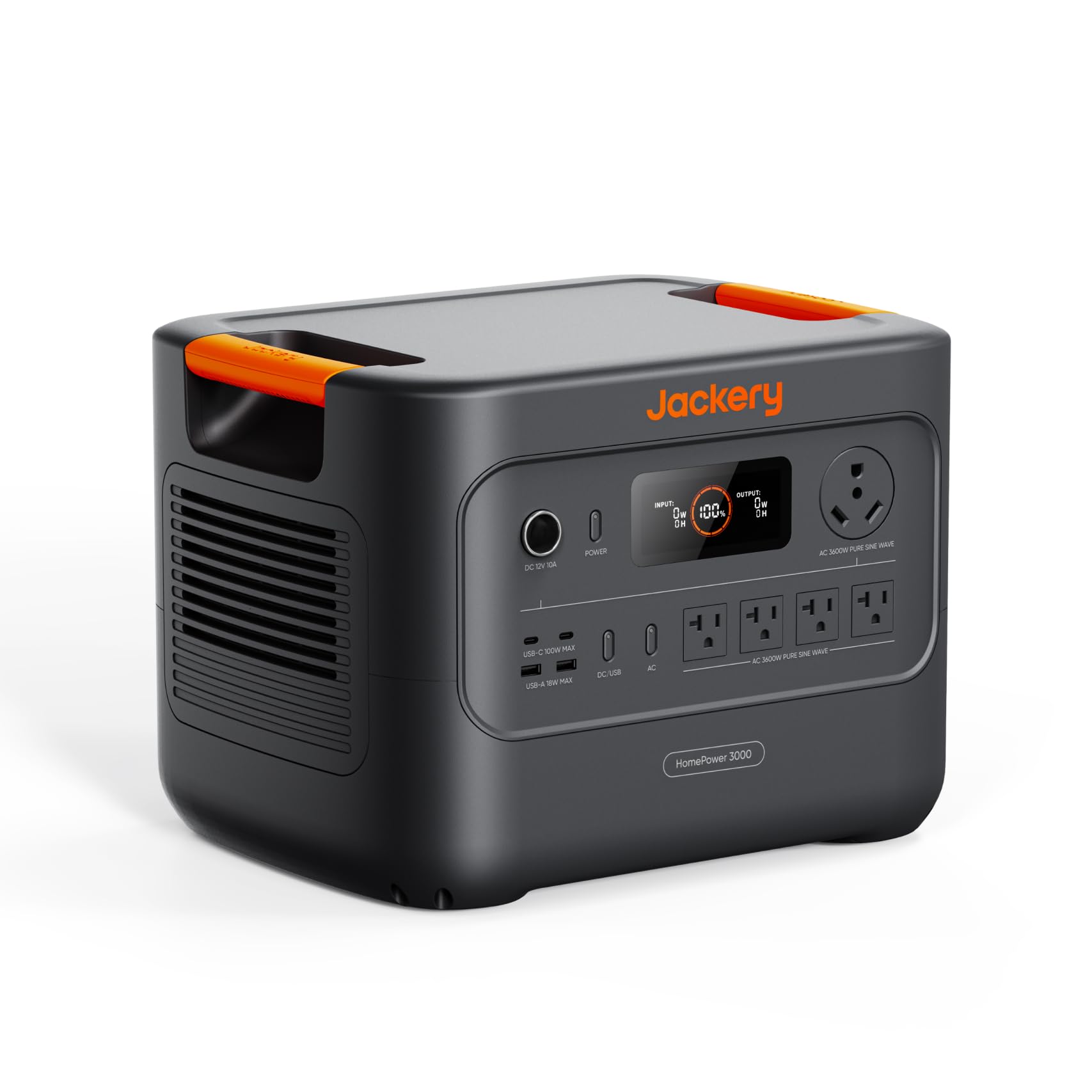
A 3072Wh station that powers the whole household for up to 15 hours straight.
When the outage stretches past a day, this is the station you want plugged into the fridge. The Jackery HomePower 3000 carries a 3072Wh capacity with a 3600W output (7200W surge), running home essentials — fridge, fan, Wi-Fi router, lights — for up to 15 hours. Buyers report powering a Whirlpool side-by-side refrigerator for 30+ hours, and one kept a large TV, router, lamps, and an electric blanket running for many hours through an outage. It even handles an air fryer oven.
The ≤20ms UL-certified UPS switchover keeps security cameras, medical refrigerators, and Zoom calls running through blinks. Dual 100W PD ports fast-charge phones, tablets, and drones, while the built-in TT-30 RV port offers plug-and-play power for campers — one owner chose it over a rival specifically for that 30A outlet for a direct camper hookup. Recharge takes 1.7 hours via hybrid AC and DC, or 2.2 hours via AC alone, with 12V car and gas generator charging as backup options.
ChargeShield 2.0 (a battery-management system with AI algorithms) cuts charging speed degradation and extends battery lifespan, and the LFP cells hold 4000 cycles at 70% capacity. As the first 3kWh station with CTB technology (cell-to-box, a space-saving design), it’s 47% smaller and 43% lighter than comparable models — though at 59.5 pounds, owners call it heavy but manageable with two hands. The honest notes: the fan runs around 60 dB (about as loud as a normal conversation) on any power draw, too loud for daily UPS use in a bedroom, and one owner found it shut off below 15°F when powering a diesel truck block heater — a cold-weather limitation worth knowing.
Why it leads
- 3072Wh capacity powers a household up to 15 hours
- 3600W output with 7200W surge starts big appliances
- Recharges in 1.7 hours via hybrid input
What to weigh
- 50+ lbs — a two-person lift or wheeled cart is essential
- Fan noise around 60 dB rules it out for quiet, daily UPS use
- Cold-weather performance has limits below 15°F
Choose it for: whole-home backup where you need multi-day fridge power and can roll a heavier unit into place.
Reconsider if: you want a silent always-on UPS for a home office or a unit you’ll move every weekend.
Understanding the Specs
Watt-hours (Wh) — your energy tank
Watt-hours measure total stored energy — how much “fuel” the battery holds. A 2048Wh station can run a 200W load for roughly 10 hours, while a 1024Wh unit runs the same load for about 5. For home backup, higher Wh means more hours of fridge, lights, and router before you need to recharge. Think of it as the size of the gas tank, not the speed of the engine.
Output watts — the engine size
Output watts tell you what the station can power at once. Continuous output is what it delivers steadily — 1800W to 2400W is common for home units. Surge watts (like 3300W or 7200W) cover the brief spike when a fridge compressor or tool motor starts. If your biggest appliance needs 600W to start, make sure the surge rating clears it comfortably.
LiFePO₄ battery chemistry
LiFePO₄ (lithium iron phosphate) is the safe, long-lived battery chemistry used in modern stations. It tolerates thousands of charge cycles — often 3000 to 10,000 — before degrading to 80% capacity. That translates to a 10-15 year lifespan for most owners, which is why the upfront cost is worth comparing against long-term use.
Recharge speed and solar input
Recharge speed tells you how fast the station refills from a wall outlet — some hit 80% in under an hour. Solar input (measured in watts) shows how quickly it charges from panels; more watts means faster sun-powered refills. If you plan to go off-grid or survive long outages, solar input is as important as capacity.
UPS mode — instant switchover
UPS (uninterruptible power supply) mode keeps the station plugged into the wall and switches to battery within milliseconds when the grid drops. Look for a switchover time under 20ms so your PC, router, and sensitive electronics never flicker. It turns a backup battery into an always-on safety net.
Expansion capability
Some stations accept add-on battery packs to grow capacity over time. A 2048Wh base might expand to 8192Wh or even 24kWh with extra units. If your power needs may grow — a bigger fridge, a home office, or an EV to charge — expansion support means you won’t need to replace the whole system later.
FAQ
How long will a home power station keep my refrigerator running?
Can I power my whole house with a portable power station?
What does watt-hours (Wh) actually mean for me?
What’s the difference between continuous watts and surge watts?
Is LiFePO₄ battery technology worth paying more for?
Can I charge a home power station with solar panels?
What is UPS backup mode and why do I need it?
How heavy is too heavy for a home power station?
Can I expand my power station’s capacity later?
How long will a power station itself last before the battery degrades?
Final Thoughts: The Verdict
For most buyers, the home power station winner is the BLUETTI AC200L because it pairs a full 2048Wh capacity with a powerful 2400W output and the ability to run real appliances — fridges, A/C units, even power tools — while expanding to 8192Wh as your needs grow. If you want the fastest recharge and a whisper-quiet night standby, grab the DJI Power 1000 V2, which hits 80% in just 37 minutes. And for the biggest single-unit capacity on this list, the Jackery HomePower 3000 is the one to reach for — its 3072Wh tank keeps a whole household powered for up to 15 hours when the grid goes dark.
How We Picked
We do not accept paid placement. Every pick is matched to a real buyer and a real use-case; we do not hands-on test units.
Sources & Methodology
Specifications: manufacturer listings and product documentation. Review insights: verified customer reviews, as of September 2026. Pricing: not shown on this page (it changes often); check the current price via the retailer link.
As an Amazon Associate, KitchPrep earns from qualifying purchases. This does not affect which products we feature.
Related Guides
