
Specs are compiled from manufacturer listings and verified buyer reviews and can change over time — please confirm the key details on the product page before buying.
Stop waking up to a sauna or a freezer: a baseboard heater with a thermostat lets you set the exact temperature you want, and the unit cycles on and off to hold that number. That makes it a set-and-forget way to warm a bedroom, office, or living space. But not all thermostats are equal — some hold a room steady to within a degree, while others let it swing wildly, so your choice depends on how precise you need the control to be.
I’m Mohammad Maruf — the founder and writer behind KitchPrep. This guide is built by comparing the manufacturers’ published specifications and the patterns across verified customer reviews, so you get each pick’s real strengths and trade-offs instead of marketing spin.
The most reliable way to buy a baseboard heater with a thermostat is to match the wattage and voltage to your room size, then choose a thermostat style you will actually use.
Our Picks at a Glance

How To Choose The Best Baseboard Heater with a Thermostat
Buying a baseboard heater with a thermostat is really three decisions in one: how much heat you need, whether it plugs in or needs wiring, and how precisely the thermostat holds your target temperature.
Match wattage and voltage to your space
Most portable units run on a standard 120-volt wall outlet and deliver 1500 watts, which suits small to medium rooms. Some premium hardwired models run on 240/208 volts, which heats more efficiently for larger areas but demands an electrician. Check your room size against the heater’s stated coverage in square feet before buying.
Dial versus digital thermostat
A dial thermostat is simple — you turn it to a rough comfort level and it clicks on and off. A digital thermostat with a display lets you set an exact number, and better ones hold that temperature much more steadily. If you want predictable warmth, lean toward digital control; if simplicity is the goal, a dial is fine.
Quick Comparison
| Model | Best For | Heat Output | Thermostat | Weight | Amazon |
|---|---|---|---|---|---|
| BEYOND HEAT 1500W★ Best Overall | Silent digital control | 1500 watts | Digital adjustable | — | Amazon |
| Comfort Zone DigitalSmart Value | Budget-friendly timer | 5120 BTU | Digital with timer | 5 pounds | Amazon |
| Cadet Portable 1500W | Dial simplicity | 1500 watts / 5120 BTU | Dial | 10.1 pounds | Amazon |
| Dimplex Connex 20″ | Small bathrooms, 240V | 500 watts | Built-in electronic | 3 pounds | Amazon |
| King KP1210 | Hardwired supplemental heat | 1000 watts | Built-in | 11.5 pounds | Amazon |
| Fahrenheat FHP1500T | Hydronic even warmth | 1500 watts | Built-in smart | — | Amazon |
In-Depth Reviews
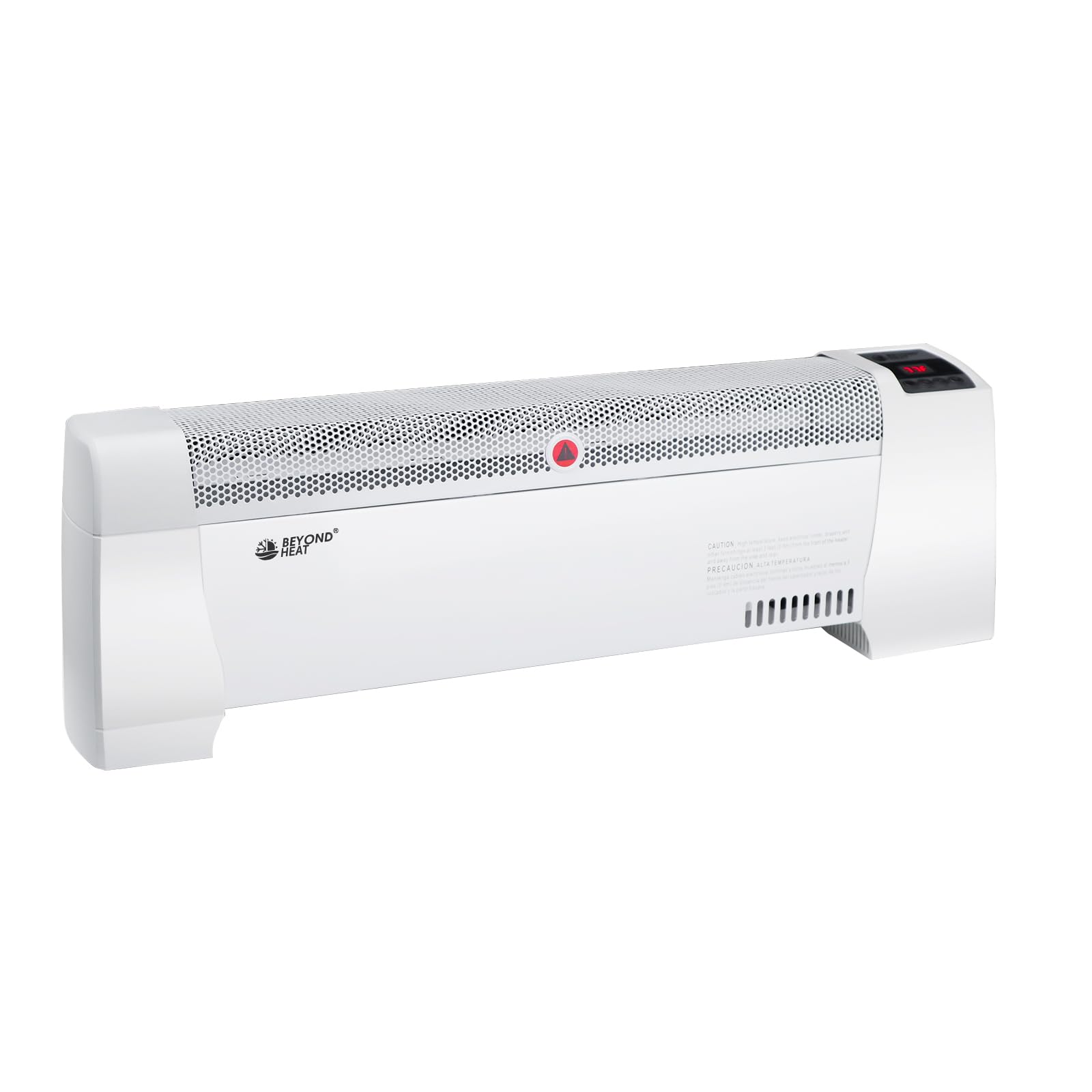
1. BEYOND HEAT Electric Baseboard Space Heater 1500W
Our pick — over 4★ from 50+ verified ratings; the strongest balance of quality and price.
Silent convection warmth with a digital thermostat that actually holds your number.
The defining spec here is the digital adjustable thermostat with a display, which lets you lock in a temperature between 40°F and 90°F. That range means this isn’t just “warm or hotter” — you can pick the exact comfort level, and buyers report it holds a room at a steady 68°F. It heats via convection (natural air circulation with no fan), so the room warms evenly and quietly, which is why owners mention it suits a bedroom where a blower-style heater would be obnoxious.
You get two heat settings — 750W for milder days or small rooms, and the full 1500W for when you really need to push heat into a living space. Safety is covered with a tip-over switch that cuts power if it’s knocked over and an overheat protection system, plus an ETL approval for the US. Unlike the Cadet below, this one runs closer to silent by owner consensus, and the compact 29.25 x 5.25 x 9.25-inch footprint slides against a wall without dominating the room.
The honest trade-off is thermostat accuracy. The review volume is smaller than the Comfort Zone’s crowd, and a few owners note the temperature swings can feel dramatic even when the unit reads the same number. Most owners agree it’s quiet, consistent, and a lifesaver during blizzards.
What wins people over
- Genuinely silent operation — no fan noise at all
- Digital display and two heat settings for control
- Tip-over and overheat protection for confidence
- Compact enough for a bedroom or office corner
Who should look elsewhere
- Large open-plan spaces need more than 1500W can deliver
- Temperature swings reported in very small rooms
- Dial-style fans of total simplicity may prefer the Cadet
Your pick if: you want a quiet, digital-controlled heater for a small to medium room and you actually use the thermostat.
Think twice if: precision is everything — a few owners found the swings noticeable in tiny spaces.
2. Comfort Zone Digital Convection Baseboard Heater
A big-output value pick that warms medium rooms and runs whisper quiet.
This one leads with raw output — 5120 BTU (British thermal units, the standard measure of heat energy) from a 1500W element, with a stated coverage of 150 square feet. The crowd favorite by far, it has thousands of owner experiences behind it, and the consensus is that it outperforms pricier rivals. Buyers describe it as stylish, effective for medium to large rooms, and whisper quiet, with one heating a poorly insulated 70s apartment to 76°F when it was 10°F outside. That’s the kind of real-world claim that separates a value pick from a compromise.
You can schedule this heater to run for a set window and shut off automatically thanks to its 12-hour timer — a feature rare at this level. The digital thermostat lets you set a precise temperature, and two heat settings manage output. At 5 pounds, it’s the lightest plug-in portable here — half the weight of the Cadet below — so moving it room to room or storing it for summer is genuinely easy.
Be honest about its quirks: some owners note the thermostat readout can swing by 4 degrees, and a recurring observation is that the cord and plug get very hot during heavy use — so plug directly into a wall outlet. A small number report the unit failed after about a year. For the money, though, the value is strong: it’s compact, quiet, and delivers serious heat for small rooms.
Reasons to buy
- 5120 BTU output with 150 sq. ft. coverage
- Built-in 12-hour timer for auto shut-off
- Only 5 pounds — easiest to move and store
- Digital thermostat for precise setting
Things to know
- Cord and plug run hot — avoid extension cords
- Temperature readout can swing a few degrees
- A few owners had reliability issues past a year
Reach for it if: you want maximum heat output and a timer on a budget-friendly, lightweight frame.
Pass if: you need rock-steady temperature precision or plan heavy daily use for years.
3. Cadet Portable Electric Baseboard Heater 1500W

A heavy-duty, dial-controlled workhorse built in the USA for no-fuss heat.
Cadet is a name synonymous with baseboard heating, and this portable 49-inch model delivers that durability with a simple promise: plug into any standard 120-volt outlet with the included 6-foot grounded cord, set the large dial thermostat, and walk away. No hardwiring, no wall cutting, no electrician needed. The trade-off versus the digital picks above is control — the dial has no readout, so you set a comfort level by feel rather than an exact number. For many, that’s precisely the appeal: set-and-forget until spring.
The build quality is the headline. A steel-sheathed heating element with aluminum fins and a tough powder-coated white finish make this feel like permanent equipment, not a fragile portable. It delivers 1500 watts and 5120 BTU of steady convection warmth, with a stated coverage of 600 square feet — the largest claim in this lineup. At 10.1 pounds, it’s a solid, planted unit, more than double the weight of the Comfort Zone above, and it carries a 2-year warranty. Dual safety protection includes a tip-over switch and high-temperature shutoff.
The reliability picture is the honest caveat. Working units deliver even heat that fills a room, but a few customers note failures after weeks or a couple of years. One owner notes the exposed coil collects dust and the surface runs hot, making it unsuitable where kids might touch it. It’s the right heater if you value American-made simplicity and can handle the manual dial.
The trade-off read: When it works, the Cadet is the most reliable-feeling baseboard heater here, with the dial thermostat holding steady in a den addition through the season.
The fit note: The reported failures and hot surface make it a pick for adults-only spaces like an office or workshop, not a nursery.
4. Dimplex 20″ Connex Proportional Linear Convector

The tiny 240-volt specialist that handles a small bathroom with clinical precision.
This is a different animal from the plug-in portables above — the Dimplex Connex is a hardwired unit running on 240/208 volts (not a standard 120-volt outlet), putting out 500 watts for small spaces. It’s not a room heater in the ordinary sense; it’s a purpose-built solution for a bathroom or powder room, and owners confirm it completely warms a small bathroom and fits a ~50 square foot space perfectly. If you’re replacing an old 220V baseboard register, this is the upgrade path.
The standout spec is the onboard electronic thermostat, which holds temperature to within 0.5°C (0.9°F) of your set point — the tightest accuracy claim in this entire lineup. Dimplex claims up to 40% faster heat via top discharge and 33% less energy use than conventional baseboards. At just 3 pounds and 20 inches wide, it’s remarkably compact, designed to sit unobtrusively on a wall. Owners who replaced old baseboards with these units in whole rooms reported heating bills cut in half during severe cold snaps.
The reality check is install complexity and longevity. This needs an electrician and right-side wiring only, which some owners found limiting. The bigger caveat is the thermostat — a few report it failing after one season of winter use, just past the warranty window. The praise is strong for those with a good install: it’s the perfect heater for a small bathroom, replacing old registers cleanly.
Built for
- Holds temperature within 0.9°F of your setting
- Only 3 pounds and 20 inches for tight spots
- Reviewers point out dramatically lower heating bills
- Full-length overheat cut-out for safety
Built for whom
- Requires 240V wiring and an electrician
- Right-side wiring only — plan your install
- Thermostat failures reported after one season
Best suited to: anyone with an existing 220V bathroom baseboard looking for a precise, efficient replacement.
Not for: plug-in convenience seekers or anyone without 240V wiring available.
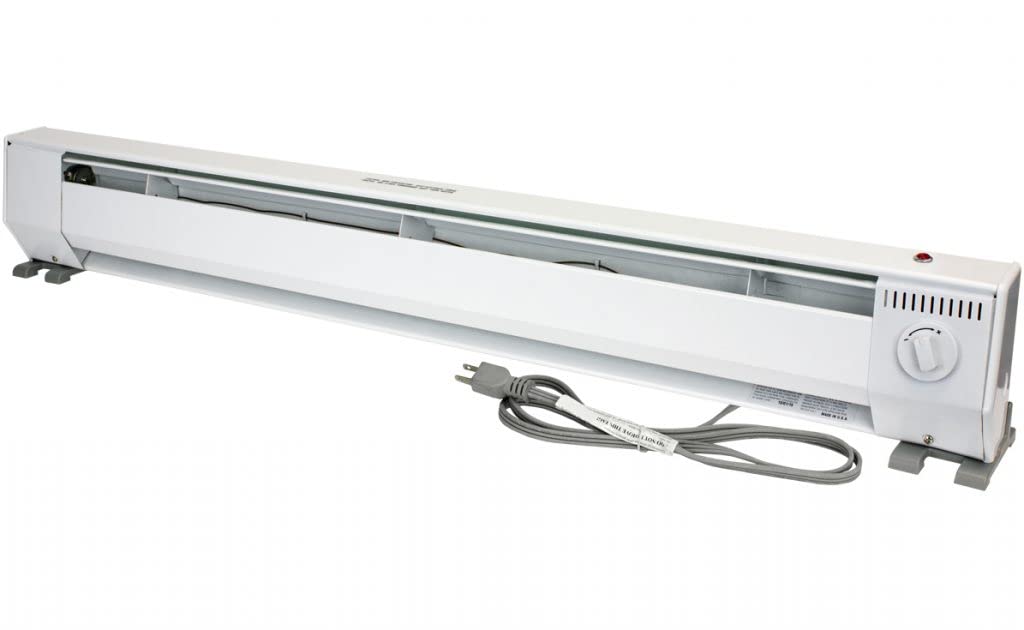
5. King KP1210 1000-Watt 4-Foot Portable Baseboard Heater
A hardwired King built for supplemental heat that hums along with minimal fuss.
King Electric is a legacy name in permanent baseboard heating, and the KP1210 is a 1000-watt, 120-volt, 4-foot unit designed to be mounted on a floor or wall with the built-in thermostat and full-length safety cutout you expect from a hardwired heater. Unlike the plug-in portables in this list, this is permanent equipment — it gets wired in and stays. The all-aluminum design is the key spec here, chosen for even heat distribution and long service life in convection heating.
The use-case is supplemental warmth, and that’s exactly how owners deploy it. Owners use it to keep a daycare warm in winter and as supplemental heat for a cold bedroom, with the thermostat cycling automatically. Shoppers say it heats a 14×19 breezeway to 60°F in sub-zero temps, though it’s slower on large rooms than a 1500W portable. The built-in thermostat at least removes the guesswork of a separate wall control.
The honest caveat is mixed owner feedback on quality and shipping. The review volume is moderate, and sentiment splits: some call it sturdy and simple, while others report units arriving damaged due to minimal packaging — broken legs and dented thermostats on delivery. A few note a developing hum or buzz over time. If a unit arrives intact, owners find it a solid, straightforward heater; the risk is in transit, so inspect the box carefully on arrival.
What it does well
- All-aluminum convection design with built-in thermostat
- Sturdy enough for a daycare or breezeway
- Thermostat auto on/off keeps rooms steady
- Full-length safety cutout included
Watch out for
- Packaging is minimal — damage in transit reported
- Developing hum or buzz noted by some owners
- 1000W runs slower on larger rooms
Choose it for: a permanent supplemental heater in a bedroom or daycare where you want thermostat control without a separate wall unit.
Be cautious if: you need a plug-in portable or want faster heating for a large space.
6. Fahrenheat FHP1500T 58 in. Hydronic Portable Baseboard Heater

A liquid-filled hydronic 58-incher that spreads even warmth across the room.
What makes the Fahrenheat different from every other unit here is the hydronic element — it’s liquid-filled, meaning the heating element warms a sealed fluid that then radiates heat evenly across the full length of the unit. This is the same idea behind a radiator-style oil heater, and it’s the reason owners describe it as wonderfully even heat. The unit runs on a standard 120-volt plug-in connection, delivers 1500 watts, and covers 150-200 square feet, making it a drop-in choice for a lower level or breezeway.
The built-in smart thermostat is the control center — you set the temperature and it automatically turns on and off to hold that number, which owners on a cold northeast winter confirm works well to keep a lower level comfortable. It’s energy-efficient by design, and it’s made in the United States. At 58 inches long and rated for that generous square footage, it’s the largest single plug-in unit in this guide, designed for bigger single rooms rather than tight corners.
The long-length design has a quirk worth knowing: the 58-inch body is too large for a truly small room, and a couple of owners received units with minor assembly defects — an improperly attached face louver or a non-working pilot light. A small number also reported very little heat production or failure after a week, though the majority of owners describe it as working great and warming a breezeway quickly. The smart thermostat and even hydronic heat make it the premium choice for a medium room where comfort matters more than price.
The standout spec: The liquid-filled hydronic element delivers the most even, radiator-style warmth of any plug-in unit here, with a smart thermostat that handles on/off cycling for you.
The honest caution: It’s a large unit, so measure your wall space, and give it a close inspection on arrival for assembly defects.
Understanding the Specs
Wattage and BTU
Wattage (like 1500W) is how much electrical power the heater draws, and it roughly determines how much heat it puts out. BTU (British thermal units) is the direct measure of heat energy — for example, 1500 watts equals about 5120 BTU. As a rule of thumb, a 1500W unit suits small to medium rooms up to roughly 150-200 square feet; 1000W is gentler for supplemental warmth. A 500W unit is for tiny spaces like bathrooms.
Voltage and Plug-In vs. Hardwired
Standard US wall outlets provide 120 volts, and most portable baseboard heaters plug straight in with no electrician needed. Heavier-duty units, like those run at 240/208 volts, heat more efficiently but must be hardwired by a professional. Before buying, check whether your space has the right outlet — a 240V unit won’t run on a standard plug, and most 120V portables should go directly into the wall, never an extension cord.
FAQ
Will a baseboard heater with a thermostat save me money?
What’s the difference between a dial thermostat and a digital thermostat?
What size room will a 1500W baseboard heater heat?
Can I plug a baseboard heater into a power strip or extension cord?
What’s the difference between a hydronic baseboard heater and a regular convection one?
Is it safe to leave a baseboard heater on overnight?
Do I need an electrician to install a baseboard heater with a thermostat?
Why is my baseboard heater thermostat not holding the temperature I set?
How long does a baseboard heater with a thermostat last?
Final Thoughts: The Verdict
For the majority of shoppers, the best baseboard heater with a thermostat is the BEYOND HEAT 1500W because it pairs silent convection warmth with a digital thermostat and a compact footprint — the full package for a bedroom or living room. If you want maximum heat output and a schedule timer on a budget, grab the Comfort Zone Digital. And for a small bathroom where precision matters, the Dimplex Connex is the specialized one to reach for.
How We Picked
We do not accept paid placement. Every pick is matched to a real buyer and a real use-case; we do not hands-on test units.
Sources & Methodology
Specifications: manufacturer listings and product documentation. Review insights: verified customer reviews, as of September 2026. Pricing: not shown on this page (it changes often); check the current price via the retailer link.
As an Amazon Associate, KitchPrep earns from qualifying purchases. This does not affect which products we feature.
Related Guides
