
Specs are compiled from manufacturer listings and verified buyer reviews and can change over time — please confirm the key details on the product page before buying.
Renting a gas-powered saw for a weekend often means paying a blade fee on top of the machine rental. Owning a solid 14-inch diamond blade changes that math for good. This guide sorts through the real trade-offs between turbo rims, segmented teeth, and vacuum-brazed metal cutters so you pick the one that matches your concrete or steel job without overpaying.
I’m Mohammad Maruf — the founder and writer behind KitchPrep. This guide is built by comparing the manufacturers’ published specifications and the patterns across verified customer reviews, so you get each pick’s real strengths and trade-offs instead of marketing spin.
The best 14 in diamond blade balances cutting speed, smoothness, and lifespan, and the picks here cover every job from paver patios to rebar-heavy demolition.
Our Picks at a Glance


How To Choose The Best 14 in Diamond Blade
Before you buy, match the blade’s rim style to what you plan to cut. A blade that shines on brick can struggle on porcelain tile, and a metal-cutting blade is a different tool entirely from a masonry blade.
Match the rim to the material
Segmented blades have a toothed, gulleted edge that removes material fast and handles rebar-embedded concrete, but they leave a rougher finish. Turbo rims add a continuous, serrated edge that cuts faster than a smooth rim while leaving a cleaner edge on stone and block. If you are cutting tile or porcelain, a thin continuous rim is the pick for chip-free edges.
Check the arbor before you buy
Before you order, check the arbor—the hole in the blade’s center that fits onto your saw’s shaft—so the blade actually mounts. Most 14-inch masonry blades use a 1-inch arbor, and many include a 20mm bushing (a small reducer ring) to fit different saws. If your saw’s shaft size doesn’t match, or you skip the needed bushing, the blade won’t attach at all.
Weigh segment height and thickness
Segment height is how tall the diamond-encrusted edge stands above the steel core. Taller segments, like a 12mm or 15mm height, mean more usable diamond before the blade wears out. Thinner blades cut faster and waste less material, but thicker cores resist flexing and binding on heavy rebar. Match thickness to your saw’s power and the job’s demands.
Quick Comparison
| Model | Best For | Thickness | Teeth | Weight | Amazon |
|---|---|---|---|---|---|
| Delta Diamond Boss Hog 14″ Turbo★ Best Overall | Clean cuts on masonry & concrete | 0.11 inches | 32 | 1.97 kg | Amazon |
| ORIXTREME 14″ General PurposeBest Value | High-volume paver cutting on a budget | 0.13 inches | 24 | 1.75 kg | Amazon |
| Cougar HS General PurposeContractor Pick | Value-driven concrete & curb work | .125 inches | 24 | — | Amazon |
| Trabo 14″ Segmented Rim | Angle grinder & light masonry jobs | 0.12 inches | 14 | 1.88 kg | Amazon |
| Ostek 14″/350mm Turbo | Thin, chip-free cuts in porcelain & tile | 2.4 mm | — | 4 pounds | Amazon |
| Diablo Diamond Segmented 14″ | Balanced speed & control on block | 3.2mm kerf | — | 4.4 pounds | Amazon |
| SHDIATOOL 14″ Metal Cutting | Multi-material metal & masonry cutting | 3.2 mm | 130 | 1.9 kg | Amazon |
| Diamond Extreme 14″ Metal Cutting | Heavy steel, pipe & demolition jobs | 0.14 inches | 24 | — | Amazon |
| EDiamondTools 14″ 5-Pack | Crews needing multiple spare blades | 12 mm segment | — | 15 pounds (pack) | Amazon |
In‑Depth Reviews
1. Delta Diamond Boss Hog 14 Inch Turbo Premium Diamond Blade
Our pick — over 4.5★ from 550+ verified ratings; the strongest balance of quality and price.
The turbo rim that leaves masonry looking glass-smooth while standing up to a full day of cutting.
The Boss Hog earns the top spot because it delivers the cleanest finish of any blade here. Its turbo rim and cooling holes let you run it continuously on construction jobs without warping, and the 32-tooth edge slices through concrete, brick, block, pavers, and stone. You get a scratch-free result that owners describe as “cuts through everything like through butter.”
This blade pairs a 14-inch diameter with a 0.11-inch thickness and a 1-inch arbor that takes a 20mm bushing. The crowd favorite — holding a 4.7-star score across 500+ owners — regularly gets praised for how it outperforms pricier alternatives. The 5,460 RPM max speed makes it a straight swap onto most walk-behind saws, and it runs wet or dry without premature wear.
You get a cleaner finish with the Boss Hog than with the ORIXTREME below, because its turbo edge (a continuous, serrated rim) cuts smoother than a segmented rim’s rougher bite. At 1.97 kg, it’s heavier, which helps it track straight through deep cuts in granite or edging blocks. The lifetime warranty against warping and cracking covers you if the blade sees heavy daily use.
Why it leads the pack
- Turbo rim leaves a smooth, chip-free finish on concrete and stone
- High Speed Steel core resists warping during continuous dry cutting
- Backed by a lifetime warranty against material defects
What to weigh first
- Premium price tag sits well above entry-level segmented blades
- The smooth rim cuts slower on heavily rebar-reinforced concrete than an aggressive segmented blade
Grab it if: you want professional-grade finish quality and long life on masonry, block, and cured concrete.
Think twice if: you only cut a few pavers a year and want the lowest-cost disposable blade.
2. ORIXTREME 14 Inch Diamond Saw Blade, General Purpose Segmented Blade
The paver-crushing budget blade that holds its own against blades costing twice as much.
The ORIXTREME is the value king for one simple reason: its tall 15mm segments give you a huge reservoir of diamond that keeps cutting long after cheaper blades go dull. It chewed through a few hundred pavers with no surface chipping, and a buyer even bet its quality “is on par with anything from the depot.” That durability is why it wins on cost per cut.
This segmented blade uses a 0.13-inch thick core with a 1-inch arbor and a 20mm bushing. At 1.75 kg it is the lighter of the two top picks here, but the 24-tooth segmented edge still plows through concrete, brick, block, and reinforced concrete. The slots pull dust and heat out of the cut, which keeps the blade cool on long dry-cutting runs.
What wins people over is the blade’s sheer endurance — buyers report cutting through 5-inch rebar-reinforced concrete without issues and seeing no signs of wear afterward. It is not quite the finish-quality match for the Boss Hog above, but for raw material removal at this price, nothing in the list beats it.
Why it is the value pick
- Tall 15mm segments deliver long cutting life
- Diamond material handles reinforced concrete with rebar
- Slots clear dust and heat for cooler dry cutting
Know before you cut
- Segmented edge leaves a rougher finish than a turbo rim
- Mixed reports on very high-speed cutting runs
Reach for it if: you are cutting hundreds of pavers or bricks and want maximum life for the least money.
Look elsewhere if: you need a glassy finish for decorative stonework.
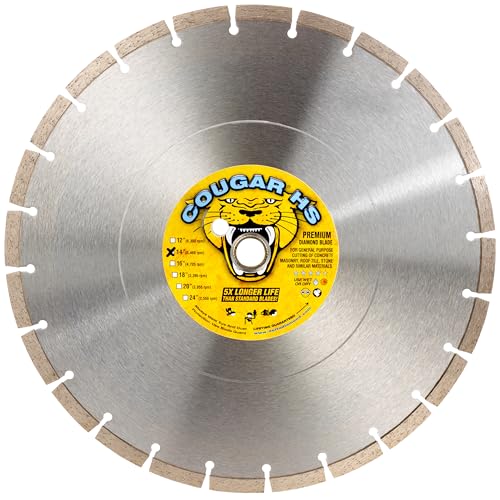
3. Cougar HS 14 Inch Diamond Concrete Saw Blade, Premium General Purpose
The curb-cutting workhorse that turns a one-time rental fee into a blade you keep.
The Cougar HS is built for the DIYer staring down a serious concrete job. One owner rented a gas saw to cut through 25 feet of curb, made cuts on both sides, and found it “worked like a dream” — skipping the rental yard’s blade fee entirely. At 12mm segment height, it packs enough diamond to handle repeated cuts on cured concrete and masonry.
This blade runs 14 inches in diameter with a.125-inch thickness and a 1-inch arbor plus 20mm bushing. Its maximum safe speed matches the Boss Hog at 5,460 rpm. The maker rates the diamond segments for up to 5X longer life than standard-grade blades., and owners mention cutting through 1/2-inch rebar and shaping stones up to 5 inches thick without complaint.
One caveat for buyers: this listing appeared with a 12-inch version in its review history, so double-check the diameter and arbor of the exact blade you order. As a value-driven general-purpose cutter, it sits between the cheaper ORIXTREME and the pricier Boss Hog, making it a smart middle-ground buy for serious one-off projects.
Best angle of attack: the recurring feedback is that this blade punches above its price on large concrete slabs and curbs — the exact jobs that scare people into renting.
Fair warning: read the listing’s diameter and arbor carefully before checkout, since a size mix-up has tripped up a few buyers.
4. Trabo 14 Inch Masonry Segmented Rim Diamond Bond Blade
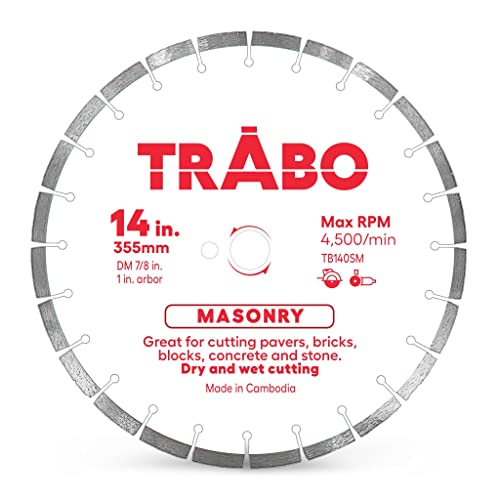
The budget-friendly segmented blade that still cuts engineered quartz and old asphalt clean.
The Trabo proves you do not need to spend top dollar for a capable masonry blade. Made from carbon steel at 0.12 inches thick, it is designed for angle grinders and circular saws, and it cuts wet or dry. A 7 1/4-inch circular saw user reported clean, chip-free cuts through engineered quartz with the included ring adapter fitting tight and secure.
This blade ships with a 1-inch arbor and a separate ⅞-inch brass reducer ring glued inside the package, so you can fit it to multiple saws. It handled a starter cut on 20-year-old asphalt mix and sliced through 20+ concrete piers without dulling, per owner reports. The 14-tooth segmented edge keeps the price down while still delivering solid performance on cement, pavers, and natural stone.
Where it sits in this list: a full step below the ORIXTREME on raw endurance, but a clear step ahead on price. If your project is light masonry — bricks, mortar, hardie backer board — this blade does the job without the premium outlay.
What owners appreciate
- Included brass reducer ring expands saw compatibility
- Carbon steel build handles light dry cutting without dulling
- Cuts clean with no chipping on engineered stone
Realistic limits
- Not built for 4-inch thick concrete pours
- Fewer teeth than pricier blades means slower feed on big slabs
Pick it up if: you need a dependable low-cost blade for pavers, bricks, and block on a circular saw.
Pass it by if: your job involves thick pours or heavy rebar all day long.
5. Ostek 14″/350mm Diamond Blade, 1″ Arbor
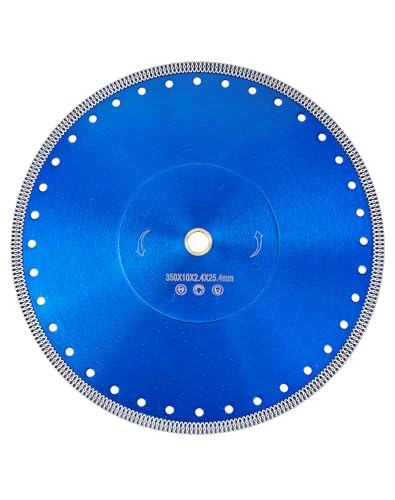
The paper-thin blade that cuts thick porcelain like a hot knife, with edges that barely need filing.
The Ostek is a specialist for a very specific job: chip-free cuts through hard, dense tile. Its thin turbo-mesh rim and core cut fast while minimizing chipping, and its 2.4mm thickness is the slimmest profile in this list. One owner tiled an entire shower with a single blade, noting it “cuts through my thick porcelain tile like a hot knife through butter.”
This blade measures 14 inches (350mm) with a 1-inch arbor and 20mm bushing and is meant for wet cutting only. Its 10mm segment height runs shorter than the masonry blades above, which makes sense for tile work rather than deep concrete. The X-mesh turbo rim segments help cool the blade and pull dust out, keeping cuts efficient on long tile runs.
Skip the Ostek if you’re cutting rebar concrete—it’s built for extra-hard ceramics, porcelain, granite, and marble instead. You must use wet cutting, so it works best on a tile saw or wet saw setup. Customers note clean edges, but note the thin rim can chip if you push it freestyle in an angle grinder, so keep it on a guided wet saw.
Its specialty: leaving beautiful cut edges on thick porcelain that barely need filing — the standout trait in the feedback.
The trade-off: this is a wet-cut tile specialist, not an all-purpose masonry blade, so keep it on tile and stone work.
6. Diablo Diamond Segmented Masonry Cut-Off Blade, 14″ Diameter
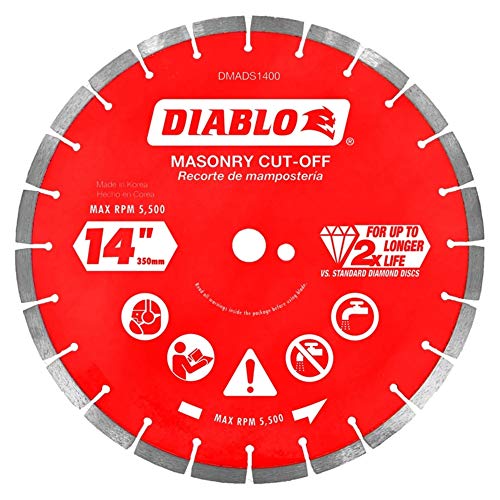
The smooth-running segmented blade that cuts cement block with almost no wobble or vibration.
Diablo brings its reputation for smooth operation to the 14-inch masonry blade market. The hardened disc body absorbs vibration and boosts impact resistance, which is exactly why owners say it “doesn’t wobble and vibrate like the others” they have tried. It cuts cement block and concrete with a stable, predictable feel that inspires confidence on thick cuts.
This blade is compatible with both 1-inch and 20mm arbors, with one 20mm bushing included in the box. It runs wet or dry up to a maximum of 5,500 rpm, and The taller segments with a strong diamond bond are rated for up to 2X longer life.. At 4.4 pounds, it carries a reassuring heft for demanding cuts.
Its 3.2mm kerf (the width of the cut it makes) is on the thicker side, so it removes more material per pass than a thin rim. Owners consistently call it a great value and praise its cement block performance, though a handful of units have had brass inserts that needed repositioning. For a balanced mix of speed, smoothness, and control on concrete, brick, and cinder block, this is a top-tier pick.
what separates it
- Hardened body minimizes wobble and vibration for smoother cuts
- Fits both 1-inch and 20mm arbors for versatile tool use
- Tall segments with strong diamond bond last up to 2X longer
Worth knowing
- Thicker 3.2mm kerf wastes more material than a thin blade
- Occasional fit issues reported with the brass arbor inserts
Choose it for: a smooth, low-vibration cutting experience on block and concrete in wet or dry conditions.
skip it if: you need the thinnest possible cut to conserve expensive stone.
7. SHDIATOOL 14 Inch Metal Cutting Diamond Blade, All Purpose Cut Off Wheel
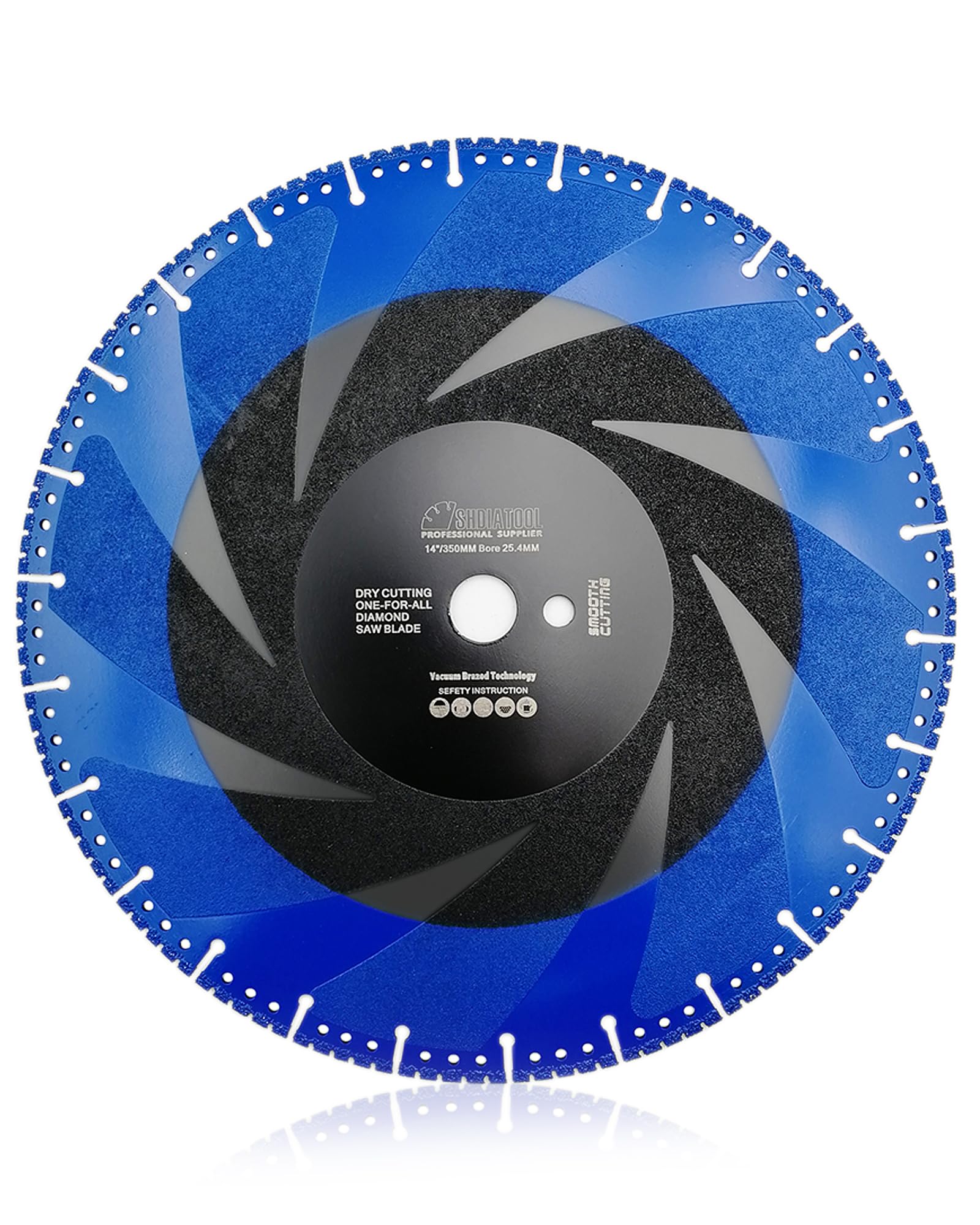
The do-everything vacuum-brazed blade that cuts steel, rebar, pipe, and masonry with one swap.
The SHDIATOOL is the chameleon of this list, cutting everything from auto body panels and cast iron to rebar, reinforced concrete, and PVC. Its vacuum-brazed technology permanently fuses diamond grains to the steel core, creating segments that resist heat and stay put under heavy use. One owner cut 4x6x3/8-inch steel angles in 6 minutes each versus 45 minutes on a band saw..
This blade measures 350mm (14 inches) with a 3.2mm incision thickness and a 1-inch bore with pin hole. The core is heat-treated high-speed steel, and its maximum safe operating speed is 4,365 rpm — noticeably lower than the masonry blades above, so check your saw’s speed before mounting. Both sides of the core are coated with abrasive grains for smooth cutting and heat reduction.
Owners praise its performance on 14-gauge steel and note it does not overheat or warp under long use. The main criticisms are that cutting speed on thick metal is slow and the price runs high for a consumable. If your jobs mix metal and masonry and you want one blade on the saw, this is the most versatile pick here — just keep it dry and let it work at its own pace.
Why it is versatile
- Cuts steel, rebar, aluminum, masonry, and wood with one blade
- Vacuum-brazed diamond resists heat and stays sharp
- 130-tooth edge slices cleanly through 14-gauge steel
Heads up
- Cutting feels slow on thick metal versus dedicated abrasive wheels
- Max 4,365 rpm speed may not suit every saw
Ideal for: mixed demolition and fabrication work where one blade must handle steel, pipe, and masonry.
Not for: fast production cutting where every minute of speed counts.
8. Diamond Extreme 14 Inch Metal Cutting Diamond Blade, Heavy-Duty Vacuum-Brazed
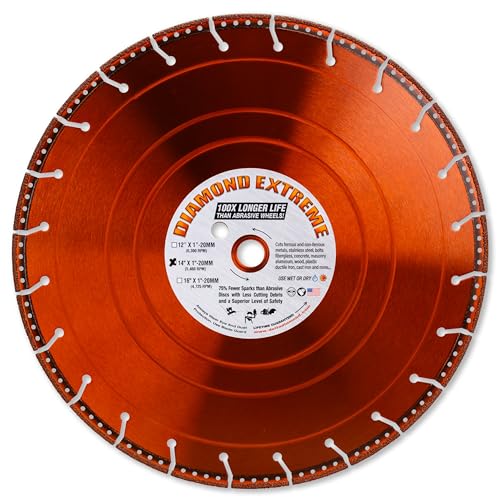
The vacuum-brazed beast that outlasts a dozen abrasive wheels on steel, pipe, and rescue work.
The Diamond Extreme is the endurance champion for metal cutting. Its heavy-duty vacuum-brazed diamond coating replaces up to 100 traditional abrasive cut-off wheels., slashing blade changes and downtime. Reviewers point out it outlasting roughly 12 standard wheels and surviving 8-plus hours cutting 1/2-inch steel., binding, and even drops without losing its edge.
This blade’s key advantage is its solid steel core: unlike abrasive wheels that shrink as they wear, the core maintains its diameter for consistent cutting depth through the blade’s entire life. At 0.14 inches thick with 24 teeth, it cuts rebar, structural steel, stainless steel, pipe, angle iron, and steel doors. Its thicker profile makes it slower than thin discs but far less prone to breaking or binding.
Owners call it “10x faster and lasts longer than abrasive blades” on a 14-inch chop saw., and it handles aluminum with less gumming than silicate wheels. The trade-off is cut quality — it leaves a rougher edge that needs grinder cleanup, making it better for rough cuts and weld prep than precision work. It is pricey, but for a shop that burns through abrasive wheels weekly, this blade pays for itself in reduced downtime.
Its superpowers
- Replaces up to 100 abrasive wheels for fewer changes and lower cost per cut
- Solid steel core keeps cutting depth consistent as it wears
- Built for heavy steel, pipe, and rescue demolition work
The honest limits
- Thicker rim cuts slower and rougher than precision blades
- Premium price is steep for occasional weekend use
Worth it for: fabricators and demo crews who cut steel daily and want to stop swapping abrasive wheels.
Overkill if: your metal cutting happens a few times a year.
9. EDiamondTools 14″ Segmented Diamond Saw Blade, 5-Pack
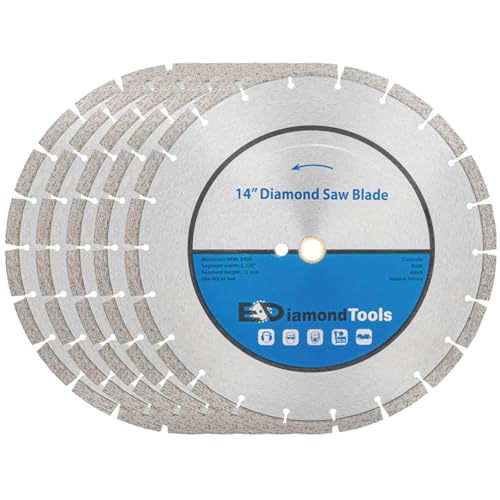
A five-pack of general-purpose segmented blades for crews that never want to stop mid-job.
The EDiamondTools 5-pack solves a very specific problem: running out of blade mid-project. Each of the five blades carries a 12mm segment height and a 0.118-inch segment width, designed for cutting concrete, brick, block, and masonry with a performance-to-price ratio in mind. Shoppers say cutting 20 retaining wall caps 3.5 inches thick with a single blade showing no wear..
The whole pack weighs 15 pounds, so you are buying serious inventory. These are recommended for use with handheld cut-off saws, wet or dry. The diamond-encrusted segmented teeth deliver efficient, precise cuts, and feedback notes they cut through stone “like butter” and stay sharp across multiple stones. The sharp segments work well on block and concrete, fitting snugly in saws.
The value equation here is simple: the per-blade cost drops well below buying singles, making this the smart buy for a crew or a homeowner with months of masonry projects ahead. These are general-purpose concrete blades, not tile or metal specialists, so keep them on masonry work. For anyone who hates stopping a big job to run to the hardware store, this five-pack is the answer.
The bulk advantage: when one blade does a full retaining wall without wearing out, five blades could cover an entire property’s worth of hardscaping.
Keep in mind: you are buying five of the same general-purpose blade, so leave the tile and metal work to the specialists above.
Understanding the Specs
Rim Style and What It Does
The rim is the cutting edge of the blade, and its style decides the cut’s speed and finish. A segmented rim has a gulleted, toothed edge that clears material fast and handles rebar, but leaves a rougher finish. A turbo rim has a continuous serrated edge that cuts quicker than a smooth rim while leaving a cleaner edge on stone and masonry. Continuous rims, the smoothest of all, are for tile and porcelain where chip-free edges matter most.
Arbor Size and Bushings
The arbor is the center hole that mounts the blade to your saw’s shaft. Most 14-inch masonry blades use a 1-inch arbor, and many ship with a 20mm bushing — a small reducer ring that lets the same blade fit a saw with a 20mm shaft. Some blades also include a ⅞-inch brass reducer for even wider compatibility. Always match the arbor or bushing to your saw’s shaft before buying.
Segment Height and Thickness
Segment height is how tall the diamond edge stands above the steel core — a taller segment (12mm or 15mm) means more usable diamond and a longer blade life. Blade thickness trades off two ways: thinner blades cut faster with less waste, while thicker cores resist flexing and binding on heavy rebar. Match thickness to the saw’s power and the materials you cut most.
Wet vs Dry Cutting
Dry cutting uses the blade’s airflow slots to cool the edge and clear dust, so it is convenient but dusty. Wet cutting adds water to cool the blade and control dust, and some blades are rated for wet cutting only — like the tile-focused Ostek. Always check the blade’s rating: using a wet-cut-only blade dry can overheat and warp it. Dry cutting demands a respirator, as owners repeatedly note.
FAQ
What is the difference between a segmented and a turbo diamond blade?
Will a 14 inch blade fit my saw?
Can I cut metal with a concrete diamond blade?
How long does a 14 inch diamond blade last?
What does wet or dry cutting mean for a diamond blade?
Is a thicker diamond blade better than a thin one?
Why do some blades include a bushing or reducer ring?
What is the maximum RPM for a 14 inch diamond blade?
Can I use a 7 1/4 inch circular saw blade with a 14 inch blade?
Final Thoughts: The Verdict
For most people, the best 14 in diamond blade winner is the Delta Diamond Boss Hog because it pairs a clean turbo finish with the longevity and warranty that pros expect. If you are cutting hundreds of pavers on a budget, grab the ORIXTREME General Purpose for its tall 15mm segments. And for steel-heavy demolition or fabrication, the Diamond Extreme is the one to reach for — its vacuum-brazed coating outlasts a dozen abrasive wheels, so you stop swapping blades and start finishing jobs.
How We Picked
We do not accept paid placement. Every pick is matched to a real buyer and a real use-case; we do not hands-on test units.
Sources & Methodology
Specifications: manufacturer listings and product documentation. Review insights: verified customer reviews, as of September 2026. Pricing: not shown on this page (it changes often); check the current price via the retailer link.
As an Amazon Associate, KitchPrep earns from qualifying purchases. This does not affect which products we feature.
Related Guides
