
Specs are compiled from manufacturer listings and verified buyer reviews and can change over time — please confirm the key details on the product page before buying.
You want a backyard shade sail that keeps your patio cool and usable without collapsing in the first breeze. The real difference between a sail that lasts and one that sags, fades, or tears hides in a few specs buried in the fine print—here is what to look for before you buy.
I’m Mohammad Maruf — the founder and writer behind KitchPrep. This guide is built by comparing the manufacturers’ published specifications and the patterns across verified customer reviews, so you get each pick’s real strengths and trade-offs instead of marketing spin.
These are the best backyard sun shade sails for covering patios, pools, and pergolas, judged by real owner experience and verified construction details.
Our Picks at a Glance


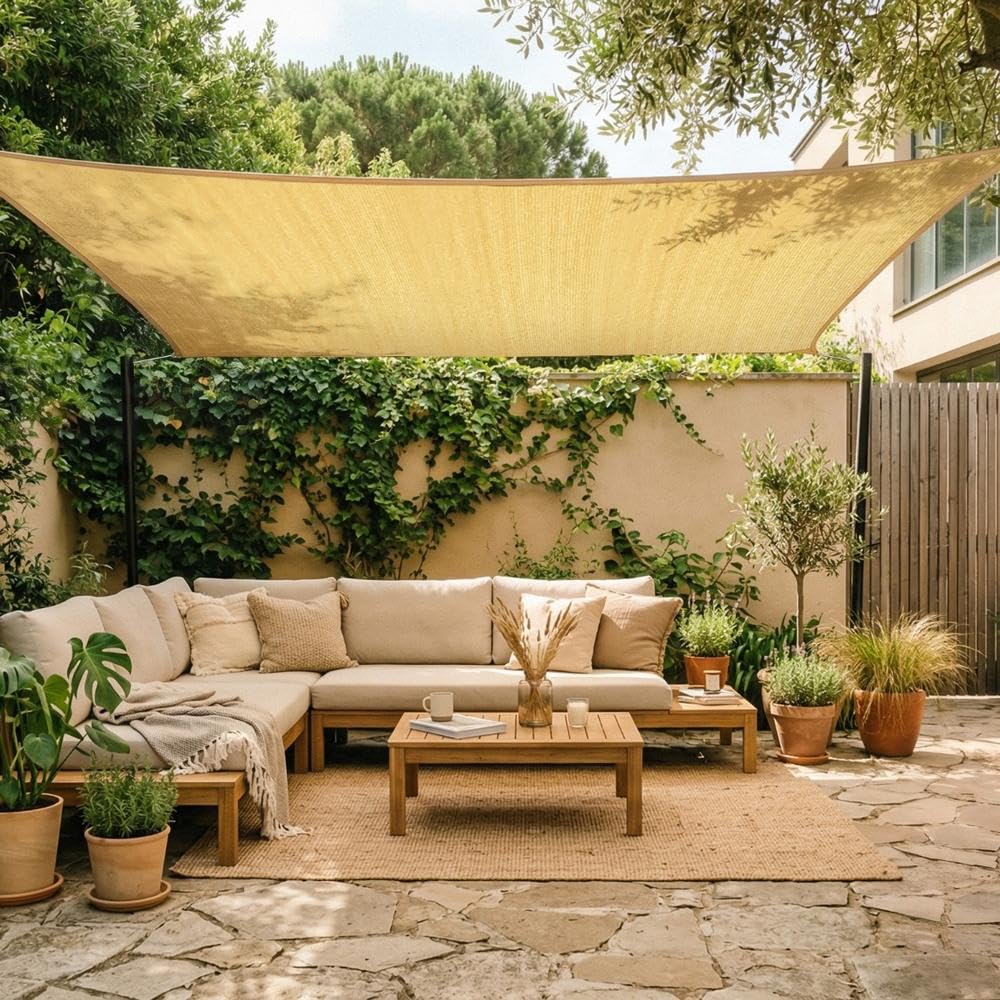
How To Choose The Best Backyard Sun Shade
Buying a shade sail is less about the brand name and more about matching the fabric, shape, and mounting plan to your actual space. The three decisions that matter most are the material weight, the edge geometry, and how far apart your anchor points sit.
Start With the Fabric Weight (GSM)
GSM stands for grams per square meter, which is simply how dense and heavy the fabric is. A higher GSM number means a thicker, beefier cloth that holds its shape better and resists tearing under tension. The sails here range from 185 GSM to 220 GSM, and that small gap on paper translates into a real difference in how taught the fabric pulls and how long it lasts in harsh sun.
Curved Edges Beat Flat Edges for Tension
A shade sail with perfectly straight edges will sag in the middle once it’s hung, because fabric naturally droops under its own weight. The best sails use slightly curved or concave sides, which look odd folded up but pull drum-tight when stretched between corners. This is the difference between a neat canopy and a floppy sheet.
Waterproof vs Water-Permeable is a Climate Call
Most shade sails let rain pass right through the woven mesh, which means no pooling water and less stress on the fabric during a downpour. Waterproof sails block rain but can balloon under the weight of water if not angled steeply enough. If you live in a windy area or want a low-maintenance setup, a breathable sail is usually the safer bet.
Quick Comparison
| Model | Best For | Fabric Weight | Size | UV Block | Amazon |
|---|---|---|---|---|---|
| Colourtree 12′ x 20′★ Best Overall | Large patios & pools | 190 GSM | 12′ x 20′ | 95% | Amazon |
| ShadeMart 16′ x 16′Premium Pick | Big square pergolas | 200 GSM | 16′ x 16′ | 95% | Amazon |
| Amgo 12′ x 20′Runner-Up Value | Anti-sag large areas | 200 GSM | 12′ x 20′ | 95% | Amazon |
| ShadeMart 10′ x 16′ | Budget large coverage | HDPE | 10′ x 16′ | 95% | Amazon |
| Royal Shade 12′ x 12′ | Square garden corners | 200 GSM | 12′ x 12′ | 95% | Amazon |
| AsterOutdoor 12′ x 16′ | Easy DIY installs | 185 GSM | 12′ x 16′ | 95% | Amazon |
| Amgo 7′ x 12′ Waterproof | Rain protection | 220 GSM PES | 7′ x 12′ | 98% | Amazon |
| Royal Shade 10′ x 13′ | Decks & small patios | 200 GSM | 10′ x 13′ | 95% | Amazon |
| LOVE STORY 12′ Triangle | Triangular corners | HDPE | 12′ x 12′ x 17′ | 95% | Amazon |
In‑Depth Reviews
1. Colourtree 12′ x 20′ Rectangle
Our pick — over 4.5★ from 850+ verified ratings; the strongest balance of quality and price.
The backyard workhorse that survives Texas sun, hurricanes, and repeat purchases.
This is the sail that owners keep coming back to — literally, since several bought a second one, and one replaced it only after a tree fell on the original. The 190 GSM virgin HDPE fabric is the crowd favorite, praised for surviving years in the Texas sun where the seller says it proves 70% more durable than recycled HDPE after 20,000 hours of UV testing. At roughly 204 inches long by 144 inches wide versus the Colourtree’s own 1-inch listing dimension, the real coverage matches its 12′ x 20′ name for most owners.
The weave lets water and air pass straight through, so rain drips down instead of pooling on top—owners note it “sags/drips center” rather than holding water, which is what you want from a shade, not a tarp. Double-layered reinforced seams and stainless steel D-rings (metal rings at each corner for attaching ropes) handle the tension, and one pool owner reports it cut evaporation and chlorine burn-off through a second Florida season.
Buyers report: “Survived years in Texas sun; not waterproof but water sags/drips center.” The honest catch is installation — the hardware kit is sold separately, and the brand warns against nylon ropes since they break easily. You’ll want the proper cable and turnbuckle setup to pull a 12′ x 20′ panel drum-tight.
What Wins People Over
- Proven lifespan through extreme sun and wind storms
- Breathable weave prevents rain pooling entirely
- Reinforced seams and stainless D-rings hold tension safely
- Owner-praised quality is the #1 talking point
What to Plan Around
- Hardware kit sold separately
- Nylon ropes won’t cut it — need proper cables
- Large 12′ x 20′ panel is a two-person job to tension
Your pick if: you need dependable large-area shade over a pool or patio and want a cloth that shrugs off brutal sun for years.
Think twice if: you want a ready-to-hang kit — this is fabric only, and you’ll source the mounting hardware yourself.
2. ShadeMart 16′ x 16′ Square
A 16-foot square of 200 GSM cloth that tames intense Southern California sun and wind.
For a large pergola or backyard expanse, this square panel delivers the most talked-about build quality in its class — 43 owners single out the construction, making it the top praise point. The 200 GSM HDPE fabric blocks 95% of UV rays and cuts temperatures by up to 15°F., and owners confirm it withstands intense SoCal sun and strong winds season after season. One report notes two years of continuous use with no fraying, sun damage, or tears.
Heavier than the budget-conscious Colourtree above, this panel weighs 3.96 kg (192 inches per side) and uses stainless steel D-rings with double-layer stitching for stronger corners. The catch: it leaks water, so you must mount it with a slope to drain—if hung loose, it pools. Sizing is another trap—several owners warn a 16′ x 16′ sail is too big for a true 16′ x 16′ pergola, so order one to two feet smaller because the curved edges shrink the usable span.
The crowd favorite keeps decks much cooler, and the sagging complaints some mention trace back to mounting gaps rather than the fabric itself. This is the pick when you want premium material density over a big footprint and don’t mind buying a size down for a perfect fit.
The Strong Suit
- Heavy 3.96 kg panel holds shape in strong wind
- Two seasons without fraying or sun damage reported
- 95% UV block with up to 15°F cooling.
- Rust-proof stainless D-rings on reinforced edges
The Fine Print
- Not waterproof — rain needs a slope to drain
- Order 1-2 feet smaller than your measured span
- Large panel is hard to handle alone
Reach for this if: you’re covering a big square pergola and prioritize material density and clean tension over budget.
Look elsewhere if: you need a rain-blocking canopy — this is a shade cloth, and water passes through it.
3. Amgo 12′ x 20′ Rectangle
Rectangle coverage with anti-sag curved edges that keep a huge 12 x 20 footprint looking tight.
Amgo’s 12′ x 20′ shares the same 200 GSM HDPE density as the ShadeMart square but adds a precision-engineered curved edge designed to distribute tension evenly and keep the center from drooping. Owners fitting it over a pergola report straightforward installs in 90°F heat, with one noting it works “fantastically” as a pergola cover while keeping the deck surface cool for kids playing underneath.
The double-layered stitching and rust-proof stainless steel D-rings give it industrial-grade staying power, and the permeable weave lets breezes and rainwater flow through freely so you never deal with heavy pooling. At 3.99 kg, it’s a substantial panel, and one owner’s only quibble is that the concave design means it covers slightly less area than the tape measure suggests — note when you size your mounting points.
Some buyers receive it with three attachment options included, though others found a separate hardware kit necessary. For the trade-off between premium density and the largest common rectangle size, this is the strongest balance of anti-sag engineering and cooling performance.
Why It Leads on Rectangle
- Curved edges prevent center droop on a large span
- 200 GSM fabric blocks 95% UV and cools up to 15°F.
- Permeable weave stops rain pooling completely
- Reinforced webbing resists tearing under wind
Before You Buy
- Concave design covers slightly less than measured
- May need a separate hardware kit
- Big panel needs solid anchor posts
Grab this if: you want a huge rectangle that stays drum-tight and looks professionally installed over a pergola or long patio.
skip it if: your mounting points are less than 20 feet apart — the curved edges need full span to reach their tension.
4. Royal Shade 12′ x 12′ Square

The 12-foot square that one owner mounted over a pop-up frame in Arizona and left through a full monsoon season.
Royal Shade’s square brings 200 GSM HDPE density to a 12′ x 12′ footprint at a friendlier price tier than the big panels. Owners praise the sun protection most — 20 call it out — and the cooling effect is real, with one courtyard report measured a ~15°F drop.. The textured fabric feels thick and does stretch slightly, which helps it settle into a smooth plane rather than fighting your anchor points.
Owners mention it’s porous enough to let rain through without pooling, so you can leave it outdoors all spring and summer without tarp-like wind resistance.
The catch is honesty about what you’re getting: one owner found the promised 20-foot HD rope missing from the package, so budget for a basic hardware kit. And it’s a shade sail, not a rain canopy — you’ll want it down during downpours. For a 12-foot square that punches above its tier in Arizona-grade abuse, this is the one.
Owner Highlights
- Survived Arizona heat and monsoons over a year
- Porous fabric lets rain through with no pooling
- Curved edges keep the 12′ span from sagging
- Easy install — one owner finished in about 10 minutes
Realistic Caveats
- Some packages miss the promised rope
- Not for use in the rain — shade only
- Fabric stretches slightly after install
Choose this when: you need a mid-size square that survives extreme sun and want the cooling effect without premium pricing.
Pass if: you expect a complete kit with rope and hardware in the box.
5. AsterOutdoor 12′ x 16′ Rectangle

The lightweight rectangle that comes with ropes in the box, so solo setup is actually possible.
This is the most-owned sail in the roundup, with tens of thousands of ratings behind it, and the reason is simple: it’s the easiest to get up. Four 5-foot polyethylene ropes and an instruction sheet ship in the package, so you can tie the D-rings to trees, posts, or a pergola without buying anything else. One owner set it up solo over a pergola gap using an extending rod and takes it down just as easily.
The fabric is a lighter 185 GSM HDPE with 95% UV block, and while it’s not as dense as the 200 GSM panels above, owners say it provides shade, not darkness, letting plants underneath still benefit. The graphite color matches brick and trim for a tidy look, and the included stainless D-rings hold up well. One creative owner draped it over a 1970s solarium to cut late-afternoon sun and reports it works perfectly in that unorthodox setup.
The honest trade-off is durability in extreme weather. Owners note it should come down for winter — one left it up through heavy snow and the weight tore it. A 5-year manufacturer warranty backs the cloth, and the buyer consensus is that at this lighter weight, it’s a fair-weather-to-moderate sail best suited for seasonal use.
Easiest Install Here: four ropes included means zero extra hardware purchases — just tie the corners and go.
The Reliability Read: lighter 185 GSM cloth is fine for sun, but bring it down for snow and severe storms to protect the seams.
6. Amgo 7′ x 12′ Waterproof
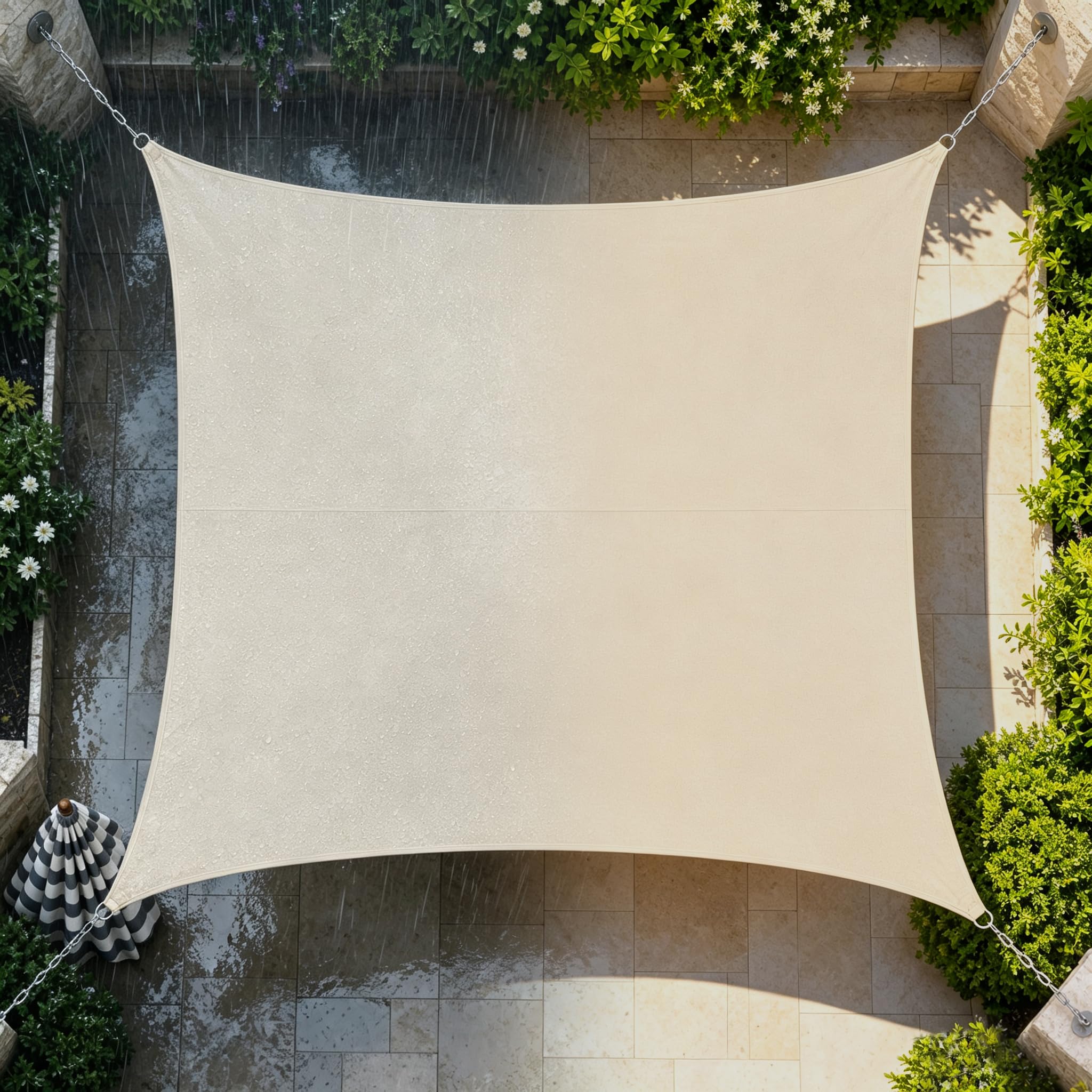
The one sail here that actually keeps you dry, with a 220 GSM coating that blocks 98% of UV.
Every other sail in this guide lets rain pass through—this Amgo is the deliberate exception. A thick PU (polyurethane) coating on 220 GSM PES (polyester) fabric repels water, so you get dry seating on a small patio, pergola, or driveway even in a shower. It also blocks the most UV in this roundup at 98%, beating the standard 95%.
The trade-off is physics: waterproof fabric holds water, so the manufacturer insists on a 20-40 degree mounting angle to prevent the balloon effect of pooling. Owners confirm it handled a storm overnight without issue when angled properly, and the concave borders maintain high tension for a smooth look. It’s locally produced in American facilities, which some buyers appreciate for quality control.
The limitation is wind. Unlike the breathable HDPE sails that let gusts through, this solid panel catches air, and the brand itself advises against using it in high-wind regions. Durability feedback splits — some report it holds up fine in normal conditions, others found it less forgiving. For a rain-blocking shade over a sheltered nook, this is the right tool; for an exposed open yard, a permeable sail is safer.
What It Offers
- Waterproof PU coating keeps seating dry
- Top-tier 98% UV block in class
- Concave edges hold high tension neatly
- American-made production
Its Limits
- Needs a 20-40 degree angle to avoid pooling
- Not recommended for high-wind regions
- Solid fabric can’t match breathable sails’ wind pass-through
Buy this if: your priority is a dry, shaded corner for patio seating rather than pure sun coverage.
Avoid it if: your backyard is exposed and gusty — a solid waterproof panel will strain its anchors.
7. ShadeMart 10′ x 16′ Rectangle
A 10 x 16 panel that rode out 60-mile winds and hail without a scratch, at a budget-friendly price.
This ShadeMart rectangle wins on sheer storm resilience per dollar. Customers note it stayed up through 60-mile winds, rain, and hail with no visible wear, and several note it lasts at least 5 years of normal use. The woven HDPE lets breeze through while blocking 95% of UV, and the brand claims a 10-15°F temperature reduction that can take the edge off your A/C bill..
Stainless steel D-rings attach to heavy-duty white webbing around the whole perimeter—a sturdier anchor than stitching alone. One owner, quoted a ridiculous price by a local installer for a wooden cover, bought this instead and called it “strong, durable and good looking.” Another said it fixed a back patio that was “horribly hot throughout most of the day.”
The honest sizing note: several owners say it runs slightly under the advertised 10′ x 16′, so measure carefully and consider the curved-edge reduction. And while it blocks most sun, one fair-skinned owner still got a sunburn under it — it’s shade, not a total eclipse. For durable coverage without the premium price, this is the value leader.
The Value Case
- Survived 60-mile wind, rain, and hail
- Stainless D-rings on full webbing perimeter
- Lasts at least 5 years per owner reports
- Lets breeze through while blocking 95% UV
Know Before Ordering
- Runs slightly under advertised 10′ x 16′
- Still possible to get a sunburn underneath
- Budget tier means lighter HDPE weave
Pick this if: you want proven wind durability on a large rectangle and don’t want to pay premium-tier prices.
Look elsewhere if: you need exact 10′ x 16′ coverage — order up if your space is tight.
8. Royal Shade 10′ x 13′ Rectangle

A dense 200 GSM rectangle that keeps a front deck 25-30 degrees cooler for the dogs to enjoy.
This Royal Shade rectangle earns its spot with a cooling claim owners back up: one deck owner says it kept their space 25-30°F cooler in summer., and another in central Texas calls it essential for a pool in harsh, direct 100-degree sunlight. The 200 GSM HDPE (high-density polyethylene) fabric outweighs the AsterOutdoor’s 185 GSM by a meaningful 5% margin, giving you a firmer, longer-lasting cloth over the same span.
The brand backs it with a 3-year warranty against UV degradation, and owners confirm the reality: a central Texas pool owner says it lasts about two years there before sun damage starts—which they consider good given the brutal exposure. The precisely calculated curved edges keep the 10′ x 13′ panel tight and neat after installation, preventing mid-sagging.
Value opinions split — some call it great for the price, others found it not worth the cost, and a few note the color runs stronger than the photos suggest. Installation is straightforward with a basic hardware kit, and owners like that it takes down quickly for heavy wind or rain. If you want dense cloth at a compact size, this is a strong mid-tier option.
Strong Points
- Measured 25-30°F deck cooling in real use.
- Denser 200 GSM than entry-level sails
- 3-year warranty against UV degradation
- Curved edges prevent mid-panel sagging
Consider This
- Color may run stronger than photos show
- Value opinions split among owners
- Harsh Texas sun still wears it in ~2 years
Reach for it if: you want the densest fabric available in a compact 10′ x 13′ size for a deck or small patio.
Think twice if: you need a larger footprint — this one is sized for tighter spaces.
9. LOVE STORY 12′ Triangle

The triangle that replaced a several-hundred-dollar custom marine canvas job — and won.
This is the shape pick for covering a corner, and its origin story is telling: an owner planned to spend hundreds with a local marine outfitter for a custom canvas sail, grabbed this as a stop-gap, then canceled the custom order entirely because this worked so well. The triangle measures 12′ x 12′ x 17′ between D-rings, and the full-cut single-piece fabric has no splicing gaps in the center—giving you better shade and a cleaner look than seamed panels.
The 100% new HDPE fabric blocks 95% of UV rays with an 85-90% shading rate, and owners confirm it has survived several wind storms and “still stay strong.” It includes 3-4 thicker ropes to help with the triangle mounting pattern, and the sand color looks handsome over a deck or pool corner. One buyer even tied it to three trees to keep pecans from dropping into a pool.
The number one owner warning is size: photos make it look bigger than it is, and the 12′ x 12′ x 17′ triangle is physically smaller than it appears. One disappointed buyer couldn’t use it because it was “much much smaller than anticipated.” The brand notes a ±4 inch tolerance from D-ring to D-ring. Installation experience splits — easy for some, difficult for others — and it’s not waterproof, so don’t expect rain shelter.
What Shines
- Replaced a custom marine canvas at a fraction of the cost
- Full-cut fabric, no center splicing gaps
- Withstood several wind storms per owners
- 85-90% shading from 95% UV-resistant HDPE
Measure First
- Photo sizing is misleading — it’s smaller than it looks
- Not waterproof — shade only
- ±4 inch D-ring tolerance to plan around
Your move if: you need a triangle to close a corner over a deck, pool edge, or between three trees and want a single clean piece of fabric.
Pass if: you’re covering a large open rectangle — measure your space against the 12′ footprint first.
Understanding the Specs
GSM: The Density Number That Predicts Lifespan
GSM stands for grams per square meter — how heavy and dense the fabric is. The sails here range from 185 GSM up to 220 GSM, and that gap matters. A 200 GSM cloth is noticeably firmer, holds its shape better across a long span, and resists tearing under tension than a 185 GSM panel. If you live somewhere with brutal sun, spend the small difference on 200 GSM or higher; the fabric will repay you with extra seasons before it starts to disintegrate.
UV Block Percentage: Shade vs Total Eclipse
Almost every sail here claims to block 95% of harmful UV rays, which is the industry standard for HDPE shade cloth. A few go higher — the waterproof Amgo claims 98%. The practical difference is small for most people: 95% block means you’re well protected from the sun’s damaging rays while still getting some diffused light underneath, which keeps plants happy. None of these are total blackout canopies, and one fair-skinned owner still caught a sunburn under a 95% sail through reflected light.
Curved Edges: The Anti-Sag Secret
A shade sail with dead-straight edges will droop in the middle once hung, because fabric sags under its own weight. That is why quality sails use slightly curved or concave sides—they look odd in the package but pull drum-tight when stretched between corners. Every brand in this guide mentions this design, and the ones that get it right are the sails owners describe as “tight and neat” rather than “floppy.” If a listing does not mention curved edges, expect mid-panel sag.
Water Permeable vs Waterproof: Know Your Climate
Most shade sails use a woven HDPE mesh that lets rain pass straight through. That’s a feature, not a flaw: no pooling water means no stress on the fabric and no sagging pockets after a storm. Waterproof sails, like the coated Amgo, block rain but must be mounted at a 20-40 degree angle so water runs off instead of pooling into a balloon. In windy areas, permeable sails are safer because air flows through them; solid panels catch gusts like a sail on a boat.
FAQ
Should I buy a shade sail smaller than my measured space?
What is GSM and why does it matter for a sun shade?
Are shade sails waterproof?
Will a shade sail survive strong wind?
What hardware do I need to install a shade sail?
How long does a backyard sun shade last?
What is the difference between 95% and 98% UV block?
Triangle or rectangle shade sail — which shape should I choose?
Does a darker color block more heat than a light one?
Can I leave my shade sail up all year?
Final Thoughts: The Verdict
For the best overall backyard sun shade, the Colourtree 12′ x 20′ is the crowd favorite for good reason — it pairs proven multi-year survival in brutal Texas sun with a breathable weave that never pools water. If you want the densest premium build for a big square pergola, grab the ShadeMart 16′ x 16′. And for a rain-blocking option that keeps your seating dry, the Amgo 7′ x 12′ Waterproof is the only one here that actually repels water. Whichever you choose, measure your anchor points carefully and order a size down for the tightest, longest-lasting install.
How We Picked
We do not accept paid placement. Every pick is matched to a real buyer and a real use-case; we do not hands-on test units.
Sources & Methodology
Specifications: manufacturer listings and product documentation. Review insights: verified customer reviews, as of September 2026. Pricing: not shown on this page (it changes often); check the current price via the retailer link.
As an Amazon Associate, KitchPrep earns from qualifying purchases. This does not affect which products we feature.
Related Guides
