
Specs are compiled from manufacturer listings and verified buyer reviews and can change over time — please confirm the key details on the product page before buying.
A blade that chips, wobbles, or burns out mid-cut on porcelain can ruin an entire tiling project. A 7-inch blade’s rim style and tooth count determine whether you get a clean factory edge or a chipped, jagged cut.
I’m Mohammad Maruf — the founder and writer behind KitchPrep. This guide is built by comparing the manufacturers’ published specifications and the patterns across verified customer reviews, so you get each pick’s real strengths and trade-offs instead of marketing spin.
To get clean cuts without chipping, you need a 7 inch tile saw blade that matches your material, rim style, and tooth count to the job on your bench.
Our Picks at a Glance

How To Choose The Best 7 Inch Tile Saw Blade
Buying a 7-inch diamond blade is about matching the blade’s geometry to the hardness and brittleness of your tile. The crowd favorite — Pearl Abrasive’s P4 — holds a 4.6-star score across 900+ owners, which tells you quality matters more than brand loyalty when cutting porcelain.
Know Your Rim Style
A continuous rim is a solid, uninterrupted edge of diamond — great for clean, chip-free cuts on porcelain and glass. A turbo or segmented rim has notches that clear debris faster, which speeds up cutting but leaves a rougher edge that needs more cleanup.
Match the Blade to the Material
You wouldn’t use a wood blade on steel, and the same logic applies here. Soft ceramic and marble cut best with a blade meant for dense materials. Hard porcelain and granite demand a thin-rim design with a stiff center to resist wobble and vibration.
Quick Comparison
| Model | Best For | Cutting Style | Kerf Width | Rim Height | Amazon |
|---|---|---|---|---|---|
| Pearl P4 Turbo★ Best Overall | Clean porcelain & hard ceramic | Wet or Dry | 0.06 in. | 10 mm | Amazon |
| FEWELL X-TeethBest Value | Budget-friendly smooth cuts | Wet or Dry | 1.6 mm | — | Amazon |
| OSTEK Super ThinContractor Pick | Cutting granite & marble | Wet or Dry | 1.6 mm | — | Amazon |
| OSTEK Wet Saw Blade | Hard porcelain & cement board | Wet | 10 mm | 10 mm | Amazon |
| Delta Piranha | Chip-free cutting, premium value | Wet or Dry | 0.06 in. | — | Amazon |
| QEP Glass Tile Blade | Glass and mosaic tile | Wet | — | 7 mm | Amazon |
| QEP Black Widow | Fast cutting on porcelain | Wet | 3 mm | 7 mm | Amazon |
| Diablo Continuous Rim | Versatile masonry & tile | Wet or Dry | 1.6 mm | — | Amazon |
| MK Diamond Hot Dog | Thin, precise porcelain cuts | Wet | 0.05 in. | — | Amazon |
In‑Depth Reviews
1. PEARL ABRASIVE CO. P4 Thin Mesh Turbo Porcelain Blade 7″
Our pick — over 4.5★ from 950+ verified ratings; the strongest balance of quality and price.
A pro-grade blade engineered for fast, near-chip-free cuts on hard porcelain.
The P4 is the blade pros reach for when a clean edge is non-negotiable. Its extra-thin kerf and premium diamond bond are engineered to slice through porcelain, hard ceramics, and stone with little to no chipping — the outcome that matters when you’re staring at a tile you can’t afford to ruin.
The core strength here is the cool-running mesh rim design, which reduces stress on both the blade and the material. A full 10 mm tall diamond rim delivers extended life, while a laminated center hub adds stability for straighter cuts. Buyers report cutting thousands of square feet across multiple bathrooms and floors with the blade still going strong.
One honest trade-off: the blade is priced at a premium, and a few owners note that it degrades as it approaches the end of its life rather than failing suddenly. If you’re tiling a single shower, the cost-per-cut may not justify the splurge.
Why Pros Reach For It
- Near-perfect smooth cuts on 40 porcelain 12×24 tiles, indistinguishable from factory edges
- Fast, minimal chipping, low run-out — cut thousands of sq ft across 8 baths
- As owners put it: “I’ve had this a year or so now and still cutting tile like butter”
Consider Before You Buy
- Longevity drops after about 80% of its life — it degrades rather than stops
- Premium pricing means it’s not the best budget option for one-off DIY jobs
Who you are: a serious DIYer or contractor who wants the best possible edge on hard porcelain and doesn’t want to fight chipping.
Who it isn’t for: budget-first shoppers tackling a single small project who would be better served by a lower-cost blade.
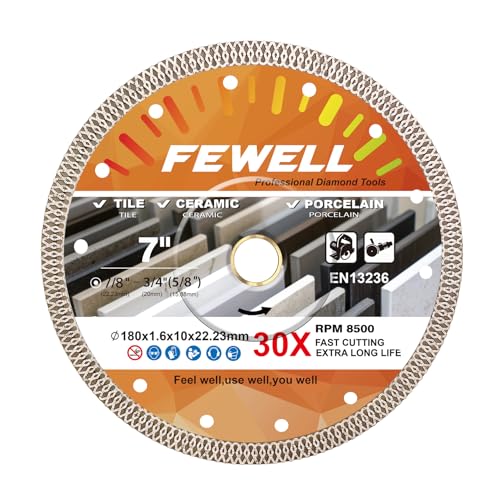
2. FEWELL 7 inch Tile Diamond Blade, Porcelain Saw Blade
An affordable 160-tooth blade that delivers exceptionally smooth cuts while staying affordable.
The FEWELL is the mathematical outlier of this list — 160 teeth versus the Pearl’s 10, a 16.0x gap that translates to a much finer cutting action. That extreme tooth count, combined with an ultra-thin 1.6 mm profile, makes this the disc that glides through ceramics and marble with minimal waste.
Owners mention these discs “cut all kinds of ceramics and marble 100 out of 100,” praising the thin sheet. A thicker center and stiffening flange reduce vibration, so you get straighter cuts even on a hand-held grinder.
The catch is durability. A professional contractor notes that while it tracks well and cuts clean both wet and dry, it has a shorter lifespan than pricier blades — though the better cost ratio makes it a sensible trade for high-volume jobs. One owner saw initial chipping on porcelain that improved once they used a scoring pass and let the blade wear in.
What You Get
- Ultra-thin 1.6 mm profile for fast cutting and low material waste
- Factory-smooth finish on brittle Spanish quartz with a battery wet saw
- Works dry or wet, fits tile saws and hand-held angle grinders
Know This First
- Shorter lifespan than premium blades — expect to replace sooner
- May chip porcelain initially until the blade wears in
Why you’d choose it: you want a genuinely smooth cut without spending pro-grade money, especially on smaller jobs.
Where it falls short: if you’re cutting thousands of feet of tile, you’ll burn through blades faster than a premium pick.
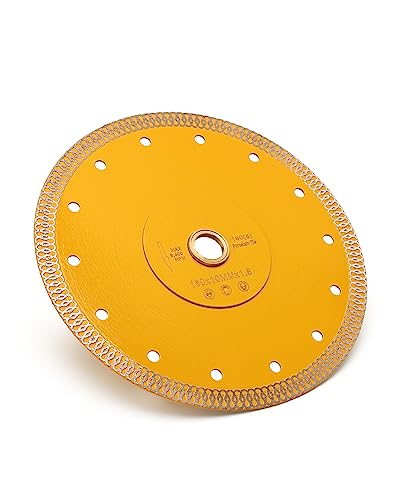
3. OSTEK 7 Inch Super Thin Diamond Saw Blade
A reliable daily-use blade that handles complete shower installations without faltering.
There’s a reason this is the blade a wet-saw owner describes as their “GO TO” for porcelain tile installations. The high-temperature extraction diamond design and X-teeth pattern deliver fast, smooth cuts on porcelain, ceramic, granite, and sandstone — and it holds up through nearly three whole shower installs before needing a swap.
It “fit nice on a Ridgid 7 inch wet saw,” as one owner reported, and becomes the daily choice for all tile cutting once mounted. The 1.6 mm super-thin profile keeps waste low and cuts fast, though at high speeds around 8,500 rpm the edge is quick but not as glass-smooth as a dedicated finishing blade.
The real-world verdict is durability for the money — it “cuts like butter” on thin glazed ceramic subway tile with minimal chipping when you take care on the glaze. Just be ready to press an adapter ring into place for some saws, which is a normal fitment quirk.
Why It’s a Daily Driver
- Nearly three full shower installs before needing replacement — strong longevity
- Cuts super straight and super fast on porcelain, per owners
- Universal for dry or wet cutting with hand-held machines
Watch For
- Fast cuts at 8,500 rpm aren’t as perfectly clean as finer blades
- May need an adapter ring pressed in for some wet saws
Ideal for: the busy tile setter who runs a saw daily and wants a blade that keeps pace through whole showers.
skip it if: you need razor-perfect factory edges on every cut and cut slowly enough to afford a finishing blade.
4. OSTEK 7″ Diamond Blade Wet Saw Tile Cutting

An ultra-thin blade that slices through thick porcelain with minimal effort and clean edges.
OSTEK’s wet-saw blade earns its place with a 10 mm rim height — the same tall diamond layer as the premium Pearl — at a fraction of the cost. That tall rim plus a thin turbo-mesh core means fast cutting on extra-hard ceramics and dense materials, with beautiful edges that barely need filing.
The customer consensus is loud on cut quality: “this cuts through my thick porcelain tile like a hot knife through butter. Beautiful cut edges that barely need filing.” One tiler completed an entire shower with a single blade. It fits most tile saws and angle grinders with either a 7/8″ or 5/8″ arbor, so check your saw’s mounting before buying.
The trade-off is that “super thin” cuts both ways — one owner found it “the actual thinnest” blade they’d used, but noted it started to chip after extended freestyle cutting in an angle grinder. That’s the nature of a thin kerf: finesse over brute force.
What Wins People Over
- Thick porcelain cuts clean with edges that barely need filing
- Tall 10 mm rim delivers extended life for the price
- Two blades here cost around half of one premium brand name
What To Know
- Thin design can chip if abused in freestyle angle-grinder work
- Durability is unproven for high-volume commercial use
Reach for this if: you want pro-quality edges on a homeowner budget and don’t mind replacing it more often than a blade.
Look elsewhere if: you’re cutting daily for a living and need maximum lifespan per blade.
5. Delta Diamond Piranha Premium 7 Inch Tile Diamond Saw Blade
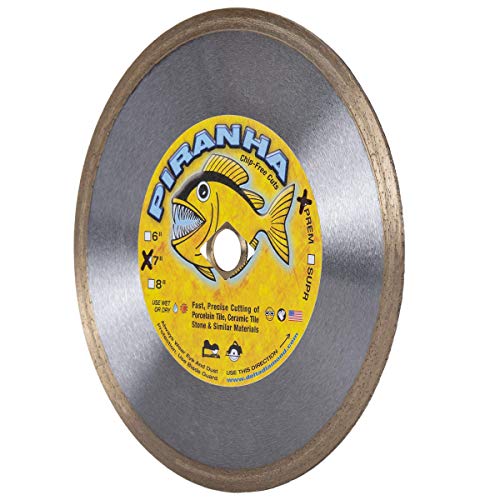
A continuous-rim blade that produces chip-free cuts on granite, marble, and porcelain.
Delta’s Piranha is built around one idea: a continuous rim packed with high-grade diamonds for smooth, chip-free cutting across porcelain, ceramic, marble, and granite. The 0.06-inch-wide profile slices without burn marks, and the max safe speed of 8,730 rpm covers most grinders and tile saws.
Customers note it cuts 48 inches of 5/8-inch marble on a circular saw with minimal dust, then chews through 8 feet of slate plus 4 feet of granite before dulling. It also handles curved cuts around a bathtub base with a grinder, where segmented blades often stumble. The included 5/8-inch bushing and lifetime warranty against warping and cracking add confidence.
The honest caveat: on a 45-degree miter cut in porcelain, one owner reported “massive chipping” that made it unusable for corners. Straight cuts are superb, but angled work on the hardest tiles demands a thinner, finer blade like the MK Hot Dog.
Why It Stands Out
- Cuts granite bullnose with precise control and no chipping
- 48 inches of marble cut with minimal dust vs an professional quote
- Lifetime warranty against warping, cracking, and material defects
Where It Struggles
- 45-degree miters on porcelain cause heavy chipping
- Slows down after extended hard-stone work until dressed
The fit: homeowners and pros cutting mostly straight lines across marble, granite, and mixed materials with one blade.
The mismatch: anyone who lives on 45-degree porcelain miters — that’s the MK Hot Dog’s territory instead.
6. QEP 6-7006GLQ 7-Inch Continuous Rim Glass Tile Diamond Blade

A specialist blade that cuts glass and mosaic tile cleanly without shattering or chipping.
Glass tile is the most unforgiving material you can feed into a wet saw — one wrong blade and you get jagged edges or outright breaks. QEP’s continuous-rim blade is engineered specifically for that challenge, with a 7 mm diamond-coated cutting edge that produces clean, smooth cuts with no chipping.
The results speak in scale: owners have cut 200 square feet of 1/2-inch to 1-inch glass tile smoothly with no jags and the blade still sharp afterward. Another handled 200-plus 2-inch glass mosaic tiles without issue. The standard 5/8-inch arbor fits most wet tile saws, and it’s rated for speeds up to 8,730 RPM.
Here’s the honest note: cutting glass is inherently slower than cutting ceramic, and the blade wears faster on glass tile — one owner called it “good for DIY, not pros” after a 35-square-foot glass subway project. For a single install it’s the right tool; for daily glass work you’d want to budget for replacements.
Glass-Tile Hero
- Smooth, non-shiny edges that need no grinding on glass mosaic
- 200+ square feet of glass cut with no chipping or jags
- Works on ceramic, porcelain, and stone too
Fair Warning
- Slower feed on glass than a standard ceramic blade delivers on tile
- Wears faster on heavy glass — better for DIY than daily pro use
Buy it when: your project involves glass subway tile, mosaics, or trim pieces that shatter with ordinary blades.
Don’t buy it for: high-volume commercial glass cutting where blade wear will eat into your margins.
7. QEP 7″ Black Widow Premium-Grade Thin Rim Diamond Blade

The thin-rim cutter that makes even a cheap tile saw cut like a professional rig.
The Black Widow’s defining trick is its thin kerf and unique diamond-shaped laser cutouts that prevent blade wobble while keeping the blade cooler. The result is a blade that lets an economy wet saw punch far above its price class, cutting porcelain and hard masonry tile with speed and minimal chipping.
Reviewers point out dramatic real-world gains: cutting time dropping from 15-plus seconds per tile to 3-4 seconds on a Rigid wet saw, with a 7 mm rim height that extends life through a 400-square-foot porcelain project. The thin continuous rim reduces chipping on ceramic, stone, and even Schluter edging, and the blade survives multiple remodels.
The honest comparison: against the MK Hot Dog, the Black Widow runs slightly less flat and cuts a thicker kerf, which means a touch more chipping on ultra-thin work. But at its price point, it’s the blade that delivers “comparable quality to + blades at about half the price.”
The Strength
- Cut time dropped from 15+ to 3-4 seconds per tile on a Rigid wet saw
- Thin continuous rim cuts ceramic, stone, porcelain with minimal chipping
- Chip-free miter cuts and fine shaving without cracked tiles
The Trade-Off
- Slightly less flat and thicker kerf than the MK Hot Dog
- Mixed reports on long-term wear for commercial-scale work
Choose it for: big wet-saw projects where you want fast, clean cuts and a thin rim without paying -plus.
Consider the Hot Dog if: your work is all ultra-thin, ultra-precise porcelain cuts where every hair of kerf matters.
8. Diablo Diamond Continuous Rim Masonry Cut-Off Disc 7″
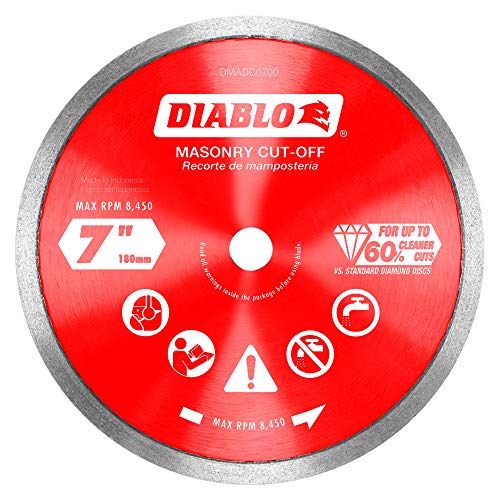
The do-everything disc that slices brick pavers, porcelain, and granite with equal ease.
Diablo’s masonry disc is the crossover blade that doesn’t care what you feed it. The ultra-thin constant-contact continuous turbo rim delivers “up to 60 percent smoother cuts” with no burn marks, and the hardened disc body stands up to extreme applications. It’s tune for both dry and wet cutting, which makes it the most flexible single blade on this list.
One owner “cut about 1000 brick pavers for a large patio” with a Milwaukee grinder and found the disc “cuts brick like butter.” Another sliced porcelain tile for a big bathroom project with “super clean cuts with minimal chipping,” impressed by durability. The 5/8-inch arbor and 1.6 mm kerf fit most grinders and saws directly.
The honest catch: it’s pricier than its competitors, and while it “lasts much longer and does an awesome job” on stone, a few owners note it didn’t last quite as long as expected on heavy porcelain duty. For a tool that handles brick, tile, and granite without complaint, that trade is usually worth it.
The All-Arounder
- Around 1,000 brick pavers cut with ease on a small grinder
- Super clean porcelain cuts with minimal chipping on a big bathroom project
- Dry or wet cutting, tune for both at up to 8,450 RPM
Before Buying
- Costs more than budget competitors despite similar specs
- Heavy porcelain duty shortens its life more than stone work does
Right for: the multi-material job site where one blade must handle brick pavers one day and porcelain the next.
Wrong for: a dedicated tile-saw porcelain job where a thinner tile-specific blade is more cost-effective.
9. MK Diamond 158434 7″ MK-225 Hot Dog Premium Thin-Rim Blade

The precision thin-rim blade for flawless 1/8-inch porcelain cuts without the chipping.
The MK Hot Dog is what you mount when the job demands the thinnest possible kerf on hard porcelain. Its 0.05-inch rim and fine diamond grit make it the flattest-running blade in this comparison — under 10 mils of run-out — which translates to straighter cuts on dense materials like porcelain, slate, and hard quartz. Stiffening and cooling slots keep the blade from wandering under load.
The precision shows in the details. It enables 1/8-inch thin cuts and angle work on large-format Spanish porcelain without chipping, and its finer diamonds make it the better choice than the Black Widow for delicate work. On rocks, it cut cutting time “from 15 minutes to about 2” for agate hobbyists using a wet saw.
The honest trade-off is lifespan: this blade wears faster than thicker options. One owner needed three blades for a single bathroom project full of bevel cuts. That’s the price of a thin kerf — you trade longevity for a flawless edge. Keep it wet and don’t force the feed, and it rewards you.
Precision That Pays
- Runs flatter (under 10 mils) than the Black Widow’s ~20 mils for straighter cuts
- 1/8-inch thin and angle cuts on porcelain without chipping
- Thin 0.05-inch kerf with finer diamonds than the QEP’s 0.064-inch
The Real Cost
- Wears faster — multiple blades needed for one bevel-heavy bathroom
- Not ideal for dry cutting; designed for wet tile saws
Choose it for: the critical finish cuts where a chipped edge ruins the whole install and precision beats longevity.
pass on it if: you’re on a commercial job cranking out square footage where blade life per dollar rules.
Understanding the Specs
Tooth Count vs. Rim Design
A blade’s cutting personality comes from whether it has discrete teeth or a continuous diamond rim. Higher tooth counts like 160 give a finer, smoother action but cut slower on thick material. Continuous rims, which have no teeth, glide through brittle porcelain and glass with the least chipping — the trade is speed on dense stone.
Kerf Width and Thin Rims
The kerf is the width of the slot the blade cuts — thinner means less material waste and less resistance. Ultra-thin blades around 1.6 mm cut fast and clean but flex more under pressure, demanding a steady hand. Thicker blades with a 10 mm rim height last longer but remove more material with each pass.
FAQ
What does the tooth count on a diamond blade actually mean?
Why does my new blade chip my porcelain tile?
Can I use the same blade wet and dry?
What is the difference between a 5/8-inch and 7/8-inch arbor?
How long should a 7-inch tile blade last?
Is a continuous rim blade better than a turbo rim for tile?
Can I use a 7-inch tile blade on my angle grinder?
Does blade width affect how my tile saw cuts?
Final Thoughts: The Verdict
For the cleanest possible cuts on hard porcelain without a fight, the winner is the Pearl P4 because its thin kerf and cool-running mesh rim deliver near-factory edges that owners trust across thousands of square feet. If you want that pro feel on a budget, the FEWELL brings a stunning 160 teeth to the bench at a fraction of the cost. And for glass and mosaic work that shatters ordinary blades, the QEP Glass Tile Blade is the specialist you reach for.
How We Picked
We do not accept paid placement. Every pick is matched to a real buyer and a real use-case; we do not hands-on test units.
Sources & Methodology
Specifications: manufacturer listings and product documentation. Review insights: verified customer reviews, as of September 2026. Pricing: not shown on this page (it changes often); check the current price via the retailer link.
As an Amazon Associate, KitchPrep earns from qualifying purchases. This does not affect which products we feature.
Related Guides
