
Specs are compiled from manufacturer listings and verified buyer reviews and can change over time — please confirm the key details on the product page before buying.
When you’re choosing a 12-volt solar kit, the brand on the box matters less than three things: enough wattage to run your fridge, a charge controller that protects your battery, and mounting hardware that holds up in rain and wind. You want a kit that matches your rig, shed, or boat without paying for extra panels you won’t use or buying panels too small to do the job. The picks below are ranked by how they perform in real daily use, so you can see which one fits your setup before you spend.
I’m Mohammad Maruf — the founder and writer behind KitchPrep. This guide is built by comparing the manufacturers’ published specifications and the patterns across verified customer reviews, so you get each pick’s real strengths and trade-offs instead of marketing spin.
We’ve matched each kit to the real-world job it does best, from trickle-charging a parked car battery to running a 12-volt fridge off-grid. Here is the honest breakdown of the 12v solar power kit market and where each contender truly shines.
Our Picks at a Glance


How To Choose The Best 12V Solar Power Kit
Before you click buy, think about what the kit is actually meant to do. A small trickle charger that keeps a weekend car battery alive is a totally different product from a 200-watt panel array that runs your RV fridge all day. Matching the job to the wattage is step one.
Size your panel to the job, not the roof
If you’re maintaining a battery on a vehicle that sits for weeks, a 30-watt panel that trickles power is often plenty — you’re replacing the slow self-discharge, not running appliances. If you want to power a 12-volt fridge through a weekend, you need several hundred watts of panel. A good rule of thumb that the kits themselves prove: an 800Wh daily output assumes around 4 hours of solid sun, so double-check what cloudy days do to your power budget.
Know your charge controller before you need it
The charge controller regulates voltage between panel and battery, preventing overcharging that shortens battery life. PWM controllers are simpler and fine for smaller setups, but an MPPT controller squeezes more usable power out of the same panel, especially in cooler or lower-light conditions. If your kit bundles a controller, check whether it matches the battery chemistry you plan to use — lithium (LiFePO₄) batteries have different charging needs than lead-acid.
Quick Comparison
| Model | Best For | Max Power | Controller | Weight | Amazon |
|---|---|---|---|---|---|
| Renogy 200W N-Type Kit★ Best Overall | RVs & off-grid cabins | 200 watts | 30A PWM | 16.5 lbs | Amazon |
| SUNER POWER 30W PROBest for Maintenance | Maintaining parked vehicles | 30 watts | Built-in MPPT | 1.81 kg | Amazon |
| SOLPERK 50W KitBest Versatile Angle | Pontoon boats & gates | 50 watts | 10A Waterproof | — | Amazon |
| Topsolar 100W Kit | Sheds & remote power | 100 watts | 30A Intelligent | 7.2 kg | Amazon |
| SUNER POWER 50W Pole Mount | Gate openers & dock posts | 50 watts | Built-in MPPT | — | Amazon |
| ECI Power 100W + 20Ah Battery | Backyard water features | 100 watts | 10A PWM | — | Amazon |
| ExpertPower 200W Kit | Expanding off-grid builds | 200 watts | 20A MPPT w/ Bluetooth | — | Amazon |
| ECO-WORTHY 200W Starter Kit | First-time camper setup | 200 watts | 30A + 600W Inverter | 11.5 lbs | Amazon |
| Renogy 400W Premium Kit | Sheds & full off-grid systems | 400 watts | 40A MPPT | 56.4 lbs | Amazon |
In‑Depth Reviews
1. Renogy 200W 12V N-Type RV Solar Panel Kit
Our pick — over 4.5★ from 500+ verified ratings; the strongest balance of quality and price.
The 200-watt powerhouse that keeps a 12-volt fridge running on two deep-cycle batteries, rain or shine.
This kit’s real-world output shows in the numbers: it delivers 200 watts of maximum power, and buyers report seeing 135 watts / 9.3 amps flowing in solid sun. That is enough to keep a 12-volt refrigerator running across two deep cycle batteries — as one owner put it: “It has enough energy to keep my 12 volt refrigerator running with two deep cycle batteries,” with run times getting close to 48 hours even when clouds roll in.
Part of the appeal is how the panels handle the elements. The corrosion-resistant aluminum frame shrugs off outdoor abuse, rated to withstand high winds of 2400Pa and snow loads of 5400Pa, while the cells run at 22% efficiency. The bundled Adventurer-Li 30A PWM charge controller adds LCD readouts and protects against overcharging, overload, short-circuit, and reverse polarity — so making a mistake on hookup won’t fry your battery bank.
Setup is geared toward beginners. Pre-drilled holes and plug-and-play cables get you mounted fast, and the kit includes Y branch connectors for adding more panels in parallel later. It supports lithium, lead-acid, and gel batteries, and Renogy backs it with a 5-year warranty plus 24/7 technical support — a comfort if you’re learning as you go.
Why it’s the crowd-pleaser
- 200W of rigid panels with 22% high-efficiency cells for real daily output
- Bolts down withstanding 2400Pa wind and 5400Pa snow loads — built for the long haul
- Complete package: controller, cables, Bluetooth module, and brackets included
The honest trade-offs
- Cloudy weather cuts output significantly — expect less on overcast days
- PWM controller is simpler than the MPPT found on pricier kits
The right call for: RV, camper, and off-grid owners who need to keep a fridge and batteries charged through the weekend — not just top off a parked car.
Reach for it if: you want a proven, complete Renogy package with a 5-year warranty and room to expand with parallel panels later.
2. SUNER POWER 30W Waterproof Charger & Maintainer PRO
This slim 30-watt panel is the set-and-forget answer for cars and boats that sit too long.
If your vehicle hibernates between uses, this is the kit that quietly keeps your battery ready. The panel pumps out 30 watts — a fraction of the Renogy’s 200 watts — but that’s the whole point. Owners tested it on a Dodge that wasn’t being driven and found the battery holding steady at 12.4 volts after two days. One also ran a bilge pump through three days of steady rain, and the charger was still steadily topping the battery back off when they returned.
A built-in UltraSmart MPPT controller tracks the sun’s power point, with tracking efficiency up to 99% and peak conversion of 98%. It steps automatically through three stages of charging — bulk, absorption, float — and shuts off at full charge, then wakes itself when the battery drains, so you never have to baby it. You can watch the 25%, 50%, 75%, and 100% charge-level lights to know what’s happening without a multimeter.
Versatility is the other strength. Three selectable modes let you match the charger to standard 12V, 12V AGM, or 12V Lithium batteries — covering flooded, gel, SLA, VRLA, and LiFePO₄ chemistries. It’s waterproof and spark-proof, with protections against over-charge, over-discharge, over-voltage, over-current, and reverse polarity. Suction cups and pre-designed holes make mounting quick, and the plug-and-play SAE harness means no hardwiring unless you want to.
The catch: this is a maintainer, not a rescue charger. It won’t revive a fully dead battery — it’s built to keep a healthy one from draining.
Smart buy for: anyone with a seasonal vehicle — a second car, boat, motorcycle, or trailer — that needs to stay ready to go without a wall plug nearby.
3. SOLPERK 50W 12V Solar Panel Kit
A 50-watt panel with a tilting bracket that is designed to squeeze every last drop of winter sun.
This SOLPERK kit sits between a tiny trickle charger and a big roof array, making it a flexible middle ground. It charges 12-volt batteries of many chemistries — LiFePO₄ (lithium iron phosphate), Lithium Ion, AGM (absorbent glass mat), SLA (sealed lead acid), GEL, EFB (enhanced flooded battery), and MF (maintenance-free) — so it suits a wide range of setups. Owners use it everywhere from pontoon boats to gate openers; one buyer swapped it in for the manufacturer’s own panel on a solar gate, getting more wattage and faster charging in a spot with limited sunlight.
What stands out is the angle-adjustable mounting bracket. It tilts in five steps — 0°, 15°, 30°, 45°, and 60° — so you can point the panel more squarely at the sun as the seasons shift. That matters when your setup is ground-mounted or on a flat surface where a fixed panel would miss out. The panel itself uses high-efficiency monocrystalline cells converting at 21%-30%, and the low-iron tempered glass and corrosion-resistant aluminum frame are rated to handle 2400Pa wind pressure and 5400Pa of snow load.
The bundled IP65 waterproof controller uses three indicator lights to show charging status, so wiring up is straightforward with pre-drilled holes and plug-and-play SAE cables. Owners note it’s simple to get running — one hooked it straight to the battery on a WiFi-enabled gate controller and saw faster top-ups instantly.
One honest note: while the panel itself gets rave reviews for output, a handful of owners mention the included controller failing a few months in. The 25-year rated panel lifespan means you might outgrow the controller first.
Best fits: a boat owner or gate-opener user who wants a solid mid-size panel with tilt control to chase the sun — and doesn’t mind eventually upgrading the controller.
4. Topsolar 100W 12V Solar Panel Kit

A straightforward 100-watt workhorse for sheds and remote spots that need dependable 12-volt power.
Topsolar’s kit is built for the person who needs batteries charged at a shed, cabin, or off-grid watering setup — places without shore power. The 100-watt monocrystalline panel sits in a heavy-duty anodized aluminum frame under tempered glass, so it’s ready to sit outside season after season.
Owners find this panel genuinely turns power back on. The most common praise focuses on the panel simply doing its job — one owner reports it charged a Class A motorhome’s engine battery in 4 hours after a simple hookup of battery then panel, with no programming required. Others wire two panels in parallel to keep tractor and buggy batteries topped up, and the consensus backs it up: this panel keeps things charged even when skies are cloudy.
The tilt-adjusted V-shape bracket lets you angle the panel toward the sun on the ground, a wall, or wood, which matters for stationary setups. The included 30A intelligent charge controller handles 12V and 24V systems and adds protection against overcharge, over-discharge, over-voltage, and short circuits. The whole panel weighs 7.2 kg, making it manageable for a solo installer.
Buyer beware on one front: the build quality of the panel is praised, but the mounting experience is more mixed — a few owners have received kits with brackets that don’t perfectly line up with the panel’s holes, needing a quick drill to fix.
What wins people over
- 100W panel with easy hookup that starts charging without programming
- Tiltable bracket for better sun angles on ground or wall mounts
- Charge controller works on both 12V and 24V systems
What to watch
- Mounting bracket fit can be inconsistent from the start
- Some customers note the controller can get stuck in the wrong voltage mode
Choose it if: your priority is a mid-range panel that reliably charges a 12-volt battery bank for gates, sheds, or tractor maintenance.
Pass if: your mounting surface needs precision hardware — you may have to drill your own holes.
5. SUNER POWER 50W MPPT Pole Mount Charger

A 50-watt smart charger on an adjustable pole bracket, built for gates and dock posts in direct sun.
When your power source needs to sit on a pole — a gate opener, a dock, a remote camera — this SUNER POWER kit comes ready for the job. The included bracket adjusts the panel through 0°, 15°, 30°, 45°, and 60° and fits poles 1.5 to 3.0 inches in diameter, so you can aim it squarely at the sun from a standard post. Reviewers point out it bolts right onto a standard dock post and works perfectly with popular gate openers — with one noting it “keeps batteries charged at 100%.”
Like its smaller sibling, the built-in UltraSmart MPPT controller auto-detects a connected battery and starts charging immediately. The maker rates tracking efficiency up to 99% and peak conversion at 98%, with charge-level lights showing progress. Three modes — 12V, 12V AGM, 12V Lithium — cover everything from flooded to LiFePO₄ batteries.
This version steps up from the 30W model in meaningful ways: a dedicated 50W panel for faster recovery after gate use, and the all-important pole mount hardware which the smaller kit doesn’t include. Owners praise the “solid construction” and note “great readout” for tracking juice flow, using it to keep boat batteries in like-new condition.
An edge case to know: the majority of owners are delighted, but isolated reports of units failing within months or missing cable ends exist. Check your kit contents on arrival.
Tailor-made for: automated gate openers, dock posts, and anywhere a pole is the only real estate — the adjustable bracket makes installation genuinely simple.
6. ECI Power 100W Kit with 12V 20Ah LiFePO₄ Battery

A rare kit that ships with its own lithium battery — plug in a fountain and walk away.
Most solar kits leave you to source the battery separately, which is exactly where the confusion starts. ECI Power bundles the whole loop: a 100W monocrystalline panel, a 12V 20Ah LiFePO₄ battery, a 10A PWM controller, MC4 cables, battery cables, and mounting brackets. Owners put it to work immediately — one runs a backyard water fountain 24/7, another powers an irrigation pump with no problems.
The included lithium battery is the star. The maker rates it for a minimum of 2000 cycles at 80% depth of discharge, with up to 5000 cycles possible at 50% DOD — far beyond what lead-acid offers. The charger’s CC-CV algorithm is specifically tuned to boost LiFePO₄ battery life, while the PWM controller auto-detects 12V or 24V systems and adjusts for ambient temperature to protect against over-charge, over-discharge, and short circuits. A digital display shows everything from state of charge to battery health.
For a first-timer, it’s a teaching tool as much as a power source. One owner says it gave them a solid understanding of solar setups before they expanded to power most of their home — noting it’s not enough for heavy loads, but perfect for a light or a fan. Owners praise the easy install and quality wiring with waterproof connectors.
Reality check: like all batteries, the included one has limits. Owners warn that leaving it outdoors in a shed through temperature swings can shorten its life — the panel may outlast the battery by years. And at 100 watts, it won’t run big appliances.
Made for beginners
- Everything included — panel, battery, controller, and cables — works together on arrival
- Rated for 2000+ cycles on the lithium battery, far outlasting lead-acid
- Auto-detect controller with digital display for easy monitoring
Know the limits
- Battery longevity suffers if kept outdoors in extreme temperature swings
- 100W output handles lights and fans, not heavy appliances
Ideal for: a first solar project, a shed, a fountain, or a small pump where you want one box with nothing left to figure out.
Look elsewhere if: you need to power tools or a fridge — this is a starter system, not a mini-grid.
7. ExpertPower 200W Kit with 20A MPPT Controller
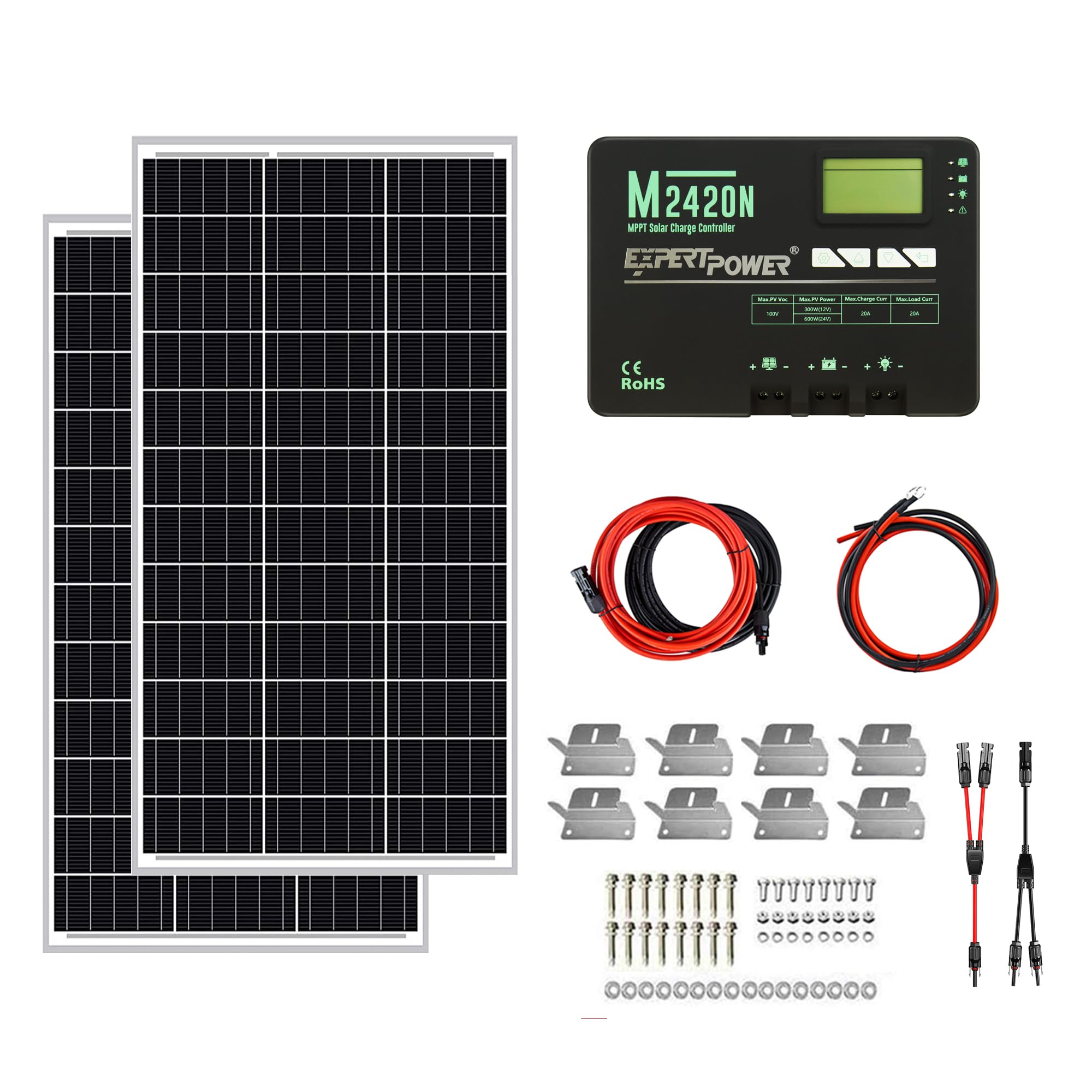
A smarter 200-watt build with an MPPT controller that claws back more power from the same sun.
ExpertPower steps up the tech game. Instead of a simpler PWM controller, this kit ships with a 20A MPPT charge controller. MPPT (Maximum Power Point Tracking) is the smarter brain that follows the sun’s optimal power point, and ExpertPower says it can boost your array’s power generation by over 20% compared to PWM through its sophisticated tracking. If you have a camper roof with limited space, that extra efficiency is how you make every panel count.
The kit ships with two 100W monocrystalline panels, mounting brackets, 10ft MC4 solar cables, and 6ft battery cables, so the basic setup is covered. The controller auto-detects 12V or 24V battery banks and adjusts its charging profile for ambient temperature, protecting against over-charge, over-discharge, overload, and short circuit. One owner uses it on an off-grid build to run a 12-inch chop saw and a compressor simultaneously, paired with two 100Ah batteries and a 5000W inverter.
The MPPT controller also streams data to a Bluetooth module, so you can check state of charge and battery health from your phone. Owners were impressed enough to call it “a fantastic little starter system.” Another notes they’re expanding it to four 100W panels and a 1000W inverter, suggesting the controller has headroom to grow.
The compromise: the Bluetooth module’s app compatibility is a bit dated, and it lacks some parameter-adjustment features. One owner found the wires weren’t labeled as claimed, slowing the install — though the overall build was still praised as quality.
Grab it if: you want the efficiency gains of MPPT at a 200W scale without jumping to a premium price tier — and want phone-based monitoring as a bonus.
8. ECO-WORTHY 200W Complete Solar Starter Kit
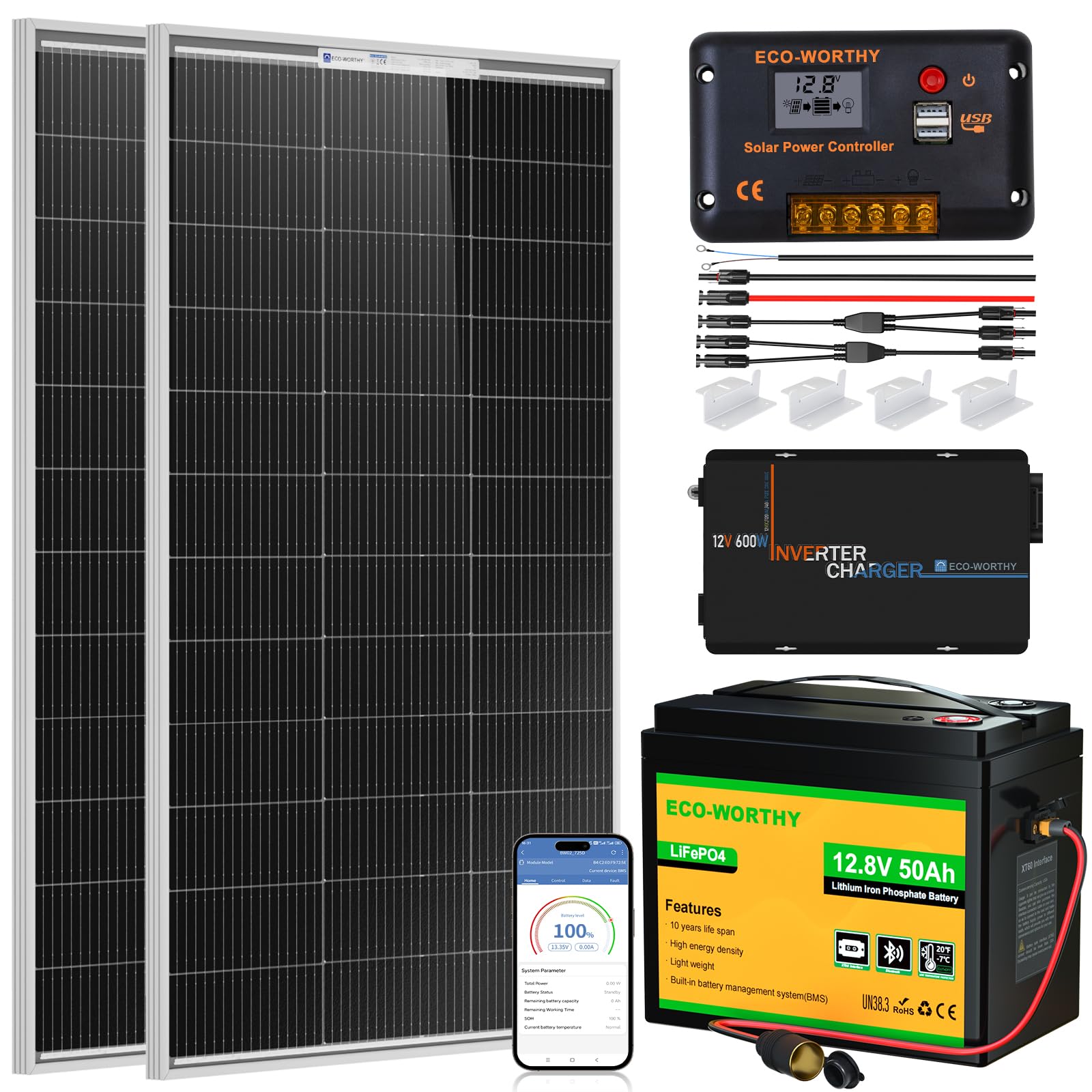
The everything-in-the-box starter kit that includes a battery, an inverter, and even USB ports.
ECO-WORTHY’s claim is in the name: complete. The box includes a pair of 100W N-Type panels, a 12V 50Ah LiFePO₄ (lithium iron phosphate) battery, a 30A charger, and a 600W pure sine wave inverter — so you can run AC appliances (like a coffee maker) straight out of the kit, not just USB gadgets. Owners call it “a great entry into solar” that powers lights, phone charging, and even coffee in a camper setup.
The panels are the tech highlight here. They use N-Type monocrystalline cells with 25% high efficiency, and the maker says the dual-sided design captures reflected light for an extra 15% output. That low-light performance matters for dawn, dusk, or cloudy days — exactly when basic panels drop off. The 50Ah lithium battery is rated for 4000-15000 deep cycles, which the maker notes is more than 10 times the cycle life of a typical lead-acid battery.
The integrated inverter runs at 600W of pure sine wave — clean power that’s kinder to sensitive electronics than modified sine wave units. It also features a 20ms UPS auto-switch and adjustable 5A-40A current, controlled via an app or button. The battery’s XT60 port even adapts to cigarette lighters or adds Type-C and USB ports for camping gadgets.
A caveat on long-term reliability: owners find it easy to install — one put panels, battery, controller, and inverter on a 10×12 shed in about 3 hours — but experiences with durability are split. Some systems keep working for years; others report issues within a week, and the support experience can be frustrating when something goes wrong.
Why it’s good value
- Full off-grid starter system with battery, inverter, and panels all included
- N-Type panels with 25% efficiency and extra low-light output
- 600W pure sine wave inverter runs AC tools and appliances
The honest risks
- Reliability reports are mixed — most work, some fail, support is unpredictable
- Not built for full-time van living in winter without strong sun
Best for: a beginner camper or shed owner who wants lights, phone charging, and small-motor power right from the start with zero extra shopping.
Steer clear if: you’re powering heavy tools full-time — and keep expectations in check about the controller’s long-term reliability.
9. Renogy 400W Premium Solar Kit with 40A MPPT Controller

The 400-watt premium build that powers a gaming PC and recharges batteries even on cloudy days.
When you need serious off-grid power — enough for a gaming computer, power tools, or running a fridge all day — Renogy’s 400W kit is the top-tier answer. It bundles four 100W monocrystalline panels with a 40A MPPT Rover controller, mounting Z-brackets, adaptor kit, tray cable, and a Bluetooth module for app-based monitoring. Owners describe it as the “excellent starter setup” for going from zero to meaningful off-grid power.
The performance stories are genuinely impressive. One owner powers a gaming PC flawlessly — a 200Ah battery drains at roughly 5A on solar and 20A while gaming, then recharges from 77A to 200A in about 8 hours even on a cloudy day. Another runs a chainsaw for 2-3 hours and a log splitter in a shed setup, with LiFePO₄ batteries recharging in 4-6 hours. The kit specs confirm the controller’s output lets it push serious amps into a battery bank.
Renogy specifies the panels at high efficiency with a 5-year manufacturer warranty on materials and workmanship, and the included Bluetooth module lets you track metrics from your phone. Owners running a 12V fridge all day report power to spare — a consistent theme across the reviews. The completeness of the kit means beginners don’t have to hunt for loose parts.
Where it stumbles: the kit ships without a proper setup manual — you get controller and Bluetooth guides, but no “here’s how it all goes together” walkthrough. Owners also note the panel-to-controller wiring is shorter than ideal and the Bluetooth monitor can be finicky. If you’re not electrically confident, budget time to learn or have a savvy friend nearby.
The flagship strengths
- 400W of panels feeding a 40A MPPT controller for high-output charging
- Powers a full fridge, gaming PC, or power tools with headroom to spare
- Includes Z-brackets, Bluetooth module, and all cabling for a complete install
Premium caveats
- No assembly manual — expect a learning curve wiring it all together
- Panel-to-controller cables are on the short side; Bluetooth app has quirks
For the serious build: sheds, workshops, or off-grid camps that need real power for tools and appliances, with the controller headroom to grow the array later.
Not for beginners: the missing manual and finicky app make it a better fit if you’re comfortable wiring your own system.
Understanding the Specs
Panel Wattage & Real Output
A panel’s watt rating is its peak output under ideal sun, and daily estimates assume about 4 hours of that intensity. A 200W panel can theoretically produce 200 watts at high noon on a clear day, but clouds, angle, and temperature all drag that number down. That’s why a 400W system feels dramatically more capable than a 200W one when skies are gray, not just twice as powerful.
PWM vs. MPPT Charge Controllers
The charge controller sits between panel and battery, governing how efficiently stored power is managed. PWM controllers are simpler and cheaper, matching panel voltage to battery for small systems. MPPT controllers adjust to extract maximum power, improving utilization by 20%-30% over PWM—worth it for larger arrays or cooler climates.
FAQ
Can a 12V solar kit actually run my RV refrigerator?
What’s the difference between a PWM and an MPPT charge controller?
Will a small 30W panel keep my car battery alive when it’s parked?
What batteries work with these 12V solar kits?
How much sun do I actually need for a full charge?
Can I start small with a 100W kit and expand later?
Do these panels survive hail, snow, and high winds?
Is a 200W kit enough to power tools in a shed?
What should I expect when mounting the panel?
Final Thoughts: The Verdict
For most RV and off-grid buyers, the 12v solar power kit winner is the Renogy 200W kit because it pairs proven 200W output with a 30A controller, rugged weather ratings, and a 5-year warranty. If you want smart maintenance for a parked vehicle, grab the SUNER POWER 30W PRO. And for a true all-in-one starter with a battery and inverter, the ECO-WORTHY 200W is the one to reach for.
How We Picked
We do not accept paid placement. Every pick is matched to a real buyer and a real use-case; we do not hands-on test units.
Sources & Methodology
Specifications: manufacturer listings and product documentation. Review insights: verified customer reviews, as of September 2026. Pricing: not shown on this page (it changes often); check the current price via the retailer link.
As an Amazon Associate, KitchPrep earns from qualifying purchases. This does not affect which products we feature.
Related Guides
