
Specs are compiled from manufacturer listings and verified buyer reviews and can change over time — please confirm the key details on the product page before buying.
Before buying a 150 amp breaker, confirm it matches your panel’s brand and mounting style exactly. Unlike a light bulb, you can’t just swap brands when one goes bad. A Square D breaker goes in a Square D panel, a Siemens breaker goes in a Siemens panel, and forcing a mismatch is a fire and safety hazard. This guide reviews top-rated 150A replacement and main breakers, detailing their intended uses and owner-reported trade-offs.
I’m Mohammad Maruf — the founder and writer behind KitchPrep. This guide is built by comparing the manufacturers’ published specifications and the patterns across verified customer reviews, so you get each pick’s real strengths and trade-offs instead of marketing spin.
Your breaker must slide into your panel, handle 120/240-volt service, and trip reliably under fault. The best 150 amp circuit breaker choices balance brand compatibility, interrupting rating, and documented owner satisfaction for your specific setup.
Our Picks at a Glance


How To Choose The Best 150 Amp Circuit Breaker
Matching the breaker to your exact panel is critical. The physical bus bar, the clip design, and the label on your panel door all tell you which brand of breaker you need. Installing the wrong brand risks arcing and a failed connection under load.
Start With Your Panel’s Brand
Look at the sticker inside your panel door. It usually says “Square D,” “Siemens,” “Eaton,” or “Homeline.” You must buy a breaker made for that specific line. A Siemens breaker will not clip into a Square D QO panel, and forcing it is dangerous. Buyers consistently identify their panel brand first, then search for the matching OEM part.
Understand the “Main” vs “Branch” Role
A main breaker is the switch that shuts off all power to the house. It sits at the top of the panel. A branch breaker protects a single circuit, such as a sub-panel feed. Some of these 150A units are designed as main breakers for a specific load center, while others are plug-on branch breakers. The product description will tell you which role it fills.
Check the Interrupting Rating (AIR)
The AIR rating tells you how much fault current the breaker can safely stop without destroying itself. A 10k AIR breaker handles a 10,000 amp short circuit, while a 22k AIR unit handles 22,000 amps. For a main service entrance, a higher AIR rating often means better protection against massive utility-side surges.
Count Your Poles
Most residential 120/240-volt mains use a 2-pole breaker, which takes up two slots and shuts off both hot legs at once. A 3-pole breaker is for three-phase commercial service or specific equipment. Check your panel and your old breaker — count the number of separate switches connected together. That number is your pole count.
Quick Comparison
| Model | Best For | Poles | Interrupting Rating | Mounting Type | Amazon |
|---|---|---|---|---|---|
| Square D QOM2150VH★ Best Overall | QO & Homeline main lug panels | 2 | 22k AIR | Panel Mount | Amazon |
| Siemens SIEMBK150ATop Performer | Siemens riser main panels | 3 | — | Panel Mount | Amazon |
| Blue Sea 7148 | Marine & DC systems | 1 | — | Surface Mount | Amazon |
| Eaton CCV2150 | Eaton tenant & service panels | 2 | — | Bolt-On Mount | Amazon |
| Square D HOM2150BB | Homeline branch circuits | 2 | — | Plug-In Mount | Amazon |
In‑Depth Reviews
1. Square D QOM2150VH QO 150-Amp Main Circuit Breaker
Our pick — over 4.5★ from 100+ verified ratings; the strongest balance of quality and price.
The field-installable main breaker that slides into QO and Homeline load centers with a flawless fit.
This is the main breaker upgrade for anyone with a Square D QO or Homeline 150–225 amp main lug panel that didn’t come with a main switch. It’s a QOM2 frame size unit rated at 22,000 AIR, meaning it can safely interrupt a massive 22,000 amp short circuit without welding itself shut — a strong safety margin for a whole-home disconnect.
You get a glove-like fit with no modification needed to seat it into the panel. Buyers report: “Had meter pulled by electric provider and changed this out easily.” That quote points to the one serious step — you must have the utility disconnect your meter before touching this, because it sits right at the service entrance.
It works in tandem with generator interlock kits on Homeline panels, and the 120/240 VAC rating covers standard North American residential service. The 2.6-pound unit is a direct OEM replacement, not an off-brand gamble, which is why replacement quality and precise fit dominate the feedback.
Why Owners Swap It In
- Rated for 22k AIR — strong protection at the main service point
- Fits both QO and Homeline main lug load centers
- Genuine Schneider Electric OEM part, not a generic
Who Should Think Twice
- Not a DIY swap — the meter must be pulled by your utility first
- Only fits QO/Homeline panels, not other brands
The go-to swap: This is the crowd favorite for Homeline and QO panel owners — 4.7 stars across 100+ ratings.
Reach for it if: your panel is already a Square D product and you want a factory-matched main breaker.
2. Siemens SIEMBK150A Riser Main Breaker Kit
A 3-pole Siemens riser main that bolts into panels missing their factory disconnect.
This kit exists for a specific scenario: you have a Siemens breaker panel that shipped without a main breaker, and you need to add the service disconnect. Owners mention: “Bought this to install on a Siemens breaker panel that didn’t originally come with one.” The 3-pole design makes it a fit for three-phase riser applications, setting it apart from the 2-pole residential units on this list.
The installation feedback is consistently positive — owners call it a breeze to fit and note that it trips when it’s supposed to. One owner pointed out a smart value move: it’s often cheaper to buy a main-lug-only Siemens panel and add this breaker yourself than to buy a pre-configured load center with a main already installed.
At 150 amps with a panel-mount design, this is genuine Siemens hardware built for the company’s own enclosures. Brand interoperability is not on the table here — this belongs in a Siemens panel, and owners themselves caution against mixing it with other manufacturers’ gear.
Panel-locked precision: Built exclusively for Siemens enclosures, with owners praising the exact fit and reliable tripping.
A fair warning: A small number of units have arrived with shipping damage to the switch — inspect on arrival and request a replacement if yours looks off.
Siemens panel owners, this is yours: the direct factory kit for adding a 150A main where one was never installed.
Look elsewhere if: your panel is made by Square D or Eaton — this will not clip in.
3. Siemens QN2150RH 150A 22K Type QNRH Circuit Breaker
The UL-listed Siemens unit engineered specifically for horizontal mounting in tight spaces.
Most breakers must sit vertically, but this one is designed for the opposite. The UL Type QNRH rating means it’s certified for use when the breaker is mounted horizontally — the configuration you need in certain panels where vertical space is constrained. It’s a 2-pole 150A unit at 120/240 volts with a 22k AIR rating, giving it the same heavy interrupt capacity as the Square D top pick.
Owner feedback centers on quality and fit, with the 22k rating being a clear draw for anyone wanting maximum short-circuit protection at a main or sub-feed position. The UL listing means it has been independently tested to a safety standard, which matters when this component is protecting your whole electrical system.
Where the Siemens QN2150R (the 10k cousin) handles lighter duty, this QNRH variant doubles down with the higher interrupt capacity — a real difference if your utility delivers high available fault current to your neighborhood.
Built for sideways duty: If your panel requires horizontal mounting, this is the certified 22k AIR answer from Siemens.
The cost reality: Owners call it genuinely good but admit it carries a premium — shop it against the 10k QN2150R if your panel doesn’t need the extra interrupt capacity.
Grab this when: your installation demands a horizontally mounted, UL Type QNRH breaker with 22k protection.
Think twice if: your panel mounts breakers vertically — the standard QN2150R is the simpler match.
4. Eaton CCV2150 Bolt-On Tenant Main Circuit Breaker
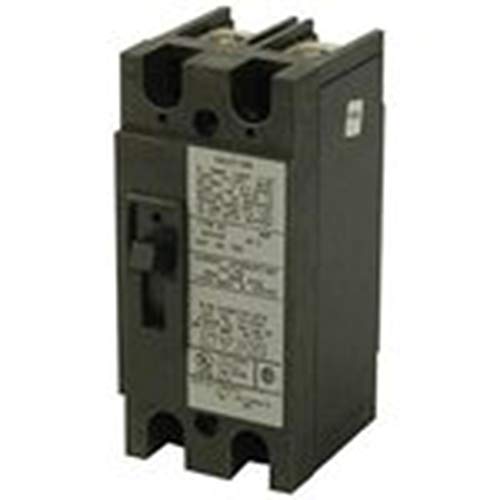
A bolt-on 2-pole Eaton main for tenant service panels that supply houses rarely stock.
This 16-ounce Eaton unit uses a thermal-magnetic trip mechanism — a bimetal element heats up under sustained overload to trip the breaker, while a magnetic coil reacts instantly to a hard short. It’s calibrated and sealed at the factory, so the trip behavior stays consistent for the life of the unit. The handle is trip-free, meaning you cannot hold it in the ON position during a fault; it will trip anyway, which is a genuine safety feature.
The resets work a specific way: after tripping, the breaker must be pushed fully past OFF before it will latch back ON. That’s standard for this design, but worth knowing so you don’t think the unit is broken. Owners describe it as a perfect fit for Eaton service interrupt panels, with one electrician reporting they send customers to Amazon because local supply houses rarely carry this exact form-fitting 150A main.
The bolt-on mount distinguishes it from plug-in breakers — instead of clipping onto the bus, it screws down for a more rigid, vibration-resistant connection. After Hurricane Ian arc-welded an old main in the closed position, owners found this Eaton unit to be the direct replacement that got power flowing again when local stores were cleaned out.
Where It Wins
- Bolt-on mount holds firm against vibration
- Trip-free handle blocks dangerous forced resets
- Direct factory replacement for Eaton tenant panels
The Nuts And Bolts
- Requires a full OFF reset before it will re-latch
- Bolt-on only — will not clip into plug-in panels
Eaton tenant panels, this is the fix: a rigid bolt-on main that owners call a perfect, low-maintenance fit.
Not for plug-in panels: if your box takes clip-in breakers, this screw-down design is the wrong mount.
5. Square D Homeline HOM2150BB Plug-on Circuit Breaker
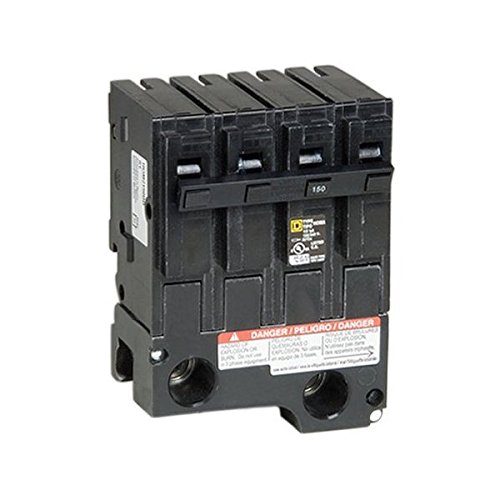
The hard-to-find Homeline plug-on 150A branch breaker that tiny-home owners hunt down.
This Square D breaker is the plug-on branch breaker for Homeline panels — the kind that powers a sub-panel or a high-demand circuit like a tiny home’s entire feed. It’s a 2-pole 150A unit at 240 volts with a UL approval, and it weighs 2.8 pounds. The included grounding lugs are a bonus for setups that need them, though owners note they’re optional depending on the install.
The story across reviews is one of scarcity — owners repeatedly call it a hard find that local stores simply don’t stock. One tiny-home owner needed it to power their whole dwelling and was glad to track it down here, and another had the old unit popped out and this one installed in under ten minutes. Arriving in the original box with the 150A capacity confirmed on the label adds confidence for buyers who need certainty on a safety component.
Quality and value-for-money are the two pillars of the feedback. The honest catch is that a few units have arrived looking like they may have been previously installed — the contact grease was intact so it likely never saw a panel, but cable attachment marks were visible on at least one delivery.
The Perks
- Ships with grounding lugs ready for your setup
- UL approved 150A capacity for branch or feeder duty
- Plug-on install takes most owners under ten minutes
The Honest Trade-off
- Genuinely scarce — when you find it, the price reflects demand
- A small number of deliveries show signs of prior handling
Homeline owners who need a 150A branch: this is the scarce plug-on part that tiny-home and sub-panel builders specifically seek.
Inspect on arrival: because stock is hard to find, check that your unit arrives sealed and unused.
6. Blue Sea Systems 7148 187-Series Surface Mount Breaker

A waterproof 1-pole marine breaker that doubles as a switch for boat and overland power.
This is a completely different breed from the residential panels above. The Blue Sea 7148 is a single-pole thermal breaker for DC systems on boats, RVs, and overland builds — it’s not for your house panel. What makes it special is that it combines switching and circuit protection into one device, so you flip a single lever to cut power and the breaker trips automatically on an overload. Customers note: “I used this on a dual battery system overland build.”
The waterproof construction and recessed mounting holes are purpose-built for the marine environment, and the ignition-protected rating meets SAE J1171 standards — that’s the certification that lets it sit safely aboard gasoline-powered boats without igniting fuel vapors. The 5/16 M8 terminal studs give you ample room for heavy-gauge wire lugs, which matters for a 150A DC circuit carrying serious current.
A “Trip Free” design means you cannot hold the switch in the ON position during a fault. Owners praise it as the best quality breaker in its class, with several running two of them in their setups. The one recurring request is a connection cover to shield the exposed terminals after install.
Built for salt and dust: The marine-grade waterproofing and SAE J1171 ignition protection make it the right call for boat and vehicle DC systems.
House panel? No: This is a 1-pole DC unit — if you’re wiring 120/240 VAC residential service, this is the wrong tool.
Dual-battery and boat builders: this waterproof, ignition-protected single-pole breaker is the trusted DC switch.
skip it if: you’re working on a residential AC panel — this lives on the DC side of your rig.
7. Siemens MBK150 150 Amp Replacement Main Breaker

The drop-in Siemens main for vintage Gould and ITE load centers, still protecting homes today.
This UL-listed Siemens breaker has a narrow but vital job: it’s the replacement main for EQ Series Siemens main breaker load centers. If you have an aging panel, this is the part that keeps it alive. One owner swapped this into a 44-year-old Gould/ITE load center and called it a direct replacement with zero problems — a reminder that quality breakers outlast the homes they’re installed in.
The 240-volt, 3-pole design fits the MBK form factor that Siemens has used for decades. Weighing just 6.08 ounces, it’s a lightweight unit that installs with a firm push or a couple of screws depending on your panel’s bus. Owners describe the fit as perfect and note you can feel the quality when it clicks into place.
It’s explicitly for replacement purposes only on those EQ Series panels, not for building a new load center. If you have one of these vintage Siemens-family panels and the main has gone weak, this is the exact OEM part — one owner confirmed it’s the exact replacement for the older EQ9683 breaker.
Vintage panel lifeline: The factory-matched replacement for Gould/ITE and Siemens EQ load centers that big-box stores no longer stock.
Check your panel model first: this is for EQ Series mains only — verify your load center before ordering.
Old Siemens-family panels: If you have the panel, this is the direct, UL-listed main to revive it.
New builds, look away: this isn’t for Siemens plug-on panels — those need the QN series instead.
8. Siemens QN2150R 150A Double Pole Type QNR Breaker
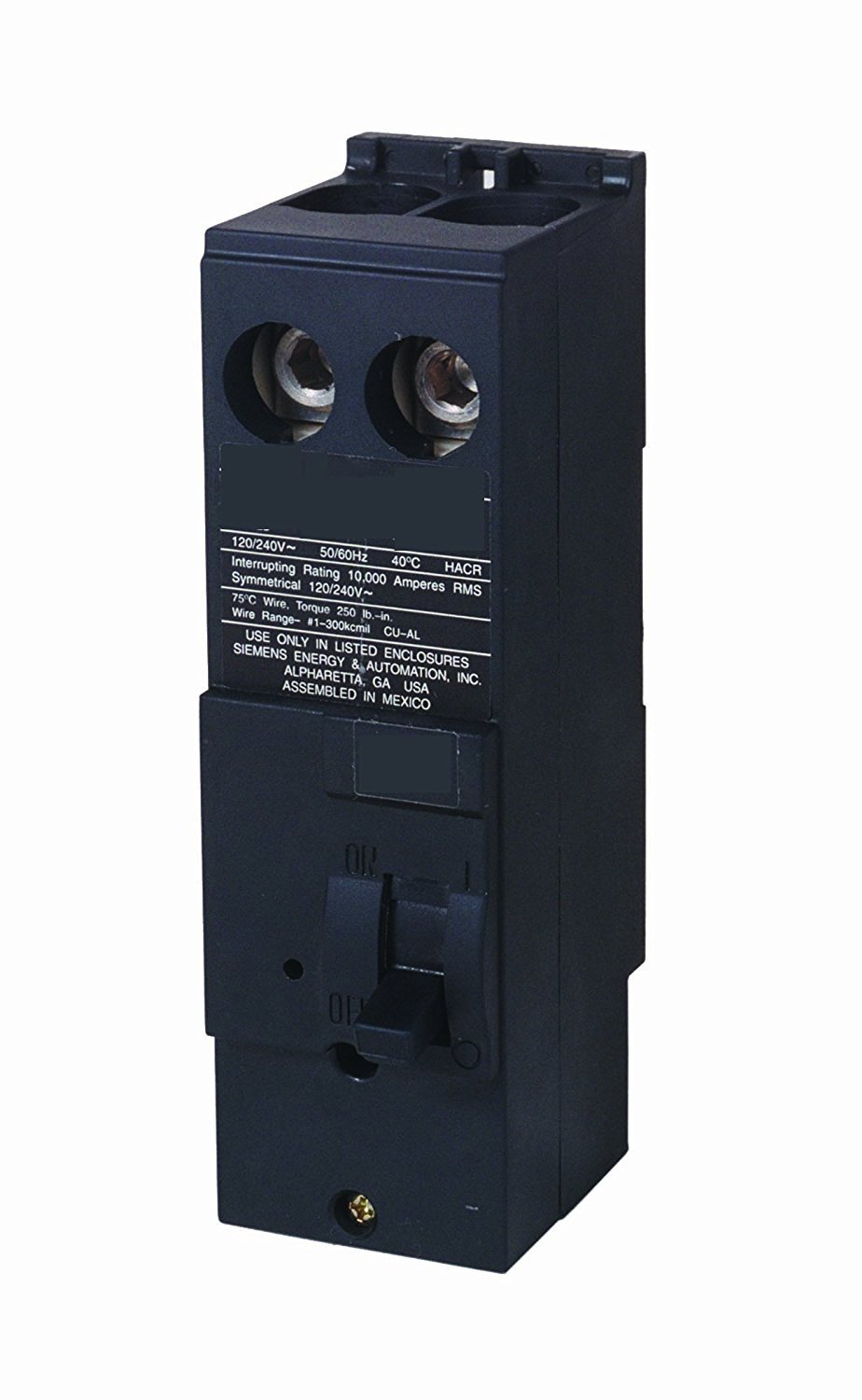
The UL Type QNR plug-in for Siemens panels that need a horizontally mounted 150A feed.
This is the 10k AIR sibling to the 22k QNRH higher up this list. Both are built for horizontal mounting inside Siemens panels, but this one carries a 10,000 amp interrupting rating instead of 22,000. For most residential services where the utility’s available fault current stays below 10k, that’s more than adequate — and it’s a lighter hit on the budget for the same 2-pole, 240-volt, 150A protection.
The plug-in mount clips directly onto the Siemens bus. It’s a UL-listed breaker with a UL Type QNR designation, so the certification explicitly covers that sideways installation. Owner feedback is essentially “works fine” and “as described” — the unglamorous but reassuring chorus you want from a safety component that just needs to do its job.
A word of caution from the review pages: the lugs on the delivered unit sit on the bottom, while some listings show them on top. If your wiring approach depends on lug orientation, confirm what you’re receiving before you commit — two buyers reported the mismatch.
Horizontal 10k duty: The certified QNR plug-in for sideways Siemens installations that don’t need the 22k headroom.
Check lug orientation: Delivered units have bottom lugs — verify against your feed before ordering.
Reach for this when: your Siemens panel needs a horizontal plug-in 150A feed and 10k AIR covers your service.
Step up to the QNRH if: your utility delivers fault current above 10,000 amps — that 22k unit is the safer call.
9. Heschen Solar DC Circuit Breaker 200 Amp 550V
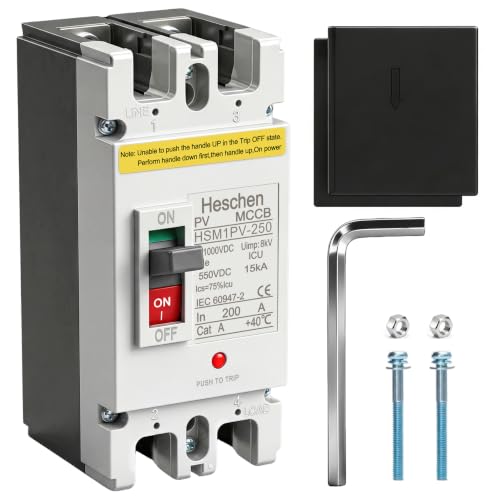
A solar-rated DC isolator that protects off-grid arrays and battery banks from brutal short circuits.
This is a 200A unit included here because it’s the DC disconnect your solar array needs — and it’s the direct comparison point for anyone shopping 150A AC mains. It’s a 2-pole molded case breaker rated for 550V DC, built specifically as a main isolator for solar panels, off-grid PV arrays, and home battery storage. The 200A rating gives it a 33% higher current capacity than a 150A AC main — a reminder that DC solar circuits often need more headroom than residential AC feeds.
The internal build is where this thing earns its keep. Pure copper braided straps resist overheating, silver-plated contacts keep resistance ultra-low, and an 8-blade arc extinguishing matrix rapidly suppresses severe short circuits. It delivers a 15kA rated short-circuit breaking capacity, meaning it can safely interrupt a 15,000 amp DC fault. Reviewers point out: “I put it under a load test confirm and definitely trips correctly.” Owners describe it as sturdy and well-built, with one using it as the main battery cutoff for their solar system.
Installation has one hard rule: top-feed connection only. The LINE must enter at the top and LOAD leave at the bottom to maintain that full 15kA capacity. It ships as a complete kit with the breaker, 2 flash barriers, mounting screws, and a hex Allen wrench. The IEC 60947-2 compliance covers the rigorous endurance standard, with an insulation voltage of 1000V and an 8kV impulse withstand rating for lightning surge resilience.
Solar System Armor
- Pure copper straps and silver-plated contacts fight overheating
- 15kA breaking capacity stops severe DC short circuits
- IEC 60947-2 compliant with 8kV impulse withstand
Wiring Discipline Needed
- Top-feed only — reverse the feed and you lose the 15kA rating
- Designed for DC solar, not residential AC mains
Off-grid builders: If you’re wiring solar panels or a battery bank, this is the heavy-duty DC isolator owners trust.
This stays out of your house panel: it’s a DC disconnect — your AC mains need a UL-listed residential breaker instead.
Understanding the Specs
The AIR Rating, Explained
AIR stands for Ampere Interrupting Rating. It’s the maximum fault current the breaker can stop without destroying itself. A 10k AIR unit handles a 10,000 amp short circuit; a 22k AIR unit handles 22,000 amps. Higher is stronger protection. Your utility determines how much fault current your service can deliver, so match the breaker to that number for real safety.
Poles: Count the Switches
A 2-pole breaker is two linked switches that shut off both 120-volt hot legs of a 240-volt circuit at once. Most residential mains are 2-pole. A 3-pole breaker handles three-phase commercial power. Count the number of connected switches on your old breaker — that’s your pole count. Ordering the wrong number means the breaker won’t fit or won’t function.
Thermal-Magnetic Trip
This is the mechanism that makes the breaker trip. A bimetal strip heats up slowly under a sustained overload and eventually bends to trip the breaker — that’s the thermal part. A magnetic coil reacts instantly to a massive short circuit — that’s the magnetic part. Together they protect against both slow overloads and instant faults.
OEM vs Generic Replacement
OEM means Original Equipment Manufacturer — the same company that built your panel made the breaker. Square D breakers go in Square D panels, Siemens in Siemens. Off-brand “universal” breakers often fit loosely and may not meet the panel’s safety listing. The reviews in this guide consistently reward genuine OEM parts for their glove-like fit and verified trip behavior.
FAQ
Can I replace a 150 amp main breaker myself?
Will a Square D breaker fit in a Siemens panel?
What does 22k AIR mean on a breaker?
What is the difference between a main breaker and a branch breaker?
Do I need a 2-pole or 3-pole 150 amp breaker?
What does “trip-free” mean on a breaker?
Can this 150 amp DC solar breaker protect my house panel?
Why is a 150 amp Homeline breaker so hard to find locally?
Final Thoughts: The Verdict
For most buyers, the 150 amp circuit breaker winner is the Square D QOM2150VH because it drops into the two most common residential panel lines with a 22k AIR rating and a fit owners describe as glove-like. If you need a Siemens riser main for a panel that shipped without one, grab the SIEMBK150A. And for a 150A branch feed into a Homeline sub-panel, the HOM2150BB is the scarce part tiny-home and sub-panel builders specifically seek — just inspect it on arrival since it’s hard to find.
How We Picked
We do not accept paid placement. Every pick is matched to a real buyer and a real use-case; we do not hands-on test units.
Sources & Methodology
Specifications: manufacturer listings and product documentation. Review insights: verified customer reviews, as of September 2026. Pricing: not shown on this page (it changes often); check the current price via the retailer link.
As an Amazon Associate, KitchPrep earns from qualifying purchases. This does not affect which products we feature.
Related Guides
