
Specs are compiled from manufacturer listings and verified buyer reviews and can change over time — please confirm the key details on the product page before buying.
Most bag sealers just suck air out of a bag and melt the end shut, leaving liquids and marinades out of reach and forcing you to buy expensive proprietary bags forever. A bag sealer machine that uses a chamber instead works differently — it removes air from the whole chamber, so you can seal soups, stews, and even jars without making a mess. This guide breaks down the two main types — chamber sealers versus impulse heat bars — and tells you exactly which one fits how you cook, store, and budget.
I’m Mohammad Maruf — the founder and writer behind KitchPrep. This guide is built by comparing the manufacturers’ published specifications and the patterns across verified customer reviews, so you get each pick’s real strengths and trade-offs instead of marketing spin.
Whether you batch-cook for the week or preserve a hunting haul, the right bag sealer machine saves money on bags and keeps food fresher far longer.
Our Picks at a Glance


How To Choose The Best Bag Sealer Machine
The first fork in the road is deciding between a chamber vacuum sealer and an impulse heat sealer. A chamber unit pulls air from a box and seals bags inside it, which lets you seal liquids and wet foods with zero mess. An impulse sealer is a manual bar that just melts the open end of a bag shut — it is fast for chips and cookies but cannot vacuum anything out.
Match the sealer to the food you actually pack
If you mostly seal dry goods like coffee, nuts, jerky, and crackers, an impulse heat bar is cheap and instant. The moment you want to freeze soups, marinades, or raw meat in its own juices, you need a chamber machine that can handle liquid without drowning the pump.
Check the seal bar length against your bag sizes
Seal bars come in fixed lengths, from 10.25 inches on compact chambers up to 16 inches on long impulse bars. Measure the widest bag you plan to seal and pick a bar that clears it, or you will be forced to buy smaller bags than you want.
Weigh recurring bag costs, not just the machine price
Chamber sealers accept plain bulk rolls and pre-cut bags that cost pennies each, while many countertop suction sealers lock you into branded rolls. If you seal a lot, the savings on bags can dwarf the higher upfront cost of the machine itself.
Quick Comparison
| Model | Best For | Sealing Type | Seal Bar Length | Max Bag Thickness | Amazon |
|---|---|---|---|---|---|
| VacMaster VP210★ Best Overall | Liquids and daily heavy use | Chamber vacuum | 10.25 inches | Up to 7 MIL Mylar | Amazon |
| Piwerod 12 InchBudget Champion | Budget impulse sealing | Manual impulse | 12 inches | 0.4 mm | Amazon |
| Bonsenkitchen VS2100 | Entry-level suction sealing | External vacuum | — | — | Amazon |
| SEELAUGH 16 Inch | Iron-bodied impulse sealer | Manual impulse | 16 inches | 0.8 mm | Amazon |
| Sangrui 16 Inch | High-volume dry bag sealing | Manual impulse | 16 inches | 12 mils | Amazon |
| VEVOR DZ-260C | Commercial-grade chamber value | Chamber vacuum | 12.6 inches | — | Amazon |
In-depth Reviews
1. VacMaster VP210 Chamber Vacuum Sealer
Our pick — over 4.5★ from 200+ verified ratings; the strongest balance of quality and price.
The commercial chamber unit that pulls liquid marinades and soups without a drop of mess.
The a neat extra here is the chamber design — the whole bag sits inside a 11.25″ x 15.25″ x 5″ stainless box while air is pulled from around it. Because the bag’s opening stays dry, you can vacuum-seal soups, sauces, and marinades that would destroy a regular suction sealer. Buyers report it handles these wet foods flawlessly, which opens up sous vide cooking in a way countertop machines simply cannot match.
It runs on a maintenance-free air pump that needs no oil changes, and the 10.25″ seal bar fits bags up to 10″ x 13″. The double seal adds a second melted line as insurance against freezer burn, and it is built to run continuously for prolonged sessions. Bulk repackaging of 30-40 lbs of meat every few months is exactly the kind of job buyers put it through, and they say it survives where other brands failed.
The catch is physical — at 72 lbs with a 20″L x 14″W x 15″H footprint, this is not a drawer gadget. Owners say it needs permanent counter space and is extremely heavy to move. A happy long-term owner notes you may need to tune the settings when switching between different bag thicknesses. But as they put it across the review pages: the cheap bulk bags it accepts make the economics work out over time, and a 10-year owner reports the oil-less pump needs no maintenance for light home use.
Why owners love it
- Seals liquids, marinades, and jars without mess or trapped air
- Accepts cheap bulk bags (3 MIL up to 7 MIL Mylar) to cut ongoing costs
- Maintenance-free air pump with no oil changes needed
Who should think twice
- Very heavy at 72 lbs and too big for most countertops
- Controls need tuning when switching bag types
- Premium price tier that suits committed users
Reach for this if: you seal liquids, batch-cook, or run a small business and want a machine that outperforms standard suction models for daily use.
Look elsewhere if: you only seal chips and dry snacks — that job does not need a 72 lb chamber.
2. Piwerod 12 Inch Impulse Heat Sealer
A pocket-friendly manual bar that melts PE and PP bags shut in seconds, no warm-up needed.
This is the simplest tool on the list — you press the arm down, a light comes on, and the heating element melts the bag shut. It works on PP and PE plastic bags (the kind used for cookies, produce, and retail packaging), and there is zero waiting because impulse heat only activates while the arm is pressed. With an 8-level adjustable temperature knob and a max thickness of 0.4 mm, you dial in the heat for thin snack bags versus thicker poly material.
You get a 12-inch sealing length that handles most home or small retail jobs in one pass, and the kit includes 3 replacement strips so you won’t hunt for spare parts later. The maker rates it to seal more than 10,000 bags, and buyers confirm it works well for sealing food storage bags. It is genuinely safe, too — since the element is not constantly hot, the chance of an accidental burn is minimal.
Buyers do warn about a learning curve on the temperature dial. One owner found this exact size needed a second stamp-down to seal cleanly, or risked burning the plastic if turned up too high — “I can’t find the perfect setting,” they admitted. Build quality reads a bit flimsy to some, and durability reports are mixed, with a minority reporting breakage after about 20 days of use.
What wins people over
- Seals PP and PE bags instantly with no heating time
- 8 temperature levels for different bag thicknesses
- Comes with 3 replacement strips
The honest trade-off
- Finding the right heat setting takes trial and error
- Some units feel flimsy or break after short use
- Only seals — it cannot vacuum air out
Best for: home cooks and small shops that need an affordable, instant seal on standard plastic bags without fancy features.
Who it is not for: anyone hoping to vacuum-seal liquids or freeze meat — this bar only seals, it does not suck air.
3. Bonsenkitchen Vacuum Sealer Machine
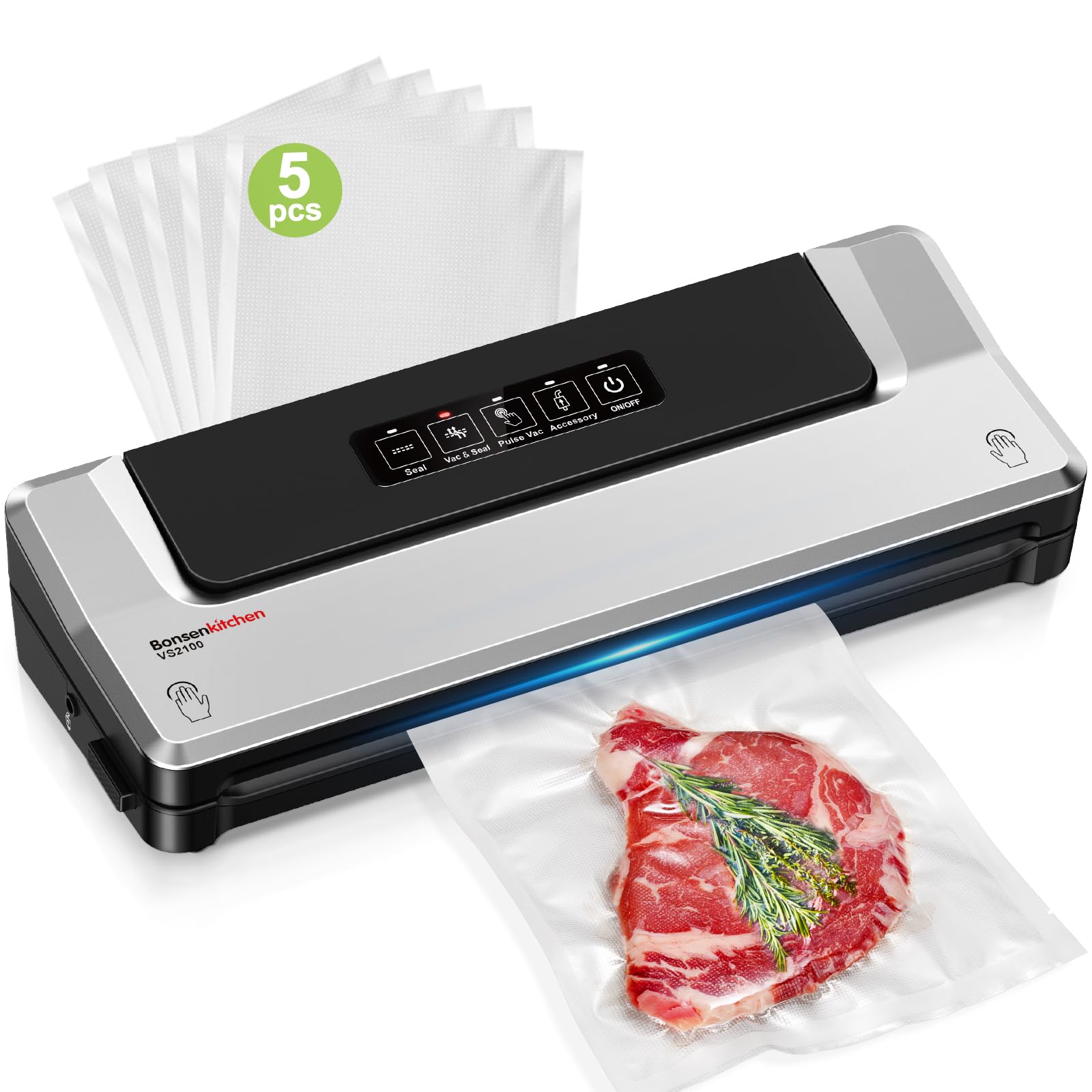
A 2.7 lb drawer-friendly suction sealer that seals up to 30 bags in 15 minutes.
If counter space is precious, this sealer slips into a drawer when dinner is done — it measures just 15.28″ x 5.71″ x 3.03″ and weighs 2.7 lbs. It is the crowd favorite here by a wide margin, and the reason is how approachable it feels. The four modes cover the essentials: one-touch vacuum and seal for firm foods, a pulse mode for soft or moist items like bread, a seal-only option for chip bags, and an accessory mode for jars or sous vide bags.
The manufacturer claims it extends freshness up to 25 days longer and seals 30 bags continuously in 15 minutes. Owners call it easily their most used kitchen tool, running daily for months to portion frozen meats and even cat food without freezer burn. The dry and moist modes are appreciated, and the strong suction on dry goods gets regular praise.
The usual starter gripes apply — the kit only includes 5 vacuum bags, so you will want to buy more, and there is no built-in cutter. One owner with a tight budget notes initial sealing issues that cleared up by using the manual mode and holding the seal longer. A few mention that thin bags can melt if the seal time is not shortened, and the moist mode takes a little manual vigilance to get right.
Why it earns its spot
- Compact 2.7 lb build stores easily in a drawer or cabinet
- 4 modes cover vacuum, pulse, seal-only, and accessories
- Strong suction for dry goods, per regular owners
Know before you buy
- Only 5 starter bags included
- No built-in bag cutter
- Moist foods need manual mode attention
Choose this for: an affordable everyday suction sealer that disappears into a drawer and handles weekly meal prep without fuss.
skip it if: you primarily seal soups or wet marinades — a suction machine struggles where a chamber shines.
4. SEELAUGH 16 Inch Impulse Sealer

An iron-bodied heat bar with a 16-inch reach for long Mylar and foil storage bags.
While the budget impulse sealer above has a plastic case, this one is built from iron — a material owners say feels more durable than typical plastic sealers. The 16-inch max seal length (400 mm) is the longest on this list, letting you close big Mylar, foil, and poly bags that smaller bars cannot fit. It seals up to 0.8 mm thick material, which covers heavy-duty food storage pouches many cheaper units cannot handle.
The 8-level adjustable timer with precision circuit controls handles different thicknesses, and the kit arrives with 4 spare parts: two flat wires for sealing and two round wires that cut off the excess bag after sealing. The built-in fuse and insulated handle add a safety layer, and the automatic shut-off after 1-3.5 seconds prevents accidental burns — a feature owners single out as a genuine relief. For long-term food storage in Mylar, regulars say it does an excellent job.
As with any manual impulse bar, you have to respect the duty cycle — the instructions recommend 5 seconds of use then a 10-second rest, and owners note burnouts come from overuse. Durability feedback is mixed: some find it reliable, while others report it can burn through bags even on the lowest setting. One fresh user coming from no experience at all found it “super easy” and perfect for larger packages.
The strengths
- Iron shell is more durable than plastic-bodied units
- Seals up to 0.8 mm thick bags across a 16-inch width
- Insulated handle and auto shut-off prevent burns
The limitations
- Needs cool-down rests between seals to avoid burnout
- Some report burning thin bags on the lowest heat
- Not a vacuum sealer — it only melts bags shut
Best suited to: long-term food storage fans who seal thick Mylar pouches and want a tough metal body that lasts.
Not the pick for: quick single-bag chip sealing — the duty cycle makes it slower than lighter bars for constant small jobs.
5. Sangrui 16 Inch Impulse Heat Sealer

An iron body, 5.2-foot cord, and 8 spare parts make this the upgrade-minded heat bar.
This sealer reads like a direct answer to the complaints owners have about cheaper heat bars. The maker swapped in an iron metal body instead of a fragile plastic case, stretched the power cord to 5.2 feet so you rarely need an extension, and packed in 8 spare repair kits — six flat wires for sealing and two round wires for trimming excess bag. You also get a 16-foot Teflon heat-resisting cloth strip that extends the time between accessory replacements.
Performance-wise it uses the same proven formula: an 8-level adjustable timer, a 16-inch (400 mm) max seal length, and a 3 mm sealing width that handles up to 12 mils thick. The handle starts the heat automatically when pressed down, and the unit powers itself off after 1-3 seconds. Owners who failed with four previous sealers report this one sealed every bag type and thickness on the first try — even wrinkled DIY rolls that needed multiple weak passes before.
The weaker signals: reliability is genuinely mixed in the feedback, with some units stopping after a few uses and reportedly lasting around three weeks for a few owners. A 4-star reviewer notes the dial controls heating time rather than temperature, and instructions are thin for plastic versus Mylar settings. Their tip: press down, wait for the click, then hold a few extra seconds for a perfect seal.
The upgrades that matter
- Iron body resists the fragility of plastic case sealers
- 8 spare wires plus 16 feet of Teflon cloth reduce re-buying
- 5.2-foot cord reaches outlets without extension cords
The uncertainty
- Reliability is mixed, with a few units failing quickly
- No clear instructions for plastic versus Mylar dial settings
- Seal-only function with no vacuum capability
Grab this if: you want a metal-bodied 16-inch bar with spare parts included so you are not shopping for replacements soon.
Think twice if: you need guaranteed daily commercial duty — the mixed reliability reports suggest lighter use is safer.
6. VEVOR Chamber Vacuum Sealer 320W
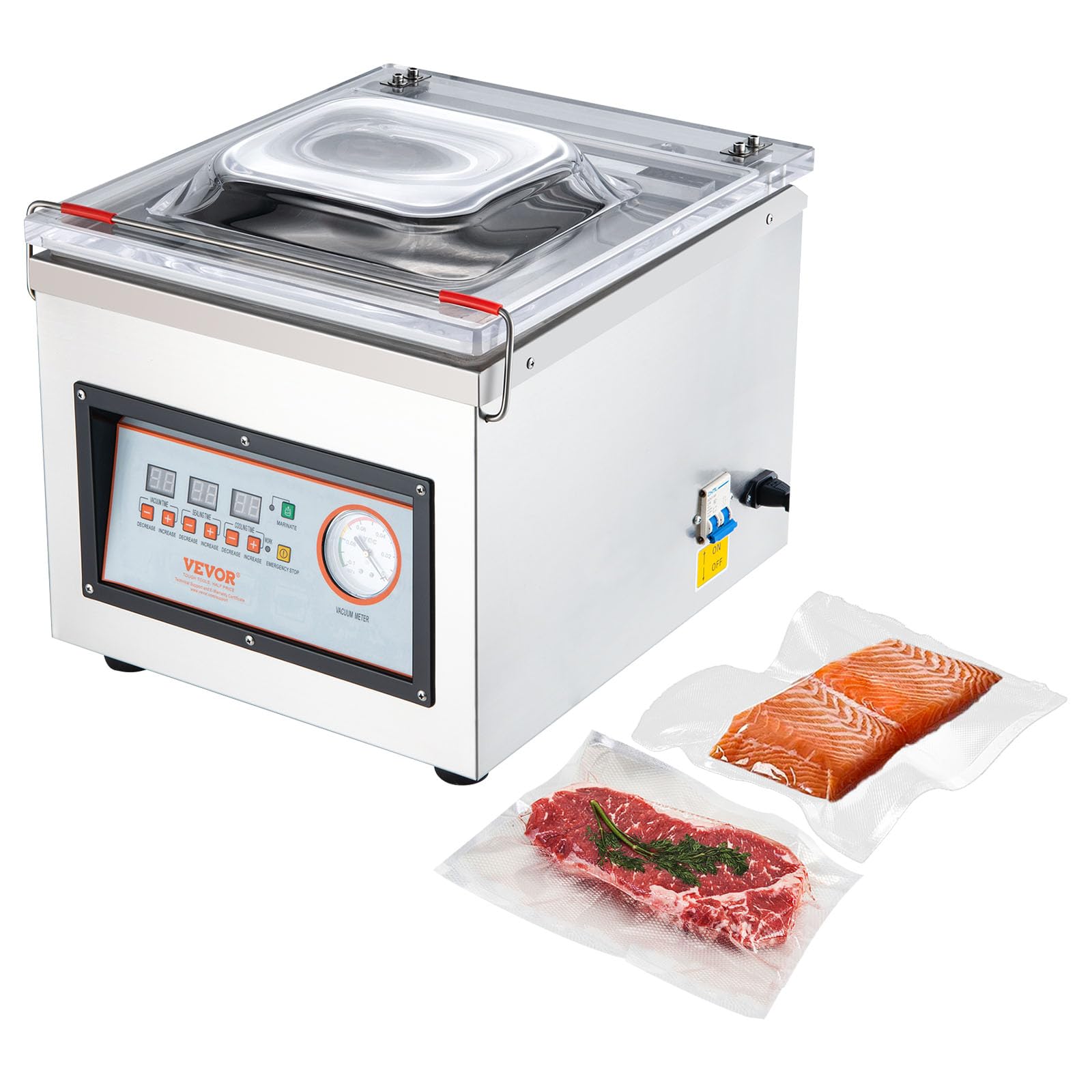
A big stainless chamber with 320W sealing power for homes, bakeries, and butcher shops.
The VacMaster above runs around triple this VEVOR’s price, yet both pull the same chamber trick. Here you get a 12.6-inch sealing length and a 10 mm wide seal strip driven by a 320W heater, so those long, strong seals survive freezer swelling and bumps without leaking. The deep stainless chamber swallows large steaks, whole bread loaves, and bulk goods, and the 180W vacuum pump with 100 kPa of suction handles oily or salty foods while resisting rust.
Owners with serious volume report sealing over 300 four-mil bags of salmon, halibut, and clams without a single failure, and they call it quieter and faster than their previous countertop machines. The sealed result on liquids and marinades earns consistent praise, and the built-in pressure gauge means you can stop before crushing fragile items like chips. It arrives with a heating wire, Teflon cloth, a vacuum pump, and a wrench as spares.
The honest setup notes: no bags are included, and you must fill the vacuum pump oil yourself — something not always clear in the manual. At 62 lbs and 17.9″L x 16.1″W x 16″H, it is heavy and non-portable, though owners accept that trade for the industrial feel. One owner with commercial machine experience calls it impressive and sturdy, noting the value is strong for the quality. Chill liquids before sealing so they do not boil out under vacuum.
What seals the deal
- 320-watt heater makes strong seals that survive freezer bumping
- Chamber design handles wet foods, marinades, and whole roasts
- Real-time pressure gauge stops fragile food from crushing
Setup and size realities
- You must add pump oil and buy your own bags first
- 62 lbs and a large footprint need permanent space
- Manual instructions skip the oil-fill step
Pick this for: serious home preservation or small commercial use where chamber convenience matters but the premium brands cost too much.
Pass if: you lack counter space or want a grab-and-go sealer with bags included — this one needs setup and room.
Understanding the Specs
Chamber versus external suction
A chamber sealer places the whole bag inside a box, then removes air from the entire chamber. This lets you seal liquids and wet marinades without them getting sucked into the machine. An external (suction) sealer pulls air from the bag’s opening with a nozzle, which works great for dry foods but struggles with moisture.
Seal bar length and bag thickness
The seal bar is the heated strip that melts the bag shut; its length in inches caps how wide a bag you can close. Bag thickness is measured in mils (thousandths of an inch) or millimeters, and heavier bags need more heat and a longer cool time. Match both numbers to the bags you actually plan to use.
FAQ
Can a bag sealer machine handle liquids like soup or marinade?
What is the difference between an impulse sealer and a vacuum sealer?
How much space does a chamber vacuum sealer need?
Which bags should I buy for a chamber sealer?
Do vacuum sealers really keep food fresh longer?
Is a heat sealer safe to use around the kitchen?
How long does an impulse sealer last?
Can I vacuum seal jars or use these for sous vide?
Why do some sealers burn holes in my bags?
Does a sealer machine come with everything I need to start?
Final Thoughts: The Verdict
If you want one dependable pick, the bag sealer machine winner is the VacMaster VP210 because it seals liquids and dry goods flawlessly with a maintenance-free pump and cheap bulk bags. If you want an affordable compact sealer for weekly meal prep, grab the Bonsenkitchen. And for serious volume on a budget, the VEVOR DZ-260C delivers chamber performance at a fraction of the premium price.
How We Picked
We do not accept paid placement. Every pick is matched to a real buyer and a real use-case; we do not hands-on test units.
Sources & Methodology
Specifications: manufacturer listings and product documentation. Review insights: verified customer reviews, as of September 2026. Pricing: not shown on this page (it changes often); check the current price via the retailer link.
As an Amazon Associate, KitchPrep earns from qualifying purchases. This does not affect which products we feature.
Related Guides
