
Specs are compiled from manufacturer listings and verified buyer reviews and can change over time — please confirm the key details on the product page before buying.
A wet basement is a different kind of stress — every heavy rain brings that anxious walk down the stairs to check the corners. The fix isn’t one magic product; it’s choosing between two very different tools: a surface channel system that catches water before it seeps in, or a sump pump kit that digs out the water already gathering under your floor. This guide breaks down both approaches so you buy the system that actually matches how water is reaching your basement.
I’m Mohammad Maruf — the founder and writer behind KitchPrep. This guide is built by comparing the manufacturers’ published specifications and the patterns across verified customer reviews, so you get each pick’s real strengths and trade-offs instead of marketing spin.
Two product types dominate—surface trench drains that divert runoff and automatic sump basins that pump groundwater away—so this basement drain system face-off helps you match the right tool to your specific flooding problem.
Our Picks at a Glance
How To Choose The Right Basement Drain System
The first question isn’t which brand — it’s where the water enters. Water seeping through floor cracks from a high water table is a pump problem. Water flowing across your lawn toward the foundation is a surface drainage problem. Picking the wrong type wastes your time and leaves water where you don’t want it.
Surface Trenches: Catch the Runoff Early
These are the long, covered channels you place in a driveway, patio, or lawn to intercept water that’s flowing over the ground before it pools against your foundation. They work by gravity and connect to your existing piping, so they need a place for the water to go — typically a lower spot or a drain line. They shine when surface runoff is your culprit and excel during downpours.
Sump Pumps: Evacuate Groundwater that’s Already In
If water is seeping up through the slab or pooling in a crawl space, the fix is a basin buried in the ground with a pump that activates automatically. These kits handle the water that appears without warning. The critical spec is flow rate — how many gallons per minute the pump can move out — since that determines how fast it can keep up with an incoming flood.
Quick Comparison
| Model | Best For | Type | Flow Rate | Material | Amazon |
|---|---|---|---|---|---|
| VEVOR Trench Drain System★ Best Overall | Outdoor runoff | Surface channel | — | HDPE plastic | Amazon |
| Vodaland 3 Inch Trench Drain | Patio & paver projects | Surface channel | — | Plastic | Amazon |
| Little Giant CS-SS Sump Kit | Crawl space groundwater | Sump pump kit | 50 gpm | Cast iron / poly | Amazon |
| Liberty Pumps CSP-257 | High-volume groundwater | Sump pump kit | 30 gpm | Cast iron / stainless | Amazon |
In‑Depth Reviews
1. VEVOR Trench Drain System 6 Pack
Our pick — over 4★ from 50+ verified ratings; the strongest balance of quality and price.
Six high-density plastic channels that stop yard runoff before it reaches your foundation.
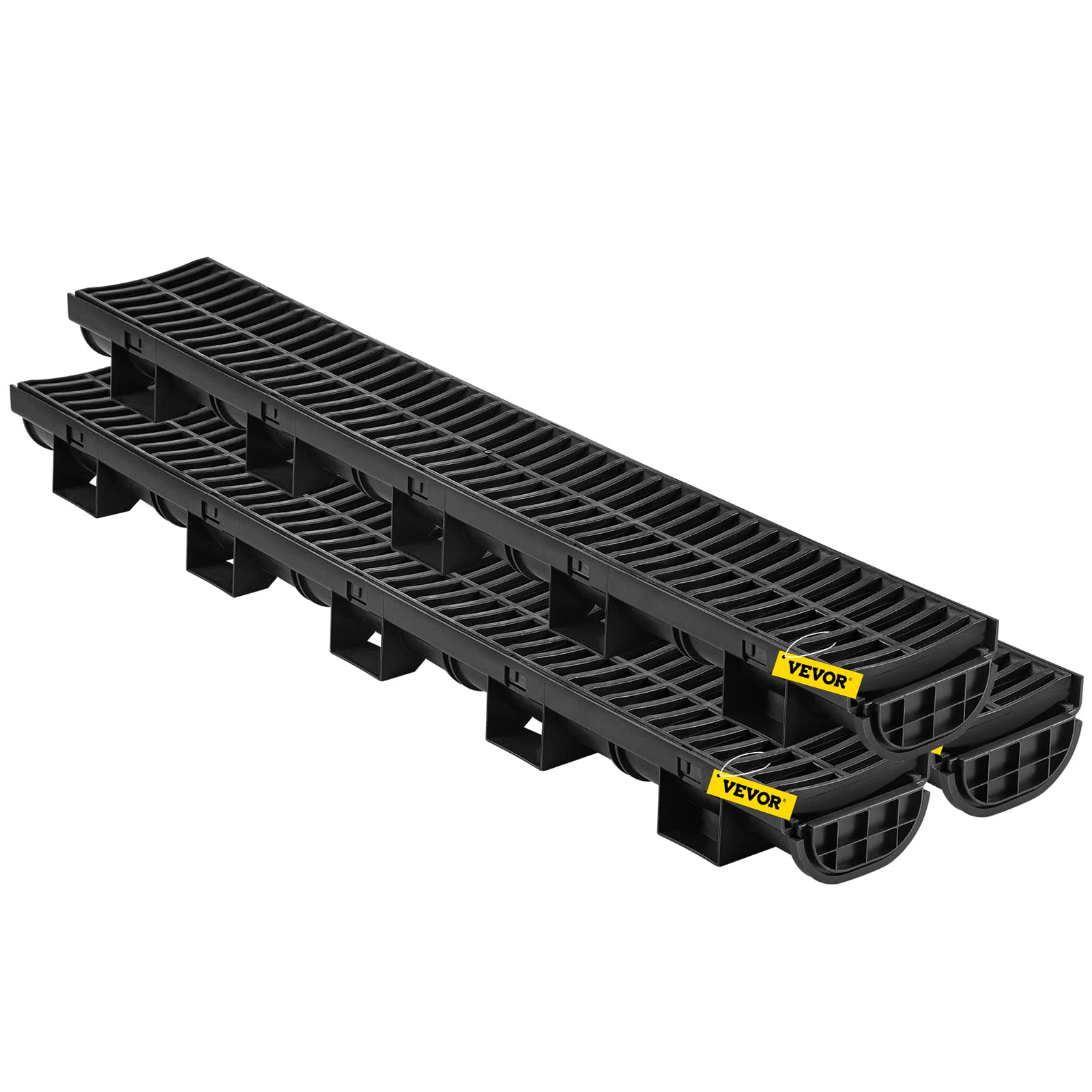
The crowd favorite here isn’t about fancy extras — it’s about sturdy, dependable surface drainage. The system comes with 6 channel sections made of thick high-density polyethylene (HDPE, a tough, durable plastic), each measuring 5.8″W x 3.1″H, so you get serious coverage for a driveway, patio, or garden edge. Owners describe the plastic as thick and the grates as strong, and the smooth inner surface is designed to keep water flowing toward your outlet instead of pooling on the surface.
Installation is meant to be straightforward. The sections interlock to extend the length you need, and the grates pop out by hand — no screws — which makes clearing leaves and debris a quick job. Each channel also has multiple built-in bottom outlets, so you can pick the size that matches your existing piping and skip buying extra connectors. The whole package includes 6 channels, 6 grates, and 6 end caps, so everything you need arrives in the box.
Buyers report that these trenches genuinely reduced water coming into a basement during a recent downpour that flooded the area. There is a recurring note about the interlocking system: some find the connections easy, while others say the pieces don’t always stay locked tight on their own. It’s a fit thing — plan to secure joints well, and this becomes a reliable line of defense against surface water.
What wins people over
- Thick, sturdy HDPE plastic holds up to weather and weight
- Tool-free grate removal makes cleanup simple
- Complete kit with end caps and outlets included
The trade-off to know
- Some pieces may not stay locked firmly — plan to secure the joints
Reach for this if: your water problem is surface runoff across a lawn, driveway, or patio.
Think twice if: your water is seeping up through the floor — that’s a pump’s job, not a channel’s.
2. Vodaland 3 Inch Trench Drain System

An ivory-finished channel system that hides discreetly under pavers while draining 16 feet.
This is the system for the landscaper who cares as much about the finished look as the function. The ivory coloring blends into patios and paver projects far more naturally than plain black, and the polished plastic finish keeps it from shouting “drain” from across the yard. The 5-pack of channels delivers 16 feet of drainage coverage, with each section measuring a compact 39.6″W x 3.63″H — a slimmer profile than the VEVOR’s 5.8″W channels, which makes it easier to tuck between pavers or along a walkway edge.
The selling point is genuinely easy installation. Grates snap in place and pop back out by hand, and the channels snap and lock together so you can extend the run without special tools. End caps come with a built-in outlet for connecting pipe drainage, and owners fitting this under pavers found the size and fit exactly as described — one called it the thing that saved the project. For a tidy, low-profile surface drain that looks intentional, this is the pick.
Quality feedback runs both directions here. Some owners mention the units are excellent and function perfectly, while others hit trouble with the locking system and found parts didn’t hold together; a few noted the kit lacks separate end caps and connectors, and recommended using concrete on the ends for a more permanent connection. The polished look is the reason to choose Vodaland, but expect to reinforce the joints yourself if you want a rock-solid long-term install.
Best for tidy projects: When drainage needs to disappear into a paver patio or walkway, the slim ivory profile and hand-removable grates make this an easy, good-looking choice.
A fair warning: The locking and connector parts are the weak spot — budget for concrete or extra connectors to firm up the joints.
3. Little Giant CS-SS Crawl Space Sump Kit

A complete, ready-to-assemble kit that evacuates crawl space water three years running.
This is the full-package answer for groundwater — everything you need arrives together. The kit bundles an automatic 1/3 HP cast iron sump pump, an 18-inch x 22-inch perforated polypropylene basin (the bucket that collects the water), a structural foam cover, a discharge hose kit, and a check valve (the one-way flap that stops water flowing back). Nothing here is sold separately, which removes the guesswork of matching parts.
At its heart is a workhorse pump with a snap-action float switch — the sensor that starts and stops it automatically. The pump activates when water rises to between 8 and 11 inches and shuts off when it drops to between 2 and 5 inches, so it runs only when needed. It moves an impressive 50 gpm (gallons per minute), which is a hefty 67% more capacity than the Liberty Pumps kit’s 30 gpm, and it lifts water up to a 22-foot shut-off height — plenty even if your discharge point sits well above the pump.
The longevity reports are the strongest part of this pump’s story. Owners describe a unit buried in a yard for 3 years pulling water from poorly draining soil, working flawlessly the entire time; another noted the digging was the hardest part of the install, with torrential rain no longer a concern once the system was in. There’s a 2-year manufacturer warranty behind it, and clear installation instructions get repeated praise. The equipment is heavy at 41 pounds, and its footprint is a large 21″L x 21″W x 22.1″H — roughly 40% bigger in each direction than the Liberty kit — so give yourself a proper-sized hole when you dig.
Why owners stick with it
- Complete kit — basin, cover, hose, and check valve all included
- 50 gpm flow outpaces most crawl space pumps
- Automatic float switch needs no babysitting
Before you dig
- Heavy at 41 pounds and wide at 21 inches — allow for a large basin hole
Pick this when: you want one box with everything and the highest flow rate for a crawl space or shallow sump pit.
Look elsewhere if: your space is tight — the big 21-inch footprint demands a generous excavation.
4. Liberty Pumps CSP-257 Crawl Space Sump Kit

A compact 30-pound sump kit built in the USA that runs quietly for over five years.
If you want a sump system that disappears into a tight space, this is the one. The kit’s footprint is a compact 15″L x 15″W x 16.5″H — roughly 40% smaller in each direction than the Little Giant’s 21-inch-wide basin — and at 30 pounds it’s noticeably easier to maneuver into place by yourself. The pump body is cast iron with stainless steel components, and it’s manufactured in the United States, which earned genuine goodwill from owners.
Real-world endurance is the defining trait here. Customers note the pump running strong 5 1/2 years in and keeping a basement bone dry, and another living on a river found it handled water seeping up through the floor whenever the river rose. The operation is notably quiet — a repeated point of praise from people who don’t want to hear their basement machinery running. It moves 30 gpm (gallons per minute), enough for steady crawl space water, though it falls short of the Little Giant’s 50 gpm output if you’re dealing with a truly torrential inflow.
The honest caveat is the included discharge hose. Several owners describe the pump and system as excellent while noting the hose is the weak link — the common workaround is swapping in PVC pipe under the house and using the hose only for the outside run. If you enjoy the idea of a quiet, compact, American-made pump that keeps water out for years, treat the hose as the one part you may replace.
A quiet workhorse: The compact cast-iron build and whisper-level operation make this the sump for anyone who wants reliable pumping without the noise.
One part to swap: The included hose gets underwhelming reviews — plan a PVC discharge line for the permanent install.
Understanding the Specs
Flow Rate (gpm)
Gallons per minute (gpm) tells you how much water a pump can move out in 60 seconds. A higher number means the pump keeps up faster when groundwater surges. The Little Giant moves 50 gpm while the Liberty Pumps kit moves 30 gpm — for a crawl space that floods hard and fast, that difference decides whether you stay ahead of the water or chase it.
Float Switch and Automatic On/Off
The float switch is the sensor that turns a sump pump on and off without you touching it. As water rises in the basin, the float rises with it; at a set height the pump kicks on, and when the water drops, the pump shuts off. The Little Giant activates between 8 and 11 inches of water and stops between 2 and 5 inches, so it runs only when the basin actually fills.
FAQ
Do I need a trench drain or a sump pump kit?
What does the flow rate in gpm mean for my basement?
How much space do I need to dig for a sump pump kit?
Will a sump pump turn on by itself during a storm?
How long does a cast iron sump pump last?
Can I extend the length of a trench drain system?
Do trench drain grates need tools to remove for cleaning?
What is the difference between a check valve and a discharge hose?
Final Thoughts: The Verdict
If your basement flood comes from surface runoff, the VEVOR Trench Drain System is the budget-friendly, thick-plastic starter that buyers trust to cut down water during a downpour. For a tidy paver project where looks matter, the Vodaland keeps a low, ivory profile. And when groundwater is the enemy, the Little Giant CS-SS gives you a complete, automatic kit with the highest flow rate, while the Liberty Pumps CSP-257 offers a quieter, more compact alternative with years of proven reliability.
How We Picked
We do not accept paid placement. Every pick is matched to a real buyer and a real use-case; we do not hands-on test units.
Sources & Methodology
Specifications: manufacturer listings and product documentation. Review insights: verified customer reviews, as of September 2026. Pricing: not shown on this page (it changes often); check the current price via the retailer link.
As an Amazon Associate, KitchPrep earns from qualifying purchases. This does not affect which products we feature.
Related Guides
