
Specs are compiled from manufacturer listings and verified buyer reviews and can change over time — please confirm the key details on the product page before buying.
When the power goes out, your first worry is probably the food in your fridge and whether your sump pump will keep your basement dry. A home backup generator is what keeps those essentials running, and this guide shows you which models actually deliver in a real outage, based on what buyers report after using them in storms.
I’m Mohammad Maruf — the founder and writer behind KitchPrep. This guide is built by comparing the manufacturers’ published specifications and the patterns across verified customer reviews, so you get each pick’s real strengths and trade-offs instead of marketing spin.
Finding the right backup generator for a home means matching fuel type, run time, and outlet layout to what you actually need to keep alive during an outage.
Our Picks at a Glance

How To Choose The Right Home Backup Generator
Buying a backup generator is a high-stakes decision because you’re trusting it with your food, your heat, and your family’s comfort during an emergency. The key is to match the machine’s output to your home’s actual needs, not just to the biggest number on the box.
Start with watts, but understand the two types
Every generator lists two power numbers: running (rated) watts, which it produces continuously, and peak (surge) watts, which it delivers for a few seconds when motors start up. A refrigerator’s compressor and a well pump both draw a heavy surge the moment they kick on, so your generator needs enough peak wattage to handle those spikes — plan for the surge, not just the steady draw.
Fuel type decides your endurance
Gasoline is the most common fuel, but it goes stale and can be hard to find during a regional emergency. Dual-fuel models also run on propane, which stores indefinitely and burns cleaner, while the rare tri-fuel adds natural gas — a pipe directly to your house means you never worry about refueling during a multi-day outage. Match the fuel to how long you expect to be off-grid.
Run time and outlets are the real-world constraints
How long a generator runs on one tank of fuel decides if you sleep through the night or get up at 4 a.m. to refill. The outlet panel decides what you can plug in: a standard 120V household duplex (a regular wall outlet for extension cords), a 30A RV outlet (for a camper), or a 50A outlet (L14-30R, a locking plug that provides 240V) that connects through a transfer switch to power hardwired circuits like your furnace.
Quick Comparison
| Model | Best For | Wattage | Fuel Type | Run Time | Amazon |
|---|---|---|---|---|---|
| Westinghouse 6500W Dual Fuel★ Best Overall | Mid-size homes needing a transfer-switch-ready standard | 5300 Running / 6500 Peak | Gasoline & Propane | 14.5 hours | Amazon |
| DuroMax XP13000HXT Tri FuelWhole-Home Beast | Whole-home power with natural gas hookup | 13,000 watts | Gas, Propane & Natural Gas | — | Amazon |
| Champion 11,000W Dual Fuel InverterQuiet Titan | Quiet whole-house power for electronics | 9000 Running / 11,000 Peak | Gasoline & Propane | 15 hours | Amazon |
| Westinghouse 12500W Peak | Households with heavy AC or well pumps | 9500 Running / 12,500 Peak | Gasoline | 12 hours | Amazon |
| DuroStar DS13000MX Dual Fuel | Whole-home power with remote start | 13,000 watts | Gasoline & Propane | — | Amazon |
| WEN 6800W Dual Fuel Inverter | EV charging and sensitive electronics | 5100 Running / 6800 Surge | Gasoline & Propane | — | Amazon |
| maXpeedingrods 4000W Inverter | Portable backup for essentials with app monitoring | 3200 Running / 4000 Peak | Gasoline | — | Amazon |
| Generac 5,200W Dual-Fuel Inverter | Parallel-ready quiet power for RVs and homes | 3900 Running / 5200 Starting | Gasoline & Propane | 15 hours on gas at 25% load | Amazon |
| Oxseryn 5000-Watt Inverter | Essential appliances with clean power on a budget | 4000 Running / 5000 Peak | Gasoline | 6 hours at 50% load | Amazon |
| Oxseryn 4400-Watt Inverter | Entry-level home backup and RV use | 3400 Running / 4400 Peak | Gasoline | 14 hours at 25% load | Amazon |
| Honda EU3200i | Whisper-quiet power for essentials | 3200 watts | Gasoline | 8.6 hours | Amazon |
In‑Depth Reviews
1. Westinghouse 6500 Watt Dual Fuel Home Backup Portable Generator
Our pick — over 4.5★ from 950+ verified ratings; the strongest balance of quality and price.
A dual-fuel generator with a 14.5-hour runtime that keeps two fridges running through a long outage.
The Westinghouse 6500W earns its spot for homes that need to stay fully running, not just keep one lamp lit. Its 4.7-gallon fuel tank gives you up to 14.5 hours of run time — more than double the Oxseryn 5000-Watt, which lasts only 6 hours at 50% load — so you won’t be stumbling outside to refuel at 3 a.m.
Owners mention it starts on the first pull, with the box including oil, an oil funnel, a propane hose, and a wheel kit for minimal assembly. The 274 cc 4-stroke engine (a 32% larger displacement than the Oxseryn 4400’s 208 cc) delivers the torque that powers larger appliances, and the automatic low-oil and CO shutdown systems add a meaningful safety layer for indoor-adjacent use.
The 30A TT-30R RV outlet and the L14-30R 30A transfer-switch outlet give you real flexibility for different hookups. Customers note the trade-off honestly: one owner said, “Saved two fridges worth of food, recharged my backup sump battery, and even ran my modem, tv, a couple lights, and my hair straightener during a prolonged outage” — a scene that shows its whole-home usefulness. With a 4.6-star rating from 900+ owners, reliability and quality are what people mention most.
Why owners stick with it
- Holds a 14.5-hour run time on a 4.7-gallon tank, enough to sleep through most outages.
- Dual-fuel design lets you switch between gasoline and propane for fuel flexibility.
- Comes with wheel kit and oil right in the box for near-instant setup.
The honest trade-off
- It’s an open-frame unit, so noise opinions are mixed — some call it quieter than most, others louder than expected.
- At 23.2″L, it needs floor space in your garage or shed.
Reach for it if: you need a transfer-switch-ready machine that can carry your fridge, sump pump, and lights for a full night.
Think twice if: neighbors within earshot and a quiet, enclosed unit matter more to you than raw run time.
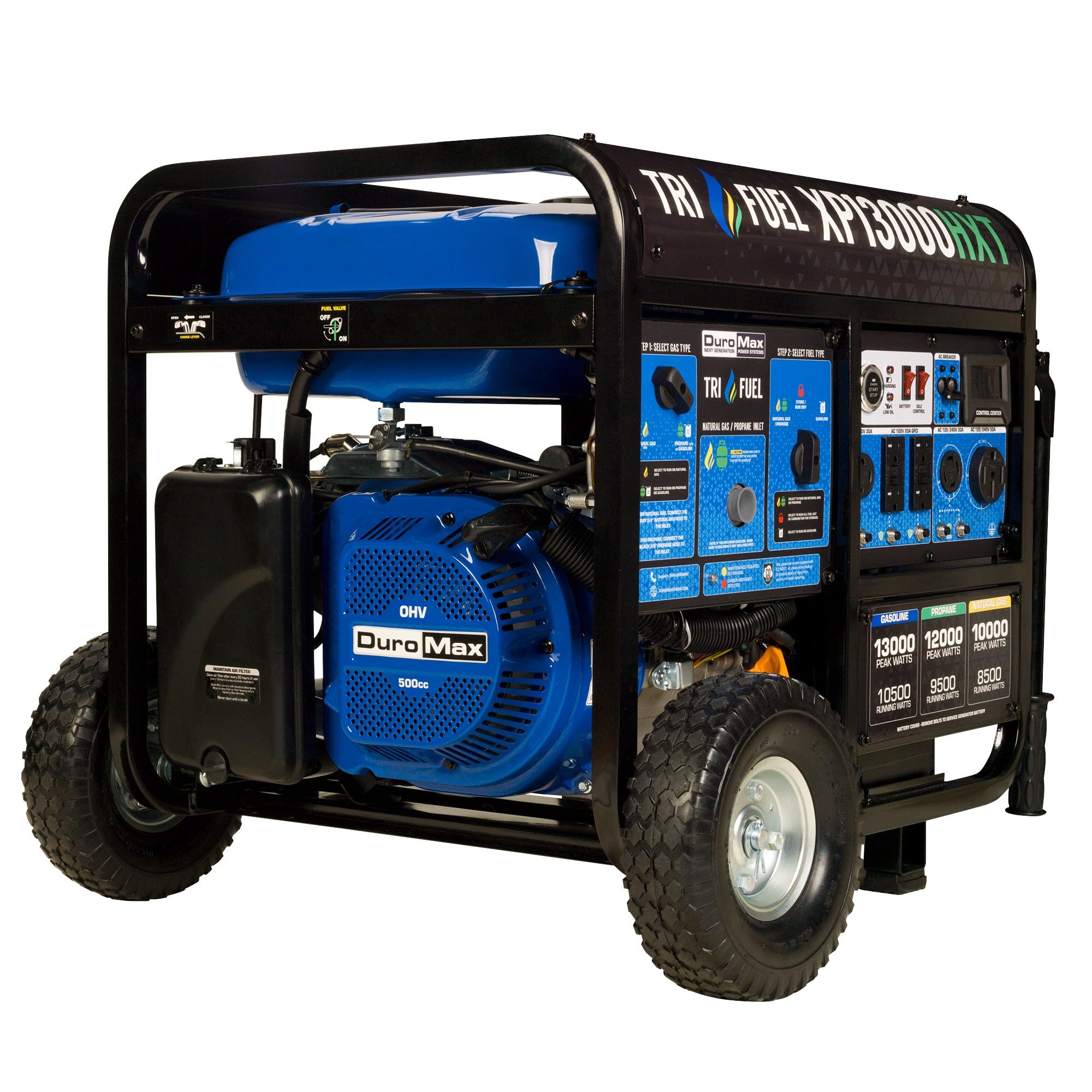
2. DuroMax XP13000HXT 13,000-Watt 500cc Tri Fuel Portable Generator
A tri-fuel generator that connects to your natural gas line for uninterrupted whole-home power.
If you want to run your entire house — AC, furnace, fridge, and lights — without ever touching a gas can, the DuroMax XP13000HXT is the answer. Its 500cc 4-stroke engine produces a massive 13,000 watts, and because it runs on gasoline, propane, or natural gas, you can connect it directly to your home’s gas pipe with the included 15-foot natural gas hose.
The push-button and remote start options mean you can fire it up from inside your house while the storm rages outside. Owners describe it as an “excellent whole home solution,” with one reporting it “powered their downstairs A/C, internet, computer, TV, refrigerators, and lights” with ease.
That natural gas advantage is the defining feature here — as one owner noted, they paid about total versus K for a comparable installed standby unit. The CO Alert system adds automatic shutdown protection, which is crucial when you’re running a machine this size. It’s a heavy, powerful tool, but for uninterrupted whole-home power during a regional emergency, this is the machine to beat.
Why it’s the ultimate backup
- Tri-fuel design gives you class-leading flexibility, especially with natural gas.
- Remote and push-button start make it easy to power up in a storm.
- 50A outlet is ready for a full transfer switch connection.
The honest trade-off
- At 240 pounds and 30″L x 30″W, it’s a substantial machine that needs a permanent home.
- Natural gas hookup may require a plumber to install the right fitting.
Best for: homes already on natural gas that want to power everything without fuel storage worries.
Not for: apartment dwellers or anyone lacking the space and budget for a 240-pound unit.
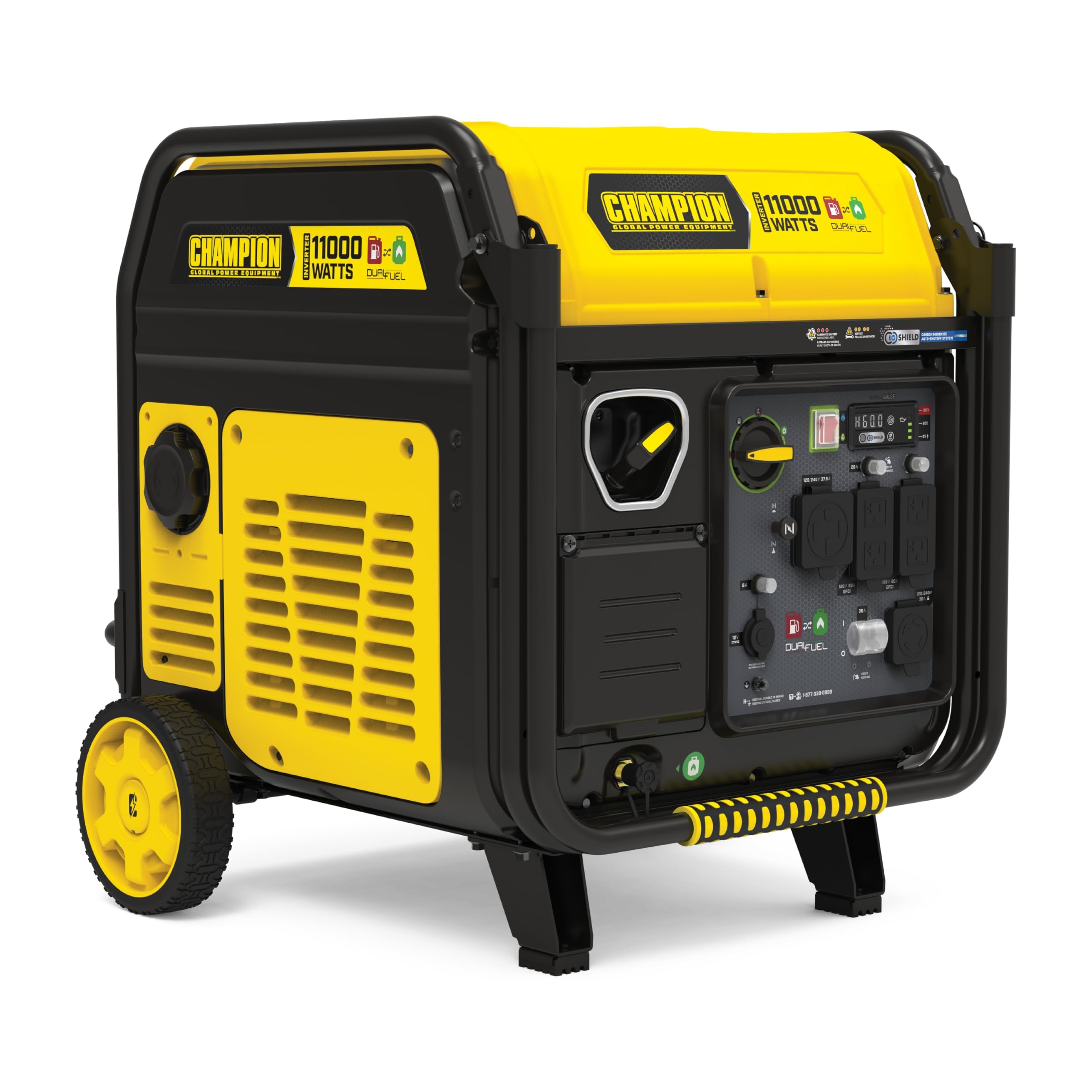
3. Champion Power Equipment 11,000-Watt Dual Fuel Inverter Generator
An inverter generator that powers a whole house at a quiet 64 dBA.
The Champion 11,000W stands out because it powers a whole house without the deafening roar of typical units. Its inverter technology (which converts power in steps to reduce noise and clean the output) keeps sound at 64 dBA from 23 feet — owners call it “surprisingly quiet” and say it’s “3x quieter than my old 4000W.” Quiet operation is the top compliment in its reviews, making it the defining feature.
Powered by a 459cc engine, it produces 11,000 starting watts and 9,000 running watts on gasoline (8,100 running watts on propane), and runs up to 15 hours on a full tank. The battery-included electric start with Cold Start Technology means no desperate pulling in freezing weather.
Its 120/240V 37.5A outlet is made to connect to a transfer switch, and reviewers point out running two fridges, two freezers, and a well pump without a hiccup. One buyer ran their entire house for about 5 hours on a 50A plug with stable voltage and frequency, noting all their electronics worked perfectly — a huge plus if you’re protecting computers and TVs from dirty power.
Why it wins owners over
- 64 dBA noise level is quiet enough for residential areas.
- 15-hour run time on gasoline covers a full overnight outage.
- Inverter tech makes it safe for laptops, TVs, and other sensitive electronics.
The honest trade-off
- At 205.1 pounds, it needs two people or a ramp to load into a truck.
- The oil fill funnel is poorly designed, causing spillage during setup for some owners.
Choose this if: whole-home power with quiet operation and clean inverter output are your top priorities.
Look elsewhere if: you need the absolute max for heavy 240V tools — this is a comfort machine, not a construction beast.
4. Westinghouse 12500 Peak Watt Home Backup Portable Generator

A 457cc generator with key-fob remote start for whole-home comfort during outages.
The Westinghouse 12500W suits families who see an outage as a nuisance, not an emergency. With 9,500 running watts and 12,500 peak watts (the surge power needed to start motors), it can run a 5-ton heat pump, a well pump, and your kitchen at the same time — one owner said it powered their entire house for 80 hours straight without a hiccup.
Its convenience features set it apart: a remote-start key fob, electric start, and auto choke (which adjusts the fuel-air mix automatically) let you fire it up from your couch when the lights flicker. The 6.6-gallon fuel tank runs up to 12 hours, and the fuel gauge tells you exactly when to refill.
A 457cc engine with a cast iron sleeve is built for the long haul, and the included 50A 14-50R outlet connects easily to a transfer switch. It’s a heavy machine at 212 pounds, but owners note the large wheels make it surprisingly manageable, even for an 80-year-old couple to maneuver. One buyer ran their 5-ton heat pump through a 48+ hour outage in below-freezing weather — proof this is genuine whole-home power.
What makes it special
- Key-fob remote start with auto choke fires it up from a distance.
- 12,500 peak watts handles heat pumps and well pumps with reserve.
- 6.6-gallon tank with fuel gauge runs up to 12 hours.
The honest trade-off
- The wheels can fail after about a year of use, per long-term owners.
- It’s gas-only, so no dual-fuel flexibility for propane.
Best for: homeowners with heavy electrical loads like central AC who want push-button convenience.
skip it if: you want propane capability or need to move it up stairs regularly.
5. DuroStar DS13000MX 13,000-Watt 500cc Dual Fuel Portable Generator

A 13,000-watt dual-fuel generator with remote start that powers an entire home.
The DuroStar DS13000MX is built for the homeowner who wants true whole-house capability with the freedom of dual fuel. Its 500cc 4-stroke engine generates 13,000 watts, and the front-facing fuel selector lets you switch between gasoline and propane in seconds — choose gas for maximum power or propane for cleaner, longer-running operation.
Shoppers say it “powered their entire home in a test, handling 1.5-ton ACs, fridge, stove, microwave, TVs, and water heater without flinching.” The push-button electric start and included remote control let you start this large unit from across the yard — a real comfort advantage when you’re dealing with a storm.
The 50A heavy-duty outlet is made for transfer-switch connection, and the rugged all-metal steel frame is designed to survive harsh weather year after year. Buyers praise the value — one noted it held up through a first storm with ease and started fine even after a user error (forgetting to open the gas valve). With its dependable 500cc core, this is a machine built for the long haul.
Why it stands out
- Dual-fuel flexibility with a simple front-facing fuel selector.
- 13,000 watts runs a full home including AC and kitchen appliances.
- Remote start and push-button electric start fire it up instantly.
The honest trade-off
- CO alarm can be sensitive during setup — some buyers report nuisance shutdowns.
- At 29.75″L it’s a large machine that needs garage space.
Pick this if: you want a dual-fuel unit that can power your entire home without breaking a sweat.
Reconsider if: you need inverter-clean power for a house full of sensitive electronics.
6. WEN 6800-Watt Dual Fuel RV-Ready Electric Start Portable Inverter Generator

A dual-fuel inverter generator that provides Level 2 EV charging during outages.
The WEN DF680iX is the only generator on this list with a neat extra: its bonded-neutral 240V configuration provides low-power Level 2 charging for battery-electric and hybrid vehicles. If you drive electric, this turns a generator from an appliance into a lifeline.
Its 224cc dual-fuel engine runs on gasoline for 6,800 surge watts and 5,100 rated watts, or propane for 6,000 surge and 4,500 rated. The electric start fires immediately on a button, and the CO Watchdog sensor automatically shuts the unit down if dangerous carbon monoxide levels build up.
Owners use it daily as a propane-powered charger for their power stations, saying it easily handles a fridge and outlets for a 24-foot car hauler. One full-time RVer reported it ran their two 15,000 BTU ACs on propane through a 30A plug. The telescoping pull handle and onboard wheels keep the 99.2-pound unit manageable, and the three-year warranty adds confidence.
Why it’s a standout
- Level 2 EV charging capability is genuinely unique in portable generators.
- Dual-fuel engine with electric start runs both gas and propane.
- Fuel shutoff runs the carburetor dry to extend engine life.
The honest trade-off
- Only two 120V outlets — owners have wanted four for more flexibility.
- Reliability reviews are mixed, with a small number reporting no-start issues after overnight runs.
Get this if: you drive electric and want an inverter generator that can double as an emergency car charger.
Pass if: you need max portable wattage and don’t care about EV hookup.
7. maXpeedingrods 4000 Watt Inverter Generator with Bluetooth App Data Monitor

A 48.5-pound inverter generator with Bluetooth app monitoring for real-time data.
The maXpeedingrods MXR4000 brings a layer of smarts you don’t see on most generators. Its Bluetooth app shows power output, fuel level, voltage, frequency, single run time, and accumulated run time in real time — and lets you toggle ECO mode remotely for better fuel efficiency.
Its 145cc 4-stroke engine (a standard engine type that runs on gasoline) delivers 4,000 peak watts and 3,200 running watts of clean inverter power, so it’s safe for sensitive electronics like laptops and TVs. At just 48.5 pounds and 18.89″L, it’s among the most portable units here, and it comes with a generator dust cover — handy for storage.
The NEMA L5-30R RV outlet with an included adapter simplifies RV charging, and owners mention it runs an RV air conditioner perfectly. On the run-time front, some owners have extended its use by running it on propane at altitude with a first-pull start. While it won’t power a whole house, it’s an ideal companion for keeping your fridge, a few lights, and your modem alive through a short outage — and its portability means it doubles as a camping power source.
Why it’s a clever buy
- Bluetooth app monitoring is genuinely useful for tracking fuel and load.
- 48.5 pounds makes it easy to lift and store compared to bigger units.
- 2-year warranty with lifetime technical support from the maker.
The honest trade-off
- The app has been described as buggy, and a dead battery can complicate starting.
- Real-world noise runs 63-65 dB at 20 feet, louder than the advertised figure.
Best for: first-time buyers who want a portable, app-connected inverter for essential loads.
Not for: whole-house backup — it’s a support unit, not a primary power source.
8. Generac 5,200 Watt Dual-Fuel Portable Inverter Generator
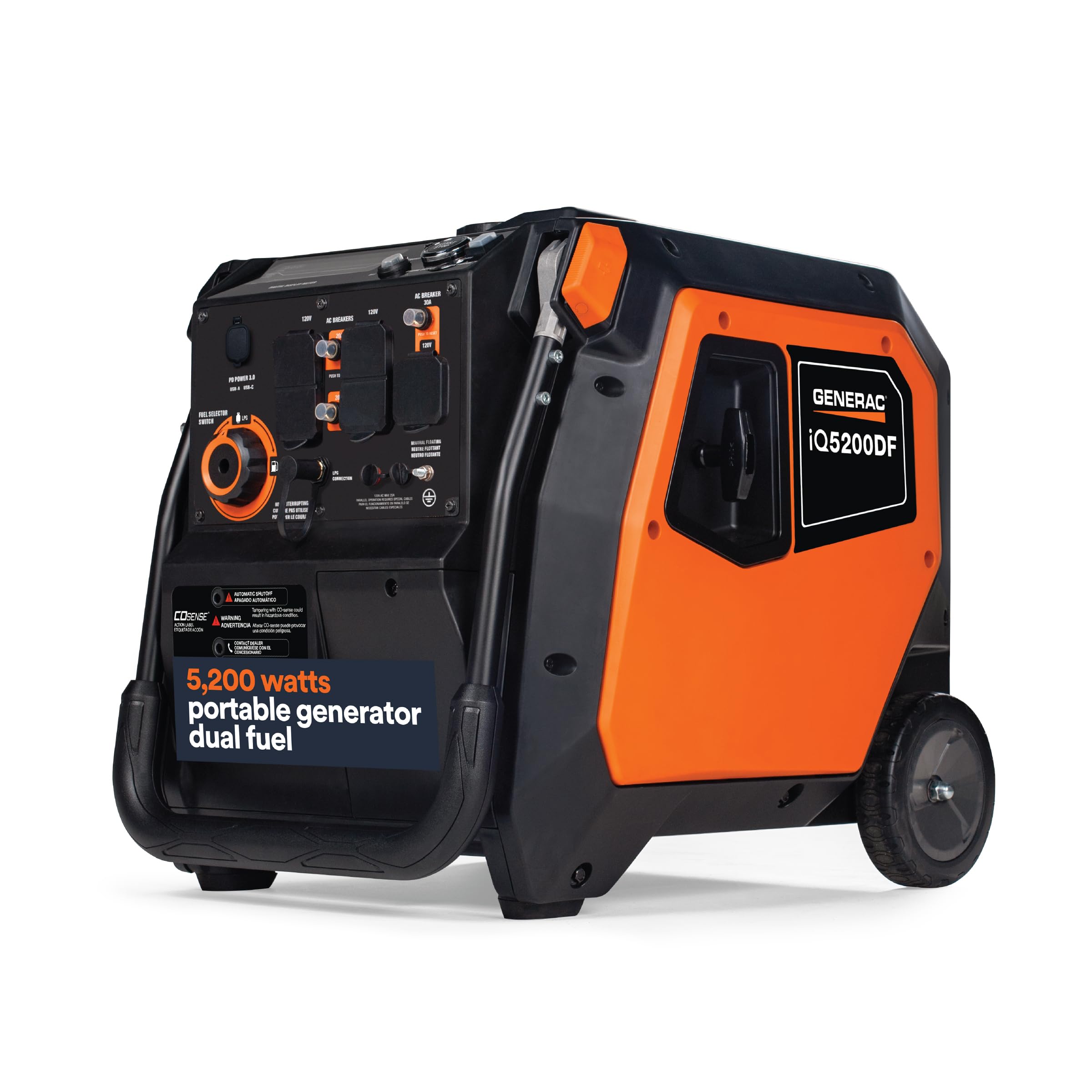
A 107-pound dual-fuel inverter generator that can parallel with a second unit for double power.
Generac’s 5,200W inverter is a study in smart flexibility. Run it solo and it delivers 3,900 running watts on gas (5,200 starting) with clean power under 3% THD to protect laptops and phones. But its real genius is the parallel capability: connect two iQ5200 units with an optional kit and you get up to 7,800 combined running watts without buying one giant, heavy machine.
It’s a dual-fuel design, so you can switch to propane for 3,500 running watts when gasoline runs short. Run time stretches to 15 hours on gas at a 25% load, or 11 hours on a standard 20 lb propane tank at 50% load. The push-button electric start with included battery eliminates pull-cord drama entirely.
Owners consistently praise its quiet operation — one called it “the quietest generator I have ever owned,” and another replaced two smaller generators with a single one of these for triple the power. It arrives with everything needed to start: oil, funnel, LP hose, and battery. Weighing 107 pounds with never-flat wheels and a folding handle, it’s genuinely manageable for one person to move around a garage.
Why owners rate it highly
- Parallel-ready design lets you double power later without a new purchase.
- Clean inverter power under 3% THD is safe for all your electronics.
- Includes battery, oil, and LP hose for out-of-the-box operation.
The honest trade-off
- A small number of owners reported fuel leaks on arrival, though most units are fine.
- At 107 pounds it’s heavier than some competing inverters in this class.
Pick this if: you want the option to start small and scale to more power later with a second unit.
Look elsewhere if: you need more than 3,900 watts today and don’t want to buy two generators.
9. Oxseryn 5000-Watts Portable Inverter Generator
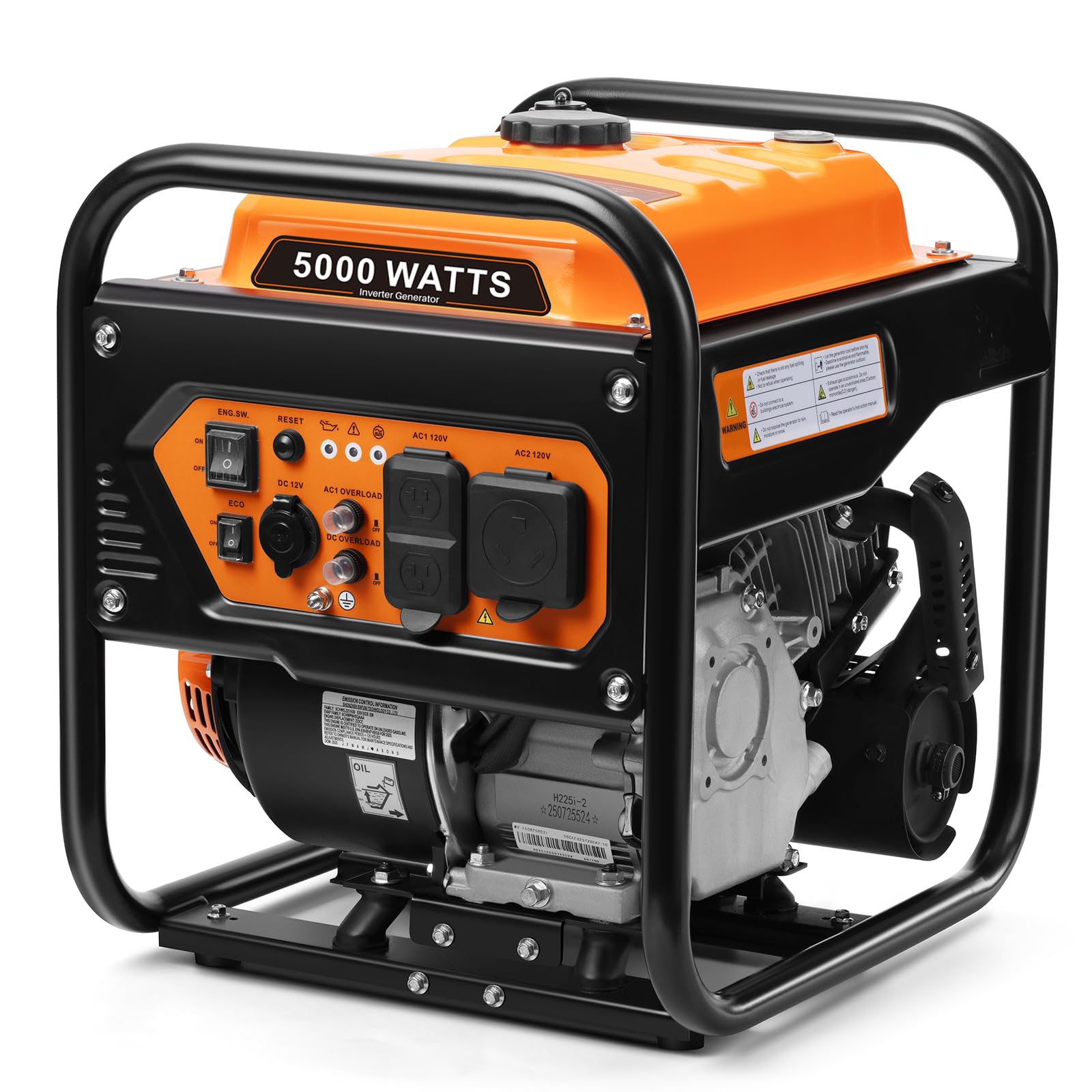
A 60-pound inverter with clean power under 5% THD for protecting your electronics on a budget.
The Oxseryn 5000-Watt hits the balance for homeowners who want inverter-clean power (which produces a steady, safe electrical flow) without premium-brand prices. Its 4,000 running watts and 5,000 peak watts easily run a fridge, freezer, lights, and a window AC, and its THD (total harmonic distortion, a measure of power cleanliness) under 5% keeps your computer and TV safe from fluctuations.
The 2-gallon tank delivers up to 6 hours of run time at a 50% load, with ECO mode automatically adjusting engine speed to stretch fuel further. Customers note a tank lasts about 10-12 hours in real-world light use, and it starts easily, with many noting it “cranked right up and purred like a kitten.”
The 30A outlet makes RV hookup simple, and its open-frame design at 60 pounds is a practical balance of power and portability — you can move it around without a dolly. It’s a clear value pick: reliability is the most-praised aspect in its review data, backed by strong reported performance running camper ACs and heat without complaint.
Why it’s a smart value
- THD under 5% gives you clean power for sensitive electronics.
- ECO mode stretches fuel for longer real-world runtime.
- 60-pound weight is genuinely manageable for one person.
The honest trade-off
- Noise opinions are mixed — some find it quieter than expected, others slightly noisy.
- 6-hour rated runtime at 50% load is shorter than larger-tank rivals.
Reach for it if: you want inverter power for essential appliances on a sensible budget.
Think twice if: you need to power a whole house — this is sized for essentials, not everything.
10. Oxseryn Power Equipment 4400 Watts Inverter Generator
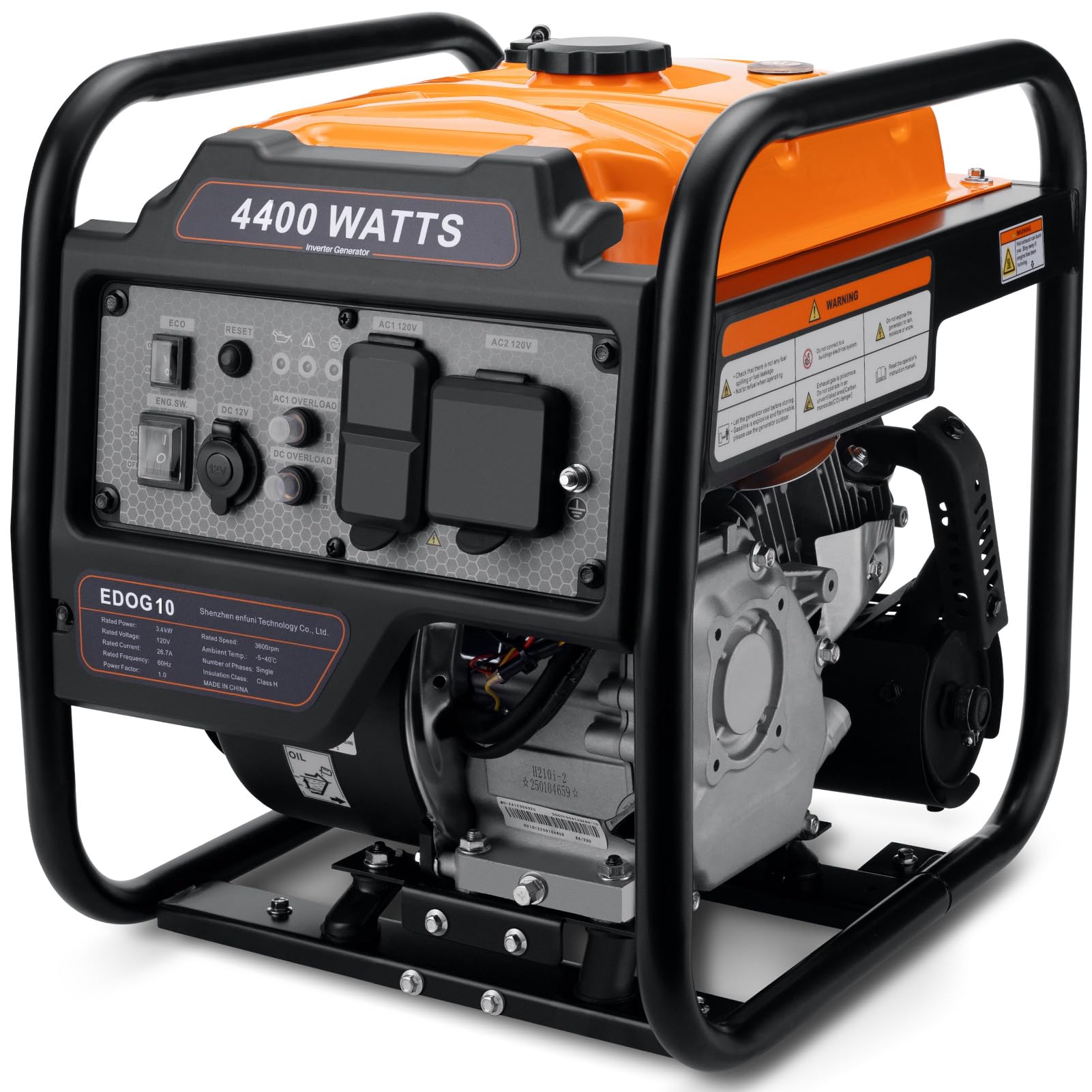
A 56-pound, 14-hour inverter that pairs serious longevity with an entry-level price.
The Oxseryn 4400-Watt is the budget-minded homeowner’s first real backup machine. Its 4,400 peak and 3,400 running watts handle a sump pump, fridge, and lights — the core essentials that make an outage tolerable. One owner reported its 2-gallon tank “lasted about 4 hours with a sump pump and washing machine,” while the ECO-mode rating stretches that to up to 14 hours at a light 25% load.
Noise stays under 72 dBA from 23 feet, which is tolerable for a residential street, and the 208cc 4-stroke engine starts on the first pull according to most owners. At 56 pounds with a 19″L footprint, it’s genuinely easier to store and move than almost anything else at this wattage.
Its inclusivity is a plus: the panel includes two 120V AC ports, a 12V DC port, and an RV port, covering a wide range of uses. Owners running a 24-foot enclosed car trailer with a fridge, AC, and outlets report it performs well — and one found it beat a comparable Champion model at two-thirds the weight. If you’re looking for an honest, affordable way to keep the essentials running, this is a strong starting point.
Why it earns its place
- Up to 14 hours of runtime at 25% load with ECO mode on a 2-gallon tank.
- 56 pounds makes it the easiest full-size inverter to move.
- Multi-outlet panel includes 12V DC and RV ports for versatility.
The honest trade-off
- Some units arrived with loose bolts, requiring a quick tightening before first use.
- Occasional reliability issues have been reported with long-term consistent use.
Best for: first-time buyers who need a light, affordable way to power essentials through short outages.
Consider a step up if: you expect frequent, multi-day outages where long-term reliability is critical.
11. Honda EU3200i 3200 Watt Inverter Generator
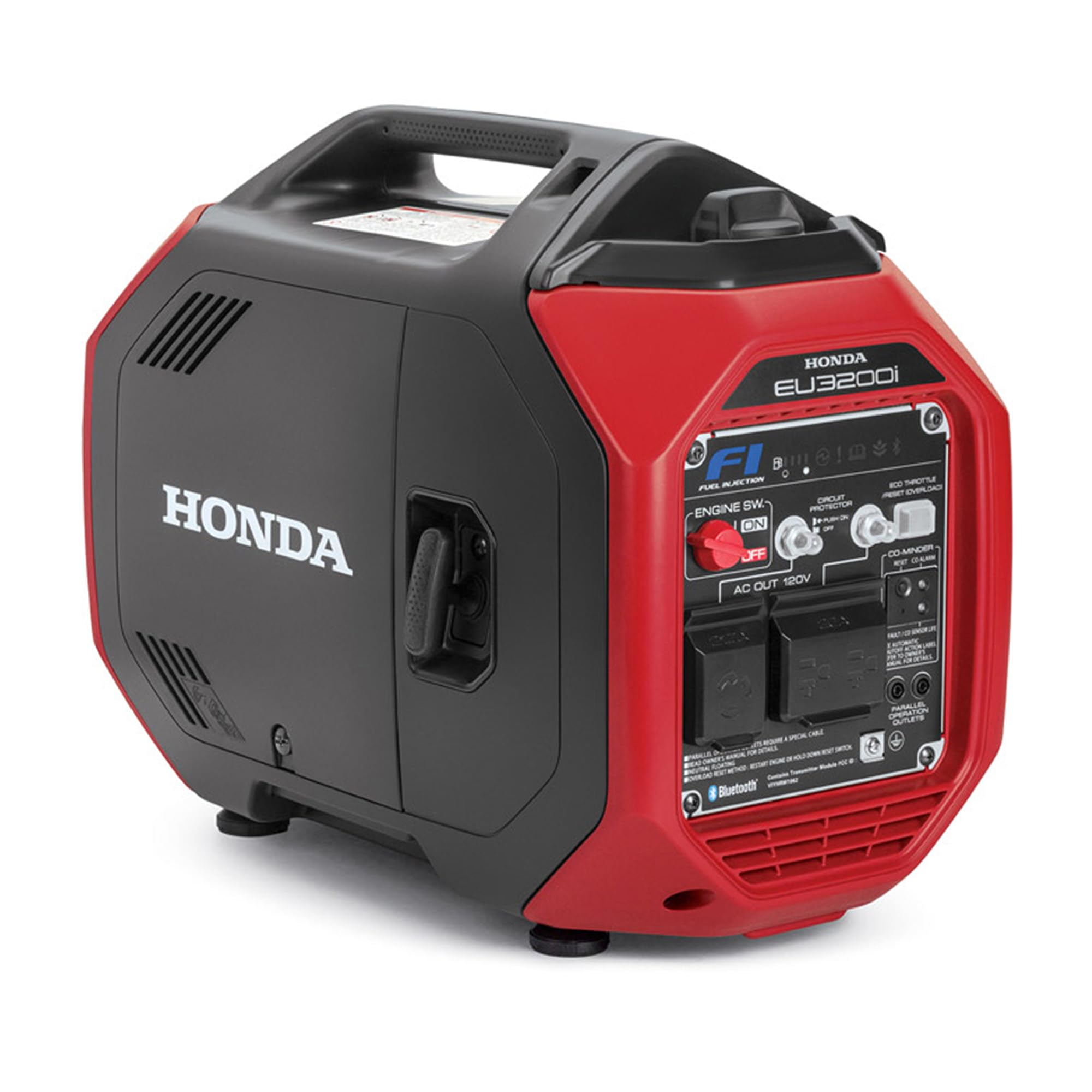
The whisper-quiet 66-pound Honda that runs a fridge at a normal conversation’s volume.
The Honda EU3200i is the gold standard for quiet, reliable power — and it earns its reputation with numbers. It operates at 54 to 58 dB(A), which is less noise than a normal conversation, so your neighbors genuinely won’t know you’re running it. That quiet operation is the most-praised aspect in its review data, and it’s the reason this is the go-to for anyone who values peace as much as power.
Honda’s exclusive My Generator smartphone app adds Bluetooth monitoring and control, including remote stop and service reminders. The 1.2-gallon tank delivers a flexible 3.3 to 8.6 hours of run time depending on load, with the Eco Throttle System stretching fuel efficiency dramatically at low demand.
Despite its modest 3,200 watts, it’s designed to handle furnaces, fridges, and most 13,500 BTU RV AC units. Weighing less than 60 pounds (listed at 66.1 pounds), it’s the easiest premium unit to load and store. One owner summarized the appeal simply: “No carburetor. No choke. Pull the cord and it started on the second yank.” The CO-MINDER system adds automatic shutoff protection, and the 3-year residential warranty backs it all up.
Why it’s legendary
- 54-58 dB(A) operation is quieter than a normal conversation.
- Honda reliability makes it a dependable workhorse — excellent for post-hurricane power.
- Weighs under 66 pounds, making it far easier to move than big-frame units.
The honest trade-off
- At 3,200 watts, it can’t power a whole house with AC.
- The price is significantly higher per watt than any other unit on this list.
Choose this if: silence, portability, and bulletproof reliability matter more to you than raw wattage.
pass on it if: you need whole-home power — this is a precision instrument for essentials, not a powerhouse.
Understanding the Specs
Running Watts vs. Peak Watts
Running watts is the power the generator delivers continuously — what your fridge and lights draw all day. Peak (surge) watts is the burst of power delivered for a few seconds when motors start, like when your well pump kicks on. Always size your generator so its running watts cover your steady load and its peak watts cover the surge of your biggest motor.
Dual Fuel and Tri Fuel Systems
Dual-fuel generators burn either gasoline or propane, letting you switch based on what you can find. Propane stores indefinitely and burns cleaner, which is why many owners prefer it for emergencies. Tri-fuel units add natural gas, giving you a direct pipe to your home’s gas line so you never need to refuel during a long outage.
DBA and Inverter Technology
Decibels (dBA) measure noise — lower is quieter, and most generators are rated from a distance like 23 feet. Inverter generators produce cleaner power with lower harmonic distortion (THD), making them safe for laptops and TVs, and they often run quieter and more fuel-efficiently than open-frame units.
Transfer Switch and 50A Outlets
A transfer switch connects your generator directly to your home’s electrical panel, letting you power hardwired circuits like a furnace without extension cords. For this, you need a generator with a 30A or 50A locking outlet (like L14-30R or 14-50R). This setup is safer and more convenient than running cords through windows.
FAQ
How many watts do I need to run a refrigerator and lights?
Can I run my whole house with a portable generator?
Is it safe to connect a generator to my house electrical panel?
What is the difference between a dual fuel and a tri fuel generator?
How long will a generator run on a full tank of gas?
Do inverter generators really protect my electronics?
What does CO Sensor or CO-MINDER do?
Can I use a generator during rainy or snowy weather?
Is it worth buying a generator with electric start?
What maintenance does a backup generator need?
Final Thoughts: The Verdict
For most homes, the backup generator for a home winner is the Westinghouse 6500 Watt Dual Fuel because its 14.5-hour runtime on a 4.7-gallon tank, dual-fuel flexibility (gasoline or propane), and 4.6-star rating from 900+ owners make it the most balanced, reliable way to keep your family’s essentials running all night. If you want whole-home power with a natural gas hookup and no fuel worries, choose the DuroMax XP13000HXT. And if whisper-quiet operation and portability matter most, the Honda EU3200i is the premium pick that owners say still starts on the second pull after years of use.
How We Picked
We do not accept paid placement. Every pick is matched to a real buyer and a real use-case; we do not hands-on test units.
Sources & Methodology
Specifications: manufacturer listings and product documentation. Review insights: verified customer reviews, as of September 2026. Pricing: not shown on this page (it changes often); check the current price via the retailer link.
As an Amazon Associate, KitchPrep earns from qualifying purchases. This does not affect which products we feature.
Related Guides
