
Specs are compiled from manufacturer listings and verified buyer reviews and can change over time — please confirm the key details on the product page before buying.
When you need serious bulk-storage cold, you face a chest-style deep freezer versus an upright model, and the size you actually need is bigger than you think. This guide sorts the honest, dependable 16-cubic-foot-class freezers from the ones that look great on paper but struggle to hold temperature, so you can buy once and stop worrying about thawed meat.
I’m Mohammad Maruf — the founder and writer behind KitchPrep. This guide is built by comparing the manufacturers’ published specifications and the patterns across verified customer reviews, so you get each pick’s real strengths and trade-offs instead of marketing spin.
We focus on real-world performance, noise, defrosting demands, and storage flexibility to help you choose the right 16 cu ft freezer for your home, garage, or small business without overpaying or undersizing.
Our Picks at a Glance

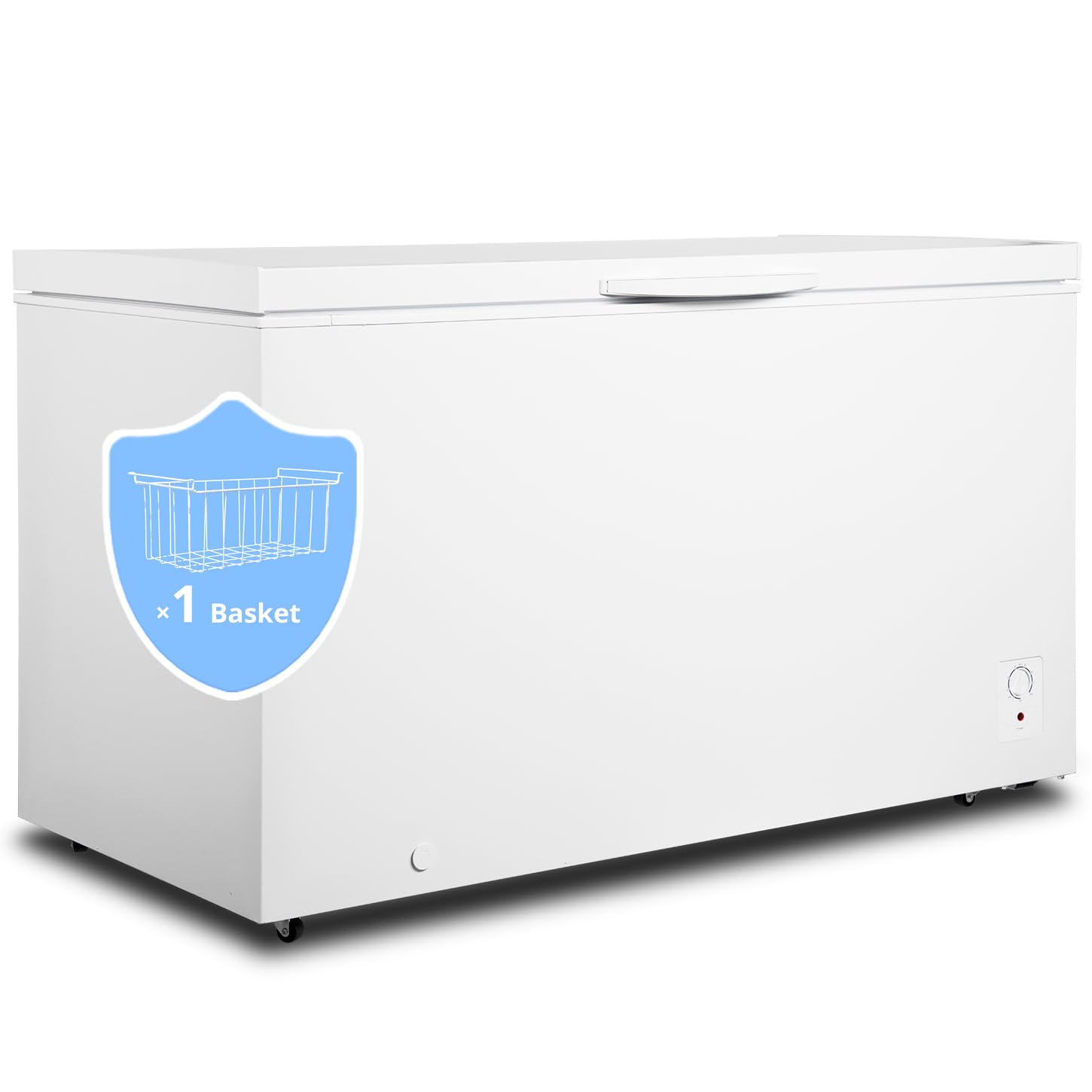

How To Choose The Best 16 Cu Ft Freezer
Choosing a freezer this size is a major-appliance decision, not an impulse buy. You are balancing how much food you store, where the unit will live, and how much maintenance you can tolerate — and every one of those answers points to a different style.
Match the style to your space and routine
A chest freezer keeps the cold locked in every time you open the top lid, since cold air sinks and stays put. An upright model takes up less floor footprint and makes rummaging easier with shelves, but it can be noisier and more prone to frost buildup without a frost-free system. If you are stocking a whole cow or bulk game meat, a chest with baskets is the classic answer.
Weigh defrost type against convenience
Manual-defrost chest freezers are simpler and usually cheaper to run, but you will need to shovel out ice and drain the water through the built-in drain a few times a year. Frost-free upright models eliminate that chore entirely, which is why they cost more upfront. Think about how much you value not spending an afternoon defrosting.
Check temperature range and control precision
For serious freezing you want a unit that can reach well below 0°F. Look at the dial or digital panel range — some models go down to -19°F, which matters if you are flash-freezing or storing ice cream that needs to stay rock-hard. A simple mechanical dial is fine for basic use, but a digital panel with 1°F adjustments gives you real control.
Don’t ignore noise, wheels, and delivery reality
A loud compressor in a garage is tolerable, but the same unit in a laundry room or office will drive you crazy. Check the stated noise level and look for casters or wheels if you will need to move it for cleaning. And remember that most of these arrive curbside — a 145-pound crate needs two strong people and a dolly to get inside.
Quick Comparison
| Model | Best For | Capacity | Defrost Type | Weight | Amazon |
|---|---|---|---|---|---|
| BLACK+DECKER BCF1620E★ Best Overall | Quiet home bulk storage | 16.2 cu ft | Manual | 141.1 lb | Amazon |
| SMETA DSC-400WUBest Value | Garage & RV flexibility | 18 cu ft | Manual | 128 lb | Amazon |
| VEVOR BD-505JATop Performer | Restaurant-grade capacity | 17.2 cu ft | Manual | 145.5 lb | Amazon |
| KoolMore SCF-16C | Lockable secure storage | 15.9 cu ft | Manual | 139 lb | Amazon |
| VEVOR BD480WE | Upright frost-free convenience | 17 cu ft | Frost Free | 165.4 lb | Amazon |
| BLACK+DECKER BUC2120MS | Convertible fridge/freezer | 21.2 cu ft | Frost Free | 176.4 lb | Amazon |
| VEVOR RI-460A | Ice cream shop display | 16.3 cu ft | Manual | 152.1 lb | Amazon |
| KoolMore MCF-16C | Retail frozen treat display | 16 cu ft | Manual | 172 lb | Amazon |
| Galanz French Door | Kitchen counter-depth fridge | 16 cu ft | Frost Free | — | Amazon |
In-Depth Reviews
1. BLACK+DECKER 16.2 Cu. Ft. Chest Freezer
Our pick — 4.5★ from 450+ verified ratings; the strongest balance of quality and price.
The chest freezer that impressed the biggest crowd — 4.5 stars across 400+ owners — and the reason is simple: it just works.
You get a 16.2 cubic foot interior wrapped in a white steel top-opening chest that buyers report is “so quiet most of the time I forget we even have it.” The mechanical temperature dial sits on the outside with indicator lights, so you adjust the cold without lifting the heavy lid and losing all that chilled air.
Two removable storage baskets ride on top of the space, which is exactly what makes this the best overall. Toss quick-grab items like pizzas and popsicles in the baskets, and dig for bulk meat below without shifting everything. It pulls double duty, too — one owner notes it’s “perfect for storing breast milk,” while others love it for small kitchens, apartments, and single-person overstock.
The main trade-off is manual defrosting, which means periodic ice removal. That means a periodic ice-chipping session, though the easy-access front drain makes the job faster than on older chest freezers. Also, it needs to sit unplugged for about 72 hours before first use to let the oil and refrigerant settle — a small patience tax before the cold kicks in.
What wins people over
- Remarkably quiet operation — owners forget it’s running
- Two removable baskets keep grab-and-go items organized on top
- Mechanical dial lets you adjust temperature without opening the lid
- Easy-access drain simplifies the manual defrost chore
The fine print
- Manual defrost means occasional ice removal
- Requires a ~72-hour settle period before the first plug-in
Your pick if: you want the most-reviewed, most-loved quiet chest freezer for home bulk storage.
Think twice if: you never want to defrost anything by hand again — you’d prefer a frost-free upright.
2. SMETA Chest Freezer 18 Cubic Feet
The space-maximizer that gave buyers a full 18 cubic feet for less than many 16-cubic-foot rivals charge.
SMETA squeezes an 18 cubic foot capacity into a 28″D x 54″W x 34″H footprint, making it 11% bigger than the BLACK+DECKER 16.2 while taking up no more floor space. It arrived at one laundry room already at -6°F within a few hours of plugging in, which tells you the R600a compressor does not mess around.
At 128 pounds, it is noticeably lighter than the VEVOR 17.2 — a 145.5-pound competitor — and light enough that one person can handle it during setup. The upper removable basket slides out so you can see what’s underneath, and the front water drain with the embossed aluminum liner makes defrosting straightforward. Owners mention their energy bills didn’t change after a full month of running it, so it sips power rather than gulping it.
Minor gripes: no interior LED light and only one basket included. A few units arrived with transit dents — usually a delivery issue, not a performance one — and the occasional unit had a hiccup that a simple unplug-and-reboot fixed.
Why it’s a value king: more cubic feet than the top pick at a lower price tier, near-silent at ≤43dB, and energy-efficient enough that one owner saw no bill change after a month.
Grab it for: garages, basements, laundry rooms, or RVs where you want maximum cold storage on a budget.
Be ready for: no interior light and only one basket from the factory — you may buy a second basket later.
3. VEVOR Chest Freezer 17.2 Cu.ft
The restaurant-grade chest that runs at just 1.62 kWh per day and rolls around on 6 wheels.
This is the biggest and most feature-dense chest freezer in our mid-range group, with 17.2 cubic feet (488 L) of storage split across 4 removable baskets. It targets small restaurants, coffee shops, and bars alongside serious home cooks, and it earns that commercial badge with a locking lid, LED interior lighting, and a working indicator light so you always know it’s running.
The cooling story is strong: VEVOR claims just 1.62 kWh per day of energy use, and owners who ran it for 6+ months call it “more than ample” and “fast freeze, nice.” The 7-level adjustable temperature spans from -28 to -12°C for freezing, plus a separate 0 to 10°C zone, so in theory this unit could double as cold storage for things you don’t want frozen solid.
The balanced hinge lid holds open at 45° to 90° angles for hands-free loading, and 6 casters make it the easiest big chest to reposition. The tight suction seal can resist reopening for a few minutes after closing. One buyer’s first unit arrived DOA, though the replacement has “been wonderful.”
Built for heavy use
- 4 removable baskets organize bulky turkeys, ribs, and pizzas
- Locking lid secures contents from staff or kids
- LED lighting makes night-time loading visible
- 6 wheels glide across the floor for cleaning
Worth noting
- The tight seal can resist reopening for a minute after closing
- Heaviest chest here at 145.5 pounds — needs a dolly for delivery
Reach for it if: you’re stocking serious bulk for a household or a small food business and want lockable, lit, mobile storage.
Look elsewhere if: you want the lightest unit to move — at 145.5 lb it is 14% heavier than the SMETA’s 128 lb.
4. KoolMore SCF-16C Chest Freezer

The lockable workhorse that holds a full cow and shrugs off a Florida garage summer.
KoolMore brings a 15.9 cubic foot chest with a serious security bent: a heavy-duty built-in lock with key keeps guests, staff, or hungry teenagers out of the prime steaks. It’s certified by ETL to NSF 7 standards, meaning it meets strict commercial food-service temperature requirements, not just home-use expectations.
The 1/5 hp compressor holds between 0 and -8°F, and owners running it in hot garages report it maintains a reliable -4°F even in Florida heat. One buyer called it “large enough for a full cow,” and a mobile food vendor says it runs smoothly on inverter truck power at -20°F on the standard setting — so this is a freezer that takes real abuse and keeps performing.
The widespread praise centers on solid performance and build quality, with caster wheels that roll smoothly across a garage or mudroom floor. Durability is the honest question mark — cosmetic dents appear on some deliveries, and one owner reported a complete failure just under a year in. It’s a small number of voices against a strong crowd, but worth knowing before you rely on it for 500 pounds of meat.
The security angle: if you need to lock down expensive meat or control access in a shared space, the built-in keyed lock sets this apart from every other chest here.
Choose this for: garages, mudrooms, or commercial back rooms where lockable, mobile, NSF-certified freezing matters.
Budget for: the small chance of an early failure — the longevity track record is the weakest stat in an otherwise positive review pile.
5. VEVOR Convertible Freezer/Refrigerator 17 Cu.Ft
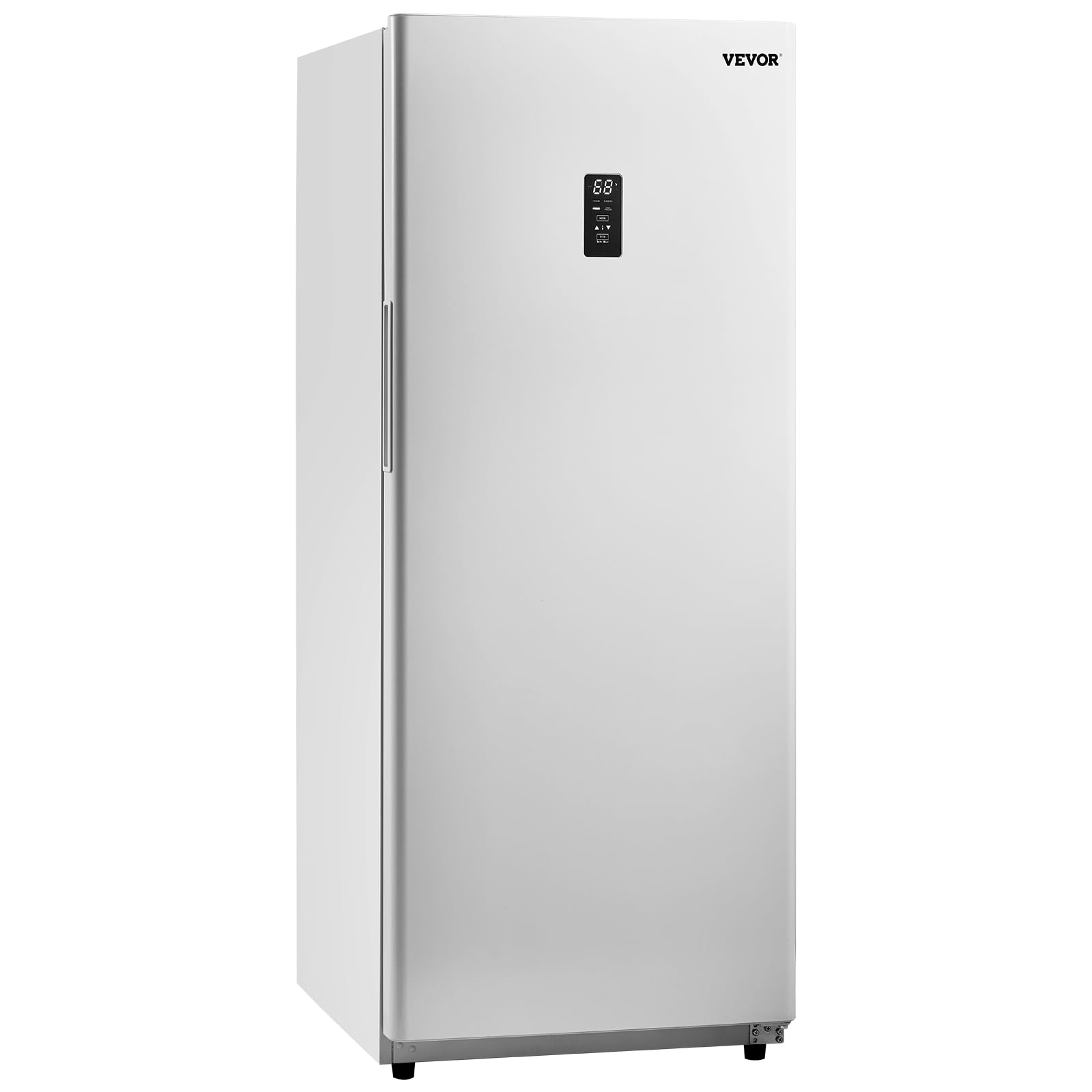
The frost-free upright that stands in a corner, beeps if you leave the door open, and never needs manual defrosting.
If you hate the ice-shoveling ritual of chest freezers, this is your cure. The 17 cubic foot (480 L) upright uses a frost-free fan cooling system that eliminates manual defrosting entirely, and it sips just 1.1 kWh per day while doing it. It converts between freezer and refrigerator modes, so one appliance can flex with your seasons — deep freeze for hunting season, fridge mode for holiday parties.
Inside, 4 adjustable shelves, a basket, and door racks give you the upright-style organization a chest can’t match. The digital control panel adjusts temperature in 1°F increments and switches between Fahrenheit and Celsius, with 4 cooling modes. A door-open alarm triggers if the door stays ajar for more than 3 minutes — a real safeguard for forgetful households. Owners put it in an office and report it’s “super quiet,” with everything staying “frozen solid” even after a year of use.
It stands on front leveling legs plus 2 rear wheels, and its narrow 6.18 ft² footprint slides into tight corners where a chest freezer never would. The door seal is so tight it requires a firm two-handed pull to open. One owner keeps one hand on the freezer body and pulls with the other, or the whole unit tips toward them.
The upright advantage
- Frost-free — zero manual defrosting, ever
- Digital panel with 1°F-accurate temperature control
- Door-open alarm after 3 minutes protects your food
- 4 adjustable shelves make items easy to find
Adjust your grip
- The tight door seal demands a strong two-handed pull
- At 165.4 lb it’s the heaviest unit in this lineup
Best suited for: offices, kitchens, and garages where frost-free convenience and a small floor footprint beat raw bulk capacity.
The trade-off: you give up chest-style space and gain a stubborn door seal that takes real muscle to open.
6. BLACK+DECKER 21.2 Cu. Ft. Convertible Freezer Refrigerator
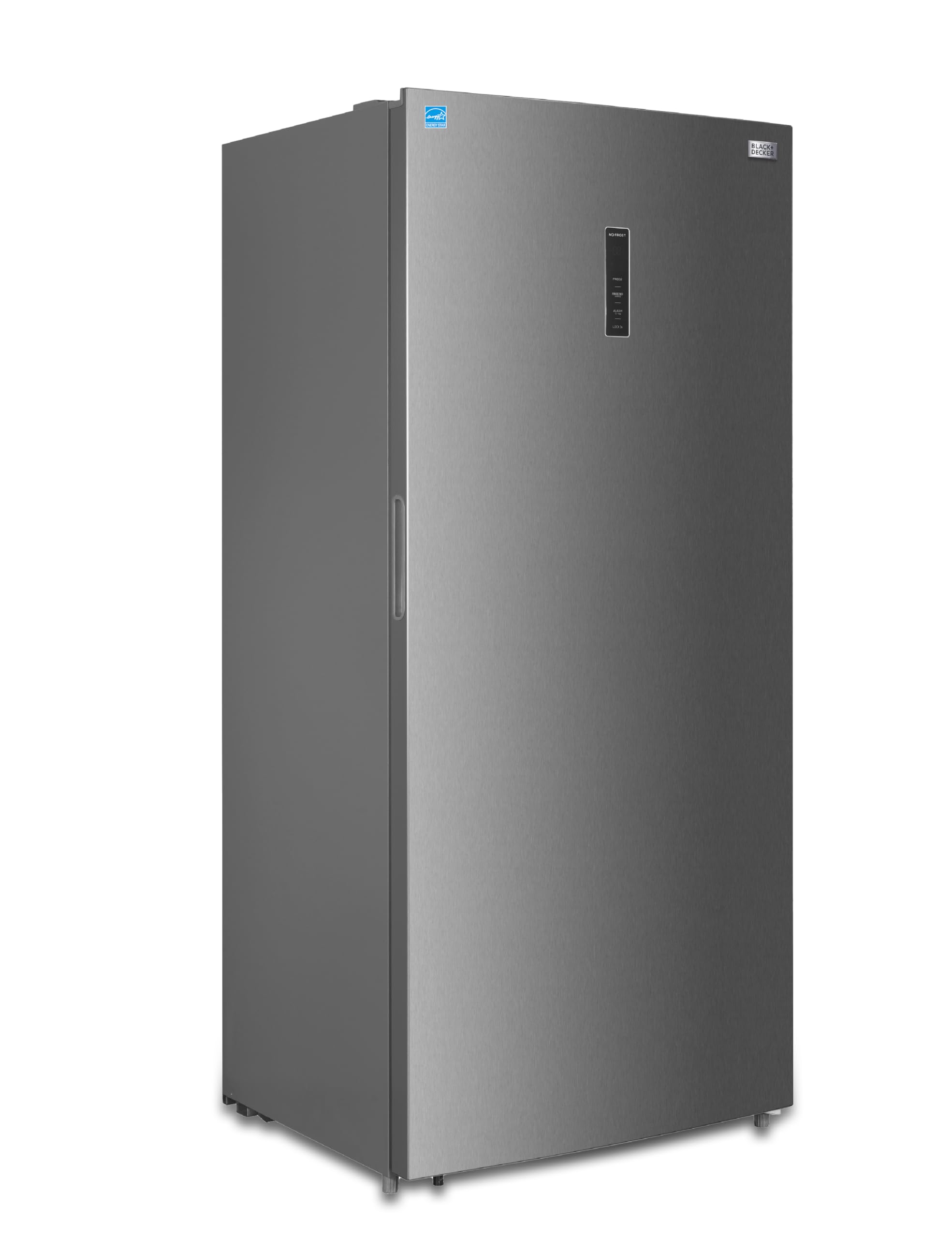
The stainless-look upright that flips between a deep freezer and a full fridge with one tap on the LED display.
This is the ultimate space-flexer: a 21.2 cubic foot upright that runs as a deep freezer when you need bulk storage, then converts to a full-size refrigerator when hunting season ends or you host Thanksgiving. The LED display and electronic controls manage both modes precisely — customers note reaching 32°F in fridge mode and -9°F in freezer mode within hours of plugging in.
The ENERGY STAR rating means it meets strict efficiency standards, and the frost-free technology means no manual defrosting in either mode. At 29.5″D x 33.1″W x 74.6″H, it’s a full-height appliance that stands against a wall rather than spreading across the floor like a chest. The stainless-look finish resists smudges, the door is reversible for left- or right-handed kitchens, and buyers consistently call it quiet.
The convertible magic is the headline, but so is the space: it ships with large shelves that one buyer says make it “25% bigger” than comparable alternatives. A minority of reviewers point out inconsistent temperature control, and some units arrived damaged with slow manufacturer support, though Amazon resolved those cases. One unit lost cooling after 2 months but came back with a simple unplug-reset.
The flexibility payoff: no other pick here switches between fridge and freezer modes, which makes this the one-appliance solution for a garage or basement that changes jobs with the seasons.
Pick this if: you want one ENERGY STAR appliance that can be a 21.2 cu ft freezer today and a full fridge tomorrow.
Factor in: a small minority report temperature drift, and the 176.4-lb weight makes setup a two-person job.
7. VEVOR Commercial Ice Cream Display Case 16.3 Cu.ft
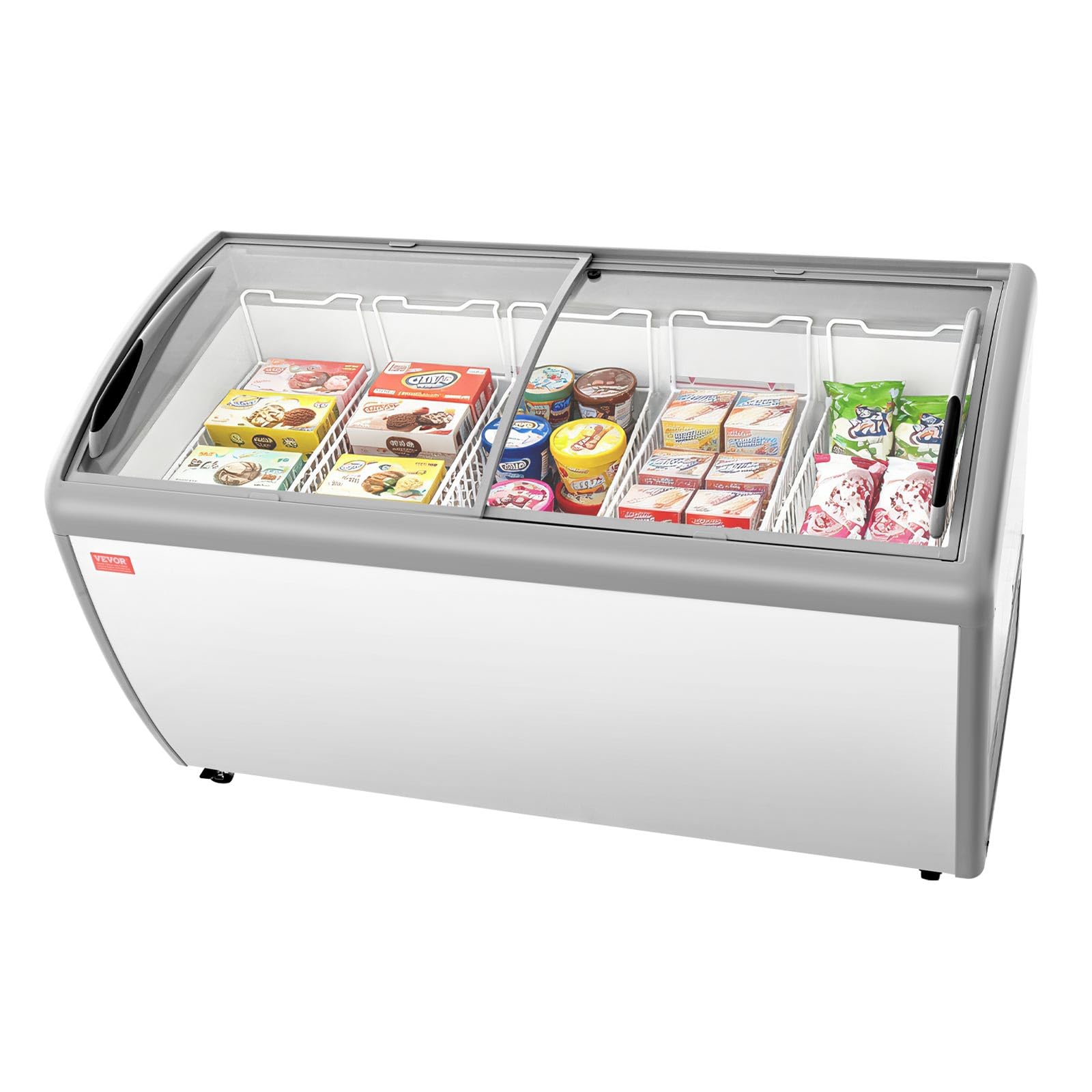
The glass-topped showpiece that displays every flavor under LED light while keeping treats at -19 to 3°F.
This is a chest freezer built to sell, not just store. Two tempered glass sliding doors slide both ways for easy access while keeping ice cream visible and secure under built-in LED strip lighting. The 16.3 cubic foot (460 L) interior holds 5 wire baskets for organizing flavors, with extra bottom space for backup stock.
The upgraded digital LCD panel shows real-time temperature and adjusts in precise 1°F steps across a -19 to 3°F range — cold enough to keep ice cream scoop-ready firm, not soupy. Four locking casters let you roll the whole display case to a new spot and lock it down for cleaning or a storefront rearrangement. Owners who run shops say it keeps “frozen treats at temp and displays them well,” and the sliding glass doors are removable for easy loading and washing.
This is a storefront investment, not a garage freezer, and early reviews are mixed. Most owners are a few weeks to a few months in and happy, but a couple report it struggles to freeze items solidly, taking days to drop temperature. One notes the lack of an obvious control knob despite the manual, requiring a few days of fiddling to dial in the right setting for a storefront.
Built to showcase
- Tempered glass sliding doors display flavors and slide both ways
- 5 wire baskets plus bottom space for high volume
- LED strip lighting makes products pop
- Locking casters reposition the whole unit easily
The commercial catch
- Freezing speed is hit-or-miss in early owner reports
- Control setup can take days to dial in correctly
Built for: ice cream shops, convenience stores, and cafes that want a self-service display that doubles as cold storage.
Not for: home bulk freezing — this is a merchandising tool first, a freezer second.
8. KoolMore MCF-16C Commercial Ice Cream Freezer
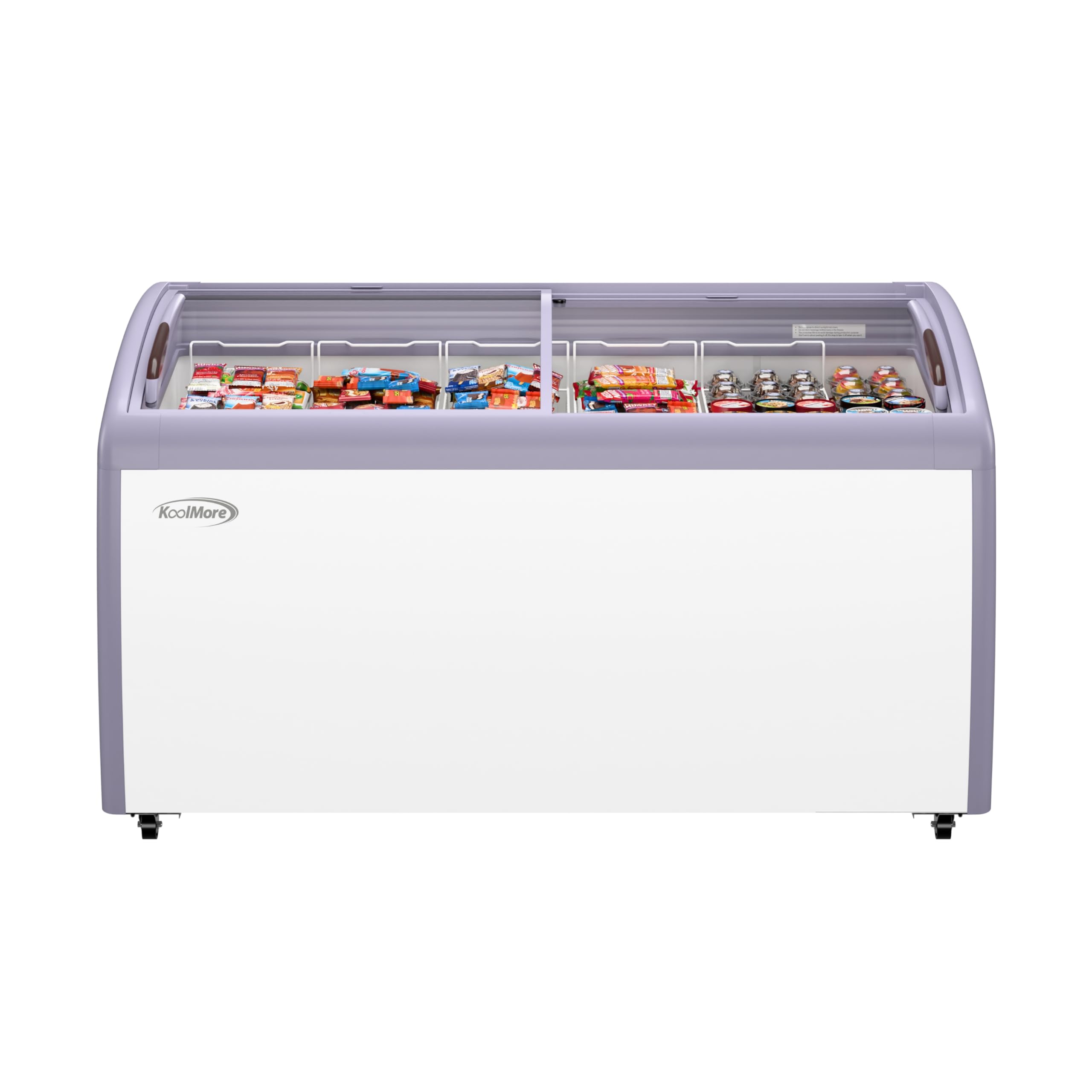
The NSF 7-certified display case that keeps ice cream firm but scoopable while winning compliments from customers.
KoolMore’s commercial display chest holds 16 cubic feet of frozen treats at the ideal serving range of -15°F to 10°F, meaning the ice cream stays firm but ready to scoop without a thawing wait. It’s certified by ETL to NSF 7 standards, so commercial health inspectors will recognize the safety credentials. The curved, lockable tempered glass top and bright LED lighting make every pint look irresistible — small shop shoppers say customers complimenting the display.
Inside, 5 removable PVC-coated baskets keep flavors or product types separated, and the coating resists rust and corrosion from constant moisture. The unit runs on a standard outlet and rolls on wheels for easy repositioning.
The realistic trade-offs for a commercial unit: there is no digital temperature display — just a dial with a default around -4°F — and the fan runs loud enough that some owners notice it. Heavy frost buildup was reported after a year of constant door openings, requiring periodic chiseling, and the top glass doors don’t fully auto-close by themselves. It’s also a hefty 172 pounds, typically curbside delivery only.
Why shops love it: the display quality, consistent serving temperature, and NSF 7 certification make it a legitimate retail investment, not a garage freezer in disguise.
Buy it for: small shops, markets, and anyone selling scooped or packaged frozen treats who needs certified commercial cold storage.
Expect: a loud fan, a manual dial instead of digital controls, and frost that builds up if the glass doors stay open all day.
9. Galanz 3-Door French Door Refrigerator with Bottom Freezer

The counter-depth French door fridge whose 16 cubic feet hides a frost-free bottom freezer in a small-kitchen silhouette.
This is a different animal entirely: a full French-door refrigerator with the freezer on the bottom, measuring just 28.3″ W x 29.3″ D x 70″ H. It’s built for the household that needs one appliance to do everything in a tight space — not for bulk freezing a side of beef. The 16 cubic feet splits between a roomy fridge section and a slide-out bottom freezer with 2 full-width storage drawers.
The fridge side earns consistent praise for its thoughtful layout: 2 half-width crisper drawers with humidity control keep produce fresh, while 3 full-width glass shelves slide out for easy spill cleanup. The finish is a clean white that fits small kitchens, and buyers report quiet operation with a low-global-warming-potential hydrocarbon refrigerant. One owner bought it for his grandmother, who “loves it” and finds everything easy to access.
Temperature control draws the most mixed feedback of any feature. Some owners mention it maintains the preferred temperature flawlessly, while others say it drifts. Reliability is split: one buyer’s unit failed after 8 months, and manufacturer support was hard to reach. If you need this as your only fridge, consider an extended warranty or a backup plan.
The kitchen-first design
- Counter-depth footprint fits tight kitchen spaces
- Crisper drawers with humidity control keep produce fresh
- Slide-out glass shelves make spills easy to clean
- Frost-free bottom freezer with 2 full-width drawers
Know before you buy
- Temperature control draws the most mixed feedback
- Reliability reports are split, with some hard-to-reach support experiences
- Needs about 6 inches of wall clearance for full door opening
Ideal when: you need a full-featured refrigerator with a usable freezer in a small kitchen, not a dedicated bulk freezer.
Proceed with care if: this will be your only fridge — the mixed temperature control and reliability reports argue for a sturdy warranty.
Understanding the Specs
Chest vs Upright Design
This is the first fork in the road. A chest freezer opens from the top, and because cold air sinks, it holds its temperature better every time you open it — which means cheaper running costs and better food safety during power blips. The trade-off is floor space and digging through baskets. An upright opens from the front like a fridge, so items are visible on shelves and easier to reach, but every door opening spills cold air out. Uprights usually need frost-free tech to stay usable, which adds cost.
Manual Defrost vs Frost Free
Manual defrost means you periodically turn the unit off, let the ice melt, and drain the water through a built-in port — typically every few months depending on humidity and how often you open the door. It’s simpler and cheaper to run, but it’s a real chore. Frost-free systems circulate air to stop ice from forming in the first place, so you never shovel frost. The trade-off is higher upfront cost and sometimes a touch more noise from the circulation fan.
Temperature Range and Control
A freezer that only reaches 10°F is fine for keeping things frozen, but it won’t keep ice cream rock-hard or flash-freeze fresh meat well. Look for a range that dips to at least -4°F, and ideally lower — some commercial units here reach -19°F. Control type matters too: a mechanical dial is basic and reliable, while a digital panel lets you set exact temperatures in 1°F steps. For ice cream serving, a warmer range like -15°F to 10°F is actually a feature so product stays scoopable.
Refrigerant and Energy Use
Most modern freezers use R600a or R-290, hydrocarbon refrigerants that cool efficiently with a low global-warming potential. You’ll also see daily energy consumption stated in kWh per day — lower numbers like 1.1 kWh mean cheaper monthly bills. The VEVOR convertible upright claims 1.1 kWh per day, while the larger chest units claim around 1.62 kWh. If energy cost matters, compare those daily figures.
FAQ
What is the real difference between 16 and 18 cubic feet of freezer space?
Can I put a chest freezer in an unheated garage during winter?
How long does a chest freezer take to reach freezing temperature after plugging in?
How often do I need to defrost a manual-defrost chest freezer?
What does R600a refrigerant mean for my freezer?
Is a frost-free upright freezer worth the extra cost over a chest freezer?
What does NSF 7 certification mean for a freezer?
Can I use a chest freezer as a refrigerator instead?
How much space does a 16 cubic foot chest freezer need around it?
What is the loudest part of a chest freezer and how noisy should I expect it to be?
Final Thoughts: The Verdict
For most homes, the 16 cu ft freezer answer is the BLACK+DECKER 16.2 Cu. Ft. Chest Freezer because it pairs a large, well-organized 16.2 cubic foot interior with remarkably quiet operation and two baskets that owners genuinely love. If you want the most cubic feet for your money and don’t mind a manual dial, the SMETA 18 Cu. Ft. stretches capacity without stretching your budget. And for buyers who refuse to hand-defrost, the VEVOR Convertible Upright is the frost-free, space-saving pick that also doubles as a refrigerator. Whatever you choose, measure your space, plan for a two-person delivery, and let the unit settle before you plug it in.
How We Picked
We do not accept paid placement. Every pick is matched to a real buyer and a real use-case; we do not hands-on test units.
Sources & Methodology
Specifications: manufacturer listings and product documentation. Review insights: verified customer reviews, as of September 2026. Pricing: not shown on this page (it changes often); check the current price via the retailer link.
As an Amazon Associate, KitchPrep earns from qualifying purchases. This does not affect which products we feature.
Related Guides
