
Specs are compiled from manufacturer listings and verified buyer reviews and can change over time — please confirm the key details on the product page before buying.
A battery-operated generator is simply a giant, rechargeable power bank that runs your appliances through a standard wall outlet — no gas, no exhaust, no pull-cord. The real buying question is always the same: how much power do you need to keep your fridge, lights, or tools running, and for how long? This guide walks you through the best options by matching capacity and output to your actual use, whether that is a weekend campsite or a multi-day home outage.
I’m Mohammad Maruf — the founder and writer behind KitchPrep. This guide is built by comparing the manufacturers’ published specifications and the patterns across verified customer reviews, so you get each pick’s real strengths and trade-offs instead of marketing spin.
Here are the best portable power stations that replace a gas generator for home backup, camping, and off-grid living.
Our Picks at a Glance


How To Choose The Best Battery Operated Generator
Before you pick a model, you need to solve for two separate numbers: the total energy stored (measured in watt-hours, or Wh) and the maximum power it can push out at once (measured in watts, or W). Capacity tells you how long a device runs; wattage tells you if the device will start at all. A portable power station with a 2048Wh battery can run a 100W light bulb for roughly 20 hours, but it might still struggle to start a 1500W space heater if its inverter caps lower.
Match capacity to your real outage or trip
For a weekend camping trip or a short storm outage, a compact unit around the 1000Wh mark usually covers lights, phones, a laptop, and a small fridge. If you are prepping for multi-day blackouts or want to run heavy loads like air conditioners, power tools, or a full-size refrigerator, you will want a 2000Wh-class station. Buyers report that a 13.5K rooftop AC keeps running on the 2048Wh BLUETTI AC200L, which shows how much headroom the larger capacity buys you.
Check the battery chemistry for longevity
All the serious options here use LiFePO4 (lithium iron phosphate) cells, a chemistry that tolerates far more charge cycles than standard lithium-ion. The marketing numbers translate simply: a station rated for 3000 cycles to 80% capacity will still hold most of its charge after years of daily use. These batteries also run cooler and carry a lower fire risk, which is why brands feel confident backing them with multi-year warranties.
Quick Comparison
| Model | Best For | Capacity | Rated Output | Weight | AC Ports | Amazon |
|---|---|---|---|---|---|---|
| BLUETTI AC200L★ Best Overall | Heavy home backup | 2048Wh | 2400W | 61.4 lb | — | Amazon |
| BLUETTI Elite 100 V2Compact Pick | Weekend portability | 1024Wh | 1800W | 25 lb | — | Amazon |
| EcoFlow DELTA 3 PlusFast Charging | Versatile fast charging | 1024Wh | 1800W | 27 lb | — | Amazon |
| Dabbsson 2000L | Rugged value | 2048Wh | 2200W | 41 lb | 6 | Amazon |
| Anker SOLIX S2000 | Fridge backup & space saving | 2010Wh | 1500W | 35.7 lb | — | Amazon |
| DJI Power 2000 | Quiet multi-person use | 2048Wh | 3000W | 47.9 lb | 4 | Amazon |
| Jackery Explorer 2000 v2 | Lightest 2kWh class | 2042Wh | 2200W | 39.5 lb | 3 | Amazon |
| EcoFlow DELTA 3 Max | High-demand appliances | 2048Wh | — | — | — | Amazon |
| Jackery Explorer 2000 Plus | Expandable whole-home prep | 2042Wh | 3000W | 62 lb | — | Amazon |
In-Depth Reviews
1. BLUETTI AC200L Portable Power Station
Our pick — over 4.5★ from 500+ verified ratings; the strongest balance of quality and price.
The heavy-duty workhorse that runs a 13.5K rooftop AC and still has room to grow.
The AC200L is the full-size answer for serious home backup and van life. Its 2048Wh battery and 2400W output carry a 1500W kettle and a 12000 BTU A/C at the same time — owners mention a full 4 hours of solar-fed A/C on sunny days. That muscle earns it the top spot here, and the crowd agrees: it holds a 4.8-star average across 500+ owners.
Where it surprises is speed. It takes just 45 minutes to hit 80% from a wall outlet, and up to 1200W of solar input can top it off in 1.7-2.2 hours. The real flexibility comes from expansion: add battery packs to reach a maximum of 8192Wh, or use the 30A RV port to charge your rig’s battery with the D40 voltage regulator. Owners consistently highlight its dependable performance on multi-day trips.
The trade-off is physical. At 61.4 pounds, this is not a one-handed grab — some owners say moving it takes two people. It also runs a quiet fan rather than a noisy charging brick, a detail owners specifically call out as an upgrade over the older AC200 Max. If your priority is raw capacity and you can live with its heft, this is the most capable single unit in the lineup.
What earns its keep
- 2400W output with 3600W Power Lifting surges for motor-heavy tools
- Reaches 80% charge in 45 minutes from a wall outlet
- Expandable to 8192Wh with BLUETTI’s battery packs
The honest cost
- 61.4 lb frame is a two-person lift for most owners
- Accessory battery packs push the total price up fast
Reach for this if: you need whole-home backup muscle and plan to run heavy appliances like A/C units or power tools for hours at a time.
Think twice if: you need to carry it solo — at 61.4 lb, this stays closer to home than the campsite.
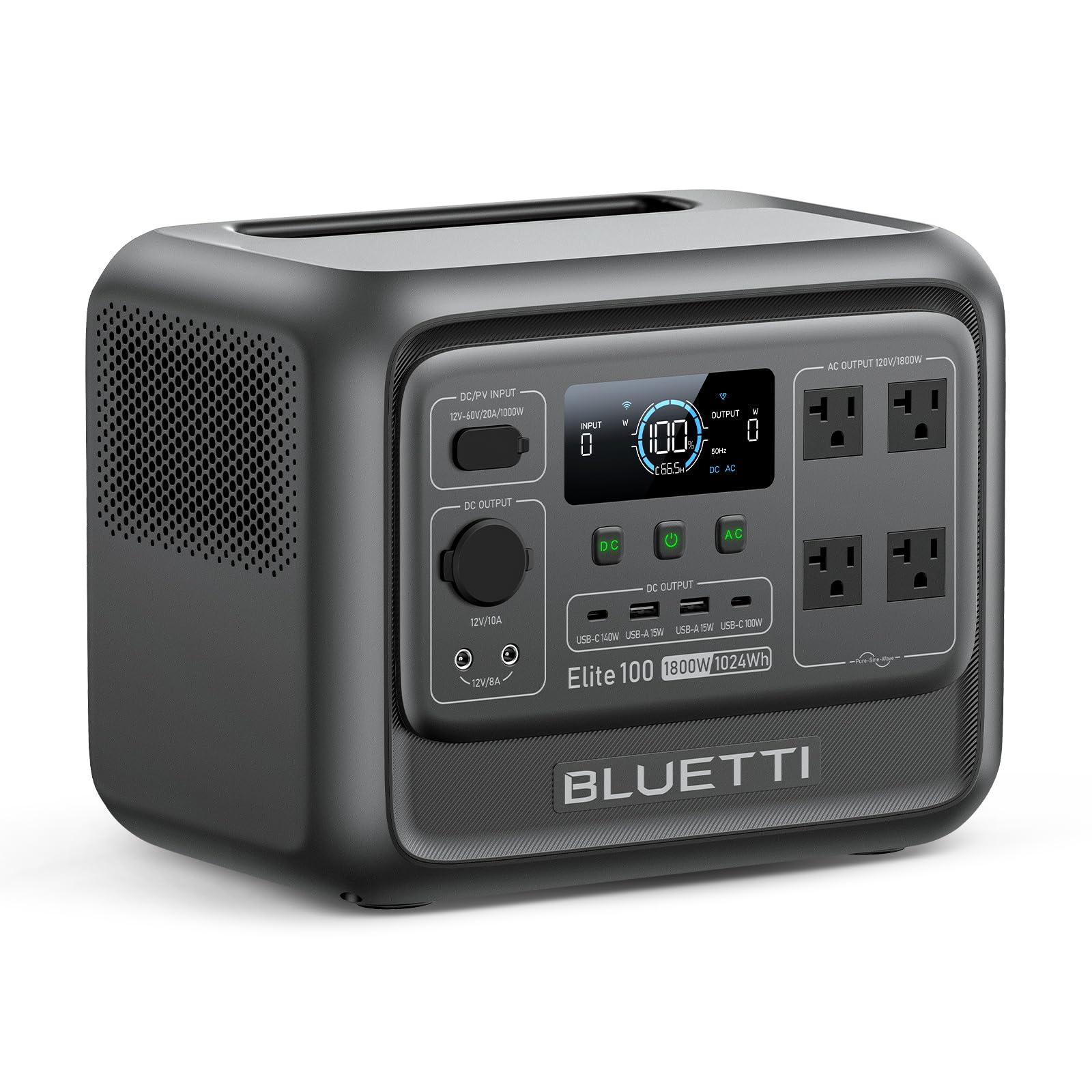
2. BLUETTI Elite 100 V2 Portable Power Station
Half the capacity of the AC200L at 25 pounds, built for one-handed trips to the campsite.
The Elite 100 V2 makes a compelling case for buyers who want real power without the 61.4-pound backache of its bigger sibling. It packs a 1024Wh battery and 1800W rated output (2700W Power Lifting) into a compact body that weighs just 25 pounds — a dramatic weight and size drop that makes it feel like a different class of product. Buyers describe it as big enough for weekend use with a nice mix of bulk and capacity.
Charging keeps pace with the bigger units: a 1200W TurboBoost AC input or up to 1000W of solar can refill it in about 70 minutes. That same solar input is the fastest for a 1kWh station, per BLUETTI. Unusual for this size, it also acts as a UPS with a 10ms switchover — customers note keeping Wi-Fi routers and PCs running through outages with zero interruption. Buyers running astrophotography gear in remote areas draw roughly 34-60W and get 6.5-7 hours of run time, up to 8 hours.
If you need to carry your power source, this model trades capacity for portability. It uses the same LiFePO4 (lithium iron phosphate, a long-lasting battery chemistry) as the AC200L, but holds 1024Wh versus 2048Wh, so a space heater will drain it faster. In silent mode it drops to 30dB (about as loud as a whisper), quiet enough for overnight camping indoors. For moderate loads where weight matters more than raw capacity, this balances carry weight and capability.
Why it wins: the 2.5x weight advantage over the AC200L (25 lb vs 61.4 lb) plus the fastest solar charging in its class make it the standout for travel-heavy buyers.
Where it yields: half the capacity of the flagship AC200L means heavy loads like A/C units will drain it in a fraction of the time.
3. EF ECOFLOW Portable Power Station DELTA 3 Plus
The 40-minute sprint to 80% makes this the fastest-refilling 1kWh station around.
The DELTA 3 Plus answers the most common complaint about smaller stations — slow refills. With 1500W AC input it hits 80% in just 40 minutes, and owners confirm real-world numbers, with one reporting a jump from 21% to 100% in 75 minutes. At 1024Wh and 1800W output, it powers 13 appliances at once, and X-Boost handles resistive loads over 2200W continuously. It holds a 4.7-star average across 600+ owner reviews.
Its 27-pound frame sits between the Elite 100 V2 and the bigger 2kWh units, making it a middle-ground option for campers and home-office UPS duty. A 10ms switch-over UPS protects sensitive gear like NAS servers and POS systems from data loss during outages — a feature usually reserved for pricier models. Buyers praise its quiet operation and dual MPPT solar inputs supporting 1000W, with one owner running a fridge for 2.5 hours using just 18% of the battery, estimating about 12.5 hours total.
EcoFlow’s ecosystem adds flexibility: pair it with DELTA 3, DELTA Pro 3, or DELTA 2 Max battery packs to expand up to 5kWh. The smart app offers 12-hour storm alerts and charge scheduling, though some owners find the app intrusive. The recurring trade-off is a high idle draw — roughly 15W with AC off and 45W with it on — so it drains slowly even when nothing is plugged in. If you value your time more than your patience, this is the fastest top-up in the 1kWh class.
Street cred
- 80% charge in 40 minutes from a wall outlet
- 10ms UPS switchover protects computers and NAS drives
- Expandable up to 5kWh with EcoFlow battery packs
Watch out
- High idle draw drains battery even when unused
- 27 lb is heavier than the Elite 100 V2’s 25 lb
Grab this for: home office UPS duty or campsites where you need a fast top-up between heavy uses.
Pass it by if: you need the full 2048Wh headroom of the larger units for multi-day outages.
4. DABBSSON Portable Power Station 2000L
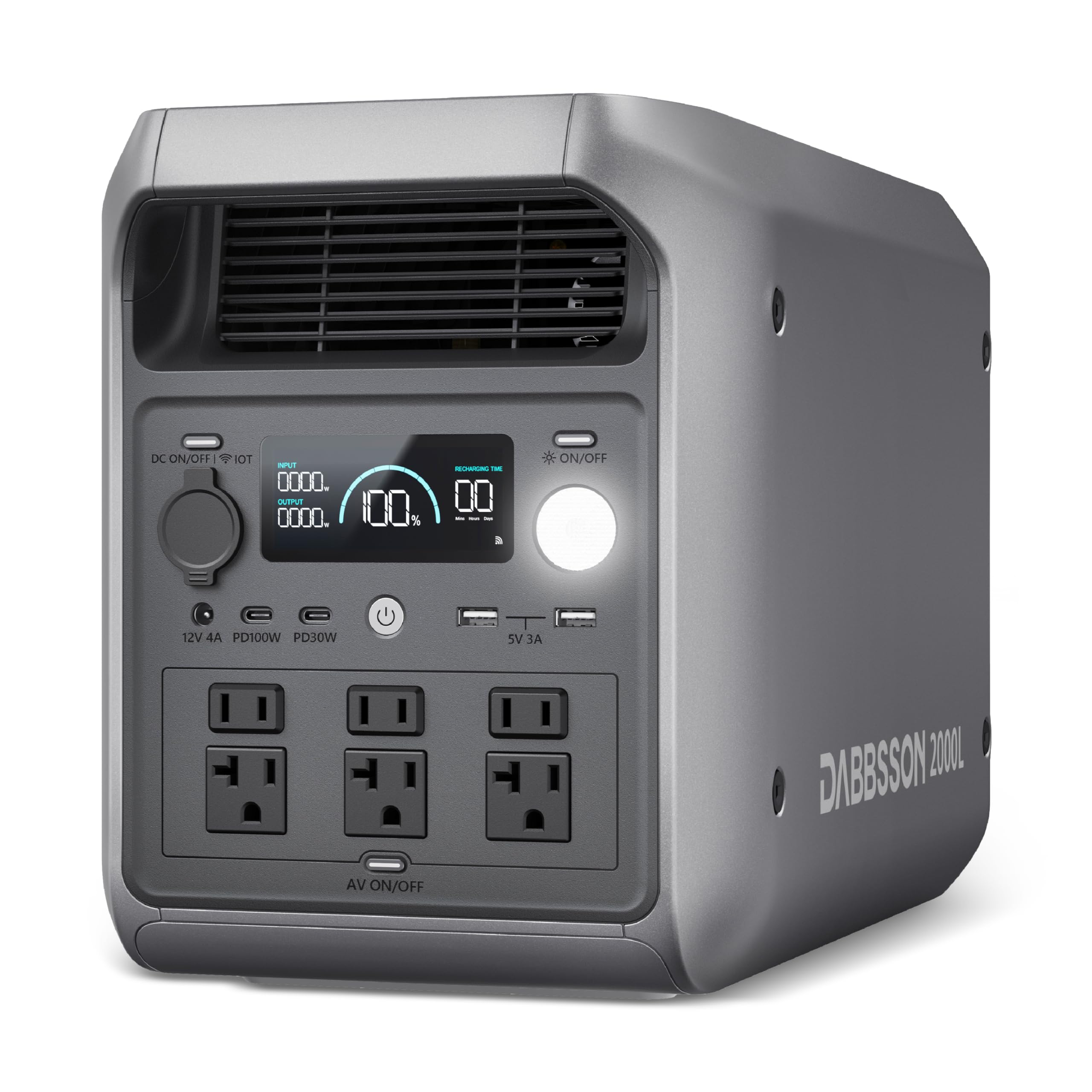
Semi-solid LiFePO4 cells and a 3300W surge set this apart in the 2kWh value tier.
The Dabbsson 2000L brings a genuinely different battery tech to the 2kWh class. Its semi-solid LiFePO4 cells promise higher stability than standard LFP, and the UL94-V0 flame-retardant housing adds a real safety layer for indoor use. At 41 pounds it undercuts most 2kWh rivals, and the 2200W continuous output (3300W surge) runs high-draw gear like air fryers, microwaves, and power tools. It holds a 4.5-star average across 200+ owners, with reliability the most-cited strength.
Recharging is quick for its class — a full 2048Wh top-up takes about 1 hour from AC input, which buyers confirm in practice. It also accepts up to 800W MPPT solar and 12V car charging, plus a hybrid dual-input mode for off-grid flexibility. The six AC outlets let a whole family or job-site crew plug in at once, and the <10ms EPS switch protects computers and routers during flickers. One owner ran it for 8-10 hours of silent solar light for family in Cuba during blackouts.
The trade-offs are minor but real. Some owners note the fans get noisy under heavy load, and the plastic housing feels less premium than metal-bodied rivals. It also skips the brand recognition of BLUETTI or EcoFlow, though the 5-year warranty (3 years standard plus 2 extended) backs the purchase. For buyers who want 2kWh-class runtime at a lower entry cost without giving up safety, this is the value pick.
Best for: job sites or family camping where six AC outlets and a 41-pound frame beat the competition’s port count.
The catch: semi-solid cells are newer to market, so long-term reliability data is thinner than the decades-old chemistries from bigger brands.
5. Anker SOLIX S2000 Portable Power Station
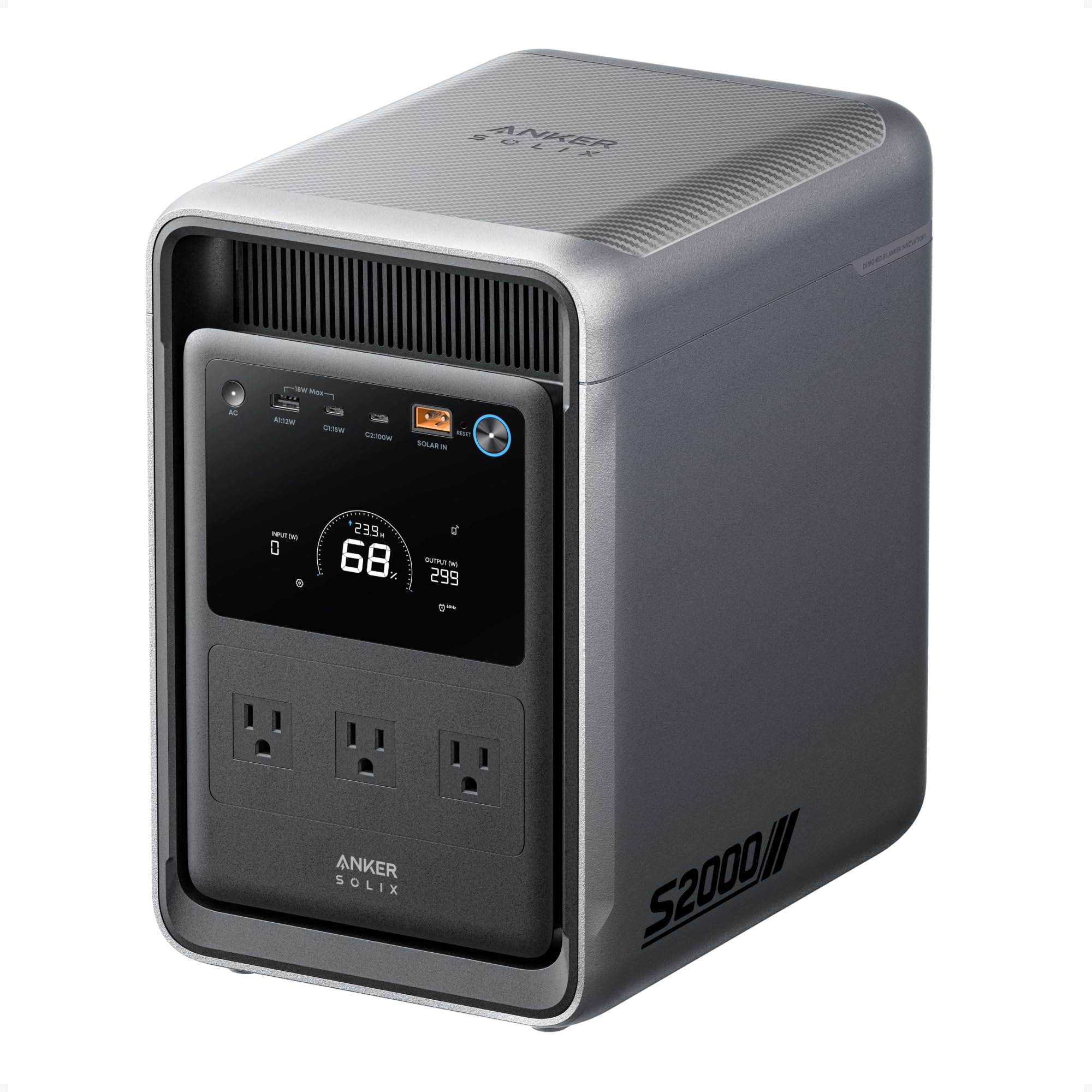
The 35-hour fridge backup that claims the title of smallest and lightest in the 2kWh class.
The Anker SOLIX S2000 focuses on one job: keeping your refrigerator running during an outage. Its 2010Wh battery and 6W idle draw (the power it uses just sitting there) let the company rate it for 35 hours of fridge backup. Buyers confirm that figure — one reports a 220L fridge running 1 hour on just 3% battery, projecting about 33 hours total. Another owner got through a 30-hour outage with lights, fridge, and coffee maker, still holding 30% at the end.
The physical design is the differentiator. At 8.19″ x 11.1″ x 12.7″ and 35.7 pounds, Anker claims it is 30% smaller and 25% lighter than the industry average for 2kWh stations. The 1500W continuous output (3000W peak) covers 99% of home essentials, per Anker, and the six charge methods — AC, solar, generator, alternator, car, or hybrid — cover nearly any recharging scenario. It holds a 4.6-star average across 200+ owner reviews.
The honest downsides: there is no 12V DC port, a miss for RV owners with 12V accessories. The fan also draws mixed feedback — quiet at some loads but noticeably noisy at the 1200W charging rate. Owners praise the dual-sided outlets that keep always-on appliances separate from daily-use gear, and the <10ms UPS switchover protects home office equipment. If fridge protection and a compact footprint matter more than 12V flexibility, this is a strong mid-range pick.
What stands out
- 35-hour fridge backup with only 6W idle draw
- 35.7 lb and compact 8.19″ footprint beat most 2kWh rivals
- Six ways to recharge, including AC + solar hybrid
Know before you buy
- No 12V DC port limits RV accessory compatibility
- Fan noise at 1200W charging draws mixed reviews
Ideal for: apartment dwellers and homeowners who rank fridge preservation and floor space above raw output.
Not for: RV owners who need a 12V DC outlet for their vehicle’s accessories.
6. DJI Power 2000 Portable Power Station
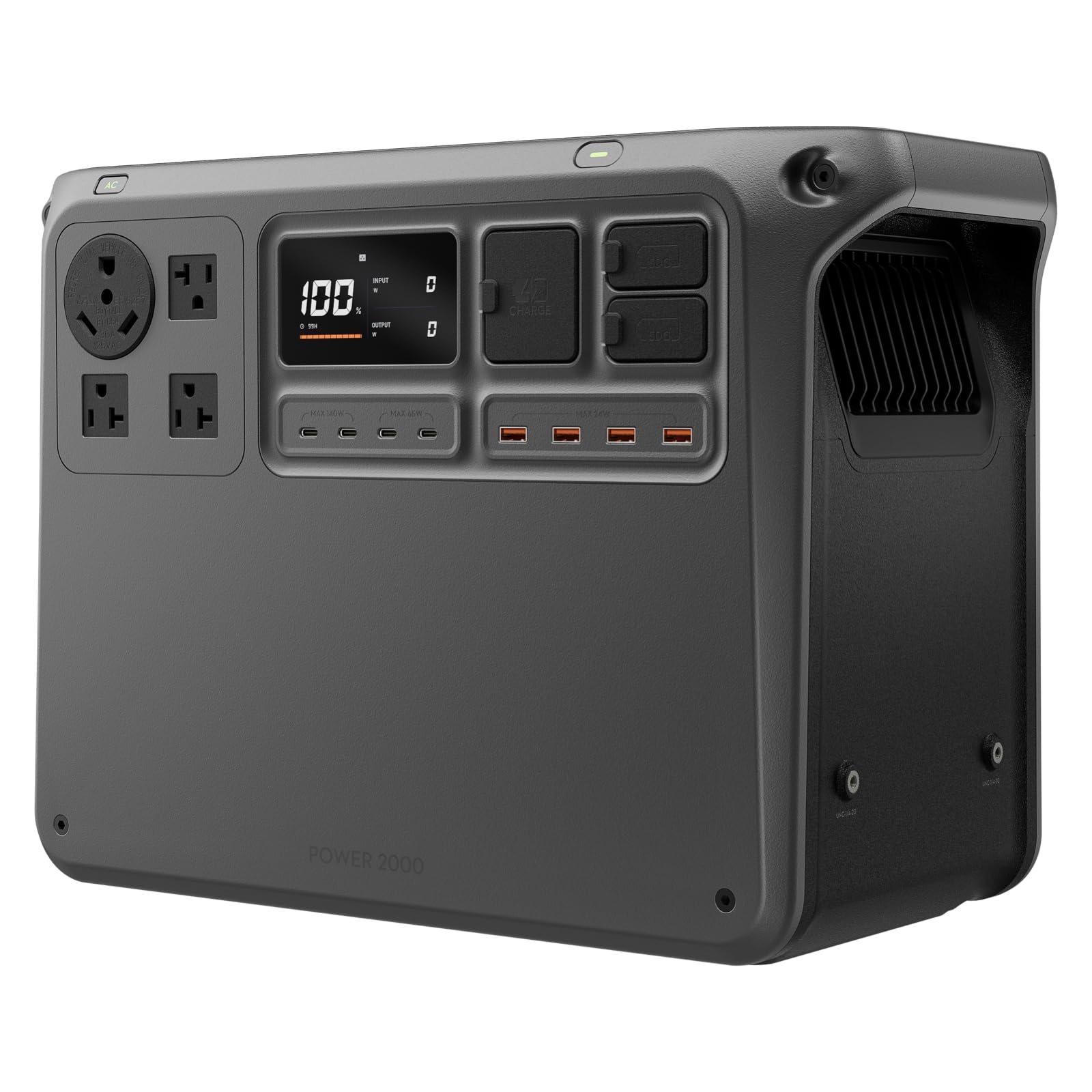
The drone-maker’s entry into home power runs 99% of appliances at a whisper-quiet 30dB.
DJI brings its engineering pedigree to the power station world with the Power 2000, a 2048Wh LFP unit that pushes 3000W continuous output (4000W peak). That is enough to run kettles, cookers, projectors, electric saws, and impact drills, per DJI. It recharges to 80% in just 55 minutes from a wall outlet, and its sub-nano coating plus flame-retardant housing add resilience for wet or rugged outdoor conditions. It holds a 4.4-star average, with owners praising its fast charging and quiet operation.
The defining feature here is silence. At 30dB it is among the quietest 2kWh stations, making it a strong fit for RV nights and enclosed spaces where generator noise would be a nuisance. With 15 ports including dual full SDC ports, it can charge phones, lights, fans, and laptops for 4-5 people simultaneously. Its UPS switches in 10ms — twice as fast as the Power 1000 — keeping devices running through flickers.
The trade-offs are ecosystem-specific. DJI’s proprietary SDC ports mean solar panels and car charging require separate adapters that are not built-in, and the app is required for full control. Owners also note the absence of wheels on a 21.72kg (47.9 lb) frame. Expansion up to 22.5kWh is possible but requires additional batteries sold separately. A 5-year warranty backs it, and buyers who received gray-market Hong Kong units reported DJI support stepping in for replacement. If you are already in the DJI ecosystem or prioritize near-silent running, this is a distinctive pick.
Why it shines
- 3000W continuous output with 4000W peak handles heavy tools
- 30dB running noise suits enclosed RV spaces
- 80% recharge in just 55 minutes
The friction points
- Proprietary SDC ports need separate adapters for solar and car
- No wheels on a 47.9 lb frame makes transport a chore
Choose it for: RV living and outdoor work where quiet operation and 3000W of headroom beat everything else.
skip it if: you want plug-and-play solar without hunting for proprietary adapters.
7. Jackery Explorer 2000 v2 Portable Power Station

Jackery’s Cell-to-Body design trims the 2kWh class down to a carry-friendly 39.5 pounds.
Jackery answers the weight problem with its v2 Explorer, built using the same Cell-to-Body (CTB) technology found in EVs to shave size and weight. At 39.5 pounds it is 41% lighter and 34% smaller than typical 2kWh LiFePO4 stations, per Jackery — a meaningful difference when you are hauling it from home to RV. The 2042Wh capacity and 2200W AC output keep refrigerators and freezers running for up to 3 days, reviewers point out. It holds a 4.4-star average across 800+ owner reviews.
Charging flexibility is a headline feature. It hits 80% in 66 minutes on AC Fast Charging, or a full charge in 102 minutes via the app’s Emergency Super Charging mode. Solar takes as little as 6 hours with 400W panels, and Silent Charging Mode delivers a full charge in 5 hours at just 30dB — quiet enough for nighttime use. The 20ms UPS switching is UL1778-certified for Uninterruptible Power Systems, a real credential for home backup buyers.
Three AC ports and a USB-C PD 100W port cover the essentials, but the honest trade-off surfaces in a few owner reports: some note unreliable Bluetooth app connections and solar barrel ports that flex inward weakly. One buyer expected longer runtime than the rated capacity delivered under an idle load, though most owners describe it as a quiet, reliable alternative to a gas generator. The 10-year LiFePO4 lifespan makes it a long-term investment for emergency prep and off-grid work alike.
The highlights
- 39.5 lb frame is the lightest in the 2kWh class
- 20ms UPS switchover is UL1778-certified
- 80% charge in 66 minutes on AC fast charging
The trade-offs
- Bluetooth app connection reliability draws mixed feedback
- Solar barrel ports flex inward and feel less sturdy
Pick it if: you want 2kWh-class capacity without the usual back-breaking weight for trips and small-business use.
Look elsewhere if: you rely heavily on solar barrel connections or need more than three AC ports.
8. EF ECOFLOW DELTA 3 Max Portable Power Station
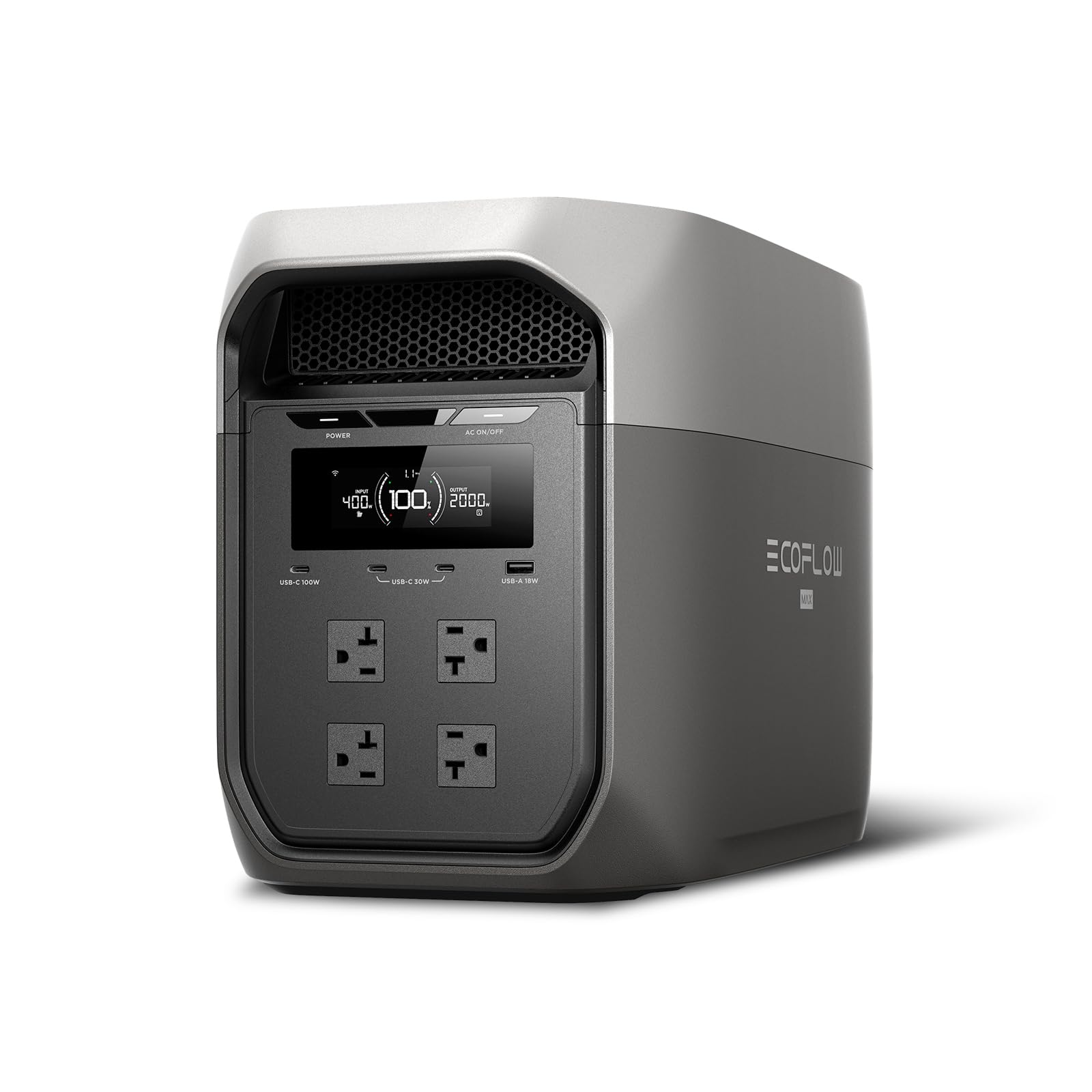
EcoFlow’s X-Boost pushes 3400W continuous to run fridges, microwaves, and power tools alike.
The DELTA 3 Max is EcoFlow’s answer to the question: how much can one 2kWh station actually run? Its 3400W continuous X-Boost output powers 99% of appliances, per EcoFlow, from fridges and microwaves to power tools. Buyers call it a top-quality system that charges incredibly fast, landing it at 4.7 stars across 500+ owners, with performance the most-praised trait. One owner running a space heater on high confirmed the output holds steady.
Charging is the other headline. EcoFlow’s X-Stream technology refills from 0-80% in just 1.13 hours, and owners confirm the speed — one reported a full charge in a little over an hour. The 10ms transfer time keeps sensitive electronics like computers and medical devices safe from outages, while its ultra-quiet operation suits overnight use. A 5-year service plan backs the LiFePO4 battery rated for 10 years of daily use.
The physical design balances portability with capability. It is lighter than many 2kWh rivals despite the aluminum and plastic build, making it carryable from home to RV. But the battery life draws mixed feedback: while some owners call it outstanding, others report only 4 hours of runtime at a continuous 400W draw — a reminder that real-world results depend heavily on what you plug in. If you need a station that churns through high-wattage appliances without complaint, the DELTA 3 Max is the one to beat.
The strengths
- 3400W X-Boost output runs high-demand appliances
- 0-80% charge in just 1.13 hours
- 10ms UPS transfer protects sensitive electronics
The checks
- Runtime at high continuous draws runs shorter than some expect
- Heavier than the compact 2kWh rivals
Reach for it when: you need to run heavy appliances like microwaves and power tools without tripping the inverter.
Hold off if: your loads are modest and you would rather save weight with a 1kWh-class unit.
9. Jackery Explorer 2000 Plus Portable Power Station

The expandable 2kWh station that scales to 24kWh and 6000W when two units pair up.
The Explorer 2000 Plus is Jackery’s modular answer for buyers who might outgrow a single station. Its 2042Wh capacity and 3000W output handle air conditioners, RVs, and heavy tools, and the expansion path is generous: add up to 5 battery packs to reach 12kWh, or connect two units in parallel for 24kWh and 6000W. It holds a 4.7-star average across nearly 200 owners, with build quality the top praise.
Real-world reports are strong. One owner ran an A/C for 2 hours to empty, then fast-charged to 100% in about an hour with a solar panel keeping it topped up — life-changing for RV living in extreme heat. Another replaced a gas generator and battery tools for heavy-duty jobs, powering a DeWalt rotary hammer for hours at full power. The 30A RV outlet and app control round out a genuinely versatile package.
The honest friction is physical and financial. At 62 pounds, this is the heaviest unit in the lineup, and while it includes a telescopic handle, some owners find that handle flimsy. The charging speed also splits opinion — some report shorter times while others say it won’t charge completely under certain conditions. ChargeShield technology boosts battery life by 50% and the LiFePO4 cells support up to 10 years of use, backed by a 5-year warranty. Owners confirm it delivers as advertised, running at a whisper-quiet 30dB.
The payoff
- 3000W output runs air conditioners and power tools
- Expands to 24kWh with two parallel units
- 30A RV outlet for direct vehicle hookup
The weight of it
- 62 lb frame is the heaviest on this list
- Telescopic handle feels flimsy to some owners
Best for: buyers planning to grow into whole-home backup who want a single platform that scales to 24kWh.
Not for: anyone who needs to lift their station regularly — 62 pounds demands a wheeled cart or a second pair of hands.
Understanding the Specs
Watt-hours (Wh) vs. Watts (W)
Watt-hours measure the total energy stored in the battery — think of it as the size of the fuel tank. Watts measure the maximum power the inverter can push out at any single moment — think of it as the size of the engine. A 2048Wh station with a 2400W output can run a 100W light bulb for roughly 20 hours, but it can also surge to start a motor-heavy appliance drawing well over 2400W briefly. Always check both numbers before buying.
LiFePO4 Battery Chemistry
LiFePO4 (lithium iron phosphate) is the safer, longer-lived cousin of standard lithium-ion. It tolerates thousands of charge cycles before degrading to 80% capacity — commonly rated at 3000 to 4000 cycles, which translates to roughly a decade of daily use. The chemistry also runs cooler and resists thermal runaway, which is why brands confidently back these batteries with multi-year warranties.
FAQ
How long will a battery operated generator run a refrigerator?
What is the difference between capacity and output wattage?
Are battery operated generators safe to use indoors?
Can a battery operated generator power an air conditioner?
What does UPS backup mean on a power station?
How long does it take to recharge these stations from a wall outlet?
How many watts do I need to run common household appliances?
Is it better to buy one large station or two smaller ones?
Final Thoughts: The Verdict
For most buyers, the battery operated generator winner is the BLUETTI AC200L because its 2048Wh capacity and 2400W output handle real home-backup loads, its 45-minute fast charge keeps downtime short, and its expansion path to 8192Wh grows with you. If you want a quiet, portable companion for camping and weekend trips without the 61.4-pound heft, the BLUETTI Elite 100 V2 at 25 pounds is the one to reach for. And for the fastest top-up in the 1kWh class — 80% in just 40 minutes — the EcoFlow DELTA 3 Plus delivers where speed matters most. Whatever your use case, the crowd consensus is clear: a LiFePO4-powered station replaces the gas generator with silent, fume-free reliability — and the AC200L leads the pack.
How We Picked
We do not accept paid placement. Every pick is matched to a real buyer and a real use-case; we do not hands-on test units.
Sources & Methodology
Specifications: manufacturer listings and product documentation. Review insights: verified customer reviews, as of September 2026. Pricing: not shown on this page (it changes often); check the current price via the retailer link.
As an Amazon Associate, KitchPrep earns from qualifying purchases. This does not affect which products we feature.
Related Guides
