
Specs are compiled from manufacturer listings and verified buyer reviews and can change over time — please confirm the key details on the product page before buying.
When the power drops or someone cuts the line, your cameras stop recording unless they get instant, smooth 12V DC power (the standard voltage most surveillance cameras run on). You need a backup pack that holds its charge, delivers clean voltage, and fits your specific camera setup—here is which one is worth buying and why.
I’m Mohammad Maruf — the founder and writer behind KitchPrep. This guide is built by comparing the manufacturers’ published specifications and the patterns across verified customer reviews, so you get each pick’s real strengths and trade-offs instead of marketing spin.
You need a device that bridges the gap between your camera’s power adapter and a wall outlet, providing instant, battery-fed 12V DC output. The best battery backup for surveillance cameras we found handles this transition flawlessly, keeping your security footage rolling through any outage.
Our Picks at a Glance


How To Choose The Best Battery Backup for Surveillance Cameras
Picking the right backup isn’t about grabbing the biggest battery. It’s about matching the power supply to your camera’s exact needs so the transfer is invisible and the runtime is real.
Capacity: mAh vs. Wh
Capacity tells you how long the party lasts. Milliamp-hours (mAh) is a common measure, but watt-hours (Wh) is the more honest figure because it accounts for voltage. A 38400mAh pack at 12.8V holds far more usable energy than a 10400mAh pack at a lower voltage, meaning it will run your camera for a much longer stretch.
The Hidden Threat of Voltage Drop
Not all 12V outputs are created equal. Some batteries deliver a voltage range (like 14.6V-9V) that can confuse sensitive electronics. For a security camera, you want a stable, consistent voltage to avoid flickering or resets. Check if the pack regulates output or just dumps raw battery voltage.
Quick Comparison
| Model | Best For | Capacity | Output Options | Special Feature | Amazon |
|---|---|---|---|---|---|
| Talentcell PB120B1★ Best Overall | Longest Runtime | 38400mAh | 12V + 5V USB | Airline-safe | Amazon |
| Shanqiu Mini UPSBudget Champion | True UPS for Home Gear | 10000mAh | 5V/9V/12V DC | Aluminum Housing | Amazon |
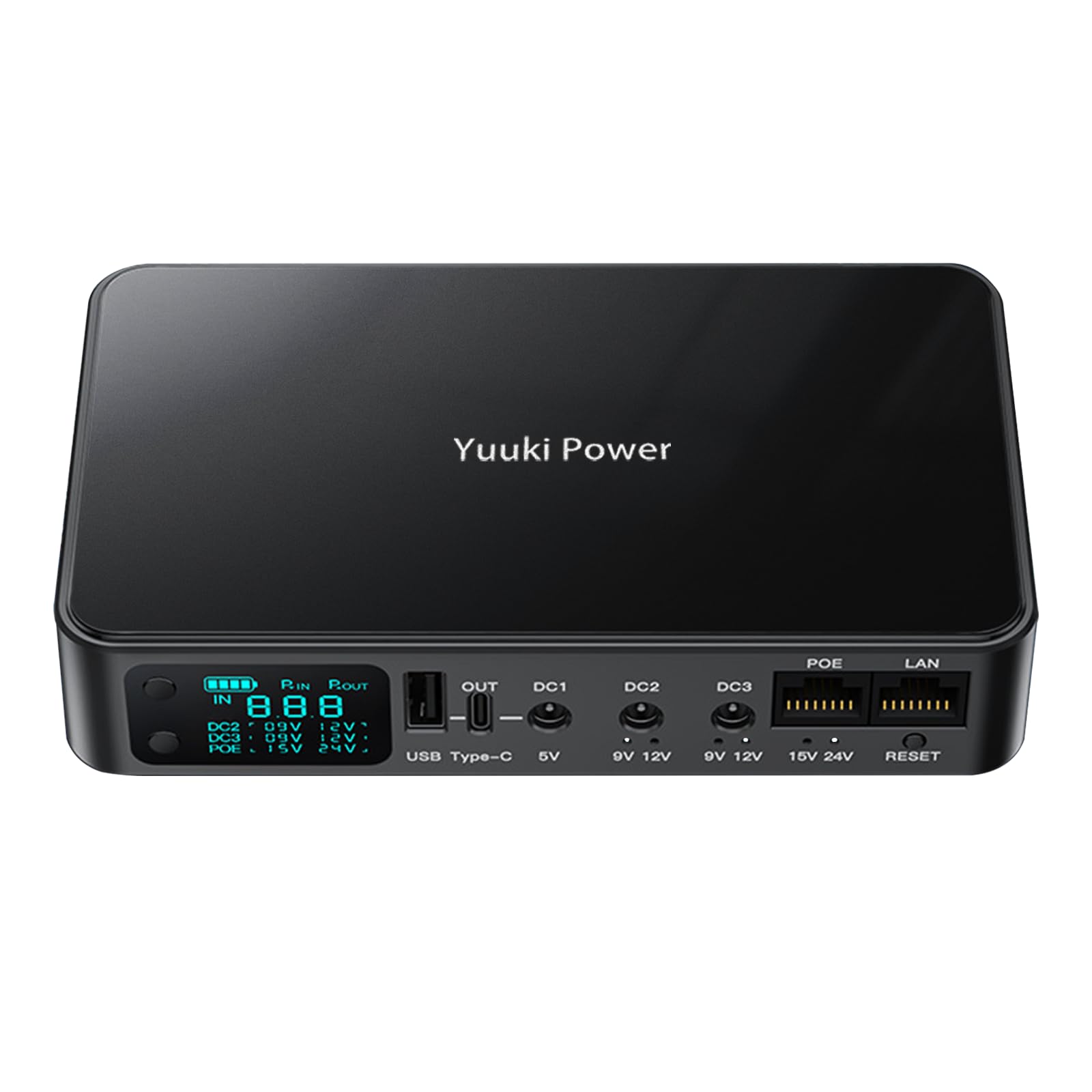
| Yuuki Power 10400PoE Specialist | PoE Camera Support | 10400mAh | 5V/9V/12V + PoE | LCD Screen | Amazon |
| Marsriva KP3 | 0ms Transfer Speed | 10000mAh | Multi DC | 0ms Switching | Amazon |
| TalentCell Mini UPS 27000 | High-Capacity All-Rounder | 27000mAh | 12V/9V + 18W PD | Pass-through Charging | Amazon |
| Yuuki Power 18000 | Router & Camera Combo | 18000mAh | 5V/9V/12V + PoE | LCD Screen | Amazon |
| SKE DC20000 Plus | Quiet Home Office Backup | 20000mAh | 5V/9V/12V + USB-C | AVR Protection | Amazon |
In‑Depth Reviews
1. Talentcell 142.08Wh Portable Power Bank PB120B1
Our pick — over 4.5★ from 350+ verified ratings; the strongest balance of quality and price.
The 38400mAh capacity delivers days of camera runtime, far outlasting smaller packs.
This is the one you reach for when an outage isn’t a blip but a siege. Its massive 38400mAh lithium-ion cell dwarfs the 6000mAh packs below for a 6.4x capacity gap, translating into days of constant surveillance instead of a few hours. It outputs 12V DC for your camera and 5V USB for your phone or a secondary device, so the whole security ecosystem stays alive.
The build quality is a consistent theme in owner experiences — it’s compact for what it holds, and it’s approved for carry-on luggage since it’s under airline capacity limits. Buyers report it has kept a NextBase 522GW dashcam “running 24/7 via car charger,” and others have leaned on it for CPAP machines during outages in Tanzania, proving its reliability under sustained load. The 4-LED indicators give you a clear read on remaining battery so you are never guessing.
There is a caveat worth knowing: the included 2A charger is not meant to power a heavy load directly; a buyer found it overheats when asked to both charge and run a device drawing 6A at once. Use it as a pure backup — charge it up, then let it discharge to your cameras during an outage — and this pack is the most dependable option here.
Why it wins
- Runs cameras for days on a single charge, not hours.
- Built-in protections cover overcharge, over-discharge, and short circuits.
- Buyers routinely praise its long-lasting battery and rock-solid reliability.
Watch the load
- Included wall charger can overheat if you run high-power gear through it while charging.
- Only one USB port limits simultaneous peripheral charging.
The pick for: Anyone needing maximum, set-and-forget runtime for multiple cameras over multi-day outages.
The trade-off: If you plan to run heavy devices directly off the charger, look elsewhere.
2. TalentCell 12V 6Ah LiFePO4 Battery Pack
This true UPS switches to battery instantly, so your camera never reboots during outages.
This is a genuine uninterruptible power supply (UPS), not just a battery you plug in when the lights go out. It sits between your camera’s power adapter and the wall, constantly trickle-charging its 10000mAh cell while passing power through. When the outage hits, it switches to battery instantly, so your camera never restarts or misses a second of footage.
The aluminum-alloy housing is a standout feature — buy a cheap plastic UPS and it feels like a toy, but this one has a solid, premium heft. It offers 5V, 9V, and 12V DC outputs at 2A each, covering virtually every consumer camera and router on the market. Buyers running TP-Link Deco M4 mesh systems and fibre modems report it powers them for around 4 hours.
The honest downside is battery degradation; several owners have seen the internal cell lose meaningful runtime within about 6 months. It’s still a solid value for keeping the internet and cameras up through short blips, but for multi-day outages, the higher-capacity packs in this list will outlast it.
Why choose it
- True UPS behavior with instant, automatic battery switchover.
- Rugged aluminum housing over typical plastic builds.
- Multiple output voltages in one compact unit.
Manage expectations
- Battery life has been reported to fade around the 6-month mark for some owners.
- Outputs are capped at 2A per port, limiting high-draw devices.
Select this if: Your priority is zero-interruption recording during frequent short power flickers, not marathon endurance.
skip it if: You live somewhere with long, multi-hour outages and need days of backup.
3. Yuuki Power Mini UPS 10400mAh
This UPS outputs PoE voltages (15V/24V) to keep PoE cameras running without extra converters.
Standard 12V DC is easy, but many modern security cameras are powered over Ethernet (PoE), which needs 15V or 24V. This Yuuki Power unit is one of the few compact backups that speaks that language, offering PoE 15V1.3A or 24V0.8A outputs alongside the usual 5V, 9V, and 12V DC. That makes it the go-to for keeping a Ring camera or a dedicated PoE security cam online when the mains drop.
Inside is a 10400mAh (38Wh) cell, and the clear LCD screen shows you real-time status — a feature owners genuinely appreciate for knowing exactly how much reserve they have. The total output is capped at 24W, which is fine for a camera and a router but means you shouldn’t stack it with heavy gear. The 0.9lb weight keeps it light enough to tuck behind furniture.
The compatibility headline is slightly mixed: setup is easy for standard gear, but owners found it incompatible with Amazon Eero 6+ routers, which is a real warning if you run that mesh system. Some also note the batteries are difficult to replace when they eventually wear out. As a camera-specific UPS with PoE support at this price, it still leads the pack.
Standing out: For a CCTV setup that runs on 24V PoE, this is one of the only mini UPS options that removes the need for a separate, bulky power supply.
Pick it for: PoE-powered security cameras where you need the voltage to match your injector or switch.
Be cautious if: You rely on Eero routers or expect easily swappable batteries down the line.
4. Marsriva KP3 Mini UPS
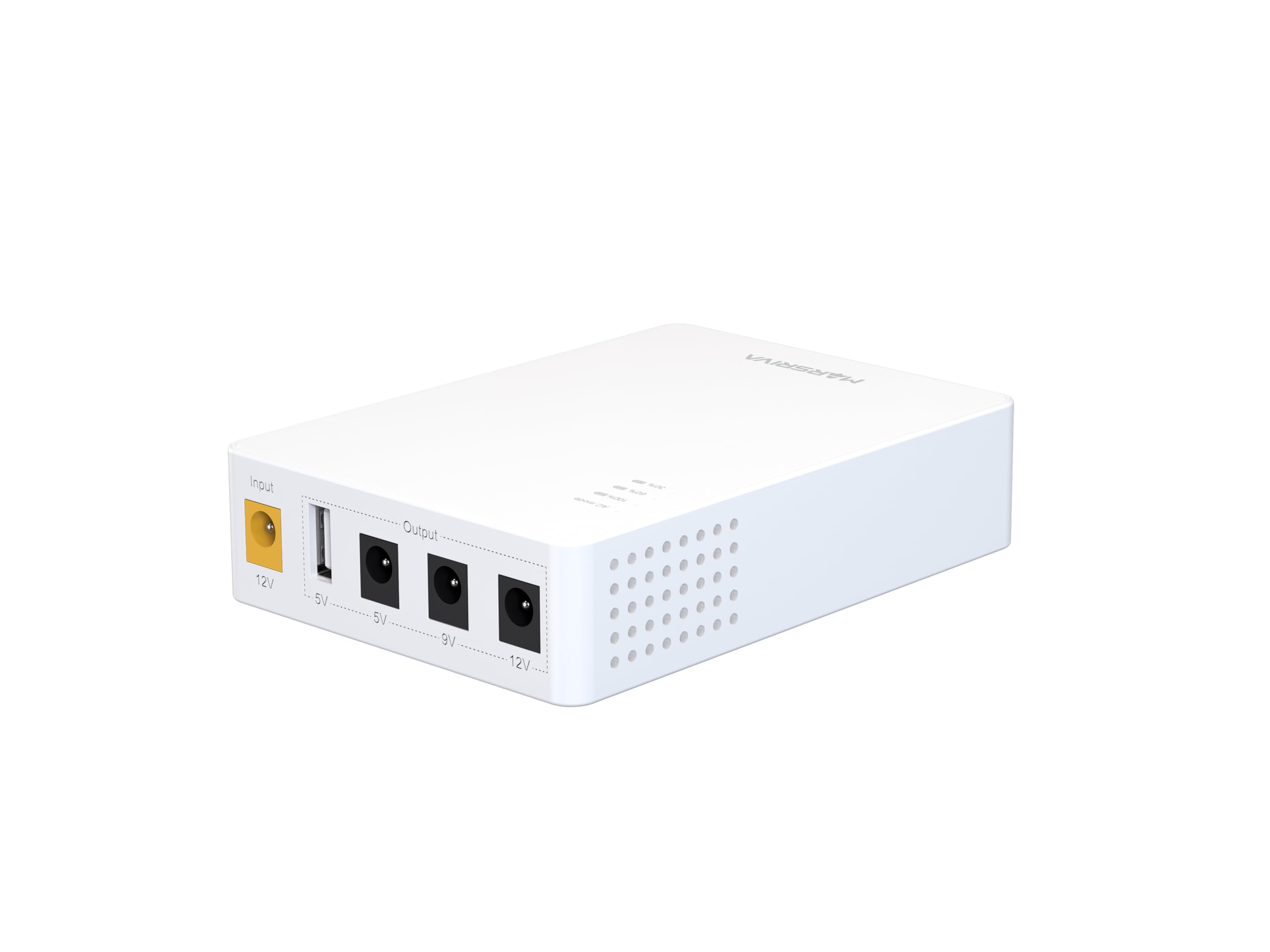
At 10.56 oz, this UPS offers 0ms transfer so your cameras never notice a power cut.
Some cameras take a few seconds to reboot after power returns, leaving a blind spot exactly when you need coverage. The Marsriva KP3 eliminates that gap with its advertised 0ms smooth power transfer—the switch to battery is so instantaneous your devices never register the outage. For surveillance, that continuity is the whole ballgame.
At only 10.56 ounces, it’s the lightest true UPS here, making it easy to stick to a wall or hide inside a cabinet next to your network gear. The 10000mAh cell is rated for a max output of 18W, which suits a single camera, router, or a small unmanaged network switch. Owners have confirmed it runs a network switch without issue.
The limitation is its modest capacity and power ceiling. A buyer noted it won’t power an Eero 6+ from the USB-A port, so check your router’s draw. It’s also a smaller brand with a shorter review history, so you’re trading some long-term data for a genuinely clever, compact design.
What it does: It is small, silent, and offers the fastest possible failover — a compelling argument for anyone with sensitive networking gear.
Ideal for: Minimalist setups needing instant failover for one or two low-power devices in a tight space.
Not for: Powering a full rack of cameras or high-draw routers that exceed its 18W limit.
5. TalentCell Mini UPS 27000mAh

With 27000mAh, this UPS powers your router and camera for 8+ hours on a single charge.
This is where battery backup gets serious. The TalentCell 27000mAh pack offers nearly triple the capacity of the compact UPS options, and reviewers point out real-world runtimes of 8 to 9 hours on a single charge when powering a router and camera. Its pass-through charging is the key feature: it sits in line, keeps your gear powered, and recharges itself simultaneously, so there’s no interruption when the grid fails.
The output layout is generous — four DC 12V ports, one DC 9V port, plus USB-A and USB-C with 18W Power Delivery (PD) fast charging. That’s enough to run a camera, a modem, a router, and charge your phone all at once. It’s built around 12 lithium-ion cells inside a compact plastic housing that weighs 700g.
Where it stumbles is quality control and internal construction. Several shoppers say cells failing after the warranty period, with the internal battery management system (BMS) showing faulty solder joints, and the cells are non-removable, making repairs difficult. Overloading it with 4+ devices can also drain it faster than it recharges. For a single camera and router, though, it’s a fantastic value.
Power player
- 27000mAh capacity delivers 8-9 hour runtimes for standard home gear.
- Pass-through charging means zero interruption during outages.
- Multiple outputs including high-speed USB-C PD for phones.
Long-term concerns
- Some units have seen internal cell failures after the warranty lapses.
- Internal batteries are not user-replaceable, complicating repairs.
Choose it for: A whole-home network and camera setup needing multi-hour endurance without a bulky lead-acid UPS.
Avoid if: You want a device you can repair or rebuild yourself in a few years.
6. Yuuki Power Mini UPS 18000mAh
This 18000mAh model nearly doubles the 10400’s capacity for a modest price increase.
If you like the PoE-friendly feature set of the Yuuki Power 10400 but need more stamina, the 18000mAh version is the logical step up. It keeps all the same outputs — including the crucial PoE 15V1.3A or 24V0.8A for CCTV cameras — but packs 76% more energy into the same footprint. The LCD screen still gives you a real-time readout of your reserve.
At 512g and 1.1lb, it’s still compact enough for a shelf, and owners praise how it keeps a Eufy homebase running through outages. One reviewer noted running a modem and router for about 5 hours on a full charge, with those devices drawing a combined 15 watts. The total output remains capped at 24W, and it comes with a 12V3A US charger.
The honest trade-off is recharge speed — that same owner noted it takes roughly 20 hours to fully recharge, which is slow if you face back-to-back storms. And while the value is strong, a minority of units have failed after about 6 months of use. Like its smaller sibling, this is best for sustaining a camera plus router through short-to-medium outages.
Where it shines: For PoE security systems, this is the highest-capacity option that natively outputs the right voltages without extra converters.
Best for: Anyone wanting the PoE support of the smaller Yuuki model but needing hours more runtime for their cameras.
Remember: Recharging is a slow overnight affair, so keep it topped up before severe weather hits.
7. SKE DC20000 Plus Altair

The quiet, quality-focused UPS that owners say powers a router for 8+ hours without a whisper of noise.
Some backup units hum or buzz, which is annoying in a bedroom or home office. The SKE DC20000 Plus is praised specifically for its silence — it “runs quietly” and produces no noise in use, a detail owners highlight repeatedly. It’s a solid 20000mAh pack with 5V, 9V, and 12V barrel outputs plus USB-A and USB-C for phone charging.
SKE is a brand with a following — several owners mention owning multiple units for years, which speaks to durability. The literal star of its feature set is Automatic Voltage Regulation (AVR): it smooths out inconsistent wall power before it reaches your camera, protecting sensitive electronics from surges and dips.
The catch, echoed in reviews, is inconsistent longevity. Some report keeping routers running up to nine hours, while a separate owner saw their unit fail after only 5 months, with unresponsive customer support. The construction feels solid and the charging is fast, but that quality-control variance means it’s a bit of a lottery.
Final read: When it works — and for most owners it does — it’s a quiet, reliable workhorse. The AVR protection is a real bonus for camera longevity that other packs lack.
Select for: A quiet home office setup where you want surge protection and clean power for your modem, router, and a camera.
Acknowledge: A small but real risk of premature failure exists based on some owner experiences.
Understanding the Specs
Capacity: mAh and Wh Explained
Milliamp-hours (mAh) is the number on the box, but it’s only half the story. Watt-hours (Wh) — which you get by multiplying voltage by amp-hours — is the true measure of stored energy. A 38400mAh pack at 12.8V holds significantly more usable energy than a 6000mAh pack at the same voltage, so always compare Wh when judging runtime. Higher Wh means longer camera uptime.
The UPS vs. Power Bank Distinction
A power bank requires you to manually unplug your camera and connect it to the battery when the power goes out. A true UPS (Uninterruptible Power Supply) sits permanently inline, constantly charging itself while passing power to your camera. When the grid fails, the UPS switches to battery in milliseconds (or instantly), so your camera never reboots and never misses a moment of recording.
FAQ
How long will a 38400mAh battery backup run my security camera?
Is there a difference between a UPS and a portable power bank for cameras?
Can I power a PoE (Power over Ethernet) security camera with these battery backups?
What does the DC connector size (like 5.5mm x 2.1mm) mean for my camera?
How do I ensure my backup battery stays healthy and ready for an outage?
What is “pass-through charging” and is it important?
Are lithium iron phosphate (LiFePO4) batteries better than standard lithium-ion for backups?
Why might my backup battery not last as long as advertised?
Can I use these backups to power my router and modem during an internet outage too?
What is AVR and how does it protect my camera?
Final Thoughts: The Verdict
For most buyers, the battery backup for surveillance cameras winner is the Talentcell PB120B1 because its 38400mAh capacity (enough to run a typical camera for days) turns a short power blip into a non-event. If you have a PoE camera (one that gets power and data over a single Ethernet cable), grab the Yuuki Power 10400 for its native voltage support—no extra converter needed. And for a budget single-camera setup, the TalentCell LiFePO4 is the one to reach for, offering battery chemistry longevity (more charge cycles before wear) that no other pack at this price matches.
How We Picked
We do not accept paid placement. Every pick is matched to a real buyer and a real use-case; we do not hands-on test units.
Sources & Methodology
Specifications: manufacturer listings and product documentation. Review insights: verified customer reviews, as of September 2026. Pricing: not shown on this page (it changes often); check the current price via the retailer link.
As an Amazon Associate, KitchPrep earns from qualifying purchases. This does not affect which products we feature.
Related Guides
