
Specs are compiled from manufacturer listings and verified buyer reviews and can change over time — please confirm the key details on the product page before buying.
When your 2.5-ton condenser dies on the hottest day of the year, you need a decision you can defend for the next two decades — not a lecture. The real question is which unit stays quiet for years after installation. Every pick here is a genuine 2.5-ton split-system condenser (a unit that pairs with your existing indoor coil or air handler), and each differs in efficiency, long-term cost, and how it manages refrigerant.
I’m Mohammad Maruf — the founder and writer behind KitchPrep. This guide is built by comparing the manufacturers’ published specifications and the patterns across verified customer reviews, so you get each pick’s real strengths and trade-offs instead of marketing spin.
This breakdown weighs owner experience against efficiency numbers to help you match the right 2.5-ton condenser to your home.
Our Picks at a Glance

How To Choose The Best 2.5-Ton AC Compressor
Before you click “buy” on any condenser, you need to know exactly what you’re replacing. A 2.5-ton unit is not an upgrade or a downgrade — it’s a strict match for what your home’s ductwork and insulation can handle. Mismatching the capacity, even by half a ton, means either wasted energy or a unit that runs constantly and dies young.
Match the Refrigerant to Your Coil
This is the single most common mistake. The newer units listed here use R-32 refrigerant, and R-32 is not backwards compatible with older R-410A systems. If you keep your old evaporator coil, it must be rated for R-32 — otherwise you’ll need a new coil as part of the job. Always verify this with the listing before purchase.
Read the SEER2 Number Honestly
The SEER2 rating (a seasonal energy-efficiency score) tells you how much electricity the unit uses to cool your home over a season. Higher numbers mean lower monthly bills, but you pay more upfront. A 14.3 SEER2 unit will cost more per month to run than a 17 SEER2 model — but that gap only matters if you face serious cooling months every year. In a mild climate, the cheaper unit often wins on total cost.
Quick Comparison
| Model | Best For | Efficiency | Refrigerant | Compressor | Amazon |
|---|---|---|---|---|---|
| Goodman GLXS4BA3010★ Best Overall | Budget-minded swaps with R-32 coil | 14.3 SEER2 | R-32 | Rotary Scroll | Amazon |
| Goodman GLXS5BA3010 | Efficiency seekers wanting a 15.2 SEER2 step up | 15.2 SEER2 | R-32 | Rotary Scroll | Amazon |
| MrCool VERSAPRO | Whole-system upgrades chasing low bills | 17 SEER2 | R-454B | Rotary Scroll | Amazon |
| Goodman GLXS4BA3010 + AMST30BU1300 | Full indoor + outdoor replacement | 14.3 SEER2 | R-32 | Rotary Scroll | Amazon |
In‑Depth Reviews
1. Goodman GLXS4BA3010 14.3 SEER2 Condenser
Our pick — over 4.5★ from 50+ verified ratings; the strongest balance of quality and price.
The reliable, quiet replacement owners trust for decades of service.
Here’s a unit where the buying logic writes itself: it’s the condenser that buyers report running “very very quiet” — so quiet you can’t hear it from inside. The secret is the rotary scroll compressor, a design that runs smoother and with less vibration than older piston types, which is exactly why noise complaints barely exist in the feedback. At 30,000 BTU of cooling power, it delivers the full 2.5 tons the spec promises without breaking a sweat.
Owner experience here is the real story, and it’s unusually consistent. Owners mention that a previous Goodman unit “lasted 24 years,” which is why this brand becomes a first choice for replacements. Owners consistently call it a great value that works exactly as advertised. The one repeated frustration isn’t the unit itself; it’s the shipping, with buyers noting delivery can take close to two weeks via a private carrier, so plan your change-out accordingly.
You’ll need to pay attention to the refrigerant reality before you commit. This condenser uses R-32, and since R-32 is not backwards compatible with R-410A, you may need a new coil to complete the job. That’s a conversation for your HVAC tech, but the unit itself is pre-charged and ready. The heavy 211-pound build and galvanized steel cabinet are exactly what you want for something sitting outside in the elements for a decade-plus.
Why owners stick with it
- Reliability reputation is the headline — multiple customers note Goodman units running flawlessly for over a decade
- Quiet operation stands out in nearly every review
- HVAC professionals on the job confirm it’s a good unit at a fair price
Plan around these
- Delivery can take up to two weeks through a private carrier
- Requires an R-32 rated coil — check with your installer before buying
- Not a DIY project; the listing itself notes the average person shouldn’t attempt installation
Your best bet if: you want a straight replacement that’s proven quiet and built to last for years of service.
Think twice if: you’re on a timeline — the two-week shipping window means you shouldn’t order this after your old unit dies.
2. Goodman GLXS5BA3010 15.2 SEER2 Condenser

The efficiency upgrade for owners in hot climates who plan to keep this unit long-term.
If you’re shopping for a condenser the way you’d shop for a car — comparing efficiency ratings before you commit — this is the Goodman model that rewards the homework. It beats the 14.3 SEER2 unit above on paper with a 15.2 SEER2 rating, which translates to meaningfully lower electricity draw during those peak cooling months. The trade-off is a higher upfront cost, but for owners in hot climates running AC eight months a year, that gap closes fast.
The hardware is built to handle the work. It’s a heavy unit at 211 pounds, wrapped in a heavy-gauge galvanized steel cabinet that shrugs off rain and sun, with an energy-efficient compressor at its heart. The seller ships it fully charged with enough refrigerant for a 15-foot line run between the compressor and condenser, and reviewers point out it arrives strapped to a wooden pallet with the wiring easily accessible. The delivery experience gets consistent praise — it shows up undamaged and ready for the tech.
Shoppers say this unit pairs smoothly with existing systems. The 10-year parts warranty only applies when a qualified installer does the job and you register online within 60 days — so keep that paperwork in order. Accessories like line sets and thermostats are sold separately, so factor those into your total job cost.
An efficiency comparison worth noting: the step from a 13 SEER2 unit to this 15.2 SEER2 model is what some owners describe as cooling the house noticeably faster, especially in brutal summer heat.
The efficiency verdict: more efficient than the base 14.3 SEER2 Goodman, and owners say the quieter operation and faster cooling justify the extra cost for year-round climates.
Reach for this if: you live somewhere with long, hot summers and want the lower running costs of a 15.2 SEER2 rating to pay you back over time.
Look elsewhere if: you’re in a mild climate where you’d never recoup the higher purchase price in energy savings.
3. MrCool SEER2 VERSAPRO Central Ducted Split System
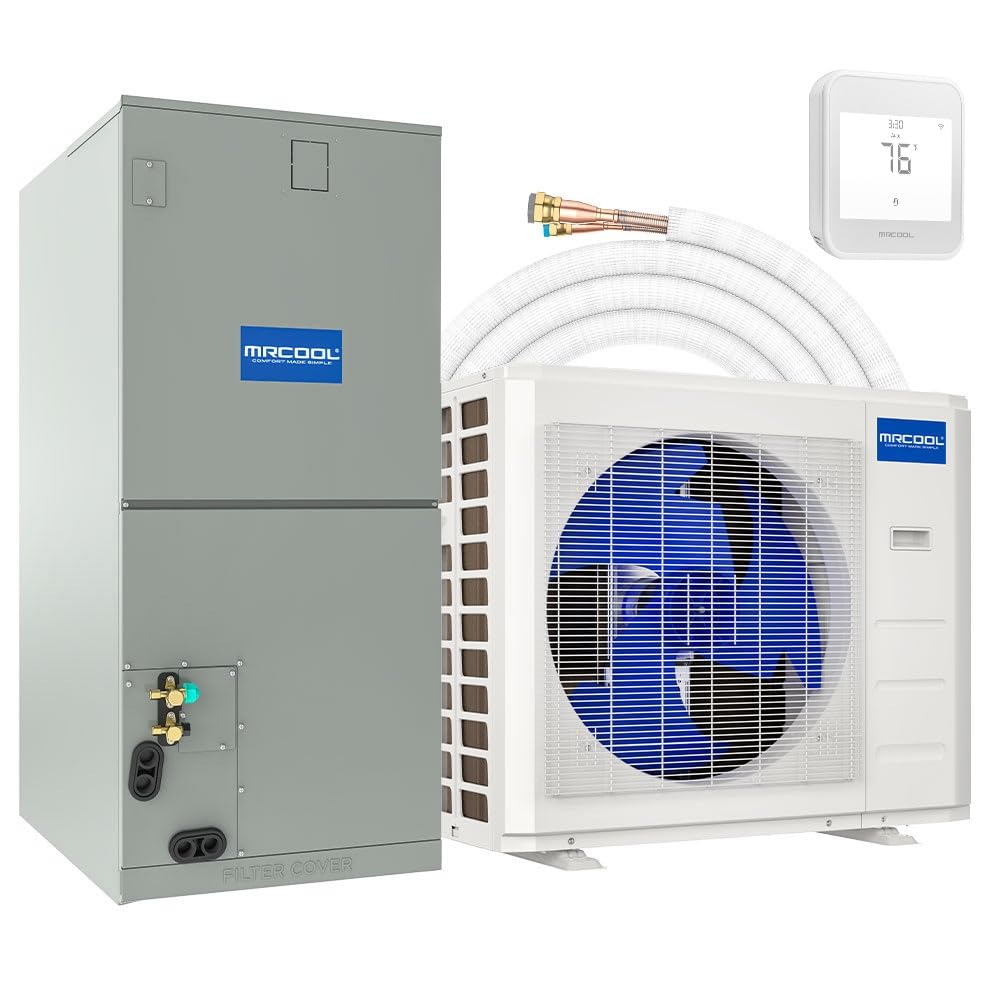
The tech-forward system for owners who want modern efficiency and smart controls in one package.
This MrCool is the only pick here with a 17 SEER2 rating that meets Energy Star standards, so it uses less electricity than the Goodman units below. It pairs that with DC inverter technology (a system that continuously adjusts compressor speed instead of slamming on and off), which delivers steadier temperatures with less wasted energy. Owners replacing 1980s units report a significant drop in kilowatt-hours and an estimated 3-year payback.
The system runs on R-454B refrigerant, a newer formulation with lower pressure levels and reduced environmental impact. It also brings 21st-century conveniences to a central system — integrated smart thermostat compatibility, a filter reminder light so you never forget maintenance, and self-diagnostic capabilities that simplify troubleshooting. Built with a galvanized steel core, this is aimed at the homeowner who wants to modernize rather than just swap parts.
Owner experience splits along one clear fault line: the cooling side earns glowing reports for being quiet and effective, with some calling it “amazing.” But the DIY promise is the catch — even an owner who used to install for a living found the thermostat integration fiddly enough to give up on it, and there are mixed notes on the heating function in warmer climates. This system rewards patience and, ideally, a qualified installer who knows inverter systems.
It also beats the Goodman units above on efficiency: at 17 SEER2 versus their 14.3 to 15.2 ratings, it’s the clear winner on energy consumption if you plan to stay in your home for the long payback window.
What the efficiency earns you
- 17 SEER2 rating with a notable drop in monthly energy use reported by owners
- DC inverter technology delivers steadier temperatures and quieter running
- Smart thermostat compatibility with self-diagnostics and filter reminders built in
Where the friction lives
- Setup is more involved than the marketing suggests — even a former installer hit a wall with the thermostat
- Heating performance in warm climates has drawn mixed feedback
- Requires a 50-foot line set if the standard lengths are out of stock, which is harder to hide
Choose this for: the highest energy savings and smart-home integration if you’re replacing a very old, inefficient system.
Pass on it if: you want a simple swap your regular HVAC tech can handle without learning inverter-system specifics.
4. Goodman 14.3 SEER2 Condenser + AMST30BU1300 Air Handler
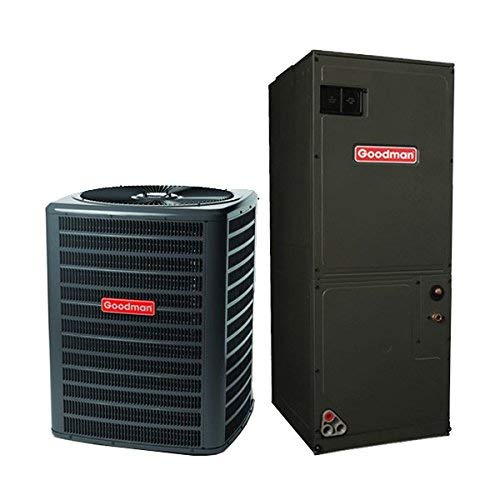
The matched indoor-outdoor pair for a full replacement, not just a parts swap.
When your old air handler is as tired as the condenser sitting next to it, this bundle answers the question before you ask it. It pairs the Goodman GLXS4BA3010 condenser with the AMST30BU1300 multi-position air handler — the indoor unit that actually blows the cold air through your ducts. You get the complete heart of a split system in one box, which removes the guesswork of matching a new outdoor unit to an aging indoor coil.
The air handler is the quiet workhorse here, packing a direct-drive, 9-speed ECM blower motor that adjusts airflow for comfort and efficiency. Its all-aluminum evaporator coil resists corrosion, and the grooved tubing improves heat transfer so the system squeezes more cooling from every watt. It’s certified by AHRI (certificate number 215214932) as a matched system, which matters for efficiency ratings and warranty compliance. The unit is pre-charged for 15 feet of tubing, and you can install the air handler in upflow, horizontal right, or horizontal left configurations.
Long-term owners are the strongest advocates here, with some reporting two of these systems running flawlessly for 12 years with no tune-ups needed — though they also note the install must be done right for that kind of reliability. Vent temperatures have been measured as low as 52°F at the register, which is genuinely cold air. The frustration points are real but specific: occasional units arrive damaged, and a loud minority is frustrated with the online-purchase warranty experience. The 10-year parts warranty requires a qualified installer and online registration within 60 days.
One note for cold climates: this is a cooling-only system, so you’ll want a heat kit purchased separately if you need heating from the same setup. And because it’s matched — condenser at 14.3 SEER2 with this air handler — it’s a step below the efficiency of the MrCool system above, but built for straightforward, dependable service.
The system take: the strongest choice when you need both indoor and outdoor units replaced, backed by owners who’ve run matched Goodmans for over a decade without a hiccup.
Best suited for: a complete 2.5-ton replacement where the existing air handler is too old to pair with a new R-32 condenser.
Not for you if: your current indoor unit is healthy and R-32 compatible — you’d be paying for hardware you don’t need.
Understanding the Specs
BTU Cooling Power
You’ll see “Cooling Power: 30,000 BTU” on every 2.5-ton unit, and that’s not a coincidence. One ton of cooling equals 12,000 BTU per hour, so 2.5 tons is exactly 30,000 BTU. This is the number that tells you how much heat the unit can pull out of your home each hour. If your old unit was a 2.5-ton and your ductwork hasn’t changed, this is the number you match — bigger isn’t better, it just short-cycles and wastes energy.
SEER2 Efficiency Rating
SEER2 measures how efficiently the unit turns electricity into cooling over a whole season — the higher the number, the less power you use for the same cooling. But the difference between a 14.3 and a 15.2 SEER2 rating is modest on your monthly bill. The real efficiency leaps come with inverter technology, which is why the MrCool’s 17 SEER2 rating stands apart — it continuously adjusts its compressor speed to match demand rather than running at full blast all the time.
FAQ
Will a 2.5-ton condenser work with my existing R-410A coil?
Is a 2.5-ton AC compressor the same as 30,000 BTU?
What’s the difference between a condenser and a complete split system?
How long should a Goodman 2.5-ton condenser last?
Can I install a 2.5-ton AC condenser myself?
What is a rotary scroll compressor and why does it matter?
Will a higher SEER2 rating really save me money?
Are there hidden costs with these condensers?
Final Thoughts: The Verdict
For most people, the 2.5-ton ac compressor winner is the Goodman GLXS4BA3010 because it pairs a proven reliability record with genuinely quiet operation at a value price that’s tough to top. If you want the efficiency step up with a 15.2 SEER2 rating, grab the Goodman GLXS5BA3010. And if you’re replacing a whole ancient system and chasing the lowest possible energy bills, the MrCool VERSAPRO with its 17 SEER2 rating is the one to reach for — the crowd favorite here has the strongest owner track record, with decades-long service lives reported across the Goodman lineup.
How We Picked
We do not accept paid placement. Every pick is matched to a real buyer and a real use-case; we do not hands-on test units.
Sources & Methodology
Specifications: manufacturer listings and product documentation. Review insights: verified customer reviews, as of September 2026. Pricing: not shown on this page (it changes often); check the current price via the retailer link.
As an Amazon Associate, KitchPrep earns from qualifying purchases. This does not affect which products we feature.
Related Guides
